Introduction
Since memory is actually a very important factor in struggle, if one controls people’s memory, … one controls their dynamism.
(Foucault Reference Foucault1975, 25)
One cannot know in advance how the articulation of a memory will function; nor can one even be sure that it will function in only one way.
(Rothberg Reference Rothberg2009)
Since the coup attempt on July 15, 2016, Turkey has entered a state of nationalistic and patriotic statumania. In almost every city of Turkey, the ruling Justice and Development Party (Adalet ve Kalkınma Partisi; AKP) has had monuments constructed dedicated to the martyrs of the coup. Party members boast of some of these monuments for being the first built in Turkey, while they praise others for their size (Muşkara Haber 2016; A Haber 2017; Kepez Belediyesi 2017; Yılmaz Reference Yılmaz2017). However, this intense monument construction has taken place simultaneously with the removal and destruction of Kurdish monuments and mnemonic practices (Gourlay Reference Gourlay2020; Smith Reference Smith2022). On the other hand, incidents in which civilians attack monuments of Mustafa Kemal Atatürk, the founding leader and first president of the Republic of Turkey, continue to take place, a practice that goes back to the 1950s. Footnote 1 Meanwhile, video footage of a small child kissing an Atatürk bust may appear on the news as a counter-performance (DHA 2018). In an era of completely new propaganda techniques, an era of bio- and thanato-political subjectivization, where people are interpellated through digital images in social media, a physical mnemonic device from the nineteenth century may seem at first thought outdated and dysfunctional.Footnote 2 However, current debates and practices in relation to monuments show us the contrary on a global scale.
After the coup attempt, parallel to the construction of the July 15 monuments, trustees installed by the AKP government to replace elected mayors started to demolish monuments in Kurdish-populated cities such as Diyarbakır, Şırnak, Van, Mardin, Ağrı, Diyarbakır, Iğdır, Siirt, and Batman between 2016 and 2022 (Cumhuriyet 2017a; Uğurlu Reference Uğurlu2017; Evrensel 2018; Gazete Duvar 2018; Bianet 2022). In 2018, a golden-plated statue of Recep Tayyip Erdoğan, the founder of AKP, former prime minister and president of Turkey since 2014, was put up in Wiesbaden’s downtown as part of the Wiesbaden Art Biennale but had to be removed by the city government after it sparked clashes between his supporters and opponents (BBC 2018). In the same year, the obelisk “Monument to Strangers and Refugees” by the artist Olu Oguibe, which was installed in the center of Königsplatz in Kassel as part of Documenta 14, was dismantled by the city government again, after it became a frequent target of local politicians from Germany’s right-wing, anti-immigration Alternative for Germany (Alternativ für Deutschland; AfD) party (Neuendorf Reference Neuendorf2018). As one of the many examples in the USA, protesters on the campus of the University of North Carolina tore down a long-contested Confederate memorial named “Silent Sam,” because of being a veneration of white supremacy, again in 2018 (Oliver Reference Oliver2018). After the murder of George Floyd in May 2020, removal of Confederate statues continued together with the removal of many historical figures of systematic racism and colonialism all around the world (WTCD 2020). After Russia’s invasion of Ukraine in February 2022, Estonia and Latvia governments started to remove or destroy former Soviet-era monuments commemorating the Red Army’s victory over Nazi Germany during World War II (BBC 2022). The monument wars continue at full speed all around the world.Footnote 3
However, contrary to the global flow of decolonization or deconstruction of monuments, the AKP government is building a new mnemonic infrastructure through July 15 monuments as part of efforts to consolidate the power of President Erdoğan. This new mnemonic infrastructure does not eliminate the previous Republican one but maintains the nationalist discourse but with an increased level of Islamism. Certain events have also shown the heterogeneous and transforming nature of these monuments, which makes it harder to assign them a stable ideological symbolism.
In the first part of the paper, I will discuss the ontological status of public monuments in relation to collective memory. I will argue that monuments are operative only when they are invisible as a part of the mnemonic infrastructure, and I will define the “glitch” as something which reveals both the fragility and the flexibility of a mnemonic infrastructure and provides at the same time the opportunity for a critical examination of individual subjectivizations. In the second part, I will briefly introduce the attempted coup and the construction process of the July 15 monuments. In the third part, I will position the July 15 monuments in the historiography of Turkish national monuments and argue that these monuments are in this sense a new type of monument, which does not refer to Atatürk or pre-Republican historical figures. Then, I will categorize July 15 monuments in Turkey in three main groups and six sub-groups focusing on their symbolic dimension. Finally, I will introduce the story of the Rabia sign – a transnational hand gesture and official symbol of AKP – and analyze Rabia monuments as a glitch in the mnemonic infrastructure of the “New Turkey.”
Monuments as invisible nodes of a mnemonical infrastructure
According to Halbwachs’ (Reference Halbwachs1992) theory of collective memory, memories are necessarily formed by collective situations such as family, religious, and professional situations, which he referred to as the social frameworks of memory. Olick (Reference Olick1999) argues that Halbwachs’ collective memory indicates two distinct phenomena: aggregation of socially framed individual memories and collective commemorative representations. The first, categorized by Olick (Reference Olick1999) as “collected memory,” emphasizes individual memory and how it is formed by social frameworks and identities. The latter, categorized as “collective memory,” is more than the aggregation of individual subjectivities and has a certain degree of autonomy. It considers the diverse aggregation affects regarding individual psychological processes and highlights the formative character of long-term social structures, together with prosthetic memories outside of individual brains.
According to Barash (Reference Barash and Mendels2007), the communicative power of symbols connects the individual bodily experiences of the past to the collective domain of remembering. Like Halbwachs’ theory – after all the members of a shared experience pass away, collective memory disappears, and historiography starts – Barash distinguishes historical narrative from the symbolic embodiment, which as a collective phenomenon precedes the historical narrative. In accordance with Olick’s (Reference Olick1999) distinction between “collected memories” and “collective memory,” Barash (Reference Barash and Mendels2007) also distinguishes between “the multitude of personal perspectives” and “the symbolic embodiment of memory.” Collective memory gravitates between this multitude of firsthand experiences and the symbolic collective remembering.
On the other hand, Till (Reference Till1999, 255) differentiates “public memory” from collective memory as an arena where the latter is negotiated. So, public memory is in fact a re-interpretation of the collective memories and part of their transformation process:
If collective memory involves the ongoing process of creating group myths about the past as, for example, expressed through landscapes and their representations, then public memory is the cultural space and process through which those myths are understood, interpreted, and negotiated by a society.
In a similar vein, Hammond (Reference Hammond2020) uses the term “memorial public” to shift the focus from memory types to the reproduction of the public through commemorative practices. Thinking in terms of memorial public thus abandons the idea of an already existing public subject that remembers or a public space within which memory is located. On the other hand, Grever and Adriaansen (Reference Grever and Adriaansen2017, 84) use the term “mnemonic infrastructure” as one of the three analytical levels of cultural history and define it as “social and cultural structures that maintain and constitute narrative and performative articulations about the past.” According to their definition a mnemonic structure provides a mediation between past and present, and between personal and collective memory. While they refer to Pierre Nora’s lieux de mémoire (sites of memory) and agree that modern mnemonic infrastructures are a product of nation states, they also highlight the participatory, plural, and symbiotic character of them. Similarly, Till (Reference Till, Agnew, Mitchell and Toal2003) argues that memory places do not inevitably subordinate individuals to the state ideology or validate state politics. However, within this approach, the term “mnemonic infrastructure” becomes almost synonymous with public memory.
In this paper I will use the term mnemonic infrastructure rather than sites of memory, collective memory, public memory, or memorial public to highlight its holistic, entangled, quasi unconscious, and invisible character. As Bellentani and Panico (Reference Bellentani and Panico2016) suggest, monuments are mostly invisible (or cold) until they get activated (or warmed up) by rituals. Rituals “naturalize” a collective identity as citizens physically enact what is normal, appropriate, or possible for a group at a particular setting (Till Reference Till1999, 254). However, monuments also function by just being invisible: they become so “normal” that they become an almost natural part of the urban landscape. We get used to their physical appearance, to their names, and to their relations with their surroundings. For example, using the term “martyr” already establishes some neural network in our brains. The word “martyr” gets connected to other words and feelings, becoming part of an unconscious hermeneutic world. The optical and cognitive images of the monument blend together into the lived space of the individuals, becoming part of their Umwelt (Ingold Reference Ingold2000). This normality is defined by Alderman and Dwyer (Reference Alderman, Dwyer, Kitchin and Thrift2009, 51) as follows:
Memorials and monuments are important symbolic conduits for not just expressing certain versions of history but casting legitimacy upon them. They give the past a tangibility and familiarity – making the history they commemorate appear to be part of the natural and taken-for-granted order of things.
Contrary to Robert Musil’s (Reference Musil and Pike1998) remark on the invisibility of monuments, they are not built to affect people optically but rather unconsciously by extending and solidifying an existing mnemonic infrastructure. I argue that they should stay invisible to be operative. If this infrastructure becomes visible it starts to reproduce new subjectivities which may in return deconstruct the existing infrastructure.
A monument is already effective while it stays as a part of a mnemonic infrastructure. This infrastructure consists of previously related monuments, books, stories, songs, rituals, and other mnemonic nodes which serve to create a consistent lived space, habitus, or Umwelt. In addition, a monument becomes effective when it is activated through rituals or bodily engagements. This kind of apolitical effect is mostly predetermined, and it does not reveal the underlying infrastructure but empowers it.
However, if the mnemonic infrastructure is somehow ruptured, it can reveal unforeseen new effects which are political. According to Knox (Reference Knox2017), an infrastructure becomes visible only after its rupture, and this breakdown of the service (which was supposed to continue in repetition and become invisible like the flag of banal nationalism) creates the conditions for an embodied or affective relationship, which at the end produces an experience of politics culminating with the reimagination of political entities. Whenever the mnemonic infrastructure creates a “glitch,” monuments become visible to individuals. The glitch reveals both the fragility and flexibility of a mnemonic infrastructure and provides at the same time the opportunity for a critical examination of individual subjectivizations.Footnote 4
The attempted coup and July 15 monuments
According to the official narrative, the July 15, 2016 coup was a treacherous attempt of a terrorist organization Footnote 5 which had infiltrated the army and other strategic institutions of the Turkish state. The prevention of the coup by the nation and security forces was conducted strictly adhering to the principles of rule of law, human rights, and justice; therefore, it was a victory of democracy. Footnote 6 July 15 would be a symbol for keeping the collective memory alive, strengthening Turkish democracy, and remembering the martyrs and veterans (Erdoğan Reference Erdoğan2019).
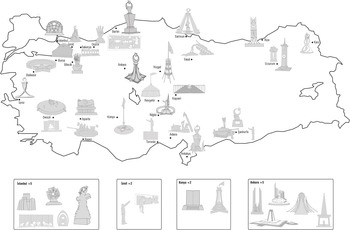
July 15 was declared a public holiday through Law No. 6752 under the name of Democracy and National Unity Day in 2016 and official commemorations were legally defined by a presidential circular in 2019 (Resmi Gazete 2019). From the first monument built in Rize (hometown of Erdoğan) in August 2016, to later ones inaugurated in İzmir, Kayseri, and Ankara in July 2020 and finally in July 2022 in Çekmeköy, İstanbul, at least forty-five July 15 monuments were built across Turkey (Figure 1).Footnote 7 The “official” ones, whose construction plans were announced in October 2016 by Erdoğan, were built in İstanbul, near the Bosphorus Bridge (renamed as July 15 Martyrs’ Bridge) Footnote 8 and in Ankara, inside the newly built Presidential Complex (Cumhurbaşkanlığı Külliyesi) in 2017 (Yeni Şafak 2017).Footnote 9
July 15 monuments across Turkey.
Source: Author.

July 15 arose as the founding moment of the “New Turkey,” which would reclaim the lost glory of the Ottoman Empire, de-emphasizing the Republican period and Mustafa Kemal Atatürk, while bringing the AKP to the center of collective memory with its more traditional and religious ideology (Altınordu Reference Altınordu2017; Taş Reference Taş2018; Uzer Reference Uzer2018; Hammond Reference Hammond2019, Reference Hammond2020, Reference Hammond2022; Solomonovich Reference Solomonovich2021). However, these monuments built across Turkey also reflect a different range of political, cultural, and local sensitivities inside the official narrative of AKP. To investigate them further, iconological categorization is necessary.
Categorization of July 15 monuments
In the monumental history of Turkey, July 15 monuments have opened a new era. The tradition of erecting “nationalist” monuments began in the Empire and was transformed after the establishment of the Republic in 1923 by the leader cult of Mustafa Kemal Atatürk and, partially again, after the death of Atatürk by the introduction of pre-Republican figures. Because of the sculpture ban in Islam, it was not possible for the Empire to erect monuments in public spaces. However, in parallel with the modernization movement in the Empire, two Tanzimat monuments were designed, and one of them was built for the 1855 Paris Exhibition even though it was not installed in a public square. Between Tanzimat monuments and Atatürk monuments (1855–1926), five Ur-nationalistFootnote 10 monuments were erected, which carry the seeds of the future national monuments.
Abide-i Hürriyet (Liberty Monument) (1911, İstanbul, Mimar Muzaffer) was the first monument to be erected in a public place. It is considered as the first nationalist monument commemorating the soldiers killed in the “March 31 Incidents” of 1909 after the declaration of the Second Constitutional Era as well as celebrating this era. Tayyare Şehitleri Abidesi (Monument for Airplane Martyrs) (1914, İstanbul, Mimar Vedat) commemorates the accidental death of air force soldiers using the term martyr (şehit), which would become a nationalist mythical dispositive of the Turkish state in the future. The bust of Osman Gazi in Sivas (1915–1916) is also one of the significant monuments, being the first figurative public monument in the Empire. Ahmed Muammer [Kardaş] – the governor of Sivas – erected it and Atatürk used it as an example in his 1923 Bursa speech (in addition to other monuments in Egypt) to support the idea that erecting monuments is not in conflict with Islam. Agricultural Monument (1916, Konya, Muzaffer Bey) was not designed as a nationalist monument but as one celebrating the agricultural wealth of Konya without figurative elements. However, ten years later it was used as a base for the second Atatürk Monument of the new regime. The last monument is the Unknown Soldier Monument (Şehit Sancaktar) (1924–1927, Kütahya, Mimar Hikmet, and Taşçı Kadri) whose foundation was laid by Mustafa Kemal and his wife Latife Hanım to celebrate the first August 30 Festival in 1924 commemorating the victory in the national war of independence. This monument is important for having the term martyr in its title and for following the European unknown soldier memorial tradition (Kreiser Reference Kreiser1997, Reference Kreiser2002). After the 1940s, different figures other than Atatürk also started to appear in monuments in public spaces (e.g., İsmet İnönü, Barbaros Hayrettin Paşa, Mimar Sinan, Fatih Sultan Mehmet); however, the production of Atatürk monuments continued and especially after the military coup of 1980, mass production of Atatürk monuments started (Tekiner Reference Tekiner2014). The July 15 monuments are in this sense a new type of monument, which does not refer to Atatürk or pre-Republican historical figures, but to nationalism and martyrdom with a religious highlight.
July 15 monuments were produced in many sizes and materials, according to the capacities and needs of local institutions. While seven monuments were built immediately after the attempted coup in 2016, more than half of the monuments were inaugurated in 2017. Out of forty-five monuments, AKP municipalities have commissioned thirty-four monuments, the Nationalist Movement Party (Milliyetçi Hareket Partisi; MHP) municipalities have commissioned three monuments, and the Republican People’s Party (Cumhuriyet Halk Partisi; CHP) municipalities have commissioned one monument.Footnote 11 In addition to municipalities, public universities have commissioned four monuments in their campuses and the Bursa Chamber of Commerce and Industry (Bursa Ticaret ve Sanayi Odası) has commissioned one. There is also a monument built inside the Special Forces Command Headquarters in Gölbaşı, Ankara and another monument in the Courtyard of the Turkish Grand National Assembly (TBMM). The monuments were inaugurated in official ceremonies with the participation of mayors, district governors, local leaders of political parties, and in some cases with the participation of ministers and university rectors. In terms of spatiality, while some of them were built in accessible urban public spaces, others were built inside university campuses, military complexes, monument parks, or next to highways. According to Azaryahu’s (Reference Azaryahu1993) classification, most of them are “city monuments,” which guarantee a maximal number of random encounters, but each encounter carries a low charge of symbolic potential in comparison to “remote monuments” which have an aura of sacredness.
The visual categorization of monuments proposed in this paper excludes the plastic properties and focuses on the symbolic dimension. However, in the analysis of Rabia monuments, a semiotic approach will be applied to show the complex relationship between the material, symbolic, and political dimensions of monuments (Bellentani and Panico Reference Bellentani and Panico2016).
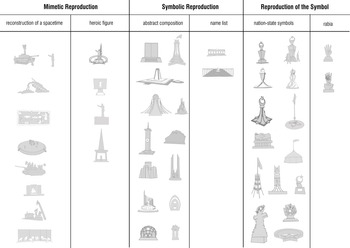
July 15 monuments in Turkey will be categorized in three main groups and six sub-groups in this paper (Figure 2). Firstly, “mimetic reproduction” includes figurative monuments depicting a body or a group of bodies. This category differentiates according to the spatial and symbolic properties of the reconstructed bodies as “spacetime reconstruction” and “heroic figure.” Secondly, “symbolic reproduction” consists of compositions which non-figuratively refer to a concept and are subdivided as “abstract composition” and “name list.” Finally, the last group “reproduction of the symbol” refers to three-dimensional reproduction of symbols and includes “nation-state symbols” and “Rabia monuments.” After a brief analysis of each group, Rabia monuments will be investigated as a case study.
Categorization of July 15 monuments in Turkey into three main groups and six sub-groups.
Source: Author.

Mimetic reproduction
Monuments in this category are 1:1 scaled actual-size reproductions of certain bodies. These monuments are supposed to be replicas extracted from digital footage. Polyester and silicone are the preferred materials. “Spacetime reconstructions” depict a frozen moment in time with bodies in relation to each other. The most usual form is the reconstruction of a military tank, which has been stopped and captured by civilians (Harran, Şanlıurfa, 2017; Kepez, Antalya, 2017; Merkezefendi, Denizli, 2017; Tokat, 2018). Another hyper-realistic version of this category reconstructs the ablution performance near the headquarters of the İstanbul Metropolitan Municipality, which was recorded via a closed-circuit television (CCTV) camera during the night of the coup attempt (Saraçhane, İstanbul, 2018). The monuments try to reconstruct a past “reality” without leaving an aesthetic/imaginary space with the participant. Regarding the Denizli monument, Bora (Reference Bora2020) refers to a will of documentation and fixation in the aesthetic culture of the AKP government. What is important here is the historical and ideological fixation or concretization Footnote 12 rather than the aesthetic experience.
“Heroic figure,” on the other hand, depicts an imaginary time and space without replicating a past spacetime. It is again a mimetic reproduction of a body, however, without reference to a specific time and space. According to Savage (Reference Savage2009), the didactic premise of the hero monument is to provide moral examples for imitation. It is the archetypal hero on a pedestal as an object of reverence and emulation which provides the model of the perfect citizen in nationalistic terms. It is not a mere report of a past event but a narrative about an attitude. While spacetime reconstructions are imitations of a past event, heroic figures are a model for imitation. It visualizes a single body, which belongs to martyr Sergeant Ömer Halisdemir (Mersin, 2016; Niğde, 2017; Ankara, 2017). Niğde University, which was renamed as Ömer Halisdemir University after the coup attempt, gives a brief biography of Ömer Halisdemir on its official website and defines him as “one of the important names in preventing the coup attempt of 15 July, … who sacrificed his life without hesitation to prevent the treacherous attempt to protect the State of the Republic of Turkey and the Turkish Nation on July 15, 2016” (OHU 2023). He is referred as the first martyr in school textbooks at primary and secondary levels due to his death during a gun battle with the leader of the attempted coup in the early hours of the incident. The depiction of him as the first martyr is like the early Republican portrayal of the first martyr of the War of Independence journalist Hasan Tahsin Footnote 13 (Parmaksız Reference Parmaksız and Christofis2019). Yılmaz and Ertürk (Reference Yılmaz and Ertürk2022) also interpret Halisdemir as the imitation of Kubilay, Footnote 14 another martyr–icon of Kemalism, to create an alternative Islamic martyr–icon and build a myth upon this.
We should also add monuments that consist of single or multiple bodies (anonymous heroes) and depict an imaginary spacetime, to this category. They again represent objects in a realistic way but do not represent an exact frozen timeframe. Instead, the compositions of the bodies are designed, and they show allegorical qualities (Ankara, 2020; Düzce, 2018; Adana, 2017; Tokat, 2018). For example, the monument in Tokat depict a single male figure pushing a military tank on top of the rocks. Unlike monuments in the spacetime reconstructions category, the chosen location and moment are imaginary. While the male figure symbolizes the “nation,” the military tank refers to the “putschists/terrorists.”
Symbolic reproduction
Symbolic reproductions do not refer to an object, event, or symbol directly. They are not figurative and are mostly abstract in nature. We can refer to Eco’s “open work” since the meaning is not fixed and there are possible interpretations which can be actualized by the performer to a degree (Monti Reference Monti2021). Symbolic reproductions are of two types: “abstract compositions” and “name list”. “Abstract compositions” is the sub-group which has the most “artistic” qualities in comparison to other categories, because of being open to imagination and interpretation to a degree (Amasra, Bartın, 2017; Ilgın, Konya, 2017; Beştepe, Ankara, 2017; Gölbaşı, Ankara, 2017; Keçiören, Ankara, 2017; Mamak, Ankara, 2017; Etimesgut, Ankara, 2020; Erzurum, 2017; Atatürk University, Erzurum, 2017; Bursa, 2017; İzmit, Kocaeli, 2017; Üsküdar, İstanbul, 2017; Beylerbeyi, İstanbul, 2017; Başakşehir, İstanbul, 2018; Kars, 2019). Unlike the previous categories of monuments, this category includes monuments which were designed by an artist or architect. Footnote 15 This category also shows different connotations ranging from Islamic (Erzurum, 2017) to military (Üsküdar, 2017). While the monument in Erzurum looks like a minaret and all the four sides have the inscription of Allah in Arabic, the fountain in Üsküdar looks like a bullet (or drop of blood) and on the front of the fountain the hadith “heaven is under the shadow of swords” is inscribed in Arabic. The sub-category “name list” consists of monuments which only list the names of the martyrs on a plain surface without further three-dimensional artistic components. They are considered symbolic because of referring to the broad concept of martyrdom and self-sacrifice (Sakarya, 2016; Cihanbeyli, Konya, 2017; Kayseri, 2020).
Reproductions of the symbol
Monuments in this category are vulgar three-dimensional reproductions of symbols. Either they are composed of several symbols, or they directly represent one single symbol. The symbols consist of the Turkish flag, components of the flag (the crescent and the moon), map of Turkey, and Erdoğan’s Rabia salute gesture (Aziziye, Erzurum, 2019; Balıkesir, 2016; İzmir, 2020; Isparta, 2017; Konya, 2017; Nevşehir, 2016; Yozgat, 2017; Bartın, 2017; Samsun, 2017; Rize, 2016; Eyyübiye, Şanlıurfa, 2016; Hatay, 2017; Ortaköy, İstanbul, 2017). Except the Rabia monuments (Düzce, 2017; Bilecik, 2017), all the others reproduce nation-state symbols of the Republic.
Among them, the Rabia sign is critical, because it may denote a “crisis” Footnote 16 in the official narrative by primarily highlighting Erdoğan and the AKP, thereby suggesting a limiting of the notion of national unity to a single political party. Also significant in this context is the complete removal of a Rabia monument in Düzce.Footnote 17 This act of destruction could create a rupture in the mnemonic infrastructure, which in return would render it visible and create a potential space for new subjectivizations. The next section will focus on Rabia monuments and on this moment of crisis.
The R4BIA monuments
The word Rabia (رابعة) means “four” in Arabic and refers to Rabia al-ʿAdawiyya al-Qaysiyya who was an Arab Muslim saint and Sufi mystic. The sign is named after the Rabia al-Adawiya Square in Nasr City which surrounds the Rabia al-Adawiya Mosque, where a sit-in was held by the Muslim Brotherhood and its supporters to celebrate the one-year anniversary of Mohamed Morsi’s inauguration as president in Egypt. The sit-in lasted for about forty days before it was dispersed by security forces, leading to clashes that resulted in 638 deaths, of which forty-three were police officers.
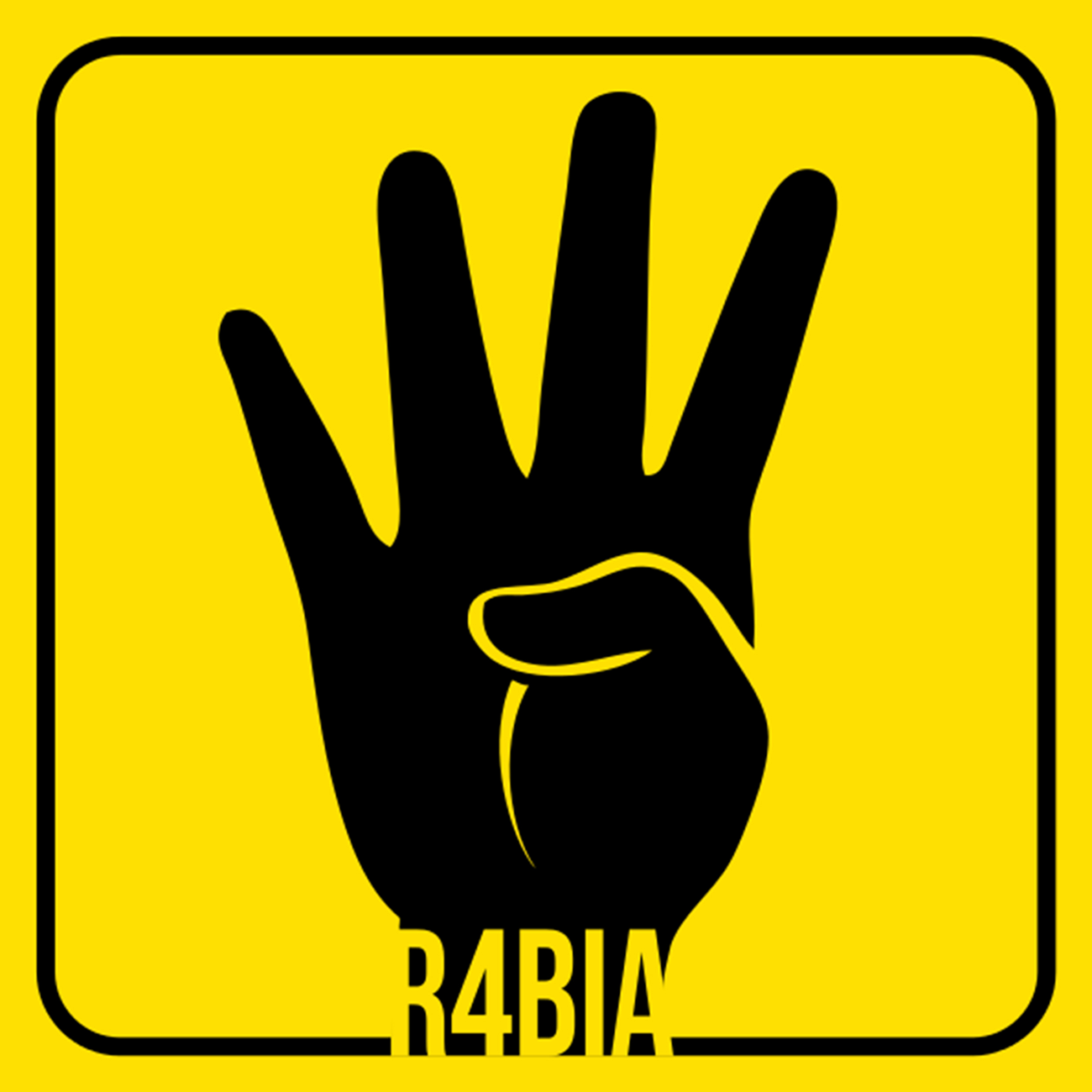
After the coup in Egypt on July 3, 2013, pro-Mursi and anti-coup protesters used the hand gesture during the protests in Rabia Al-Adawiya square. After the massacre in the square on August 14, 2013, Turkish graphic designers Saliha Eren and Cihat Döleş designed the Rabia logo as an act of solidarity with the Muslim Brotherhood (Eren Reference Eren2017) (Figure 3). On August 17, 2013, Erdoğan made the Rabia gesture with his hand during a speech in Bursa’s Mevlana neighborhood (AA 2013). The next day, Turkish football players Sercan Kaya and Emre Belözoğlu made the same gesture after scoring goals in a football match. On August 23, 2013, Erdoğan made this gesture again after Friday prayers in Ankara (Akşam 2013). Since then, he has been extensively using this rallying sign. On September 15, 2013, the International Rabia Platform was established in Turkey. It was pioneered by Abdurrahman Dilipak, a columnist in a fundamentalist Islamic Turkish daily newspaper which is an avid supporter of the AKP. In 2014, the platform declared August 14 as World Rabia Day.
The Rabia logo, an act of solidarity with the Muslim Brotherhood, designed by Turkish graphic designers Saliha Eren and Cihat Döleş.
Source: https://en.wikipedia.org/wiki/Rabia_sign#/media/File:Rabia_sign.svg (Public Domain).

According to Vannetzel (Reference Vannetzel2018), while the “yellow” demonstrations (with the yellow logo of Rabia) in 2013 and 2014 were all opportunities to show support for Erdoğan and to strengthen the government’s anti-coup narrative; the “red” demonstrations (mostly with the red Turkish flag) organized by the AKP against the Gezi Uprising and Gülen Movement were in support of Erdoğan’s presidential campaign during the spring and summer of 2014. The common use of the Rabia sign in the “yellow” and “red” demonstrations produces an effect of circularity of the cause, which accentuates the integration of national and transnational registers and spaces, where Islamic solidarity, anti-coup resistance, and support for the government merge.
In 2016, one month after the coup attempt, the Rabia Platform made a written declaration highlighting the importance of the Rabia sign:
If the July 15 FETO coup attempt had succeeded, similar events to the Rabia massacre would have taken place in Turkey…. Born in Rabia Square after the July 3 coup, the Rabia sign became the symbol of anti-coup in Turkey and was adopted by all segments of society during the 27 days of democracy and independence vigils after July 15 (AA 2016).
During the extraordinary congress of AKP on May 21, 2017, the meaning of the symbol was added to the party guideline under Article 4.16 (AK Parti 2022). Regarding the phrase “one nation, one flag, one homeland, one state” added to the fourth article of the bylaw, AKP Deputy Chair Hayati Yazıcı said, “Of course, this represents Rabia … We have added this to the bylaw this time, and we refer to it as Rabia. This is what it means” (Bloomberg HT Reference Bloomberg2017). On September 30, 2017, RTE declared the Rabia sign as the symbol of the AKP (T24 2017).
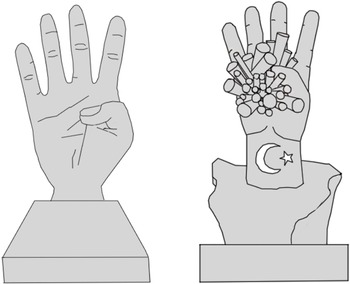
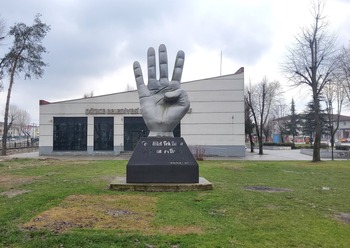
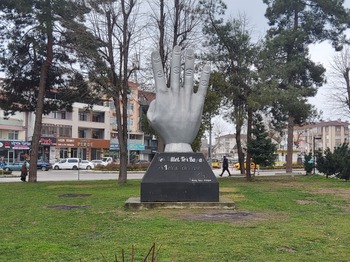
There are only two Rabia monuments in Turkey which are commissioned for the commemoration of July 15 martyrs.Footnote 18 The monuments in Düzce and Bilecik are larger than human-size reproductions of the Rabia symbol (Figure 4). The monument in Düzce is made from silver-colored polyester with the inscription “one nation, one flag, one homeland, one state” on the base. The monument in Bilecik is made from stone and has varied sizes of bullets inside the palm as an allegory to the power of the nation which stopped the coup attempt. Below the bullets there are a crescent and a star referring to the national flag and at the bottom there is an inscribed text:
The power of our people, who protect their democracy, flag, homeland, and faith, has defeated all kinds of treacherous coup attempts and attacks. We commemorate the martyrs of July 15 and all our martyrs with mercy and gratitude.
Representations of Rabia monuments in Düzce and Bilecik in Turkey that were commissioned for the commemoration of July 15, being larger than human-size reproductions of the Rabia symbol.
Source: Author.

MHP criticized the July 15 Democracy and National Unity Monument built by the Bilecik Municipality and announced that it would not attend the opening on July 15, 2017, but, rather, it would participate in the ceremonies in Republic Square in the city.Footnote 19 MHP Central District President Talha Özkan said:
We are of the opinion that a symbol imported from Egypt cannot represent the national unity and the martyrs and veterans of our beloved nation. It was not an imported symbol, but the trust of our nation in democracy, the unconditional love for the homeland within unity and solidarity that saved the bullets fired by traitors. Using July 15 as political material is a mistake, and this mistake should be reversed (Yarın 2017a).
After MHP, the Confederation of Public Employees’ Unions of Turkey (Türkiye Kamu Çalışanları Sendikaları Konfederasyonu; Kamu-Sen) also declared that they would not attend the opening ceremony of the monument by highlighting the difference between the Rabia gesture and the slogan of “one nation, one flag, one homeland, one state:”
As Türkiye Kamu Sen; One State, One Flag, One Homeland, One Nation and One Language are our sine qua non. However, we think that the “July 15 Democracy and National Unity Monument” built by the Bilecik Municipality in the Bahçelievler District has been politicized and does not comply with the spirit of July 15. For this reason, as Türkiye Kamu Sen, we will not participate in the opening of this statue (Yarın 2017b).
When Semih Şahin from the CHP became the new Mayor of Bilecik after the local elections in 2019, he criticized the monument again because of being a symbol of the Muslim Brothers: “That weird hand sign? It does not suit the city aesthetic at all. I will do better. It is the sign of the Ihvan (Muslim Brotherhood), we are not Ihvan. Ihvan is not related to us” (Cam Reference Çam2021). Also, Ahmet Gürses, Deputy Mayor of Bilecik from the Good Party (İyi Party; İYİP), demanded that the commemoration program at the July 15 Martyrs’ Monument be abolished. However, it was refused by the established commission (Habertürk 2021). The monument still stands today at the same spot.
In 2017, Semih Daştan, a businessperson working on real-estate and polyethylene packaging, produced a small sized desktop trinket in the shape of the Rabia hand gesture and sent it to President Recep Tayyip Erdoğan. Daştan’s story about the production of the trinket reveals the opportunist political atmosphere around AKP at that time:
I am a volunteer soldier who devoted his heart to the cause of our President, Mr. Recep Tayyip Erdoğan, a strict follower, just one of the shrouded (kefenli) soldiers of the shrouded leader. I think it was during our President’s visit to Colombia. Our President, seeing hand-shaped symbols in a place he visited, said, “It would be different if it was a Rabia-shaped product.” It was around 11 pm when I watched this on the news. While we had all kinds of opportunities in our country thanks to our leader, I perceived this sentence as an order and started working at that moment. After about two months of work, we revealed our Rabia trinket (İleri 2017).
Daştan’s company SD Fides owned the patent of the product and, after a while, built the first Rabia monument for the Municipality of Bilecik. Daştan announced this monument as “Turkey’s first and largest Rabia symbol application” in his own website (Daştan Reference Daştan2017). On the other hand, the controversy surrounding the first Rabia monument in Düzce was fierce enough to have it removed.
In June 2017, Düzce Mayor Mehmet Keleş Footnote 20 made a statement about the reorganized crossroads at the end of Kuyumcuzade Boulevard. Speaking about the Rabia statue positioned on the crossroads, Keleş pointed out that Rabia, as the symbol of the unity of the Turkish Nation against the July 15 coup, was immortalized in Düzce:
We need some symbols that will show that some things cannot happen in this country after the coup syndrome we experienced on July 15. One of these is the emphasis on “one homeland, one flag, one nation, one state,” which our President has especially emphasized (Hürriyet 2017a).
However, the Düzce branch of the Grey Wolves – the ultra-nationalist paramilitary group associated with the MHP – reacted to the Rabia statue and covered it with the Grey Wolves flag. Fatih Gülaçtı, leader of the Düzce Grey Wolves, criticized the monument:
What we oppose is the imposition of the Rabia sign, which is the sign of the Muslim Brothers, as a national symbol on our nation after the uprising in Egypt. If the Düzce Mayor wants to make a national symbol here, he will either make a Grey Wolf or a double-headed eagle [the symbol of Anatolian Seljuks]. Rabia is not our symbol (Hürriyet 2017a).
Kemal Kılıçdaroğlu, the leader of CHP, questioned Erdoğan on his use of a sign belonging to a “terrorist organization,” referring to the Muslim Brothers (Hürriyet 2017b). A fake photograph depicting the monument with the middle finger only (as an obscene insult gesture) was circulated in social media, claiming that ultra-nationalists (Mersin Portal 2017) had broken the other three fingers. Another conflict regarding the Rabia sign was introduced by the MHP, which condemned the public use of the salute because of it being a political party symbol. Despite having become a supporter and political partner of the AKP government in 2015, MHP leader Devlet Bahçeli warned his party members not to use the Rabia salute together with the Grey Wolf (Bozkurt) salute of ultra-nationalists (Sol Haber 2018). Finally, the Rabia statue was removed two years later by the newly elected Mayor Faruk Özlü and two fingers were broken during an accident while the statue was being transported to a wedding hall garden (Düzce Pusula 2019) (Figures 5 and 6).
Palm side of the Rabia statue positioned on the crossroads at the end of Kuyumcuzade Boulevard, Düzce, Turkey.
Source: Author.

Back of the hand side of the Rabia statue positioned on the crossroads at the end of Kuyumcuzade Boulevard, Düzce, Turkey.
Source: Author.

According to Tetik (Reference Tetik2021), transferring the party salute from the Muslim Brothers demonstrated how the AKP identifies its ideological position with that of the Muslim Brothers in Egypt. After the death of former president Morsi during a court trial in 2019, Erdoğan called President Abdel Fattah al-Sisi a “murderer” and “cruel,” and made an analogy between himself and the deceased Morsi, declaring him a “martyr.” The Turkish Ministry of Foreign Affairs furthered this narrative, declaring that “Martyr Mohammed Morsi will be always remembered as an exceptional personality in his country’s fight for democracy.”
After September 2021, Erdoğan stopped using the controversial Rabia salute, a move that was interpreted by oppositional media as a signal of improving relations with Egypt (Cumhuriyet 2021; Gazete Duvar 2021). According to Tetik (Reference Tetik2021), this is a rhetorical entrapment because while the AKP government tries to protect Turkish national interests (energy fields in the eastern Mediterranean, military engagement in Syria and Libya), it also tries to continue with its identity narratives regarding Egypt and the Muslim Brotherhood (i.e., the analogy between the 2013 Egyptian military coup and the 2016 Turkish coup attempt).
The removal of the Düzce Rabia monument rendered all these controversial relations visible by rupturing the mnemonic infrastructure of the “New Turkey.” It created a crisis by being “visible” and started a potential critical process inside the monolithic narrative of the AKP government.
Conclusion
This paper argues that the Rabia monument in Düzce is a “glitch” in the system – one that calls our attention to the failures of social reproduction. Instead of helping to consolidate the power of the AKP, the Düzce monument (and especially its removal) calls our attention to the failures or tensions built into this moment. July 15 monuments are one of the spatial components of the new mnemonic infrastructure which is being installed by the AKP government. Between 2016 and 2022, at least forty-five July 15 monuments were built across Turkey, opening a new era in the monumental historiography of the country. Most of the monuments were built by construction companies and anonymous producers. Although most of the monuments show poor artistic qualities, they can still be categorized semiotically, with an understanding of semiotics showing the complex relationship between the material, symbolic, and political dimensions of monuments. This paper analyzes them under three main groups: the first group “mimetic reproductions” are realistic or hyper-realistic reproductions which aim to relive the coup atmosphere to recreate the emotions related to civil martyrdom and self-sacrifice. The second group “symbolic reproductions” opens a relatively free space for interpretation because of its abstract symbolism. The third group “reproductions of the symbol” focuses only on three-dimensional reproduction of nationalist symbols, which mostly refer to a common notion of nationalism. While “mimetic reproductions” unveil the continuity (and the replacement) of the previous nationalist myths and icons, the “reproduction of the symbol” works as a litmus test to understand which symbols are allowed to signify the July 15 event.
July 15 monuments are the new actors of Turkey’s monument wars. It is particularly important that the construction period of the July 15 monuments and the demolition period of the Kurdish monuments completely coincide. Even this simultaneous act of construction and deconstruction is pointing out that the new narrative does not involve the whole nation but just a part of it. In this sense, the Rabia monuments indicate the main subject of the narrative by referring to the Muslim Brothers, AKP, and Erdoğan. This “glitch” in the visual narrative creates a rupture in the mnemonic infrastructure of July 15 by bringing controversial issues forward against the supposed unity of the nation. The construction of Rabia monuments, the protest against the Rabia monument in Düzce, and its subsequent removal reveals that the established identity between AKP and July 15 is not welcomed by all segments of society. While there are other controversial July 15 monuments which deserve a detailed analysis, it is beyond the limits of this paper.Footnote 21 However, similar critical instances have the potential to create a rupture in the mnemonic infrastructure, which in return provides a critical space for new subjectivities. Singular nodes of a mnemonic infrastructure do not operate alone; they become only functional as a member of the whole mnemonic network. While a singular glitch may not harm the whole infrastructure, interaction between diverse types of mnemonic nodes may increase the critical effect. Further analysis of other mnemonic nodes may help to reveal the modus operandi of July 15’s complex mnemonic infrastructure.
Acknowledgements
I deeply thank Geoffrey Grulois, Umut Azak, Alptuğ Güney, Gülşah Aykaç, and all the researchers at cinquième étage for their support.
Competing interests
None.