INTRODUCTION
It has been argued that the legitimacy of government and the justification of political decisions depend on a country's political culture. From the perspective of the relations of the political system to society as a whole, political culture is usually formed by value systems consisting of social norms, moral traditions, and people's ideological orientation, and subjective attitudes about the political institution (Lipset Reference Lipset1959; Inglehart Reference Inglehart, Harrison and Huntington2000; De Koster and Van Der Waal Reference De Koster and Van Der Waal2007; Phipott Reference Phipott2007; Wink, Dillon, and Prettyman Reference Wink, Dillon and Prettyman2007; Mueller Reference Mueller2008). Therefore, in addition to economic factors, social and cultural features also affect people's perceptions about what political system is most suitable for their country — that is, differences in political culture may lead to different political systems across countries.
Such an argument has stemmed a controversy over whether many East Asian countries dominated by “Asian values” of Confucianism, Buddhism, Taoism, and other Eastern cultural traditions are fundamentally incompatible with the development of democracy (Pye Reference Pye1985; Diamond and Plattner Reference Diamond and Plattner1998; Hsieh Reference Hsieh2000; Park and Shin Reference Park and Shin2006; Perry Reference Perry2008). The key issue is that people's ideological orientation stemming from these “Asian values” — which emphasize more on obedience to authority, social hierarchy, social stability, social harmony, and collective interests — might lead to a system with more active political agents making political decisions rather than a system of political autonomy with self-determination (Ellison and Sherkat Reference Ellison and Sherkat1993; Peterson, Doty, Winter, Reference Peterson, Doty and Winter1993; Pye Reference Pye1985; Park and Shin Reference Park and Shin2006). In other words, this type of argument suggests that the cultural basis of East Asian societies might be fundamentally inconsistent with the democratic value of self-determination. Nevertheless, these Asian values have been shaped by over 20 years of democracy in Taiwan after the lifting of martial law in 1987. Despite it has been argued that these Asian values were subordinate to the authoritarian regime prior to democratization, they are not immutable and their impact in today's Taiwan may be to facilitate, support, and consolidate democracy. This article intends to investigate the role of Confucianism, Buddhism, Taoism, and other Eastern cultural traditions in the consolidation of democracy by examining people's attitudes toward the usage of referendum for policy decisions in Taiwan.
There is a growing trend in using the mechanism of direct democracy for public policy decisions in many developed as well as developing countries (Matsusaka Reference Matsusaka2005a; Reference Matsusaka2005b; Frey and Stutzer Reference Frey, Stutzer, Congleton and Swedenborg2006). Direct democracy is usually defined as a form of democracy in which sovereignty stems from the assembly of all citizens who choose to participate, and the mechanisms of direct democracy often include initiatives, referendums, and recall. In short, direct democracy gives every citizen the right to decide on certain issues (for further discussions, see Cronin (Reference Cronin1989), Frey, Kucher, and Stutzer (Reference Frey, Kucher and Stutzer2001), and Frey and Stutzer (Reference Frey, Stutzer, Congleton and Swedenborg2006)).
Compared to representative democracy and an authoritarian regime, it has been argued that direct democracy has several advantages as a mechanism of political decision. Specifically, direct democracy is superior in making government decisions closer to people's interests (Frey, Kucher, Stutzer, Reference Frey, Kucher and Stutzer2001; Matsusaka Reference Matsusaka2005a), preventing rent-seeking behaviors (Matsusaka Reference Matsusaka2005a, Reference Matsusaka2005b), fostering civic virtue (Frey Reference Frey1997), generating procedural utility through people's direct participation in decision making (Frey, Kucher, and Stutzer, Reference Frey, Kucher and Stutzer2001), and increasing the legitimacy of political decisions (Lind and Tyler Reference Lind and Tyler1988). Despite this growing trend, the important factors that lead to differences in political institution and a preference for direct democracy across countries have remained a vigorously debated issue among researchers in political science, economics, as well as other social sciences (e.g., Huntington (Reference Huntington1991); Putnam (Reference Putnam1993); Landes (Reference Landes1998); Barro (Reference Barro1999); Aghion, Alesina, and Trebbi (Reference Aghion, Alesina and Trebbi2004); Mueller (Reference Mueller2008)).
After the passage of the Referendum Act on November 27, 2003, a nation-wide consultative referendum was held in Taiwan on March 20, 2004 along with the 2004 presidential election. In the referendum ballot, voters were asked two questions regarding Taiwan's relations with China. The referendum originated in the defensive clause of Taiwan's Referendum Act, which authorizes the President to initiate a referendum when the nation's sovereignty is confronted by external forces (Chen Reference Chen2004; Hsu Reference Hsu2004; Lin Reference Lin2004; Tsai Reference Tsai2004). This referendum initiated by President Shui-bian Chen was boycotted by the opposition Pan-blue camp of the Nationalist Party (Kuomingtang, KMT), People First Party (PFP), and New Party (NP) due to the concern that it would destabilize the status quo across the Taiwan Strait. Even though most voters agreed with these two questions put by the incumbent government, the result of the referendum was invalid due to a less than 50% turnout rate. Again, another referendum with two questions on the ballot calling for Taiwan to join the United Nations was held on the same day as the presidential election in 2008. Similarly, the result of the referendum was also ineffective, because the turnout rate failed to reach 50% of all eligible voters.Footnote 1 From the viewpoint of partisan traditions the Pan-green camp led by the Democratic Progressive Party (DPP) — Taiwan's major opposition party before it won the presidential election in 2000 — and Taiwan Solidarity Union (TSU) has favored an institutionalized referendum system in politically challenging the Pan-Blue camp led by the long-time authoritarian KMT.
In Taiwan, it is often argued that the referendum debate was caused by regular elections, a contingent crisis, and competition among political elites (e.g., Lin (Reference Lin2004); Hsu (Reference Hsu2004)). By contrast, an institutionalized referendum may provide an alternative way for the expression and realization of civil rights that can counterbalance the political blocking of representative democracy. In particular, as a form of shifting the final rights in decision making to citizens, direct democracy is highly related to social and cultural ideologies in defining the legitimacy of political decisions. In terms of democracy, using a referendum in political decision making can be considered as an ultimate form of the realization of individual rights and self-determination. What the role of religion is in shaping the ideological orientation about a political system with the mechanism of direct democracy in these countries becomes especially significant. This article contributes to this line of research by examining the role of religion in affecting people's attitudes toward direct democracy when using a referendum on a political decision in the case of Taiwan.
PREVIOUS LITERATURE
The fundamental social structure in the determination of a country's political institution has been widely discussed in the literature. Lipset (Reference Lipset1959), Huntington (Reference Huntington1991), Putnam (Reference Putnam1993), and Landes (Reference Landes1998) argue from the sociological and behavioral standpoint that the relationship between a political system and society as a whole is fundamentally constructed by the values and social institutions largely stemming from a set of tradition, religion, culture, and ideological elements in society.
One of the primary concerns for explaining the determinants of political institutions in East Asia also aims at cultural and social factors (e.g., Billings and Scott (Reference Billings and Scott1994); Park and Shin (Reference Park and Shin2006); Perry (Reference Perry2008)). Compared with Christianity, the value systems of East Asian societies dominated by Buddhism, Taoism, folk religions, and Confucianism have been argued to emphasize more on social stability, social cohesion, conformity, tolerance, and obedience to government authorities (e.g., Wright (Reference Wright, Wright and Twitchett1962); Berling (Reference Berling1982)). Perry (Reference Perry2008) argues that traditional political thought and the policy of a society have substantial effects on the priority assigned by the government. As a consequence, the meaning of people's rights and the attitude toward a political system in the political discourse of East Asian societies differ significantly from the Western Anglo-American tradition that focuses on individual rights. Pye (Reference Pye1985) and Scalapino (Reference Scalapino1989) present that the social values of paternalism and obedience in East Asian societies appears to be inconsistent with the democratic norms of promoting individual rights. Park and Shin (Reference Park and Shin2006) shows that attachment to Confucian Asian values makes it more difficult to reject authoritarian rule than to embrace democracy. Their findings suggest that Asian values detract from cultural democratization primarily by keeping the mass public oriented toward the virtues of authoritarian politics. In contrast, Friedman (Reference Friedman and Friedman1994), Fukuyama (Reference Fukuyama1995), Sen (Reference Sen1999), Fetzer and Soper (Reference Fetzer and Soper2007), and Madsen (Reference Madsen2007) point out that the social and cultural elements of East Asian societies are compatible and beneficial to democratic development.
Many scholars in economics and political science argue that direct democracy not only is a more efficient system that makes political decisions that fulfill citizens' preferences and economic interests in preventing losses from rent-seeking behaviors and bureaucracy, but also generates procedural utility for the citizens through direct political participations in decision making as well as bolsters civic virtues. On the aspect of economic efficiency, Feld and Kirchgässner (Reference Feld and Kirchgässner2001; 2002), Feld and Matsusaka (Reference Feld and Matsusaka2003), and Feld, Schaltegger, and Schnellenbach (Reference Feld, Schaltegger and Schnellenbach2008) argue that direct democracy provides citizens with incentives to collect more information about political issues and therefore politicians have fewer opportunities to pursue their personal interests. As a result, public expenditure, budget deficit, and public debt are lower when citizens own direct democratic rights. Moreover, under direct democracy, citizens feel more responsible for their society and are more willing to engage in political participation such that tax evasion is lower (Feld and Kirchgässner Reference Feld and Kirchgässner2001), tax morale is higher (Torgler 2005), and citizens' subjective well-being is higher (Frey, Kucher, and Stutzer, Reference Frey, Kucher and Stutzer2001; Dorn et al. 2005).
Ever since the transition from an authoritarian to a democratic system in the 1980s, Taiwan has experienced a rapid advancement and consolidation of democracy along with economic success. The democratic system of Taiwan has provided a valuable paradigm for many other Asian countries. What the role of religion is in influencing people's preferences and attitudes toward a democratic system appears to be one of the key factors for the development of democracy in Asian societies.
A few previous studies such as Kuo (Reference Kuo2002; Reference Kuo2004) and Laliberté (Reference Laliberté2001; Reference Laliberté2004), focusing on the relationship between religious groups and democracy in Taiwan, suggest that Taiwanese religious groups were submissive to the authoritarian KMT government before the lifting of martial law with the exception of Presbyterian groups (Rubinstein Reference Rubinstein2001). After the lifting of martial law in 1987, participation in religious groups had significant impacts on political values, but the religious behaviors of most Taiwanese believers are very personal, de-institutional, and non-theological. By contrast, Madsen (Reference Madsen2007) argues that over 20 years of democracy, the Asian value systems of Buddhist and Taoist religions and Confucian moral discourse in Taiwan respond as much as shape attitudes toward political events, and help consolidate democracy after the country transformed from an authoritarian to a democratic political system. More importantly, there are large variations in the developing path of democratic theology and ecclesiology between Buddhist and Christian groups and among the sects of each religion. Thus, from social and cultural perspectives, the case of Taiwan offers a valuable opportunity to further investigate how religion affects the attitude toward direct democracy.
RELIGIONS AND TRADITIONAL VALUES IN TAIWAN
Religions in Taiwan are polytheistic and syncretistic, and among the various types, Buddhism, Taoism, and folk religions are considered as traditional religions on this island. Taoism is an indigenous Chinese religion and became widespread as early immigrants from mainland China came across the Taiwan Strait. Folk religions in Taiwan are a mixture of ethical ideology and philosophy of Confucianism, Buddhism, and Taoism (e.g., Jordan (Reference Jordan1985); Katz (Reference Katz2003)). In this mixture, Confucianism is often considered to be a system of social and ethical philosophies that emphasize ritual actions beyond the formal sacrifices and religious ceremonies that are courtesies and accepted standards of behaviors in everyday life (Yao Reference Yao2000).
Although not mutually exclusive to Confucianism, Taoism offers some alternative approaches to one's way of life. Taoism considers Tao (way or path) as the ultimate origin of all creation and the force that lies behind the functions and changes of the natural world. Taoism teaches that the order and harmony of nature are more stable and enduring than any states or institutions constructed by humans, and human life can only flourish in accordance with Tao, by conforming with the natural way of things (Wu-Wei, no action) (Berling Reference Berling1982; Kirkland Reference Kirkland2004).
Two potentially important concepts embedded in Confucianism and Taoism may be related to people's ideological orientations about a political institution. On the one hand, the Confucian and Taoist concept of governance is to govern by virtue. When a political leader's behavior follows moral doctrines, his or her personal virtue can spread positive influences throughout the country and the leader can achieve more of the collective interests by doing less and allowing everything to function smoothly. On the other hand, Confucian tradition also stresses meritocracy whereby a virtuous plebeian who cultivates his qualities can be a “Junzi” (gentleman) such that personal efforts can break through the barriers of social class and the hierarchic structure in society (Berling Reference Berling1982; Yao Reference Yao2000). While the concept of virtue governance might lead to a positive attitude toward political authorities, the emphasis of meritocracy potentially enhances individual rights and promotes the value of self-determination. The effect of Confucianism and Taoism on shaping people's political orientations may depend on the interplay of these two features.
Buddhist beliefs are based on the law of Karma, which is the principle that good conduct will be rewarded and evil conduct will be punished. The cycle of reincarnation is linked to Karma in that a human may be reincarnated as a different type of creature according to the good and evil actions he has done in a previous life. This repetitive cycle of birth, life, death, and rebirth continues until one reaches Nirvana, which is an end to the suffering of existence and a state of non-being or voidness (Gethin Reference Gethin1998; Tola and Dragonetti Reference Tola and Dragonetti2002). Buddha Dharma seeks to approach the problems of society by providing general principles through which the society can be guided toward greater humanism, improved welfare of its members, and more equitable sharing of resources. The connection between Buddhism and democracy can be perceived in the teachings of the Buddha that advocate tolerance, the idea of discussion, freedom of choice, equality, and non-violence. These Buddhist concepts require the government to protect its citizens from exploitation and the system of political justice in economic and legal spheres as well as in social welfare to achieve the way of salvation. Therefore, Buddhism encourages the spirits of social cooperation and active social participation, while stressing the importance and the prerequisites of political authority (Dhammanada Reference Dhammanada2002). The spirit of consultation and democratic process and the equality of all human beings are strongly emphasized within the community guided by Buddha Dharma in which all members have the right to decide on matters of general concern. It is argued that a country could become corrupt and degenerate when the leader of the political authority becomes corrupt and unjust. The tenet of Buddhism goes against corruption and believes that the political authority and social system should be established in accordance with humanitarian principles.
As discussed in some previous literature (e.g., Weller (Reference Weller1987; Reference Weller2000); Tu (Reference Tu1996); Laliberté (Reference Laliberté2001; Reference Laliberté2004); Katz (Reference Katz2003)), these religious beliefs and moral principles not only have shaped the form of self governance in many activities organized by local religious groups but also have established the long-standing traditions for the relationships among people, society, authority and the government in Taiwan.Footnote 2
DATA SOURCE AND EMPIRICAL FRAMEWORK
This study uses data from the Taiwan Social Change Survey (TSCS) in the year 2004 with a nationwide sample of 1,781 to examine the relationship between religion and the attitude toward a referendum in Taiwan. The survey was conducted by face-to-face interviews of registered non-institutional residents in Taiwan, aged 18 years old and over. The sampling procedure used the approach of probability proportional to size for selecting respondents in 10 stratified areas. The response rate of the survey was 44.4%.Footnote 3 Excluding those from the sample who did not answer the question about a referendum, there are 1,689 observations used in this study.
According to responses to the question about religious affiliation in the TSCS 2004, the types of religious affiliation are captured by six dummy variables — Buddha (Buddhist), Tao (Taoist), Folk (Folk religionist), Catholic, Protestant, and Other — with those who are non-affiliated being the reference group.
An index, Referendum, related to the attitude toward using a referendum to resolve political issues is constructed to examine its relationship with religion. This index is constructed by assigning a score scaled from 0 (strongly disagree) to 4 (strongly agree) according to the respondents' answers to the question asking: “Thinking about politics in Taiwan, to what extent do you agree or disagree that referendums are a good way to decide important political questions?”
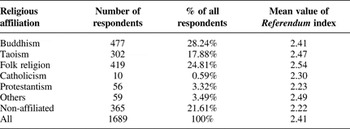
Table 1 shows the distribution of religious affiliation among the respondents and the mean value for the Referendum index by different religions. The mean value of Referendum is 2.41 for the full sample, while folk religionists have the highest mean value of Referendum at 2.54, and non-religious people have the lowest mean value at 2.22. In between, the mean value of Referendum is 2.49 for the people who are affiliated with other religions, followed by 2.47 for Taoists, 2.41 for Buddhists, 2.30 for Catholics, and 2.23 for Protestants.
Attitude toward a referendum by religious affiliation

Data source: Taiwan Social Change Survey (TSCS), 2004.
Note: The referendum index is scaled from 0 to 4, with 4 indicating the respondent strongly agrees that using a referendum is a good way to resolve political issues and 0 indicating strongly disagree.
The empirical model used to investigate the relationship between the attitude toward a referendum and religion is as follows.
 $$Referendum_i = \alpha + \beta _1 \, Religion_i + \beta _2 \, Group_i + \beta _3 \, X_i + \varepsilon_i\comma \;$$
where Referendumi is the variable for individual i's attitude toward using a referendum, Religioni is the type of religion that individual i is affiliated with, Groupi is the religious group that individual i participates in or supports, Xi refers to a set of socioeconomic characteristics for the respondent, and εi is the error term. Since Referendum is an unobserved latent variable and measures the propensity of an individual's attitude toward using a referendum, the estimation is undertaken with an ordered probit model (Greene Reference Greene2000).
Eastern religions usually do not require organizational affiliation and membership, and religious affiliation (Religioni) is used as a proxy measure of religious belief and ideology. Since an individual may not claim any religious affiliation, although he or she still may have religious beliefs and engage in religious activities, the participation or support of a specific religious group (Groupi) is also used to capture the effects of the intensity of an individual's religious beliefs and engagements in religious activities. In the 2004 TSCS, the respondents were also asked to specify their engagements or support for 29 specific religious groups. According to the responses to this question, the religious groups are classified and six dummy variables are constructed to reflect the respondents' attachments to different types of religious groups, Buddhist groups (Bgroup), Taoist groups (Tgroup), Folk religionist groups (Fgroup), Catholic groups (Cgroup), Protestant groups (Pgroup), and other religious groups (Ogroup).
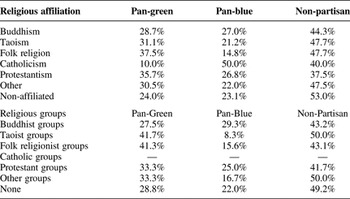
Table 2 reports the political background of the respondents by religious affiliation and religious group. Regardless of the respondents' religious affiliations and groups, non-partisan individuals mostly have the highest percentages followed by Pan-green supporters, while Pan-blue supporters have the lowest percentages across all types of religious affiliations and groups. Individuals affiliated with Catholicism are more likely to be Pan-blue supporters with a percentage of 50%, whereas there are 27.5% of Pan-green supporters, 29.3% of Pan-blue supporters, and 43.2% non-partisan individuals among the people attached to Buddhist groups. Among the individuals affiliated with Taoism and folk religions or attached to Taoist and folk religionist groups, Pan-green supporters have higher percentages than Pan-blue supporters. Apparently, religious people in Taiwan are more likely to have no partisanship or a Pan-green partisanship than to be a Pan-blue supporter.
Political background by religious affiliation and religious group

Data source: Taiwan Social Change Survey, 2004.
The set of socioeconomic characteristics Xi includes age (Age), age square (Age2), Gender, dummy variables for marital status (Married and Divorced), educational level (High, College, and Graduate), employment status (Unemployed), partisanship (Green and Blue), ethnicity (Ethnicity), perception about government bureaucracy (Bureaucracy1 and Buraucracy2), and income level (FYD1, FYD2, FYD3, and FYD4). The inclusion of these variables intends to capture the effects of an individual's demographic background and socioeconomic status on shaping the attitude toward direct democracy.
As discussed earlier, the Pan-green camp (Green) consisting of the DPP and TSU favors a more institutionalized system of referendum than the Pan-Blue camp (Blue) of KMT, PFP, and NP. The effect of partisanship is taken into account with two dummy variables, Green and Blue, indicating whether a respondent is a supporter of the two major political camps in Taiwan. These two dummy variables of partisanship capture the effects of political traditions embedded in different political parties on the attitude toward a referendum. While Ethnicity captures the effect of ethnic diversity on a political institution (Alesina, Baqir, and Hoxby, Reference Alesina, Baqir and Hoxby2004), Bureaucracy1 and Bureaucracy2 are included in the set of explanatory variables to reflect the effects of the desire for greater direct participation in political decisions induced from people's perceptions about the bureaucracy of government (Bowler, Donovan, and Karp Reference Bowler, Donovan and Karp2002; Reference Bowler, Donovan and Karp2007).
In the literature on the relationship between Asian values and democracy, the degree to which Confucian values aid or hinder democracy is a heavily debated issue. However, there is no single question on the 2004 TSCS that measures adherence to Confucianism. Since the values of ritual and propriety, filial piety, righteousness, honesty and trustworthiness, benevolence, loyalty to the state, and meritocracy are strongly emphasized in Confucian ethical doctrines (Taylor Reference Taylor1985; Yao Reference Yao2000; Legge Reference Legge2004), we construct three dummy variables to measure support for key Confucian values based on the availability of the survey questions. One variable is Law, which is constructed from responses to the question asking: How important do you think that being a good citizen, a person should obey the law and government regulations? This variable is considered as a proxy measuring the Confucian values of ritual, propriety, righteousness, and loyalty to the state. Another dummy variable, Benevolence, is constructed from responses to the question asking: How important do you think that being a good citizen, a person should help those who live a worse life than himself? The third variable is Effort, which is constructed from responses to the question asking: How important do you think that a person's effort will influence whether he or she can succeed or not? This variable intends to capture the effect of the concept of meritocracy stating that a virtuous plebeian who cultivates qualities can be a “Junzi” (gentleman) such that personal efforts can break through the barriers of social class and the hierarchic structure in society. The values of these three variables are coded as 1 when the responses are very important and coded as 0 otherwise. Appendices 1 and 2 (Online Supplemental material) show the definitions and descriptive statistics of the variables used in this study.
EMPIRICAL RESULTS
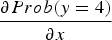
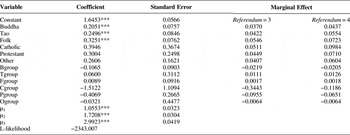
Table 3 presents the results from an ordered probit estimation of the basic model, including only the religious variables as the explanatory variables. We find that religious affiliations of Buddhism, Taoism, and folk religions are positively associated with the attitude toward using a referendum in political decision making. Specifically, as shown by the marginal effects in column 3 and column 4, followers of Buddhism, Taoism, and folk religions are 3.7%, 4.22%, and 5.46% more likely, as well as 4.37%, 5.54%, and 7.23% more likely to agree and strongly agree with the usage of a referendum in political decision making than are non-affiliated people, respectively.Footnote 4
Ordered probit estimation of the attitude toward a referendum basic model (N = 1689)

Note: ***, **, and * denote significance at 1%, 5%, and 10%, respectively.
Apparently, these results suggest that religion plays a significant role in shaping people's political ideology and orientation about a political system and government authority. More importantly, these results are different from the findings of Park and Shin (Reference Park and Shin2006),Footnote 5 which employs several dimensions of collectivism (social hierarchy, social harmony, group primacy, and anti-pluralism), and conception of good governance (the family-state, the moral state, and anti-adversarial politics) as measures of Asian social and political values. The results of this study indicate that Buddhism, Taoism, and folk religions appear to have positive influences on the enhancement of the values of autonomy and self-determination in the conduction of direct democracy. In Taiwan, Buddhist, Taoist, and folk religionist beliefs and values are intertwined with Confucian moral ideals, and these beliefs and values respond and evolve along with the course of economic and political developments. Even though these religions could be subordinate to the authoritarian regime prior to democratization as discussed in some previous literature, they have adapted to modernized forms of old traditions and become compatible with a democratic political economy. As an important factor of social and cultural values, these types of Eastern religions potentially facilitate the cultivation and consolidation of democratic norms in promoting individual rights.
A person's attachment to a religious group is not significantly correlated to the attitude toward a referendum. One possible explanation is that an attachment to a religious group may result in other benefits, such as providing social support and psychological comfort for people on the individual level, instead of the establishments of political orientation about the issues of a political system and the legitimacy of government policies for the society as a whole. As argued in Madsen (Reference Madsen2007), the Taiwanese government has been relying heavily on religious groups such as Tzu Chi (The Buddhist Compassion Relief Association), Fokuangshan (Buddha's Light Mountain), and Faku Shan (Dharma Drum Mountain), to provide social welfare and services since the 1970s and early 1980s. Following the end of martial law in 1987, most restrictions on social and political associations were removed and the country has transited rapidly from an authoritarian to a democratic society. As numerous political and social groups have emerged to take active roles in political participations, it is possible that actual participations in these religious organizations have been mostly engaged in social assistances and charitable activities instead of political agenda. By contrast, religious affiliations may more directly reflect the fundamental ideological orientations about democratic institutions.Footnote 6
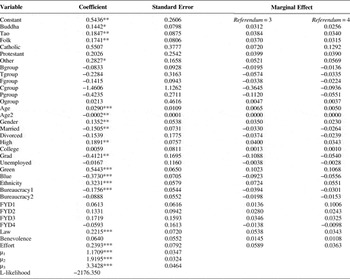
Table 4 reports the estimation results of the complete model with control variables. It is found that religious affiliations of Buddhism, Taoism, folk religions, and other religions are positively associated with the attitude toward using a referendum in political decision making. The marginal effects, indicated in column 3 and column 4, show that adherents to Buddhism, Taoism, folk religions, and other religions are 3.12%, 3.84%, 3.7%, and 5.21% more likely, as well as 2.56%, 3.4%, 3.15%, and 5.69% more likely to agree and strongly agree with the usage of a referendum in political decision making than are non-affiliated people, respectively. The attachments to religious groups do not have significant relationships with the attitude toward a referendum. Again, affiliations with Eastern religions are positively associated with the attitude toward referendums.
Ordered probit estimation of the attitude toward a referendum, the complete model (N = 1689)

Note: ***, **, and * denote significance at 1%, 5%, and 10%, respectively.
Aside from religious variables, Ethnicity also is positively correlated with the attitude toward a referendum and indicates that people of the majority group, whose fathers were born in Taiwan with a Minnan ethnic identity, are more likely to agree with the usage of a referendum in political decision making than those who are not.Footnote 7 A potential explanation for this result is that people in the majority group of ethnicity in society are more likely to see a political decision made in their favor when it is determined by a referendum. This result will be apparent when there are differences in political and economic interests across ethnic groups in society.
People's perceptions about government performance tend to have potential effects on their attitudes toward a political institution and a democratic system. Bureaucracy1 is negatively associated with the attitude toward a referendum, which suggests that when people believe that government officials are not always doing things for the people, they are less likely to favor the usage of a referendum in political decision making. Statistically, those who think that government officials are not always doing things for the people are respectively 3.94% and 3.01% less likely to agree and strongly agree with the usage of a referendum in resolving political issues. In other words, bureaucracy may lead to weaker support for a referendum, because there lacks sufficient trust in government to effectively implement public policies. This result is inconsistent with some previous studies (e.g., Bowler, Donova, and Karp (Reference Bowler, Donovan and Karp2007)) on western countries that suggest a positive relationship between the lack of trust in the government and the favor for direct democracy. However, some other studies such as Hibbing and Theiss-Morse (Reference Hibbing and Theiss-Morse1995; Reference Hibbing and Theiss-Morse2001) indicate that people who dislike the workings of democratic institutions and distrust the government often have distastes for further participation in politics. In Taiwan, the relationship between bureaucracy and the attitude toward referendum certainly leaves an open question for some future research.
As for the variables being proxies of Confucian values, by separating them from identification with a particular religious tradition, the coefficients of Law and Efforts are positively significant. This indicates that these values of righteousness and meritocracy lead to a more positive attitude toward a referendum. Specifically, those who think it is important that being a good citizen, a person should obey the law and government regulations are, respectively, 5.38% and 3.43% more likely to agree and strongly agree with the usage of a referendum in resolving political issues. The agreement that a person's effort will influence whether he or she can succeed leads to a 5.89% and 3.63% more likelihood to agree and strongly agree with the usage of a referendum, respectively. Of course, the variables Benevolence, Law, and Effort less than fully capture the Confucian beliefs of benevolence, ritual, propriety, righteousness, loyalty to the state, and meritocracy. It is possible that the values of legal obedience, helping those who are worse off, or personal effort are also considered as Christian or humanistic values or the effects of these Confucian values are mostly captured by the variables of religious affiliations. A further investigation by dropping these three variables from the estimations is also undertaken in this study, and this leads to very similar results. Perhaps further research can focus on directly examining the effects of Confucianism with more information about the measures of Confucian values.
Some of the socioeconomic variables are also found to have significant relationships with the attitude toward a referendum. Age has an inverted U-shaped relationship with the attitude toward a referendum — that is, as age increases, people become more positive toward the usage of a referendum in making political decisions, and then the support for the usage of a referendum starts declining after people become older than a certain age. This may indicate that people in their middle age are more inclined to political autonomy and more willing to participate in political decisions than those who are at younger and older ages. Moreover, because the data used in this study is collected from the 2004 TSCS, the age variation may also reflect some differences in the opposition against the usage of a referendum for the fear of China's invasion. Different cohorts of Taiwanese who came to maturity before, during, and after the democratic transition may display markedly different attitudes toward the referendum issue.
While males are more likely to have a positive attitude toward a referendum than females, married people are less supportive for its usage in political decisions than those who are single. It is possible that men presumably have greater self-confidence about their capacity for political decision making and political participation than women in a Confucian society. Another possible explanation is that the traditional ideal woman has been perceived to be one who bears most of the responsibilities in childrearing and housework, while a man is perceived as being the main breadwinner for the household and has less housework responsibilities (e.g., Goldin (Reference Goldin2006)). Because political participation often substantially influences public policies related to issues on the labor market and social welfare, males are traditionally more interested and active in political participation than females. This result suggests that men may prefer a more important role in political decision making with a referendum, instead of allowing the government or elected representatives to make decisions for them. As for married people, the conduction of a referendum may be more costly for them, because of their responsibilities to their family. It is possibly more beneficial for them to have political decisions made by government officials and elected representatives in the legislature.
The positive attitude toward a referendum surprisingly does not simply increase with educational attainment. People with a high school degree tend to have a more positive attitude toward a referendum than people with an educational attainment less than the level of high school. However, individuals with a graduate school education are less supportive for its usage. At the high school level, education may increase the benefits of political participation through training in the skills of civic engagement and social interaction. This leads to a positive attitude toward a referendum for high school graduates. The negative association between graduate school education and the attitude toward a referendum may be explained by the position about political issues held by the elite group of society that often appears with more highly educated people having graduate degrees.
Partisanship is not surprisingly also strongly correlated with the attitude toward a referendum. Supporters of Pan-green parties are more likely to have a positive attitude, and people with political inclinations toward Pan-blue parties are less likely to support the usage of a referendum. Traditionally, parties in the Pan-blue camp, including the KMT, PFP, and NP, all originated from the same authoritarian government before the democratization process of Taiwan in the 1980s, while parties in the Pan-green camp of DPP and TSU were newly established after the 1980s to challenge the Pan-blue parties. Consequently, it is not surprising to find that the supporters of Pan-green parties are more likely to have a positive attitude toward a referendum. Pan-green supporters are 10.23% and 10.68% more likely to agree and strongly agree over the usage of a referendum, while people supporting Pan-blue parties are 9.23% and 5.56% less likely to support the usage of a referendum than people without partisanship.
ROBUSTNESS
Although the main purpose of this article is to examine the role of religion in shaping people's attitudes toward direct democracy, some may argue that a person could be fully supportive of political democracy, but not predisposed to want a political referendum. To further investigate this issue and broaden the scope of this article, we conduct additional estimations with two dependent variables as the measures of democratic values, Demo-value1 and Demo-value2, to examine the role of Eastern religions in shaping the attitude toward democracy in general. Demo-value1 is constructed from responses to the question asking: How important do you think that the government should treat a person equally regardless of his or her status in the society? This value of the variable is coded as 1 when the response is quite important and coded as 0 otherwise. Demo-value2 is another measure of democratic value constructed from responses to the question asking: How important do you think that the politicians should consider people's opinions before making their decisions on public policies? The value of this variable is coded as 1 when the response is quite important and coded as 0 otherwise. Considering the available information from the 2004 TSCS, these two variables are constructed to reflect some fundamental values such as equal rights, unalienable rights, political pluralism, and the legitimacy of a political system with the capacity to engender and maintain the most appropriate and proper political institutions for the society (Lipset Reference Lipset1959; Reference Lipset1981) that are emphasized in many different forms of a democratic system.
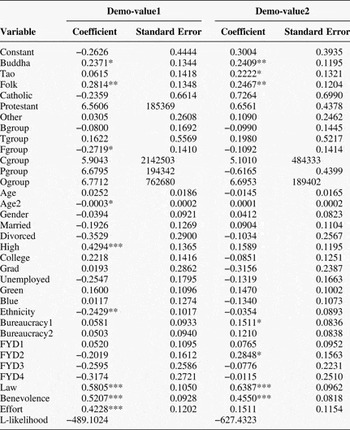
As shown in Table 5, the estimation results provide further supportive evidence that Eastern religions and beliefs have positive relationships with the attitudes toward some fundamental democratic values. Specifically, the affiliations with Buddhism, Taoism, and folk religions have significantly positive relationships with Demo-value2, while the affiliations with Buddhism and folk religions are positively associated with Demo-value1. Similarly, regarding some measures of ritual, propriety, righteousness, benevolence, and meritocracy, Law, Benevolence, and Effort have significantly positive coefficients in the Demo-vlaue1 estimation and Law and Benevolence are positively associated with Demo-value2. These results indicate that the values of Eastern religions have some positive influences on openness to democracy.
Probit estimation of the attitude toward democratic value (N = 1689)

Note: ***, **, and * denote significance at 1%, 5%, and 10%, respectively.
In the literature of political science, two perspectives are often provided to explain people's support for direct democracy. One perspective links the favor for direct democracy to a rise in dissatisfaction with government (e.g., Dalton, Bürklin, and Drummond (Reference Dalton, Drummond, Bürklin and Drummond2001); Donovan and Karp (Reference Donovan and Karp2006); Bowler, Donova, and Karp (Reference Bowler, Donovan and Karp2007)), and another perspective suggests that support for direct democracy stems from the desire for more political participation (e.g., Dalton, Bürklin, and Drummond (Reference Dalton, Drummond, Bürklin and Drummond2001); Donovan and Karp (Reference Donovan and Karp2006)). As a result, there may be concern for the issue that one can either favor a referendum out of suspicion toward democracy or out of desire for more democracy. The results are robust to various alternative specifications to take into account this concern.
We first estimate an alternative of model specification by including two additional variables to capture the effects of people's perceptions about the democratic system and democratic rights in Taiwan on their attitudes toward direct democracy. One variable is Demo, which is a dummy variable constructed from respondents' answers to the question asking: “How do you think about the performance of the democratic system in Taiwan these days?” This variable is coded as 1 if the response is “good,” and coded as 0 otherwise. In addition to the effects captured by Bureaucracy1 and Bureaucracy2, the inclusion of Demo allows us to examine the hypothesis that dissatisfaction with the government and the democratic system leads to a desire for more political participation.
Another variable is DemoRight, which is constructed from respondents' answers to the question asking whether an individual agrees or disagrees with the statement: “No matter under what circumstance, the government should not restrict people's democratic rights.” Again, this variable is coded as 1 if the respondent agrees with the statement and coded as 0 otherwise. It is assumed that people who have a strong commitment to the principles of democracy and democratic values will more likely support direct democracy. The results are robust for including these two additional variables.
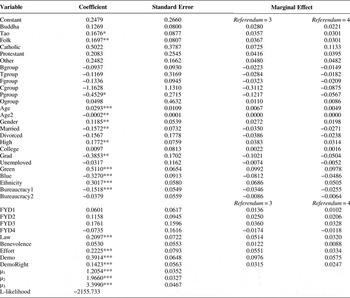
Table 6 reports that the coefficients of Tao and Folk are positive and significant, and their marginal effects are only slightly lower than those described in Table 4. Moreover, both the coefficients of Demo and DemoRight are significantly positive, indicating that people who are more satisfied with the performance of Taiwan's democratic system these days and those who more strongly believe in people's democratic rights tend to be more supportive to the usage of a referendum. Consequently, the estimation result is inconsistent with the hypothesis that dissatisfaction with the democratic system leads to a desire for more political participations. By contrast, a higher degree of belief in people's democratic right leads to a more supportive attitude toward direct democracy.
Robustness check on effects of democratic system and participation (N = 1689)

Note: ***, **, and * denote significance at 1%, 5%, and 10%, respectively.
Our results are robust to various alternative specifications to further investigate the issue of the linkage between the support for direct democracy and dissatisfaction with the democratic system and the desire for more political participation.
CONCLUSION
The role of political culture in shaping political attitudes and values has been an important question in sociology and political science. The study herein contributes to this line of research by examining the link between religion and the attitude toward direct democracy for an East Asian country. The findings from this study suggest that affiliations with the Eastern religions of Buddhism, Taoism, and folk religions have positive relationships with some fundamental democratic values and also indicate that the believers of these Eastern religions have more positive attitudes toward the usage of a referendum in political decision making.
Contrary to the argument that “Asian values” are inconsistent with the democratic values of self-determination and self-expression, the results indicate that the political ideology cultivated by the value systems of Eastern religions along with other social and cultural factors increases the positive attitude toward direct democracy. From the perspective of political legitimacy, the meaning of people's rights and the perception about government authorities based on the principles of Eastern religions are beneficial to a political system with the mechanism of direct democracy for enhancing the values of civic society and self-determination. Under direct democracy, more opportunities for political participation are offered and citizens feel more responsible for public affairs, and therefore satisfaction with the political institution can be enhanced. Since the lifting of Martial Law in 1987, Taiwan has been experiencing rapid democratic development along with economic success. These results suggest that the value systems of Eastern religions are compatible with the fundamental democratic values captured by people's beliefs in equal and unalienable rights as well as their attitudes toward direct democracy on the decision making of political issues. While dissatisfaction with the government caused by bureaucracy may easily rise in many forms of representative democracy and authoritarianism, direct democracy is another possible resolution with broader political participation that can increase the legitimacy of political decisions.
The fundamental values of social cohesion and collective interest influenced by the religious beliefs of Buddhism, Taoism, and folk religions that are embedded in society often can provide a stabilizing effect for the political and economic development of East Asian countries. Religion also plays an important role in affecting people's attitude toward political institutions and fostering civic virtues. As many East Asian countries continue to enjoy economic progress, the influences of religion upon the development of political institutions have become increasingly important. Future research can aim at identifying the relationships between various forms of democratic systems and more specific Confucian values, which are the limitations of this study given the availability of the TSCS data. Since Confucianism is usually not defined as a religion, but rather an ethical and philosophical system of cultural and social values, the potential challenge might be in how to separate the beliefs between Confucianism and other Eastern religions.