Introduction
In western Canada, crop resistance is widely used to minimise damage to developing seeds of spring wheat (Triticum aestivum Linnaeus; Poaceae) by wheat midge, Sitodiplosis mosellana (Géhin) (Diptera: Cecidomyiidae) (DePauw et al. Reference DePauw, Knox, Thomas, Smith, Clarke and Clarke2009; Fox et al. Reference Fox, McKenzie, Lamb, Wise, Smith and Humphreys2010, Reference Fox, Lamb, McKenzie, Wise, Smith and Humphreys2012), reducing yield loss (Vera et al. Reference Vera, Fox, DePauw, Smith, Wise and Clarke2013; Smith et al. Reference Smith, Wise, Fox, Vera, DePauw and Lukow2014). The resistant cultivars are seeded with a 10% interspersed refuge of susceptible plants to delay the evolution of virulence by this midge (Smith et al. Reference Smith, Lamb, Wise and Olfert2004; Fox et al. Reference Fox, McKenzie, Lamb, Wise, Smith and Humphreys2010). Resistance is due primarily to a partially dominant gene, Sm1, which expresses as antibiosis to wheat midge larvae (Lamb et al. Reference Lamb, McKenzie, Wise, Barker and Smith2000a; McKenzie et al. Reference McKenzie, Lamb, Aung, Wise, Barker and Olfert2002). This resistance is induced when larvae begin to feed and is associated with a rapid rise in the level of phenolic acids in seeds (Ding et al. Reference Ding, Lamb and Ames2000). Oviposition deterrence can also provide resistance against wheat midge (Lamb et al. Reference Lamb, Smith, Wise, Clarke and Clarke2001, Reference Lamb, Wise, Smith, McKenzie, Thomas and Olfert2002, Reference Lamb, Sridhar, Smith and Wise2003; Fox et al. Reference Fox, Thomas, Wise, Smith, Humphreys and Brown2009; Thomas et al. Reference Thomas, Fox, McCallum, Fetch, Gilbert and Menzies2013). However, this mode of resistance is less well understood and involves more than one gene, which makes the trait more difficult to incorporate in a breeding programme (Gharalari et al. Reference Gharalari, Fox, Smith and Lamb2009a, Reference Gharalari, Smith, Fox and Lamb2009b).
Resistance to wheat midge was initially discovered not in spring wheat where the midge is a pest, but in nine winter wheat cultivars (Barker and McKenzie Reference Barker and McKenzie1996). These cultivars were being used as a Hessian fly differential set in field plots to identify the biotype of Hessian fly (Mayetiola destructor Say) (Diptera: Cecidomyiidae) that damages spring wheat in Manitoba, Canada. A Hessian fly differential set consists of an array of cultivars with different genes for resistance each effective against a different biotype of Hessian fly, allowing the appropriate resistance gene for a particular pest biotype to be identified (Berzonsky et al. Reference Berzonsky, Ding, Haley, Harris, Lamb and McKenzie2003). When the cultivars in the differential set appeared to be resistant to wheat midge (Barker and McKenzie Reference Barker and McKenzie1996), they were crossed with susceptible spring wheat breeding lines to produce F1 plants. A doubled-haploid procedure was applied to the F1 plants to produce homozygous lines that could be selected for spring growth habit and resistance to wheat midge (McKenzie et al. Reference McKenzie, Lamb, Aung, Wise, Barker and Olfert2002). Both the antibiosis and oviposition deterrence modes of resistance to wheat midge were characterised in these spring wheat lines (Lamb et al. Reference Lamb, McKenzie, Wise, Barker and Smith2000a, Reference Lamb, Wise, Smith, McKenzie, Thomas and Olfert2002), and assumed to have been inherited from the winter wheat parents.
Although resistance to wheat midge is now well documented in spring wheat inbred lines and cultivars, little is known about the expression of resistance in the winter wheat cultivars that were the sources of Sm1-based resistance now used in spring wheat. Of particular interest is the fact that all nine winter wheat cultivars in the Hessian fly differential set were sources of the Sm1-gene for resistance to wheat midge, although wheat midge was not a consideration in the development of any of them. Furthermore, all these cultivars were developed and grown in the eastern United States of America where wheat midge has not been reported to be a pest in winter wheat for at least 50 years. Both the wheat midge and winter wheat have been present in North America since the early days of European colonisation (Fletcher Reference Fletcher1888; Felt Reference Felt1912). The original source of the resistance is also likely to have been in early European land races of wheat, but curiously, unlike the winter wheat of North America, winter wheat has been plagued by wheat midge in Europe (Barnes Reference Barnes1956). No effective resistance to wheat midge was deployed in Europe until Sm1 was identified.
The puzzling observation that all nine cultivars from the Hessian fly differential set were sources of resistance (McKenzie et al. Reference McKenzie, Lamb, Aung, Wise, Barker and Olfert2002) and the uncertain origins of resistance to wheat midge in winter wheat led us to investigate resistance in winter wheat. Our objectives were to determine: what modes of resistance occur in the nine winter wheat cultivars where resistance was first identified; if this resistance is present in the early ancestors of North American winter wheat, and how widespread resistance is in winter wheat.
Materials and methods
Resistance to wheat midge in winter wheat was assessed by testing 16 North American cultivars and 11 Chinese breeding lines against the susceptible spring wheat, “Roblin”. The methods were the same as those used originally to characterise resistance in spring wheat (Lamb et al. Reference Lamb, McKenzie, Wise, Barker and Smith2000a, Reference Lamb, Wise, Smith, McKenzie, Thomas and Olfert2002; McKenzie et al. Reference McKenzie, Lamb, Aung, Wise, Barker and Olfert2002). Four trials were conducted: trials 1–3, in the laboratory where repeatable results could be achieved reliably, and trial 4, in the field to assess whether laboratory results were agriculturally realistic. Nine winter wheat cultivars from the Hessian fly differential set, the original sources of Sm1, were included in trial 1, along with five other winter wheat cultivars (Table 1). Four of these five, “Goens”, “Mediterranean”, “Trumbull”, and “Fairfield”, were early cultivars grown in the eastern United States of America, part of the ancestry of cultivars in the Hessian fly differential set, and the first three were among the first cultivars registered in North America (Clark et al. Reference Clark, Love and Gaines1927). “Rawhide” was included as a more modern hard red winter wheat resistant to Hessian fly (Baenziger et al. Reference Baenziger, Schmidt, Peterson, Johnson, Mattern and Nelson1992).
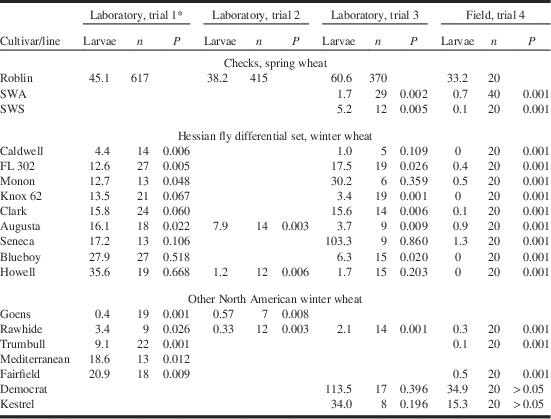
Mean number of wheat midge larvae reaching the final instar per spike of wheat, the number of spikes tested (n), and the probability (P) that a difference is detected between a cultivar or line and the check, “Roblin”, in three laboratory and one field trial. Spring wheat lines with “Augusta” (SWA) or “Seneca” (SWS) as a winter wheat parent were included as resistant checks in two of the trials.

Note:
* All living larvae on ripe spikes.
Eleven Chinese winter wheat lines from a programme aimed at developing wheat midge resistance (Institute of Plant Protection, Chinese Academy of Sciences, Beijing, China) were tested in trial 2, as representatives of germplasm with a different ancestry from the North American cultivars. For comparison, four cultivars from trial 1 were included. In trial 3 we re-examined the cultivars of the Hessian fly differential set, two of the Chinese lines and “Rawhide”, and added the old cultivar “Democrat” (Clark et al. Reference Clark, Love and Gaines1927) and a modern cultivar “Kestrel” (Fowler Reference Fowler1997). In trial 4 we repeated trial 3 in the field, with the addition of “Fairfield” and “Trumbull” from trial 1. The intention for trial 4 was to include all North American cultivars that had been tested in the laboratory, but insufficient seed was available to test “Goens” and “Mediterranean”.
The primary check was “Roblin”, a hard, red spring wheat susceptible to wheat midge (Lamb et al. Reference Lamb, McKenzie, Wise, Barker and Smith2000a, Reference Lamb, Wise, Smith, McKenzie, Thomas and Olfert2002). We included two spring-wheat breeding lines with resistance derived from “Augusta” and “Seneca” in trial 3 and 4 to assess whether the expression of the resistance was similar in spring and winter wheat.
Trial 1 was conducted following the methods described for the original characterisation of resistance in spring wheat (Lamb et al. Reference Lamb, McKenzie, Wise, Barker and Smith2000a), so that direct comparisons could be made between resistant spring wheat lines and their winter wheat parents. Seeds of the winter wheat cultivars were germinated, vernalised at 3 °C for two months, and transplanted into plastic tubular pots of artificial soil kept moist with a fertiliser solution in growth cabinets. At the early heading stage plants were trimmed to two spikes and placed in cages. Up to 20 test and five check plants were assigned at random to the 25 locations in each cage and wheat midge adults of both sexes were added at the rate of 2–3 per wheat spike.
Trials 1–3 were conducted in a controlled environment room with minimal air flow, at 20±3 °C, 45–70% relative humidity, and a 20-hour day including dawn and dusk periods of two hours each. After three to four nights spikes were covered with pollination bags and the plants were transferred to a greenhouse. Ten days later one spike from each plant (termed a “green spike”) was removed and dissected under a microscope. Unhatched eggs, larvae, and larval corpses were counted, and the instar (1, 2, or 3) of each living larva was tallied. The total of eggs, larvae, and corpses estimated the number of eggs laid on each of these spikes. The second spike from each plant (termed a “ripe spike”) was removed four to six weeks later when seeds were ripe and surviving larvae had reached the third and final instar. Larvae and damaged seeds were counted. Tests on individual cultivars were repeated simultaneously and sequentially with a target of 20 replicate spikes for each. This target was sometimes exceeded or not achieved depending on how many spikes and wheat midge were available for each test. Thus, the sample of spikes varied among cultivars.
Trial 2 was conducted as for Trial 1 except that only green spikes were dissected for the Chinese wheat lines, and only the surviving larvae were counted for the North American winter wheat cultivars. Trial 3 was conducted as for trials 1 and 2, but only green spikes were dissected and only the numbers of living larvae in each instar were recorded. Trial 4, in the field at Winnipeg, Manitoba, Canada, consisted of a single 2-m row for each cultivar or line and the checks, with the order of rows randomised and extra check lines added at both ends of the single block of rows, as described previously for field trials on spring wheat (Lamb et al. Reference Lamb, McKenzie, Wise, Barker and Smith2000a). Seeds of winter wheat were germinated, vernalised at 3 °C for two months, and transplanted into the appropriate rows in the field. The spring wheat checks were germinated in the laboratory and transplanted at the same time, so that winter and spring wheat reached heading stage at about the same time and when wheat midge adults were active. For each row, 20 green spikes were collected and the total number of larvae surviving on each spike was recorded.
Data for each line or cultivar were compared with that of the check “Roblin” in an unbalanced analysis of variance using a mixed model procedure (SAS Institute Inc. 1989), as described for spring wheat (Lamb et al. Reference Lamb, McKenzie, Wise, Barker and Smith2000a). In addition, the frequencies of larvae surviving to various growth stages were compared between individual cultivars and “Roblin” using a χ2 analysis (SAS Institute Inc. 1989).
Results
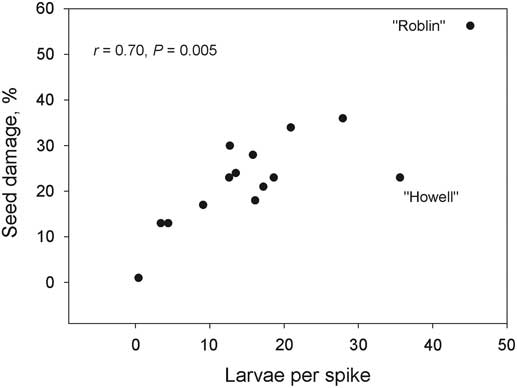
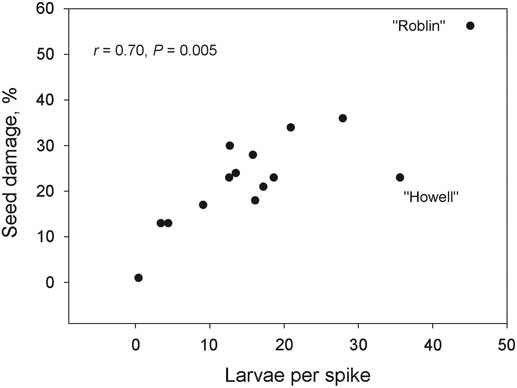
In laboratory and field trials the susceptible check “Roblin” averaged 33–61 wheat-midge larvae per spike; most of the North American winter wheat cultivars had relatively few larvae (Table 1). Seed damage to the 14 winter wheat cultivars and “Roblin” in trial 1 increased as the number of larvae increased, based on a positive correlation coefficient (Fig. 1). Most lines had less than half as much damaged seed as “Roblin”. The only cultivar that deviated markedly from the linear relationship was “Howell”, which had less damage than expected for the number of larvae found (Fig. 1).
Relationship between seed damage and the number of wheat midge larvae in wheat spikes, for 14 winter wheat cultivars and a susceptible check, the spring wheat “Roblin”, in a laboratory trial.
Resistance in winter wheat cultivars from the Hessian fly differential set
Winter wheat cultivars from the Hessian fly differential set usually had less than half as many larvae as “Roblin”, but only four and five out of nine of these differences were significant in laboratory trials 1 and 3, respectively (Table 1). Some cultivars, for example “Augusta”, had few larvae in all three trials, but others, for example “Seneca”, “Blueboy”, and “Howell”, were inconsistent (Table 1).
The nine winter wheat cultivars had 51±8% and 29±13% as many larvae as on “Roblin” in trials 1 and 3, respectively (Table 1), but many more than the resistant spring wheat lines derived from them (5±5%, Lamb et al. Reference Lamb, McKenzie, Wise, Barker and Smith2000a). In the field, however, all nine winter wheat cultivars had <5% as many larvae as “Roblin”, and similar numbers to the two resistant spring wheat checks (Table 1). “Caldwell” always showed the highest level of overall resistance among the nine winter wheat cultivars and “Seneca” the lowest in trial 3, but we detected no correlation in overall resistance between cultivars for trials 1 and 3 (r=0.44, P=0.24, n=9).
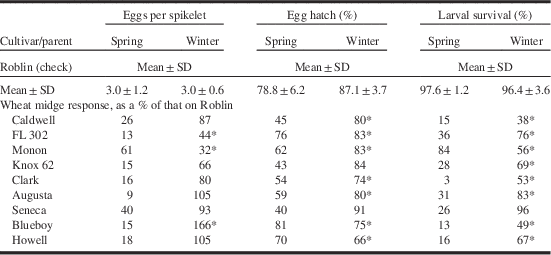
In trial 1 we partitioned overall resistance into three components: oviposition deterrence, antibiosis to egg hatch, and antibiosis to larvae (Table 2). The components of resistance for the nine winter wheat cultivars were compared with those from an identical study on spring wheat lines each of which had one of the nine cultivars as a parent (Lamb et al. Reference Lamb, McKenzie, Wise, Barker and Smith2000a). In the two studies, the check “Roblin” showed similar levels of oviposition, egg hatch, and larval survival (Table 2). Two of nine winter wheat cultivars deterred oviposition, seven reduced hatch, and eight reduced larval survival (Table 2). However, for all three components of resistance, the levels of resistance were usually lower (seven or eight cases out of nine) for each of the winter wheat cultivars than for the corresponding spring wheat line, which had that winter wheat cultivar as a parent (Table 2).
Three components of resistance to wheat midge (oviposition deterrence, antibiosis to egg hatch, and antibiosis to larvae) estimated for nine winter wheat cultivars, and corresponding spring wheat lines with each winter wheat as a parent.
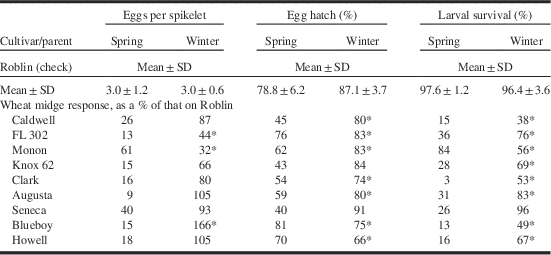
Notes: The data are from the laboratory: trial 1 for the winter wheat and Lamb et al. (Reference Lamb, McKenzie, Wise, Barker and Smith2000a) for the spring wheat. The performance of each cultivar/line on replicate wheat spikes is presented as a % of the response on the check, “Roblin”.
* Differs from the response on “Roblin” (analysis of variance on square-root transformed data, P<0.05).
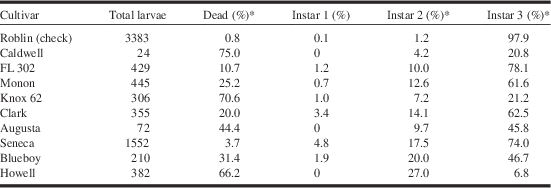
In trial 3 we assessed the numbers of larvae dying early, developing slowly, or surviving to maturity, the relative proportions of which are diagnostic of the resistance gene Sm1. On the susceptible spring wheat check, “Roblin”,<1% of larvae died and 98% reached maturity (Table 3). On the nine winter wheat cultivars, 4–75% larvae died, many failed to develop past instar 2, and <80% reached instar 3 (Table 3). Interestingly, “Howell” had the highest proportion of larvae that survived to instar 2 (27%), although few of these reached instar 3. The slow developing larvae on “Howell” apparently damaged fewer seeds than larvae damaged on the other cultivars (Fig. 1). Sample sizes were sufficiently large that the proportions in each category differed from “Roblin” for all cultivars, except for instar 1 where most values were too low to test. For example, a comparison between survival on “FL 302”, the winter wheat with the highest proportion of third instars (78%), and on “Roblin” gave a χ2=183 (P=0.0001), and between “Caldwell”, with the lowest sample size (24 larvae), and “Roblin” gave a χ2=11 (P=0.0009). Resistant spring wheat checks in trial 3 had two to five mature larvae per spike, similar to the numbers found on five of the winter wheat cultivars, but four of the winter wheat cultivars had more than 15 mature larvae per spike (Table 1).
Development and mortality of wheat midge larvae in laboratory trial 3 on the susceptible spring wheat check, “Roblin”, and nine winter wheat cultivars from a Hessian fly differential set.

Note:
* All differences between winter wheat and check differ, χ2 test of independence (P<0.05).
Other North American winter wheat cultivars
In trials on other North American winter wheat cultivars, no resistance was detected in “Democrat” and “Kestrel” (Table 1). “Fairfield”, “Mediterranean”, and “Trumbull” showed overall resistance levels in the range observed for cultivars from the Hessian fly differential set (Table 1). These three winter cultivars received 42–48% of the eggs laid on “Roblin”, not a significant reduction (P>0.05 in ANOVA on square-root transformed egg counts), but similar to “FL 302”, which had fewer eggs than “Roblin” (Table 2). They did not reduce egg hatch (91–100% of the hatch on “Roblin”, P>0.05).
“Goens” and “Rawhide” showed the highest overall resistance among North American winter wheat cultivars in trial 1 and 2, and “Rawhide” had similar resistance to the resistant spring wheat checks in trial 3 and 4 (Table 1). This resistance was the result of high levels of oviposition deterrence (“Goens” had 3% and “Rawhide” had 22% as many eggs as “Roblin” (P<0.05)), but eggs showed no reduction in hatch (97% on “Goens” and 94% on “Rawhide” of that on “Roblin” (P>0.3)), and no reduction in larval survival was detected (72% on “Goens” and 64% on “Rawhide” of that on “Roblin” (P>0.08)).
Chinese winter wheat lines
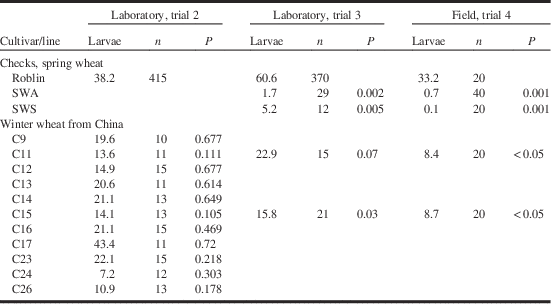
For the 11 Chinese winter wheat breeding lines in trial 2 no resistance was detected, although some lines produced relatively few larvae compared with “Roblin” (Table 4). In trials 3 and 4, less than half as many larvae were found on lines C11 and C15 as on “Roblin” (Table 4), but in the field 5–10 times as many larvae were found on C11 and C15 as on cultivars from the Hessian fly differential set (Tables 1 and 4).
Mean number of wheat midge larvae reaching the final instar on spikes of Chinese winter wheat, the number of spikes tested (n), and the probability (P) that a difference is detected between a line and the check, “Roblin”, in two laboratory trials and a field trial. Spring wheat lines with “Augusta” (SWA) or “Seneca” (SWS) as a winter wheat parent were included as resistant checks in two of the trials.

Discussion
Nine winter wheat cultivars from a Hessian fly differential set that were sources of antibiosis to wheat midge larvae in spring wheat (Lamb et al. Reference Lamb, McKenzie, Wise, Barker and Smith2000a; McKenzie et al. Reference McKenzie, Lamb, Aung, Wise, Barker and Olfert2002) also proved to be resistant. This result was expected because antibiosis against larvae is controlled by a single partially dominant gene, Sm1. This gene was transferred from each of the nine cultivars to corresponding spring wheat lines in crosses with a susceptible spring wheat, followed by a doubled haploid method to produce homozygous lines and selection for spring habit and resistance (McKenzie et al. Reference McKenzie, Lamb, Aung, Wise, Barker and Olfert2002). Some of the winter wheat cultivars also showed oviposition deterrence and antibiosis at hatching. The combined effect of the three modes of resistance (overall resistance) reduced the number of larvae maturing on these winter wheat cultivars and reduced the amount of damaged seed a proportional amount. Unexpectedly, in the laboratory, winter wheat cultivars did not express resistance as strongly as the spring wheat lines derived from them, although they did express high levels of resistance in the field. Modifying genes in the winter wheat cultivars, interacting with the laboratory testing environment, may have altered the expression of Sm1.
The expression of Sm1 varied from cultivar to cultivar. For example, “FL 302” and “Seneca” had relatively few dead larvae compared with “Caldwell” or “Knox 62”. On “Howell”, most of the larvae that survived were delayed in their development compared to “Caldwell” or “Knox 62”. The delayed development of surviving larvae on “Howell” probably explains why fewer damaged seeds than expected were found for the number of larvae present. These differences in the expression of Sm1 may be related to the rate of production and the types of phenolic acids that the seed surfaces exhibit once the resistance has been induced (Ding et al. Reference Ding, Lamb and Ames2000).
Oviposition deterrence also contributes to overall resistance in spring wheat lines derived from eight of the winter wheat cultivars; only a spring wheat line derived from “Monon” was not deterrent (Lamb et al. Reference Lamb, McKenzie, Wise, Barker and Smith2000a). However, only two of the nine winter wheat cultivars, “FL 302” and “Monon”, exhibited oviposition deterrence. Curiously, “Monon” was deterrent, but the progeny from a cross with “Monon” and susceptible spring wheat were not, whereas other winter wheat parents that showed no oviposition deterrence produced oviposition deterrent progeny when crossed with susceptible spring wheat. The spring wheat “Superb” shows oviposition deterrence but not antibiosis (Lamb et al. Reference Lamb, Sridhar, Smith and Wise2003), as does the spring wheat “Waskada” (Fox et al. Reference Fox, Thomas, Wise, Smith, Humphreys and Brown2009), whereas “Vesper” shows both deterrence and antibiosis (Thomas et al. Reference Thomas, Fox, McCallum, Fetch, Gilbert and Menzies2013), and both of the latter two spring wheat cultivars have “Superb” in their pedigree. Genes for oviposition deterrence must be present in both North American spring and winter wheat cultivars. The inheritance of oviposition deterrence is controlled by two or more genes inherited independently from Sm1 (Gharalari et al. Reference Gharalari, Smith, Fox and Lamb2009b), and therefore it is not surprising that the relationship between deterrence in the winter wheat cultivars and spring wheats derived from them is more complex than for resistance due to Sm1. The wheat midge behaviours affected by oviposition deterrence are only beginning to be understood (Ganehiarachchi and Harris Reference Ganehiarachchi and Harris2007, Reference Ganehiarachchi and Harris2009; Gharalari et al. Reference Gharalari, Smith, Fox and Lamb2010). Orientation of wheat midge females towards a spike is influenced by plant volatiles (Gharalari et al. Reference Gharalari, Smith, Fox and Lamb2011), but the plant cues that lead females to successfully oviposit once they are on a spike are not known, except that morphological features seem not to be important (Smith and Lamb Reference Smith and Lamb2001; Gharalari et al. Reference Gharalari, Fox, Smith and Lamb2009a).
Egg hatch was reduced in comparison with “Roblin” on all of the winter wheat cultivars except “Knox 62” and “Seneca” among the Hessian fly differential set. Reduced egg hatch was also detected in many of the spring wheat lines derived from eight of the winter wheat cultivars, including “Knox 62” and “Seneca”, the exception being a line derived from “Monon” (Lamb et al. Reference Lamb, McKenzie, Wise, Barker and Smith2000a). The contribution of this phenomenon to resistance was in the range of 17–34% for the winter wheat cultivars, an appreciable reduction but usually less than the larval mortality associated with Sm1. It is possible that reduced egg hatch is not an independent mode of resistance, however. The corpses of larvae that die soon after hatching and the remnants of their egg shells shrivel quickly, making them difficult to detect and a count of mortality around hatching problematic. Furthermore, mortality around hatching could be elevated on deterrent lines because many of the eggs laid on these lines are deposited on the rachis rather than between the glumes (Lamb et al. Reference Lamb, Sridhar, Smith and Wise2003; Gharalari et al. Reference Gharalari, Fox, Smith and Lamb2009a) perhaps leading to increased desiccation of eggs, or newly hatched larvae as they make their way to the seed surface. Reduced hatching might also be another aspect of the expression of Sm1, the result of mortality of newly hatched larvae when they initiate feeding but are small enough to escape detection when heads are dissected many days later. Nevertheless, antibiosis to hatching warrants further investigation as a possible additional source of resistance to wheat midge.
In addition to the nine cultivars from the Hessian fly differential set, five other winter wheat cultivars from eastern and central United States of America showed antibiosis, and four of the 14 cultivars also showed oviposition deterrence. Yet, the wheat midge has not been recognised as a pest in this region for many decades, and was not a consideration during the development of these cultivars. Where did the resistance come from, and why is it so common? Nine of the resistant winter wheat cultivars were part of a Hessian fly differential set, which suggests that resistance to wheat midge might be associated with resistance to Hessian fly, the main cecidomyiid pest of winter wheat in the United States of America (Berzonsky et al. Reference Berzonsky, Ding, Haley, Harris, Lamb and McKenzie2003; Harris et al. Reference Harris, Stuart, Mohan, Nair, Lamb and Rohfritsch2003). This possibility can be ruled out, however, as three of the nine cultivars have no resistance genes against Hessian fly (McKenzie et al. Reference McKenzie, Lamb, Aung, Wise, Barker and Olfert2002).
“Mediterranean” and “Trumbull” were included in this study because they were among the first cultivars registered in the United States of America (Clark et al. Reference Clark, Love and Gaines1927) and were included in early crosses that led to the development of modern winter wheat cultivars. Both show resistance consistent with the expression of Sm1, although neither exhibits oviposition deterrence. “Mediterranean” was a land race that came to North America from northern Italy in the 1880s (Clark et al. Reference Clark, Love and Gaines1927). Sm1 may have first come to North America with this cultivar, but certainly many other land races came to eastern North America from Europe, where wheat midge has long been a serious pest (Barnes Reference Barnes1956).
Even if a European source of the gene is likely, why is resistance still present in so many winter wheat cultivars? Wheat midge was a serious pest of wheat in the southeastern United States of America and Nova Scotia in Canada in the 1800s (Fletcher Reference Fletcher1888; Felt Reference Felt1912). Interestingly, in Nova Scotia, Canada, in the 1880s a variety called “Democrat” was reported to be “almost free from the attacks of this insect”, and another unnamed variety was referred to as “midge-proof wheat” (Fletcher Reference Fletcher1888: 11). “Democrat” was one of the early cultivars registered in 1927, but the seed of “Democrat” we obtained had no resistance to wheat midge. After about 1930 wheat midge was not considered a pest in eastern North America. Modern outbreaks occurred first in spring wheat in Manitoba and Saskatchewan, Canada, in the 1980s (Barker Reference Barker1984; Olfert et al. Reference Olfert, Mukerji and Doane1985; Lamb et al. Reference Lamb, Wise, Olfert, Gavloski and Barker1999). Although breeding for resistance to Hessian fly in winter wheat was actively pursued for decades (Berzonsky et al. Reference Berzonsky, Ding, Haley, Harris, Lamb and McKenzie2003; Harris et al. Reference Harris, Stuart, Mohan, Nair, Lamb and Rohfritsch2003), no such work was conducted for wheat midge in North America until the mid-1990s and then only in spring wheat in Canada and bordering states in the western United States of America.
With little selection pressure for many decades from wheat midge on winter wheat and no active breeding for resistance, the resistance genes might be expected to occur less frequently than appears to be the case. Perhaps Sm1 controls a general defence mechanism against organisms that attack developing wheat seeds, both insects and pathogens, and selection by these organisms has preserved the gene in winter wheat. This explanation does not account for the occurrence of oviposition deterrence to wheat midge in spring and winter wheat, however. It is also possible that the resistance to wheat midge in winter wheat has been maintained by unconscious selection by breeders who might be expected to detect even low levels of the seed damage (Lamb et al. Reference Lamb, Tucker, Wise and Smith2000b) and yield loss (Vera et al. Reference Vera, Fox, DePauw, Smith, Wise and Clarke2013) caused by wheat midge. Breeders might well discard samples with such damage and reduced yields even if they were unaware of the cause. This explanation does not account, however, for the apparent scarcity of resistance in Europe where wheat midge has been a serious pest for decades and was the probable source of the resistant germplasm for winter wheat in North America.
Not all winter wheat cultivars are resistant to wheat midge. “Democrat”, an old cultivar mentioned above is not, nor is “Kestrel”. Some Chinese winter wheat breeding lines show little or no resistance to wheat midge, although some show low levels of larval antibiosis and ovipostion deterrence. The resulting overall resistance in the Chinese lines is detectable in the field, but at a lower level than occurs in resistant North American winter wheat cultivars. Nevertheless, the larval antibiosis that is evident in the Chinese lines warrants further investigation, as the expression of this resistance differs from that observed when the Sm1 gene is present.
Two North American winter wheat cultivars, “Goens” and “Rawhide”, exhibit particularly high levels of overall resistance to wheat midge. “Goens” has one of the highest levels of oviposition deterrence so far observed, with about 2.5% of the eggs laid on “Roblin”. Usually oviposition deterrence reduces oviposition by 75–50% (Lamb et al. Reference Lamb, Smith, Wise, Clarke and Clarke2001, Reference Lamb, Wise, Smith, McKenzie, Thomas and Olfert2002, Reference Lamb, Sridhar, Smith and Wise2003; Gharalari et al. Reference Gharalari, Fox, Smith and Lamb2009a; Thomas et al. Reference Thomas, Fox, McCallum, Fetch, Gilbert and Menzies2013). Although the eggs present on “Goens” mostly hatch and most larvae survive, the lowest numbers of mature larvae and lowest damage of any of the winter wheat cultivars occurred on this cultivar. The contribution of antibiosis to the overall resistance of this cultivar is difficult to assess because so few eggs are deposited on “Goens”. “Rawhide” shows the second-highest level of oviposition deterrence.
Many North American winter wheat cultivars exhibit high levels of resistance to wheat midge. These cultivars could serve as useful sources of both oviposition deterrence and larval antibiosis in breeding programs seeking to incorporate wheat midge resistance into either winter or spring wheat.
Acknowledgements
This research was conducted at the Cereal Research Centre when it was located in Winnipeg, Canada. The authors thank J. Hatchett, Kansas State University and H.W. Ohm, Purdue University, United States of America, who provided seed of most of the winter wheat cultivars from North America; and H. Ding, then of the Institute of Plant Protection, Chinese Academy of Agricultural Sciences, Beijing, China, who provided the Chinese lines of winter wheat. R. Georgison and S. Wolfe provided technical assistance. The research was supported financially by the Western Grains Research Foundation, Agri-Food Research and Development Intitiative, and the Matching Investment Initiative of Agriculture and Agri-Food Canada.