


Background
Anxiety is a highly prevalent condition, with lifetime rates for its derived mental disorders between 14.5% and 33.7% in Western countries (Alonso and Lepine, Reference Alonso and Lepine2007; Kessler et al., Reference Kessler, Petukhova, Sampson, Zaslavsky and Wittchen2012), and global estimates across countries between 3.8% to 25.0% (Remes et al., Reference Remes, Brayne, van der Linde and Lafortune2016). Anxiety can manifest in different ways depending on the underlying disorder subtype, to configure a heterogeneous group of conditions. Nevertheless, all of these conditions are typically characterized by states of hyper-arousal, cognitive beliefs that focus on risk and danger, and excessive fear and worry, all of which are symptoms that allow anxiety to be distinguished from other psychopathologies (Olthuis et al., Reference Olthuis, Watt, Bailey, Hayden and Stewart2016). Anxiety symptoms have a debilitating impact on wellbeing, quality of life and general functioning, and involve considerable costs to individuals and to society at large (Simpson et al., Reference Simpson, Neria, Lewis-Fernández and Schneier2010).
Psychological treatments of anxiety frequently include relaxation therapy, which is considered a behavioural approach that emphasizes the development of a specific response that counteract anxiety (Manzoni et al., Reference Manzoni, Pagnini, Castelnuovo and Molinari2008). This response ‒ i.e. relaxation response ‒ is characterized by a set of physiological adjustments that are elicited in the absence of tension in the body and mind, and they are often accompanied by reduced neurological arousal together with a decrease in sympathetic activity and a sense of being physically rested (Esch et al., Reference Esch, Fricchione and Stefano2003; Klainin et al., Reference Klainin-Yobas, Oo, Suzanne Yew and Lau2015). The rationale of relaxation interventions seems to be mainly physiological so that persons suffering from anxiety would have elevated activation of the sympathetic nervous system and relaxation would have a direct impact in its reduction (Taylor et al., Reference Taylor, Thordarson, Maxfield, Fedoroff, Lovell and Ogrodniczuk2003; Conrad and Roth, Reference Conrad and Roth2007; Chiang et al., Reference Chiang, Ma, Huang, Tseng and Hsueh2009). In addition, when people learn to relax, they learn a psychological coping strategy, and a sense of control. Relaxation interventions incorporate several techniques, all of which are particularly focused on changing physiological responses to anxiety with relaxing and stabilizing effects on the autonomic nervous system. They cover different procedures such as abdominal or diaphragmatic breathing, e.g. slow, deep inhalations and exhalations (Chen et al., Reference Chen, Huang, Chien and Cheng2017); autogenic training, e.g. imagination of physical sensations such as heat or heaviness (Schultz and Luthe, Reference Schultz and Luthe1969); progressive muscle relaxation, e.g. alternate tensing and relaxing of different muscle groups (Bernstein and Borkovec, Reference Bernstein and Borkovec1973); cue-controlled relaxation, e.g. a combination of deep breathing and repetition of the word ‘relax’ (Russel and Sipich, Reference Russell and Sipich1973); applied relaxation, e.g. making relaxation a portable skill to be used when anxiety is encountered in natural settings (Öst, Reference Öst1987); and music relaxation, e.g. singing, listening to or playing music to promote relaxation states (Seaword, Reference Seaword2012). Relaxation therapy has been used as an intervention for anxiety with a certain degree of success. In fact, a recent meta-analysis has suggested that there is no evidence that relaxation therapies are less effective than cognitive and behavioural therapy (CBT) for the treatment of generalized anxiety disorder (GAD) and panic disorder, at least considering short-term results (Montero-Marin et al., Reference Montero-Marin, Garcia-Campayo, López-Montoyo, Zabaleta-del-Olmo and Cuijpers2018a).
Over the last two decades, mindfulness practice has become very popular and has been the object of a growing focus of scientific research. A recent meta-analysis (Goldberg et al., Reference Goldberg, Tucker, Greene, Davidson, Wampold, Kearney and Simpson2018) examined the efficacy of mindfulness for clinical populations suffering from psychiatric disorders, concluding that there might have consistent evidence for depression, pain, smoking and addictive disorders. However, mindfulness constitutes a limited part of all the range of meditation practices, which form ‘a family of complex attentional and emotional regulatory training regimes developed for various ends, including the cultivation of well-being and emotional balance’ (Lutz et al., Reference Lutz, Slagter, Dunne and Davidson2008). Meditation is not only the attentional training regimen on which mindfulness is mainly focused (Lutz et al., Reference Lutz, Jha, Dunne and Saron2015), but also includes constructive practices that try to restructure individual priorities and values, and deconstructive techniques that allow exploration of self-related assumptions (Dahl et al., Reference Dahl, Lutz and Davidson2015). ‘Attentional’ practices aim to cultivate the regulation of attention, including the ability to initiate, direct and sustain attentional processes, strengthening the capacity to be aware of the processes of thinking, feeling and perceiving (Dahl et al., Reference Dahl, Lutz and Davidson2015). ‘Constructive’ practices aim to strengthen regulatory psychological patterns that foster well-being by targeting maladaptive self-schema, replacing them with more adaptive conceptions of the self (Dahl et al., Reference Dahl, Lutz and Davidson2015). ‘Deconstructive’ practices aim to undo maladaptive cognitive patterns by exploring the processes of perception, emotion and cognition, generating insights into one's internal models of the self, others and the world (Dahl et al., Reference Dahl, Lutz and Davidson2015). Another meta-analysis (Goyal et al., Reference Goyal, Singh, Sibinga, Gould, Rowland-Seymour, Sharma, Berger, Sleicher, Maron, Shihab, Ranasinghe, Linn, Saha, Bass and Haythornthwaite2014) used a definition of meditation that included mindfulness and other techniques based on transcendental and mantra meditation, but again all of them were belonged to the attentional regimen of meditation trainings. This study found that mindfulness had moderate evidence for improving anxiety when the comparator was a non-specific active control ‒ e.g. education or attention control ‒ but insufficient evidence when the comparator was treated with some specific active control ‒ e.g. CBT or progressive muscle relaxation. Nevertheless, the study included not only populations presenting high anxiety scores but also a primary diagnosis of other disorders such as depression, chronic pain, stress, insomnia, diabetes and hypertension, among others.
Based on evidence of parasympathetic activation, meditation was initially considered to be a form of relaxation technique (Benson, Reference Benson1975). In fact, it has been observed that meditation induces the relaxation response referred above (Deepak, Reference Deepak2019). However, relaxation procedures are thought to differ from meditation techniques in that relaxation has an intentional and main focus to relax, while meditation not only creates a relaxation response but also maximizes the potential of mental ability by enhancing arousal and cognition (Young and Taylor, Reference Young and Taylor1998; Amihai and Kozhevnikov, Reference Amihai and Kozhevnikov2014). This apparent paradox of meditation might be result of altered states of consciousness that facilitate meta-cognitive modes of thinking, making possible cognitive-behavioural benefits such as reducing distractive and ruminative thoughts and behaviours, increasing positive mood states due to its specific focus on cultivating moment-to-moment awareness (Jain et al., Reference Jain, Shapiro, Swanick, Roesch, Mills, Bell and Schwartz2007; Manzoni et al., Reference Manzoni, Pagnini, Castelnuovo and Molinari2008). In summary, relaxation gives the central nervous system the opportunity to adequately process internal sensations and activities while receiving lower amounts of somatosensory inputs and generating lower amount of event outputs, whereas meditation involves additional mechanisms that process the information in a particular way, channelling mental processes, and nullifying wandering thoughts as potential influencers of new thoughts or somato-motor sequences (Deepak, Reference Deepak2019). Notwithstanding whether the cognitive restructuring ability that meditation techniques provide can be considered an advantage in relation to relaxation techniques when treating anxiety is presently unknown and this research gap should be addressed.
In this context, we decided to conduct a systematic review and meta-analysis to examine the comparative effectiveness of meditation techniques considered in a broad sense by the attentional, constructive and deconstructive regimens of practices, compared to relaxation therapies that are specially aimed to change physiological responses to anxiety in order to treat high-anxiety populations.
Method
The Cochrane Collaboration recommendations, as well as the PRISMA guidelines for systematic reviews and meta-analyses (Moher et al., Reference Moher, Liberati, Tetzlaff and Altman2010; Higgins and Green, Reference Higgins and Green2011), were followed. The protocol was registered with the Centre for Reviews and Dissemination PROSPERO (registration number CRD42018104722).
Identification and selection of studies
We built a database of papers by searching four of the major bibliographical databases in the field (MEDLINE via PubMed, Embase, PsycInfo and the Cochrane Central Register of Controlled Trials ‒ CCRCT). The search strategy had four sets of terms: (1) health condition: anxiety; (2) intervention evaluated: meditation techniques; (3) intervention compared: relaxation therapies; and (4) terms to search for the types of study design to be included. We combined controlled vocabulary, e.g. mesh terms, and a wide range of text words with methodological search filters for retrieving randomized controlled trials (RCTs) and therapy studies (Glanville et al., Reference Glanville, Lefebvre and Wright2008). The online Supplementary Material 1 shows the full electronic search strategy for MEDLINE (via PubMed). We also included additional records identified through other sources, such as the reference lists of earlier reviews and meta-analyses related to the use of meditation and/or relaxation interventions to reduce anxiety (Delmonte, Reference Delmonte1985; Eppley et al., Reference Eppley, Abrams and Shear1989; Krisanaprakornkit et al., Reference Krisanaprakornkit, Krisanaprakornkit, Piyavhatkul and Laopaiboon2006; Manzoni et al., Reference Manzoni, Pagnini, Castelnuovo and Molinari2008; Ospina et al., Reference Ospina, Bond, Karkhaneh, Buscemi, Dryden, Barnes, Carlson, Dusek and Shannahoff-Khalsa2008; Davis and Kurzban, Reference Davis and Kurzban2012; Bolognesi et al., Reference Bolognesi, Baldwin and Ruini2014; Goyal et al., Reference Goyal, Singh, Sibinga, Gould, Rowland-Seymour, Sharma, Berger, Sleicher, Maron, Shihab, Ranasinghe, Linn, Saha, Bass and Haythornthwaite2014; Orme-Johnson and Barnes, Reference Orme-Johnson and Barnes2014; Hilton et al., Reference Hilton, Maher, Colaiaco, Apaydin, Sorbero, Booth, Shanman and Hempel2017; Cushing and Braun, Reference Cushing and Braun2018; Goldberg et al., Reference Goldberg, Tucker, Greene, Davidson, Wampold, Kearney and Simpson2018; Niles et al., Reference Niles, Mori, Polizzi, Pless Kaiser, Weinstein, Gershkovich and Wang2018), as well as from the reference list of the included primary studies. The deadline for the search was 13 July 2018.
The inclusion criteria for studies were: (1) RCTs, (2) in which participants met diagnostic criteria for anxiety according to a formal interview or they scored above a specific cut-off point on a self-rating scale, (3) with age ⩾18 years, (4) published in a peer-review journal, (5) comparing at least one meditation group with one relaxation group.
Patients, intervention, comparison, and outcome
Anxiety (patients) was defined according to the DSM-IV, and included GAD, panic disorder, social anxiety disorder, specific phobias, OCD and PTSD. Although DSM-V is the most recent prescriptive diagnostic manual for mental disorders, DSM-IV appears to be more appropriate for the retrospective nature of our meta-analytical study because it was the valid prescriptive instrument when the broad literature reviewed took place. Moreover, there seems to be lack of agreement regarding the reliability and comparability of DSM-V in relation to previous epidemiological studies, which could be low due to criteria changes that inflate prevalence rates, or even because DSM-V seems to pose problems concerning treatment and prognosis ( Frances and Nardo, Reference Frances and Nardo2013; Heimberg et al., Reference Heimberg, Hofmann, Liebowitz, Schneier, Smits, Stein, Hinton and Craske2014; Uher et al., Reference Uher, Payne, Pavlova and Perlis2014; Crome et al., Reference Crome, Grove, Baillie, Sunderland, Teesson and Slade2015). Finally, DSM-IV retains PTSD and OCD as anxiety disorders, which offers an important advantage in achieving enough statistical power for the present meta-analysis. Moreover, high trait anxiety was also included when subjects were classified above established cut-off points in rating scales. Comorbidity of mental/somatic disorders was not excluded if anxiety was the primary diagnosis, or in the presence of a dual diagnosis. Meditation techniques (intervention) included attentional, constructive and deconstructive training regimes (Lutz et al., Reference Lutz, Slagter, Dunne and Davidson2008, Reference Lutz, Jha, Dunne and Saron2015), but those techniques that included physical activity (e.g. yoga, tai chi, qigong, etc.) were not considered. Relaxation therapy (comparison) included those techniques focused on changing physiological responses to counteract anxiety (Manzoni et al., Reference Manzoni, Pagnini, Castelnuovo and Molinari2008), but we did not include bio-feedback or neuro-feedback procedures because of their particular characteristics (e.g. the need for specific applications and devices). Anxiety was the main dependent variable (outcome) and it was extracted using self-reported and assessor-reported measures by means of cognitive, physiological, behavioural and mixed domains. Studies that did not report enough data to calculate standardized effect sizes (ESs) were excluded. No language restrictions were applied.
Data extraction and quality assessments
Two independent reviewers screened titles and abstracts, and the full text of potentially relevant studies. Data extraction and quality assessments were also driven by two independent assessors, using a previously established data extraction sheet. In case of lack of agreement, a third assessor was incorporated into the discussion in order to reach a resolution. We coded the year of publication, country, number and characteristics of participants (averaged age and percentage of women), setting for delivery, person who delivered the therapy, follow-ups (post-test, 3‒12 months), meditation training (attentional, constructive, deconstructive), type of relaxation therapy (progressive muscle relaxation, applied relaxation, others), format (group, individual), application (audio, therapist), study design (experiment with only one session, intervention with more than one session), target population (anxiety disorder, high trait anxiety), assessment procedure (self-reported, assessor-reported), anxiety outcome domain (mixed, e.g. Hamilton Anxiety Scale; cognitive, e.g. worry; physiological, e.g. heart rate; behavioural, e.g. avoidance), depression outcomes (e.g. Beck Depression Inventory), other outcomes (e.g. quality of life), acceptability (completion rate), and hours of meditation and of relaxation therapy (based on the number of sessions and the length of interventions).
We evaluated the quality of studies using four criteria adapted from the Cochrane Collaboration's tool for assessing risk of bias (Higgins et al., Reference Higgins, Altman, Sterne, Higgins and Green2011), including: (1) generation of allocation sequence, which refers to selection bias due to inadequate generation of a randomized sequence; (2) concealment of allocation to conditions, which includes selection bias due to inadequate concealment of allocations prior to assignment; (3) prevention of knowledge of the allocated interventions, which refers to detection bias due to knowledge of the allocated interventions by participants, personnel or outcome assessors; and (4) dealing with incomplete outcome data, which considers attrition bias due to amount, nature or handling of incomplete outcomes, and which was considered in a positive way when intention-to-treat analyses were conducted. Quality of interventions was assessed using the following three criteria: (1) using a treatment manual, (2) provision of therapy by specially trained therapists, and (3) verification of treatment integrity (Chambless and Hollon, Reference Chambless and Hollon1998). We examined researcher allegiance, coding that it was in favour of the meditation techniques, against relaxation therapy, where (Cuijpers et al., Reference Cuijpers, Driessen, Hollon, van Oppen, Barth and Andersson2012): (1) meditation was the only therapy referenced in the title, (2) meditation was explicitly mentioned as the main experimental intervention in the introduction, (3) relaxation therapy was explicitly described as a control condition and it was included to control for the non-specific components of meditation, and (4) there was an explicit hypothesis that meditation was expected to be more effective than relaxation therapy.
Statistical analysis
We calculated Hedges’ g as an ES measure for each comparison between a meditation group and a relaxation condition, assuming normal distributions with equal variances. Hedges’ g corrects for possible small sample bias, indicating the differences between groups ‒ and the 95% confidence interval (95% CI) ‒ which is usually considered small when g = 0.20, moderate when g = 0.50, and large when g ⩾ 0.80 (Hedges, Reference Hedges1981; Cohen, Reference Cohen1988). If each of the previously specified groups of variables that were the subject of analyses (anxiety outcomes, depression outcomes, other outcomes) included more than one different measure in the same study, they were first pooled within-study before pooling them across-studies (the variables included in the analyses are specified in Table 1). Given that considerable heterogeneity was expected among the studies owing to the different therapeutic techniques included in each of the groups being compared, as well as the different outcome domains used and also the distinct subtypes of anxiety disorders considered, all of which could produce variations in the effects sizes, the random-effects model was used to estimate the pooled ES. In this model, the ESs not only differ because of the random error within studies, but also because of the true variation in ESs from one study to another. We examined the degree of heterogeneity using the I 2 parameter ‒ and its 95% CI by means of the non-central χ 2 approximation (Ioannidis et al., Reference Ioannidis, Patsopoulos and Evangelou2007) ‒ as the proportion of the dispersion of ESs that is due to variance in true effects rather than sampling error (Borenstein et al., Reference Borenstein, Higgins, Hedges and Rothsteind2017). Although not in absolute terms, it is considered that if I 2 = 0, there is no heterogeneity; if I 2 = 25, heterogeneity is low; if I 2 = 50, heterogeneity is moderate; and if I 2 = 75, there is high heterogeneity (Higgins et al., Reference Higgins, Thompson, Deeks and Altman2003).
Characteristics of the included studies in the meta-analysis
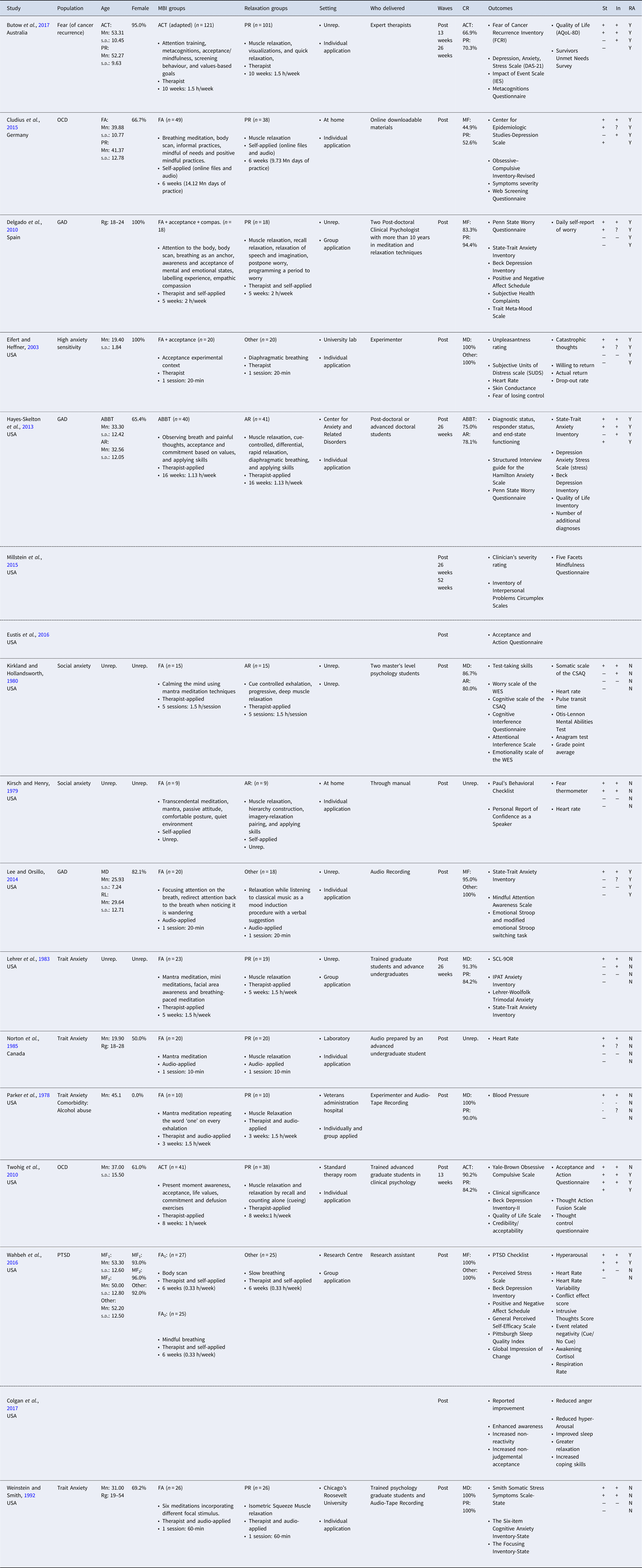
GAD: generalized anxiety disorder. PANIC: panic disorder. PHOB: any phobia. PTSD: post-traumatic stress disorder. OCD: obsessive-compulsive disorder. MIXED: mixed disorders. Dashed lines separate the same study analysed by different articles (reporting distinct time measures, outcomes, parameters, etc). CR: completion rate. St: study quality ‒ considered as the opposite of risk of bias (Higgins et al., Reference Higgins, Altman, Sterne, Higgins and Green2011): low (−)/high (+)/unclear (?), from top to down: adequate generation of allocation sequence, concealment of allocation to conditions, prevention of knowledge of the allocated intervention, and dealing with incomplete outcome data. In: intervention quality (Chambless and Hollon, Reference Chambless and Hollon1998): low (−)/high (+)/unclear (?), from top to bottom: the study referred to the use of a treatment manual; the therapists who conducted the therapy were trained; treatment integrity was checked during the study. RA: researcher allegiance (Cuijpers et al., Reference Cuijpers, Driessen, Hollon, van Oppen, Barth and Andersson2012): Y (yes)/N (no), from top to bottom: meditation was the only therapy referenced in the title; meditation was explicitly mentioned as the main experimental intervention in the introduction; relaxation therapy was explicitly described as a control condition and it was included to control for the non-specific components; there was an explicit hypothesis that meditation was expected to be more effective than relaxation therapy. Mn: mean. s.d.: standard deviation. Rg: range. MBI: mindfulness-based intervention. PR: progressive relaxation. AP: applied relaxation. Other: other different relaxation technique. Unrep.: unreported data. FA: focused attention. ACT: acceptance and commitment therapy. ABBT: acceptance based behavioural therapy. Acceptance: acceptance contexts of meditation practices. Compas.: compassionate meditation practices.
When two distinct meditation groups were compared with the same relaxation group ‒ including multiple comparisons that were not independent of each other ‒ we used the following sensitivity analysis procedure so as not to artificially affect heterogeneity and the overall ES: (1) we only included the largest ES comparison, (2) we only included the smallest ES comparison, and (3) we calculated the pooled ES for the two comparisons and included that one. Results from non-independent multiple comparisons and the afore-mentioned sensitivity analysis were compared in order to evaluate whether heterogeneity and ES remained similar. We also developed separate analyses that limited the outcomes to each anxiety outcome domain, assessment procedure and time point measurement.
ESs for continuous outcomes were estimated by subtracting the post-test (or follow-up) mean score of the meditation group from the mean score of the relaxation group, dividing by the pooled standard deviation. For dichotomous outcomes, we used the procedures provided by Borenstein et al. (Reference Borenstein, Hedges, Higgins and Rothstein2009) to calculate the corresponding Hedges’ g. We transformed Hedges’ g into the number needed to treat (NNT) to facilitate clinical interpretability, by using the methods of Kraemer and Kupfer (Reference Kraemer and Kupfer2006). The NNT is a measure used in communicating the effectiveness of healthcare interventions, and indicates the number of patients that need to be treated in order for one of them to benefit compared to a control condition, so that the higher the NNT, the less effective the treatment (Laupacis et al., Reference Laupacis, Sackett and Roberts1988). Finally, we defined acceptability as the study drop-out for any reason (Montero-Marin et al., Reference Montero-Marin, Garcia-Campayo, López-Montoyo, Zabaleta-del-Olmo and Cuijpers2018a), and thus, we calculated the relative risk (RR) of dropping-out of meditation compared to relaxation. Because we only expected a limited number of studies, we conducted a sensitivity post-hoc power calculation according to the procedures described by Valentine et al. (Reference Valentine, Pigott and Rothstein2010).
Publication bias was evaluated by: (1) visually inspecting the funnel plot on anxiety outcomes; (2) Duval and Tweedie's trim and fill procedure, which provided the number of studies probably absent (Duval and Tweedie, Reference Duval and Tweedie2000); and (3) Begg and Mazumdar's rank correlation, to test whether the adjusted and observed ESs differed from each other (Begg and Mazumdar, Reference Begg and Mazumdar1994); (4) Egger's test of the intercept to contrast the hypothesis of bias absence (Egger et al., Reference Egger, Davey Smith, Schneider and Minder1997). We also calculated Rosenthal's fail-safe N test (Rosenthal, Reference Rosenthal1979) to compute the number of studies needed to be added to the analysis to reach a statistically non-significant total effect, assuming a nil effect in the hidden studies.
We conducted subgroup analyses according to the mixed-effects model, in order to evaluate possible differences in ESs in regard to the meditation regimen, relaxation technique, target population, quality of the study (high quality ‒ e.g. low risk of bias: met 3–4 criteria, and low quality ‒ e.g. high risk of bias: met <4 criteria; Cuijpers et al., Reference Cuijpers, Gentili, Baños, García-Campayo, Botella and Cristea2016; Montero-Marin et al., Reference Montero-Marin, Garcia-Campayo, López-Montoyo, Zabaleta-del-Olmo and Cuijpers2018a), quality of intervention (high: met 3 criteria, and low: met <3 criteria; Chambless and Hollon, Reference Chambless and Hollon1998), and researcher allegiance (no allegiance: met 0 criteria, and allegiance: met any criteria; Cuijpers et al., Reference Cuijpers, Driessen, Hollon, van Oppen, Barth and Andersson2012). This mixed-effects model pools studies within the subgroups according to the random-effects model, and tests for possible significant differences between subgroups using the fixed-effects model (Borenstein et al., Reference Borenstein, Hedges, Higgins and Rothstein2009). Finally, we conducted two bivariate meta-regression analyses, with anxiety ES as the dependent variable, using the method of moments. As predictors, we entered the continuous variables of averaged age and percent of females. Regression coefficients and their associated Z-value and p-value were calculated.
All the contrasts were set with a significance level of α < 0.05, and they were all two-tailed, except for the bias-related tests, which were one-tailed. Data were analysed by using the R-3.1.1, Stata-12 and Comprehensive Meta-Analysis-3.0 statistical packages.
Results
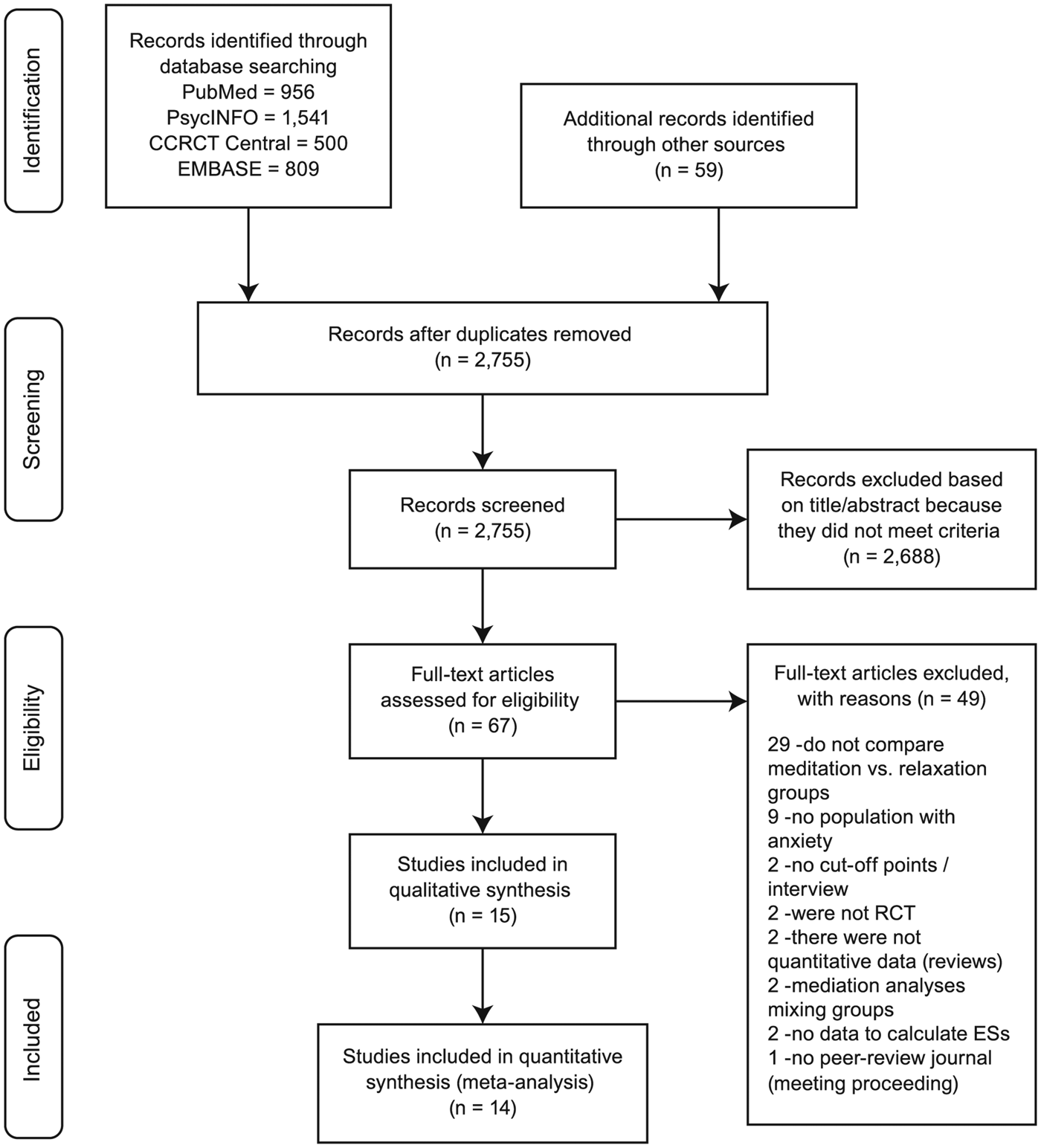
As can be seen in the flow chart (Fig. 1), 14 studies on anxiety (reported in 17 papers, with 16 possible comparisons between meditation and relaxation using anxiety outcomes) met inclusion criteria for the meta-analysis and were analysed ‒ 1 study (Zargar et al., Reference Zargar, Farid, Atef-Vahid, Afshar and Omidi2013) met criteria for qualitative synthesis, but was discarded for meta-analysis because it did not provide anxiety outcomes. The characteristics of the 14 included studies are shown in Table 1 and their references are in the online Supplementary Material 2.
PRISMA flow diagram.
Characteristics of included studies
The 14 selected studies included 862 participants, 464 in the meditation groups and 398 in the relaxation groups. The average number of participants per condition was 31. There were 5 studies on high trait anxiety as a target (1 with alcohol abuse dual diagnosis, and 1 on high anxiety sensitivity), 3 on GAD, 2 on OCD, 2 on social anxiety, 1 on fear (of cancer recurrence), and 1 on PTSD. All the meditation procedures incorporated attentional elements, with focused attention the most commonly used (5 studies included mantra recitation; 3 studies included different focal stimulus; 2 studies used the breath as an anchor; and 1 study developed body awareness practices), but the open monitoring attentional technique was also used (2 studies with acceptance and commitment therapy, and 1 study with acceptance-based behavioural therapy, being that 2 studies also used other constructive contexts). A total of 5 studies included ingredients of constructive meditation practices, with a values orientation added to the attentional exercises (hereinafter ‘attentional + constructive’). We found no studies using training in deconstructive meditation. There were differences in the sort of relaxation used, with progressive muscle relaxation the most present (8 studies), followed by applied relaxation (with 3 studies), although other techniques were also included (slow breathing with 2 studies, and music relaxation with 1 study). The interventions also differed in terms of treatment format (with 9 studies using an individual format, 3 studies using a group format, 1 study using both formats, and 1 study with unreported data), and application (with 9 studies using therapist application, 3 studies using audio application, and 2 studies using both therapist + audio applications). A total of 10 studies drove the research through a long intervention design, with an average duration of 7.11 weeks and 1.30 h per week (1 study reported no data), while 4 studies used short designs with only one day of exercises. The average number of therapy hours was 6.30, ranging from 0.18 to 18 h. The year of study publication ranged from 1978 to 2017. Of the studies, 11 were conducted in the USA, 1 in Australia, 1 in Canada, 1 in Germany, and 1 in Spain.
The quality of the studies, quality of interventions and researcher allegiance also varied. Only one study (7.2%) met all four study quality criteria; 3 studies (21.4%) met three criteria; and 10 studies (71.4%) met two criteria or fewer. Thus, 4 studies (28.6%) had low risk of bias, and 10 studies (71.4%) presented high risk of bias. All the studies (100%) reported an adequate sequence generation; 10 studies (71.4%) reported concealment of allocation to conditions; 2 studies (14.3%) reported prevention of knowledge of the allocated intervention; and 3 studies (21.4%) dealt correctly with incomplete outcome data. On the other hand, 3 studies (21.4%) met all three quality of intervention criteria; 6 studies (42.9%) met two quality of intervention criteria; and 5 studies (35.7%) met only one criterion (6 studies showed unclear quality of intervention in some criterion). Therefore, 3 studies (21.4%) showed high quality of intervention, and 11 studies (78.6%) were classified as having low quality of intervention. Finally, we found 8 studies (57.1%) with some evidence of researcher allegiance v. 6 studies (42.9%) with no evidence.
Overall effects on anxiety outcomes
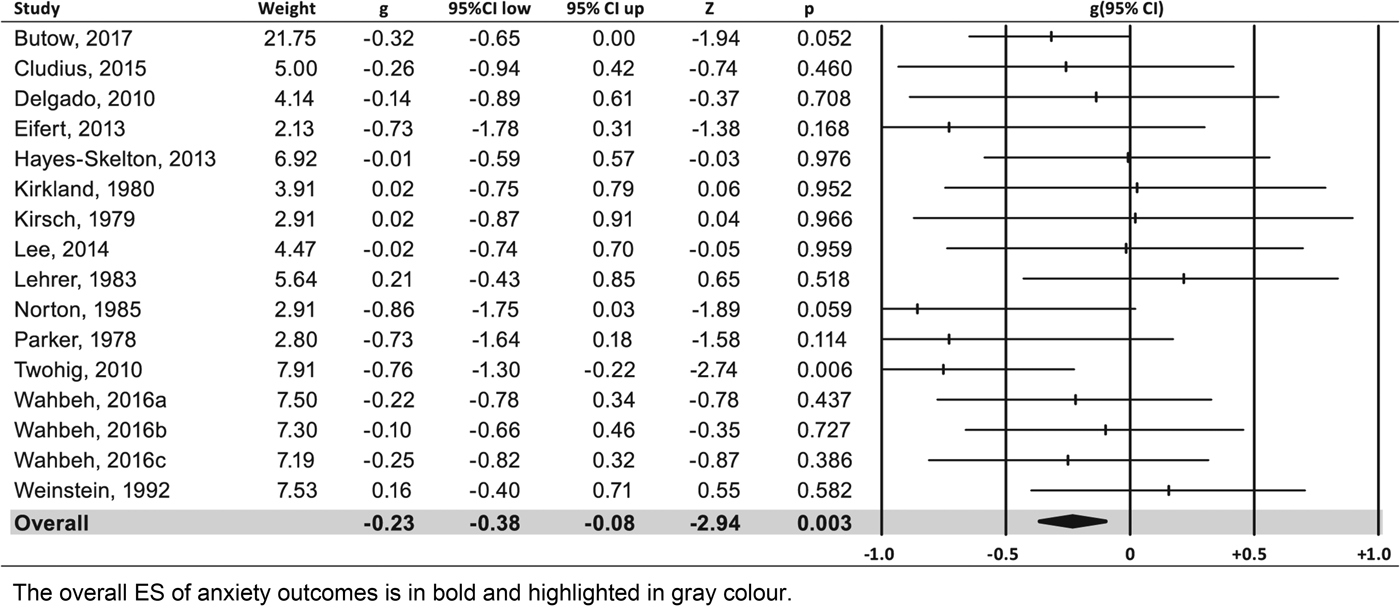
From the 14 included studies, we compared the effects of meditation with relaxation in 16 possible comparisons (Table 2). The overall ES for anxiety outcomes was g = −0.23 (95% CI −0.38 to −0.08), favouring meditation, which corresponded to an NNT of 7.74. Heterogeneity was zero (I 2 = 0; 95% CI 0–52). Inspection of the forest plot of the ESs and their 95% CIs (Fig. 2) indicated there were no outliers and that taken one by one, almost all studies were underpowered ‒ results of the power calculation for the meta-analysis are shown in Supplementary Material 2. We calculated the overall ES with the removal of mixed-methods data from one study (Colgan et al., Reference Colgan, Wahbeh, Pleet, Besler and Christopher2017), and the results were very similar (Table 2). We also removed the most weighted study (Butow et al., Reference Butow, Turner, Gilchrist, Sharpe, Smith, Fardell, Tesson, O'Connell, Girgis, Gebski, Asher, Mihalopoulos, Bell, Zola, Beith and Thewes2017), which accounted for 21.75% of the overall ES, obtaining a significant g = −0.20 (95% CI −0.37 to −0.03), and maintaining no heterogeneity (I 2 = 0; 95% CI 0–54). Because one study included multiple meditation groups (Wahbeh et al., Reference Wahbeh, Goodrich, Goy and Oken2016) that were included in the same analyses, we conducted an analysis with only one ES in this study (the largest, the smallest, and a combination of all of them). The resulting ESs ranged from g = −0.24 to g = −0.23, with a combined ES of g = −0.23 (95% CI −0.40 to −0.07), leaving an NNT of 7.74, with very low heterogeneity (I 2 = 2; 95% CI 0–56). Only the mixed domain category of anxiety outcomes showed significant results, with a very similar ES to the overall calculation. Both the self-reported and assessor-reported outcomes showed significant ESs, with no or low heterogeneity. Post-test and follow-up (3‒12 months) measures presented significant and very similar ESs, with low heterogeneity (Table 2).
Forest plot of standardized effect sizes on anxiety outcomes. Weight: study weight in terms of the contribution to the overall ES from the sample size. g: Hedges’ g ES value. 95% CI low: low bond of the 95% confidence interval. 95% CI high: high bond of the 95% confidence interval. Z: Z statistic associated with the ES contrast. p: p-value related to the Z statistic. Wahbeh, 2016a includes the mixed-method results presented in Colgan et al. (Reference Colgan, Wahbeh, Pleet, Besler and Christopher2017). Wahbeh (2016b) includes the body scan comparison presented in Wahbeh et al. (Reference Wahbeh, Goodrich, Goy and Oken2016). Wahbeh (2016b) includes the mindful breathing comparison presented in Wahbeh et al. (Reference Wahbeh, Goodrich, Goy and Oken2016). More details are available in Table 1.
Effects of relaxation compared to meditation for the treatment of anxiety
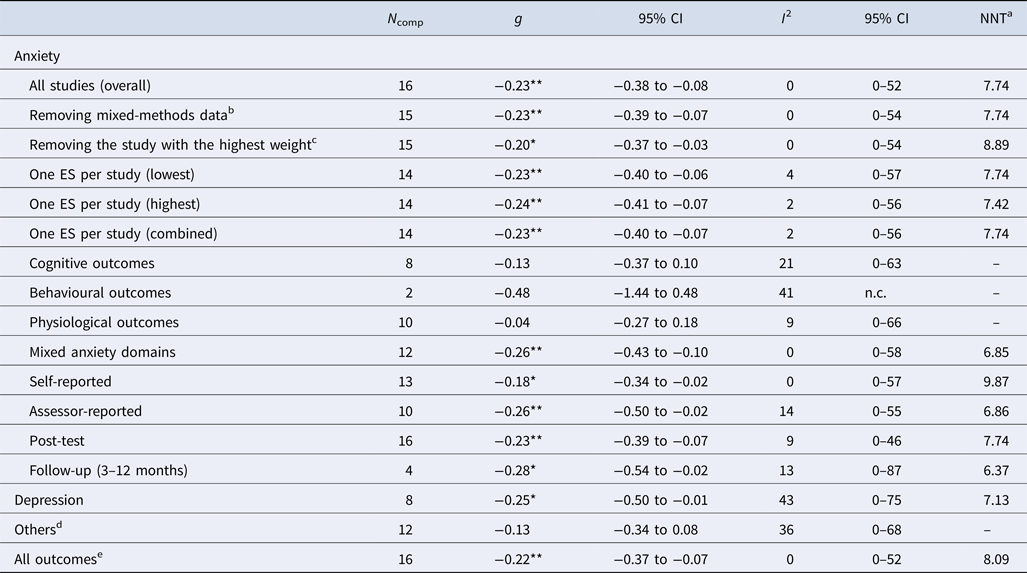
N comp, number of comparisons; g, Hedges’ g ES measure; 95% CI, 95% confidence interval; I 2, heterogeneity; NNT, number-needed-to-treat. n.c., not calculated confidence interval because of the absence of enough comparisons. *p < 0.05; **p < 0.01.
a NNT for non-significant results are not reported.
b Sensitivity analysis removing the mixed-methods data from Colgan et al., Reference Colgan, Wahbeh, Pleet, Besler and Christopher2017 (pertaining to the study of Wahbeh et al., Reference Wahbeh, Goodrich, Goy and Oken2016).
c Sensitivity analysis removing the most weighted study (Butow et al., Reference Butow, Turner, Gilchrist, Sharpe, Smith, Fardell, Tesson, O'Connell, Girgis, Gebski, Asher, Mihalopoulos, Bell, Zola, Beith and Thewes2017), which implied 21.75% of the overall ES.
d Including general functioning, clinical improvement, quality of life, auto-efficacy, distress, perceived stress, sleep quality, interpersonal problems, affectivity, emotional intelligence, mindfulness, attention/interference, cognitive ability and symptoms.
e Including anxiety, depression and others.
Risk of publication bias
We found no indications of publication bias by inspecting the funnel plot. Duval and Tweedie's trim and fill procedure indicated that no studies were missing. Begg and Mazumdar's rank correlation was not significant (τ = −0.15; p = 0.222). Egger's regression intercept was also not significant (intercept = −0.12; 95% CI −2.08 to 1.85; p = 0.449). The fail-safe N was 13. Therefore, 13 ‘null’ studies would need to be included in order to find a statistically insignificant overall effect. In other words, 0.9 missing studies would be needed for every observed comparison in order for the effect to be nullified.
Overall effects on other outcomes
The overall ES on depression outcomes (Table 2) was significant (g = −0.25; 95% CI −0.40 to −0.01; NNT = 7.13), with moderate heterogeneity (I 2 = 43; 95% CI 0–75). The ESs for other outcomes (general functioning, clinical improvement, quality of life, auto-efficacy, distress, perceived stress, sleep quality, interpersonal problems, affectivity, emotional intelligence, mindfulness, attention and interference, cognitive ability and symptoms) were not significant (g = −0.13; 95% CI −0.34 to 0.08) and showed low to moderate heterogeneity (I 2 = 36; 95% CI 0–68). Considering all the outcomes described above (Table 1), differences between meditation and relaxation were small but significant (g = −0.22; 95% CI −0.37 to −0.07; NNT = 8.09), with no heterogeneity (I 2 = 0; 95% CI 0–52). The overall estimate of acceptability did not show significant differences between interventions (RR = 0.97; 95% CI 0.75–1.26).
Subgroup and meta-regression analyses
Subgroup analyses (Table 3) gave no significant differences in ESs on anxiety outcomes according to the type of meditation, relaxation technique, target population, quality of the study, quality of the intervention, and researcher allegiance. However, significant ESs only remained in the following subgroups: attentional + constructive meditation (g = −0.39; 95% CI −0.62 to −0.13), progressive relaxation (g = −0.30; 95% CI −0.56 to −0.04), target population (g = −0.24; 95% CI −0.41 to −0.07), high study quality, i.e. low risk of bias (g = −0.28; 95% CI −0.51 to −0.04), high intervention quality (g = −0.36; 95% CI −0.72 to −0.01), and presence of researcher allegiance (g = −0.28; 95% CI −0.46 to −0.10). The meta-regression analyses gave no indication that ES was associated with mean age (B < 0.01; Z = 0.03; p = 0.975), and percent of females (B < 0.01; Z = 0.01; p = 0.988).
Effects of relaxation v. meditation for the treatment of anxiety: subgroup analyses
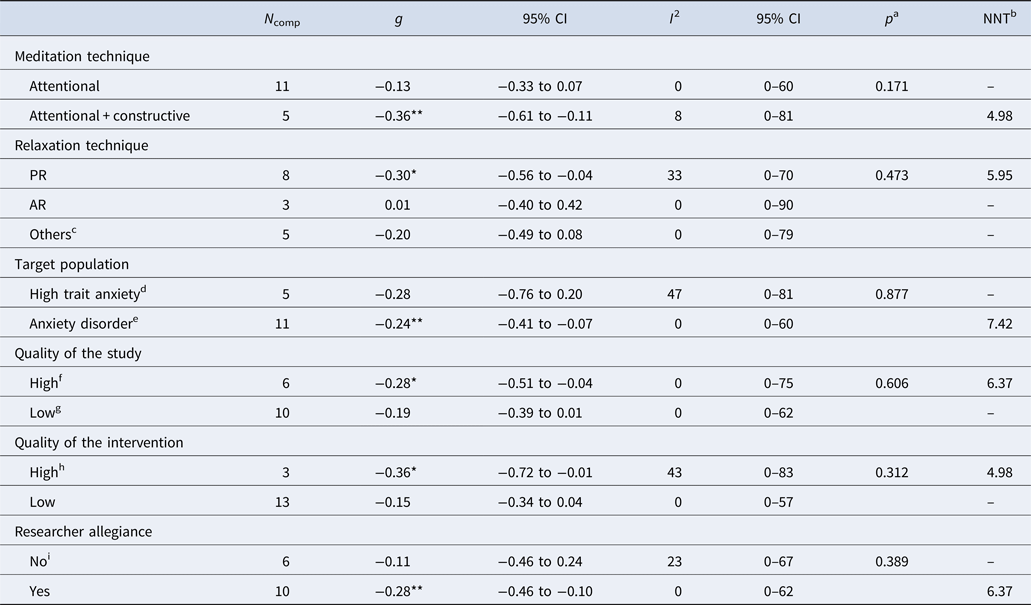
N comp, number of comparisons; g, Hedges’ g ES; 95% CI, 95% confidence interval; I 2, heterogeneity; NNT, number-needed-to-treat; PR, progressive relaxation; AP, applied relaxation. *p < 0.05; **p < 0.01.
a p-values in this column indicate whether the difference among the ESs in the subgroups is significant.
b NNT for non-significant results are not reported.
c Including slow breathing and listening to relaxing music.
d Including high trait and sensitivity anxiety.
e Including GAD, OCD, social anxiety, fear of recurrence, PTSD.
f High quality of the study (low risk of bias) includes those studies that meet three or four study quality criteria (Higgins et al., Reference Higgins, Altman, Sterne, Higgins and Green2011; Cuijpers et al., Reference Cuijpers, Gentili, Baños, García-Campayo, Botella and Cristea2016; Montero-Marin et al., Reference Montero-Marin, Garcia-Campayo, López-Montoyo, Zabaleta-del-Olmo and Cuijpers2018a).
g Low quality of the study (high risk of bias) includes those studies that meet less than three study quality criteria (Higgins et al., Reference Higgins, Altman, Sterne, Higgins and Green2011; Cuijpers et al., Reference Cuijpers, Gentili, Baños, García-Campayo, Botella and Cristea2016; Montero-Marin et al., Reference Montero-Marin, Garcia-Campayo, López-Montoyo, Zabaleta-del-Olmo and Cuijpers2018a).
h Including studies that meet the three intervention quality criteria (Chambless and Hollon, Reference Chambless and Hollon1998).
i Including studies meeting none allegiance criteria (Cuijpers et al., Reference Cuijpers, Driessen, Hollon, van Oppen, Barth and Andersson2012).
Discussion
We examined the effects of meditation techniques for the treatment of anxiety compared to relaxation therapy ‒ a specific active condition that has demonstrated moderate efficacy in reducing anxiety symptoms in different types of populations with significant effects (Manzoni et al., Reference Manzoni, Pagnini, Castelnuovo and Molinari2008), and with no evidence of being less effective than CBT for some anxiety disorders (Montero-Marin et al., Reference Montero-Marin, Garcia-Campayo, López-Montoyo, Zabaleta-del-Olmo and Cuijpers2018a). For this purpose, a meta-analysis of fourteen RCTs was conducted, from which a small but statistically significant overall ES was obtained in favour of meditation that was maintained at 12-month follow up, with very low heterogeneity. Surprisingly, results showed more homogeneous effects than expected. This could mean that despite the different therapeutic techniques and subtypes of anxiety disorders, effects could be quite similar when comparing meditation and relaxation. Nevertheless, not all meditation and relaxation techniques were included in the analysis and no study included patients suffering from panic disorder. Therefore, it cannot be ruled out that if future research is able to include a broader spectrum of techniques and anxiety disorders, higher levels of heterogeneity may be found.
The difference between conditions was consistently observed across self-reported and assessor-reported measures, and it was maintained when only high-quality studies ‒ 28.6% of selected studies (Higgins et al., Reference Higgins, Altman, Sterne, Higgins and Green2011) ‒ and high-quality interventions ‒ 21.4% (Chambless and Hollon, Reference Chambless and Hollon1998) were considered. However, we found low and non-significant effects when only studies free of researcher allegiance were included ‒ 42.9% (Cuijpers et al., Reference Cuijpers, Driessen, Hollon, van Oppen, Barth and Andersson2012). There were also non-significant effects when using cognitive, behavioural and physiological anxiety outcomes separately, and only the mixed domain of anxiety appeared significant. This result was also observed in a previous meta-analysis comparing CBT v. relaxation therapy (Montero-Marin et al., Reference Montero-Marin, Garcia-Campayo, López-Montoyo, Zabaleta-del-Olmo and Cuijpers2018a), noting that the coupling of all the anxiety domains would be where differential effects of treatments can be detected. Although we did not find significant differences in the subgroup analyses, not all the subgroups remained significant. Our results suggest that the constructive regimen of meditation added to attentional practices is the option that would keep significant benefits, perhaps as a result of synergies obtained from meditative components that strengthen the self-regulation of attentional processes, but also allowing cognitive and affective patterns to be cultivated that foster well-being at the same time (Lutz et al., Reference Lutz, Slagter, Dunne and Davidson2008, Reference Lutz, Jha, Dunne and Saron2015; Dahl et al., Reference Dahl, Lutz and Davidson2015). It was observed that progressive muscle relaxation was significantly worse than meditation ‒ although differences were small and the risk of bias among this subgroup was considerable ‒ which is easy to understand if we consider that it does not usually include training to cope with real situations, as occurs with other relaxation techniques ‒ e.g. applied relaxation (Öst, Reference Öst1987). Interestingly, significant effects were maintained when the groups studied were patients specifically diagnosed with anxiety disorders and not only suffering from elevated trait anxiety, which reinforces the use of meditation techniques in clinical settings (Graser and Stangier, Reference Graser and Stangier2018). The bivariate meta-regression analyses using the continuous variables of age and percent of females did not show significant effects, but the statistical power to develop this kind of analysis was rather fair owing to the number of studies included.
Although significant, the overall ES observed was small and its clinical relevance could be put in doubt. This result is actually not very surprising if we consider that relaxation itself has been proposed as an active control condition or even as a clear behavioural strategy to reduce anxiety (Hayes-Skelton et al., Reference Hayes-Skelton, Roemer and Orsillo2013). A previous meta-analysis that included different types of populations concluded that relaxation techniques such as autogenic training, progressive relaxation and others may present moderate effects on anxiety (Manzoni et al., Reference Manzoni, Pagnini, Castelnuovo and Molinari2008). This meta-analysis also showed that mindfulness-based interventions and transcendental meditation might present effects that would be significantly greater than those obtained by the previously described relaxation techniques, which is in line with our results. However, the comparability of this study is limited due to the enormous diversity of populations included, and the scarce types of meditation regimens used. Another meta-analysis (Orme-Johnson and Barnes, Reference Orme-Johnson and Barnes2014) that tested the effects of transcendental meditation on the high trait anxiety suffered by several populations obtained moderate effects compared to controls who received some active treatment, and moderately large effects when using controls with treatment as usual. Goldberg et al. (Reference Goldberg, Tucker, Greene, Davidson, Wampold, Kearney and Simpson2018) observed low effects on patients suffering from anxiety disorders, favouring meditation when they used active control conditions as comparators, but favouring evidence-based treatments for anxiety when this comparator was used. However, the potential of using meditation practices for the treatment of anxiety was not really clarified with this study, because the analysis was restricted to the reduced field of mindfulness-based interventions (Goldberg et al., Reference Goldberg, Tucker, Greene, Davidson, Wampold, Kearney and Simpson2018), and thus, other forms of meditation were discarded (Lutz et al., Reference Lutz, Slagter, Dunne and Davidson2008, Reference Lutz, Jha, Dunne and Saron2015; Dahl et al., Reference Dahl, Lutz and Davidson2015). The study of Goyal et al. (Reference Goyal, Singh, Sibinga, Gould, Rowland-Seymour, Sharma, Berger, Sleicher, Maron, Shihab, Ranasinghe, Linn, Saha, Bass and Haythornthwaite2014) used a more extensive definition of meditation, including both mindfulness and mantra-based meditations, but it suffered from the same limitation as the previous studies, ruling out programmes that include techniques with a values orientation added to attentional exercises (Lutz et al. Reference Lutz, Slagter, Dunne and Davidson2008, Reference Lutz, Jha, Dunne and Saron2015; Dahl et al. Reference Dahl, Lutz and Davidson2015). This study obtained a moderately low ES at post-test, but heterogeneity was very high, perhaps because they included distinct psychiatric and medical conditions, and because the comparators they used comprised specific and non-specific active control conditions ‒ only those comparisons with non-specific controls remained significant, and no evidence was found that meditation programmes were superior to specific active controls, although they observed an effect at follow up that was very close to that obtained in our study.
We observed a small but significant difference in depression outcomes, which was similar to that obtained by Goyal et al. (Reference Goyal, Singh, Sibinga, Gould, Rowland-Seymour, Sharma, Berger, Sleicher, Maron, Shihab, Ranasinghe, Linn, Saha, Bass and Haythornthwaite2014), who observed that after separating non-specific and specific active controls, only the first comparison remained significant. However, as mentioned, the comparability of that study is limited. Mindfulness-based interventions compared to no treatment in depressive patients have demonstrated moderately large effects, and these have been moderately low when compared to specific active control conditions (Goldberg et al., Reference Goldberg, Tucker, Greene, Davidson, Wampold, Kearney and Simpson2018), which is coherent with our results ‒ in the case of evidence-based treatments for depression no differences were found. We observed no significant differences in other outcomes, e.g. quality of life, nor treatment acceptability. The latter may be due because none of the programmes forced to cope with uncomfortable situations, and thus caused similar attrition rates (Montero-Marin et al., Reference Montero-Marin, Garcia-Campayo, López-Montoyo, Zabaleta-del-Olmo and Cuijpers2018a). However, we do not know ‒ because no studies using this regimen were found ‒ whether the deconstructive family of mediation practices, e.g. those driven by self-inquiry processes, might produce different effects and attrition rates. Self-inquiry should aim to identify the fearful assumptions that underlie anxiety, inquiring into the rationale of beliefs and directly examining the anxious experience, noticing how thoughts, feelings and physical sensations that compose that emotion change and influence each other (Dahl et al., Reference Dahl, Lutz and Davidson2015).
In general, we may suppose that the differential effects between meditation and relaxation might respond to distinct mechanisms of action. It has been suggested that decentring could be a potential mechanism of change in meditation practices such as mindfulness trainings (Feldman et al., Reference Feldman, Greeson and Senville2010). Through them, patients may learn to disengage with negative thoughts and emotions, experiencing the temporary and passing nature of mental events, and thus reducing reactivity (Bohlmeijer et al., Reference Bohlmeijer, Prenger, Taal and Cuijpers2010). This may be accompanied by increases in attentional performance, and reductions in rumination and worry (Jain et al., Reference Jain, Shapiro, Swanick, Roesch, Mills, Bell and Schwartz2007; Semple, Reference Semple2010; Gu et al., Reference Gu, Strauss, Bond and Cavanagh2015). On the contrary, relaxation therapies such as progressive muscle relaxation aim to induce physiological relaxation as the opposite of tension, and they have been proposed as logical treatments for the overly anxious person (McCallie et al., Reference McCallie, Blum and Hood2006). Their aims and rationale could be summarized in the words of their founder: ‘an anxious mind cannot exist in a relaxed body’ (Jacobson, Reference Jacobson1974). However, few studies have explored the specific action mechanisms of relaxation. It appears that some aspects of relaxation therapy might overlap with some meditative practices, in the sense that both incorporate components that train attentional processes (Gao et al., Reference Gao, Curtiss, Liu and Hofmann2018). This is why relaxation seems to lead to improvements in some of the mindfulness skills, but to a lower extent than meditation practices do (Agee et al., Reference Agee, Danoff-Burg and Grant2009; Moritz et al., Reference Moritz, Cludius, Hottenrott, Schneider, Saathoff, Kuelz and Gallinat2015; Gao et al., Reference Gao, Curtiss, Liu and Hofmann2018). Nevertheless, aside from the common attentional training processes derived from present-moment awareness exercises, there could be other therapeutic action mechanisms that might differentiate meditation (in a broad sense of practices) and relaxation therapies. For instance, psychological flexibility has been proposed as a mediator of changes in the attachment-based compassion therapy (ABCT) of the constructive regimen of meditation (Montero-Marin et al., Reference Montero-Marin, Navarro-Gil, Puebla-Guedea, Luciano, Van Gordon, Shoning and García-Campayo2018b), and might constitute a candidate that should be specifically investigated in anxious patients.
Limitations
This meta-analysis has the important limitation of not counting on a large enough number of studies with which to analyse the specific effects on the distinct anxiety disorders ‒ e.g. we found no studies with agoraphobia and panic, and there was not a sufficient number of studies on other disorders with which to establish comparisons among them. Nor did we find comparisons integrating deconstructive meditation techniques, and consequently, our intention of using the broadest definition of meditation was not entirely met. A comprehensive search strategy was implemented focused on including a wide range of text words and synonyms. We believe this search strategy had no bearing on the fact that few studies were retrieved, although other strategies may offer different results. However, it is clear that more RCTs including specific anxiety disorders, comparing meditation practices in a broad sense, and relaxation as a specific active control condition, are needed. Some of the deconstructive practices used in other diseases that could be tested are mindfulness-based cognitive therapy (MBCT), vipassana-insights, koan-practices, self-inquiry, etc. Other attentional ‒ e.g. breath counting, mindfulness-based stress reduction (MBSR), dialectical behaviour therapy (DBT), etc. ‒ and constructive ‒ e.g. loving-kindness, compassion practices, well-being therapy, etc. ‒ meditation practices should also be tested v. relaxation therapy in the context of anxiety disorders with appropriate RCT designs. We observed that effects were maintained significant until 12-months, but the number of studies with follow-up measures was scarce, and more research is needed in this regard. We also found some evidence that researcher allegiance might be playing a moderating role, because the total absence of this characteristic revealed no significant effects. Therefore, it seems necessary to be more cautious in this regard when developing new research. In addition, although there was no evidence of publication bias, possible bias due to selective outcome reporting was not assessed, and thus we do not know whether statistically non-significant results were selectively withheld from publications, overestimating intervention effects. Finally, we were not able to investigate whether baseline anxiety scores were related to outcomes because of the use of different instruments and anxiety domains.
Implications
Despite the mentioned limitations, we should note that meditation practices have a small but significant advantage compared to relaxation therapy for the treatment of anxiety symptoms. However, we do not possess enough information to specify their effects on each anxiety disorder. In addition, more RCTs using the entire range of meditation techniques from all the regimens that comprise this family of practices seems to be recommended, if we are to have a precise idea of the potential of these techniques in comparison with relaxation therapy. In conclusion, one meditation practice based on attentional and constructive techniques appears to be somewhat more effective than relaxation therapy for the treatment of anxiety, and it seems to remain more effective at 12-month follow-up. Therefore, its use can be recommended. Nevertheless, considering the small effect size obtained, future cost-benefit analyses are needed to clarify to what extent it is worth using meditation or relaxation therapy to treat anxiety disorders.
Supplementary material
The supplementary material for this article can be found at https://doi.org/10.1017/S0033291719001600
Acknowledgements
This research was supported by the Primary Care Prevention and Health Promotion Research Network (RedIAPP), Zaragoza, Spain; and the Vrije Universiteit, Department of Clinical, Neuro and Developmental Psychology, Amsterdam, The Netherlands.
Financial support
This research received no specific grant from any funding agency, commercial or not-for-profit sectors.
Conflict of interest
None.
Ethical standards
The authors assert that all procedures contributing to this work comply with the ethical standards of the relevant national and institutional committees on human experimentation and with the Helsinki Declaration of 1975, as revised in 2008.



