The clay mineral CIS collection of Palaeozoic mudrock samples from southwest England used for calibration of Kübler and Árkai index values has become an essential part of reliable grade determinations covering the transition from diagenesis to low-temperature metamorphism (Warr & Rice, Reference Warr and Rice1994; Warr, Reference Warr2018). Up to now, the age of illite in the CIS samples has not been published, apart from a selection of whole-rock K–Ar (Dodson & Rex, Reference Dodson and Rex1971; Warr et al., Reference Warr, Primmer and Robinson1991) and 40Ar/39Ar radiogenic isotopic results (Warr, Reference Warr, Woodcock and Strachan2009) of similar rock types from the region. Initially, Warr & Rice (Reference Warr and Rice1994) originally presented four standards from the Variscan very-low-grade metamorphic belt that is well exposed in the coastal section of North Cornwall and Devon (collected in 1992). Two further standards were added in 2000, along with a further two in 2012, during which all 1992 sites were resampled. Currently, nine standards are available for calibration purposes, which are detailed in an accompanying paper (Warr, Reference Warr2018).
This contribution reports on a combined powder X-ray diffraction (XRD) and K–Ar radiogenic isotope study of eight of the CIS samples, each prepared in five different grain-size fractions. It represents a reference study for future interlaboratory comparison of K–Ar and 40Ar/39Ar techniques and for testing the various methods of illite polytype quantification. These samples can also be used to evaluate the procedures of illite age analysis applied to the various types of mudrock, namely shale, mudstone, slate and illite-bearing fault gouge (Hunziker, Reference Hunziker1986; Grathoff & Moore, Reference Grathoff and Moore1996; van der Pluijm et al., Reference van der Pluijm, Hall, Vrolijk, Pevear and Covey2001; Ylagan et al., Reference Ylagan, Kim, Pevear and Vrolijk2002; Szczerba & Środoń, Reference Szczerba and Środoń2009). The XRD and isotopic results presented here are discussed within the context of the geological history of the Palaeozoic rocks of southwest England. These results indicate that the area was affected by a number of previously unrecognized Mesozoic hydrothermal events.
Sample material and regional geology
Carboniferous diagenetic to anchizonal mudstones
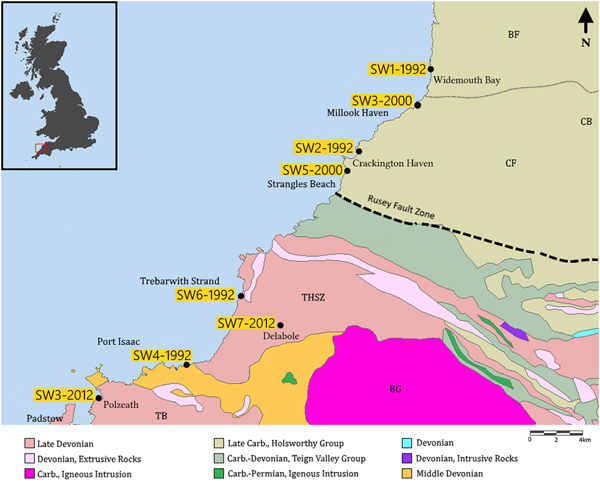
The sample material investigated is summarized in Table 1, with more complete descriptions available in Warr & Rice (Reference Warr and Rice1994), Warr & Nieto (Reference Warr and Nieto1998) and Warr (Reference Warr2018). SW1-1992 is comprised of a diagenetic mudstone from the Late Carboniferous Bude Formation, which was deposited as a storm facies with a stratigraphic age of ~313–309 Ma (Wesphalian A–C). This original sample is currently still available as a standard and is supplied together with SW1-2012, which originates from the same locality (Fig. 1). SW3-2000 of the lower anchizone is a very similar lithology collected from upper part of the Crackington Formation (Late Namurian, Marsdenian stage; 315–317 Ma), just 3.1 km to the south of the SW1-1992 site. Two other Late Carboniferous anchizonal mudstones originate from the distal turbidite sequence of the Crackington Formation further south, with Early to Middle Namurian stratigraphic ages (Chokierian to Kinderscoutian stages; ~325–317 Ma). SW2-1992 (and its new equivalent, SW2-2012) is a cleaved, lower-anchizonal mudstone from Crackington Haven, whereas SW5-2000 is a cleaved mudstone of upper-anchizonal grade from Strangles Beach, located 650 m north of the prominent Rusey Fault Zone (Fig. 1). All Late Carboniferous lithologies were deposited in a foreland basin, known as the Culm Basin (Fig. 1), which formed synchronously with the advancement of the northward-migrating Variscan fold-and-thrust belt (Hartley & Warr, Reference Hartley and Warr1990; Warr, Reference Warr, Woodcock and Strachan2009). This deformation eventually led to the shortening of the basin by the end of the Carboniferous, prior to intrusion of the Early Permian granite batholith (293–275 Ma; Chen et al., Reference Chen, Clark, Farrar, Wasteneys, Hodgson and Bromley1993; Clark et al., Reference Clark, Chen, Farrar, Northcote, Wastenays, Hodgson and Bromley1994). SW1-1992 contains illite-smectite, illite-muscovite, Mg-rich chlorite and minor amounts of albite and quartz in the <2 µm fraction, whereas SW2-1992 has no chlorite, but does have illite-smectite, illite-muscovite and kaolinite (Warr & Rice, Reference Warr and Rice1994; Warr & Nieto, Reference Warr and Nieto1998). Its replacement sample (SW2-2012) does contain minor amounts of chlorite, quartz, albite and K-feldspar (Warr, Reference Warr2018). The mineral assemblage of the SW3-2000 lower-anchizonal mudstone is similar to that of SW1-1992, except for the presence of discrete smectite and some lepidocrocite (Warr, Reference Warr2018). The illite-smectite is generally assumed to have formed during burial diagenesis and subsequent deformation of the Culm Basin during the Late Carboniferous–Early Permian (Warr et al., Reference Warr, Primmer and Robinson1991).
The CIS as described in Warr & Rice (Reference Warr and Rice1994) and Warr (Reference Warr2018), stratigraphic ages and additional information derived from the British Geological Survey and metamoprhic grade determinations using the Kübler-equivalent boundary limits of Warr & Mählmann (Reference Warr and Mählmann2015).

F = Formation; U = Upper; L = Lower; strat. = stratigraphic; anch. = anchizone.
Sample localities of the CIS samples. Map derived from the British Geological Survey. BF = Bude Formation; CF = Crackington Formation; CB = Culm Basin; THSZ = Tintagel High-Strain Zone; BG = Bodmin granite; TB = Trevone Basin; Carb. = Carboniferous.

Devonian upper-anchizonal slates
The two upper-anchizonal slates (SW3-2012 and SW4-1992) originate from Devonian rocks lying to the south of the Tintagel High-Strain Zone (Fig. 1). SW3-2012 is a new standard composed of a reddish-coloured, Late Devonian mudrock of the Polzeath Slate Formation. It comes from the type locality at Polzeath Beach and is assigned a stratigraphic age of 372–359 Ma (Frasnian–Famennian). It is located in a syncline in the region of Padstow, where former studies considered that the illite ‘crystallinity’ in this region was imprinted before the Namurian D1 backthrusting (Primmer, Reference Primmer1985a; Pamplin, Reference Pamplin1990). This is in accordance with the recalculated K–Ar age of 342 Ma (post-1977 constant of McDougall & Harrison, Reference McDougall and Harrison1999) measured on the sieved 40–80 µm fraction of a slate sample near the location of SW3-2012 (Dodson & Rex, Reference Dodson and Rex1971; Warr et al., Reference Warr, Primmer and Robinson1991). SW4-1992 is a grey slate of the Middle to Late Devonian Trevone Slate Formation and has a stratigraphic age of ~388–375 Ma (Givetian–Frasnian). The slates were deposited as outer-shelf to deep-water basinal mudrocks in the Trevone Basin and subsequently metamorphosed during the Variscan Orogeny. They contain illite-muscovite, chlorite, quartz and traces of albite plus K-feldspar in the <2 µm fraction (Warr, Reference Warr2018). Based on whole-rock K–Ar and 40Ar/39Ar results from this area, the cooling age of metamorphism is considered to have occurred between 340 and 320 Ma, corresponding to the Sudetian phase of the Variscan Orogeny (Warr, Reference Warr, Woodcock and Strachan2009).
Greenschist facies epizonal slates
The two epizonal slates (SW6-1992 and SW7-2012) were collected from the higher-grade, greenschist facies metamorphic rocks of the Tintagel High-Strain Zone (Primmer, Reference Primmer1985a; Warr et al., Reference Warr, Primmer and Robinson1991), which is located to the south of the Late Carboniferous Culm Basin (Fig. 1). Both slate samples are of Late Devonian age (372–359 Ma; Famennian) and are collected from the Tredorn Slate Formation. SW6-1992 is a grey–green slate from Trebarwith Strand and SW7-2012 is a blue–grey slate from the Delabole Slate Member of the same formation that is exposed at the Delabole Slate quarry. The <2 µm fraction of SW6-1992 is made up of illite-muscovite, chlorite, quartz and albite. The SW7-2012 sample is a new epizone standard and contains abundant illite-muscovite, chlorite, quartz and albite. These rocks were deposited as shelf sediments on the northern margin of the Trevone Basin, which is considered to have been part of an extensional back-arc basinal complex (Warr et al., Reference Warr, Primmer and Robinson1991). Together with greenschist facies metamorphism, high ductile strains occurred during an early D2 stretching event (Warr, Reference Warr1989, Reference Warr, Woodcock and Strachan2009). K–Ar dating (Dodson & Rex, Reference Dodson and Rex1971) of the sieved 40–80 µm fraction of slate samples revealed a cooling age of ~285 Ma (no errors given, post-1977 constant) near the locality of SW6-1992 at Trebarwith Strand, indicating a protracted phase of greenschist facies (M2) metamorphism (Primmer, Reference Primmer1985a; Warr et al., Reference Warr, Primmer and Robinson1991). This age is close to the intrusion age of the Bodmin granite (291.4 ± 0.8 Ma; Chen et al., Reference Chen, Clark, Farrar, Wasteneys, Hodgson and Bromley1993). As these rocks experienced maximum metamorphic temperatures of >375°C (Primmer, Reference Primmer1985a,Reference Primmerb), this K–Ar age of 285 Ma and similar values from the Delabole Slate Member of 287 and 292 Ma (Dodson & Rex, Reference Dodson and Rex1971; no errors given, post-1977 constant) are considered to represent reliable cooling ages with complete recrystallization of all white mica phases present.
Sample preparation and analytical methods
Sample preparation: separation of clay-size fine fractions and XRD measurements
The eight investigated CIS samples were prepared using the usual laboratory routine of the Department of Isotope Geology at the University of Göttingen: five fine fractions (<0.2 µm, 0.2–1.0 µm, <2 µm, 1–2 µm and 2–6 µm) were separated using a combination of Atterberg sedimentation and centrifugation. Chemical treatments to remove iron oxides, carbonates or organics matter were not carried out. Textured slides for XRD measurements, performed for identification of mineral assemblages and for the measurement of the FWHM parameter according to Kübler (Reference Kübler1966), were prepared following the procedures described in Moore & Reynolds (Reference Moore and Reynolds1997). All textured slides were air dried and treated with ethylene glycol to identify swelling smectite phases as well as to estimate the degree of illitisation (Moore & Reynolds, Reference Moore and Reynolds1997). The FWHM values of 10 Å illite reflections were determined using IDEFIX (Friedrich, Reference Friedrich1991), a piece of software used to calculate Kübler Index values from digital XRD data. All experimental results were calibrated to standardized CIS values using a regression curve (f(x) = 1.18x + 0.04, R2 = 0.98) determined by plotting Göttingen's experimental data vs. CIS data based on measurements of the standard material (Schomberg, Reference Schomberg2017).
Random powder specimens, used for the study of the mineralogy and quantification of illite polytype ratios, were prepared with the side- and back-loading method (Brindley & Brown, Reference Brindley, Brown, Brindley and Brown1980; Moore & Reynolds, Reference Moore and Reynolds1997). The back-loaded method was carried out as described in Moore & Reynolds (Reference Moore and Reynolds1997) with the material packed loosely enough in the cuvettes to build fine fissures in the powder at the inner margin of the holder. Allowing the material to escape vertical pressure thereby ensures that it is as randomly ordered as possible and prevents crystals from aligning perpendicular to the vertical pressure. The degree of preferred orientation was checked for all measurements by comparing the 002 and the 020 illite reflections, where the 002:020 intensity ratio for random samples should be <1 (Moore & Reynolds, 1989). All measurements were made with a Philips PW 1800 diffractometer using an automatic divergence slit.
Illite polytype ratios
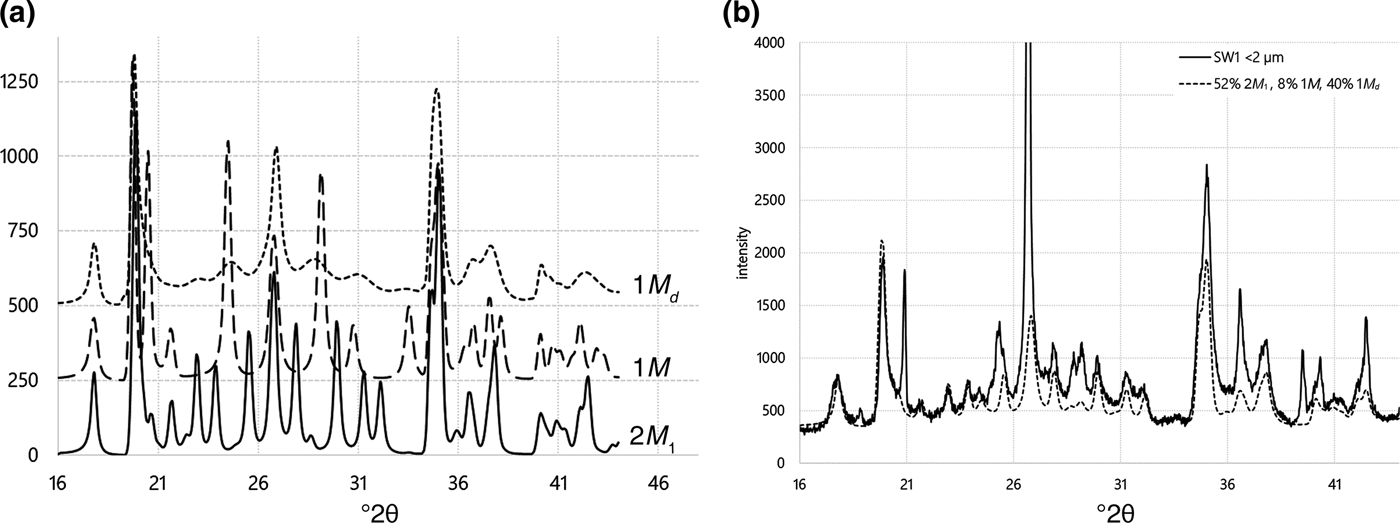
Illite polytype ratios were calculated from XRD raw data using RockJock, which is a program for mineral quantification based on Excel’s Solver function (Eberl, Reference Eberl2003). Calculations of the 19–64.5°2θ range were used to match the integrated intensities of the selected minerals with that of the measured pattern. However, RockJock does not involve any structural refinement as do Rietveld-based programs. In this study, no background corrections were applied in order to avoid removing the illite hump around the 003 illite peak caused by the presence of 1M d illite or by mixed-polytype assemblages. The Auto Shift option was also not used. For comparison, the polytype content of the <2 µm subfraction was additionally calculated from the <0.2, 0.2–1.0 and 1–2 µm subfractions. The standard deviation of the RockJock calculations is estimated to lie in the range ± 5–15%. To refine the polytype calculations derived from RockJock, pure end members (1M, 1M d and 2M 1) were mixed in Excel by adding the peak data from Grathoff & Moore (Reference Grathoff and Moore1996) after multiplying it with corresponding ratios. The generated mixture was superimposed on the measured pattern for visual comparison and modified manually until a good match was achieved. The error of polytype quantification following refinement is considered to be ± 5 of the 100% total. An example of a RockJock calculation is given for the <2 µm fraction of mudstone sample SW1-1992 (Fig. 2).
(a) Polytype mixture calculated after visual adjustment of RockJock results for SW1-1992 <2 µm (dashed line). Deviations point out peaks that are not illite polytype peaks and have to be explained by other minerals. (b) Pure illite polytype patterns with polytype-specific peaks for comparison. 1M d is disordered illite, 1M is ordered illite and 2M 1 is ordered illite-muscovite.

K–Ar ages
Details of the method of K–Ar analyses at the University of Göttingen are given in Wemmer (Reference Wemmer1991) and are summarized as follows: for the determination of K concentration, the sample was dissolved in a mixture of HF and HNO3 following Heinrichs and Herrmann (Reference Heinrichs and Herrmann1990). CsCl and LiCl were added as an ionization buffer and as an internal standard, respectively. The K2O content was measured in duplicate by flame photometry using a BWB-XP flame photometer and the 40K content was calculated using available decay constants (Wemmer, Reference Wemmer1991). Argon was extracted from the size fractions by fusing samples in a Mo-crucible within a Pyrex glass extraction and purification line linked to a Thermo Scientific ARGUS VI noble gas mass spectrometer operating in static mode. The amount of radiogenic 40Ar was determined by converting selected measured argon isotope ratios into a volume with the help of an enriched 38Ar spike (Schuhmacher, Reference Schuhmacher1975). The spike was calibrated against the biotite standard HD-B1 (Fuhrmann et al., Reference Fuhrmann, Lippolt and Hess1987). The age calculations are based on the constants recommended by the International Union of Geological Sciences (IUGS) as reported in Steiger & Jäger (Reference Steiger and Jäger1977). The analytical error of the K–Ar age calculations is given at the 95% confidence level (2σ).
Illite age analysis
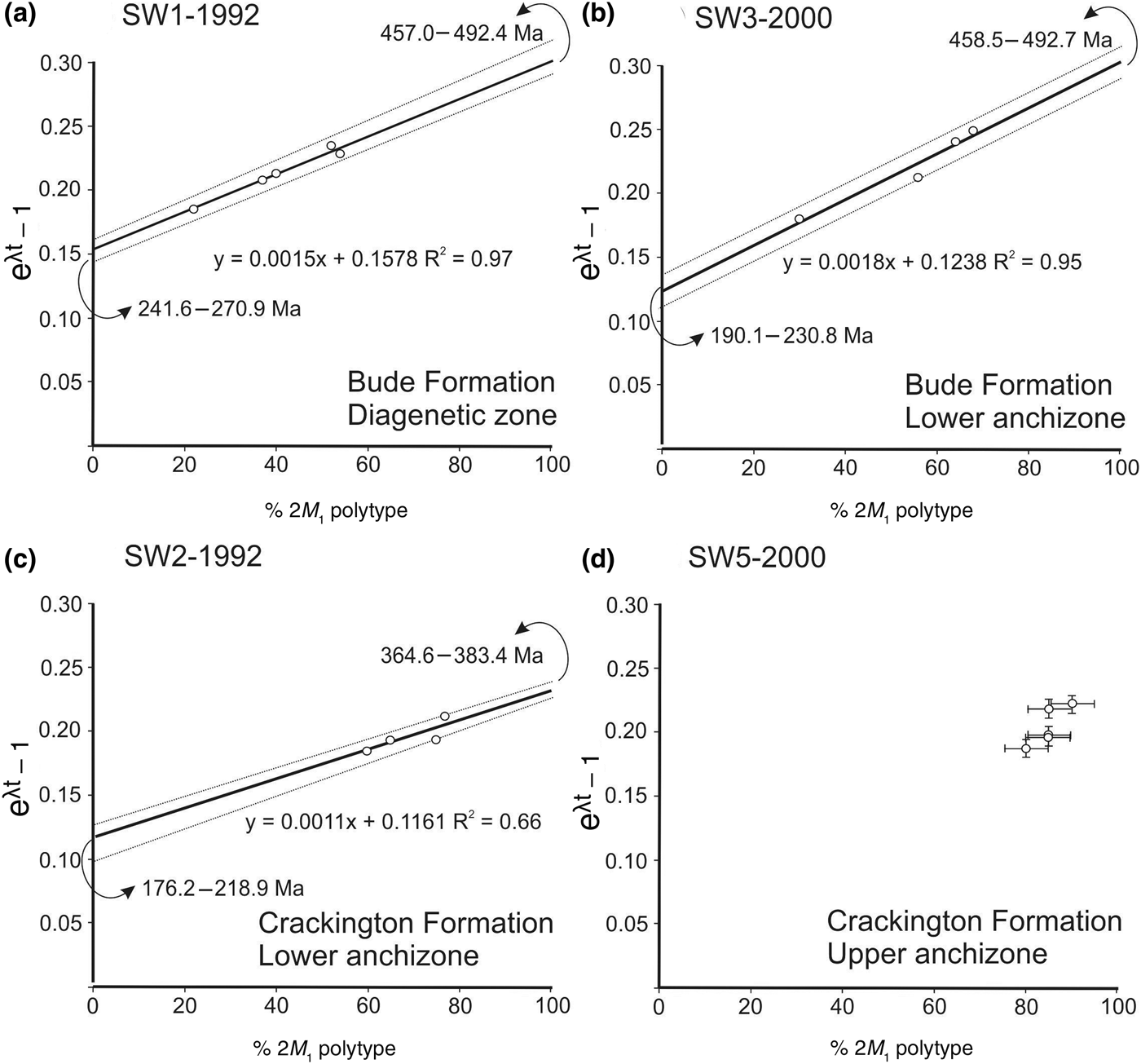
K–Ar illite age analysis was undertaken following the procedure of van der Pluijm et al. (Reference van der Pluijm, Hall, Vrolijk, Pevear and Covey2001), which plots the percentage of 2M 1 polytype of each subfraction against the corresponding K–Ar age expressed as eλt – 1 to improve the linearity of the data. End-member ages for the 2M 1 and 1M + 1M d polytypes are extrapolated from the intercepts of the fitted curve at 100% and 0% 2M 1 polytype axes (Pevear, Reference Pevear1999). The errors of both K–Ar and polytype quantification were included in the illite age analysis and used to determine best-fit lines (including the minimum and maximum data ranges) based on the least-squares method. The 2M 1 end member provides an estimate of the oldest phase of illite and represents a temperature regime of >300°C, where all contained illite is transformed into the 2M 1 polytype. The 1M d end member marks the geological event where the minimum temperature required for authigenic illite formation prevailed during prograde burial diagenesis, hydrothermal alteration or retrograde cooling. The considerations detailed above apply only for authigenic illite in the low-temperature regime and, in most cases, the 2M 1 polytype is a detrital mica (e.g. muscovite) that formed at temperatures >300°C. With respect to the primary scope of illite polytypism in sedimentary basins, the 2M 1 polytype is referred to as the detrital end member and the 1M d polytype is referred to as the diagenetic end member. One main indication of a detrital illite is a K–Ar age that is greater than the stratigraphic age (marked in Table 2), although the presence of excess argon in these samples, such as those described in the Palaeozoic slates of the Welsh Basin, cannot be fully ruled out (Sherlock et al., Reference Sherlock, Zalasiewicz, Kelly and Evans2008). The accuracy of the illite age analysis performed in this study was tested using published K–Ar age values and illite polytype quantifications for three synthetic preparations (Ylagan et al., Reference Ylagan, Kim, Pevear and Vrolijk2002). These consisted of constrained mixtures of two pure illite fractions of known age and %K content: a 1M illite (RM30) with a K–Ar age of 24.8 ± 0.6 Ma (%K 7.58) and a 2M 1 polytype (Wards) phase with a K–Ar age of 428.0 ± 9.0 Ma (%K 9.38). Our analysis of the three mixtures calculated an age of 26.3 Ma and 438.4 Ma, respectively, for the two end members. The differences between the measured ages and extrapolated ages were + 5.7% and –2.4%, respectively. These values lie close to the 2.4% and 2.2% measured error ranges given by Ylagan et al. (Reference Ylagan, Kim, Pevear and Vrolijk2002) for these two samples, which are similar despite some variation in K content. The extrapolated age values also do not significantly exceed the ± 5% error involved in illite polytype quantifications.
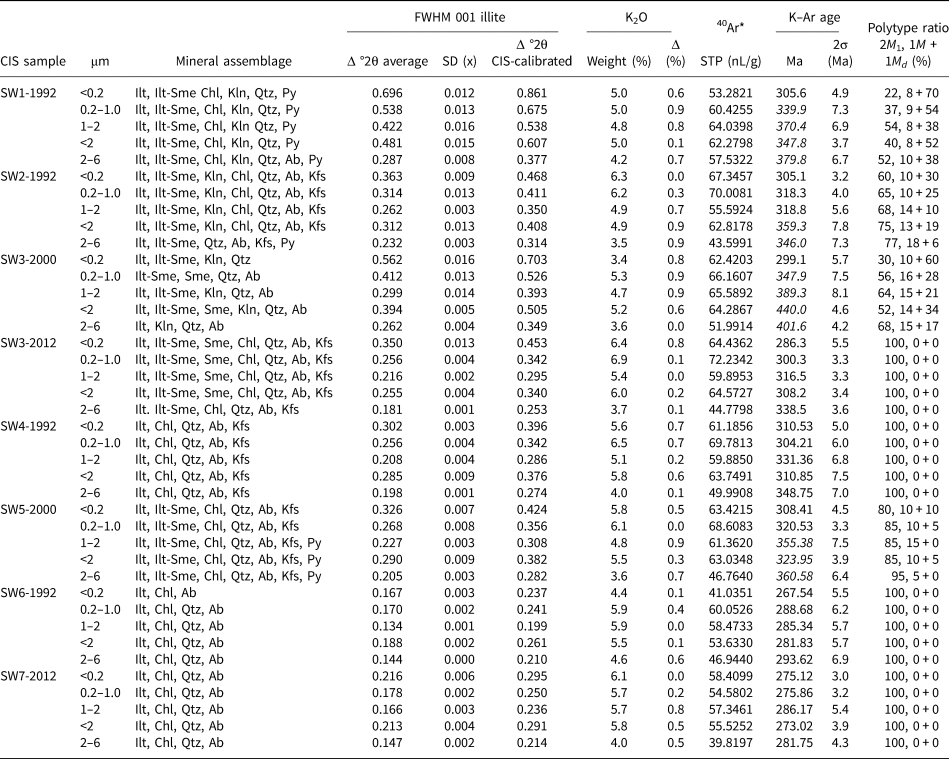
Compilation of the results for the FWHM of illite (001) reflection (Kübler Index calibrated to CIS values), K2O and Ar determinations, resulting K–Ar ages and illite polytype ratios. Δ %K2O refers to the analytical error derived from repeat determinations. 40Ar* is the radiogenic argon content. STP refers to standard temperature and pressure conditions (273.15 K and 1 bar). K–Ar ages are in italics if older than the stratigraphic age. The order of listed minerals is not based on accurate quantifications, but prominent clay minerals are listed first, followed by the accessory minerals. Ilt = Ilt and Ilt-Ms combined (abbreviations according to Whitney & Evans, Reference Whitney and Evans2010). Differences in the mineral assemblages compared to Warr (Reference Warr2018) are only minor and probably due to analytical variation.

Results
FWHM values of 001 illite reflections
The CIS-calibrated FWHM values of 001 illite reflections determined for the various size fractions show a wide range of variation (Table 2). The largest difference is observed between the finest (0.861°2θ for <0.2 µm) and the coarsest (0.377°2θ for 2–6 µm) fractions of the diagenetic SW1-1992 mudstone, indicative of variable mixtures of detrital 2M 1 (crystalline illite-muscovite), increasing in the coarser fractions, and illite-smectite phases, increasing in the finer fractions. Previous XRD and transmission electron microscopy studies showed that the illite in the <2 µm fraction of this sample contains the greatest amount of interlayered smectite (3–4%) and the smallest crystallite thicknesses (mean 14 nm) compared to the other CIS samples (Warr & Rice Reference Warr and Rice1994; Warr & Nieto, Reference Warr and Nieto1998). A very similar pattern is observed for the SW3-2000 mudstone of the upper part of the Crackington Formation, which, despite being assigned to the lower anchizone, has similar characteristics to that of SW1-1992.
Similarly, all of the other anchizonal mudrocks (SW2-1992, SW3-2012, SW4-1992 and SW5-1992) produce broader 001 illite reflections (higher FWHM values) for the finer fractions, but with a significantly lower degree of broadening than SW1-1992 and SW3-2000. The lowest FWHM values are 31–44% lower than the highest values (Table 2). In contrast, the lower FWHM values (<0.3°2θ) of the illite-muscovite (001) reflections from the epizonal-grade samples (SW6-1992, SW7-2012) fall much closer together with no clear trend of peak broadening towards the finer fractions. Here, the FWHM values vary within a range of <30% difference.
K content and K–Ar ages
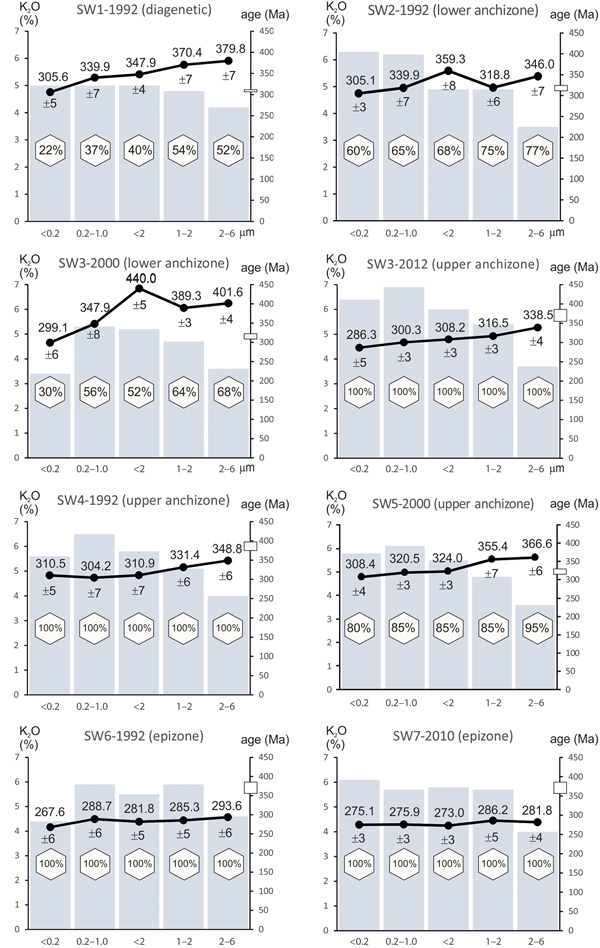
All of the size fractions of the standard samples yield reasonably high K concentrations of between 3.5 and 6.9 wt.% K2O (Table 2, Fig. 3). Most samples show a general increase in K content with decreasing grain size (SW1-1992, SW2-1992, SW3-2012 and SW5-2000), probably reflecting the increasing abundance of K-bearing illite-smectite and illite-muscovite phases in the finer fractions in relation to quartz and feldspar. Such trends are not as evident in samples SW3-2000, SW4-1992, SW6-1992 and SW7-2012, where the K content of the 0.2–1.0, 1–2 and <2 µm fractions are generally more consistent and vary between 3.4 and 5.2%, 4.0 and 6.5%, 4.4 and 5.5% and 5.7 and 6.1%, respectively.
Graphical summary of the K content (wt.% K2O), K–Ar ages and 2M 1 illite polytype abundance for the eight CIS. The stratigraphic age of the sample is marked as a white box on the age (Ma) axis.

The K–Ar ages of the various size fractions show systematic variation in most cases, with 23 out of 31 ages being lower than those of the next coarsest fractions (Fig. 3). The age trend is not complete for samples SW2-1992 and SW3-2000, where the age of the <2 µm subfraction is too high in both of these samples. In the case of SW4-1992, the <0.2 µm and 0.2–1.0 µm subfractions show the same age, taking into account the error ranges. For the two Late Carboniferous Bude Formation mudstones, the three coarsest fractions of SW1-1992 yield ages that are greater than the stratigraphic age, whereas for SW3-2000, the four coarsest fractions are older than sedimentation. For the two Late Carboniferous Crackington Formation mudstones, the two coarser fractions of SW2-1992 are older than the stratigraphic age and the three coarsest fractions in SW5-2000. For all of these Late Carboniferous mudstone samples, the maximum and minimum age difference between the size fractions of each sample varies by 52.2–140.9 ± 3.2–7.8 Ma. The youngest ages of the <2 µm fractions fall in a narrow range of 310.5 ± 5.0 to 299.1 ± 5.7 Ma, which is <12 Ma after sedimentation.
The K–Ar ages of all of the Devonian slates of both upper-anchizonal and epizonal grade are significantly younger than the stratigraphic age by 20.5–107.5 Ma. A general trend towards younger ages for the fine fractions of the two upper-anchizonal slates is also observable, but this is not as prominent as in diagenetic and lower-anchizonal mudstones. The difference between the minimum and maximum ages ranges from 44.5 to 52.2 ± 3.6–7.0 Ma, and the youngest ages of the finest fractions are >67 Ma less than the age of sedimentation. The most consistent K–Ar ages were measured on the two epizonal slates, which vary between 293.6 and 267.6 ± 6.0 Ma for SW6-1992 and between 281.8 and 275.1 ± 5.0 Ma for SW7-2012; both are of Permian age. The youngest age recorded from the <0.2 µm fraction of SW6-1992 is 26 ± 6 Ma less than the coarsest 2–6 µm fraction, whereas for SW7-2012, the difference between these two size fractions is just 6.7 ± 4.0 Ma. Both slates yield ages that are notably less than the stratigraphic ages by 65–107 Ma.
Overall, no obvious relationship is evident between the traces of K-feldspar detected in some size fractions of SW2-2012, SW3-2012, SW4-2012 and SW5-2000, the measured K content and the described variation in K–Ar ages (Table 2). The K concentration of this K-bearing mineral is therefore considered too low to be of importance in the age dating of these samples. The occurrence of albite in all of the samples also appears not to have influenced the K–Ar determinations.
Illite polytype ratios
All four Late Carboniferous mudstones have varying mixtures of 1M + 1M d illite-smectite and 2M 1 illite-muscovite. Although the 1M and 1M d polytypes were fitted separately in this study, it is likely that, in these mudstones, many intermediate states of ordering occur between these end members. The highest abundance of 1M d illite is found in the finest <0.2 µm fraction of all of the mudstone samples; however, the 1M illite does increase in the coarser fractions. The diagenetic sample SW1-1992 (Bude Formation) has an 8% 1M, 70% 1M d and 22% 2M 1 mixture in the finest fraction, with the 2M 1 polytype content increasing until reaching 52% 2M 1 in the 2–6 µm fraction. A very similar pattern of increasing 2M 1 polytype characterizes the upper (Marsdenian) part of the Cracktington Formation SW3-2000 mudstone, ranging from 30% 2M 1 for the finest fraction to 68% 2M 1 in the coarsest fraction. In contrast, this sample appears to contain more 1M illite than SW1-1992.
The mudstone of the middle (Alportian–Kinderscoutian) part of the Crackington Formation, SW2-1992, contains a notably higher amount of 2M 1 polytype for all of the size fractions, ranging from 60% 2M 1 in the finest <0.2 µm fraction to 77% in the coarsest 2–6 µm fraction. The abundance of the 1M + 1M d illite ranges from 10% to 18% and is present in similar concentrations as in SW3-2000. The greatest abundance of the 2M 1 polytype and therefore the lowest amount of 1M + 1M d polytype was recorded in the upper-anchizonal mudrock of the lower (Chokierian) part of the Crackington Formation (SW5-2000), which ranges from 80% to 95% 2M 1 with no significant change in relation to the size fraction. This sample is also dominated by the 1M polytype and contains 0–10% 1M d. In contrast to the variably cleaved Late Carboniferous mudstones, the well-cleaved Devonian slates of upper-anchizonal and epizonal grade contain only 2M 1 illite-muscovite with the absence of both 1M and 1M d illite-smectite.
Illite age analyses
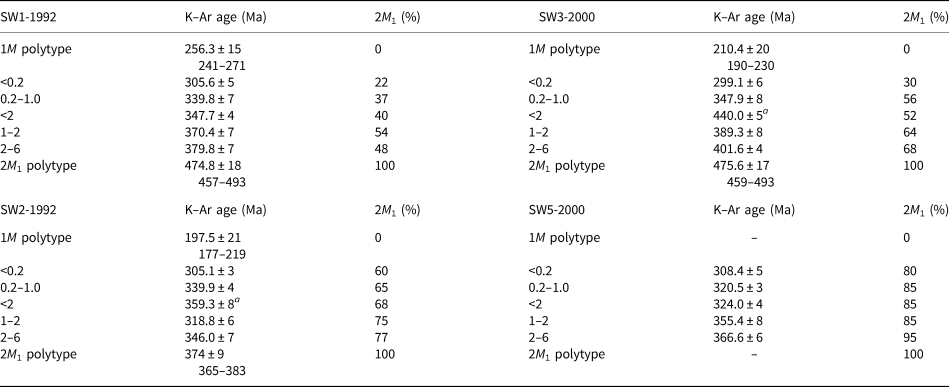
Three of the four Late Carboniferous mudstones (SW1-1992, SW2-1992 and SW3-2000) produced successful linear correlations when plotting the K–Ar age (expressed as eλt – 1) against percentage of 2M 1 polytype (Fig. 4, Table 3). Both conventional errors and an error range are stated for the illite age analysis. The mudstones of the Bude Formation and upper part of the Crackington Formation resulted in very similar 2M 1 end-member ages of 474.8 ± 18.0 Ma (error range: 493–457 Ma) for SW1-1992 and 475.6 ± 17.0 Ma (493–459 Ma) for SW3-2000 (Fig. 4a,b). These are clearly detrital ages and correspond to a Late Cambrian to Middle Ordovician origin, whereas from the SW2-1992 Crackington Formation mudrock, an age of 374 ± 9 Ma (383–365 Ma) is extrapolated, indicating a Late Devonian source (Fig. 4c). The 0% 2M 1 end-member ages of the three mudstones all result in significantly younger ages: 256.3 ± 15.0 Ma (271–241 Ma; Middle Permian–Middle Triassic) for SW1-1992, 210.4 ± 20.0 Ma (230–190 Ma; Late Triassic–Early Jurassic) for SW3-2000 and 197.5 ± 21.0 Ma (219–177 Ma) for SW2-1992. No end-member ages could be determined for the SW5-2000 sample due the absence of a trend of percentage of 2M 1 polytype values distributed over the five subfractions (Fig. 4d).
Extrapolation of the K–Ar ages for (a) SW1-1992, (b) SW3-2000, (c) SW2-1992 and (d) SW5-2000 according to van der Pluijm et al. (Reference van der Pluijm, Hall, Vrolijk, Pevear and Covey2001). The equation eλt – 1 was used to calculate the K–Ar ages, with λ as decay constant and t as the apparent age, and these were plotted against the detrital content.

Extrapolation of the K–Ar ages for SW1-1992, SW2-1992, SW3-2000 and SW5-2000 following the procedures described in van der Pluijm et al. (Reference van der Pluijm, Hall, Vrolijk, Pevear and Covey2001).

a Excluded from the illite age analysis.
Discussion
CIS as reference material for comparing K–Ar age determinations, polytype quantifications and procedures of illite age analysis
The CIS have been widely used since 1994 for the standardization of empirical Kübler Index values and thus enable compatible numerical results to be obtained, irrespective of interlaboratory variation. In contrast, K–Ar age determinations are considered to be absolute measurements that rely on the analysis of reference standard material and subsequent isotopic calibration (e.g. Kelley, Reference Kelley2002). Despite application of these strict procedures, recent selective testing of K–Ar ages determined on the clay-sized fractions revealed significant variations of ± 10 Ma when measured in various laboratories (Kowalska et al., Reference Kowalska, Halas, Wójtowicz, Wemmer and Mikolajewski2017). Such results indicate that more routine measurements of standard mudrock material would be beneficial for controlling the consistency of K–Ar ages produced.
Similarly, there has been little comparison of illite polytype quantifications, despite the wide range of analytical approaches adopted (Grathoff & Moore, Reference Grathoff and Moore1996; Ylagan et al., Reference Ylagan, Kim, Pevear and Vrolijk2002; Haines et al., Reference Haines and van der Pluijm2008). The method tested here – a combination of RockJock polytype calculations and manual fitting of pure patterns to the measured pattern in Excel – tries to minimize the possible variability by utilizing the whole pattern and not only selected illite reflections. The idea behind the manual fit is to compensate for RockJock’s shortcomings in identifying illite polytypes in the presence of overlapping phases such as illite-smectite, smectite and chlorite: a procedure that is probably strongly user dependent. Furthermore, comparisons made on the same mudrock materials would be of benefit for improving the accuracy of applied methods and the compatibility of datasets between researchers.
With these objectives in mind, the authors present the first K–Ar ages and illite polytype quantifications on a range of various size fractions separated from the CIS mudrocks that may be used for future comparison and discussion of methodology. Although some of the standards studied belong to the older collection of CIS (SW2-1992, SW4-1992 and SW6-1992), newly recollected standards are available as equivalent (SW2-2012, SW4-2012 and SW6-2012) material (Warr, Reference Warr2018).
Influence of progressive low-temperature metamorphism on K–Ar age and FWHM variability
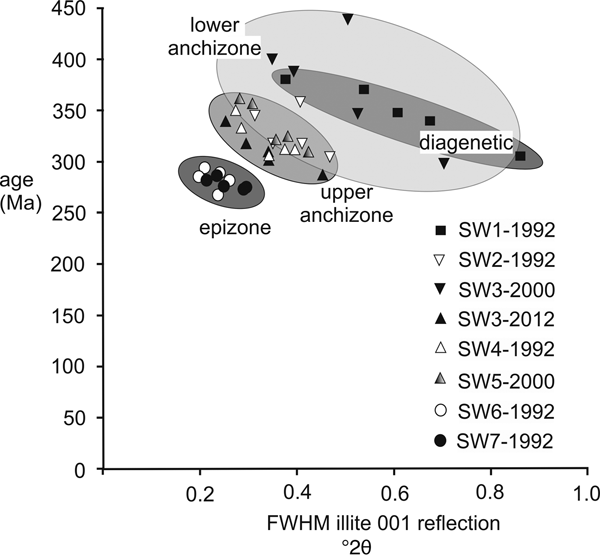
The general changes in K–Ar age variation and microstructural characteristics in ‘crystallinity’ that occurred during progressive low-temperature metamorphism are highlighted by plotting the K–Ar age against the FWHM values for the five size fractions studied (Fig. 5). The broad 001 illite reflections of diagenetic and lower-anchizonal mudstones result in the highest degree of FWHM variability. This reflects the diverse mixtures of young and small authigenic 1M + 1M d illite-smectite particles and significantly older, crystalline detrital 2M 1 illite-muscovite phases, which vary dependent on grain size. Such high degrees of sample heterogeneity are typical of low-temperature, weakly cleaved mudrocks characterized by a limited degree of clay mineral neocrystallization and reaction progress (Merriman & Frey, Reference Merriman, Frey, Frey and Robinson1996; Merriman et al., Reference Merriman, Peacor, Frey and Robinson1999). The variability is significantly less for the upper-anchizonal slates, which contain abundant recrystallized 2M 1 illite-muscovite phases, but with some 2M 1 detrital mica still present in the coarser size fractions. Complete recrystallization of the 2M 1 polytype and isotopic resetting of all particle sizes was achieved only in the epizonal slates, resulting in minimal variation in both K–Ar ages and FWHM values across the various size fractions. Despite the described heterogeneity of most of the mudrock samples from the CIS collection, the following section addresses the challenge of extracting meaningful geological ages by procedures of illite age analysis.
K–Ar ages for the various size fractions plotted against the FWHM illite 001 reflection. Solid squares are diagenetic-grade samples, inverted triangles are lower-anchizone-grade samples, normal triangles are upper-anchizone-grade samples and circles are epizone-grade samples.

New constraints on the geological history of the Palaeozoic mudrocks of southwest England
Assuming our K–Ar ages and illite polytype quantifications to be accurate and the adopted procedure of illite age analysis to be valid, the extrapolated end-member ages for the 1M + 1M d illite-smectite and the 2M 1 illite-muscovite phases have relevant implications for reconstructing the geological history of the Palaeozoic mudrocks of southwest England. In this treatment, it is assumed that the traces of K-feldspar detected in some fine fractions have no or limited impact on the illite age analysis.
Thermal history of the Late Carboniferous Culm Basin
The old 100% 2M 1 end-member ages of the of diagenetic- and lower-anchizonal-grade mudrocks (474.8 ± 18.0 Ma, error range 457–493 Ma for SW1-2012 and 475.6 ± 17.0 Ma, error range 459–493 Ma for SW3-2000) of the Culm Basin together with the lower FWHM values (2–6 µm values of 0.377Δ°2θ and 0.349Δ°2θ, respectively) clearly indicate detrital illite-muscovite to be present in both of these samples. The same is observed for sample SW2-1992, where the 100% 2M 1 end-member age is significantly younger (374.0 ± 9.0 Ma, error range 365–383 Ma) but still older than the stratigraphic age, and the 0.343°2θ FWHM value of the 2–6 µm subfraction is clearly of a more crystalline character than the <2 µm subfraction (0.437°2θ). These 2M 1 illite-muscovite phases constrain the age of detrital white mica in these samples.
The SW1-1992 mudstone sample of the Bude Formation and the SW3-2000 mudrock of the Crackington Formation both yield surprisingly similar detrital mica ages of Late Cambrian to Middle Ordovician. As the SW3-2000 sample was collected within 2 km of the boundary between the Bude and Crackington formations and from a locality characterized by younger Namurian goniatites of the Marsdenian stage (R2 index zone fossils of Freshney et al., Reference Freshney, McKeown and William1972), it is probable that both of these rocks shared a common origin. The source was most probably located in the area of the Bristol Channel, where a landmass formed either as a flexural bulge between the foreland basins of the Culm and South Wales Coalfield (Hartley & Warr, Reference Hartley and Warr1990) or by major Palaeozoic strike-slip faulting and related uplift of basement rocks (Woodcock et al., Reference Woodcock, Soper and Strachan2007).
In contrast, the SW2-1992 mudstone of the Crackington Formation collected further south yields a Late Devonian detrital mica age (374.0 ± 9.0 Ma, error range 365–383 Ma). These older (Namurian) distal turbidites, which contain goniatites of the Alportian and Early Kinderscoutian stages (H2 and R1a index fossils; Freshney et al., Reference Freshney, McKeown and William1972), were deposited at the beginning of foreland basin subsidence and are more likely to have been derived from the deforming Variscan orogenic wedge that lay to the south (Warr, Reference Warr, Woodcock and Strachan2009). Late Devonian to Early Carboniferous metamorphic (Bretonian) ages are well documented from the Lizard ophiolite and Dodman complexes and represent exhumation and obduction of amphibolite and greenschist facies rocks along the northern margin of the Armorican terrane complex (Warr, Reference Warr, Woodcock and Strachan2009).
An unexpected result of the illite age analysis of the Late Carboniferous mudstones is the Middle Permian to Early Jurassic (265.3 ± 15.0 Ma for SW1-1992 and 210.4 ± 20.0 Ma for SW3-2000, error ranges of both: 271–190 Ma) age range for the 1M + 1M d illite phases. When ordered by location from north to south (SW1-1992, SW3-2000 and SW2-1992), the three mudstone samples reveal progressively younger 1M + 1M d illite ages towards the south. The northernmost sample of SW1-1992 (Bude Formation) indicates a Middle Permian to Middle Triassic age (256.3 ± 15.0 Ma, error range: 271–241 Ma), whereas the SW3-2000 and SW2-1992 samples (Crackington Formation) give Late Triassic to Early Jurassic ages (210.4 ± 20.0 Ma, error range: 230–190 Ma and 197.5 ± 21.0 Ma, error range: 219–177 Ma, respectively). The reason for this apparent trend may relate to their proximity to the Rusey Fault Zone (Fig. 1), which represents the southern faulted margin of the foreland basin sequence of the Culm Basin and is a recognized zone of intense fluid–rock interaction (Cox & Munroe, Reference Cox and Munroe2016). One potential scenario is that the Rusey Fault marks a zone of multiple reactivations during Middle Permian to Early Jurassic times.
Although these results clearly indicate that post-Variscan thermal activity affected these mudstones, the mechanism by which this occurred remains unclear. One possibility is that the 1M + 1M d polytypes formed by authigenic neocrystallization during the circulation of K-bearing hydrothermal fluids are linked to Permo-Triassic and Mesozoic fault activity during the opening of the North Atlantic Ocean. Such events are well documented by K–Ar illite age dating across Europe in both Variscan basement and Mesozoic sedimentary cover rocks (Clauer et al., Reference Clauer, O'Neil and Furlan1995; Zwingmann et al., Reference Zwingmann, Clauer, Gaupp and Parnell1998; Schleicher et al., Reference Schleicher, Warr, Kober, Laverret and Clauer2006). That these rocks were affected by Mesozoic fluid-flow events and younger stages of illite crystallization does require a change in perspective concerning the thermal history of the Culm Basin, which has up until now been considered to have resulted solely as a response to Late Variscan burial and deformation during the Late Carboniferous to Early Permian. Similarly young hydrothermal events of ~215–205 Ma (post-1977 constant; McDougall & Harrison, Reference McDougall and Harrison1999) and ~165–155 Ma were recognized by the dating of adularia K-feldspars from the Lizard Complex (Halliday & Mitchell, Reference Halliday and Mitchell1976).
Another possible origin of the hydrothermal fluids is related to the intrusion of the nearby Cornubian granite batholith which, due to its radiogenic nature, played a key role in the circulation of mineralizing fluids in the surrounding rocks of Cornwall and Devon (Sams & Thomas-Betts, Reference Sams and Thomas-Betts1988; Willis-Richards & Jackson, Reference Willis-Richards and Jackson1989). In combination with fault reactivation during the Permo-Triassic and Early Mesozoic, the dissipation of heat away from the batholith is therefore likely to have contributed to the circulation of hydrothermal fluids through faults and within the Culm Basin. This is indicated by thermal modelling of the Cornubian batholith showing isotherms dipping gently beneath the Late Carboniferous strata to the north of the Bodmin granite and continuing high heat flow during Mesozoic and Cenozoic times driven by groundwater convection and epithermal mineralization (Sams & Thomas-Betts, Reference Sams and Thomas-Betts1988; Willis-Richards & Jackson, Reference Willis-Richards and Jackson1989).
An alternative explanation for the younger 1M + 1M d illite ages is that they do not represent crystallization ages, but instead reflect partial thermal resetting of the Late Variscan diagenetic and lower-anchizonal illites that originally crystallized during burial diagenesis in a foreland basin setting and were heated during subsequent hydrothermal events. This explanation is supported by the high vitrinite reflectance values of these rocks (Rmean 4.83–5.18%; Cornford et al., Reference Cornford, Yarnell and Murchison1987) that indicate maximum temperatures approaching 300°C, which was high enough to isotopically reset the fine-grained illite in these samples. An increase in the reflectance of organic matter was also recognized in the footwall of the Rusey Fault Zone, where enhanced vitrinite reflectance values indicate temperatures were locally elevated by a further 80°C (Andrews et al., Reference Andrews, Day and Marschall1996).
Thermal history of upper-anchizonal mudrocks
Although a relatively clear picture emerges from the Late Carboniferous diagenetic and lower-anchizonal mudstones SW1-1992, SW2-1992 and SW3-3000, the upper-anchizonal SW5-2000 sample collected from the lower part of the Crackington Formation sequence at Strangles Beach is more difficult to interpret. This results from the low content of 1M + 1M d illite and a lack of a trend of the percentage of 2M 1 polytype across the subfractions (Figs 3, 4). Whereas it is unclear whether there is any neocrystallized 2M 1 polytype in this sample, this pattern may be explained by a higher proportion of detrital mica in the fine fractions, which would artificially increase the interpreted grade of metamorphism by shifting the sample into the upper anchizone. Kelm & Robinson (Reference Kelm and Robinson1989) also recognized such anomalous values in their illite ‘crystallinity’ index study of the Culm Basin mudrocks.
Although no illite age analysis could be undertaken on the anchizonal Devonian slates due to the lack of polytype mixtures, these samples do provide some constraints on the timing of thermal events. The presence of the illite 2M 1 polytype with upper-anchizonal FWHMs in the coarser size fractions indicates that these slates probably contain some detrital mica that has not been fully reset during very-low-grade metamorphism. However, all of the finer-sized <2 µm fractions yield consistent Late Carboniferous to Early Permian ages (310.5 ± 5.0–286.3 ± 5.0 Ma for SW3-2012 and SW4-1992 combined) that date a thermal event. These results are comparable to published examples of the incomplete resetting of detrital white mica, which have been documented in similar Late Palaeozoic upper-anchizonal slates from other parts of the Variscan orogenic belt (Reuter & Dallmeyer, Reference Reuter and Dallmeyer1987, Reference Reuter and Dallmeyer1989; Dallmeyer & Takasu, Reference Dallmeyer and Takasu1992).
The ages of the <2 µm (and finer) fractions determined in this study are notably younger than the Early Carboniferous sieved 40–80 µm K–Ar age of Dodson & Rex (Reference Dodson and Rex1971) measured on an anchizonal slate from the same area: an age that is likely to be greater than the true age of metamorphism due to the incomplete recrystallization of the detrital mica. Probably the most reliable age of the upper-anchizonal slates is recorded in the three finest fractions of SW4-1992, with consistent results lying between 310.9 and 304.2 ± 7.0 Ma. Such an age range indicates a regional metamorphism event during the Westphalian, synchronous with deposition of the Bude Formation rocks located in the Culm Basin to the north.
Thermal history of the Tintagel High-Strain Zone
Only the two epizonal slates yielded consistent ages across all size fractions, indicating complete recrystallization. These slates yield Early Permian ages (293.6 ± 7.0–273 ± 4.0 Ma) and correspond with previous studies based on K–Ar analyses of the coarser 40–80 µm fraction of slates that underwent greenschist facies metamorphism (Dodson & Rex, Reference Dodson and Rex1971; Warr, Reference Warr, Woodcock and Strachan2009). The relatively consistent epizonal FWHM values range from 0.295°2θ (SW7-2012 < 0.2 µm) to 0.210°2θ (SW6-1992 2–6 µm) and characterize the newly grown 2M 1 polytype as a high-temperature metamorphic white mica phase. Isotope geothermometry data indicate that maximum regional metamorphic temperatures in the Tintagel High-Strain Zone exceeded 375°C (Primmer, Reference Primmer1985a,Reference Primmerb). Therefore, the K–Ar ages of these slates are regarded as cooling ages following peak greenschist facies metamorphism, which overlap with the intrusion age range of the Early Permian Cornubian batholith at 293–275 Ma and that of the Bodmin granite at 291.4 ± 0.8 Ma (Chen et al., Reference Chen, Clark, Farrar, Wasteneys, Hodgson and Bromley1993). The strong correspondence between the age of granite emplacement and the white mica cooling ages of the Tintagel High-Strain Zone supports the idea that the two events were related.
Conclusions
The CIS represent a diverse collection of mudrock standards that range from weakly deformed mudstones to strongly deformed recrystallized slates that are ideal for testing the methods of K–Ar (and 40Ar/39Ar) study, illite polytype quantification and illite age analysis adopted by researchers. The age analysis of three of the Late Carboniferous CIS mudstones indicates variations in both the age of authigenic 1M + 1M d illite and the inherited 2M 1 detrital mica. A number of younger thermal events may be recognized as influencing the K–Ar ages of the authigenic illite-smectite end member, which occurred between the Early Permian and Early Jurassic. Either these ages represent neocrystallization of illites linked to the circulation of K-bearing hydrothermal fluids or they represent thermal resetting and loss of radiogenic argon from the finer grain sizes without new crystal growth. The age of detrital mica (illite-muscovite) indicates that a change in the source area occurred with the older Namurian sediments of the Crackington Formation (SW2-1992) containing Late Devonian mica and the younger, Late Namurian and Westphalian mudstones of the upper part of the Crackington Formation and Bude Formation (SW1-1992, SW3-2000) composed of Late Cambrian to Middle Ordovician detritus. Devonian CIS slate samples of upper-anchizonal grade do contain detrital mica in the coarser size fractions, whereas the recrystallized finer fractions indicate Late Carboniferous (Westphalian) to Early Permian metamorphic ages that partly overlap with the age of foreland basin sedimentation (deposition of the Bude Formation). The fully recrystallized 2M 1 illite-muscovite assemblages of the two epizonal slates from the Tintagel High-Strain Zone yield Early Permian metamorphic cooling ages that correspond to the intrusion ages of the Cornubian granite batholith.
Acknowledgements
Sarah Sherlock and an anonymous reviewer are thanked for their constructive suggestions that improved this contribution.