Throughout his career, György Ligeti was distrustful of established authorities, both political and artistic. He was continually aware of the dialectic between freedom and control, both in his life and in his approach to composition, and especially in the highly original techniques he developed for ordering his own artistic creations. Seeing the promise of freedom dissolve into a reality of censorship and restrictions in post-war Hungary had a profound and lasting effect upon his artistic sensibilities. This is evident in his tastes in art and literature, which encompassed the works of Kafka, in which labyrinthine systems of precise rules seem to operate without any overriding logical end; the ‘Ubu’ plays of Alfred Jarry, which satirize notions of duty and authority, and question the very possibility of complete freedom; and Piranesi's series of etchings Carceri d'invenzione, where massive architectural constructions again demonstrate an intricacy and technical mastery without apparent human purpose or practical direction.Footnote 1 This dialectic helped shape his reaction to prevailing artistic movements of his time, and particularly to serialism, which interested him greatly at first, and had a significant impact on his compositional development, but which he began to distrust as soon as he sensed that it had become a fixed and inflexible system, rigid in its definition and application. Ligeti remarks directly on this dialectic in his article, ‘Decision and Automatism in Structure Ia’,Footnote 2 a critical analysis of Boulez's most strictly formulated serial work. Ligeti is careful not to oversimplify either side of the dialectic; instead, he works to undercut the supposed difference between the freedom of innovation and the slavish imitation of established models – whether traditional or new – reminding us that neither pole is ever present without its counterpart in some degree. Through the course of his essay, Ligeti calls for a general reevaluation of the decision-making process in compositional systems, often using urgent imagery: ‘you build your own prison as you please, and once safely inside you are again free to do as you please.’Footnote 3 Later in the article he compares the degree of free choice afforded by strict serial and tonal composition, and returns to the same metaphor, maintaining that, ‘“the poor old serialist” is no more a captive than the tonal composer chained to his cadences; now as ever, the vital thing is how far, and in what way, one can tug at one's chains.’Footnote 4 Most telling of all, however, is how this dialectic operates in the composer's actual practice, how it shaped his attitude towards compositional rule making, and in turn affected the types of systems he developed for his own compositions. In his recent study of ‘rules and regulation’ in Ligeti's music, Jonathan Bernard has noted that, ‘Ligeti often affirmed the existence of such rules in his part-writing, although he never disclosed for publication exactly what they were.’Footnote 5 Following Bernard and others to have examined this area, the present article investigates Ligeti's rules with regard to pitch and rhythm in two of his works from the 1960s. Through the examination of both explicit and implicit rules, and a detailed look at how they are ultimately employed in the compositions, this study shows how Ligeti was able to carve out an approach that was meticulous and strict, while still leaving himself the degree of freedom he desired in its implementation.
While he emphasized the importance of technique throughout his career,Footnote 6 Ligeti never wholly subscribed to any single artistic movement or school, but rather drew on multiple inspirations, both traditional and contemporary, synthesizing – or rather transforming – them into something new, unique, and personal.Footnote 7 He is as likely to cite Bach or Ockeghem as an influence as he is Webern, and, while acquiring ample knowledge of various styles, he never followed any kind of orthodoxy, and, in fact, remained antithetical to the very notion. This contempt for dogma did not, however, prevent Ligeti from developing systems of personal ‘rules’ for his compositions. In fact, the construction of prescriptive guidelines and proscriptive constraints on composition was a vital part of his working method,Footnote 8 and is essential in understanding how he maintained this balance between innovation and tradition – particularly so as he moved from the first orchestral experiments in texture and timbre, Apparitions and Atmosphères, to a mature style of micropolyphony with compositions such as the Requiem, Lux aeterna, and Lontano in the mid-1960s.
Ligeti came from a background where regulations for composition were heavily emphasized. He recalls that in Budapest, ‘my counterpoint studies under Veress and Farkas certainly played an important role in working out impenetrable textures of sound, as did studying Jeppesen, which Kodály made de rigueur for would-be composers.’Footnote 9 And indeed, among Ligeti's student sketchbooks, preserved at the Paul Sacher Foundation in Basel, there are over seventeen notebooks containing counterpoint exercises, including extensive musical examples from Jeppesen's book, copied out by hand.Footnote 10 In the late 1950s and 60s, Ligeti was again working in an environment substantially concerned with compositional rule making, although in Cologne and at Darmstadt, composers such as Boulez and Stockhausen were now taking the principles of serial composition, as developed by Schoenberg and Webern, and expanding them to apply to the organization of other parameters, thereby generating new systems based on the original precepts.
In a 1978 interview Ligeti describes his own, more individual approach to the formation of the rules that he used in the ‘Kyrie’ from his Requiem:
In this movement I wanted to combine Flemish polyphony with my own new micropolyphony. I took Ockeghem as my model, and adopted his ‘varietas’ principle, where voices are similar without being identical…. The canonic parts are identical in their notes but their rhythmic articulations are always different and no rhythmic pattern is ever repeated in a canon. I think that here I succeeded in realizing Ockeghem's ‘varietas’ principle. I had worked out for myself beforehand a set of rules both for the melodic lines and for the harmonic structure, rules that are almost as strict as those of the Flemish composers or Palestrina's. For instance, the permutation of the rhythmic patterns, which is reminiscent of methods employed in serialism although the Kyrie-fugue is not serial music. Working on the composition was rather like weaving a carpet, some parts ready, some threads still hanging loose: and then I would go on weaving according to the rules I prescribed for myself. At any given point there were several possibilities of how to go on; I chose one and went on weaving the smaller patterns of the canons and the larger ones of the fugue.Footnote 11
Despite some of his criticisms of Boulez and others, the attitude Ligeti expresses here is neither a reactionary stand against the avant-garde nor the disavowal of a more traditional style of composition. The dialectic between control and freedom is more complex than this, and so rather than rebelling against the need for systems of control altogether, he worked to synthesize these disparate points of view into a personal system of rules – to build a prison he could live and work in, and to tie these rules directly to his artistic vision.
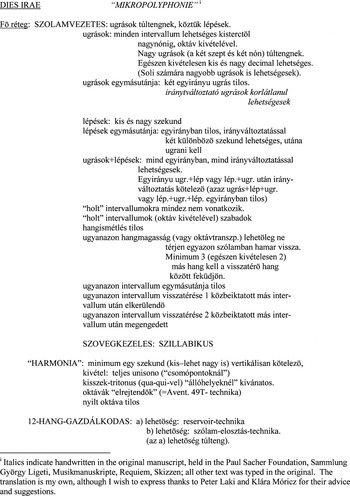
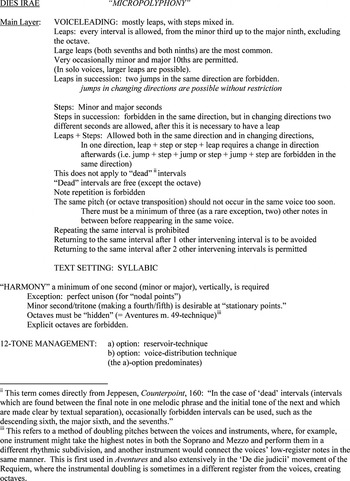
Examples of such rules survive in written form in some of Ligeti's sketches. One particular sketch page lays out the explicit principles of voice leading and harmony for parts of the Requiem's ‘Dies irae’; it is transcribed in its entirety as Figure 1, along with an English translation. The sketch reads like the text of a counterpoint treatise, containing both hard and soft rules and allowances for certain exceptions and preferences. A similar, though not identical, version of many of these rules was first transmitted by Erkki Salmenhaara, who discussed them in the abstract, but did not examine them in practice or in connection to specific musical examples.Footnote 12 While Salmenhaara cites Ligeti's sketches directly, Jonathan Bernard has discovered another apparent source for this information, a letter in German which Ligeti wrote to Salmenhaara on 10 August 1965, and which now resides in the Ligeti collection of the Paul Sacher Foundation.Footnote 13 While it cannot be proven from an undated sketch, it seems likely that the Hungarian version reproduced as Figure 1 is Ligeti's original formulation, from around the time of composition, and so predating the letter to Salmenhaara.Footnote 14 It fills in a number of new details. As transmitted by Salmenhaara, the rules are missing the voice-leading provision allowing limited use of tenths (something seen in the solo voices), and when stipulating three intervening notes between pitch-class repetitions, they do not include the parenthetical qualification, ‘as a rare exception, two,’ something which can be observed in Ligeti's practice (as discussed below). Another significant difference is found in the rules for managing aggregates of all twelve chromatic pitch classes. As quoted in Salmenhaara, Ligeti only mentions the completion of aggregates collectively across the voices (i.e. the ‘reservoir technique,’ and not the ‘voice-distribution technique’). But he also states that ‘this even-as-possible distribution [of pitch classes] is subject, however, to the rules of voice leading and of harmony: early repetition of a note is possible if these other, more important rules do not allow for even note distribution.’Footnote 15 This explicit prioritization of the rules governing individual lines, rules that are spelt out in greater detail in the Hungarian sketch, allows for more flexibility and freedom in the handling of the rules for aggregate completion.Footnote 16
‘Dies irae’, rules for micropolyphony.

Continued

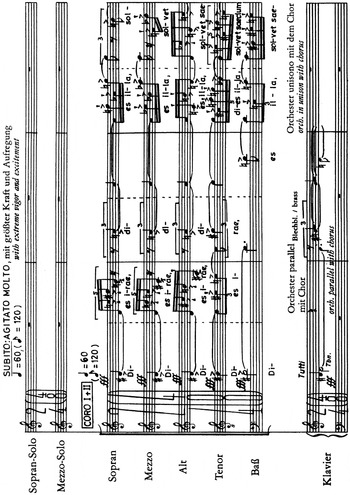
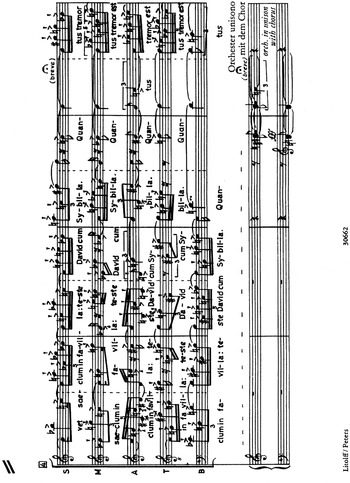
These rules apply specifically to the main choral material of the ‘Dies irae’ section of the Requiem, and their relevance to the final composition is apparent from an analysis of the opening vocal parts of this movement (shown in Example 1). This example shows both the explicit degree to which Ligeti formulated his rules, and also his adherence to the rules in the actual work – something which might not be taken for granted. The opening measures demonstrate many of the intricacies of these rules in handling steps and leaps, as well as the use and non-repetition of pitches and intervals. Not only do large leaps predominate, but moreover, while ninths, sevenths, and even sixths occur freely, the tenths, which the rules identify as rare occurrences, do not. Additionally, when consecutive seconds occur (e.g. in the opening of the tenor line, and again in the bass at the end of b. 3) they are, in fact, in alternating directions and of different sizes, creating chromatic (012) cells rather than neighbouring or scalar patterns. The rules concerning the combination of steps and leaps in various directions are also evident in the opening bars, ensuring that lines acquire a jagged contour by forbidding more than two moves in the same direction.
De die judicii’, opening (C.F. Peters, 1975, reproduced with permission).

Continued

As is common in traditional counterpoint rules, there is a degree of redundancy in the expression of certain prohibitions; different rules work towards common results. In this case, numerous rules help ensure that no pitch classes will recur too soon in the same voice. The rules for consecutive seconds, along with the prohibition of repeated intervals and of leaps in the same direction, work together to prevent most cases in which the same pitch class might occur after one intervening note.Footnote 17 Ligeti, however, over-protects against this eventuality, prescribing that ideally there should be at least three intervening notes in a single voice before a return to the same pitch class. The opening measures also show a strict observance of this rule. It is common to find the minimum distance of three intervening notes between a pitch and its octave transposition; this occurs at least once in every voice in the first seven measures (see for example, the e♭1-d♯ in the Bass and c♯1-c♯2 in the Alto in b. 4). The exceptional distance of two intervening notes occurs only once in this passage (c♯1-c♯ in the Bass, in bb. 4–5). Within a single phrase, though, this rule is never violated, and proximate pitch-class repetitions are consistently de-emphasized by using the octave transposition rather than a return at the exact pitch level.
Ligeti's rules for harmony are observable in the opening as well. Example 1 clearly shows the ‘mandatory second’ – a major or minor second between at least two of the voices at any given moment. The exception that allows a unison for ‘nodal’ points may be seen at the beginning of the movement and the beginnings of similar passages later on.Footnote 18 One can also observe the preference for seconds and tritones, and especially the (016) trichord. This ‘signal’ harmony is evident at both of the static points in Example 1: the A-G♯-D♯ and A-G♯-D harmonies in b. 2, and later embedded in the harmony of bb. 6–7 as B-B♭-F. This preference for seconds and tritones is also evident when the soprano and mezzo move in unison rhythms at the opening, and the embedding of these intervals occurs throughout the movement, though not in any systematic way.Footnote 19 Aggregate completion is also less systematic. The tenor's g♯1 in b. 2 completes the first aggregate, coinciding exactly with the sustained (016) harmony. This aggregate, however, does not use a completely equal distribution of pitch classes, repeating pitch class E between the soprano and tenor, and pitch class C♯ between the alto and mezzo. Later aggregates have similar repetitions, as Ligeti clearly does prioritize the rules for voice leading and harmony over equal pitch-class distribution.
While Figure 1 applies to the ‘main layer’ of the movement, this version of Ligeti's text specifies exceptions for solo voices, and aspects which pertain to other textures as well. Analysts, starting with Salmenhaara and Harald Kaufmann, have divided the ‘Dies irae’ into five contrasting layers or types of material, based on differences in texture, instrumentation, and dynamics.Footnote 20 Beyond these basic contrasts, however, three of the types (the main choral texture (Type I), the solo passages (Type II), and soli passages later in the piece (Type V)) relate back to the same set of principles, although they follow different exceptions in different situations. The solo voices are permitted more leniency than the choral parts. While Figure 1 states that solo voices are permitted larger leaps, it appears that, in practice, they are also allowed more license in other ways. The mezzo-soprano solo in bb. 12–16 (Example 2) demonstrates many of these exceptional features, including consecutive jumps in the same direction, as well as the use of larger intervals, and even, rarely, tenths. Balancing these freedoms, though, is the greater stringency applied to the solo lines in other respects. Larger intervals predominate to an even greater degree, to the near exclusion of steps and smaller leaps. And while the choral parts frequently resort to the minimum of three intervening notes between pitch-class repetitions, the solo voices typically go much longer without such repetitions. Salmenhaara's Type V (exemplified by the duet passage ‘ingemisco tamquam reus,’ starting in b. 111, and other soli passages thereafter) resembles aspects of both Types I and II, predominantly using tritones, sixths, sevenths, and ninths, with few steps or smaller jumps. Like the solo voices, Type V includes consecutive leaps in the same direction (although not as often as in the solos) and goes for long stretches between pitch repetitions, but unlike the solo voices, leaps of a tenth or greater are not employed. While the overriding principle of the movement is still one of juxtapositions and contrasts, the analysis of these different layers in relationship to Ligeti's strictures shows a more nuanced picture, where he achieves both underlying connections and degrees of variation through the flexible employment of his system of compositional rules.
‘De die judicii’, bb. 12–16.

Lux aeterna, although composed just a year after the completion of the Requiem, is a very different piece, almost completely contrasting with the ‘Dies irae’ in style, but nevertheless comparable in approach. This well-known work consists of three ‘microcanons’Footnote 21 linked by two brief passages in the basses (both on the word ‘domine’). The canonic ‘melodies’ of the piece replace the strictures for more angular lines seen in the ‘Dies irae’, and notably permit neighbouring and scalar patterns that the ‘Dies irae’ did not, even creating moments of diatonic emphasis that sharply contrast with the chromaticism of the Requiem. Despite this shift of emphasis, these basic melodies are clearly constructed to accommodate the basic harmonic principle of a ‘mandatory second,’ which was found in the rules for the ‘Dies irae’, but which also prevails through most of Lux aeterna. The canons (shown in Example 3) do not generally introduce notes further than a major second away from one of the previous notes of the canon, notes that are likely to be sustained in other voices and thus provide the mandatory second. The only exception to this is in the short canon using the ‘Requiem aeternam’ text. When the sopranos introduce b♭1 – a major third away from d2, the closest note already introduced – the altos provide the required second by sustaining c2 as part of the trichord g1-b♭1-c2, a (025) trichord which falls outside the canonic scheme and which is kept in play throughout the section. In fact this interval signal, featuring a prominent major second, is quite prevalent in Lux aeterna, replacing the (016) found in the Requiem. It is emphasized in various ways through the course of the composition, including moments in both the canons and the linking passages. As with the signals in the Requiem, the use of this interval combination seems to be more opportunistic than systematic, but this type of interval signal is nevertheless a common feature of Ligeti's music in the 1960s, and here, along with the hard constraint of the mandatory second, it works as a softer preference, helping guide the vertical, or harmonic, aspect of the work.
Pitch canons in Lux aeterna
‘Lux aeterna’ (sopranos and altos, bb. 1–37).

‘Cum sanctis tuis’ (tenors bb. 39–88, basses join at m. 46).

‘Requiem aeternam’ (sopranos, bb. 61–79, entering as tenor 4 reaches g, note 24 of Canon 2a).

‘Et lux perpetua’ (altos, bb. 90–119).

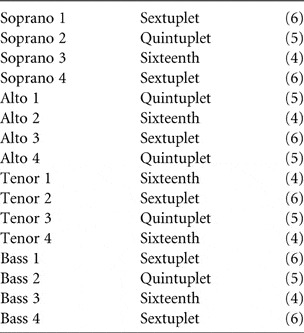
Rules governing Ligeti's rhythmic practice in Lux aeterna were, it seems, never explicitly spelled out by the composer, but they can be deciphered in part from the sketches, and in part from the score itself. The large-scale rhythmic organization does suggest a degree of systematization. Each voice part uses one of three rhythmic strands (summarized in Table 1): Soprano One uses sextuplet semiquavers; Soprano Two uses quintuplet semiquavers; Soprano Three uses unmodified semiquavers; and Soprano Four again uses sextuplet semiquavers, so the four rhythmic strands are divided from high to low as 6, 5, 4, 6. The other voice parts rotate through this sequence: Altos use rhythmic strands 5, 4, 6, 5; tenors use 4, 6, 5, 4; and basses return to an arrangement of 6, 5, 4, 6, identical to the sopranos. This creates symmetry between the arrangement of the four sections SATB, symmetry reproduced in the arrangement of the four voices within each section; the arrangement of the four soprano voices is consequently reflected in the arrangement of the primary voice of each section (S1-A1-T1-B1).
Rhythmic strands in Lux aeterna.

Other scholars have noted as much about Lux aeterna's rhythmic structure, but generally relegate any further analysis of rhythm to the idea of an ‘elastic talea,’Footnote 22 reflecting a perception that certain syllables tend to be longer or shorter than others, but that any definite order of durations is greatly distorted or otherwise ‘impossible to reconstruct.’Footnote 23 While the simultaneous division of the beat into four, five, or six subdivisions could be compared to contemporary composers such as Luigi Nono, who uses concurrent rhythmic strands in the second movement his Il Canto Sospeso (1955–56), several of these authors make a more distant comparison, viewing it as a micropolyphonic analogy to the mensuration canons in Ockeghem's Missa Prolationum.Footnote 24 The comparison with the basic idea of a talea may also be found in Ligeti's own comments:
Although it does not involve a strict canonic technique, both the voice leading and harmony and also the rhythmic articulation are subjected to a set of certain strict rules. This means that, by the criteria of a canon, the counterpoint cannot be described as ‘strict,’ but according to other criteria, namely specific compositional techniques for this work, it is however a ‘strict setting.’
Compulsory for the rhythmic articulation is a type of ‘secret construction,’ which resembles the talea formation of isorhythmic motets, although with the difference that Lux aeterna exhibits no rigid rhythmic structure. Rather, the talea-type succession is altered according to definite rules from voice to voice, and in this rhythmic network the voices are all bound together. Therefore, on the one hand, the construction is less strict than in the talea technique, since the rhythmic ordering is not fully fixed; on the other hand, it is stricter, since the collected voices are always rhythmically regulated.Footnote 25
A close reading of the passage reveals, however, an interesting balance of control and freedom in Ligeti's description of his compositional method. The definite rules do not govern the talea, but rather the rhythmic network that binds the individual voices together. While the idea of the talea provided a convenient means of describing his composition in a general way, the sketch materials investigated in the following discussion confirm a very different emphasis, in which the sense of a talea is handled quite freely, and the strict rules are of a very different kind.
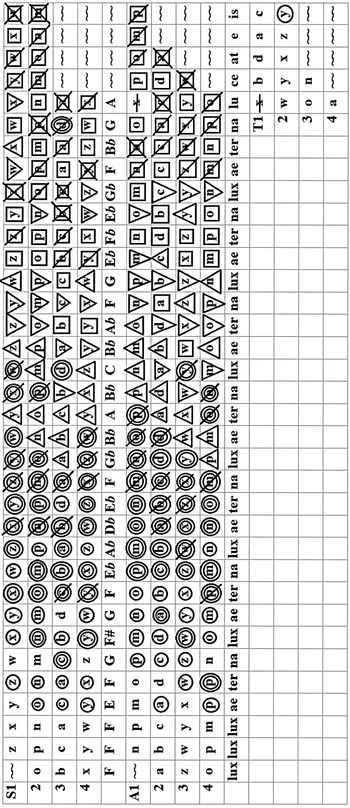
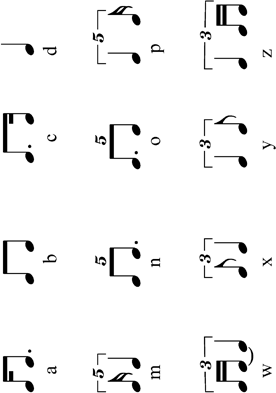
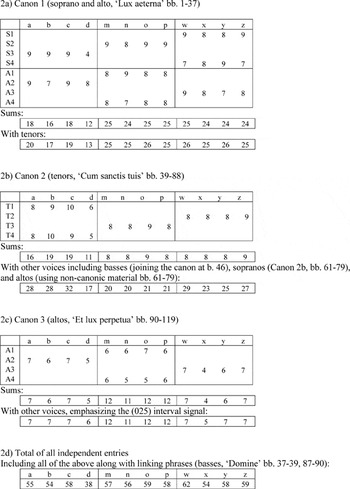
The first clue to a deeper level of organizational principles and regulations for individual rhythmic changes comes from a page in the sketches for Lux aeterna (transcribed in Figure 2a).Footnote 26 In this sketch the composer has planned out the opening section of the piece. The sketch includes the text, the note names connected with each syllable of text, and a list of letter names which stand for rhythmic ideas. Specifically, each letter name refers to the exact point within the crotchet beat at which a note will change. Figure 2b is a transcription from another page in the sketches (omitting several scratched out drafts and extraneous material) which associates these letter names with specific rhythmic modules.Footnote 27 These also show Ligeti's preference for using retrograde-symmetrical pairings of beat divisions (e.g. dotted-quaver+semiquaver reversed to semiquaver+dotted quaver) and his care in avoiding the duplication of any individual time point in different strands (which could have occurred in the quadruple and sextuple divisions, for example).
Transcription of Ligeti's sketch, planning the opening section of Lux aeterna
N.B. The original sketch contains much that is scratched out or written over, and I have transcribed only the end result of these changes. I have also re-notated the pitches with accidentals rather than using the German system (e.g. changing “Fis” to “F♯”). There are two inconsistencies or apparent mistakes in Ligeti's sketch, however, which are both transcribed here – first, in the line for soprano 1, the x module is marked with a double-circle and slash twice (the 12th and 18th notes); second, in the line for alto 4, the 11th note (‘Lux’, A♭) is written as an “n” but realized in the score as an m-module.

Rhythmic modules used in Lux aeterna.
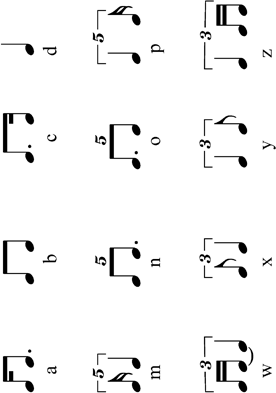
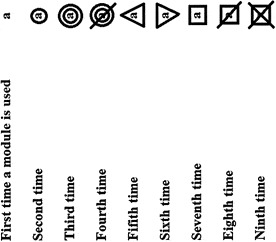
The circles, triangles and boxes around these letters are a refined system of tallying the number of times each letter is used, as explained in Figure 2c.Footnote 28 Sketches for Ligeti's earlier works, including Artikulation and Apparitions, show simple hash-mark tallying of the number of instances of a particular duration.Footnote 29 This tallying was often deployed in conjunction with the technique Ligeti compares to using a printer's letter case,Footnote 30 where smaller durations are more common than longer ones according to a desired global distribution. In Lux aeterna, however, Ligeti monitors time points rather than durations, and he clearly favours the equal (or near-equal) distribution of these divisions of the beat.
Tallying system used in Lux aeterna.

Through the work's opening section, then, these modules are distributed as evenly as possible. In the sextuplet divisions (w-x-y-z) each letter occurs 7 to 9 times in the voices S1, S4, and A3, and each letter occurs 24 times total in the section, with the exception of w, which occurs 25 times. The quintuplet divisions (m-n-o-p) have a similar distribution, occurring 7 to 9 times in each voice (S2, A1, A4) and 25 times each in the total, with the exception of n which occurs 24 times. The unmodified semiquaver divisions (a-b-c-d, in S3 and A2) are less regular, as Ligeti seems reluctant to use ‘d’ – requiring a note change that would fall on the conductor's beat – as often as the others. These totals are given in Table 7a.
The other major canons of the piece show a similar tendency towards equal distribution of these rhythmic modules, as summarized in Table 2b and 2c. The initial canon on ‘Cum sanctis tuis,’ carried by the tenors, uses the quintuplet and sextuplet modules either 8 or 9 times each. The simple semiquaver modules are carried by both Tenor 1 and 4, and as before, de-emphasize ‘d,’ the ‘on-beat’ note change, resulting in a slightly skewed balance in this particular division. Canon 2 is the densest section of the piece, and also the most varied in terms of material. The basses join the tenors with only a part of their canon, while the sopranos and altos use a different part of the text (‘Requiem aeternam’), with the altos even abandoning the strict canonic arrangement shared by the other voices, and emphasizing the (025) signal, as mentioned earlier. Nevertheless the other voices in this section remain fairly well balanced within the whole.
Tally of rhythmic modules used in Lux aeterna.

The final canon of the piece, ‘et lux perpetua’ in the altos, follows in kind. The apparent neglect of x and y in the sextuplet divisions is explained by the fact that the other voices use these divisions prominently in the final section of the piece, albeit separately from the canon. If independent instances of ‘x’ and ‘y’ are counted as contributing to the presence of these modules, then the distribution becomes 7-5-7-7, much closer to equal. Moreover, similar uses of both ‘b’ and ‘d’ bring the sixteenth layer in this section to a tally of 7-7-7-6. In fact, with the exception of the ‘d’ modules, through the whole of Lux aeterna one could achieve perfect equality of distribution of these rhythmic divisions by changing as few as seven notes; out of the 668 independent note changes in the piece this constitutes a deviation from the ideal of barely 1%.
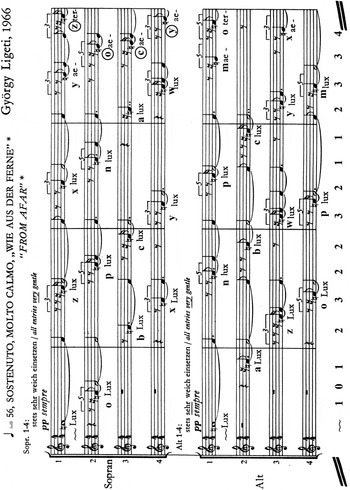
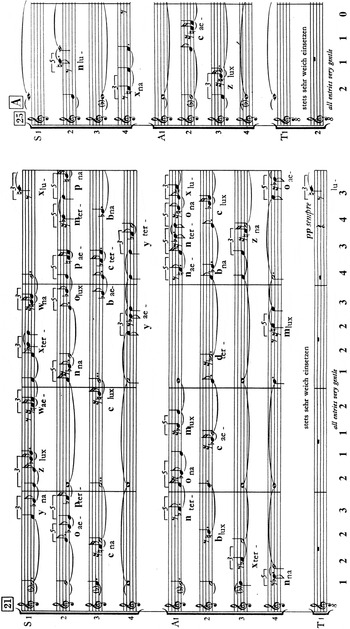
While these rhythmic modules loosely reflect the influence of serial thought in their preference for symmetry and equal distribution, they are not serially arranged – there are no systematic permutations or ordering schemes. Rather than retrogrades or inversions of basic orderings of these modules, their arrangement seems to reflect the ‘varietas’ principle that Ligeti discussed in relation to Ockeghem, aiming for minimal repetition of any given segment. And in support of this, we can begin to uncover several rules that help refine their use in Lux aeterna, and which, although unwritten, can be formulated with the same precision as the rules for pitch in the Requiem's ‘Dies irae’. For instance, no module is used by different voices in the same beat – that is to say, different voices do not change together. Modules may be repeated, although rarely are there more than two consecutive occurrences in the same voice before moving to a different division. These principles appear to have directly guided Ligeti's work on the final score. Example 4 presents my completion of a type of analysis found in a partial draft of the score.Footnote 31 Here, we can see Ligeti using this same system of tallying rhythmic modules. The letter symbols, written over the notes of the score itself, and done in green ink in the original sketch, would have given him the flexibility to make adjustments to the musical surface that might not be foreseeable in the abstract plan, while still ensuring an equal distribution, thus shortening the conceptual distance between the early, abstract planning and the concrete musical surface.
Lux aeterna, opening (C.F. Peters, 1968, reproduced with permission).

Continued

In addition to the rules governing the use of these rhythmic modules, Ligeti was also concerned with another type of constraint: the rate of change from beat to beat, which he calculated at the bottom of each system of the score, this time in red ink. He counts the number of modules used in each beat, i.e. the number of note changes including syllable changes on the same pitch. Throughout Lux aeterna the rate of change is consistently within the range of plus-or-minus one, from beat to beat. So if there are three note changes in one beat, the next can have two, three, or four, but not one or five. This is a way of ensuring a smooth surface without any sudden changes, or bursts of activity, and something we can take as another important ‘rule’ of his new counterpoint for this piece. Moreover, no more than four note changes occur in any one beat, setting a maximum level of activity for the piece. By balancing this concern for rate of change with his distributional scheme for avoiding periodicity and mixing beat divisions, Ligeti arrives at the essential features of rhythm in the mature form of this style of counterpoint. Balancing the vertical, harmonic constraint of cluster-like, secundally-weighted sonorities there is a horizontal constraint – a certain number of voices can, and must change from one beat to the next, but those voices must do so with respect for a global balance of time-points, and also with respect for the harmonic criteria.
In toto we can postulate a set of rules for rhythm in this type of counterpoint quite succinctly and formally:
1. Each voice uses one rhythmic strand, based in sextuple, quintuple, or quadruple divisions.
2. Within each rhythmic strand, there are four possible places for a voice to change, reflecting the rhythmic modules (a,b,c,d; m,n,o,p; and w,x,y,z).
3. These rhythmic modules are distributed as evenly as possible through major sections of the piece.
4. No two voices use the same rhythmic module during the same beat (i.e. no two voices change at the same time).
5. The direct repetition of rhythmic modules in the same voice is allowed, but should be used sparingly. There should be a maximum of two of the same modules in a row before changing to another module, or as a rare exception three.
6. No more than four voices change in any one beat.
7. From one beat to the next, the number of voices that change should be within the range of plus-or-minus one from the number of voices that changed in the previous beat.
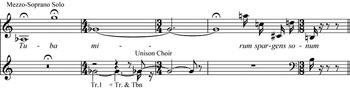
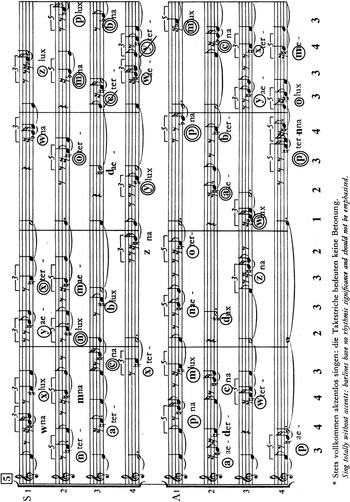
There are very few exceptions to these rules, and in general, due to the redundancies that Ligeti has built into his rules and the consequent robustness of the system, these exceptions prove to be largely inconsequential. One such point is the entrance of Tenor 1 in b. 24 (Example 5). Several factors indicate that the tenor part here is not to be considered an independent voice. The fact that it coincides with both Soprano 1 and Alto 1 (which has broken species from quintuplets to sextuplets), the fact that this coincidence is both in rhythm and in pitch (or pitch class, with the soprano) and even on the same syllable (‘lu’), and the fact that the entry is marked as ‘very gentle’ and ‘pp sempre’ all indicate that this is to be an imperceptible entry, the tenor first reinforcing the alto part and then branching off later. Also supporting this interpretation is Ligeti's approach to rate of change; calculating these three voices together as a single change results in three total changes in the beat, rather than five, and is thus more consistent with rhythmic practice in the rest of the piece. A passage towards the end of the piece (starting in b. 94) also involves non-independent voices changing together in a similar way. Other exceptions are very slight, involving one moment (b. 74) where rate of change is slightly disrupted, and two instances where a voice uses the same module three times in a row. Given the remarkable consistency of the piece as a whole, these minor deviations are imperceptible.
Lux aeterna, bb. 21–5 (C.F. Peters, 1968, reproduced with permission).

It is not surprising that Ligeti was aware of how his music might be heard by an audience, given that much of his critique of Boulez's Structures Ia had to do with the same issues of perception. In considering his works from the 1960s, Ligeti expressed a conscious concern with the overall effect resulting from his system of rules:
Technically I have always approached musical texture through part-writing. Both Atmosphères and Lontano have a dense canonic structure. But you cannot actually hear the polyphony, the canon. You hear a kind of impenetrable texture, something like a very densely woven cobweb. I have retained melodic lines in the process of composition, they are governed by rules as strict as Palestrina's or those of the Flemish school, but the rules of this polyphony are worked out by me. The polyphonic structure does not actually come through, you cannot hear it; it remains hidden in a microscopic, under-water world, to us inaudible. I call it micropolyphony (such a beautiful word!). All in all, you cannot hear my music as it appears on paper. Of course, while actually composing each piece I worked on what we hear, as we hear it.Footnote 32
These rules do, indeed, have a direct relationship to the expressive goals of the piece as a listener may perceive them, and one can easily see how they are geared towards a typical effect.Footnote 33 The strict regulation of rhythmic strands ensures that there will be a constant conflict between divisions into fours, fives and sixes and that no pulse will come to the fore. The regulation of time-points will reinforce this, and prevent any kind of periodicity from emerging within the texture, even momentarily. The regulation of attacks per beat ensures that the surface will remain seamless and smooth, making only the most gradual ebb and flow. Moreover this general effect relates quite clearly to the expression of eternity implied by the title of the work – eternity as a stretch of time that is indivisible and immeasurable.
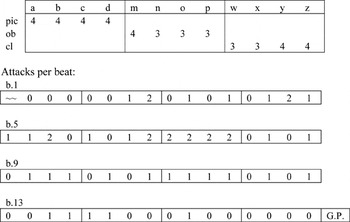
In addition to this clear aesthetic goal, Ligeti's newly developed technique provided a practical benefit, in the form of a definite means of regulating rhythm and texture.Footnote 34 The works leading up to Lux aeterna made incremental progress towards this fully-defined technique. In sections of Atmosphères and Aventures, Ligeti investigates a wide range of possible rhythmic modules. Later, in parts of the Requiem – especially the ‘Christe’ sections of the ‘Kyrie’, and the chorales, ‘Salva me’ (bb. 94–100) and ‘Oro suplex’ (bb. 148–158) in the ‘Dies irae’ – he refines the use of the modules to a repertoire similar to that of Lux aeterna, but he is more haphazard in their distribution and regulation. In fact, in sketches for the Requiem, Ligeti is still calculating durations, monitoring them for non-repetition, and it is not until Lux aeterna that he fully implements the system of tallying time-point modules and monitoring rate of change.Footnote 35 Once Ligeti developed these rules, he drew on them repeatedly, and in sketches where Ligeti is brainstorming ideas for a new piece, numerous references to the ‘Lux technique’ occur. A brief look at the ninth movement of the Ten Pieces for Wind Quintet reveals not only the same canonic micropolyphony and division of voices into rhythmic strands, but it also shows exactly the same rhythmic modules and the same global distribution (Table 3). The constraints on rate of change are largely the same as well; there are only a few instances where the rate of change decreases by two notes in a single beat, but all of the accelerations are strictly measured. Thus the rhythm is constructed nearly identically to that in Lux aeterna in every regard.
Rhythmic structure of Ten Pieces for Wind Quintet, movement 9.

Thus Ligeti's handling of rhythm in Lux aeterna is significant in a number of ways: as a shift from thinking in terms of durations to thinking in terms of time points and rate of change, but also as a refinement of his technique, and a tool to construct the fluid-yet-static music for which he was gaining a reputation. Moreover, this link between technique and style posits a significant difference in compositional philosophies between his approach and that of Boulez and other Darmstadt contemporaries, whose compositional systems were an outgrowth of serialism. Much of the rhetoric around serial rules involves ‘generation’ of material and ‘logical consistency’ between ideas, where the expression of a form is the result of the logic of the technique. In the ideal articulated by Boulez, ‘aesthetics, poetics, and technique are all in phase’ and there is a union stretching from ‘the generating of the component materials right up to the global architecture of the work.’Footnote 36 In his article, ‘Metamorphoses of Musical Form,’ Ligeti identifies several problems arising from the overuse of serial preformation and the unintended consequences of such extensive and detailed planning, especially regarding the coordination of lines, which might rely on independent rhythmic schemes. Ligeti objects that, ‘the composer can hardly even retain an influence over the intervals that are to result, let alone determine them. They follow automatically from the type of procedure.’Footnote 37
In place of this compositional approach – the ‘decision and automatism’ described in his analysis of Structures – Ligeti advocates two different phases of compositional labour:
1. Serial preformation of the global determining factors.
2. Filling out by detailed decisions the network of possibilities that is the result of the first phase. The desired characters can be worked out by postulating or avoiding certain specific constellations.Footnote 38
Ligeti describes this model as a ‘statistical-serial regulation’ that is ‘slightly reminiscent of traditional systems of control,’ where both ‘predetermination and chance are kept within bounds… [so that] a composer can work out individual, unconfused characters,’ and where ‘the weight of serial composition has been shifted onto the global categories… The total form is serially guided, but the individual moments are, within given limits, left to the composer's discretion.’Footnote 39 This focus on developing ‘unconfused characters’ in music seems to be of the utmost importance to Ligeti, which he places in opposition to the ‘indifference’ he sees in works like Structures.Footnote 40 In fact, this stance separates him quite clearly from the more logical-positivist viewpoint of many of his contemporaries who would maintain that the appropriate subject for a work of art is the elucidation of aspects of its structure. Ligeti joins Adorno in labeling this a ‘fetish’ of technique.Footnote 41 In place of duration series or other systems for generating material, he imposes additional constraints on decisions affecting every beat. And by reducing the amount of material determined by each decision, he tightens his control over the musical result, allowing for a high level of complexity and intricate detail, while still guarding against chance, instinct, and habit by adhering to the rules for global balance defined at the outset.
In a piece like Structures, as well as in the alienating worlds described by Piranesi and Kafka, technique seems to be its own end, eclipsing what is foreseeable by the composer and perceptible by the audience. Ligeti spells out his response to the over-reliance on automatism, first theoretically in ‘Metamorphoses of Musical Form,’ and then practically in his compositions. Recalling that in this same essay one of Ligeti's particular complaints is the tendency of both integral serialism and chance composition to result in structures he describes as ‘event – pause – event – pause, etc.,’Footnote 42 it is a simple matter to read the seamless continuity in pieces including Atmosphères and Lux aeterna as a direct response to this. Lux aeterna is a response at the theoretical level as well, on account of the way the strictures determining counterpoint in this work systematically deter the development of any rhythmic profile that could disrupt or segment this continuity. Rather than allowing structure to follow as a logically consistent result of technique, and running the risk of having the system take control of the aesthetic experience, Ligeti develops his rules to ensure that the desired content is achieved, and that the specifics of his technique support a preconceived idea of the work. In the Requiem and Lux aeterna Ligeti has managed to construct an adaptable system without losing sight of the initial inspirations for the compositions or the original intention of the rules, and by doing so he has created exactly the kind of system described in his writings; to borrow from the composer's own imagery, he has constructed a prison where he is free to do as he pleases, where he can tug at his own chains in exactly the way he wants, and determine the effect of every little push and pull.