1. Introduction
Social interactions and trust among farmers have been documented as crucial for farmer's well-being and for the design of support programs. For example, informal insurance mechanisms (Fafchamps and Lund, Reference Fafchamps and Lund2003; Karlan et al., Reference Karlan, Mobius, Rosenblat and Szeidl2009), adoption of new farming techniques (Conley and Udry, Reference Conley and Udry2010) or take up of insurance products (Karlan et al., Reference Karlan, Osei, Osei-Akoto and Udry2014) have been shown to be closely related to information about and trust in neighbor's behavior.
We focus on the case of coffee, in which mill's buying locations are focal for farmers’ social interactions and two institutional types of mill ownership coexist (privately owned and cooperatives). Although cooperatives are often viewed as institutional structures that enforce social and fair behavior, scientific evidence of the existence of such effects is scarce. Through the analysis of contributions to an experimental public good performed with coffee farmers in Costa Rica, we analyze how farmer's behavior depends on the type of mill to which they sell their coffee (cooperative vs. privately owned mills). We additionally vary the background of the partners they are paired with in the game (partners selling to same vs. a different type of mill) and study how self-selection into a mechanism that will punish the lowest contributors in the group affects contributions.
Specifically, we address the following general questions: (1) Do the two types of farmers react differently when interacting with farmers selling to the same type of mill versus the other type? and (2) In case a mechanism could be established to punish free riders, which group of farmers would be more willing to implement such a mechanism, and how would it affect contributions? The answers to these questions allow us to analyze whether belonging to a participatory institution (cooperative) has a differential effect on the contributions inside the mill compared to farmers selling to private mills. Our main result is that farmers selling to cooperative mills cooperate less with game partners that do not sell to a cooperative mill, and they respond more to the introduction of control mechanisms.
Costa Rica is a good setting to answer these questions. Land distribution is quite homogeneous among many small farmers, and historically the relationship of farmers with all types of mills has been peaceful (Paige, Reference Paige1997). The role of Instituto del Cafe de Costa Rica (ICAFE), the coffee board, is to regulate the distribution of profits along the value chain with no intervention on the farmer's choice of where to deposit their cherries.Footnote 1 We focus on behavior by coffee farmers that are active members of a cooperative and contrast their choices to farmers that are selling to the privately owned mills. The peculiarity of our sample is that almost all farmers have belonged to a cooperative at some point in their lives, and for different circumstances (mainly financial failure of the institution), a part of them got involved in selling to the private sector. We acknowledge that the coexistence of the two types of mills in the same areas raises selection issues into each type of mill, and we therefore do not attempt to make causal claims for the observed effects.Footnote 2 On the other hand, this coexistence offers the possibility to study how the type of mill the farmers in a given area sell to affects behavior with farmers selling to either type of mill present in their community.
We structure the presentation of our results along three main parts: (1) Do the contributions to the public good game differ between farmers belonging to the two types of mills when they play with partners selling to the same type of mill? (2) What is the relationship between the groups, i.e., are contributions sensitive to the background of the partners when farmers of different types are matched? and (3) In which settings (which type of mill and against which partner's background) will farmers be willing to add a mechanism to the public good game that punishes free riders and what will be their reaction to it when added? Finally, as an external validity check, we study whether cooperative farmers’ side-selling behavior is correlated with experimental contributions.
With respect to the first question, both cooperatives and privately owned mills offer farmers a forum of interaction. The main difference between the two types of mills is that cooperatives provide an institutional structure that allows its members to ‘cooperate’ for joint social or financial benefits. We find that contributions in a public good game played with partners from the same type of mill do not differ significantly across the two types of mills. This result shows that the extra-involvement intrinsic to the cooperative structure does not translate into more collaborative behavior. Or inversely that more cooperative individuals are not more likely to join cooperative structures.
When looking at the reaction to the background of partners, we find that cooperative farmers strongly react to it, significantly decreasing contributions when paired with farmers selling to private mills. For private market participants, on the other hand, we do not find significant reaction to the background of partners. One possibility is that this result is due to a ‘negative stigma’ attached to private mills from the point of view of cooperative farmers. This is supported by the fact that cooperative farmers reporting at least some side selling make a significantly smaller difference between the groups than cooperativists not reporting side selling. Other possibilities could be related to differences with respect to individual characteristics or group identity and are discussed at the end of this paper.
After analyzing the behavior on the standard public good game, we offer participants the possibility to introduce to the game a mechanism that penalizes free riders. The role of this scheme is to implement a fee on the lowest contributor to the game and revert part of this fee to the common pool. We find that the adoption of this scheme is very high across groups and partners: from 93% for farmers selling to private mills when matched with cooperativists to 73% for cooperative farmers playing with private market participants. Although the introduction of the scheme does not have a significant effect when matched with partners selling to the same type of mill, its effect is large (increase of 3 contribution points over 10 feasible) when matched with partners of a different background.
In an extension, we discuss the external validity of abstract game behavior by correlating free riding in the abstract public good with real-world side selling. We find that side selling is negatively correlated with public good contributions.
The paper contributes to several strands of the literature. First, cooperatives are a traditional cash crop structure in developing countries and have been extensively studied. Banerjee et al. (Reference Banerjee, Mookherjee, Munshi and Ray2001) and Sukhtankar (Reference Sukhtankar2012) have analyzed how land distribution and political pressure affect their governance structure and outcomes for farmers, and Simmons and Birchall (2008) have focused on their lack of success in increasing well-being of rural poor. We add to this literature by checking how cooperatives may affect farmers’ collaborative behavior, and cooperative farmer's choice of institutional mechanisms in that context.
Second, the paper adds to the literature making use of experimental economics to measure cooperative behavior and social capital (e.g., Fehr and Leibbrand, Reference Fehr and Leibbrand2011; Karlan, Reference Karlan2005). Studies of in-group versus out-group behavior suggest that contributions are higher when paired with participants from one's own group than with out-group members (Bernhard et al., Reference Bernhard, Fehr and Fischbacher2006; Goette et al., Reference Goette, Huffman and Meier2006; Tajfel and Turner, 1979). Differences in pro-sociality of different types of groups have also been investigated by Banuri and Keefer (Reference Banuri and Keefer2012), by comparing the behavior of government officials in Indonesia with the private sector participants. Experimental work on fishing cooperatives (Carpenter and Seki, Reference Carpenter and Seki2011; Gelcich et al., Reference Gelcich, Guzman, Rodriguez-Sickert, Cardenas and Castilla2012) shows that special institutional structures as pooling of fish and involvement of well-organized unions can increase contributions in laboratory settings. Our contribution is to look at behavior related to interactions with the own versus a different group, where one of the groups is composed of farmers from cooperatives and the other of farmers selling to private mills. Cooperatives add benefits (credit, supplies and public goods as health and education programs) but also costs (assemblies, exclusivity restrictions on sales) to the social interactions taking place at mills. One limitation of our setting, discussed at the end of this paper, is that we cannot control for selection into the two groups. Although this is a limitation, the coexistence of both types of mills at the same location is what allows us to compare behavior of farmers with respect to own and the other type of mills.
Finally, we provide some insight related to the sustainability of both types of institutions. Indeed, side selling, even if it violates the cooperative's exclusivity clause, is common and has given rise to a growing literature on loyalty of members to the cooperatives (e.g., Casaburi and Macchiavello, Reference Casaburi and Macchiavello2015). In our extension, we study the collaborative behavior of farmers that declare to side sell a part of their production.
The structure of the paper is as follows. In Section 2, we describe the setting in which the study was performed and the details of the sample. Section 3 presents the structure of the study. In Section 4, we present the results. Section 5 presents extensions to analyze how real-world behavior and cooperative characteristics correlate with contributions. Section 6 provides a discussion and Section 7 concludes.
2. Background and data
Coffee market in Costa Rica
Coffee is the third most important agricultural export product in Costa Rica, after bananas and pineapples.Footnote 3 In Costa Rica, coffee commercialization is at the hands of the private sector, with strong supervision by the state through the ICAFE.Footnote 4
At the first stage of the coffee value chain, coffee farmers have the choice to bring their produce to any mill with the constraint of bringing the cherries to the mill within 24 hours from collection. In all districts (sub-locations), the farmers can go to two types of mills: privately owned and cooperatives. On average, there are six mills buying coffee at each location, ensuring plenty of choice to the farmers. The sales to both types of mills, with respect to payment terms and prices paid, are subject to identical ICAFE regulations. However, cooperative mills have membership requirements as well as exclusivity clauses specific to the cooperative institution.
Cooperativism is important in the Costa Rican culture and economy: 37% of the economically active population is directly or indirectly related to a cooperative. From the estimated 52,500 farmers growing coffee in Costa Rica, 26,881 are members of cooperatives.Footnote 5 As presented in Paige (Reference Paige1997), cooperatives have historically had an important role on the coffee industry in Costa Rica. All cooperatives have the same governance structure as regulated by the Costa Rica cooperative laws. The internal regulation for each of the cooperatives establishes the roles and responsibilities of the cooperative members. Among other, these regulations establish the obligation of members to bring all their produce to the cooperative and the vote and voice rights attached to cooperative membership. Cooperatives offer their members multiple benefits, like credit for inputs and training in farming techniques.
Sample characteristics
We conducted our study with coffee producers selling to each type of mill: private and cooperative. The mills where the study was performed are located at the high-altitude mountains and valleys of the Tarrazu region and at the lower altitude volcanic region of Turrialba. The Tarrazu region, in Los Santos District, represents 30% of the Costa Rican coffee production and is the country's most traditional coffee region, with the majority of farmers not having alternative sources of income. The three cooperatives and one of the private mills that we visited are located in the Tarrazu Region. The second private mill is located in the Turrialba region. Detailed information about the different areas can be found in Appendix A in the supplementary material.Footnote 6 We observe no major differences between the areas involved in this study concerning land tenancy or use. The selected cooperatives and private mills are similar in terms of age and competition from other mills in the area. The cooperatives and private mills were selected in a traditional coffee area and with similar characteristics to be able to compare the behavior of both cooperative and non-cooperative farmers.
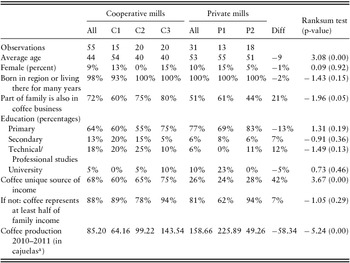
Farmers were contacted by the cooperative or private mill, respectively, to ask their voluntary participation in a scientific study. All the collaborating institutions were requested to contact a random sample of farmers from the mill.Footnote 7 Response rates were approximately 70%. The study was run in groups of 15–20 farmers at the cooperative meeting room and at adapted spaces at the private mills and lasted for approximately 2 hours. The average age of participants was 47 years and about 10% of participants were women. Summary statistics of the participants can be found in Table 1.
Summary statistics of participants.

aOne cajuelas is approximately equal to 4 pounds of roasted coffee.
Our aim is to compare the two groups in terms of behavior inside the group and with respect to the other group. We analyze if belonging to a participatory institution (cooperative) has a differential effect on the contributions inside the group compared to farmers selling to private mills. Common to both types of group are the social interactions at the buying point but they differ with respect to the management of the institution. An obvious concern when considering the two samples is that the two groups are not randomly assigned. It needs to be noted that in all the locations where the study was performed there were buying points of both types of mills. Table 1 presents the descriptive statistics for both samples. Farmers selling to cooperative mills are significantly younger and less likely to have other sources of income than coffee. Farmers in both samples reported to know almost all the farmers selling to the same mill buying point. In the post-experimental questionnaire, only 16% of the farmers selling to private mills reported to have never been members of a cooperative. We control for these characteristics in our analysis to acknowledge the selection concerns. However, farmers belong to small communities, where family and social interactions are of great importance and the point of deposit for coffee is an important social and economic meeting point that is not easily changed, especially for older generations.
3. Methods
The experimental part of the study had two parts, as summarized in Figure 1. The protocol can be found in Appendix B in the supplementary material. All participants made choices with respect to four different incentivized choice tasks in which they had to make decisions concerning contributions to an abstract public good option. Across the tasks, we varied the identity of the partners (either cooperative farmers or free market participants) and whether a control mechanism was available or not. No feedback was given between the tasks.
Order of the tasks during laboratory study.

Hence, the first part of the game allows us to compare the contributions of participants depending on the background of their partners. The second part of the game allows us to study, on the one hand, the decision to introduce the control mechanism depending on the type of partners, and, on the other hand, the reaction to this mechanism (when activated) depending on the background of the other players.
In total, 86 farmers participated in the study. Cooperative farmers were members of three different cooperatives (N = 55) and private market participants were associated with two different private mills (N = 31). To maximize the number of independent observations, participants did not participate in a simultaneous public good game but made individual decisions with respect to three hypothetical partners. Strategies of partners were drawn from previous sessions and pre-tests. This gives us a total of 86 independent observations concerning contributions to the public good.
Instructions were orally explained and a short written summary was provided (for the detailed protocol see Appendix B in the supplementary material). Given the age range (from 21 to 76 years old) and education level of participants, great care was taken that all participants understood the decision situation and could answer control questions. It was clearly explained that all decisions were anonymous and participants received an identifying code that was linked to their decisions. It was further stressed that experimental units would be exchanged for real money at the end of the session.Footnote 8 After the decision task, participants were requested to fill out a questionnaire on personal information. At the end of the session, all decisions were paid out to participants and average total earnings represented approximately a half-day labor salary for participants (3,270 colonesFootnote 9 ).
Abstract public good task without control mechanism
Participants were presented with an incentivized questionnaire to elicit behavior in a public-good-type choice situation. The questionnaire format was used due to logistic constraints, not allowing for a proper experimental setup. Recent research has indeed confirmed that answers to hypothetical experimental scenarios are the best predictors of actual game behavior (Falk et al., Reference Falk, Becker, Dohmen, Huffman and Sunde2015).
The study had two parts, as summarized in Figure 1. The first part consisted of an anonymous choice task concerning investment into an abstract public good. Participants made their individual decisions and were informed that total public good production would be determined by their own choices and the strategies of three other players that had previously participated in the game.Footnote 10
Each participant received an initial endowment of 10 monetary units and had to decide how many of these to transfer to a group envelope (xi ∈ {0,10}). Each unit transferred to the group envelope was multiplied by 1.5 by the experimenters and the individual received 1/4th of the group envelope. The payoff function for the participant was therefore
 $$\begin{equation*}
{\pi _i} = \left( {10 - {x_i}} \right) + \frac{{1.5}}{4}*\left( {\sum {x_j}} \right).
\end{equation*}$$
Since individual payoffs are higher if all monetary units are kept in the private envelope, own payoff maximizing individuals should never transfer units to the group envelope.Footnote 11 The task was presented in neutral and abstract terms. Each farmer received two envelopes: One labeled ‘personal envelope’ with 10 monetary units (wooden ice-cream sticks) and one empty envelope labeled ‘group envelope’. Each participant had to decide how many monetary units to transfer from one envelope to the other. Participants made decisions on two different situations in relation to the origin of the three group members whose strategies they were matched with. Strategies came either from (1) farmers being members of a cooperative or (2) farmers that sell to private mills.Footnote 12 In an in-subject design, we can therefore compare behavior when paired with farmers that shared the same background or with farmers that belong to the other group. Envelopes concerning the different situations were color coded to avoid any confusion and collected by the experimental assistants at the end of each game. To simplify procedures, earnings from all games were paid out to participants at the end of the session. To avoid income effects or learning, no feedback about behavior of others was given between the games.
Participants were aware that their own strategies might be used to determine outcomes for participants in future sessions.Footnote 13 However, the Nash equilibrium in the two games is independent of the background of the partners: It is always optimal to keep all the points in the individual envelope. Hence, when analyzing the differences between them we can study the different beliefs about behavior of partners of different backgrounds and the effect of belonging to each of the groups. This exercise will allow us to analyze the cohesion inside each of the groups, cooperative and private and their reaction to playing with partners with a different background.
Abstract public good task with control mechanism
In the second part, we study the impact of a control mechanism that penalizes free riding and redistributes part of the collected fines to the group.Footnote 14 Participants were informed that they would have to make the same decisions as in the first part; however, for each game they could decide whether to add a control mechanism to the game and hence be paired with three other individuals that also had chosen to add such a mechanism. Participants that added the control mechanism had to pay a monetary cost of one point per game. The control mechanism was such that participants contributing less than the average of their group would lose some of their monetary units. To limit efficiency losses due to control, 1/4th of the collected fees were added to the public good envelope, the rest was returned to the experimenter. Implemented penalties differed across participants and were based on randomly drawn punishment strategies from previous pilot sessions. Since we wanted to study the general reaction to control, independent of knowing whether it would render free riding unprofitable, the precise penalty amount was held ambiguous and participants were informed that the mechanism was based on previous control decisions by other participants. Participants were informed that penalties would be proportional to their deviation from average contributions in the group.
This exercise will allow us to answer two questions: (1) in which situation concerning partners background are the participants more willing to activate the control mechanism? And, once control is activated, (2) in which situation does the control mechanism have a greater effect on contributions? And how does the answer to these questions vary for the two groups considered? The answer to the first question gives us a measure on the belief of the participant on the other players’ willingness to free ride, and the willingness to pay a cost to ensure other partners will have incentives to contribute. The answer to the second question gives a measure of how players act differently when they know free riding by others will be punished, and when they know they are playing with partners (whatever their background is) that also choose to introduce a control mechanism on the game. We will look both at how reaction to control depends on the group wherein the participants belong and to their previous experience with control mechanisms.
4. Results
We present the results following the structure of the experimental sessions. We start by analyzing the results of the public good games played with different partners’ background. We continue presenting the results on the willingness to activate the control mechanism by each of the groups with respect to the different game partners and conclude the results section with the reaction to the activation of the control mechanism on the different games played.
In the extension section, we discuss the external validity of the results by investigating how real-life behavior (side selling) affects contributions and reactions to the control mechanism.
Reactions to partners’ background
We start presenting how choices in the public good task are influenced by the pool from which are drawn the strategies of the three interaction partners. Cooperativists interacted either with other, unknown cooperativists or with farmers selling to private mills. We can compare this to behavior by free market participants being paired with either cooperative members or other private mill participants.
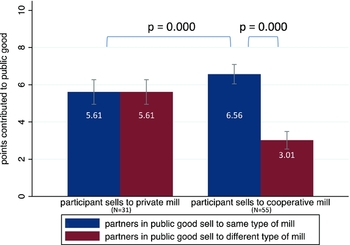
In Figure 2, we present the average contributions for each of the four games: Cooperative and private mill farmers playing with their own or other background partners. Contributions to the public good when playing with participants of one's own type were 65% for cooperativists (N =55) and 56% for farmers selling to private mills (N = 31) and were not statistically different (see Figure 2, Wilcoxon test, p = 0.1,419).Footnote 15 Contributions when playing with participants from the other group were 30% for cooperativists and 56% for farmers selling to private mills. Contributions by cooperativists strongly decreased when being paired with private mill participants (Wilcoxon test, p = 0.000).
Contributions in public good scenario dependent on background of partners.

Result 1: In the games played with own background partners, there are no significant differences across the two groups. In the games played with partners from the other group, contributions significantly decrease for cooperative farmers while are very similar for the private mills participants.
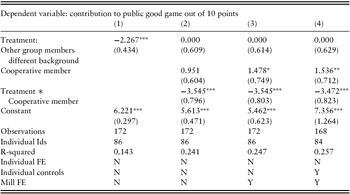
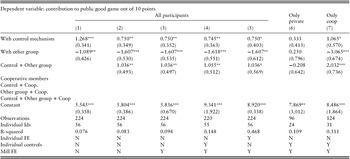
We present in Table 2, the result of the estimation of the determinants of the contributions to each of the games. We will estimate
 $$\begin{eqnarray}
{c_{ib}} &=& \alpha + \ \beta {}^{*}\;{\rm{PartnersBackgroun}}{{\rm{d}}_b} + \ \gamma {}^{*}{\rm{MillTyp}}{{\rm{e}}_i}{}^{*}{\rm{PartnersBackgroun}}{{\rm{d}}_b} \nonumber\\
&&+\, \ \delta {}^{*}{X_i} + \ {\varepsilon _{ib}}
\end{eqnarray}$$
where cib represents contribution of individual i to the game played with own or other partners background, and Xi is a vector of individual characteristics.
Contributions to public good as function of background of others.

Robust standard errors in parentheses (cluster individual):*** p < 0.01, ** p < 0.05, * p < 0.1.
Individual controls: Age, gender, born in the town, other incomes than coffee, education.
We see in Column (1) of Table 2 that there is a negative and significant effect of playing with partners of a different background, but in column (2) we see that this result is driven by the cooperative farmers group. Cooperative farmers contribute in both games more than farmers selling to private mills, but they do contribute significantly less when the background of the partners is different from their own. In columns (3) to (5), we show that this result is consistent when we include individual controls, individual fixed effects and mill fixed effects respectively.
The reaction by cooperative farmers also indicates that members of cooperatives cannot be categorized as ‘generally’ more willing to contribute to the public good. The hypothesis that both institutions provide a center of interaction among the farmers seems supported by the fact of non-different contributions towards the own group in both cases. In contrast, farmers selling to the private mills were not influenced in their behavior by the background of their partners. Recall that cooperativists have generally always been members of a cooperative and only 31% of them have occasionally sold to a private mill (another 30% report having sold to other cooperatives). Thus, cooperativists have, in general, had very limited interactions with farmers selling to private mills. In contrast, only 16% of private mills participants have never been part of a cooperative. The previous result thus suggests that having had previous exposure to other deposit structure influences game behavior. This is confirmed when comparing contributions by farmers (both private and cooperative) that have previously sold coffee to another sort of deposit structure to those that never did. We find that the average contribution when paired with participants from the other structure is 47% for farmers that have sold to other structures (N = 43) versus 31% for farmers that have never done so (N = 43) (Wilcoxon test, p = 0.012). We discuss side selling further in the extensions.
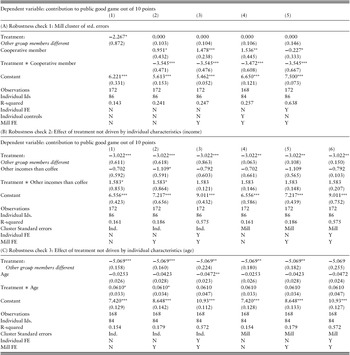
As robustness tests, in Table 3, we present the results clustering the standard errors at the mill level and the interaction of the treatment (playing with different background partners) with two individual characteristics. We see that the interaction of the treatment with age and alternative sources of income, the characteristics that were statistically different between farmers belonging to the two groups, is not robustly significant. These are the two individual characteristics on which the sample of participants in both types of mill differed; hence, we can interpret it as a test of the results being driven by the institutional characteristics of the cooperatives and not by individual characteristics.
Robustness checks for contributions in function of partners’ background.

Robust standard errors in parentheses (cluster mill):***p < 0.01, **p < 0.05, *p < 0.1.
Individual controls: Age, gender, born in the town, other incomes than coffee, education.
Introducing external control
In the second part of the study, farmers were informed that they would make decisions concerning the same situations as encountered in the first part but that they would have the possibility to self-select into groups that either have or do not have an impartial control mechanism. This mechanism would penalize free riding and would redistribute part of the collected fines but had a cost to be paid by each of the farmers who decide to add the mechanism. Figure 3 shows the proportion of participants opting for the control mechanism. A total of 83% of cooperativists opt for control when playing with other cooperativists, whereas 72% do so when paired with private mills participants.
Decision to choose control mechanism by cooperative and private market participants dependent on background of partner.

A concern at this point is how participants self-select into the treatment with the control mechanism. We first check whether participants that choose to introduce the control made significantly different contributions in the first games, and we can reject this being the case (Wilcoxon p = 0.64 for own group and p = 0.1,281 other group, no significant effect for cooperative or private mill sellers). The only individual characteristic related to selection into control for the cooperativists when playing with sellers to private mills is their previous experience with private mills: Cooperativist that reports to have sold coffee to private mills choose less often control when matched with private mills participants (Wilcoxon p = 0.059).
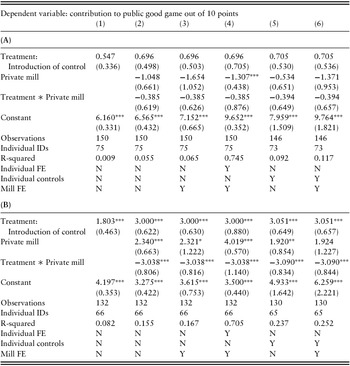
Although control is almost equally often chosen by cooperativists and by private mill participants, the effect of control on behavior in the abstract public good is significantly different for the two groups. Figure 4 shows contributions in the second part of the study when control was available, and as reference we also include contribution levels from the games played when no control was available. We only consider participants that chose to add control in the second part. We see that the insurance against free riders by control has a significant effect on contributions by cooperativists, both when playing with their own type and when playing with private mills’ participants. The increase in contributions when playing with their own type is about 10%, and the increase when playing with private mill participants is more than 100% (see also Table 4). In contrast, control has no effect on contributions by private mill participants. We therefore observe the following result.
Contributions to Public Good when control mechanism is chosen.

Contributions to public good when playing with (A) own group and (B) other group, dependent on control being active.

Robust standard errors in parentheses (cluster individual): ***p < 0.01, **p < 0.05, *p < 0.1.
Sample: participants that choose to include control when playing with own group.
Individual controls: Age, gender, born in the town, other incomes than coffee, education.
Result 2: Introducing an institution that would punish free riding increases contributions by cooperativists when paired with both cooperativists and with private mill participants.
We proceed now to study how the control mechanism increases contributions for each of the possible partners’ background. We estimate, for the games played with own and with other group partners,
 $$\begin{eqnarray}
{c_{ibc}} &=& \alpha + \ {\beta _1}{}^{*}{\rm{PartnersBackgroun}}{{\rm{d}}_b} + {\beta _2}{}^{*}{\rm{ControlActiv}}{{\rm{e}}_c} \nonumber\\
&&+\,\ {\beta _3}{}^{*}{\rm{PartnersBackgroun}}{{\rm{d}}_b}{}^{*}{\rm{ControlActiv}}{{\rm{e}}_c} \nonumber\\
&&+\, \ {\gamma _1}{}^{*}{X_i}{}^{*}{\rm{PartnersBackgroun}}{{\rm{d}}_b} \nonumber\\
&&+\, \ {\gamma _2}{}^{*}{X_i}{}^{*}{\rm{ControlActiv}}{{\rm{e}}_c} + \ \delta {}^{*}{X_i} + \ {\varepsilon _{ib}}
\end{eqnarray}$$
where cibc represents contribution of individual i to the game played with background partners b (own vs. other group) and with control c (not activated or activated), and Xi is a vector of individual characteristics. In Column (1) of Table 5, we see that the introduction of a control mechanism has a positive and significant effect on contributions, whereas the fact of playing with partners from the other group has a negative and significant effect. In Column (2), we see that the interaction term between partners’ background and control is positive and significant: The increase in contributions is greatest when control is introduced in the game played with the opposite group. Columns (3) to (5) show that the result is consistent when including mill and individual fixed effects, and individual controls, respectively. In Columns (6) and (7), we split the sample for cooperative and private mill participants, and we show that the effect of the control mechanism and group is mainly driven by the farmers selling to a cooperative mill. Column (8) confirms the previous result with the pooled sample and dummies for a mill type. We proceed with a more detailed analysis of the farmers selling to a cooperative mill in the following section.
Contributions to experimental public good.

Robust standard errors in parentheses (cluster individual): ***p < 0.01, **p < 0.05, *p < 0.1.
Individual controls: Age, gender, born in the town, other incomes than coffee, education.
5. Extension: real-world behavior (side selling)
In this section, we analyze how the farmer's real-world behavior relates to the choices made in the lab. We exclusively focus on farmers that are members of a cooperative (N = 55), recognizing that this is a rather small sample.
Cooperativists face a real-world free-riding problem: Financial and technical assistance from the cooperative are guaranteed by membership independently of the production and hence of the contribution to the institution. Cooperative members therefore have the possibility to benefit from the ‘common services’ while side selling a part or all their high-quality harvest to the free market for higher prices.Footnote 16 Side selling is against cooperative rules, but punishment is very rare.
The question we would like to answer in this section is whether self-reported side selling is correlated with abstract public good contributions.Footnote 17 We use self-reports by participants concerning whether they have previously sold to mills different from their own cooperative: 61% of the cooperative farmers admit to have sold coffee out of their own cooperative (either to other cooperatives or private mills), and 31% have sold to private mills.Footnote 18
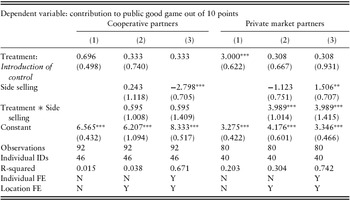
We investigate the relationship between self-reported behavior and behavior in the abstract public good situation. Cooperative farmers that self-reported side selling contribute less to the public good in all four scenarios (paired with cooperative farmers/free market farmers and with/without control mechanism). However, without control for differences in other variables, this difference is only significant for the game with free market participants given a control mechanism (side selling: 3.29 vs. no side selling: 6.24, t-test p = 0.005). To get a more complete picture, we estimate the effect of the control mechanism for the sample of cooperative farmers when playing with other cooperativist or with private market farmers, while interacting the presence of the control mechanism with self-reported side selling. Results are presented in Table 6. Columns (1) to (3) look at the behavior in the games with partners of the same group, and columns (4) to (6) look at the behavior with partners from private mills. Columns (1) and (4) replicate the results presented in the previous section: Cooperative farmers change their contributions when the control is added when they play with partners from the opposite group but not when paired with other cooperative farmers. From columns (3) and (6), we observe that self-reported side selling decreases contributions with respect to other cooperative farmers, however, increases contributions with respect to free market participants. Finally, in column (6), we also see that the control mechanism increases contributions of the side-selling group when playing with private market participants.
Contributions to public good of cooperative members, controlling for self-reported side selling behavior.

Robust standard errors in parentheses (cluster individual): ***p < 0.01, **p < 0.05, *p < 0.1.
Sample: Cooperative participants that choose to include control when playing with own/other group respectively.
Individual controls: Age, gender, born in the town, other incomes than coffee, education reason to join cooperative, family in coffee, perception of implication in cooperative.
6. Discussion
Our results showed differences in behavior between members of a cooperative and farmers selling to the free market. An important question to discuss is what might drive these effects. Specifically, as we already discussed in Section 1, the matter of coexistence of the two types of mills in the same areas raises selection issues into each type of mill and thus prevents us from making causal claims. However, in our results, we were able to control for some of the observable differences between the two groups, most notably the difference in age and source of income. Controlling for these variables did not change our results. However, other variables might very well drive the difference between the two types of farmers. Notably poorer farmers or those more interested in ‘cooperation’ might be more likely to become members of a cooperative. Members of poor (and other non-WEIRD) populations receive increasing interest from the literature (Henrich et al., Reference Henrich, Heine and Norenzayan2010), and some results suggest that the poorer might act differently in many types of games. Similarly, participants in a democratic environment have been suggested to react more cooperatively (Dal Bo et al., Reference Dal Bo, Foster and Putterman2010). However, our results showed no difference in cooperation levels with respect to the in-group of the two types of farmers. Thus, if indeed farmers that became members of a cooperative were initially more willing to cooperative with others, the experience with the institution might have driven out this effect. However, farmers being member of a cooperative might be more ‘groupy’ in general (Kranton et al., Reference Kranton, Pease, Sanders and Huettel2016), specifically more willing to be members of a specific group and to feel affiliated with this group. As we discussed earlier, most free market participants were at some point members of a cooperative. Thus, the fact that they left the cooperative might be indication that they were less interested in being member of a group. Our result showed that cooperative members, and not free market participants, cooperate less with participants from the other group.Footnote 19 The effect could be caused by a negative social stigma of free market participants in the context of the Costa-Rican coffee market (for cooperative members). Alternatively the Costa-Rican cooperative members might have a higher tendency to be ’groupy’, which leads to stronger out-group feelings.
Our second results concerned the difference in reaction to the presence of a control institution between the two types of farmers. Our design does not allow us to disentangle whether cooperative farmers were more responsive to the institution or to the way the institution was implemented. The institution was not externally imposed but participants self-selected into the institution. The way an institution is chosen has been shown to be important to its acceptance (e.g., Grosse et al., Reference Grosse, Putterman and Rockenbach2011; Kamei et al., Reference Kamei, Putterman and Tyran2015; Markussen et al., Reference Markussen, Putterman and Tyran2014; Martinsson and Persson, Reference Martinsson and Persson2016; Mellizo et al., Reference Mellizo, Carpenter and Matthews2014; Putterman et al., Reference Putterman, Tyran and Kamei2011). Specifically democratically chosen institutions versus exogenously imposed institutions seem to be more effective in inducing norm compliance. Farmers selling to a cooperative mill might be more influenced by this. Farmers selling to cooperative mills could also hold characteristics that lead them to use control institutions differently, for example, strong reciprocity (Carpenter et al., Reference Carpenter, Bowles, Gintis and Sung-Ha2009). It should also be noted that our control institution differed from institutions that impose a minimal contribution level. The control institution was presented as imposing a fine on participants whose contribution differed from the average of contributions. This difference might be important, since minimal contribution levels have been shown to lead to crowding out (e.g., Kocher et al., Reference Kocher, Martinsson, Persson and Wang2016; Martinsson et al., Reference Martinsson, Medhin and Persson2016; Ziegelmeyer et al., Reference Ziegelmeyer, Schmelz and Ploner2012). The concrete design of our control institution was developed based on discussions during pre-tests and focus groups with cooperative farmers. Thus, the specific design might indeed mirror institutional design features that are especially effective for cooperatives. An interesting research question for future work would be a comparison of different types of control institutions.
7. Conclusion
Although cooperatives are often viewed as institutional structures that enforce social and fair behavior, scientific evidence of the existence of such effects is scarce. In this study, we investigated behavior in an abstract, laboratory public good situation, contrasting, in particular, the contributions of cooperative members to the behavior of farmers selling to private mills when paired with members of their own group versus members of different background. Our results show that members of a cooperative do not cooperate more when paired with their own type compared to free market participants. In contrast, cooperative members show high distrust concerning free market participants. Thus, we find no evidence that cooperative members are generally more cooperative in an abstract, anonymous dilemma. We further find evidence that cooperative members would be willing to cooperate more in such games, if free riding would be penalized through some independent authority. This result is in line with findings by Gelcich et al. (Reference Gelcich, Guzman, Rodriguez-Sickert, Cardenas and Castilla2012) that show that especially members of fishing unions that have rather low performance profit from an external control mechanism. This stresses the importance of well-defined and functional control mechanisms to prevent deterioration of beliefs in cooperatives. Our findings hint that collaborative behavior among farmers selling to a mill is independent of the type of mill to which they sell. But it is found that cooperative mill participants do have a significantly lower collaborative behavior when paired with private mill farmers, whereas private mill farmers do not make a difference between the different types of farmers.
Acknowledgements
We would like to thank CATIE (Centro Agronómico Tropical de Investigación y Enseñanza) for their hospitality while the experiments were performed. Special gratitude goes to Juan Robalino and Maria Angelica Naranjo for their invaluable logistic support on the field and to Itsaso Hormaeche for her excellent assistance. We thank for their comments Stephane Straub, Peter Martinson, Francisco Alpizar, seminar participants at UAB, TSE, Universidad de Oviedo and the Santa Fe Institute and workshop participants at the Montpellier workshop on field experiments and the TIES workshop in Toulouse. Support by ANR-Labex IAST and financial help through the ANR research grant (2010 JCJC 1803 01) is gratefully acknowledged.