INTRODUCTION
Twenty percent of Canadians reside outside of urban areas where comprehensive, interdisciplinary palliative treatment services are located and must commute, often significant distances, to gain access to those services. Although little is known about the experience of commuting for care (Robinson et al., Reference Robinson, Pesut and Bottorff2009), a small body of empirical work has suggested that leaving one's community for care involves unique burdens and stresses (Reif et al., Reference Reif, Golin and Smith2005). The aim of this research project was to gain an understanding of the experiences of rural cancer patients who commute to an urban cancer center for palliative care (PC). A better understanding of these experiences is needed to extend knowledge of rural health care access and to provide direction for offsetting the burden of commuting.Footnote 1
Increasingly, studies have begun to focus on the needs of rural advanced cancer patients and their families. Factors influencing rural families' ability to cope with advanced cancer are lack of critical information, lack of locally available palliative services, lack of transport, and long distances to treatment centers (Wilkes et al., Reference Wilkes, White and O'Riordan2000; McGrath, Reference McGrath2001; Wilkes et al., Reference Wilkes, White and Mohan2006). The lack of critical information is particularly important when informational needs tend to increase with disease progression (White et al., Reference White, Given and Devoss1996). Accurate information is essential when weighing the burdens and benefits of commuting from rural areas for advanced cancer care. Yet, a higher proportion of rural advanced cancer patients misunderstand the intent of treatment, believing intent is curative rather than supportive (Craft et al., Reference Craft, Burns and Smith2005).
There is some indication that the burden for family caregivers is greater in rural settings (Hughes et al., Reference Hughes, Ingleton and Noble2004) and that there are greater challenges to death occurring at home (Burge et al., Reference Burge, Lawson and Johnston2005). These findings are supported by a recent review of literature regarding rural women caregivers in Canada (Crosato & Leipert, Reference Crosato and Leipert2006). The difficulties associated with accessing appropriate health care, combined with multiple other stressors, contributed to vulnerability for these women. Although this study was not specific to caregivers of advanced cancer patients, one could speculate that declining health among advanced cancer patients could exacerbate these vulnerabilities.
Research to date on the experiences of cancer patients who commute from rural areas have focussed primarily on patients who are newly diagnosed or in the early stages of the disease. The findings indicated that timely, consistent access to information, assistance with navigating the system, better communication between health professionals, and financial/emotional/practical support are significant needs (Davis et al., Reference Davis, Girgis and Williams1998; Gray et al., Reference Gray, James and Manthorne2004; Wilkes et al., Reference Wilkes, White and Mohan2006; Hall et al., Reference Hall, Holman and Threlfall2008). Financial implications of travel figure prominently in the research, and financial worries make the experience more difficult (Davis et al., Reference Davis, Girgis and Williams1998; Fitch et al., Reference Fitch, Gray and McGowan2003; Wilkes et al., Reference Wilkes, White and Mohan2006; Longo et al., Reference Longo, Deber and Fitch2007; Hall et al., Reference Hall, Holman and Threlfall2008). A sense of isolation and the need for social support is of concern to patients who commute (Davis et al., Reference Davis, Girgis and Williams1998; Fitch et al., Reference Fitch, Gray and McGowan2005). Other difficulties associated with commuting for care that have been reported include living away from one's home, maintaining responsibilities while undergoing treatment, and feeling as if one is a burden to those who must assume additional responsibilities (Payne et al., Reference Payne, Jarrett and Jeffs2001; Martin-McDonald et al., Reference Martin-McDonald, Rogers-Clark and Hegney2003; Hegney et al., Reference Hegney, Pearce and Rogers-Clark2005).
The requirement to travel for cancer care appears to influence treatment decisions, which may result in differing patterns of care between rural and urban patients, potentially leading to suboptimal treatment for rural residents (Athas et al., Reference Athas, Adams-Cameron and Hunt2000; Gray et al., Reference Gray, James and Manthorne2004; Celaya et al., Reference Celaya, Rees and Gibson2006; Baird et al., Reference Baird, Flynn and Baxter2008; Baldwin et al., Reference Baldwin, Cai and Larson2008; Hall et al., Reference Hall, Holman and Threlfall2008). For rural residents there are barriers to accessing both specialist cancer services and PC (Cinnamon et al., Reference Cinnamon, Schuurman and Crooks2008). However, as the majority of the studies have been done with patients in the early stages of the disease it is difficult to know how extensive those barriers are for those in the advanced stages, although one could assume that they would be more significant.
The research to date indicates that for cancer patients residing in rural areas the burden of commuting for care is significant, even for those in the early stages of the disease. What we do not know about is the experience of those in the advanced stages of cancer who commute to urban treatment centers for care. Therefore, the aim of this study was to gain a better understanding of that experience with the purpose of improving the delivery of services to this population in a way that respects salient contextual elements of rural living.
METHOD
The study utilized a mixed method design, employing largely qualitative interview data supplemented with quantitative data. The qualitative data was used to provide an in-depth description of the experience; the quantitative data was used to provide information about the problems participants were encountering and the desire they had for more assistance. The study was conducted in British Columbia, Canada where cancer services are provided to the southern interior region of the province from an urban regional Centre, which is part of a population-based province-wide cancer control program for the residents of British Columbia. The Centre serves a large rural and remote area characterized by mountainous terrain and severe winter weather conditions that make road travel hazardous for about five months of the year. The catchment area for the study was approximately 215,346 km2 with a population density of 3.4 persons per km2. The population in this region is projected to increase from 737,908 in 2009, to 832,578 by the year 2024 with the proportion of persons >75 years of age expected to grow from 8.7% to 10.5% (Interior Health Authority, 2008). Access to the Centre by air is both costly and inconvenient because there are few direct flights and flights tend to be cancelled due to inclement weather in winter months. Although some chemotherapy is available in other areas of the region, radiation treatment and specialized pain and symptom management/palliative services are centralized at the Centre.
Participants were recruited through treatment clinics at the Cancer Centre. Patients who had advanced cancer and were attending the Centre for care/treatment that was not curative in intent, and who were commuting from a rural locale, were eligible to participate. The treatment could include any of chemotherapy, radiation therapy or pain and symptom/palliative management or consultation appointments with medical providers. Potential participants were identified via clinic lists by one of the researchers (GF or SB) prior to their visit to the Cancer Centre and were flagged for specially trained volunteers who approached them with study information at the time of their visit. If the participants agreed to speak to a research assistant, they were given further information and invited to participate. If the decision was made to participate, a written consent was signed and an interview was arranged. Fifteen patients provided informed consent. Ethical approval for the study was obtained through the Institutional Review Boards of the University and the Health Authority.
Data were collected through in-depth, semi-structured interviews either in person or by telephone by a trained research assistant. Interviews ranged in length from 20 to 80 minutes. Questions focused on the experiences of planning for the trip, travelling, receiving care at the Cancer Centre, the return home, influences on quality of life, and support that was both needed and accessed. Demographic information was collected and participants were asked to fill out the Problems and Needs in PC Questionnaire – patient form (PNPC-p) (Osse et al., Reference Osse, Vernooij and Schade2004). This 138- item questionnaire elicits the problems individuals are experiencing and whether they desire professional attention for those problems. The questionnaire includes items in the following areas: activities of daily living; physical symptoms; role activities; financial and administrative issues; social issues; psychological issues; spiritual issues; autonomy; problems in consultations; overriding problems in quality care; informational needs; the general practitioner; and the specialist. This questionnaire was tested with advanced cancer patients living in their own homes. Alpha coefficients of >0.70 were reported for dimensions that had five or more items and coefficients of >0.65 for those dimensions that had three or four items. The questionnaire showed convergent validity with two quality of life measures (Osse et al., Reference Osse, Vernooij and Schade2004). Although this new inventory was not designed with rural patients in mind, we included it to assist our understanding of the problems and needs of this group of patients.
Interview data were audio-taped, transcribed verbatim, and entered into NVIVOQSR for analysis. Data were analyzed thematically by three experienced qualitative researchers (JB, BP, CR) utilizing the method of constant comparison (Glaser & Strauss, Reference Glaser and Strauss1967). The three researchers independently read and re-read the data, coding for major meaning units or themes; then jointly reviewed preliminary codes to develop a coding framework. Once the coding framework was established, the data were systematically coded in NVIVOQSR. Detailed review and comparison of data was completed to develop descriptions of salient themes. Questionnaire data were managed using SPSS.
RESULTS
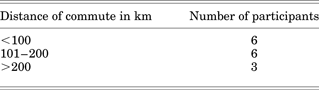
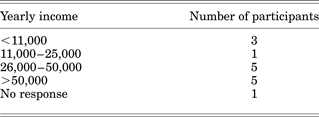
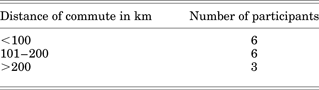
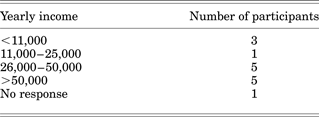
Eight women and seven men participated in the study. Mean age of participants was 62 with a range of 48–78. All participants were Caucasian. Twelve of the participants were married or living common law. Twelve participants resided in their own home. Eight participants had an educational level beyond that of high school. Of particular importance for this study was the length of commute to the Cancer Centre (Table 1) and income levels of participants (Table 2). Average length of commute was 177 km one way to the Cancer Centre. All of the participants relied upon significant others or friends to assist them with the commute. Income levels varied with four participants having an income level <$25,000 per year, a significant factor when having to bear the cost of commuting for care.
Participants' length of commute to Cancer Centre (one way)
Income level of participants
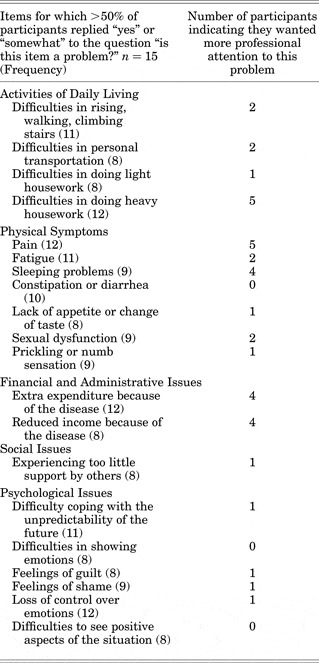
Despite the large number of items on the PNPC-p, only 20 items were highlighted by 8 or more (>50%) of the 15 participants as being a problem (see Table 3). These items were related to physical symptoms, activities of daily living, finances, and psychological and support issues. Few of the participants that indicated problems wanted more professional attention to those problems. For example, although 12 of the 15 participants indicated that pain was a problem, only 5 participants indicated that they wanted more professional attention to this problem.
Responses to PNPC-p Questionnaire

The interviews resulted in findings around three major themes: cultures of rural life and care; strategies for commuting; and effects of commuting. The issues identified as needs in the questionnaire also figured prominently in the interviews.
Cultures of Rural Life and Care: The Places We Call Home
Understanding the impact of commuting for care begins with an understanding of the importance of rural life to participants. Participants spoke eloquently of the benefits of their rural lifestyle including physical beauty, privacy, and accessibility of recreational activities. The level of support provided by community members was an important factor in why individuals valued rural life. Friends provided assistance in multiple ways: cooking meals, taking care of animals, doing household chores, and helping to care for what were sometimes labour-intensive rural properties. Community-based organizations such as churches and volunteer fire departments provided organized assistance ensuring that individuals had basic needs such as transportation, meals, and financial support. Community fundraisers were held to offset the costs of illness. “How incredible people are in a small community. And people that aren't even close to you, people that you may have squabbled with in the past, they're there and they offer their support in the most amazing ways.” (58-year-old woman residing two days' drive from Centre)
However, participants also described the drawbacks of rural life. They did not always have access to modern amenities such as cell phones, high speed internet or advanced medical care. Harsh weather conditions made travel difficult. For most, however, the benefits of rural life outweighed these drawbacks.
“I mean I just live in a really remote area. And that's one of the things you factor in when you make your decision to live there. You know. You counter this incredible place with some major lacks in amenities.” (58-year-old woman residing two days' drive to Centre)
The culture of the Cancer Centre was a significant factor in how individuals experienced treatment. Two aspects of the Cancer Centre were particularly important to participants, the attitudes of the health care providers and the overall ambiance. What participants valued from providers was similar to that found throughout the health care literature: clear and accurate information, sufficient time to have their questions addressed, and a compassionate manner that enabled them to feel more than simply “a number.” Complementing the hospitable attitudes of health care providers was the attempt to create a homelike atmosphere in the Cancer Centre. Participants spoke of an ambiance that was more welcoming than the traditional “sterile” hospital atmospheres. Those commuting for treatment had the option of staying in the “Lodge” a reasonably priced residence adjacent to the Cancer Centre that offered a variety of amenities.
Strategies for Commuting: Making it Work
Coping with a diagnosis that palliative care is the best that can be offered, while having to travel significant distances to get the treatment required, was a significant burden. Although patients had the assistance of family caregivers, they tried to do as much as they could do on their own to minimize the demands on others. Participants described ways of making it work that included careful preparation for the trip, maximizing a routine, managing time, and maintaining their significant relationships. Although they constructed this work as their own, it was clear as well that they were not able to manage all the preparations themselves. This extensive work often required the involvement of family members.
Layered upon this was the preparation required for the debilitating symptoms many patients were experiencing. Pain was a consideration for many and pharmacological agents had to be carefully timed to ensure analgesic coverage while commuting.
“Through the city you stop and go, stop and go, and this movement on the body is pretty tough, or a rough road can be really painful. If you're driving down a road and you hit a big hole in the road, it just jars your whole body, like somebody sticking a knife in you”. (73-year-old man living170 km from Centre)
Ensuring that all the appropriate pills were available and that there were enough of them should the trip be extended was an important priority. All of this had to be managed in the midst of tremendous fatigue. Those with a longer commute often broke the trip into stages to make it less tiring, and frequent rest breaks were a necessity.
Getting into a routine helped participants manage the uncertainty associated with commuting for care. The first visit was often the most anxiety-producing because individuals did not know what to expect, how to plan their time, and what was important to bring. A typical treatment day involved numerous appointments and participants were apprehensive about locating where they needed to be, finding parking close to the Centre and navigating new relationships. Traffic delays, something that is normal for those living in cities, made it difficult for participants to gauge the length of their commute; the potential for missing appointments created apprehension. However, once participants had completed the first trip, the complexity of details became routine and anxiety was reduced.
Commuting for care took extensive amounts of time, and waiting for appointments was an inevitable part of the process. Participants focused on making the most of their time. For some, this included stopping to visit friends and family on the way. Others would take the opportunity to shop for things that were not available in smaller communities. The trip to the city could even be reframed as a unique opportunity to do and see different things; although, this excitement wore off over time. One 57-year-old woman who commuted from a rural community about an hour drive from the Centre stated: “It's like a honeymoon so to speak, and a bit of a treat, right? I'll stop here, pick up that, you know – things I wouldn't normally do unless I go to [city]. But, you are going everyday so that only lasts for the first couple of weeks.”
Care on the part of staff to accommodate commuting patients was essential. Typically this meant scheduling appointments in the middle of the day so that there was time to commute on each end and grouping appointments. Last minute changes or delays were particularly stressful because they had the potential to disrupt a carefully orchestrated schedule.
Maintaining relationships was a significant priority for those commuting. The opportunity to spend extended times together in the car provided a certain level of intimacy for patients and significant others. For some, this was a tangible benefit of commuting that helped to bring them closer to their loved ones during the stress of illness that they knew was not curable.
“It's time we can spend together. And therein lies the challenge of making that time even better with each other when we're travelling back and forth”. (48-year-old man commuting 85 km to Centre)
Computers, internet access, and phone calling cards were helpful in allowing participants to stay connected with those back home when treatment required separation. This included maintaining relationships with primary care providers in their home communities.
The Effects of Commuting: A Cost/Benefit Analysis
Commuting for care was a significant financial burden for participants. Gasoline prices had escalated considerably while data were being collected for this study, and participants felt the impact of those rising prices. Additional expenses were incurred from accommodation, parking, calling cards, meals, and the time family members were away from work to support their commute. For those participants who were unable to work because of their illness, the financial burden was even more significant. For a few individuals, the financial cost was so high that they found themselves having to cut back on necessities such as groceries.
“It can really add up. You know you go back and forth five or six time in a two week period and that's quite common for a lot of people between the tests and the treatments. Suddenly that's an extra $800 that you never imagined. You never imagined you'd have to start coming up with that just because you got sick eh?” (48-year-old man commuting 85 km to Centre).
Reasonably priced accommodation at the Lodge and income tax deductions helped to offset some of the expenses. Overall, the cost of commuting was beyond what most patients had anticipated and this was viewed as a significant oversight in the British Columbia medical system that disadvantaged rural residents.
The costs of commuting were counterbalanced somewhat by the comraderie participants experienced at the Cancer Centre and Lodge, and the quality of life they obtained through treatment.
“I found it really helpful to stay in the Lodge because it was easy to go to the relaxation therapy, the touch therapy and see the nutritionist. Whereas, if I was driving back and forth every week I probably wouldn't have participated in those things. And I enjoyed the relationships I formed with other cancer patients. Just being able to sit down over a meal and talk about where you're from or talk about your family, or your cancer situation.” (58-year-old woman commuting 100 km to Centre).
Participants had the opportunity to form relationships with other patients, to share stories, to enjoy companionship, and to learn from one another's experiences. This helped to counteract the loneliness they felt from being away from their communities and provided a support network away from home. The multi-faceted treatment that included access to a nutritionist, healing touch, relaxation therapy, counseling, and comprehensive pain and symptom management was cited as contributing to overall quality of life. In essence, commuting for care, while costly, provided participants with hope for better symptom management and prolonged life.
Participants had concrete recommendations for improving the experiences of other patients commuting from a rural area for advanced cancer care. Advice for other patients included bringing meaningful items from home that would allow them to stay occupied and in touch with supportive others; making the best of the commute by using it as an opportunity to rest, enjoy the scenery, and interact with others; staying at the Lodge for both financial and supportive reasons; and learning from others who have been through the experience. Advice for health care providers and volunteers included booking appointments to accommodate commuting schedules, being aware of the extra challenges faced by commuters and providing appropriate information, and providing personalized, unrushed, care that took into account their unique supportive needs.
DISCUSSION
This study adds to the body of literature on the experiences of patients commuting from rural areas for cancer care by focusing specifically on the experiences of those who commute for PC, a population that has been neglected to date. The experiences of those with advanced cancer are similar to those who commute earlier on in their cancer trajectory; although, pain and symptom management seems to be a more predominant concern.
Commuting is a regular part of rural lifestyle. However, the complexity of the details related to managing symptoms on the road and navigating a new treatment environment generated anxiety until participants were able to establish a routine. The idea of anticipatory anxiety prior to travelling and the importance of getting into a routine are findings that have been reported elsewhere in the literature on commuting for cancer care (Fitch et al., Reference Fitch, Gray and McGowan2003). Members of this research team who are also experienced clinicians were sensitized to the effort patients put into commuting to the Centre and how important it is to be sensitive to this complexity when scheduling appointments.
The monetary costs of commuting cited in other studies (Fitch et al., Reference Fitch, Gray and McGowan2003) figured prominently in the responses of participants in our study. For palliative patients the costs may be more difficult to bear because many are not able to work; significant sacrifices had to be made by some participants in this study. Participants cited the need for government programs, beyond simply tax relief, to help offset some of the costs of commuting for advanced cancer care. Although there are other areas of financial relief available, and this information is distributed to those attending the Cancer Centre, participants seemed unaware of these resources. Further research needs to be done around how information is delivered and received in this context.
Pain and symptom management was a significant concern for those in our study, a finding that is similar to other studies that have explored the commuting experience in a non-palliative population (Fitch et al., Reference Fitch, Gray and McGowan2003). Pain was particularly prominent. Greater attention needs to be focused on anticipating and addressing pain during the commuting process; strategies must account for the increased pain that occurs from travelling long distances in a car, especially over uneven and winding roads. The findings from the PNPC-p questionnaire given to the participants were particularly intriguing. Although participants indicated a number of symptom problems related to pain, fatigue, sleeping and constipation or diarrhea, a much smaller percentage reported wanting more professional attention to these problems. Similar findings occurred in Osse et al.'s (Reference Osse, Vernooij-Dassen and Schade2005) study where they tested this questionnaire with 94 patients with disseminated cancer. They concluded that “problems are not synonymous with unmet needs” (p. 722). The question remains of why participants do not desire professional attention to problems that are clearly within the purview of health care providers? Anecdotal evidence from our discussions with individuals with cancer around advanced care planning include: the notion that symptoms are part of advanced cancer and to be expected; reluctance to “bother” the clinicians with requests that are not directly related to treatment; and an expectation that clinicians will ask about these things if they are important and if they can be of assistance. A possible additional explanation may include the financial implications of seeking assistance. For example, we had a number of persons with low incomes who were already experiencing financial hardship. Requesting assistance with pain management might mean another prescription, which would be avoided if the prescription could not be filled due to financial constraints. Findings from this study suggest that clinicians cannot assume that individuals will seek assistance for the problems they are experiencing, and so should engage in systematic assessment of relevant symptoms. Further research is required to explore why individuals would not expect more practical and instrumental support from healthcare providers in meeting their palliative needs.
Findings of this study support an emerging body of literature acknowledging the relationship of place to health. Parry et al. (Reference Parry, Mathers and Laburn-Peart2007) used focus groups in England to explore the influence of place of residence on health. Participants in their study indicated that health includes intangibles such as happiness, contentment, and peace of mind, and that these intangibles are influenced by the physical and social structures, and service provision of each community. Participants in our study valued their rural lifestyle, acknowledging that commuting for advanced cancer care was simply one of the tradeoffs they had to make for living in a place that contributed to their overall health. However, this raises the issue of the relative contributions of commuting for advanced cancer treatment to overall quality of life. In this study, there was no indication that participants were seeking unrealistic treatment goals by commuting. However, in light of other literature that has suggested rural advanced cancer patients may sometime misunderstand the intent of treatment (Craft et al., Reference Craft, Burns and Smith2005), it is important for health care providers to assist individuals to weigh the relative contributions of staying in their rural locale versus commuting for care to their overall health and well-being.
Although researchers often focus on family caregivers to represent the experiences of patients, in this study we collected data directly from patients. The patients who participated in this study were interested in sharing their experiences and were well enough to do so. We also interviewed caregivers in the larger study from which these data were drawn (Lockie et al., 2009). There are interesting parallels between caregiver and patient narratives. Common themes, for example, include the extra work and stress that commuting added to dealing with advanced cancer. Although there are clearly some shared responsibilities associated with commuting, it was sometimes difficult to sort out different roles. For example, patients recounted that they tried to anticipate and prepare for pain management during commutes. Family caregivers also reported that they tried to anticipate needs for pain control by monitoring their family member's health and taking along adequate supplies. Although it is certainly possible this was a joint endeavor, patients and their caregivers did not represent it in this way. For example, family caregivers reported that patients were sometimes reluctant to make the commute because they were discouraged or too uncomfortable. In these instances, it was only through family caregiver efforts that patients made the commute. However, this brings into question whether commuting at that point was in the best interests of the patient. These data emphasize the need to include both patients and caregivers in discussions about the benefits and burdens related to commuting so that decision-making aligns with the aim of palliative care, which is supporting and enhancing quality of life.
CONCLUSION
This study provides a snapshot of the experiences of palliative oncology patients in one rural region commuting for care. However, experiences may vary with different geographies, rural communities, commuting distances, and regional cancer services. The majority of patients in this study were <65 years of age. Commuting may be more difficult for older cancer patients. The findings suggest that other social factors such as socioeconomic status and gender may also have significant influences on experiences and should be considered in future studies. All of the participants in this study had supportive individuals who assisted them with commuting; however, many advanced cancer patients do not have access to this type of support or may be too ill to travel. Future research needs to focus on patients in rural communities who are unable or choose not to commute.
Acknowledgements
Funding was provided through a grant received from the BritishColumbia Cancer Foundation – Southern Interior. We thank P. Maurine Kahlke (research coordinator) and Sharon Lockie (research assistant) for their help.