Emotion regulation processes involve a set of behaviors, skills, and strategies used to modulate, inhibit, and enhance emotion-related experiences, whether these processes are conscious or unconscious, reactive or effortful (Calkins, Gill, Johnson, & Smith, Reference Calkins, Gill, Johnson and Smith1999). Emotion regulation strategies begin to develop during infancy. Based on repeated early interactions with caregivers, infants learn whether signaling for caregiver assistance is an effective strategy for regulating their arousal (e.g., is the caregiver consistently responsive? Kopp, Reference Kopp1989). Although infants less than 18 months old are capable of engaging in self-regulatory behavior (e.g., avoidance, withdrawal, and orienting to other aspects of their environment), the use of self-regulatory strategies at this age (as opposed to relying on caregivers) is associated with elevated behavioral and physiological distress (Diener, Mangelsdorf, McHale, & Frosch, Reference Diener, Mangelsdorf, McHale and Frosch2002; Enlow et al., Reference Enlow, Kullowatz, Staudenmayer, Spasojevic, Ritz and Wright2009; Khoury et al., Reference Khoury, Gonzalez, Levitan, Masellis, Basile and Atkinson2015; Manian & Borenstein, Reference Manian and Bornstein2009; Stifter & Braungart, Reference Stifter and Braungart1995). For example, Diener et al. (Reference Diener, Mangelsdorf, McHale and Frosch2002) found that 12- to 13-month-old infants who used more self-soothing behaviors (as opposed to engaging the parent) showed more frowning, grimacing, fussing, and crying. Khoury et al. (Reference Khoury, Gonzalez, Levitan, Masellis, Basile and Atkinson2015) showed that 15-month-old infants of mothers with higher depressive symptomatology who rely on their mothers less to regulate their emotions have elevated cortisol reactivity to mild psychosocial challenge.
To date, most evidence linking maternal factors to infant regulation comes from studies of maternal depression (Brand & Brennan, Reference Brand and Brennan2009; Brummelte & Galea, Reference Brummelte and Galea2010; Khoury et al., Reference Khoury, Gonzalez, Levitan, Masellis, Basile and Atkinson2015). The impact of maternal maltreatment history on infant regulation has rarely been studied. However, mothers with maltreatment histories are at greater risk for atypical physiological stress reactivity (Carpenter et al., Reference Carpenter, Carvalho, Tyrka, Wier, Mello, Mello and Price2007), less social support (Min, Singer, Minnes, Kim, & Short, Reference Min, Singer, Minnes, Kim and Short2012), less optimal parenting (Periera et al., Reference Pereira, Vickers, Atkinson, Gonzalez, Wekerle and Levitan2012; Schofield, Lee, & Merrick, Reference Schofield, Lee and Merrick2013), and nonsecure attachment relationships with their infants (Cicchetti, Rogosch, & Toth, Reference Cicchetti, Rogosch and Toth2006). Such factors may link mothers’ early experience to their infants’ emotion regulation behavior by impacting the degree to which they are responsive to their infant's cues. One of the few studies that did examine the link between maternal maltreatment history and infant emotion regulation showed that the infants of mothers with a more extensive maltreatment history evinced greater regulatory difficulties than did infants whose mothers reported less extensive histories of maltreatment, and this relation held even after contemporaneous maternal posttraumatic stress and depressive symptoms were controlled for. Infants of mothers with greater lifetime trauma histories took longer to recover from psychosocial stress behaviorally (e.g., hard crying) and in terms of cardiorespiratory activation (Enlow et al., Reference Enlow, Kullowatz, Staudenmayer, Spasojevic, Ritz and Wright2009). The link between maternal maltreatment history and infant emotion regulation is particularly important, given associations between maternal maltreatment history and offspring outcomes related to emotion regulation, such as externalizing and internalizing symptoms, hyperactivity, and difficulties with peer relations (Collishaw, Dunn, O'Connor, & Golding, Reference Collishaw, Dunn, O'Connor and Golding2007; Miranda, de la Osa, Granero, & Ezpeleta, Reference Miranda, de la Osa, Granero and Ezpeleta2013; Roberts, O'Connor, Dunn, & Golding, Reference Roberts, O'Connor, Dunn and Golding2004).
Of course, not all infants of mothers with a history of maltreatment develop emotion regulation and related difficulties (Enlow et al., Reference Enlow, Kullowatz, Staudenmayer, Spasojevic, Ritz and Wright2009), suggesting the probable role of moderating factors. There are likely many such factors, but one potential neurobiological moderator, salient because it is linked to all aforementioned factors, involves dopaminergic function. Child maltreatment influences dopaminergic function (e.g., Galvin et al., Reference Galvin, Shekhar, Simon, Stilwell, Eyck, Laite and Blix1991; Meaney, Brake, & Gratton, Reference Meaney, Brake and Gratton2002), and dopamine has a critical impact on brain structures implicated in emotion regulation (Wager, Davidson, Hughes, Lindquist, & Ochsner, Reference Wager, Davidson, Hughes, Lindquist and Ochsner2008) such as the prefrontal cortex, striatum, and amygdala (Salgado-Pineda, Delaveau, Blin, & Nieoullon, Reference Salgado-Pineda, Delaveau, Blin and Nieoullon2005). On reviewing the literature on dopamine and an array of psychiatric disorders, Salgado-Pineda et al. (Reference Salgado-Pineda, Delaveau, Blin and Nieoullon2005) concluded, “DA has, undoubtedly, a direct and/or indirect role in the full emotional process” (p. 228).
We propose that several dopamine-related genes, specifically dopamine receptor D2 (DRD2), dopamine transporter solute carrier family C6, member 4 (SLC6A3), and catechol-O-methyltransferase (COMT) genes, may moderate the relation between maternal maltreatment history and infant emotion regulation strategies. Although these relations have not been demonstrated directly (that is the purpose of the current study), these genes have been found to interact with maternal factors to predict features related to emotion regulation. For instance, the DRD2 gene interacts with the caregiving environment to influence neurobiological processes underlying emotion regulation following psychosocial stress. Specifically, following maternal separation, infants with the Taq A1 allele (relative to infants without the A1 allele) show atypically low respiratory sinus arrhythmia withdrawal (Propper et al., Reference Propper, Moore, Mills-Koonce, Halpern, Hill-Soderlund, Calkins and Cox2008) and cortisol reactivity (Ludmer et al., Reference Ludmer, Levitan, Gonzalez, Kennedy, Villani, Masellis and Atkinson2015) if their mothers are insensitive and high in depressive symptoms, respectively. The A1 allele of DRD2 also interacts with maternal behavior to predict affective problems (Mills-Koonce et al., Reference Mills-Koonce, Propper, Gariepy, Blair, Garrett-Peters and Cox2007), outcomes that reflect difficulties regulating emotional states (Eisenberg et al., Reference Eisenberg, Cumberland, Spinrad, Fabes, Shepard, Reiser and Guthrie2001). Mills-Koonce et al. (Reference Mills-Koonce, Propper, Gariepy, Blair, Garrett-Peters and Cox2007) found that infants with the A1 allele (relative to those without the A1 allele) have more affective problems at age 3 if their mothers showed insensitive behavior during their infancy.
With respect to COMT, the valine expression of the gene has been related to infant basal salivary alpha amylase response (Frigerio et al., Reference Frigerio, Ceppi, Rusconi, Giorda, Raggi and Fearon2009), a marker of physiological stress regulation that is shaped by the early caregiving environment (Atkinson, Jamieson, Khoury, Ludmer, & Gonzalez, Reference Atkinson, Jamieson, Khoury, Ludmer and Gonzalez2016). Thus, Frigerio et al. (Reference Frigerio, Ceppi, Rusconi, Giorda, Raggi and Fearon2009) found that infants homozygous for the valine allele (relative to infants with other genotypes) have the highest basal alpha amylase concentrations if they are in nonsecure attachment relationships with their mothers. COMT is also linked to the allocation of attention, a foundational skill for effective emotion regulation strategies (Voelker, Sheese, Rothbart, & Posner, Reference Voelker, Sheese, Rothbart and Posner2009). Markant, Cicchetti, Hetzel, and Thomas (Reference Markant, Cicchetti, Hetzel and Thomas2014) linked the valine allele to more rapid infant approach to novel toys and reduced sustained attention. Voelker et al. (Reference Voelker, Sheese, Rothbart and Posner2009) found that infants with the valine allele (relative to infants without the valine allele) show enhanced shifting of attention to attractive stimuli if they received high-quality parenting.
In regard to SLC6A3, Ludmer et al. (Reference Ludmer, Levitan, Gonzalez, Kennedy, Villani, Masellis and Atkinson2015) found that infants with the 10-repeat allele (relative to other infants) show atypical levels of cortisol following psychosocial stress if their mother self-reported high levels of depressive symptoms (Ludmer et al., Reference Ludmer, Levitan, Gonzalez, Kennedy, Villani, Masellis and Atkinson2015). Laucht et al. (Reference Laucht, Skowronek, Becker, Schmidt, Esser, Schulze and Rietschel2007) found that adolescents homozygous for the 10-repeat allele (relative to adolescents with other genotypes) have more symptoms of inattention and hyperactivity–impulsivity if they were raised in environments with high psychosocial adversity (e.g., parental psychiatric disorder, marital discord, and low parent education level), as assessed at age 3 months. Thus, dopamine-related genetic polymorphisms have been consistently found to interact with maternal factors to predict outcomes related to emotion regulation, and may interact with maternal maltreatment history to predict infant emotion regulation behavior directly.
The Current Study
The current study examines the hypotheses that DRD2, SLC6A3, and COMT genotypes interact with maternal maltreatment history to predict infant emotion regulation behavior. Specifically, infants with more DRD2, SLC6A3, and COMT plasticity alleles (A1, 10-repeat, and valine alleles, respectively), relative to infants with fewer plasticity alleles, are expected to engage in independent regulatory strategies for greater durations of time (i.e., rely less on the mother for regulation) if the mother has a history of greater, as opposed to lower, maltreatment. These specific genes were selected based on the aforementioned associations with correlates of emotion regulation, and the role of dopamine within emotion regulation (Salgado-Pineda et al., Reference Salgado-Pineda, Delaveau, Blin and Nieoullon2005). This study does not specifically differentiate between diathesis–stress, differential susceptibility, and vantage sensitivity models of Gene × Environment (G × E) interaction (Roisman et al., Reference Roisman, Newman, Fraley, Haltigan, Groh and Haydon2012) given that maternal maltreatment history does not equate to infants’ direct rearing environment.
The current study addresses the aforementioned issues as they pertain to infancy. There is little genetic research addressing the first years of life, an important oversight, given early brain plasticity in response to favorable or unfavorable environmental conditions (Cirulli, Berry, & Alleva, Reference Cirulli, Berry and Alleva2003). In terms of methodological considerations, we acknowledge from the outset that we do not have an independent replication sample. Nevertheless, we adopt several design features to bolster the validity of findings. We adopt a multilevel approach, incorporating maternal self-report, genotyping, and behavioral observation. This feature precludes spurious variance contributed by the common method and operationalizes variables in such a way that they convincingly represent the constructs at hand without maximizing expected interrelationships (see Prentice & Miller, Reference Prentice and Miller1992). Further, many studies assessing G × E interactions “bin” alleles to create dichotomous groups of “plasticity genotype” and “nonplasticity genotype” individuals. This practice could create ambiguities in cases of heterozygosity by unjustifiably presuming allele dominance (see Ludmer et al., Reference Ludmer, Levitan, Gonzalez, Kennedy, Villani, Masellis and Atkinson2015). To avoid such ambiguities, we do not “bin” alleles, but rather tally the number of plasticity alleles (i.e., an individual homozygous for plasticity alleles would be scored 2, an individual heterozygous for plasticity and nonplasticity alleles would be scored 1, and an individual homozygous for nonplasticity alleles would be scored 0; Bradley et al., Reference Bradley, Westen, Mercer, Binder, Jovanovic, Crain and Heim2011; Ludmer et al., Reference Ludmer, Levitan, Gonzalez, Kennedy, Villani, Masellis and Atkinson2015). Finally, recognizing the potential influence of maternal depressive symptoms on infant emotion regulation, we controlled for maternal depressive symptoms in analyses.
Method
Participants
This sample is part of a larger longitudinal study, the Toronto Longitudinal Cohort, which consists of 314 demographically low-risk mother–infant dyads, who were recruited from Ontario Early Years programs and from postings and in-person “Baby Time” convention shows in Toronto (Atkinson et al., Reference Atkinson, Gonzalez, Kashy, Basile, Masellis, Pereira and Levitan2013; Ludmer et al., Reference Ludmer, Levitan, Gonzalez, Kennedy, Villani, Masellis and Atkinson2015; Pereira et al., Reference Pereira, Vickers, Atkinson, Gonzalez, Wekerle and Levitan2012). Participants were included if infants were healthy, with no major developmental disorders, and gestation exceeded 32 weeks. Mothers were 18 years or older at the time of the infant's birth, spoke English with sufficient fluency to complete inventories, and had no known hormonal disorders. This study examines data collected during a home visit when infants were 15 months old, where mother–infant dyads participated in a toy frustration procedure (TFP; Braungart-Rieker & Stifter, Reference Braungart-Rieker and Stifter1996), which was coded for emotion regulation behavior.
Because we began videotaping the TFP partway through the study, we were able to code only 193 of the 314 dyads who participated in the larger study. This subsample included 51.8% female infants. At the time of the home visits, infants were approximately 15 months old (M = 15.41; SD = 1.00), and mothers ranged from 21 to 46 years (M = 33.03; SD = 4.67). The majority of the sample was Caucasian (72.3%), with a smaller proportion of Asian (10.1%), African Canadian (3.9%), and other ethnicities (13.6%). The majority of mothers were highly educated, with postgraduate (24.5%), undergraduate (45.3%), community college (22.2%), secondary school (7.1%), and primary school (0.9%) as their highest level of education. Family income was as follows: >$200,000 (23.7%), $150,000–200,000 (18.5%), $114,000–$150,000 (22.2%), $92,000–$114,000 (16.9%), $70,000–$92,000 (10.1%), $35,000–$70,000 (5.3%), and $20,000–$35,000 (3.2%). Compared to the full 314-dyad sample, the subsample did not differ significantly on ethnicity, emotion regulation, genotypes, or sex; or maternal depressive or childhood maltreatment scores, education, or income.
Procedure
Two researchers video recorded mothers and infants interacting during the TFP in the home. After the TFP, mothers completed a questionnaire package and reported on demographics (ethnicity, education, own income, and spousal income, to be assessed as potential covariates), childhood maltreatment history, and depressive symptoms. To assess maternal sensitivity (potential covariate), the researchers observed mothers and infants interacting for 2 hr during a free-play and divided attention task. Mothers were instructed to interact with their children as they would during a typical day, and they were also observed as they completed questionnaires while the infants were in the room (unattended by observers). DNA was obtained from infant buccal cells. After the visit, the researchers independently coded maternal sensitivity. Infants and mothers also participated in the Strange Situation procedure (SSP; Ainsworth, Blehar, Waters, & Wall, Reference Ainsworth, Blehar, Waters and Wall1978) 1 month after the TFP for the purpose of presenting the infant with a cortisol challenge (Atkinson et al., Reference Atkinson, Gonzalez, Kashy, Basile, Masellis, Pereira and Levitan2013; Ludmer et al., Reference Ludmer, Levitan, Gonzalez, Kennedy, Villani, Masellis and Atkinson2015); however, because infants were not assessed for independent emotion regulation (nor attachment classification) in this context, only the TFP is included in the current study.
Measures
Infant regulatory behaviors
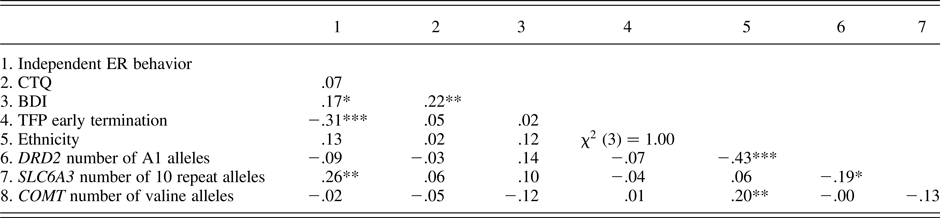
The TFP (Braungart-Rieker & Stifter, Reference Braungart-Rieker and Stifter1996) consists of a series of three episodes lasting 90 s each in which the mother alternately engaged the infant with a toy and disengaged, placing the toy in a clear container with a lid. If the infant cried continuously for 20 s during a TFP episode, that episode was terminated. Once the data were coded for emotion regulation, we did not retain the tapes, but later were able to recover 138 (71.5%) tapes to code for whether or not the TFP was terminated early. Of these tapes, a TFP episode was terminated early for 14 infants (10.1%). To explain the decision to terminate early, we note as follows. Early termination of infant challenges in the context of distress is standard practice in the developmental literature for both ethical and methodological reasons. The ethical aspect of this decision is self-evident. Methodologically, unchecked distress invalidates the procedure by determining response to each successive episode. For example, SSP separation episodes are terminated if the infant cries hard for more than 20 s but SSPs are still coded and represented in the data (e.g., Ainsworth et al., Reference Ainsworth, Blehar, Waters and Wall1978). Crying hard is an index of emotion regulation, and as such, we would expect it to be related to the dependent variable, emotion regulation strategy. This proved to be the case, with early termination correlating at –.31 (p < .001) with independent emotion regulation strategy (i.e., early termination due to crying was associated with less independent emotion regulation). To ensure that early termination did not influence results, we included it as a covariate in all analyses (although results were substantively identical whether or not it was included as a covariate).
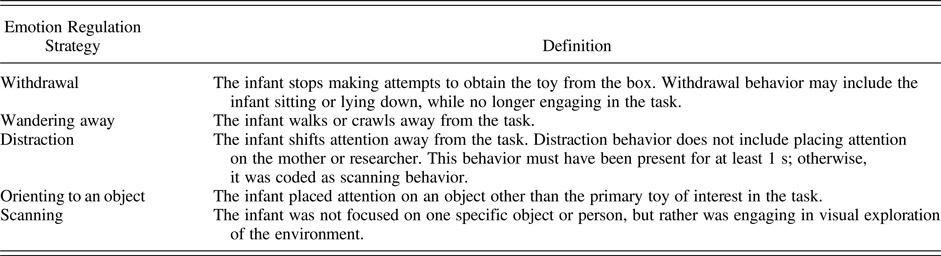
Infants self-regulate by avoiding/withdrawing from distressing stimuli (Rothbart & Derryberry, Reference Rothbart, Derryberry, Lamb and Brown1981), self-soothing (e.g., thumb sucking; Rothbart & Derryberry, Reference Rothbart, Derryberry, Lamb and Brown1981), and using distraction strategies (e.g., averting gaze; Stifter & Braungart, Reference Stifter and Braungart1995). Independent regulatory behaviors that were coded in the current study included withdrawing from the task, distracting him/herself, wandering away from the task, orienting to another object, and scanning the environment (see Table 1 for definitions and Khoury et al., Reference Khoury, Gonzalez, Levitan, Masellis, Basile and Atkinson2015, for a fuller description of coding development). Infants use these behaviors independently; that is, when using these regulatory strategies, the infant is not relying on or looking to the mother to help regulate emotions. The TFP episodes coded for emotion regulation behavior were the two in which the infant was denied the toy, as these were the most frustrating episodes. Infant independent regulatory behaviors were coded in terms of the duration of time each behavior was displayed, and these values were summed to create the independent emotion regulation composite score.
Infant independent emotion regulation behavior during the toy frustration procedure

Twenty percent of the videos were coded by a second coder for interrater reliability. The following are reliabilities for each behavior: scanning, intraclass correlation (ICC) = 0.69; withdrawal, ICC = 0.79; wandering, ICC = 0.83; orienting to another object, ICC = 0.93; and distraction, ICC = 0.74. The mean reliability was ICC = 0.80, and the reliability of the composite was ICC = 0.83. Cronbach α = 0.64 for 10 behavioral items across the two coded TFP episodes. This latter value is not particularly high, but it is adequate, and in any event, clustering on conceptual grounds is commonly practiced in the area. Moreover, it is psychometrically sound, insofar as any two items may be strategically linked but unrelated to one another empirically (Streiner, Reference Streiner2003; Streiner & Norman, Reference Streiner and Norman2008).
Maternal maltreatment history
Mothers completed the Childhood Trauma Questionnaire (CTQ; Bernstein & Fink, Reference Bernstein and Fink1998). The CTQ is a self-report questionnaire consisting of 25 items assessing history of childhood maltreatment and 3 items assessing minimization/denial of childhood maltreatment. The total CTQ score (i.e., the 25 main items) was used so as to assess across varied types of maltreatment (i.e., sexual, physical, and emotional abuse and neglect), with each type of maltreatment consisting of 5 items. The 3-item minimization/denial score was also assessed in the current study as a potential covariate. The CTQ has good psychometric properties for clinical (Bernstein et al., Reference Bernstein, Fink, Handelsman, Foote, Lovejoy, Wenzel and Ruggeriero1994) and community-based populations (Paivio & Cramer, Reference Paivio and Cramer2004), including factor, criterion, and external validity (Bernstein et al., Reference Bernstein, Stein, Newcomb, Walker, Pogge, Ahluvalia and Zule2003; Miller, Green, Fettes, & Aarons, Reference Miller, Green, Fettes and Aarons2011; Spinhoven et al., Reference Spinhoven, Penninx, Hickendorff, van Hemert, Bernstein and Elzinga2014). In the current sample, Cronbach α = 0.93.
Genotyping
Extraction and genotyping of the DNA was performed at the Neurogenetics Laboratory at the Centre for Addiction and Mental Health in Toronto, Canada. Four paper buccal swabs were collected from each subject and stored at 4 °C in a 15 ml polypropylene tube until extracted. Total genomic DNA was extracted using the Qiagen QIAamp DNA Mini and Blood Mini kit as per manufacturer's instructions with the reagents used prior to the spin steps (protease, phosphate-buffered saline, buffer AL, and 95% ethanol) doubled. A total of two single nucleotide polymorphisms across two genes were genotyped using commercially available TaqMan single nucleotide polymorphism genotyping assays (LifeTechnologies, Burlington, ON). These included COMT rs4680 (assay ID C__25746809_50) and DRD2 rs2740210 (assay ID C__7486676_10). For each reaction, 1 μl of the genomic DNA was amplified as per manufacturer's directions scaled to a total volume of 10 μl in an Applied Biosystems (AB) 2720 thermal cycler. Postamplification products were analyzed on the AB ViiA7 Real-Time PCR (polymerase chain reaction) System, and genotype calls were determined manually by comparison to six no-template controls.
For the SLC6A3 variable number tandem repeat, 3 μl total genomic DNA was combined with 1× MBI Fermentas PCR buffer containing KCl, 1.5 mM MgCl2 (MBI Fermentas), 0.13 μg each primer (Vandenbergh et al., Reference Vandenbergh, Persico, Hawkins, Griffin, Li, Jabs and Uhi1992; forward primer labeled with 5′ NED fluorescent tag), 10% dimethyl sulfoxide (Sigma-Aldrich), 0.16 mM each deoxynucleotide triphosphate (MBI Fermentas), and 2 U Taq polymerase (MBI Fermentas) to a total volume of 25 μl. The PCR reactions were subjected to an initial denaturation for 5 min at 95 °C, followed by 35 cycles of amplification in an AB 2720 (Thermofisher Scientific Burlington, ON) thermal cycler: denaturing for 30 s at 95 °C, annealing for 1 min at 65°C, and extension for 30 s at 72 °C, and a final extension at 72 °C for 10 min. One microliter of the PCR product was electrophoresed on an AB 3130-Avant Genetic Analyzer according to manufacturer's directions, and product sizes were determined by comparison to a GeneScan 1200 LIZ size standard using GeneMapper (version 4.0). Genotyping of 10% of samples from each run were replicated for quality control purposed for each marker. Genotypes were in Hardy–Weinberg equilibrium.
Maternal depressive symptoms
Mothers completed the Beck Depression Inventory—II (BDI-II; Beck, Steer & Brown, Reference Beck, Steer and Brown1996). The BDI-II is a self-report questionnaire consisting of 21 items assessing depressive symptoms and severity on a 4-point scale. Scores from the 21 items are summed to form one total score. The BDI-II has high internal consistency (Bos et al., Reference Bos, Pereira, Marques, Maia, Soares, Valente and Azevedo2009; Dozois, Dobson, & Ahnberg, Reference Dozois, Dobson and Ahnberg1998) and is valid in maternal samples (e.g., Murray & Cooper, Reference Murray and Cooper1997). In the current sample, the Cronbach α = 0.89.
Maternal sensitivity
Maternal sensitivity, a potential covariate, was assessed using the Maternal Behavior Q-Sort (MBQS; Pederson, Moran, Sitko, & Campbell, Reference Pederson, Moran, Sitko and Campbell1990). The MBQS consists of 90 items, each describing specific maternal interactive behaviors. Items are sorted into nine piles on a rectangular distribution, in which Pile 1 represents behaviors that are most like the mother and Pile 9 behaviors that are least like the mother. Each item is assigned a score that corresponds to the pile it is sorted into (i.e., item in Pile 4 receives a score of 4). The overall MBQS score is a correlation between the mother's derived score and a prototypical sensitivity score. Scores range from –1.0 (extremely insensitive) to +1.0 (prototypically sensitive). MBQS scores predict infant attachment security (Atkinson et al., Reference Atkinson, Paglia, Coolbear, Niccols, Poulton, Leung, Chisholm, Tarabulsy, Larose, Pederson and Moran2000). For the current study, interobserver agreement was ICC = 0.88. In the current study, MBQS scores ranged from –0.39 to 0.88 (M = 0.49, SD = 0.27).
Statistical analysis
We conducted hierarchical multiple regressions for each G × E interaction model, including covariates, genotype, CTQ score, and the Genotype × CTQ score interaction term as predictors, and infant emotion regulation score as outcome. Based on the literature reviewed here, plasticity genotypes were classified as follows: A1 allele for DRD2, 10-repeat allele for SLC6A3, and valine allele for COMT. Our models were run without binning alleles; for example, the SLC6A3 moderator was scored as the number of 10-repeat alleles ranging from 0 (no 10-repeat alleles) to 2 (2 10-repeat alleles; Bradley et al., Reference Bradley, Westen, Mercer, Binder, Jovanovic, Crain and Heim2011; Ludmer et al., Reference Ludmer, Levitan, Gonzalez, Kennedy, Villani, Masellis and Atkinson2015). We utilized the Bonferroni corrected significance level of p < .017 for the overall regression models.
In terms of missing data, there were 2 (1.0%) missing or incomplete maternal maltreatment history questionnaires and 21 (10.9%) missing or incomplete maternal depressive symptom questionnaires. This discrepancy is a consequence of the maltreatment questionnaires being completed with an experimenter present and the depressive symptom questionnaires being left with the mothers and mailed back. In 28 (14.5%) cases, DNA samples failed to amplify. To address missing data for CTQ, BDI-II, and TFP early termination, 20 multiple imputations were conducted with SPSS (Collins, Shafer, & Kam, Reference Collins, Schafer and Kam2001). Based on Little's (Reference Little1988) missing completely at random test, data were missing at random, χ2 (2) = 2.44, p = .30, and suitable for imputation.
Results
Descriptive statistics and preliminary analyses
Infant emotion regulation scores were log transformed to address positive skew; the log transformed values ranged from 0.72 to 2.66 (M = 1.96, SD = 0.35). CTQ scores ranged from 25 to 102 (M = 36.07, SD = 13.87). CTQ minimization/denial scores ranged from 3 to 15 (M = 10.15, SD = 2.67). BDI-II scores ranged from 0 to 36 (M = 7.65, SD = 6.77). Genotype distributions are presented in Table 2. Correlations and chi square analyses between main study variables are presented in Table 3.
Infant genotype distributions

Correlations and chi-square values among main study variables

Note: ER, emotion regulation; CTQ, Childhood Trauma Questionnaire score; BDI, Beck Depression Inventory score; TFP early termination, whether the toy frustration procedure was terminated early (coded as 1) or not (coded as 0). Ethnicity is coded as Caucasian = 1, not Caucasian = 2 to aid in interpretation of this correlation table. The chi-square value is reported for the association between ethnicity and TFP early termination (not significant).
*p < .05. **p < .01. ***p < .001.
We assessed the potential covariates of infant sex, maternal education, maternal sensitivity, maternal income, spouse's income, ethnicity (coded as Caucasian = 1, Asian = 2, African Canadian = 3, other = 4),Footnote 1 CTQ minimization/denial, BDI-II scores, and whether the TFP was terminated early. Infant emotion regulation behavior was significantly related to BDI-II scores (r = .17, p < .05), such that infants of mothers reporting more depressive symptoms utilized more independent regulatory behavior. As noted above, infant emotion regulation behavior was negatively associated with episode termination of the TFP (r = –.31, p < .001), such that the episode was more likely to be terminated early for infants who utilized less independent regulatory behavior. No other significant associations emerged. Therefore, we controlled for early TFP episode termination and BDI-II scores in all analyses. Although ethnicity was not related to infant emotion regulation, to address potential effects of population stratification (i.e., when allele frequencies are attributable to ethnic population and unrelated to outcome status; Cardon & Palmer, Reference Cardon and Palmer2003), we controlled for ethnicity in all analyses. To properly control for the impact of these variables on the interaction term of our model (Keller, Reference Keller2014), for each covariate we included covariate, Gene × Covariate, and CTQ × Covariate terms in our models.Footnote 2
DRD2 genotype as a moderator of the relation between maternal history of maltreatment and infant emotion regulation behavior
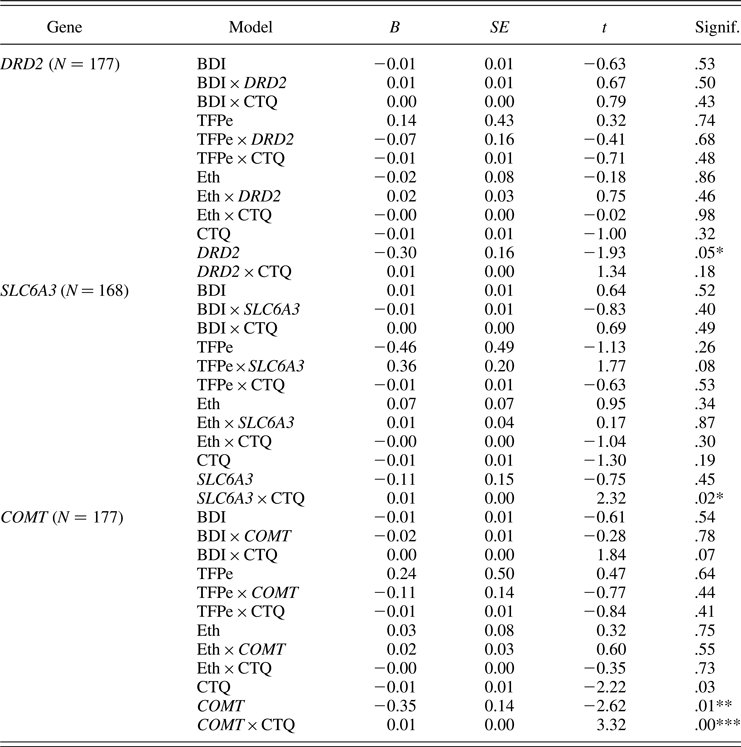
The overall model was nonsignificant using Bonferonni corrected significance levels, F (12, 176) = 2.25, p = .04, R 2 = .14. Regression coefficients indicated that neither the main effects nor the G × E interaction exceeded the corrected significance level (Table 4).
Multiple regression terms for infant genotypes moderating the relation between maternal maltreatment history and infant emotion regulation

Note: BDI, Beck Depression Inventor; TFPe, whether or not the toy frustration procedure was terminated early; Eth, ethnicity; CTQ, Childhood Trauma Questionnaire.
*p < .05. **p < .01. ***p < .001.
SLC6A3 genotype as a moderator of the relation between maternal history of maltreatment and infant emotion regulation behavior
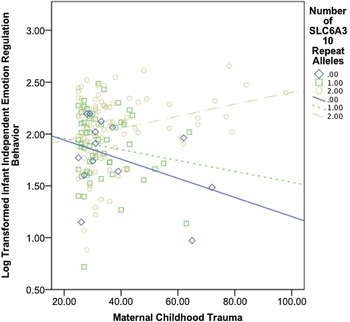
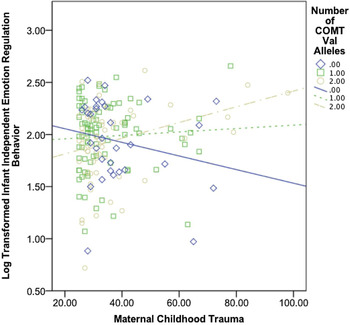
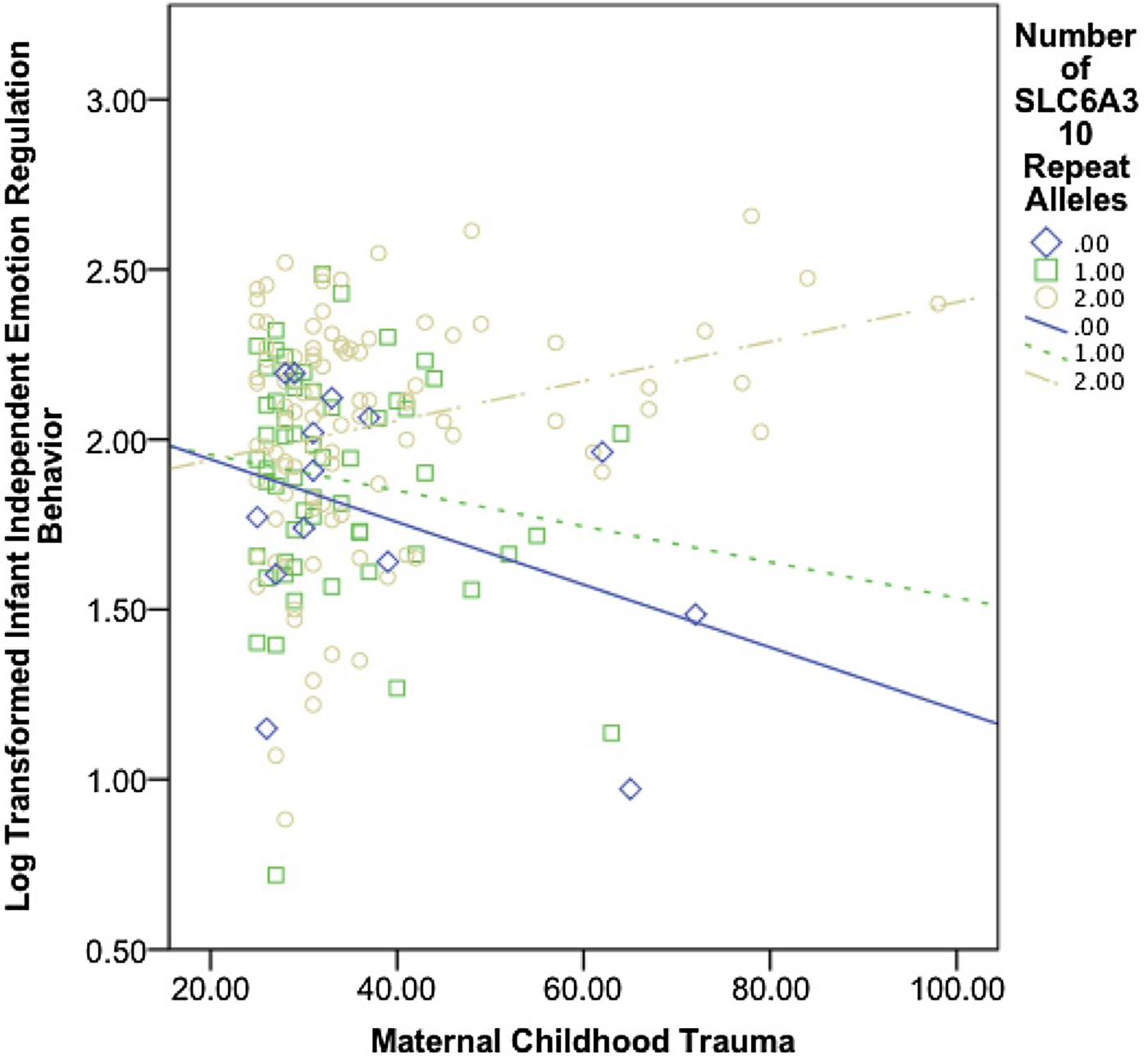
The overall model was significant, F (12, 167) = 3.78, p < .001, R 2 = .23. Regression coefficients indicate that only the interaction between maternal history of maltreatment and infant SLC6A3 genotype significantly predicted infant emotion regulation behavior (Table 4). The interaction between maternal history of maltreatment and infant SLC6A3 genotype significantly improved the prediction of infant regulation behavior, R 2 change = .03, F change (1, 155) = 5.76 p = .02. Simple slopes tests revealed that the relationship between CTQ and infant independent emotion regulation behavior was significant for infants with two 10-repeat alleles (p < .05), but not for infants with zero or one 10-repeat alleles. The overall findings indicate that SLC6A3 genotype moderates the relationship between maternal history of maltreatment and infant emotion regulation such that maternal maltreatment history is more strongly associated with independent infant emotion regulation behavior for infants with two 10-repeat alleles of SLC6A3, relative to infants with one or no 10-repeat alleles (Figure 1).
(Color online) The SLC6A3 genotype moderates the relationship between maternal history of maltreatment and infant emotion regulation such that maternal maltreatment history is more strongly associated with independent infant emotion regulation behavior for infants with two 10-repeat alleles of SLC6A3, relative to infants with one or no 10-repeat alleles.
COMT genotype as a moderator of the relation between maternal history of maltreatment and infant emotion regulation behavior
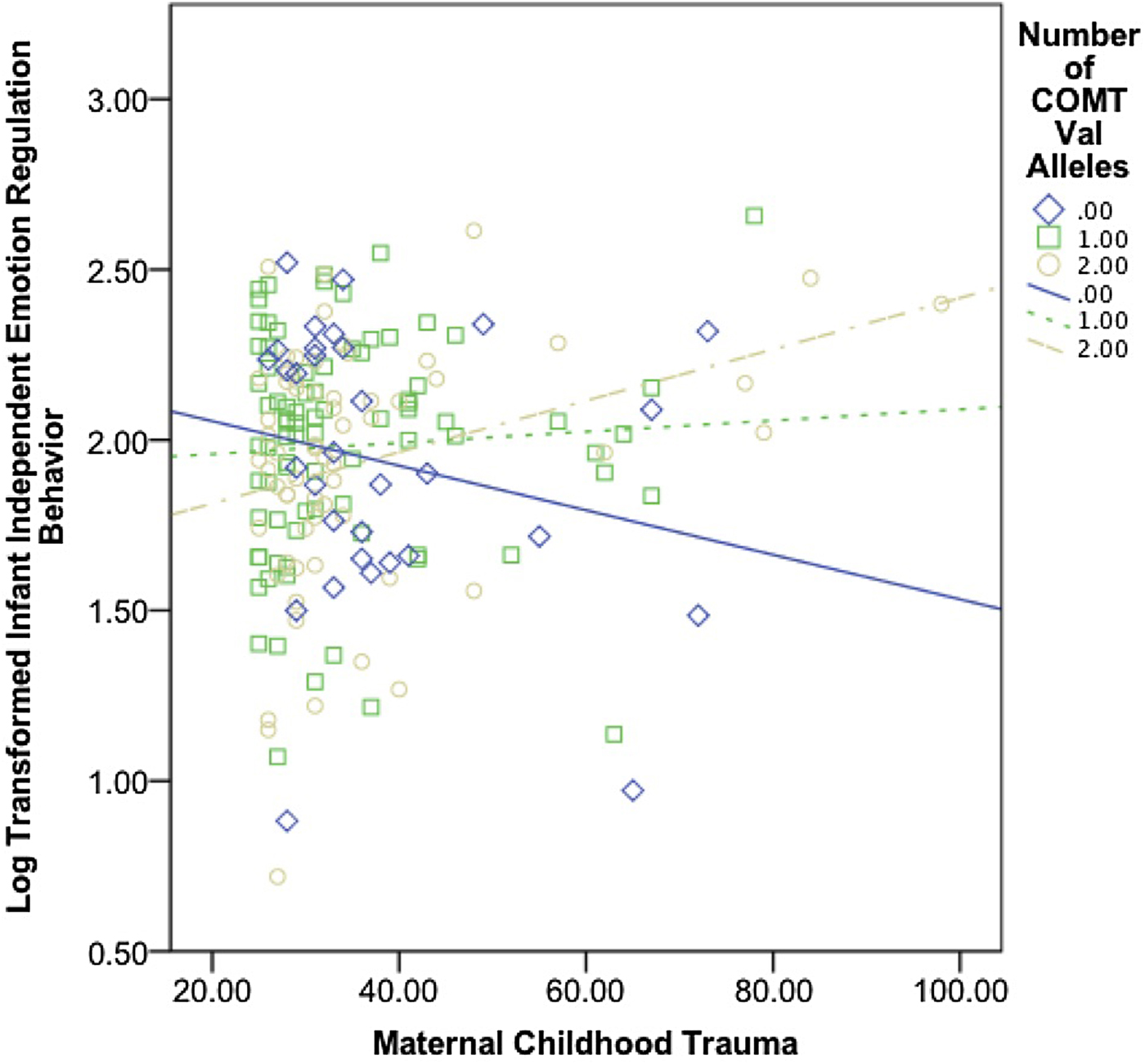
The overall model was significant, F (12, 176) = 2.95, p < .01, R 2 = .18. Regression coefficients indicate that infant COMT genotype and the interaction between maternal history of maltreatment and infant COMT genotype significantly predicted infant emotion regulation behavior (Table 4). The interaction between maternal history of maltreatment and infant COMT genotype significantly improved the prediction of infant regulation behavior, R 2 change = .06, F change (1, 164) = 12.00, p < .001. Simple slopes tests revealed that the relationship between CTQ and infant independent emotion regulation behavior was significant for infants with 2 valine alleles (p < .05), but not for infants with 0 or 1 valine allele. The overall findings indicate that COMT genotype moderates the relationship between maternal history of maltreatment and infant emotion regulation such that maternal maltreatment history is more strongly related to independent infant emotion regulation behavior for infants with two valine alleles of COMT, relative to infants with one or no valine alleles (Figure 2).
(Color online) The COMT genotype moderates the relationship between maternal history of maltreatment and infant emotion regulation such that maternal maltreatment history is more strongly related to independent infant emotion regulation behavior for infants with two valine alleles of COMT, relative to infants with one or no valine alleles.
Discussion
This study investigated interactions between dopamine-related genetic polymorphisms (DRD2, SLC6A3, and COMT) and maternal history of childhood maltreatment to predict infant emotion regulation behavior. The results revealed that the association between maternal maltreatment history and infant emotion regulation strategy is moderated by infant genotype. These relations hold even after controlling for maternal depressive symptoms. Specifically, maternal maltreatment history more strongly predicts independent infant emotion regulation behavior for infants with two plasticity alleles of SLC6A3 (10-repeat allele) and for infants with two plasticity alleles of COMT (valine allele), relative to infants with one or no plasticity alleles of each gene, respectively.
Each element examined in the current study, that is, maternal maltreatment history (Carpenter et al., Reference Carpenter, Carvalho, Tyrka, Wier, Mello, Mello and Price2007; Cicchetti, Rogosch, & Toth Reference Cicchetti, Rogosch and Toth2006; Min et al., Reference Min, Singer, Minnes, Kim and Short2012), dopamine function (Ludmer et al., Reference Ludmer, Levitan, Gonzalez, Kennedy, Villani, Masellis and Atkinson2015; Salgado-Pineda et al., Reference Salgado-Pineda, Delaveau, Blin and Nieoullon2005), and emotion regulation (Eisenberg et al., Reference Eisenberg, Cumberland, Spinrad, Fabes, Shepard, Reiser and Guthrie2001; Lam, Dickerson, Zoccola, & Zaldivar, Reference Lam, Dickerson, Zoccola and Zalvidar2009), has been associated with a host of negative psychosocial and physiological outcomes, such as internalizing and externalizing difficulties, and atypical cortisol secretion. This study is the first to identify early interrelations among these elements. From the perspective of developmental psychopathology (Cicchetti, Reference Cicchetti1989; Cicchetti & Toth, Reference Cicchetti and Toth2009), a failure to grasp effective emotion regulation skills in infancy may lead to such outcomes later in life. Accordingly, maternal factors (e.g., sensitivity and depressive symptoms) have been found to interact with infant dopamine-related genotypes to predict various outcomes that reflect emotion regulation, such as infant physiological response to psychosocial stress (i.e., titrating physiological responses to appropriately match the nature of social and frustration challenges; Frigerio et al., Reference Frigerio, Ceppi, Rusconi, Giorda, Raggi and Fearon2009; Ludmer et al., Reference Ludmer, Levitan, Gonzalez, Kennedy, Villani, Masellis and Atkinson2015; Propper et al., Reference Propper, Moore, Mills-Koonce, Halpern, Hill-Soderlund, Calkins and Cox2008), infant attention allocation (i.e., shifting or sustaining attention to important stimuli; Voelker et al., Reference Voelker, Sheese, Rothbart and Posner2009), and toddler affective problems (i.e., managing or recovering from negative emotions; Mills-Koonce et al., Reference Mills-Koonce, Propper, Gariepy, Blair, Garrett-Peters and Cox2007). Thus, emotion regulation may be part of a cluster of physiological and behavioral processes influenced by the early caregiving environment and dopaminergic function, and early difficulties with emotion regulation may place infants on a maladaptive developmental trajectory toward outcomes such as internalizing and externalizing difficulties (Eisenberg et al., Reference Eisenberg, Cumberland, Spinrad, Fabes, Shepard, Reiser and Guthrie2001), and neurobiological dysregulation (Lam et al., Reference Lam, Dickerson, Zoccola and Zalvidar2009).
The current results further indicate that normative variation in maternal history of maltreatment in a low-risk, community sample has implications for infant emotion regulation behavior, particularly for infants with the 10-repeat and valine alleles. Hane and Philbrook (Reference Hane and Philbrook2012) discuss how offspring phenotypic change can occur in response to minor environmental variations, shaping the individual's adaptation to his or her idiographic ecology. Consistent with the intergenerational transmission of extreme maltreatment (Pears & Capaldi, Reference Pears and Capaldi2001), even mothers with lesser histories of maltreatment may rear children with proportionately suboptimal emotion regulation skills, and these skills are further moderated by infant genotype. These findings are best understood within a developmental psychopathology framework, with its emphasis on psychopathology as a multidimensional construct, as an outcome of normal development gone awry (Cicchetti, Reference Cicchetti1989; Cicchetti & Toth, Reference Cicchetti and Toth2009).
The present study does not address mechanisms linking the Maltreatment × Gene interactions to emotion regulation strategy. However, consistent with the attentional basis of independent emotion regulation strategies (see Table 1), and the role of dopamine within “attentional, motivational, and exploratory neurobehavioral processes” (Laucht et al., Reference Laucht, Skowronek, Becker, Schmidt, Esser, Schulze and Rietschel2007, p. 585), we suggest that the mediating mechanism involves infant attention allocation. This would be consistent with findings pertaining to both SLC6A3 and COMT and with findings related to correlates of maternal maltreatment history. For example, infants with COMT valine alleles are more likely to allocate their attention to attractive stimuli and less likely to sustain their attention (Holmboe et al., Reference Holmboe, Nemoda, Fearon, Csibra, Sasvari-Szakely and Johnson2010; Markant et al., Reference Markant, Cicchetti, Hetzel and Thomas2014; Voelker et al., Reference Voelker, Sheese, Rothbart and Posner2009). Infants with 10-repeat alleles of SLC6A3 have more symptoms of attention-deficit/hyperactivity disorder in childhood and adolescence (including attentional issues; Brooks et al., Reference Brooks, Xu, Zhou, Neale, Lowe, Aneey and Johansson2006; Laucht et al., Reference Laucht, Skowronek, Becker, Schmidt, Esser, Schulze and Rietschel2007). In this regard, Laucht et al. (Reference Laucht, Skowronek, Becker, Schmidt, Esser, Schulze and Rietschel2007) found that SLC6A3 interacts with psychosocial adversity to predict attention-deficit/hyperactivity disorder.
Therefore, we speculate that increased distractibility among infants with valine and 10-repeat alleles may predispose them to orient away from the inaccessible object and toward other environmental features, perceived as more engaging. These features may include aspects of the environment associated with maternal maltreatment history, such as mother's atypical stress reactivity (Carpenter et al., Reference Carpenter, Carvalho, Tyrka, Wier, Mello, Mello and Price2007) and related parenting (Pereira et al., Reference Pereira, Vickers, Atkinson, Gonzalez, Wekerle and Levitan2012). In turn, these features may simultaneously promote regulation independent of mother and undermine focus on the inaccessible toy. This coincident process may describe the underlying dynamics of the G × E interactions found here. It is paradoxical that the genetic predisposition to distractibility may support the infant's adoption of an independent emotion regulation strategy, and this strategy may be adaptive in an immediate context where other options (i.e., dependence on the mother) are less accessible. Nevertheless, like all adaptations, it comes at a cost. Khoury et al. (Reference Khoury, Gonzalez, Levitan, Masellis, Basile and Atkinson2015) showed that reliance on independent emotion regulation at this age is associated with elevated cortisol reactivity to a low stress challenge. Thus, we suggest that the increased distractibility and independent emotion regulation strategies of infants with 10-repeat and valine alleles (in the context of maternal maltreatment history) place them on a maladaptive developmental trajectory toward physiological and behavioral problems.
Contrary to the hypotheses, we did not find the A1 allele of DRD2 to significantly moderate the relation between maternal maltreatment history and infant emotion regulation behavior. While the DRD2 gene has been identified in several previous studies as a marker of environmental plasticity (e.g., Belsky & Pluess, Reference Belsky and Pluess2009), differences in the observed plasticity markers may be a consequence of differing age groups, methodology, environmental predictors, and/or outcome variables. Only a cumulating literature will help in identifying the nuances of association already evident in the literature. Relative to the valine allele of COMT and the 10-repeat allele of SLC6A3, the A1 allele of DRD2 has been less consistently associated with attentional capacity in infancy (e.g., Holmboe et al., Reference Holmboe, Nemoda, Fearon, Csibra, Sasvari-Szakely and Johnson2010), which may also help to explain differences in results across genes.
While maternal maltreatment histories may place mothers at risk for providing less sensitive care to their infants (Pereira et al., Reference Pereira, Vickers, Atkinson, Gonzalez, Wekerle and Levitan2012), the current study did not find maternal sensitivity to significantly predict infant emotion regulation behavior. Thus, future studies could explore whether other family variables such as nonsecure attachment (Cicchetti et al., Reference Cicchetti, Rogosch and Toth2006), low social support (Min et al., Reference Min, Singer, Minnes, Kim and Short2012), increased parenting stress (Pereira et al., Reference Pereira, Vickers, Atkinson, Gonzalez, Wekerle and Levitan2012), or atypical stress physiology (Carpenter et al., Reference Carpenter, Carvalho, Tyrka, Wier, Mello, Mello and Price2007) account for the relation between maternal maltreatment history and infant emotion regulation behavior and, as discussed, the role that infant attentional capacity and genotypes may have within these relations. Understanding the interplay of infant COMT and SLC6A3 genotypes, maternal maltreatment history, and mediating factors can potentially inform interventions aimed at personalizing care (e.g., understanding who may benefit the most from specific interventions).
Several limitations of this study warrant consideration. Sample size was small for the assessment of G × E interactions (Duncan & Keller, Reference Duncan and Keller2011), and an independent replication sample would have been desirable. However, other studies reviewed here showed similar G × E results using related environmental and outcome variables. In addition, we relied on maternal retrospective reports of maltreatment, although it is also true that the CTQ has good psychometric properties, including good criterion and external validity (Bernstein et al., Reference Bernstein, Stein, Newcomb, Walker, Pogge, Ahluvalia and Zule2003; Miller et al., Reference Miller, Green, Fettes and Aarons2011; Spinhoven et al., Reference Spinhoven, Penninx, Hickendorff, van Hemert, Bernstein and Elzinga2014).
In any event, we attempted to attenuate Type I error rate in several ways. This study incorporates multiple levels of analysis and several research methods, including maternal report, genotyping, and behavioral observation, thereby reducing the threat of shared method variance. We also adopted Bonferroni correction procedures and conformed with Keller's (Reference Keller2014) covariate interaction recommendations. We used nonbinned genetic terms, which reduce potential error due to unjustifiable assumptions of allele dominance. The results were remarkably consistent for SLC6A3 and COMT, showing that risk increased with number of plasticity alleles (Figures 1 and 2).
In summary, this study showed that infant SLC6A3 and COMT genes interact with maternal history of maltreatment to predict observed infant emotion regulation behavior. Maternal maltreatment history is more strongly associated with independent infant emotion regulation behavior for infants with more 10-repeat and valine alleles of SLC6A3 and COMT, respectively, relative to infants with fewer or no 10-repeat and valine alleles.