The incidence of CHD ranges from 6.9 to 9.3/1000 births. In the United States of America, one in every 150 adults has CHD.Reference Go, Mozaffarian and Roger 1 With advances in medicine, many patients are diagnosed prenatally or shortly after birthReference Huber, Peres and Jeronimo 2 and life expectancy increases. Recently, our group has shown that these children are exposed to acquired risk factors for cardiovascular disease, such as obesity.Reference Barbiero, D’Azevedo Sica, Schuh, Cesa, de Oliveira Petkowicz and Pellanda 3
Adipose tissue is metabolically active secreting proinflammatory cytokines such as C-reactive protein.Reference Hotamisligil, Shargill and Spiegelman 4 , Reference Kim, Park and Kawada 5 Visceral fat plays an important role in the pathogenesis of cardiovascular disease, as proinflammatory cytokines are released in the body via the portal vein, which rapidly reach the liver and accelerate the inflammatory process.Reference Franco, Bodanese and Repetto 6 In addition, a number of mechanisms increase the expression of genes that encode proteins involved in inflammatory response, such as the nuclear transcription κ B factor, responsible for a number of metabolic changes that are related to chronic non-communicable diseases, such as those that affect the cardiovascular system.Reference Smidowicz and Regula 7 , Reference Ikeoka, Mader and Pieber 8
C-reactive protein has been described as an important marker of vascular inflammation and as a predictor for cardiovascular diseases in numerous epidemiological studies.Reference Hashimoto, Kitagawa and Hougaku 9 – Reference Ridker 13
Children with CHD are exposed to inherent risk factors for ischaemic heart disease, such as vascular and inflammatory changes, in addition to the development of modifiable risk factors such as overweight and obesity. Although this could be a group at special risk of developing ischaemic heart disease, there are a few studies evaluating risk factors in children with CHD. As C-reactive protein is an important marker of mild chronic inflammation, the objective of this study was to evaluate the correlation between serum levels of C-reactive protein and body mass index of children and adolescents with CHD.
Methods
A cross-sectional study was conducted with 377 patients with CHD, aged 2 to 18 years, seen at the paediatrics clinic of a reference hospital for cardiology between October 2010 and September 2014.
The protocol of the study was approved by the Institutional Research Ethics Committee of The Institute of Cardiology of Rio Grande do Sul, Brazil (4470/2010).
Patients with innocent heart murmurs, clinical conditions that were impeditive to anthropometric measures, such as use of a wheelchair, lower limb malformation, etc., genetic syndromes, or children without a diagnosed structural heart disease were excluded from the study.
All patients and caregivers were informed about the study, and the legal guardians and children who agreed to participate signed an informed consent form. Data collection was conducted according to a weekly list of scheduled routine outpatient visits. On the basis of this list, children’s guardians were contacted by telephone and patients were invited to participate in the study. Those who agreed to participate were asked to fast for 12 hours before the laboratory tests. Patients who could not be reached by telephone were invited to participate during the scheduled medical visit, and the laboratory tests were scheduled for another day.
Data were obtained from a questionnaire administered by health professionals trained specifically for the study, who received regular training updates. After being evaluated, participants who showed abnormal results were referred to a multidisciplinary outpatient care for prevention and treatment of risk factors.
Participants were divided into groups according to the type of defect – cyanotic/acyanotic – and the presence of clinical symptomatology. This resulted in three groups: cyanotic, acyanotic with clinical repercussion, and minimal heart defects, which was considered as the control group.
Anthropometric assessment
Weight and height were measured with the child in the upright position, barefoot, and wearing light clothes. Weight was measured to the nearest 0.1 kg using a Welmy electronic digital scale, with a maximum capacity of 200 kg, and height was measured in centimetre using a stadiometer coupled to the scale, with a maximum capacity of 200 cm. Nutritional status was based on body mass index, which was calculated and classified using the World Health Organization (WHO) software Anthro and Anthro Plus 2007© version 3.2.2 with cut-off points for low weight/normal (<85th percentile) and overweight (>85th percentile, being overweight for 85–95th percentiles and obesity for >95th percentile) according to the WHO-2006/2007.Reference Mercedes de, Adelheid, Borghi, Siyam, Nishida and Siekmann 14 , 15
Laboratory tests
Blood samples were collected through peripheral venous puncture after 12 hours of fasting. Levels of hs-CRP were determined in serum by nephelometry, using a Behring Nephelometer 100 Analyzer (Deerfield, Illinois, United States of America). Blood levels of C-reactive protein were considered abnormal according to the US Pediatric Guidelines (2011) if C-reactive protein was >0.30 mg/dl.
Statistical analysis
Sample size was estimated to detect a correlation of 0.3 at the 5% significance level and statistical power of 80%, including 367 patients. Statistical analyses were conducted using SPSS Statistics software© version 17.0. A descriptive analysis was performed using means and percentages. C-reactive protein values among groups were evaluated using medians, interquartile ranges, and the Kruskal–Wallis test. The Mann–Whitney test was used to evaluate differences in C-reactive protein between sexes. The body mass index percentile variables, age, birth weight, and hours of sleep were analysed using Spearman’s test.
Results
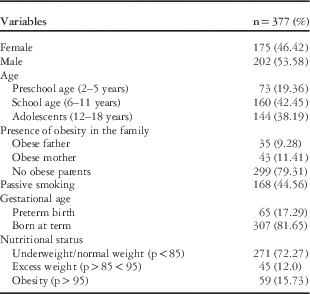
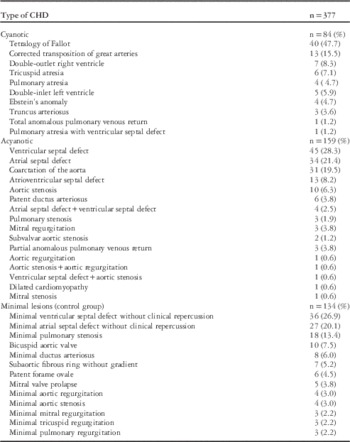
The sample consisted of 377 patients. Cyanotic disease corresponded to 84 children (22.28%), symptomatic acyanotic disease was found in 159 children (42.18%), and minimal heart defects were present in 134 children (35.54%). Table 1 presents the general characteristics and nutritional status of the population, and Table 2 presents the specific lesions in each group. Among the cyanotic lesions, the most frequent was tetralogy of Fallot (47.6%), followed by transposition of the great arteries (15.5%), and double-outlet right ventricle (7.1%). The acyanotic group was comprised mainly of patients with ventricular septal defect (28.3%) and atrial septal defect (21.4%), followed by coarctation of the aorta (19.5%). The control group included patients with minimal ventricular septal defect (26.9%) and atrial septal defect (20.1%), as well as minimal pulmonary stenosis (13.4%), all with no clinical repercussion.
General characteristics of the participants.

Frequency of specific CHD according to group.

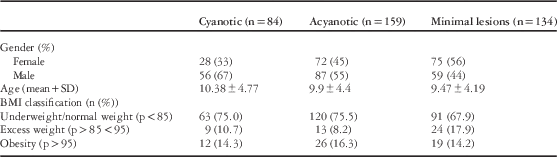
The distributions of age, body mass index percentile, and sex by group of CHD are shown in Table 3.
Age, body mass index (BMI) classification, and gender distribution, according to groups of CHD

There were no significant differences in body mass index percentiles according to congenital heart lesion group or sex.
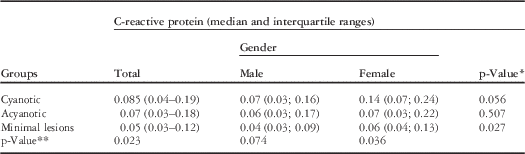
Table 4 shows comparative analysis of C-reactive protein according to groups of CHD and sex. There was a significant difference between C-reactive protein medians in the total sample (r=0.023). There were differences in C-reactive protein levels between boys and girls, with higher levels of C-reactive protein in females (p=0.034). The direction of effect was the same across all groups, but statistical significance was observed only in girls.
Median values and interquartile ranges of C-reactive protein, according to groups of CHD and gender.

* Between genders (Mann–Whitney test)
** Between groups (Kruskal–Wallis test)
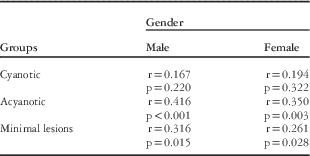
There was a significant correlation between C-reactive protein and body mass index percentile (r=0.293, p<0.001). Table 5 shows the Spearman’s correlations between C-reactive protein and body mass index percentile, according to groups of CHD and sex.
Spearman’s correlations between C-reactive protein and body mass index percentile, according to groups of CHD and gender.

There were no significant correlations between C-reactive protein and age, birth weight, or hours of sleep a day.
Discussion
In the present study with 377 patients with CHD, we found a significant correlation between body mass index percentile and C-reactive protein (p<0.01), confirming the evidence found in children in other settings.Reference Cook, Mendall and Whincup 16 – Reference Kaplan, Aviles-Santa and Parrinello 18 Adiposity may be considered, thus, an important risk factor for elevated C-reactive protein in children with CHD. In addition, we observed higher levels of C-reactive protein in the cyanotic group, corroborating other studies showing higher biomarker levels in cyanotic patients.Reference El-Melegy and Mohamed 19
Children with CHD have higher levels of inflammatory markers such as tumour necrosis factor α,Reference Takaya, Ikemoto, Teraguchi, Nogi and Kobayashi 20 C-reactive protein, and interleukin-6, when compared with controls. These values were higher in cyanotic when compared with acyanotic children.Reference Nassef, Hamed and Aly 21 Reports indicate that adults with CHD have higher levels of tumour necrosis factor α and interleukin-6,Reference Sharma, Bolger and Li 22 which should be a matter of concern, as interleukin-6 is a cytokine that stimulates the synthesis of C-reactive protein by hepatocytes, thereby contributing to systemic effects of inflammation.Reference Yudkin, Stehouwer, Emeis and Coppack 23 There were moderate and significant correlations between C-reactive protein and body mass index in the acyanotic and minimal lesions groups, for both sexes. The cyanotic group showed weaker and non-significant correlations. These may be due to statistical power; however, considering the higher levels of C-reactive protein consistently shown in cyanotic patients, the weaker correlation with body mass index could also be attributed to a lesser role of body mass index in determining inflammation in this group.
There were differences in C-reactive protein levels between boys and girls, with higher levels of C-reactive protein in females. The direction of effect was the same for both sexes across all groups of CHD, but statistical significance was observed only in girls. These findings may be explained by different immunological responses between sexes. Females tend to consistently show a more pronounced proinflammatory innate immune response.Reference Fish 24
A characteristic feature of the adipose tissue is the ability to secrete a number of proinflammatory cytokines including C-reactive protein, which over time will trigger a low state of chronic inflammation. The mechanisms by which the proinflammatory mediators lead to manifestation of disease appear to involve the attenuation of insulin response, fat mobilisation, endothelial dysfunction, and oxidative stress. As body mass index increases, the risk for development of a chronic non-communicable disease increases significantly. Individuals with body mass index >35 kg/m2 are six times more likely to develop type II diabetes and three times more likely to develop hypertension.Reference Gomes, Telo, Souza, Nicolau, Halpern and Serrano 25 C-reactive protein levels have been associated inversely with insulin action, regardless of the percentage of fat.Reference Weyer, Yudkin, Stehouwer, Schalkwijk, Pratley and Tataranni 26 These results demonstrate the important role of adipose tissue in the pathophysiology and development of chronic non-communicable disease.
Interestingly, recent data have shown that children with high C-reactive protein levels had a higher risk of developing overweight or obesity during growth.Reference Nappo, Iacoviello and Fraterman 27
In our study, we found 12.0% of overweight and 15.73% of obese children, accounting for almost one-third of individuals with excess weight. This finding is in accordance with the literature that shows a prevalence of overweight in children with CHD varying from 7.6 to 28%.Reference Massin, Hövels-Gürich and Seghaye 28 – Reference Chen, Wang, Lue, Hua, Chang and Wu 30 Our study and this previous evidence demonstrate that the prevalence of overweight in children with CHD is similar to that found in children in general, which shows that this particular population is not immune to the obesity epidemic that affects both developed and developing countries.
This is an important finding, as recent data have indicated that children with CHD have a tendency to increase the accumulation of fatty tissue over the years.Reference Tamayo, Manlhiot, Patterson, Lalani and McCrindle 31 In Brazil alone, population-based studies have shown that being overweight has linearly increased in children aged 5–9 years from 10.9% in the 1970s to 34.8% in 2009. 32 , 33
World Health Organization data show that in 2013, 42 million children under 5 years of age were overweight or obese in the world. According to The Brazilian Ministry of Health, the National Health System spends R$ 488 million (≈US$160 millions) with the treatment of diseases associated with obesity in Brazil. Between 2008 and 2011, there was an increase of 16 million with the total costs for treatments related to obesity.Reference Mazzoccante, Moraes and Campbell 34 In the United States of America, the reduction of 1% in the prevalence of overweight and obesity in adolescents between 16 and 17 years of age would account for savings of US$ 586.3 million in future expenses with adult health.Reference Wang, Denniston, Lee, Galuska and Lowry 35
Children aged 2–19 years, without any heart condition, are 5 kg heavier compared with children of the same age in the 1980s,Reference Crowley, Khoury, Urbina, Ippisch and Kimball 36 which brings attention to the need for prevention strategies to control infant overweight and obesity, particularly because a good portion of them will remain obese over the years.Reference Conde and Borges 37 Approximately 70% of children remain obese in adulthood.Reference Freedman, Khan, Serdula, Dietz, Srinivasan and Berenson 38
The development of obesity is influenced by genetic factors, lifestyle, and social and emotional environment. As risk factors amount over the years, the risk for cardiovascular diseases increases significantly.Reference Chiuve, Cook and Shay 39 Obesity interferes with quality of life, and children living with this condition tend to have low self-esteem and to suffer from social discrimination.Reference Victorino, Soares, Marcon and Higarashi 40 – Reference Sahoo, Sahoo, Choudhury, Sofi, Kumar and Bhadoria 42 In children with CHD, these implications are even more relevant, as they overlap with their already impaired quality of life. This can influence development and social relationships.Reference Kalra, Sousa, Sonavane and Shah 43 , Reference Compas, Jaser, Dunn and Rodriguez 44
This study has some limitations that merit discussion. High-sensitivity C-reactive protein measurement was performed only once. The cut-off points for C-reactive protein in children are still not as well established as that for adults; however, we sought to study a simple measurement that could be performed in clinical practice. Moreover, the absence of precise cut-off points does not prevent examining the correlations between variables, and may offer a contribution towards having more significant thresholds established in the future.
A major strength of this study is the large number of children with CHD that were evaluated, which contributes to establish a reference parameter for this population. These results bring attention to the need for having a differentiated look towards this population, as the advances in diagnostic and therapeutic techniques provided longevity to the individuals, increasing the period of exposure and the risk of development of chronic diseases such as obesity and its consequences.
The direct and significant correlation between C-reactive protein and body mass index percentile in children with CHD emphasises that the adipose tissue is an important secretor of proinflammatory markers related to the development of atherosclerosis in this population as well.
Acknowledgements
None.
Financial Support
This research received no specific grant from any funding agency or from commercial or not-for-profit sectors.
Conflicts of Interest
None.
Ethical Standards
This study was approved by the Ethics in Research of the Rio Grande do Sul Cardiology Institute Committee after being in accordance with established ethical standards.