Introduction
In reference to the Arctic Ocean, D. I. Mendeleev (Reference Mendeleev1948) wrote: “Victory over its ices is one of the economic issues of the future of North-Eastern European Russia and almost the whole Siberia…” (p. 172). Northern dominance in Russia’s economic development is one of the important ideas that he brought into economic literature, although he was not the first to do so. More than a century earlier, M. V. Lomonosov noted that “…Russia’s power will grow by Siberia and the Northern Ocean” (Lomonosov, Reference Lomonosov1952, p. 490).
The development of the Arctic was addressed even before the 1917 revolution (Shilovskii, Reference Shilovskii2009). Numerous projects had been prepared for the development of maritime transport and the construction of ports (Khromykh, Reference Khromykh2012; Zaozerskii, Reference Zaozerskii2018). However, they did not provide for the widespread development of the Arctic and the involvement of a large number of people. At that time, the authorities were only making their first attempts to implement centralised state management to the processes of studying and developing the Arctic (Timoshenko & Elert, Reference Timoshenko and Elert2016).
In the USSR, the Arctic became a zone of broad economic development (Timoshenko, Reference Timoshenko2013a). As a result, almost the entire history of the USSR passed under the sign of an active policy of complex development of the Arctic regions (Karpov, Reference Karpov2016). It was carried out at a rapid pace (Laruelle, Reference Laruelle2019; Timoshenko, Reference Timoshenko2013b), and as early as the 1930s, the following provision was formulated: “The development of the North fully follows from the immediate objectives of the development of the USSR national economy” (Slavin, Reference Slavin, Moskovin and Zaprudskii1987, pp. 191–192). The history of the USSR has shown that this thesis was perceived as guidance for action (Isaev et al., Reference Isaev, Il’inykh, Romanov, Andreenkov and Kupershtokh2013). This macroregion was in some way a showcase of domestic achievements of social and economic development (Turkov, Reference Turkov2016) since only a strong and self-confident state can spend resources on developing territories with such harsh living and economic conditions.
The development of the North required a much greater labour force than was available there at the time (Sukneva, Reference Sukneva2014; Tatarkin, Reference Tatarkin2015; Zaionchkovskaya, Reference Zaionchkovskaya2000). The migratory inflow to the Arctic was large. However, the outflow of the population was also significant, albeit smaller than the inflow (Grandstaff, Reference Grandstaff1975). It was related not only to the climate or to dissatisfaction with expectations but also to the disorganisation of everyday life (Gonina, Reference Gonina2016; Karpov & Yudakova, Reference Karpov, Yudakova, Zhiromskaya and Stas’2015; Kelmeneva, Reference Kelmeneva2017), although participation in the heroic process of the exploration of the North partially smoothed out everyday problems in people’s minds (Agapov & Klyueva, Reference Agapov and Klyueva2018).
Russia’s geographical location registers the duality of its development. Foreign researchers have noted that Russia by its main features is “like Europe, but not Europe, like Asia, but not Asia” (Xueling & Man, Reference Xueling and Man2017, p. 243). As a result, some claim that Russia should “fix itself as a ‘civilization of the North’” (Ryazanov, Reference Ryazanov2018, p. 646), since after the collapse of the USSR, Russia became even more of a northern country. The structure of the Russian economy confirms this thesis to the fullest extent. Given the amount of mineral resources that are concentrated in the northern regions and their importance to economic development, it is not surprising that the Arctic regions make significant economic contributions to the general welfare of the country.
Until 1991, the Arctic population grew rapidly. This was caused by a large migratory inflow due to two reasons. First, a significant number of people were attracted by high wages and propaganda, which used the image of a heroic explorer of the north. The second source of incoming population was forced migration. Up to the 1950s, its contribution was greater compared to later times. A large part of migrants was young people, which also ensured high natural population growth. Following the events of 1991, demographic trends became negative. The number of births in the 1990s would have decreased anyway because of the demographic wave. However, the dramatic deterioration in living standards in the Arctic regions has led to a sharp and very significant decline in fertility rates and a huge migratory outflow. At the same time, there has been a very strong increase in mortality. In the 2000s, the situation partly stabilised, but fertility has remained below replacement level, with high both migration outflow and mortality.
The demographic policy that is currently being implemented in Russia is primarily aimed at increasing birth rates and reducing mortality. Less attention is given to the optimisation of migration. However, migration has always had a very large impact on the demographic dynamics in the Arctic regions. This was particularly evident during the Soviet exploration of the Arctic and in the 1990s. It is necessary to reflect on the experience of our recent past to better understand current trends and assess potential threats to Russia’s socio-economic development. In this regard, we will touch upon migration issues during the very difficult period of the Russian Arctic exploration when population decline in the Arctic zone of Russia was permanent. These trends have determined the prospects for the demographic development of the Arctic for many years to come.
Literature review
The neoclassical theory of migration states that migration occurs when the benefits of such action outweigh the costs associated with it (Ritchey, Reference Ritchey1976). In practice, this means that people move primarily from regions with lower wages and higher unemployment to regions with higher wages and lower unemployment (Sjaastad, Reference Sjaastad1962; Todaro, Reference Todaro1969), but Greenwood (Reference Greenwood, Rozenzweig and Oded1997) has shown that these statements cannot always be empirically proven.
Migration in the USSR in search of favourable economic conditions has been considered in sufficient detail in the literature. The secondary influence of economic factors (at least labour market conditions) has been noted (Buckley, Reference Buckley1995; Grandstaff, Reference Grandstaff1980; Mitchneck, Reference Mitchneck1991; Mitchneck & Plane, Reference Mitchneck and Plane1995). However, the same authors have also questioned the importance of economic factors in the post-Soviet era; during the transition to capitalism, the state sharply reduced the financing of its social obligations, while recently, privatised companies and local governments have lacked the financial means and willingness to fulfil them. Not everyone agrees with this approach (Gerber, Reference Gerber2006), as changes in labour market conditions in the Russian Arctic have a decisive impact on migration flows because its economy is primarily oriented to mineral extraction. Moreover, in the 1990s, significant heterogeneity of regions in terms of their economic development (Gerber, Reference Gerber2006) played a very important role, which is a new factor as compared to the Soviet period when migration was carried out according to a planned approach and was strictly regulated. As a result, the main migration factors affecting the Arctic were arguably economic, not social, or any other types of factors. This is supported by the post-Soviet survey results (Andrienko & Guriev, Reference Andrienko and Guriev2004; Brown, Reference Brown1997; Fidrmuc, Reference Fidrmuc2004; Gerber, Reference Gerber2006). By studying rural–urban migration, Soviet researchers have also confirmed the relevance of economic factors for migration within the USSR. They have pointed out that the most important migration factors were primarily economic, not social. Among the economic factors, those related to labour market conditions were particularly notable (Shubkin, Reference Shubkin1970; Zaslavskaya, Reference Zaslavskaya1970; Zhuchenko & Steshenko, Reference Zhuchenko and Steshenko1972).
The collapse of the USSR created two major migration flows. The first one is the large-scale migration of Russians and Russian speakers from the former USSR Republics to Russia. The second flow is a mass migration from the east and north of Russia to the west and south. Migration from the Arctic and extreme north regions is a part of this flow. Both of them have had a tremendous impact on demographic processes in Russia and deserve particular attention as they are historically unprecedented. Nevertheless, if an adequate state policy had been implemented, migration from the Arctic would have been much less, while the probability of the existence of the first stream of migration is high in almost any scenario.
Migration out of the Arctic, its causes and its demographic consequences in the context of economic transformation are quite well considered (Heleniak, Reference Heleniak1997; Heleniak, Reference Heleniak1999). However, these papers do not address the particular regions of the Arctic in detail, which makes it impossible to provide a detailed description of the Arctic regions and to identify migration preferences of the population.
In addition to a comprehensive study of migrations in the Arctic zone of Russia as a whole, a certain amount of literature is devoted to its particular regions. Detailed statistics are available to local researchers, and population surveys are regularly conducted, so the research findings are quite justified. Nevertheless, general issues of population migration dynamics at the regional level are considered rather weak, as this issue has not practically been raised for some regions.
The Republic of Sakha (Yakutia) has been reviewed in detail. The analysis was carried out over a long period of time and showed significant differences between the Soviet and post-Soviet periods of the Republic’s demographic development (Sukneva, Reference Sukneva2008; Sukneva, Reference Sukneva2010). A typology of the intensity of migration processes was developed for municipalities in the region (Sukneva, Reference Sukneva2017). Migration trends in the capital of the Republic, Yakutsk, are particularly discussed. This interest exists because, unlike most other Arctic cities, its population has increased almost 1.8 times since 1989 (Sukneva & Laruelle, Reference Sukneva and Laruelle2019).
Much attention has also been paid to Chukotka Autonomous Okrug because the population losses in this region, expressed in percentage terms, were by 2000 the largest in the Arctic and the whole country. Both municipal districts and individual settlements have been considered (Kumo & Litvinenko, Reference Kumo and Litvinenko2019). There has also been a focus on further plans for population reduction (Thompson, Reference Thompson2004). The emphasis has not only been on the Arctic but also the nearby Extreme North (Round, Reference Round2005).
Norilsk, the northernmost city in Russia with a population of over 150 thousand people, is a large industrial city that possesses significant financial resources. Its development has required large human resources, and it has been able to avoid strong migratory outflows. Thus, the study of the population dynamics of this city is an important chapter in the study of the dynamics of the Russian Arctic population (Laruelle & Hohmann, Reference Laruelle and Hohmann2017; Zamyatina, Reference Zamyatina2016).
There are also publications devoted to the Komi Republic (Fauzer, Reference Fauzer, Popova and Burtsev2014) and the city of Vorkuta (Fauzer et al., Reference Fauzer, Lytkina, Smirnov and Fauzer2018), which were important centres of forced migration with the subsequent attraction of migrants for the extraction of mineral resources. A sharp decline in migration has been noted in the post-Soviet period, especially outside Russia, and a significant surplus of departures over arrivals.
Aims of the study
The study aims to consider demographic trends that existed in the regions of the Arctic zone of Russia at the intersection of eras during significant socio-economic transformation. By the Arctic zone of Russia, we mean the territories listed in the Presidential Decree of 02.05.2014 296 ‘On Land Boundaries of the Arctic Zone of the Russian Federation’ with the amendments made by the Presidential Decree of 13.05.2019 No 220 ‘On Amendments to the Presidential Decree of 02.05.2014 No 296 ‘On Land Boundaries of the Arctic Zone of the Russian Federation’’. Following the latter decree, the Republic of Karelia has small areas in the Arctic zone, but we do not review this region in our work.
We distinguish the European and Asian parts of the Arctic zone of Russia based on geographical features, but other criteria, such as demographic disparities between them, are noticeable, too (Sinitsa, Reference Sinitsa2016). The European part of the Arctic zone of Russia includes Arkhangelsk Oblast, Murmansk Oblast, the Komi Republic and Nenets Autonomous Okrug. The Asian part of the Arctic zone of Russia includes the Sakha Republic (Yakutia), Krasnoyarsk Krai, Chukotka Autonomous Okrug and Yamalo-Nenets Autonomous Okrug. Some researchers divide the Asian part into mid-regions (the Siberian regions of Russia) and eastern regions (the Far Eastern regions of Russia) (Loginov, Reference Loginov2015). Problems with the availability of statistical data at the municipal level, which made it impossible to restrict ourselves only to municipal entities when it was necessary, led to the fact that all regions, including those that only partially belong to the Arctic zone of Russia, are considered in full extent.
This work uses the methodology of the balance of the population movement with the associated analytical and forecasting tools, which allows considering the natural and migratory movement of the population from a unified point of view (Baranov & Breev, Reference Baranov and Breev1969; Korovkin, Reference Korovkin2001; Korovkin et al., Reference Korovkin, Dolgova, Korolev and Polezhaev2009). The population movement balance in the 1990s is based on data from the Federal State Statistics Service (Rosstat, n.d.a; Rosstat, n.d.b.).
We estimate the probabilities of moving to a new place of residence in several directions. The first direction is migration within a region of the Arctic zone of Russia. The second is migration from one region to another region of the Arctic zone. Third, we estimate within the framework of the modern federal districts the probabilities of permanent movement outside the Arctic zone as well as resettlement into the zone from areas of Russia outside of the zone. Fourth, we consider migratory exchange associated with a change of residence to other countries (the Near and Far abroad countries). The practical application of these tools to the Arctic regions has been implemented by Korovkin (Reference Korovkin2016a, Reference Korovkin2016b) and Korovkin et al. (Reference Korovkin, Dolgova, Edinak and Korolev2015).
Three matrices were calculated based on the balance. They characterise the structure of the population movement in the Arctic zone and federal districts of Russia.
Matrix Q is a diagonal matrix which shows the probabilities of staying in the region after moving to a new place of residence. It allows estimating how many people remained in the region at each stage of population movement, taking into account all arrivals in the region. Further, we call it population acclimation. It is described as follows:
 $$Q\left( t \right) = \Vert{q_{}}\left( t \right)\Vert = \;{\frac{{{n_i}\left( t \right)}}{{{a_i}\left( t \right)}}} = \;{\frac{{{n_i}\left( t \right)}}{{{n_i}\left( {t - 1} \right) + \;\mathop \sum \nolimits_{j = 1}^n {b_{ji}}\left( t \right)}}}$$
where ni - population of region i at the end of the period
ni(t-1) – population of region i at the beginning of the period.
 $\mathop \sum \limits_{{\rm{j}} = 1}^{\rm{n}} {{\rm{b}}_{{\rm{ji}}}}\left( {\rm{t}} \right)$
– the sum of all incomings of population to the region i from the state j (internal and external migration and births).
Matrix M is a matrix of the probabilities of moving from region i to a new place of residence or dying, based upon the initial population in region i and the arrival of the population moving to a new place of residence within region i, moving from another region or country, or birth. It is an estimate of the average number of incomes to state j over a period of time t for persons who were in state i at the beginning of the period. Matrix M is described as follows:
 $$M\left( t \right) = \Vert{m_i}\left( t \right)\Vert = \;{\frac{{{b_{ij}}\left( t \right)}}{{{a_i}\left( t \right)}}} = \;{\frac{{{b_{ij}}\left( t \right)}}{{{n_i}\left( {t - 1} \right) + \;\mathop \sum \nolimits_{j = 1}^n {b_{ji}}\left( t \right)}}}$$
where bij are transitions from region i to other states (internal migration, external migration, death). Other designations remain the same.
Matrix P is a matrix of estimates of probabilities of resulting transitions from region i to state j (move within a region, move outside a region, die) for the whole time period under review.
 $$P\left( t \right) = \Vert{p_i}\left( t \right)\Vert = D\left( t \right)Q\left( t \right)$$
 $$D\left( t \right) = \Vert{d_{ij}}\left( t \right)\Vert = {\left( {E - M\left( t \right)} \right)^{ - 1}}$$
is a matrix that is similar to the full cost factor matrix in the model of input–output tables. Matrix P is a matrix of probabilities of being in a new state at the end of the period t. E is an identity matrix.
In the post-Soviet period, population decline in the Arctic zone of Russia was constant. In 1991–2000, it was the most significant and it determined the prospects for demographic development in the Arctic for many years to come. This determined our choice of the research period.
General demographic dynamics in the regions of the Arctic zone of Russia in 1991–2000
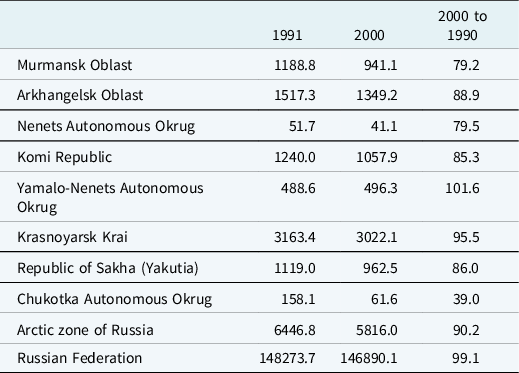
The data in Table 1 show that the decrease in the population in the regions of the Arctic zone of Russia under the new socio-economic conditions was enormous. It significantly exceeded the population decrease in the country as a whole.
Population of regions of the Arctic zone of Russia in 1991–2000 as compared to January 1 (in thousands of people and %).

Source: (Rosstat, n.d.a; Rosstat n.d.b).
In nine years, Russia’s population declined by 0.9%. Increased mortality and declining birth rates were offset by a significant migratory influx from the former Soviet Republics, which had become independent countries and in which local elites tried to push out Russians and Russian-speakers. The regions of the Arctic zone lost a much larger share of their population. Indeed, at the end of the period, the population of the Arctic zone was 90.2% of its original population. Migration outflows and increased mortality far exceeded all sources of incoming population.
The population decline was not homogeneous, and its size depended strongly on the region. The most financially well-off regions were the least affected ones. In Yamalo-Nenets Autonomous Okrug, whose economy is almost entirely related to hydrocarbon production, the population was even able to increase slightly. However, this region is the only example of a positive outcome. Krasnoyarsk Krai is the centre and the most developed region of Eastern Siberia. Its economy specialises in the extraction of highly profitable minerals, electricity and non-ferrous metallurgy, which also provided the population with some economic stability.
The second group of regions consisted of the Komi Republic, Arkhangelsk Oblast and the Sakha (Yakutia) Republic. In these regions, demographic losses were much more significant. The Komi Republic and the Sakha (Yakutia) Republic had a population that became surplus under the new conditions. Even the extractive sector could not offer enough jobs to maintain the former standard of living and the attractiveness of these territories as a place to live. Arkhangelsk Oblast is an old-developed region. The population has lived in the region for many centuries, so it is more difficult for people to move out of the region compared to the more migratory population of newly-developed regions. Moreover, a more developed and diversified economy made it possible to attract residents from neighbouring regions.
In Nenets Autonomous Okrug, the population decrease was large. Some residents moved to the neighbouring Arkhangelsk Oblast and retained ties with their old place of residence; this region was in a more favourable position than the other two regions in this group. In Murmansk Oblast, the young residents of the regional capital (the city of Murmansk) made up the main number of those who moved to a new place of residence. Chukotka Autonomous Okrug suffered the greatest loss. This region has extremely unfavourable living conditions, and almost all food, household and industrial goods are imported, which means they are at extremely high cost. With mass unemployment and disruptions in the delivery of all the necessities of life, people left this region the most quickly.
The decline in the population was caused by rising unemployment and declining living standards against the background of the general disorganisation of socio-economic processes observed at the time. It was primarily the younger population who left and who found it easier to make up their minds to do so. As a result, the demographic prospects for Russia’s Arctic zone regions became less favourable.
Population acclimation in the regions of the Arctic zone of Russia
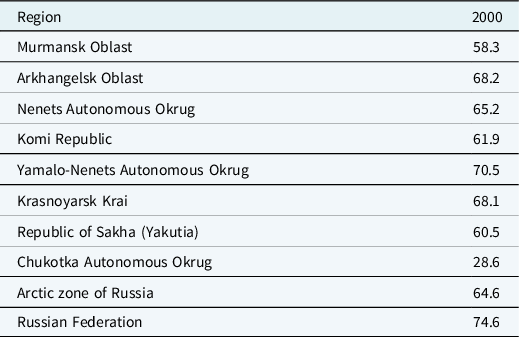
According to the matrix Q, by the end of 2000, the share of people who had left their permanent residence (died or moved to a new place of residence) in the regions of the Arctic zone of Russia was higher than in the country as a whole. Taking births and migration inflows into account, the population acclimation rate in these regions was 64.4%. The national average amounted to 74.6% (see Table 2).
Population acclimation in the regions of the Arctic zone of Russia as compared to that of 1 January 1991.

Source: calculated by the authors on the basis of information on the natural and inter-regional population movement balance for 1991–2000 according to the Rosstat data.
Chukotka Autonomous Okrug suffered the highest losses as it faced large company closures (primarily in the mining sector) and rising unemployment amid a sharp decline in quality of life. The same reasons had a significant impact on the population dynamics in regions with a focus on mineral extraction, such as Murmansk Oblast and the Komi Republic where there was also a high attrition rate. There was low acclimation of population in the Republic of Sakha (Yakutia). However, this region still had high birth rates which could partially compensate for this factor. In Krasnoyarsk Krai, despite the increase in the death rate and the emigration of Germans, economic conditions caused a smaller volume of migration which resulted in a higher acclimation rate. Yamalo-Nenets Autonomous Okrug specialises in hydrocarbon production. This activity has high profitability, which allowed the region to ensure relatively high standards of living for the population in the new environment. The attrition of the population in this region was also much lower than the average level of Russia’s Arctic zone. In Arkhangelsk Oblast, the local centre of gravity (the city of Arkhangelsk) is located inside the Arctic zone of Russia. Despite the increase in mortality and the decrease in the birth rates, this geographic peculiarity helped to slow down population attrition. The fact that Arkhangelsk Oblast had a more diverse economy compared to Murmansk Oblast or Nenets Autonomous Okrug also played a role.
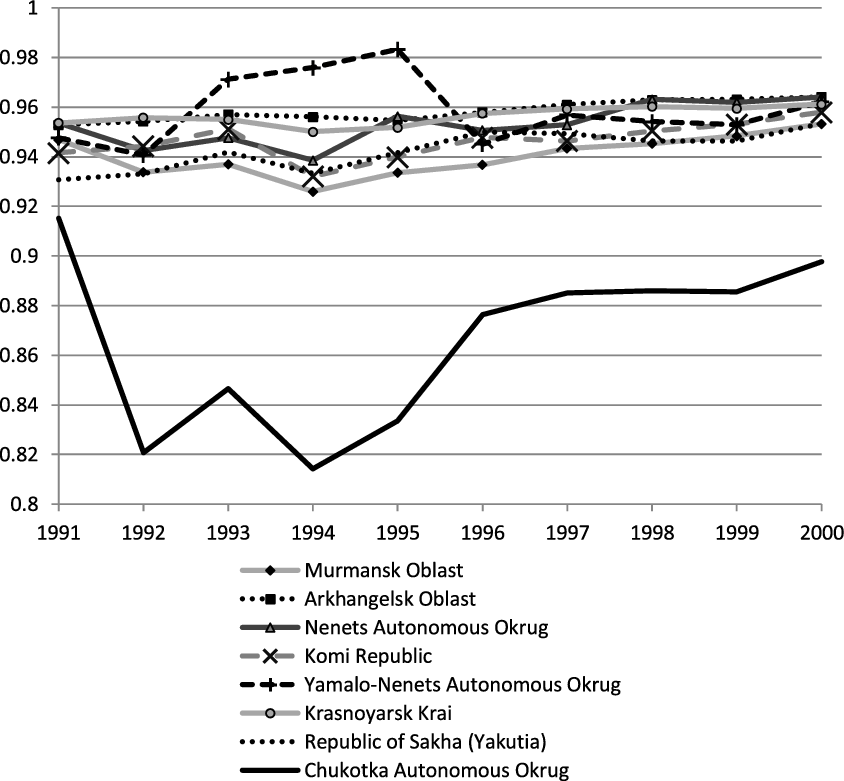
Figure 1 shows the dynamics of population acclimation in the regions of the Arctic zone of Russia in 1991–2000 based on one-year balances of population movement. Chukotka Autonomous Okrug, where the probabilities of staying in the region in the first half of the 1990s were less than 85%, stands out among them. In the second half of 1990, the figures increased but still remained below 90%. Other regions had similar rates of population acclimation. Only in Yamalo-Nenets Autonomous Okrug were the probabilities in some years slightly above the average. By the end of the period under review, the rates of acclimation converged, as most of those who wanted and could leave the Arctic had done so or had died. See Korovkin, Korolev & Sinitsa (Reference Korovkin, Korolev and Sinitsa2020) for more details on the dynamics of the Q matrix in 1991–2015.
Yearly population acclimation in the regions of the Arctic zone of Russia in 1991–2000.

Population movement within the Arctic zone of Russia
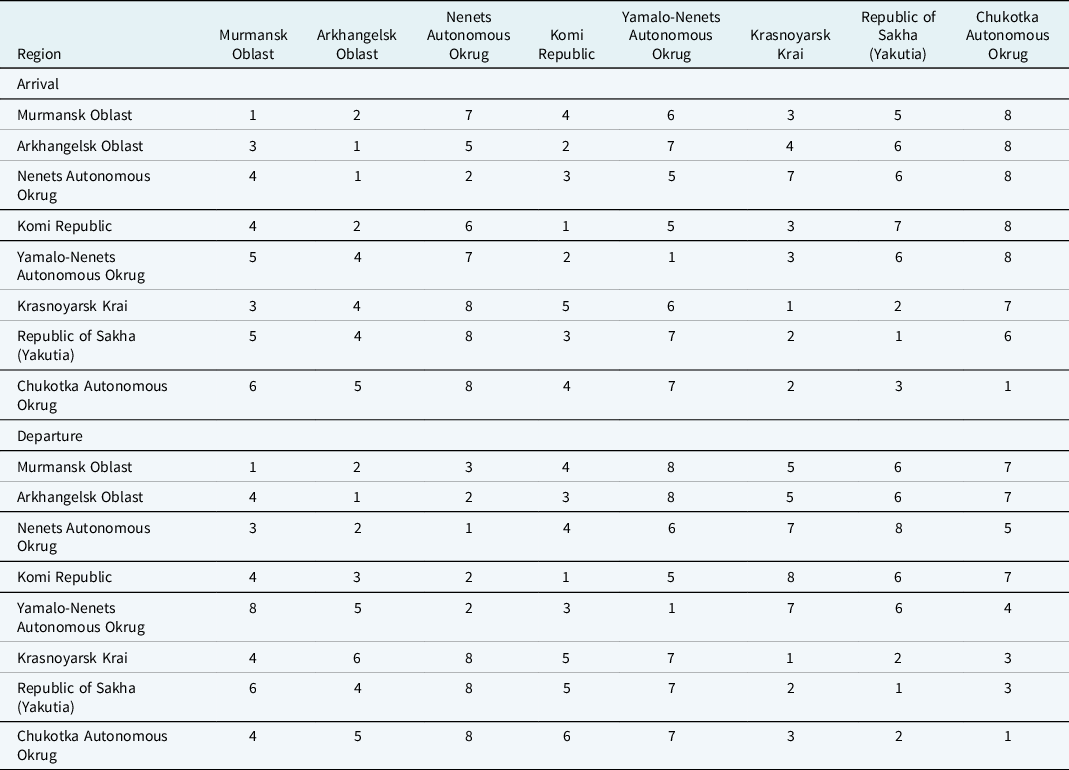
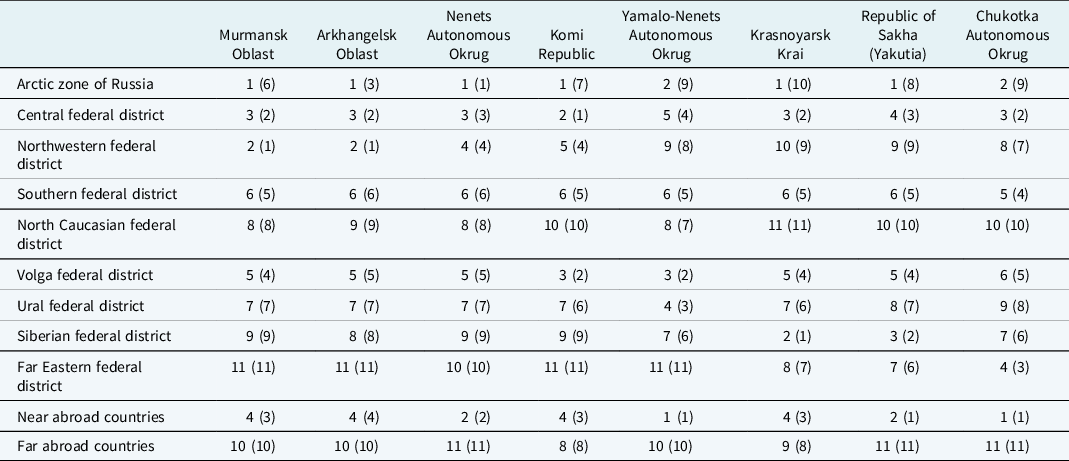
In the analysis shown in Tables 3–5, we rank the directions of migration according to the data of the matrix M, but not by absolute numbers because it is obvious that the greater the population of a region or a federal district, the more its migration exchange with the regions of the Russian Arctic zone, and the higher its rank will be. The ratio (2) shows how widely a certain direction of incoming population or attrition has spread, for example, for Chukotka Autonomous Okrug. We can say that we analysed the propensity of the population to move to a certain direction of permanent residence for the Arctic regions of Russia in 1991–2000.
Distribution of the regions in the Arctic zone of Russia by the priority of arrival and departure directions within the Arctic zone of Russia.

Source: calculated by the authors on the basis of information on the natural and interregional population movement balance for 1991–2000 according to the Rosstat data.
Comments: rank 1 is the most probable direction of arrival or departure, and rank 8 is the least probable direction.
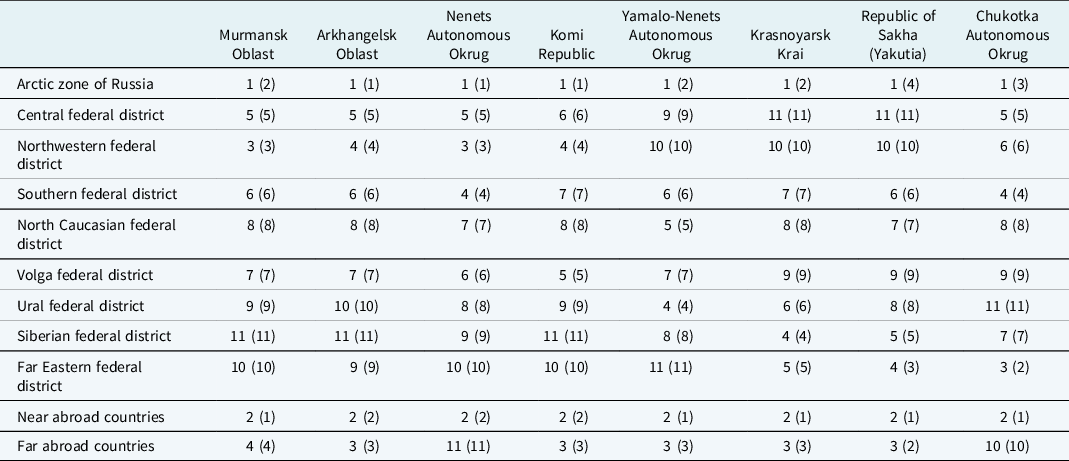
Distribution of the regions of the Arctic zone of Russia by the priority of departure directions to the federal districts of Russia and foreign countries.

Source: calculated by the authors on the basis of information on the natural and interregional population movement balance for 1991–2000 according to the Rosstat data.
Comments: the table should be read by columns; rank in parentheses is marked when migration within the Arctic zone of Russia does not include migration within a region; rank 1 is the most probable direction of departure, and rank 11 is the least probable direction.
Distribution of the regions of the Arctic zone of Russia by the priority of arrival directions from the federal districts of Russia and foreign countries.

Source: calculated by the authors on the basis of information on the natural and interregional population movement balance for 1991–2000 according to the Rosstat data.
Comments: the table should be read by columns; rank in parentheses is marked when migration within the Arctic zone of Russia does not include migration within a region; rank 1 is the most probable direction of arrival, and rank 11 is the least probable direction.
The share of intraregional migration in the regions of the Arctic zone of Russia varied markedly. In those regions that are fully included within it, the share of those who have migrated was 0.016–0.057. In regions partially included in the Arctic zone of Russia, their share was higher (0.088–0.12). The differences are explained by the fact that the regions belonging to the first group faced a significant migration outflow beyond their borders due to the new conditions weakening the role of the state. The second group had more diversified economies, and the population had more employment opportunities without leaving the region. Moreover, the natural and climatic conditions in these regions are better.
Table 3 shows that intraregional migration was the most important direction of both arrival and departure for all regions in the Arctic zone of Russia in 1991–2000, which is consistent with Ravenstein’s law of migration. The only exception was Nenets Autonomous Okrug. The main migration flows inside the regions of the Arctic zone were directed from rural to urban areas and from less prosperous to more prosperous areas.
The main population flows within the Arctic zone of Russia were directed to neighbouring regions or to regions within the same part of the Arctic zone of Russia. This is statistically confirmed by the fact that Spearman’s rank correlation coefficients of outflows of the population between the European and Asian parts are negative, while the correlation coefficients for movements within the parts of the Arctic zone of Russia are positive. As for the population out-migration flows, the relationship of Arkhangelsk Oblast with Nenets Autonomous Okrug and the relationships of Krasnoyarsk Krai and Nenets Autonomous Okrug with Krasnoyarsk Krai and Chukotka Autonomous Okrug were significant at the level of 0.01. For the level of significance 0.05, the relationships of Arkhangelsk Oblast with Chukotka Autonomous Okrug, Nenets Autonomous Okrug with the Republic of Sakha (Yakutia), the Komi Republic with the Republic of Sakha (Yakutia), Krasnoyarsk Krai with the Republic of Sakha (Yakutia) and Chukotka Autonomous Okrug with the Republic of Sakha (Yakutia) were significant. All significant correlations had module values greater than 0.750 which indicates a high strength of relationship. As for the population in-migration flows, significant relationships at the level of 0.01 of Arkhangelsk Oblast with Krasnoyarsk Krai, and Chukotka Autonomous Okrug, Nenets Autonomous Okrug with the Komi Republic, and Krasnoyarsk Krai, Krasnoyarsk Krai with Chukotka Autonomous Okrug existed. For the level of significance 0.05, there were significant relationships of Murmansk Oblast with Yamalo-Nenets Autonomous Okrug, Arkhangelsk Oblast with Nenets Autonomous Okrug, Nenets Autonomous Okrug with the Republic of Sakha (Yakutia), and Chukotka Autonomous Okrug, the Komi Republic with Krasnoyarsk Krai, the Republic of Sakha (Yakutia) with Chukotka Autonomous Okrug. Significant correlations in the case of in-migration had slightly lower values but remained high and were not below 0.725. Obviously, the main factor for migration within the Arctic zone of Russia is geographic proximity. The lowest number of significant relationships with other regions is typical for Murmansk Oblast and Yamalo-Nenets Autonomous Okrug. In the first case, this is due to the remoteness of Murmansk Oblast from the rest of the Arctic zone of Russia. In the second case, the explanation is that Yamalo-Nenets Autonomous Okrug takes an intermediate position between the European and Asian parts of the Arctic zone of Russia.
Population movement outside the Arctic zone of Russia
If we consider migration beyond a region’s borders, it becomes clear that the Arctic zone of Russia’s rank is highly dependent on the region (see Table 4). However, through intraregional migration, the Arctic zone of Russia has been a priority of the out-migration for all regions except Yamalo-Nenets and Chukotka Autonomous Okrugs. This was due to a significant departure of the population that had previously come to work but had remained permanently resident. If intraregional migration is excluded, the Arctic zone of Russia will remain as a high priority destination only in Nenets Autonomous Okrug, which has close ties with Arkhangelsk Oblast. Also, the rank remains quite high in Arkhangelsk Oblast itself. For the rest of the regions, this direction of out-migration was in the second half of all out-migration directions. Its rank was especially low in the regions of the Asian part of the Arctic zone of Russia which started to be widely developed much later in comparison with the regions of the European Arctic zone of Russia.
The Central federal district was the most popular destination of departure among all federal districts for all regions of the Arctic zone of Russia. It was in the first half of directions even in the Asian part of the Arctic zone. The Near abroad countries also had a high rank for all regions of the Arctic zone of Russia. The Far abroad countries were the most unpopular direction of departure, which is explained by the complexity of such a move. For all regions, except Chukotka Autonomous Okrug, the Far Eastern federal district was also an unpopular direction of departure. The Southern, Volga and Ural federal districts had quite stable ranks. The North Caucasian federal district had a low rank. However, despite all the dramatic events that took place in it at that time, it was often a more popular departure direction than the Far Eastern federal district and sometimes the Siberian federal district. The Siberian federal district and the Northwestern federal district were the districts for which geographical proximity determines migration. The Siberian federal district had high ranks for the regions of the Asian part of the Arctic zone of Russia and low ranks for the regions of the European part. In contrast, the Northwestern federal district was attractive for the population from the regions of the European part of the Arctic zone of Russia and was a much less important destination for the regions of the Asian part. From our point of view, purely economic reasons played a significant role only for the Central and the Far Eastern federal districts. Geographical proximity and other migration factors were very important for the other federal districts.
The analysis of the rank correlation matrix confirms this assumption. There are positive significant correlations between the regions in terms of departure to federal districts within the European and Asian parts of the Arctic zone of Russia. The correlation coefficients are at least 0.636. Whether or not intraregional migration is taken into account does not matter because in both cases the overall picture is about the same. There are no significant relationships between the regions located in different parts of the Arctic zone of Russia even at a 0.05 significance level. The exception is the positive relationship between Nenets Autonomous Okrug, on the one hand, and the Republic of Sakha (Yakutia) and Chukotka Autonomous Okrug, on the other. However, this is probably due to the small number of migrants in the Autonomous Okrugs. Within the European part of the Arctic zone of Russia, there are slightly more significant relationships than in the Asian part of the Arctic zone of Russia. This is probably due to greater transport accessibility and closer links between regions in this part of the Arctic zone of Russia.
As a source of population arrival, the Arctic zone of Russia had a high rank even without intraregional migration (see Table 5). Thus, those leaving the regions of the Arctic zone of Russia considered the Arctic zone itself as the most desirable direction of departure, even though in absolute numbers there were much more departures outside of it. Immigration was of high rank for both Near abroad countries, which is not surprising, and the Far abroad countries, which is more interesting and requires more consideration. To understand the reasons for such decisions, it is necessary to consider in more detail the incoming and outgoing flows of the population that have migrated to the Far abroad countries, which is not the purpose of our work.
Geographical proximity as a factor for population arrivals is quite evident since the rank of destinations depends on in which part of the Arctic zone of Russia a region is located. Ranks were quite stable only for the Southern, North Caucasian and Volga federal districts. The European and Asian parts of the Arctic zone of Russia are considerably different in the directions of arrival, as there are significant correlations at the level of 0.05 and 0.01 only for the regions located within the same part of the Arctic zone of Russia. These correlations are positive, and the correlation coefficients are at least 0.627. There are more statistically significant correlations within the European part of the Arctic zone of Russia than within the Asian part.
Fertility and mortality as directions of population movement in the regions of the Arctic zone of Russia
If mortality is included in population attrition, then taking into account intraregional migration, it has the second rank for all regions except Chukotka Autonomous Okrug, where it had the fourth rank due to high migration. It had the first to second rank (the third rank for Chukotka Autonomous Okrug) when intraregional migration was excluded. Fertility as a source of the incoming population was ranked second to third for all regions, and in the case of the exclusion of intraregional migration, it is ranked first to second.
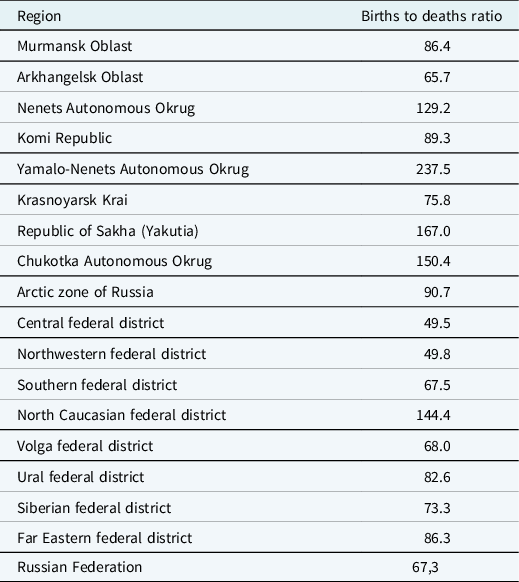
When comparing the total number of deaths and births, it can be seen that the birth rates in 1991–2000 did not compensate for mortality (Table 6). For the whole Arctic zone of Russia, the ratio was 90.7% in 1991–2000. The most advanced and economically developed regions (Arkhangelsk and Murmansk Oblasts, the Komi Republic, Krasnoyarsk Krai), which was where the majority of the population of the Arctic zone of Russia lived, showed the lower values. The natural decline of the population for these four regions was combined with a significant outflow of population, resulting in heavy demographic losses and strong ageing of the population. The regions with more recent extensive development, primarily mining regions, had younger population. This is the reason why the fertility rates of these regions were higher than the mortality rates. In addition, they were home to many indigenous peoples of the North, whose fertility rates were much higher. As a result, we cannot consider the Arctic zone as a net population donor, despite the existence of regions where fertility exceeded mortality.
Births to deaths ratios (Pokrovsky-Pearl life index) in the Arctic zone and federal districts of Russia in 1991–2000.

Source: calculated by the authors on the basis of the Rosstat data.
The ratio of births to deaths in the country as a whole is much lower. In 1991–2000, only 67.3% of deaths were compensated by births. Immigration from the former USSR Republics prevented very poor demographic results from being absolutely disastrous.
This situation is primarily related to extremely low ratios in the densely populated Central and Northwestern federal districts. During the years 1991–2000, births did not even compensate for half of the deaths that occurred there. The ratios in the Southern and Volga federal districts were at the level of Arkhangelsk Oblast, where fertility compensated for mortality in the smallest amount among all regions of the Arctic zone. The Siberian federal district was at the level of Krasnoyarsk Krai, where it was also one of the lowest. The Ural and Far Eastern federal districts were at the level of the Komi Republic. This can be explained by the younger age structure of the population in some regions. Only the North Caucasian federal district corresponded to the regions of the Arctic zone of Russia with the highest ratio. Nevertheless, its contribution, as well as that of these regions, was not enough to correct the extremely unfavourable trends. Thus, it is clear that the general tendencies in fertility and mortality in the Arctic zone of Russia and Russia as a whole were generally the same.
Assessment of the probabilities of participation in different forms of the population movement
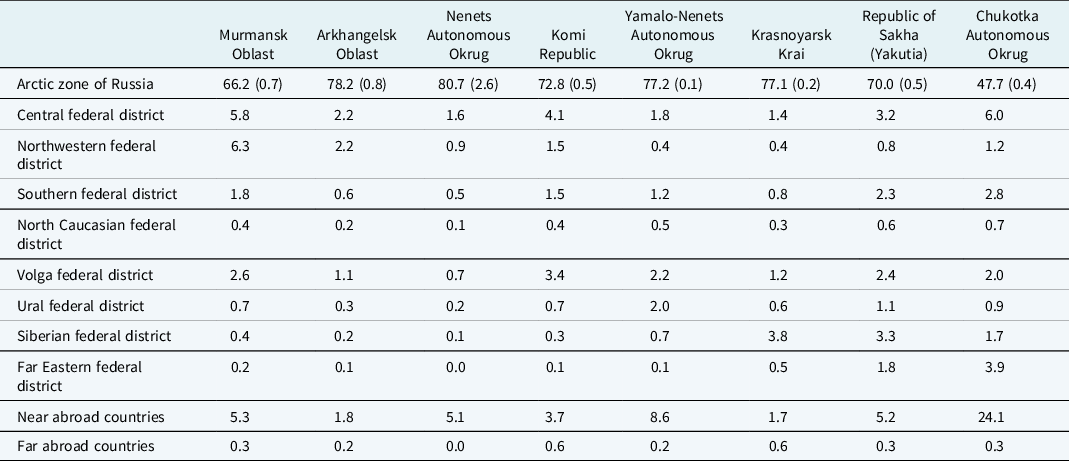
Let us consider assessments of the probabilities to be in a new state at the end of the period under consideration as a result of participation in migration or natural movement by one of the directions (Table 7), that is, the matrix P. The probability of staying in the same region of the Arctic zone of Russia at the end of the period was no less than 70%. It was lower only in Murmansk Oblast and Chukotka Autonomous Okrug. However, in the first case, it was noticeably above 50%. If intraregional migration was excluded, the probability of moving from one region of the Arctic zone of Russia to another was less than 1%. It was higher (2.6%) only in Nenets Autonomous Okrug due to migration from this region to Arkhangelsk Oblast.
Estimates of the probabilities of population attrition by the regions of the Arctic zone of Russia.

Source: calculated by the authors on the basis of information on the natural and interregional population movement balance for 1991–2000 according to the Rosstat data.
Comments: the table should be read by columns; probabilities in parentheses are marked when migration within a region is not included in the Arctic zone of Russia migration; the sum of the probabilities is less than 100%, and the rest is the probability to die.
The Central federal district and the Near abroad countries were the most likely destinations for departure for most of the regions. The Central federal district (primarily the Moscow region) attracted the population by higher standards of living, while the former Soviet Republics were the birthplace of many Arctic residents. The North Caucasian and Far Eastern federal districts, as well as the Far abroad countries, had low probabilities of departure. Both these federal districts showed a greater decline in living standards than the other federal districts, so they were not considered as probable destinations for departure. Migration to the Far abroad countries was seen by most of the population as a complicated and unpredictable event. The probability of migrating to the Northwestern federal district and the Siberian federal district depended on the region of departure. In the case of the European part of the Arctic zone of Russia for the Northwestern federal district and the Asian part of the Arctic zone of Russia for the Siberian federal district, the probability was quite high. The Volga, Ural and Southern federal districts had average probabilities of departure for all regions, which means that there were stable and there were steady outflows to these districts in 1991–2000. At the same time, the probabilities to replenish the population of the regions of the Arctic zone of Russia due to immigration were low: the Arctic was attractive for 4.7% of all those who came during this period from the former USSR countries and 1.9% of all those who came from the other countries.
In most regions of the Arctic zone of Russia, the probability of dying was 10–13%. However, three exceptions can be identified. The lowest probability of dying was in the Yamalo-Nenets Autonomous Okrug. The probabilities in Chukotka Autonomous Okrug and the Republic of Sakha (Yakutia) were even higher despite high migration. These three regions had a younger age structure of the population compared to other regions of the Arctic zone of Russia, which reduced the probability of dying. In the latter two regions, high migration out of the region contributed and outweighed the contribution of mortality due to deteriorating living conditions.
If we consider fertility nationwide, the probability of being born in the Arctic zone of Russia was 5.6%, which is close to the results of the Northwestern (6.2%) and Far Eastern (5.7%) federal districts. This is due to the small population. The probability of being born in the more populous Central and Volga federal districts was 22.5% and 21.6%, respectively. However, for the regions of the Arctic zone of Russia, this source of population replenishment is the second in importance after intraregional migration. The third place is occupied by immigration from the Near abroad countries.
Conclusion
Studying the population through the balance of population movement gives researchers a wide range of tools that allows them to study not only the dynamics of the entire population, particular gender and social groups but also to make forecasts of changes in population numbers. Moreover, it is wider than the cohort-component method, especially in terms of migration, as it allows to take into account population flows by country or region and not just in general. It can also be used in models that include various migration factors. If the necessary data are available, it is technically very easy to do so. Finally, balances allow taking into account the reoccurrence of a certain phenomenon, such as a change of residence many times, and include it in models.
Our main goal was to show directions of incoming population and attrition, to define their statistical patterns and to give readers an idea of the methodology and possibilities of the balance of population movement. Analysis of the data shows that regions of the Russian Arctic zone were donors, as migration outflow outweighs migration inflows. This finding is not new, but quantitative estimates of the level of population acclimation and identification of statistically reliable links between the flows of incoming population and attrition, as well as confirmation of the fact of a noticeable impact of distance on the probability of migration, are of interest for research work and public policy. The trends under consideration were particularly strong in 1991–2000 when the outflow of the population due to social and economic instability significantly destroyed the demographic potential accumulated over the previous 30–40 years.
The demographic processes discussed in the article are of great importance for the present and future development not only of the Arctic territories but also the entire Extreme North of Russia. The significant population decline that took place in 1991–2000 will not be overcome in the foreseeable future, as material and non-material incentives that are currently used are not enough. The main consequence is that the population in the most densely populated regions is ageing since the unresolved issues of infrastructure development lead to a continued outflow of the population, primarily youth. As soon as this issue is at least partially resolved, the outflow of the population will slow down. Such difficult natural and climatic conditions require a government policy that offers adequate measures to compensate for them, which has not yet been done.
Two approaches to the development of the Arctic zone of Russia are singled out in the literature: the full-scale integrated development that was carried out in the USSR and the modern type that is characterised by focal development. The second option implies a further reduction in the population of the Arctic and settlements, especially in the newly developed areas, with a transition to primarily shift employment. For all its economic attractiveness, such an approach has huge negative social and economic consequences as it implies a further reduction of infrastructure for life, which is the reason for the migration outflow. However, it is the second approach that has been recognised as more important in the post-Soviet era. The events of the 1990s when the state withdrew from the Arctic and was still unable to restore its presence (primarily in social terms) contributed greatly to this. Sometimes this is justified, but not in all cases, because the migrants are less sensitive to the surrounding area as it is not their native land and is considered only a temporary residence.
The loss of population in the Arctic zone of Russia as a result of increased mortality and the tremendous migration outflow that occurred in the 1990s was very high. Demographic trends, common to the whole country, have been superimposed on the Arctic and have led to an intensification of the negative trends that were already in place. Nevertheless, our research shows that there is considerable potential for acclimation of the local population in these territories. This can be fulfilled if the social infrastructure is improved, employment is increased and living conditions are improved. Such a significant decrease in the population could be avoided by implementing a more adequate state policy concerning the Arctic zone of Russia, which would take into account all the consequences of the decisions that have been made.
Acknowledgements
The study was carried out according to the program of the basic scientific research for State Academies of Sciences for 2013–2020. Topic 167 “Research on the dynamics of the global-national ratio in socio-economic development and optimization of Russia’s participation in regional and global integration processes”.
Funding
This research received no specific grant from any funding agency, commercial or not-for-profit sectors.
Conflict of interest
The authors declare none.