Introduction
Eighty percent of individuals diagnosed with schizophrenia experience a chronic course of illness, with either persistent or fluctuating symptoms often characterized by difficulties in various domains of everyday functioning (Harvey & Strassnig, Reference Harvey and Strassnig2012). Two of the factors that emerge as the strongest predictors of functional outcome in individuals with schizophrenia are negative symptoms (Ho et al. Reference Ho, Nopoulos, Flaum, Arndt and Andreasen1998; Addington et al. Reference Addington, Saeedi and Addington2005; Milev et al. Reference Milev, Ho, Arndt and Andreasen2005) and performance on tests of neurocognition (Green et al. Reference Green, Kern, Braff and Mintz2000). Negative symptoms, in particular, are associated with hospital readmission (Patel et al. Reference Patel, Jayatilleke, Broadbent, Chang, Foskett, Gorrell, Hayes, Jackson, Johnston, Shetty, Roberts, McGuire and Stewart2015), reduced duration of stay in the community (Ahmed et al. Reference Ahmed, Murphy, Latoussakis, McGovern, English, Bloch, Anthony and Savitz2016), and general poor adjustment (Harvey & Strassnig, Reference Harvey and Strassnig2012).
An emerging literature has identified defeatist beliefs (e.g., ‘If you cannot do something well, there is little point in doing it at all’) as proximal determinants of negative symptoms and low functioning, both cross-sectionally (Grant & Beck, Reference Grant and Beck2009) and longitudinally (Thomas et al. Reference Thomas, Luther, Zullo, Beck and Grant2017). Individuals with the most severe, persistent negative symptoms (i.e., those who meet criteria for the deficit syndrome) endorse defeatist beliefs to a greater degree than a comparison group with mild negative symptoms (Beck et al. Reference Beck, Grant, Huh, Perivoliotis and Chang2013). A meta-analysis of 10 studies found defeatist beliefs significantly predicted negative symptoms and functional outcomes (Campellone et al. Reference Campellone, Sanchez and Kring2016).
Translating these findings into practice, we developed a new cognitive model of low functioning schizophrenia in which defeatist beliefs are proximal obstacles to recovery and therefore natural targets for psychosocial treatment (Beck et al. Reference Beck, Rector, Stolar and Grant2009). Recovery-Oriented Cognitive Therapy (CT-R) ameliorates defeatist beliefs with the expectation that this would reduce negative symptoms and improve functional outcomes. In the spirit of the recovery movement (Davidson et al. Reference Davidson, Harding, Spaniol, Rowe, Tondora, O'Connell and Lawless2008), CT-R is also formulated to help the person achieve meaningful and valued aspirations and activate positive attitudes. Positive motivation and interpersonal contact are accentuated by a therapist's engaging and working collaboratively with the individual in therapy to successfully achieve proximal goals (being active, participating in group activities, helping other people) that are linked to meaningful long-term aspirations.
We tested CT-R in a randomized controlled trial (Grant et al. Reference Grant, Huh, Perivoliotis, Stolar and Beck2012), finding a statistically significant end of treatment improvement in global functioning, negative symptoms, and positive symptoms relative to standard treatment in the community that was maintained at a 6-month follow-up (Grant et al. Reference Grant, Bredemeier and Beckin press). The positive findings motivate a search for essential ingredients and mechanisms of the therapy. A possibility is that success generalizes to reduce defeatist beliefs as well as to enhance self-concept and mood.
The present study was designed as an analogue experiment of CT-R to test the rationale and internal validity of the clinical trial. We utilized an experimental procedure from the depression literature in which an experimenter collaborates with the subject to produce success on a card-sorting task (Loeb et al. Reference Loeb, Beck and Diggory1971). The aim is to create a controlled, successful experience that is analogous to one that an individual might experience in CT-R (setting long and short term goals and successfully achieving them collaboratively). We randomly assigned individuals with schizophrenia who had prominent negative symptoms and had performed poorly on neurocognitive tests to receive either guided success on a performance task or unguided practice (control condition). We predicted that individuals in the guided success condition would perform better on the experimental task and improve on cognitive and mood measures. We also predicted that improvement on the theorized mechanism variables would predict improvement on the card-sorting task.
Methods
Participants
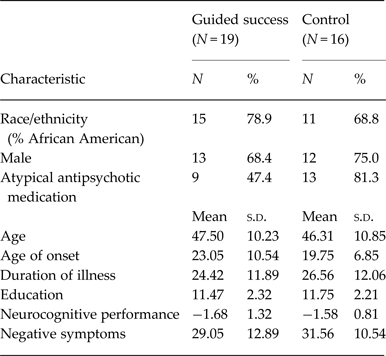
Participants were 35 adult outpatients (Table 1) who had taken part in previous studies in our research center at the University of Pennsylvania. Participants met the following criteria: (i) DSM-IV-TR diagnosis of schizophrenia; (ii) prominent negative symptoms (at least moderate severity on two Scale for Assessment of Negative Symptoms (Andreasen, Reference Andreasen1984b ) global scores or marked severity on one global score); (iii) having neurocognitive performance difficulties on a standardized computerized neurocognitive test battery, as indicated by an average index score 0.5 standard deviation or more below a normative sampleFootnote † Footnote 1 ; (iv) Age 18–65; (iv) proficiency in English; and (v) ability to provide informed consent. Exclusion criteria were: (i) neurologic disease or damage; (ii) systemic medical illnesses that may compromise neurocognitive functioning; (iii) history of head injury with documented loss of consciousness; or (iv) physical handicaps that would interfere with assessment procedures.
Participant characteristics

Note: Neurocognitive performance, mean of abstraction and mental flexibility, attention, and verbal memory domain scores on a computerized neurocognitive battery; negative symptoms, total score, Scale for the Assessment of Negative Symptoms.
Procedure
After each participant was given a complete description of the study, written informed consent was obtained from each participant. Trained clinicians (masters- or doctoral-level) then administered a neurocognitive test battery and structured clinical interview to determine diagnosis and assess negative symptoms. Collateral information from family members, treating psychiatrists, and medical records was factored into clinician ratings of symptoms and functioning, and in determining eligibility. All participants received compensation regardless of their eligibility. The Institutional Review Boards at the University of Pennsylvania and the City of Philadelphia approved this procedure.
Randomization
Participants who met eligibility criteria were randomly assigned to either the guided success or control condition, using a password-protected computer-generated randomization list. A staff member who had no contact with participants determined the condition and informed the experimenter. A single-blind design was used in which individuals were not informed of their condition.
Eligibility/descriptive measures
Neurocognitive performance
In order to determine eligibility, all participants completed the Computerized Neurocognitive Battery (CNB; Gur et al. Reference Gur, Richard, Hughett, Calkins, Macy, Bilker, Bresinger and Gur2010), which assesses domains of abstraction and mental flexibility, verbal memory, attention/vigilance, and emotion recognition. The computer tests were given in a fixed order and were displayed in a window within a web browser. Accuracy scores were determined using previously established procedures (Gur et al. Reference Gur, Nimgaonkar, Almsay, Calkins, Ragland, Pogue-Geile, Kanes, Blangero and Gur2007), in which participants’ raw scores are converted to z-scores using normative data. The battery has demonstrated validity and reliability in patients with schizophrenia (Gur et al. Reference Gur, Ragland, Moberg, Turner, Bilker, Kohler, Siegel and Gur2001).
Negative symptoms
All participants were scored on the Scale for the Assessment of Negative Symptoms (SANS, Andreasen, Reference Andreasen1984a) a 25-item interviewer-scored measure assessing the domains of blunted affect, alogia, avolition-apathy, and anhedonia-asociality (the attention subscale was administered but not included in the scores). Each item is rated on a 6-point scale ranging from 0 (not present) to 5 (severe). The 18-item SANS total score (excluding attention subscale items, inappropriate affect, and poverty of content) showed good internal consistency in the current sample (α = 0.80).
Outcome measures
Belief and attitudes measures
Participants completed a baseline and post-test battery consisting of two self-report questionnaires that assessed beliefs and attitudes. The first measure completed was the defeatist performance belief subscale (Grant & Beck, Reference Grant and Beck2009) of the Dysfunctional Attitude Scale (DAS; Weissman & Beck, Reference Weissman and Beck1978), which consists of 15 statements describing beliefs about one's ability to perform tasks (e.g., ‘If I fail partly, it is as bad as being a complete failure’). Responses were on a scale ranging from 1 (agree totally) to 7 (disagree totally). The defeatist performance beliefs subscale score showed acceptable internal consistency (α = 0.74) in the present sample.
Participants also completed the Beck Self-Esteem Scale-Revised (BSES-R), which is based upon the Beck Self-Esteem Scales (Beck et al. Reference Beck, Brown, Steer, Kuyken and Grisham2001). The BSES-R is an 18-item questionnaire that assesses participants’ beliefs about themselves. In the revised version used here, nine of the items are positive (e.g., powerful, successful, good) and nine are negative (e.g., weak, worthless, bad). Responses were on a 4-point scale: ‘not at all,’ ‘somewhat,’ ‘very much,’ and ‘extremely.’ The primary outcome index score is created by subtracting the sum of ratings for negative attributes from the sum of ratings for positive ones, with higher scores indicating higher self-esteem. These scores showed good internal consistency (α = 0.88) in the present sample. Exploratory analyses were planned using separate positive and negative attribute scores from this scale, based on our hypothesis that success experiences may have a more prominent impact on positive rather than negative views of the self.
Mood check
Participants completed a pre- and post-test mood check by rating their mood on a 9-point scale. Responses included ‘extremely bad mood (0),’ ‘somewhat good mood (5),’ and ‘extremely good mood (9).’
Card-sorting
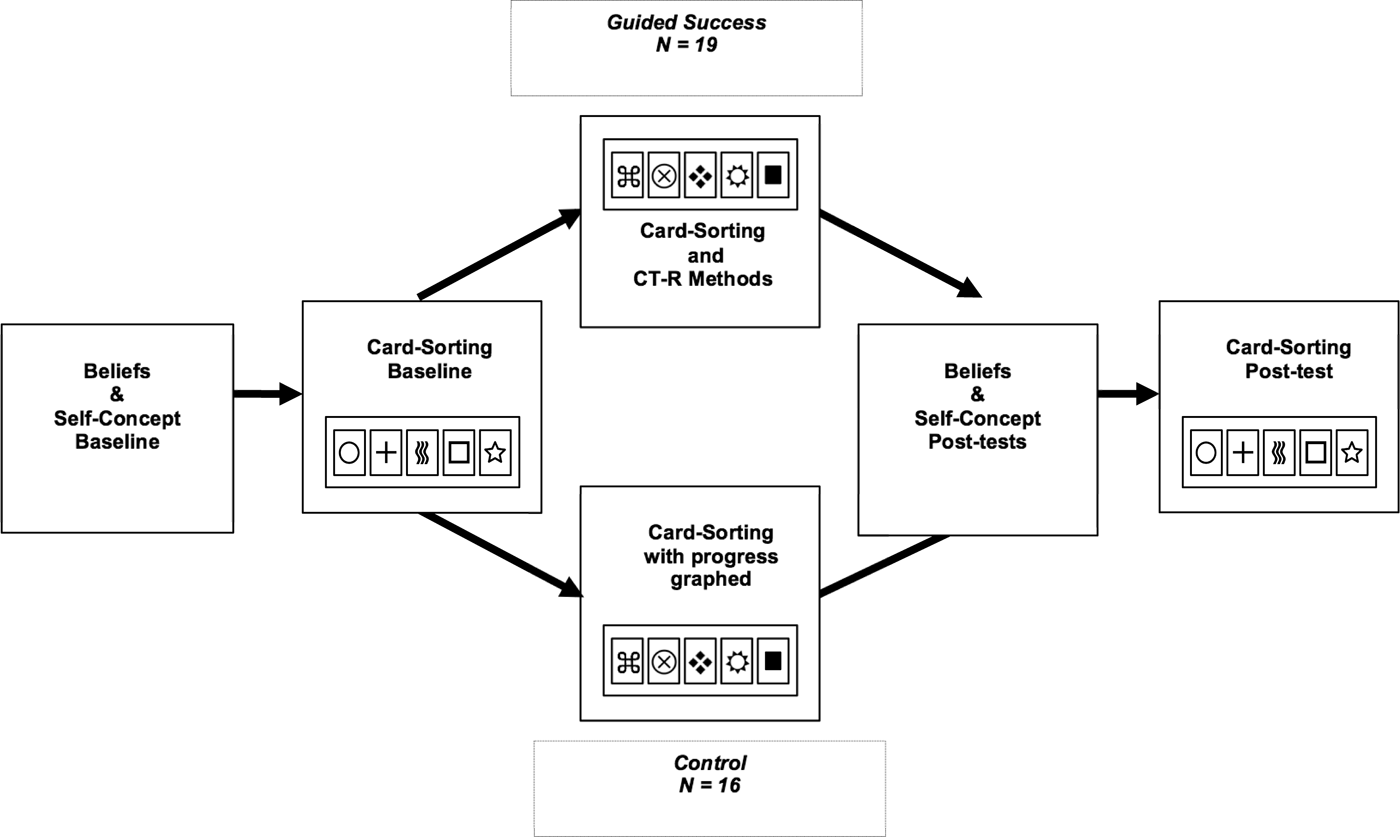
Participants in both groups completed 15 card-sorting trials, with five trials each during baseline, experimental or control test, and post-test. For each of the 15 trials, a deck of 50 cards was placed into an automatic card shuffler, and participants were given 20 s to sort as many cards by symbol as they could. Baseline and post-test trials were completed using a 50-card deck of Zener cards (Rhine, Reference Rhine1934) consisting of 10 cards of each of the following five symbols: circle, cross, three vertical wavy lines, five-pointed star, and square (see Fig. 1). For the experimental phase, a different set of cards was used for both conditions. There were 10 cards of each of the following five symbols: a square with a circle at each corner, a circle containing an ‘X’, four opaque squares forming a diamond, a sun, and an opaque square (replicated in Fig. 1).
Study procedure after randomization.

For the five trial baseline test, participants were instructed to match as many cards by symbol as they could within 20 s without any feedback or reinforcement from the experimenter. Participants then completed their assigned condition (detailed below) before completing a five trial post-test that followed the same procedure as the baseline.
Conditions
Guided success condition
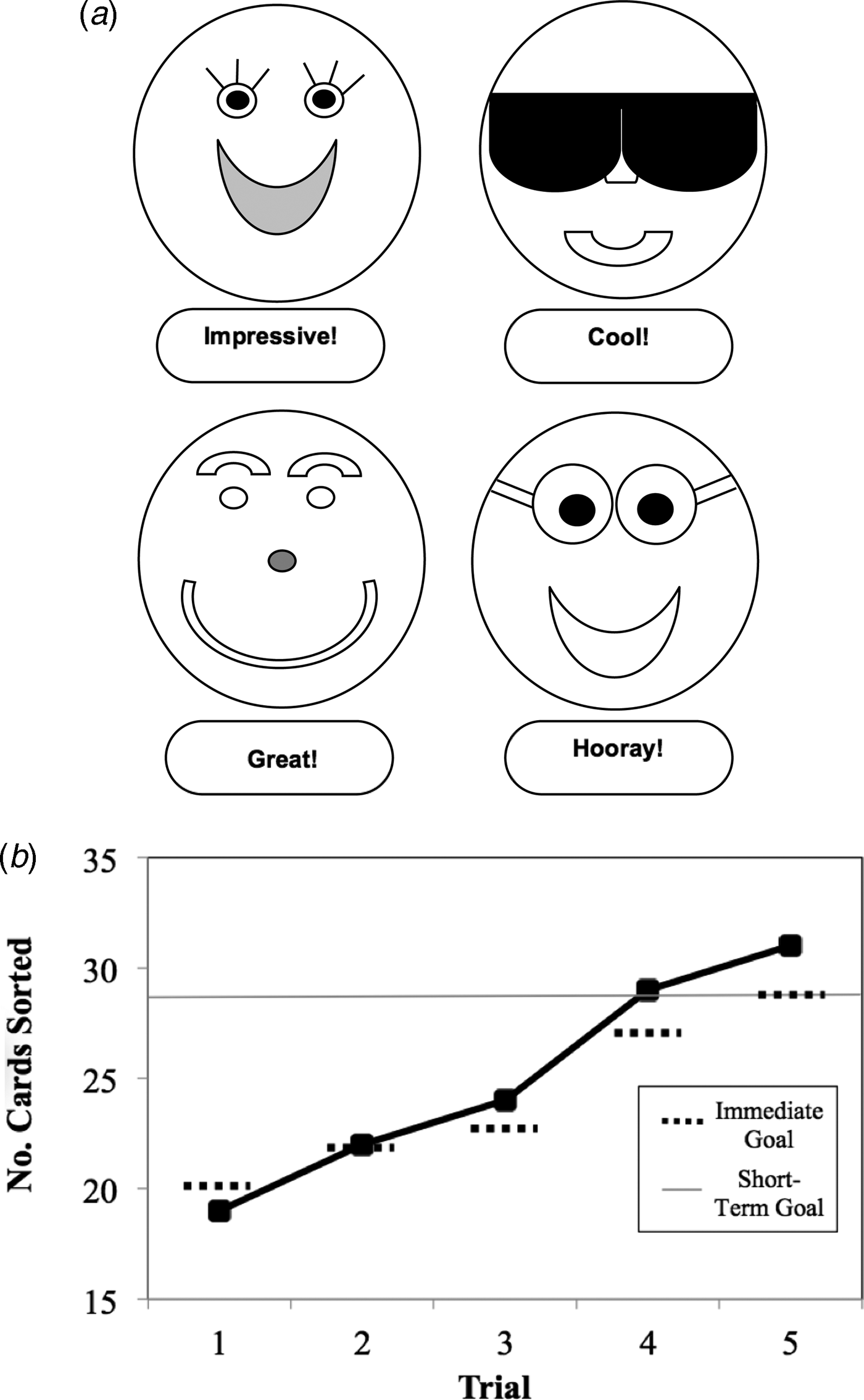
After looking at the number of cards sorted in each trial of the five baseline trials, the experimenter and participant first worked collaboratively to set a goal for the number of cards to be sorted successfully by the fifth guided success trial. Also, prior to each trial, the experimenter and participant set the goal for that trial. The experimenter utilized a number of scripted statements that aimed to help the participant set achievable goals, while still ensuring that the process was collaborative (e.g., ‘I'd like you to pick a goal for how many cards you'll try to match by the 5th try. Based on how you did in the last test, a good goal to shoot for would be to match between ___ and ___ cards [range of 2 cards]. So, how many will you try to match by the 5th try?’). The first trial and fifth trial goal were plotted on a white board graph. Before each subsequent trial, the goal for that trial was also recorded on the graph. After each trial, the experimenter recorded the number of cards sorted on the same graph (see Fig. 2b ).
(a, b) Tools used to promote success.

After each trial, the experimenter provided positive reinforcement to the participants. The positive reinforcement was not contingent on sorting success and was provided in the same way to the participants regardless of their performance. This included verbal praise (i.e., ‘Excellent!’ or ‘Great Job!’) and printed visual emoticons containing congratulatory or encouraging phrases (see Fig. 2a ). Emoticons were given after each success experience to add salience.
Control condition
Participants completed the middle five card-sorting trials in the same manner as the baseline. They did not set goals and did not receive positive reinforcement. The experimenter plotted the number of cards correctly sorted after each of the five trials on a white board graph.
Statistical analysis
The principal aims of the analyses were to determine if participants in the guided success condition had: (i) a greater degree of improvement in card-sorting performance, (ii) lower dysfunctional belief endorsement; (iii) increased self-concept; and (iv) improved mood at the post-test relative to the baseline than the control group. An additional aim was to determine if improvement in beliefs and mood predicted improvement in card sorting. To identify any group differences, separate one-way analysis of covariances (ANCOVAS) was carried out for each outcome variable. The dependent variables were post-test scores, and the covariates were the corresponding baseline measure scores. To test whether theorized mechanisms contributed to improved performance, a composite score was created by summing standardized residuals for defeatist beliefs, self-concept, and mood. Zero-order correlations were calculated between the mechanism composite and change in card sorting. To control for response sets, we excluded the results from individual measures where participants responded to 75% or more of the items with the same response (i.e., agree totally), or only selected the two most extreme responses.Footnote 2 All data were analyzed using SPSS version 20.0, including the calculation of summary statistics and effect sizes. Missing data were accounted for by the use of pairwise deletion. We followed Cohen (Reference Cohen1988) in categorizing effect sizes, (d), of ⩽0.2 as small, 0.5 as medium, and ⩾0.8 as large.
Results
Performance on card-sorting
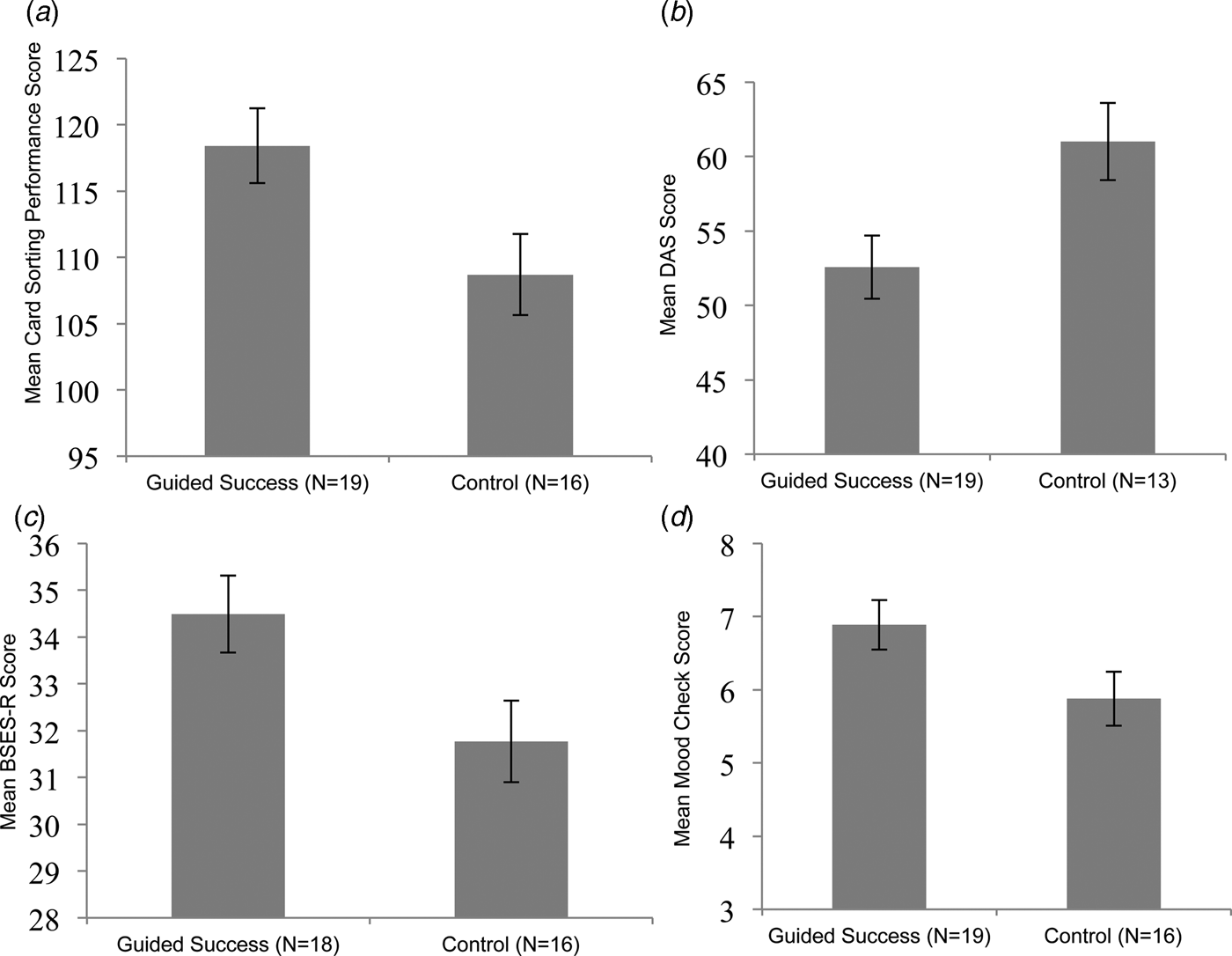
After controlling for pre-test scores, the guided success condition correctly sorted more cards on the card-sorting post-test trials than the control condition (Fig. 3a ). The group difference between the control and guided success groups was statistically significant with a large effect size, F(1,32) = 5.45, p = 0.03, d = 0.79.
(a–d) Adjusted post-test means. (a) After controlling for baseline scores, the guided success condition correctly sorted significantly more cards on the card-sorting post-test trials than the control condition, F(1,32) = 5.45, p = 0.03, d = 0.79. (b) After controlling for the baseline scores, the guided success group reported significantly fewer defeatist beliefs than the control condition after completing the card-sorting post-test, F(1,29) = 6.02, p = 0.02, d = −0.91. (c) After controlling for baseline scores, participants in the guided success condition scored significantly higher on the self-concept post-test than those in the control condition, F(1,31) = 5.06, p = 0.03, d = 0.78. (d) After controlling for baseline mood scores, the guided success group reported a significantly improved mood after the card-sorting post-test, as compared with the control group, F(1,32) = 4.06, p = 0.05, d = 0.68.

Defeatist beliefs
After controlling for the pre-test scores, the guided success group endorsed defeatist beliefs to a lesser degree than the control condition after completing the card-sorting post-test (Fig. 3b ). The difference between the success group and the control group was statistically significant with a large effect size, F(1,29) = 6.02, p = 0.02, d = −0.91.
Self-concept
Participants in the guided success condition scored higher on the self-concept post-test than those in the control condition when the pre-tests scores were statistically controlled (Fig. 3c ). The difference between the control and guided success groups was statistically significant with a large effect size, F(1,31) = 5.06, p = 0.03, d = 0.78. When focusing on positive self-concept items, the difference between the control and guided success groups was statistically significant with a large effect size, F(1,31) = 4.25, p = 0.05, d = 0.74. In contrast, there was no significant difference between groups on the negative self-concept items, F(1,31) = .06, p = 0.81, d = 0.09.
Mood
After controlling for pre-test mood scores, the guided success group reported improved mood after the card-sorting post-test, as compared with the control group (Fig. 3d ). The group difference in mood between the guided success and the control group was statistically significant with a medium effect size, F(1,32) = 4.06, p = 0.05, d = 0.68.
Correlation analyses
As hypothesized, the composite change score based on the theorized mechanisms measures (defeatist beliefs, self-concept, and mood) was significantly correlated with standardized residual changes in card-sorting performance; r = 0.36, p = 0.05.
Discussion
The present results confirmed our predictions: guided success that emulated the therapeutic action of cognitive therapy produced greater improvements in beliefs and mood relative to the control condition in individuals with schizophrenia who have significant cognitive impairment and elevated negative symptoms. Participants in the experimental condition improved more on task performance, with this superiority being accounted for by the improvement in belief and mood. Despite the fact that this was a short intervention and the individuals were on the severe end of the impaired functioning continuum, their rapid improvement is an indicator of the surprising responsiveness of this population to supportive reward interventions.
In this necessarily simplified analogue study, we found, contrary to common thinking but consistent with the general cognitive model, that beliefs can be relatively malleable in certain circumstances, specifically in reaction to novel or disconfirmatory experiences. In order to create lasting or generalized changes, repeated success experiences are necessary. Indeed, recovery-oriented cognitive therapy consists of a series of nested success experiences and goal achievement that embody personal recovery, activating adaptive beliefs and deactivating dysfunctional beliefs. Such collaborative success experiences appear to improve the individual's views of their own self-worth, as well as expectations for their capability, especially in regards to working productively with others. The present findings buttress research showing that goal attainment leads to improved hope and sense of self and purpose (Clarke et al. Reference Clarke, Oades, Crowe, Caputi and Deane2009) as well as better outcomes in psychosocial interventions for individuals with serious mental illness (Michalak et al. Reference Michalak, Klappheck and Kosfelder2004; Michalak & Holtforth, Reference Michalak and Holtforth2006).
The results of the current study are in the spirit of Meichenbaum's (Meichenbaum & Cameron, Reference Meichenbaum and Cameron1973) pioneering study, errorless learning (Kern & Reddy, Reference Kern and Reddy2014), and attention shaping (Silverstein et al. Reference Silverstein, Spaulding, Menditto, Savitz, Liberman, Berten and Starobin2009), and can be generalized to an overall approach to negative symptoms and poor functioning in schizophrenia. While the context is different from the experiment, the same psychological principles apply across the settings of care – hospital, intensive residential program, community treatment team, outpatient clinic, or home. The formula to promote recovery begins with an equalizing, energizing, and constructive relationship with the individual. This bond is actively applied to collaborative work towards a meaningful goal, providing sufficient support and feedback to achieve it. The experiences of valued goal-setting, success, control, and mastery need to be repeated continually as the person's recovery advances and their positive assets and resilient beliefs are strengthened (Grant et al. Reference Grant, Reisweber, Luther, Brinen and Beck2014). There is evidence that, given sufficient time, even the most chronic individuals can respond to this recovery-oriented approach (Grant et al. Reference Grant, Bredemeier and Beckin press).
The present study has important limitations. There were a relatively small number of participants within each experimental condition. The use of larger samples in replication attempts would allow for more focused investigations of the mechanisms of improvement in task performance. It is not clear from these results how long the effects of such guided success experiences last (Goldberg et al. Reference Goldberg, Weinberger, Berman, Pliskin and Podd1987). We hypothesize that repeated guided success experiences of this nature may be necessary to produce lasting effects. While the results are consistent with causation, longitudinal studies would more explicitly test whether these mechanisms lead to improved performance. Another advantage of a longitudinal study would be to directly measure the impact of negative symptoms and functional outcomes. The reliance on self-report measures of mood and beliefs in the present study leaves open the potential for biased reporting due to demand characteristics. This could be addressed in future studies (e.g., by using psychophysiological indices of mood). Finally, as in any single experimental study, potential confounds exist in the conditions here that could be addressed by using a different control group in future studies. For example, to ensure that the effects are not solely due to improved mood, a control group could be utilized in which a traditional positive mood manipulation is employed (e.g., watching a funny video clip).
In summary, we found that for individuals with elevated negative symptoms and poor performance on neurocognitive tests, a brief guided success experience can lead to improved task performance, decreased defeatist beliefs, and improved self-concept and mood; moreover, improvement in beliefs and mood predicted better performance. The present study provides support for the rationale of CT-R. While some questions about this treatment approach remain to be answered, findings from the present study have important implications for the promotion of recovery in low functioning individuals with schizophrenia, who historically have experienced very poor outcomes.
Acknowledgements
The authors express gratitude to the individuals who participated in this research and thereby made it possible. The authors also thank Rob DeRubeis, Ph.D., Neal M Stolar, MD-PhD, Nadine Chang, PhD, Mary Tabit, MS, Kara Devers, MSEd, Sean Gallagher, MS, Jason Cha, MSEd, Eren Semen, MS, EdS, and Rachel Hodas, BA, for their assistance with the study, and Marguerite Cruz, BA, and Nina Bertolami, BA, for assistance in preparing this manuscript. The study was supported by The Fieldstone 1793 Foundation and the Foundation for Cognitive Therapy. The sponsors had no role in the design and conduct of the study; collection, management, analysis, and interpretation of the data; or preparation, review, or approval of the manuscript.
Declaration of Interest
Drs. Grant and Beck report a conflict of interest in receiving royalties from Guilford Press. Drs. Perivoliotis and Bredemeier and Ms. Luther report no competing interests.
Ethical Standards
The authors assert that all procedures contributing to this work comply with the ethical standards of the relevant national and institutional committees on human experimentation and with the Helsinki Declaration of 1975, as revised in 2008.