

Introduction
Between the 1950s and 2010, Chilean political, economic, and welfare regimes have shifted radically: from a modernizing democracy to a brutal dictatorship and then back to a democratic regime; from an internal focus on substituting imports to an external concern with exports on the global market; from a state that slowly expands rights to one that radically curtails these and to a state torn between its concerns with maintaining efficiency and expanding rights. These changes have deeply altered the content of citizenship in Chile. Surprisingly, some aggregate-level welfare outcome indicators—such as infant mortality and malnutrition—do not reflect these disruptions.Footnote 1 Instead, the data show relatively continuous improvement, suggesting citizens continued to secure basic welfare services in periods of retrenchment, rollback, recession, and even brutal repression.
The welfare literature doesn’t have a good explanation for this. Contemporary dominant theories in the social sciences focus on formal institutions, discussing whether economics, politics, policy orientation, or a combination of these determine levels of welfare provision, which they define as a dependent variable. However, welfare provision occurs in on-the-ground encounters between state workers and citizens, and there is often a large gap between central policy and the informal institutions that coexist, compete, and clash with formal rules. Therefore, by focusing only on formal institutions, scholars have missed the informal on-the-ground practices that govern social welfare.
This article uses Chile’s infant-maternal primary health care network as a prism to map the trajectory of Chile’s social state throughout three combinations of political, economic, and welfare regimes. It traces the everyday strategies deployed by citizens and service providers at the local level and presents a historical typology of these informal institutions. Alongside formal institutions, these also determine service provision and shape what commodification and decommodification mean to families in their everyday lives—in this case, how families adapt to and resist dramatically different political, macroeconomic, and social provision systems. The next section briefly lays out state-of-the-art welfare literature and introduces the analytical approach. The following three sections present the empirical findings that are organized by political, economic, and social policy regime type. The article concludes by making the claim that, by focusing only on formal institutions, scholars have missed the informal on-the-ground practices that govern social welfare and proposes a research agenda for welfare studies that includes observations made at the implementation level.
State of Welfare and Latin American Social Policy Studies
Dominant theories on welfare focus on whether economics, politics, policy orientation, or a combination of these determines levels of welfare provision, which they define as a dependent variable. For the most part, the welfare literature has focused on spending and program design and has constructed what both Pierson (Reference Pierson2000) and Amenta (Reference Amenta1993, Reference Amenta2003) agree to be a successful research agenda with significant advances both on the empirical side as well as theory building and testing. Early studies, referred to by Amenta as “effort researchers” given their focus on state outputs (1993), used social spending as a percentage of gross domestic product to assess levels of welfare. They did not specify the kind of citizen covered—public-sector workers, middle class, formal workers, urban poor, men, and/or women—or the quality or extent of this coverage. Esping-Andersen (Reference Esping-Andersen1990) opened the Pandora’s box of spending by creating a typology of advanced welfare states differentiated and assessed in terms of their degree of decommodification for individuals—defined as freedom from market exigencies and fluctuations. Building on his work, power resources and institutionalists have built multivariable causal accounts of welfare that examine the role of labor movements, political parties, and bureaucratic institutions in creating and shaping welfare regimes (Hicks Reference Hicks1999; Hicks and Kenworthy Reference Hicks and Kenworthy2003; Hicks et al. Reference Hicks, Misra and Ng1995; Huber 2001; Iversen Reference Iversen2001; Lister Reference Lister2002; Lynch Reference Lynch2006; Pierson Reference Pierson1994, Reference Pierson2001).Footnote 2 Feminist critiques have stimulated a reinterpretation of the welfare state both as an outcome of particular societal arrangements and as an active promoter of these (Fraser Reference Fraser1996; Orloff Reference Orloff1993, Reference Orloff1996) and revamped Esping-Andersen’s typology to include a gender perspective (Huber and Stephens Reference Huber and Stephens2001).
Analyses of Latin American social provision models have followed similar research strategies and the leftward turn at the beginning of twenty-first-century Latin American politics has been accompanied by a growing interest in Latin American social policies. This research agenda, while inconclusive as to whether the political changes also signify long-lasting transformations in the distribution of responsibility for providing welfare among state, families, and market,Footnote 3 has been extremely productive. Studies have included regional typologies (Filgueira Reference Filgueira2005; Martínez Franzoni Reference Martínez Franzoni2008; Pribble Reference Pribble2013b); medium-n studies that attempt to explain interregional variation (Haggard and Kaufman Reference Haggard and Kaufman2008; Huber and Stephens Reference Huber and Stephens2001); a focus on the effects of political regimes and parties (Huber and Stephens Reference Huber and Stephens2012; Pribble Reference Pribble2013b); identifying and exploring the trajectory and architecture of noncore cases that are successful at providing well-being for citizens while facing globalization pressures (Martínez Franzoni and Sánchez-Ancochea Reference Martínez Franzoni and Sánchez-Ancochea2016; Pribble Reference Pribble2013b; Sandbrook et al. Reference Sandbrook, Edelman, Heller and Teichman2006); work focused on waves of policy diffusion among and from noncore countries (Weyland Reference Weyland2004); and small-n comparative (Castiglioni Reference Castiglioni2005a, Reference Castiglioni2005b). There is also a growing body of research on Chile’s welfare arrangements for women (Gideon Reference Gideon2006, 2010, Reference Gideon2015; Martínez Franzoni and Voorend Reference Martínez Franzoni and Voorend2012; Mooney Reference Mooney2009; Pribble Reference Pribble2006; Staab Reference Staab2012, Reference Staab2016).
In the previously mentioned literature, the outcome variable—social policy—is measured as a function of its formal institutions: spending, coverage, and program design. This focus has the benefit of permitting intercountry comparisons. However, not all state social spending is directly translated into services. For example, there is usually higher spending during periods of structural adjustment (financing the administrative costs of the reform) and both Gideon (Reference Gideon2015: 8) and Nelson (Reference Nelson2007: 80) point to the lack of direct correlation between higher spending and more equitable or improved services. To avoid problems with using spending data, some analyses focus on a bundle of policy outcomes measured in terms of health, pension, and education indicators (Glatzer and Rueschemeyer Reference Glatzer and Rueschemeyer2005; Pribble 2008). In the case of Chile, these studies bundle together the effects of contributory and noncontributory programs, individual capitalization programs and solidaristic arrangements, targeted and or short-term programs, therefore not distinguishing between services that are guaranteed as social rights from those that happen to be available through temporary state programs or affordable on the market.
In addition, program implementation is rarely considered relevant in political science or sociological accounts.Footnote 4 In received theories, policy implementation is assumed to follow a rational-bureaucratic model roughly synonymous to formal rules and therefore not closely examined.Footnote 5 Divergences from formal rules are thought to be of minor importance in strong states, of greater importance in what the literature deems as failed states or gray areas of governance,Footnote 6 and, for the most part, due to isolated events of corruption or clientelism. Public servants’ compliance is attributed either to the fact that it does not occur to actors to not comply or given the role of “sanctions and monitoring” (Mahoney and Thelen Reference Mahoney and Thelen2010: 10). Citizens are conceived of as service recipients who passively comply, opt out, or on rare occasions engage in “open defiance,” “voice options,”Footnote 7 or protest. The work of Martínez Franzoni (Reference Martínez Franzoni2008) presents an innovation to this literature by recognizing the active participation of families in attaining provision through a diverse array of vicarious or paralegal means. However, her conclusions are drawn mainly from aggregate-level spending data and therefore do not reflect these variations in modes of attaining services. In this way, the reigning approach does not reflect variations in on-the-ground service provision and might mask clientelistic or discriminatory distribution practices. The relationships between providers and recipients—be these antagonistic or based on shared goals—are largely ignored and whether services are provided with dignity or with attitudes of disgustFootnote 8 is considered unimportant for the larger welfare narrative.
Formal and Informal Institutions
In this article, I trace shifts in provision by focusing on a single program through three different political economic and welfare regime combinations to diagram the long-term trajectory of the Chilean social state.Footnote 9 This article pairs formal program rules and everyday practices, weaving ground-level observations of program implementation with interviews to top-level decision makers and testimonies from local service providers and beneficiaries. It offers thick descriptions and a typology of everyday citizen-stateFootnote 10 interactions across three periods. I focus on the interface levelFootnote 11 that is everyday encounters between citizens and public-service providers. In my findings, service providers and recipients were neither obedient nor passive, would instigate counterparts to bend formal program rules, and found creative ways to assure services through changing contextual conditions. The everyday strategies are similar to what James Scott (Reference Scott1985) describes as “everyday resistance” (1985) defined as “low profile techniques” that “make use of implicit understandings and informal networks” and require “little or no coordination or planning.”
It is sustained here that the everyday strategies to extract services from the state described in this article have significant material ramifications on the allocation of state resources and ultimately on infant-maternal macrohealth indicators.Footnote 12 They are not due to weak institutions or clientelistic practices and were not performed out of “neglect”Footnote 13 nor “habit.”Footnote 14 Instead, they are best understood as informal institutions. There is a recent focus in political science of so-called informal institutions defined by Helmke and Levitsky as “socially shared rules, usually unwritten that are created, communicated and enforced outside of officially sanctioned channels” (2004: 727). For example, Waylen’s edited book (Reference Waylen2016) draws on new institutionalist and feminist institutional literature to examine the informal aspects of institutions during Chile’s Bachelet presidency, focusing primarily on the practices among power holders at the central level. They are differentiated from “behavioral regularities” in that they violate a rule, creating external sanction and involving shared expectations (Helmke and Levitsky Reference Helmke and Levitsky2004: 727–28). While Waylen and colleagues focus on the political institutions, I propose extending this conceptualization to the welfare and service provision context and echoing the conclusions of both Tsai (Reference Tsai2006) and Grzymala-Busse (Reference Grzymala-Busse2010). I close by suggesting that informal institutions can be partial determinants of both policy outputs and outcomes.Footnote 15
Research Findings
It is particularly relevant to discuss the Chilean case given that the developmental path has been radically discontinuous in terms of regime type, economic model, and ideologies governing social provision. This is sometimes referred to in the literature as Chilean exceptionalism: Generous though segmented welfare programs were introduced early on (Arellano Reference Arellano1985; Filgueira Reference Filgueira2005), extreme neoliberalism was adopted in the 1980s, and democratization did not produce policy reversals. Furthermore, Chile’s long reputation for having low levels of corruption, having little clientelism, and keeping good statistical records makes it the country “most likely” to conform to a rational-bureaucratic model of policy making and implementation.Footnote 16 Within Chile, I focus on what I consider the population “most likely” to have positive experiences interacting with public-service providers: urban working-to-middle-class neighborhoods that are neither wealthy enough to opt out of public services nor poor enough to be marginalized by the public apparatus. Interviewed families were often part of the rural-to-urban migration of the 1930 through 1960s.Footnote 17 While the oldest family members recall their struggle for formal incorporation—achieving legal ownership of land, mobilizing for the extension of electric and water supply grids, and the creation of neighborhood clinics—their grandchildren becoming first-generation college graduates with middle-class expectations. While the grandchildren experienced severe economic difficulties during the recessions of the 1980s, they now fit neatly into Chile’s national progress narrative.Footnote 18
Chile’s state milk program, known as the National Program for Complementary Foodstuffs (PNAC) was initiated in 1954 and distributes milk to families at neighborhood primary health care clinics (consultorios) in exchange for keeping up to date with a preventative health care program. Families are eligible for aid from pregnancy until children turn six years old and associated preventative services include nutritional monitoring and vaccines, evolving alongside national health needs.Footnote 19 The PNAC program and the primary health care network that supports it have had substantial continuity across regime changes. Even as politics, economics, and most other welfare policies were retrenched in the 1980s, this significant portion of the welfare state—which is extended throughout the country and has almost-universal coverage—has survived. Through this program, up to four generations of Chilean families have come into periodic contact with local public-service providers for a significant period of their family life cycle, making it an ideal site at which to make observations in such distinct periods and regime types. In this article, the implementation of the PNAC functions as a natural experiment where formal rules are held relatively constant to observe changes in the citizen-local state workers’ interactions that result from this program.
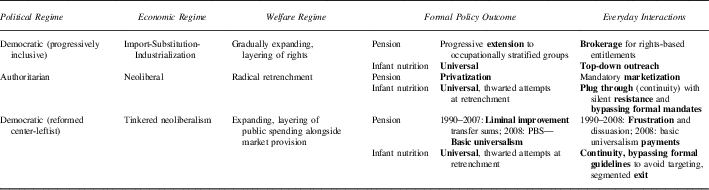
To increase comparative leverage, the analyzed program is briefly contrasted here with the pension sector. These two policy arenas, which in practice function as the bookends of the life cycle, experienced mostly change (pension) and continuity (infant nutrition), respectively, and are also the most and least studied. The standard view on Chile is often based around shifts in Chile’s pension modelFootnote 20 and much of know about Latin America often implicitly modeled around the Chilean case (Gideon Reference Gideon2015: 46). On the other side of the spectrum, the analysis of the infant nutrition program reveals an extensive welfare state, which for the most part has been overlooked in the welfare literature. Table 1 summarizes the findings of this article. The first three columns provide information on the formal institutions. In the welfare literature these are independent variables and policy outcomes (column 4) the dependent variable.Footnote 21 The fifth column in this table describes state-citizen interactions—or the informal institutions—that the rest of this article will focus on. The pension sector confirms hypotheses about formal institutions dictating policy outcomes and the pension regime was substantially changed with each regime combo. However, in the case of the infant-maternal health services analyzed here, theories that predict welfare outcomes based on politics, economics, and policy orientation accurately predict welfare outcomes in one case, miss the mark in another, and have partial success at predicting outcomes in the third regime combination.
Political, economic, and welfare regimes: Formal policy and informal institutions

The next three sections provide a ground-level examination of each combination of political, economic, and social policy regimes that is based on interviews with high-level politicians and Ministry of Health professionals and on testimonies from providers and recipients at two Santiago neighborhood health clinics.Footnote 22
Outreach, Recruitment. and Empathy, 1954–73
While the most adequate categorization for Chile’s early-twentieth-century political regime might be that of an oligarchy with competitive elections, from the 1930s on, there was a strong democratizing impetus and voting rights were gradually extended to women (1935, 1949), finally becoming universal in time for the 1971 election.Footnote 23 During this period, the extension of state services took the form to an uneven process of accretion producing a fragmented and corporatist model that gathered speed during the progressive presidency of a Christian Democrat (1964–70), hit a climax during a brief socialist experiment (1971–73), and came to an abrupt end with the 1973 military coup. In terms of the economic model, efforts at state-led development focused on exporting natural resources (nitrate and copper) and on import substitution industrialization to supplement trade on a depressed global economy.
For this period, models of welfare provision accurately predict outcome and infant-maternal services were in fact expanded. While similar charitable and targeted initiatives preceded the PNAC, this benefit became universal in 1954.Footnote 24 Extension of services was particularly accelerated during the 1960s in tandem with the construction of neighborhood clinics across the country and the quantity of milk distributed during this period spiked: from 5 million kg per year in 1955, doubling to 10 million in 1964, and doubling again to 20 million in 1968 (Jímenez de la Jara Reference Jímenez de la Jara2009: 105).
On the ground level, recruiting PNAC beneficiaries was a laborious process and neighborhood clinic workers acted as a foot army walking door to door through working-class neighborhoods establishing relationships with mothers of infants on a one-to-one basis. According to testimonies of clinic workers and families, the nature of these home visits was very different from today’s context where interactions are governed by strict guidelines, program target goals, and time constraints. Instead, clinic workers had significant autonomy and actions were loosely oriented toward the goal of convincing mothers to bring children to the clinic for regular checkups, transmitting modern puericulture techniques, and more generally organizing the central themes of Frei’s Promoción Popular program.Footnote 25 Based on testimonies from clinic users and service providers from the time it appears that for the most part while families—and in general mothers—received “educational information” readily, they also put their own concerns on the table. This resulted in interactions defined by Illanes as a policy guided by norms of “negotiated conditionality” (2007: 306–7). With time, and only after repeated face-to-face encounters, these same negotiated interactions were transported to local clinics and through them the policies designed by doctors at the central level were adapted to local realities. By the early 1970s, attending local clinics had become a regular part of family’s life.
Plugging through and Bypassing the Rules, 1973–89
The September 11, 1973 military coup d’état brought an end to the process of state expansion. Between 1973 and 1989, Chile was ruled by an authoritarian dictatorship firmly committed to liberalizing economic trade and reducing state interventions according to neoliberal doctrine. The economy went through two major recessions, and social services were significantly retrenched. The pension and health systemsFootnote 26 were privatized, and in the pension sector there was a mass exodus from public services. In this context, infant-maternal programs stand out as a “policy of exception” in that they were not only improved but also coverage was extended. This section briefly reviews the literature on welfare provision during Chile’s dictatorship and attempts to reconstruct ground-level encounters and describes everyday strategies to secure state services.
Despite worsening economic conditions, retrenching and deteriorating services, and a repressive political environment, some macroeconomic indicators such as infant malnutrition and infant mortality continued to improve between 1973 and 1989. One explanation offered to this statistical puzzle is that citizens’ exit Footnote 27 from the public sector, purchasing services on the private health market or creating informal parastate structuresFootnote 28 through which to organize, create, attain, and distribute resources.Footnote 29 This narrative is not sustained by numerical evidence.Footnote 30 Other authors attribute statistics to the fact that health programs targeted at women and infants were both maintained and improved in a context of massive public health cutbacks (Racynski and Oyarzo Reference Racynski and Oyarzo1981) and ponder over what Dreze and Sen refer to as “the intriguing question of why a government that had no hesitation in resorting to the most brutal political repression to protect the privileges of the dominant classes was so interested in looking after child health and extreme poverty” (Dreze and Sen Reference Dreze and Sen1989: 230). McGuire presents an inventory of five potential explanations to this puzzle that include international reputation, protest deterrence, state paternalism, market failure, and technocratic leadership (Reference McGuire2010: 114–17).Footnote 31
The fact that during the dictatorship citizens continued to interact with state services in a quotidian way has remained largely understudied and the contents of these everyday interactions not explored in the policy and welfare literature. After the military coup, the dynamics at neighborhood health clinics dramatically changed: from lively sites—full of popular promotion programs, which were an integral part of the community that performed services both on and off site—to a barricaded closed site with a hierarchical structure and a culture of fear and silence. In the words of Dr. Patricio Hevia: “During the military dictatorship, there was no community outreach, no home visits, none of those things.… they prohibited all community-oriented actions.”Footnote 32 Military officials provided constant surveillance: One Macul clinic nurse recalls: “We had very few resources and we couldn’t say anything.…. the clinic was surrounded by soldiers with war paint on their faces. They would check people’s documents at the entrance and exit,… they kept us surrounded.”Footnote 33 Medical teams were disbanded with activists singled out and removed,Footnote 34 personnel shuffled to different clinics, and regime supporters and military-medical officials placed in clinic positions.Footnote 35 In addition to these measures of intimidation, ambitious family-planning programs were cut, clinic workers lost some of their benefits,Footnote 36 and there were freezing hires and emergency labor program participants used to fill gaps.Footnote 37 In conjunction, this created a context of silence. In the words of a Macul clinic nurse: “In simple terms, I did not know who my colleagues were.… In that time, we were all more silent.”Footnote 38 This “silence” affected the quality of services.Footnote 39 Empathy with families now became an almost secret affair, carefully guarded from the military presence. As one Recoleta paramedic (1966–2010) explained:
Ties had to be built [in privacy], in the medical box, by the act of touching—placing a hand on someone when giving instructions. That is what I did, what I was like; I don’t know what my colleagues did.Footnote 40
Despite often violent treatment and worsening conditions at local primary health clinics, citizens continued to “plug through” showing up at neighborhood clinics regularly. In my interviews to service providers and citizens, I identified three different types of bottom-up strategies exercised at the local level to attain provision despite adversarial conditions. These include funneling state resources to and from resistance movements, finding creative ways to exercise political voice in a repressive context, and finding alternate uses for state-provided milk. The next three paragraphs provide examples of these strategies enacted in everyday encounters.
At the Recoleta clinic, resources were funneled into and from resistance organizations. Citizens would routinely pick up their PNAC milk, cross the street, and leave it on the steps of the church. From here, it would be taken to an organization working against the dictatorship, therefore, effectively using public resources to protest the government. This practice, which was elegantly described by prominent activist nun and founder of religious-run primary clinicFootnote 41 as one in which “[p]eople would bring milk from the clinic when they did not need it or it was not good for them, as a way to give a fraternal hand”Footnote 42 was widespread and came up frequently in group and individual interviews in Recoleta.Footnote 43 At the same time, resources from antidictatorship organizations were also funneled into the clinic. The military dictatorship had implemented “an ambiguous reproductive rights regime.”Footnote 44 As a way to wiggle outside the confines of this mandate, public health workers at the Recoleta clinic would smuggle intrauterine devices (IUDs) donated by international solidarity groups into the public clinic, and health workers found ways to offer and place them in patients without the knowledge of military directives and guards.
Some citizens actively resisted retrenchment of services through what I call “muted voice,”Footnote 45 referring to unplanned acts of defiance implemented at the ground level. In 1985, the regime tried to cut back the program replacing milk distribution with rice. Without prior coordination, citizens took these bags of rice and split them open, spilling the rice at clinic doors, within sight of the clinic personnel and military guards. These “silent acts” of protest were replicated at neighborhood clinics across the country and were so widespread that within days of implementing the replacement, Pinochet personally decreed milk distribution be reinstated.Footnote 46
Finally, citizens made alternate use of what were perceived as low-quality clinic food products (thus converting them into resources with value for the family). Here, I use the case of Fortesán—a product made from a mix of soy and dairy productsFootnote 47 —to highlight the differences between top-level perceptions and mandates and ground-level practices. By official accounts, low-cost Fortesán had low solubility and acceptability and was therefore a failed experiment (Gobierno de Chile 2005: 67–72). In the words of Dr. Hector Aliaga, in charge of the PNAC at the time, “Fortesán was like a block of stone or cement” and it “had no acceptance rate” amongst beneficiaries.Footnote 48 Dr. Fernando Mönckeberg BarrosFootnote 49 —well-known advocate for programs that combat infant malnutrition—remembers Fortesán as being commonly sold on the black market.
[T]he milk in the first years [after 1973] was dramatic. The mother would receive a package of 3 kg of milk and Fortesán … and on her way out she would sell it. For three full years, they would be selling the milk [every month].Footnote 50
At the local level, clinic workers would help families find ways to make “use” of these products. Not preparing state milks according to instructions was not merely an issue of domestic mismanagement as the top authorities believed but also, as in the case of Fortesán,Footnote 51 a coping strategy sometimes learned at the clinic. For example, one paramedic would teach beneficiaries not to dissolve Fortesán as the instructions state but instead to get around its low solubility with alternate uses: “Sometimes some really bad milks came in … and people didn’t want it. So we would teach them to make desserts with that milk … to make little dessert balls of Fortesán.”Footnote 52
The different narratives of local provision presented in this section illustrate the ways in which policy implementation occurred independent of formal mandates. The microepisodes of solidarityFootnote 53 in conjunction with low Instituciones de Salud Previsional (ISAPRE) enrollment rates reveal a state that rather than retrenched is ubiquitous in the health sector—even in the everyday working of resistance organizations. By the end of the military regime, PNAC was accompanied by a series of targeted programs,Footnote 54 the quality of state-distributed milk was greatly improved,Footnote 55 and PNAC coverage increased from an estimated 72 percent in 1975 to 80 percent in 1987,Footnote 56 with the number of children younger than six years old under surveillance in Ministry of Health establishments rising from 1,015,000 in 1975 to 1,258,200 in 1985.Footnote 57 Therefore, despite the political situation that led citizens to retreat from the state whenever possible, in the area of infant-maternal health and nutrition programs, citizens continued to “plug through” by finding creative ways to continue extracting resources and services from local state offices despite the repressive and adversarial context—a practice that continues beyond the dictatorship.
Democratic, Leftist, and Still Bypassing the Rules, 1990–2010
Between 1990 and 2010, Chile was governed by presidents of a center-left coalition committed to expand social services and rights while fomenting competitive conditions for trade on international markets and assuring government spending was both efficient and had visible results. Even though beginning in the early 1990s, social spending increased in terms of policy outcomes, most of the social spending was framed in what can be called an essentially market-based logic where the responsibility of the state as a provider of welfare was subordinated to its role as protector of fair market conditions. This was translated into temporary subsidies to families, training programs in market-friendly skills, or transfers to the private sector for services provided. This tension created a disjuncture between a rights-based rhetoric and limited welfare expansion and resulted in a constellation of ground-level encounters between state workers and citizens. While attempts at deuniversalizing the state milk program were abruptly halted by the threat of a political scandals and media uproar, the posttransition socialist governments (2000–10) implemented a series of “technical adjustments” that, taken together, constitute an attempt to retrench the program without the political costs of changing legislation. At the local level, citizens and providers coordinated to counter these attempts at de facto targeting by strategically scripting encounters to meet eligibility criteria and engaging in diverse paralegal strategies including finding alternate uses of clinic milks, intrafamilial dispersion, intracommunity redistribution, and funneling resources. This section briefly summarizes the literature on the social program of the Concertación, describes changes and continuities in the PNAC program rules, and moves on to describe the ground-level strategies to secure state milk.
In the welfare literature, there seems to be a consensus that, for the most part, the spending of the 1990s in Chile did not reverse the neoliberal reforms. Political scientists have attempted to explain the Concertación’s insistence on gradual change and commitment to not challenging basic neoliberal tenets by focusing on the institutional (Borzutzky Reference Borzutzky2002; Siavelis Reference Siavelis2006, Reference Siavelis2009; Taylor Reference Taylor2004), actor-centered (Davila Reference Davila2005; Ewig and Kay Reference Ewig and Kay2011), or authoritarian legacies. Ewig and Kay (Reference Ewig and Kay2011) highlight the lock-in effect of the increased power of business and capital interests in social provision, and Staab concludes that, from a gender perspective, “market reforms layered new gender inequalities on to the already existing legacies of maternalism and male-breadwinner bias” (2012). Whether the spending of the Lagos 2000–6 and Bachelet 2006–10 presidencies reverses the model is an open debate:Footnote 58 For example, while Pribble (Reference Pribble2013b) categorizes 2000–10 Chile as moving toward what she defines as “basic universalism,” Farias (Reference Farías2014) questions this categorization.
At the ground level, as in the previous period, policy outputs at the local level occurred somewhat independent of formal mandates. Unlike in the previous period, where providers broke the rules because of what they consider a “bad government,” here contestation is due to the idea that program rules are “mistaken” and sometimes guided by the idea that other program rules would most help the center-leftist presidency meet its stated goals. The case of the introduction of a new milk product and the ground-level strategies to resist, reuse, and avoid it serve as a lens through which to observe the informal strategies deployed at the local level to resist this change. In 2008, Leche Purita Mamá, a fortified milk product designed to provide benefits for infants when consumed by pregnant and nursing mothers, was introduced.Footnote 59 In practice, Purita Mamá tasted and smelled bad and gave women acid reflux. While it was presented as a milk that would “deepen equal opportunities,” government evaluations tended to focus on economic efficiency over equality. Ministry of Health officials pointed to its unfavorable organoleptic qualities as a positive externality, assessing Purita Mamá’s foul taste as a positive externality given that it has lower rates of intrafamily dilutionFootnote 60 and would therefore deter citizens in higher income levels milk pickups (Contreras et al. 2011: 318), in this way creating a de facto targeting of the program without the political cost of formal retrenchment. Dr. Eduardo Atalah,Footnote 61 one of the proponents of the Purita Mamá and author if its two evaluations, explains in a 2011 interview: “The advantage of the Purita Mamá is that there is some self-targeting. The distribution has gone down a little. The proportion of milk pick-ups amongst recipients with private insurance has gone down.”Footnote 62
Citizens reacted to the introduction of Purita Mamá by engaging in techniques of intrafamily dispersion, donating milk to political organizations, and scripting encounters with health providers to bypass the new product. In practice, these ground-level strategies manage to somewhat resist the intended socioeconomic targeting of Chile’s state milk program. Purita Mamá created conflicts between top- and mid-level Ministry of Health professionals. For example, one Ministry of Health nutritionist developed a set of strategies and recipes to coax women to drink this (foul-tasting) milk, an experience she shared at a Minsal conference. After her presentation, she had an argument with a doctor who told her teaching recipients alternate preparations was an “incorrect” practice. She feels that distributing milk that makes pregnant women queasy is an incorrect practice and has continued bypassing the rules teaching women alternate preparations explaining “what I care about is that they drink the milk.”Footnote 63
While the ministry’s obsession with reducing “intra-family dispersion” deepened,Footnote 64 it is based on my fieldwork, “sharing” (i.e., intrafamily dispersion) is the most common way to make use of all resources including clinic foodstuffs for families. For example, when I visited the house of one Recoleta, a multigenerational household containing three milk recipients—a senior citizen (Program for Complementary Foodstuff for Senior Citizens [PACAM]Footnote 65 recipient), one child younger than six, and a breastfeeding mother—she explained that one of the children is eight years old and therefore is no longer a PNAC recipient. However, he is not fussy and will drink any milk:
Whatever milk, you give him he will drink. Even that milk that they give mothers—that expecting mother one … I don’t like it because it tastes acid to me, but he is fine with it.… His little sister will drink her grandmother’s milk mixed with Purita Cereal, but she won’t drink that “Future Mother” milk. She said it tasted weird and that was the end of it. I have to buy milk separately for her.Footnote 66
This brief window into one family’s consumption practice shows how clinic milk is seen as a useful resource for families. Even in the case that it is not consumed by the intended beneficiaries, the consumption of clinic milk by other family members frees resources for the family to purchase preferred products.
Other kinds of redistribution include intracommunity solidaristic arrangements. Some recipients only drink part of their ration and distribute the rest to those close to them in need. For example, one Recoleta resident and PACAM recipient shares her rations with her brother and his family.Footnote 67 Another who struggles to make ends meet for basic needs explains that while her family doesn’t like and will not drink clinic foodstuffs, she still picks them up and gives them to a neighbor:
I pick them up, but give them away. An elderly lady across the street loves them.…. She eats them when she doesn’t have anything else to eat or when she is cold.Footnote 68
Despite her own stretched economic and time resources, she still values being able to help her neighbor with this ration of state milk.
Other solidaristic redistribution arrangements are more institutionalized. As described previously, during the dictatorship milk flowed from the clinic to resistance organizations through churches and nongovernmental organizations (NGOs). In the democratic era, this practice of funneling state resources to political organizations continues and is sometimes organized within the clinic. In both clinics in which I conducted in-depth research, there were mechanisms for PNAC and PACAM recipients to pick up their milk and then drop it off at a different part of the clinic to be distributed to others. In Macul, citizens could leave their foodstuffs outside the office of a social worker who would then pass them on to families in need. In Recoleta, a midwife collects PNAC (mostly Purita Mamá) and PACAM foodstuffs to funnel to the indigenous Mapuche movements engaged in political struggle in the south of Chile.Footnote 69
While some families responded to the introduction of what was considered a substandard product by ceasing to go to the clinic for milk pickups and medical checkups after 2008, there is a marked increase in families that do not pick up milk;Footnote 70 others actively resist the change. In regular health checkups, mothers of infants in the Purita Mamá mama recipient age bracket claim to not breastfeed to bypass Purita Mamá and receive regular milk instead. Minsal nutritionist explains: “When they ask mothers if they are breastfeeding, these respond that they are not. So they give them Purita—the milk for children, and the mother drinks it. Women tip each other off on how to do this in clinic waiting rooms.”Footnote 71 The knowledge on how to bypass formal policy and this undesired milk product is usually learned from family members or neighbors. However, when these mechanisms fail for individual beneficiaries, health providers will instruct women on the necessary scripts with which to fudge eligibility criteria and receive desired state products. Midwives will ask new mothers whether they tolerate clinic milk and, in cases in which they do not, suggest they tell the nutritionist they do not breastfeed.Footnote 72 In these interactions, service providers collude with service recipients to bypass formal policy and provide a service that is understood as an acquired right.
After 2008, citizens quickly learned to adjust their responses to health questions in such a way as to assure the distribution of a desired product. This apparently “small digression” by which mothers routinely bypass policy changes has the output that, despite a government mandate to distribute Leche Purita Mamá, pregnant and nursing mothers continue to receive Leche Purita Fortificada and has significant outcomes, potentially biasing national statistics on breastfeeding. Dr. Mardones Santander—public health and nutrition expert—explains:
This situation is so serious that many mothers who are breastfeeding say they are not to get Purita milk.… This means that the surveys on the duration of breastfeeding … are probably biased.Footnote 73
In conjunction, the measures taken by Chile’s leftist presidencies threatened the prestige of Purita Mamá milk, understood as “milk for Chileans,” and potentially jeopardized the relationships between families and providers.Footnote 74 For the first time, in terms of effective coverage, there is a small decrease—in particular in the families with infants in the 0 to 6 months age group—in those who would receive the controversial Purita Mamá milk. In sum, in leftist-neoliberal Chile, on-the-ground state workers often behaved according to a narrative shared with elected government public discourse bypassing government policies, therefore “breaking the rules to maintain the spirit of the law.” Therefore, while the welfare literature would predict expansion results can at best point to continuity and, at the same time, top-level efforts at covert retrenchment were resisted by everyday actions.
Everyday Strategies to Secure and Make Use of State Milk
Each regime combo in 1954–2010 Chile created the conditions for specific strategies to be enacted in neighborhood clinics. In the first regime combination analyzed in this article: democratic, inward-focused state-led development with an expanding social state in which the implementation of a top-down project ended up effectively extending rights for citizens, we could say that expectations guided by formal theories are concordant with policy outcomes. In the authoritarian, neoliberal, and retrenching social policy combination (1973–89), received theories would predict retrenchment. Not only did this not occur but also the quality of services provided in this area improved during this period. In addition, while the regional literature mostly suggests that citizens exit from public services, an analysis of this program finds that citizens continued to plug through, and while eligibility rules for this program remained constant, coverage increased. In the third combination analyzed, with the return to democracy, the elections of increasingly leftist leaders, the relative prosperity of the country, and increased social spending, one would expect services and social rights to expand. What we find instead is that they improved in only a piecemeal way during the 1990s, modernizing and introducing some new services with on-the-ground provisions that failed to live up to citizens’ expectations. In the 2000s, rather than the expansion the election of leftist presidencies might lead one to expect, a series of “technical” adjustments effectively lowered the quality of services provided and, for the first time, coverage rates began to decline, producing a de facto targeting. Therefore, as in the previous period, received theories do not predict the outcomes for this particular policy sector.
Table 2 presents the everyday strategies observed in all three periods. Examining these microinteractions and their macroeffects on policy outcomes where change was resisted by the same forces under both right-wing dictatorship and left-wing democracy leads us to rethink standard views on the importance of political regime type for policy results. It pushes us to examine our conceptual tools for thinking about continuity, which in this case is an outcome of a series of agentic actions enacted in everyday encounters between families and local service providers.
Everyday strategies: Securing state milk

Conclusion
Between 1954 and 2010 Chile changed dramatically. PNAC, however, did not and outlived government turnover and privatizations, constituting an extensive infant-maternal primary health care networkFootnote 75 that has been underexamined by scholars who focus exclusively on formal institutions. This article uses the PNAC as a lens to observe how macroeconomic changes affect everyday interactions between citizens and local service providers. It finds that changes in regime type and program rules are filtered through and resisted using practices and strategies deployed in face-to-face encounters between local state representatives and citizens. As the political, economic, and provision landscape changes, bottom-up practices are constantly adjusted, mobilizing empathetic local providers to move beyond formal rules, drawing on paralegal routes to services, or activating resistance networks to locate service providers who draw from and distribute state services.
Beyond the Chilean case, the article’s most important finding is that political, economic, and social policy regime types shape but do not determine levels of provision. Welfare provision does not only occur as and when mandated by politicians, but also in everyday interactions between state workers and citizens. Second, there is often a large gap between central policy and these informal institutions that coexist, compete, and clash with formal rules. The informal institutions created in on-the-ground encounters between state workers and citizens are the sites of welfare provision. Third, people who are regulated by the state and have some capacity to control the state and state workers who organize and are organized by the state to distribute resources have some discretionary power, often breaking rules to follow their vision of the correct state or what they interpret as the spirit of the law. The contents of the interactions between service providers and recipients have substantive ramifications on the level of services received, quality of life for individuals and families, and state strength, efficacy, and stability. Therefore, everyday citizens and public servants—regulated and regulators of formal rules—also find ways to exert agency through informal institutions.
Taken together, the observed everyday strategies constitute informal institutions and present an innovation to the institutionalist literature. This article concludes by suggesting avenues for research that, while referring to macroprocesses of substantive importance, are attentive to the everyday people who experience these in their lives. In this vein, it proposes two lines of inquiry to the welfare literature. The first implies dehomologating formal program guidelines and implementation and proposes the necessity to empirically examine implementation. The second is related to reconceptualizing service beneficiaries and local bureaucrats as agents who influence policy outcomes. Therefore, informal institutions, norms, and networks observed at the implementation level are essential for understanding how people experience welfare “on the ground,” and formal institutions are best understood as shaping but not determining the possibilities for citizens to extract resources and services from the state.
Notes
Research funded by Fondo Nacional de Desarrollo Científico y Tecnológico de Chile CONICYT- FONDECYT/POSTDOCTORADO/N∘ 3140116. Preliminary versions were presented at a workshop at Centro de Investigación sobre Sociedad y Políticas Públicas 2015, XII Congreso de Ciencia Política Sociedad de Análisis Argentinos de Política 2015, and the Research Committee on Poverty, Social Welfare and Social Policy RC19 Annual Conference (2016). Many thanks to Gonzalo Delamaza, Oscar Mac-Clure, James Mahoney, Luisina Perelmiter, Ann Shola Orloff, Julieta Suárez-Cao, and the anonymous reviewers at Social Science History Journal for their encouragement and insightful comments.