INTRODUCTION
‘It is certainly very astonishing that a region so much frequented as the Arabian Sea is unexplored with regard to animals so large and striking as the Scyphomedusae’ (Stiasny, Reference Stiasny1937: 27). Written 77 years ago, Stiasny's observation is still valid. The study of scyphozoan jellyfish has been neglected in the northern Arabian Sea, especially along the coast of Pakistan. Just three species have been recorded for Pakistani waters: Rhizostoma pulmo (Macri, 1778); Catostylus perezi Ranson, 1945; and Pelagia cf. noctiluca (Forskål, 1775) (Stiasny, Reference Stiasny1937; Muhammed & Sultana, Reference Muhammed and Sultana2008; Gul & Morandini, Reference Gul and Morandini2013). The records of Catostylus mosaicus (Quoy & Gaimard, 1824) from Pakistani waters (Tahera & Kazmi, Reference Tahera and Kazmi2008) and from north-western Arabian Gulf (Al-Yamani et al., Reference Al-Yamani, Valeriy, Aleksandra, Sergey and Irina2011: 182–183, figure 229) are possibly a misidentification of C. perezi (see Gul & Morandini, Reference Gul and Morandini2013; Morandini, personal communication). Here we present the first record of a cepheid jellyfish, Marivagia stellata found off the mouth of the River Indus, Pakistan.
MATERIALS AND METHODS
The specimen was collected from the trawl catch by M. Moazzam on 11 November 2010, off the mouth of the River Indus, Pakistan (Station 49: 23°54.35′N 67°06.19′E) during surveys of the offshore fisheries resources of Pakistan, using FAO/NORAD Research Vessel ‘Dr Fridtjof Nansen’ (Fanning et al., Reference Fanning, Khan, Kidwai and Macauley2011). The specimen was photographed in a plastic jar; measurements and some other morphological observations were noted. However, due to absence of preservation facilities, the specimen was brought to the laboratory in mutilated condition. We deposited a voucher photograph (JMGDC/MDZ/CN 14P) at the Museum of the Department of Zoology, Jamia Millia Government Degree College, Malir, Karachi, Pakistan. The specimen was identified following the description by Galil et al. (Reference Galil, Gershwin, Douek and Rinkevich2010).
RESULTS
SYSTEMATICS
Class SCYPHOZOA Goette, 1887
Subclass DISCOMEDUSAE Haeckel, 1880
Order RHIZOSTOMEAE Cuvier, 1800
Family CEPHEIDAE Agassiz, 1862
Genus Marivagia Galil & Gershwin, Reference Galil, Gershwin, Douek and Rinkevich2010
Marivagia stellata Galil & Gershwin, Reference Galil, Gershwin, Douek and Rinkevich2010
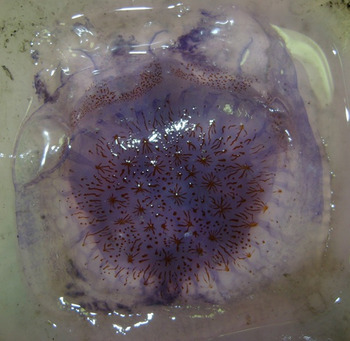
(Figure 1)
MATERIAL EXAMINED
11 November 2010, 1 specimen, Station 49 (23°54.35′N 67°06.19′E) caught by bottom trawl net, voucher photograph (JMGDC/MDZ/CN 14P), umbrella 147 mm wide.
DESCRIPTION
The specimen lacks exumbrellar central dome, papillae or knobs; the exumbrella is ornamented only with raised reddish-brown dots, streaks and starburst-like marks clustered in the central part. Velar lappets broad, tongue-shaped. Eight oral arms, shorter than bell radius, bi-forked halfway, branched with frilled mouths and devoid of any type of appendages. Rhopalar canals eight, widest proximally. There are three inter-rhopalar canals in each octant, anastomosed loosely in proximal 2/3 and complexly in distal 1/3 of the umbrella. The umbrella is translucent pale purplish-blue; oral arms with translucent jelly and purplish-blue mouths in life (Figure 1).
Specimen of Marivagia stellata found off the mouth of the River Indus, Pakistan: exumbrellar view; umbrella width 147 mm (photograph by M. Moazzam).

DISCUSSION
Presence of exumbrellar central dome, papillae or knobs, number of inter-rhopalar canals per octant, and the characteristic subumbrellar filaments and appendages on the oral arms and arm disc are the features that distinguish the four cepheid genera (Kramp, Reference Kramp1961). The following characters identify the present specimen as Marivagia stellata: exumbrella lacking central dome, papillae or knobs, with only microscopic warts and ridges on the exumbrellar surface; and no filaments or appendages between the mouths and on the arm disc, and three inter-rhopalar canals per octant, anastomosing loosely in proximal 2/3 and complexly in distal 1/3. The pattern of pigmented marks on the exumbrellar surface and the colour of specimen in life are also similar to the type specimen (see Galil et al., Reference Galil, Gershwin, Douek and Rinkevich2010).
Marivagia stellata was described from Mediterranean coast of Israel (type locality: Bat Gallim, south of Haifa Bay, Israel) (Galil et al., Reference Galil, Gershwin, Douek and Rinkevich2010). It was first observed in the Mediterranean Sea in 2006, on the southern rim of Haifa Bay, Israel. Additional specimens were collected and photographed in several locations along the coast of Israel, and in 2010 a swarm was reported and photographed off Lebanon (Galil & Goren, Reference Galil, Goren, Goffredo and Dubinsky2013). Galil et al. (Reference Galil, Gershwin, Douek and Rinkevich2010) argued that the species originated in the Indian Ocean and entered the Mediterranean through the Suez Canal. The species has recently been reported from Vizhinjam, Kerala, India (Galil et al., Reference Galil, Biju and Abdul2013); so far, the only record from the Indian Ocean. Now, the present record off the mouth of the River Indus, Pakistan, greatly extends the range of its distribution to the north-east of the Arabian Sea.
ACKNOWLEDGEMENTS
The authors are grateful to Dr Lisa-Ann Gershwin for providing comments on Marivagia stellata. Partial support for this research was provided by the European Community's Seventh Framework Programme (FP7/2011-2015) for the project Vectors of Change in Oceans and Seas Marine Life, Impact on Economic Sectors (VECTORS) (B.S.G.). We also thank the anonymous referees for their helpful comments and suggestions.