


Introduction
Recent conceptual models of anxiety have emphasized the role of cognitive vulnerabilities (e.g. interpretation biases such as catastrophizing) in the development and maintenance of anxiety and its disorders (e.g. Barlow, Reference Barlow1991; Reference Barlow2002; Beck, Reference Beck1976; Carter and Barlow, Reference Carter, Barlow, O'Donohue and Krasner1995; Taylor, Reference Taylor1995). Given the research evidence demonstrating the relation of cognitive vulnerabilities and anxiety (see Kendall, Reference Kendall2006; Prins, Reference Prins, Silverman and Treffers2001; Wells, Reference Wells1997) coupled with the strong empirical support for the efficacy of cognitive behavioral treatments (CBTs) in reducing anxiety and its disorders in youths (e.g. Kendall, Reference Kendall1994; Silverman et al., Reference Silverman, Kurtines, Ginsburg, Weems, Lumpkin and Carmichael1999a, Reference Silverman, Kurtines, Ginsburg, Weems, Rabian and Serafinib) and adults (e.g. Barlow, Rapee and Brown, Reference Barlow, Rapee and Brown1992; Borkovec, Newman, Pincus and Lytle, Reference Borkovec, Newman, Pincus and Lytle2002), continued research on specific cognitive vulnerabilities can serve to enhance understanding of the cognitive biases that underlie problematic anxiety, which in turn can be used to sharpen the foci of CBT interventions.
One cognitive vulnerability that has attracted a great deal of research attention is anxiety sensitivity (AS). AS refers to individuals' beliefs that their anxious physical symptoms may lead to aversive physical, psychological, and social consequences (e.g. Reiss, Reference Reiss1991; Reiss, Peterson, Gursky and McNally, Reference Reiss, Peterson, Gursky and McNally1986). Research on AS has evolved considerably since the construct was first introduced (Reiss and McNally, Reference Reiss, McNally, Reiss and Bootzin1985). Issues of concern that were the focus of initial research attention, such as whether AS is distinct from trait anxiety, have been generally put to rest in youth and adult samples: AS is distinct from trait anxiety in youth (e.g. Weems, Hammond-Laurence, Silverman and Ginsburg, Reference Weems, Hammond-Laurence, Silverman and Ginsburg1998) and adults (e.g. Marian and McNally, Reference Marian and McNally1996; McNally, Reference McNally1989).
In the child and adolescent area, another issue of concern in the “early AS research days” was the applicability of the construct in younger children relative to older children and adolescents (e.g. Chorpita and Lilienfeld, Reference Chorpita and Lilienfeld1999; Weems et al., Reference Weems, Hammond-Laurence, Silverman and Ginsburg1998), with AS assessed in these studies using the Childhood Anxiety Sensitivity Index (CAST; Silverman, Fleisig, Rabian and Peterson, Reference Silverman, Fleisig, Rabian and Peterson1991). This issue too has been generally put to rest (e.g. Weems et al., Reference Weems, Hammond-Laurence, Silverman and Ginsburg1998). Research attention next turned to comparing AS levels in different types of samples including anxiety disordered and nonanxiety disordered samples (Kearny, Albano, Eisen, Allan and Barlow, Reference Kearney, Albano, Eisen, Allan and Barlow1997; Rabian, Peterson, Richters and Jensen, Reference Rabian, Peterson, Richters and Jensen1993). Findings from these studies demonstrated that AS is elevated in anxious samples relative to nonanxious samples, suggesting that AS may serve as a risk factor in the development and maintenance of anxiety and its disorders in young people (e.g. Hayward et al., Reference Hayward, Killen, Kraemer, Blair-Greiner, Strachowski, Cunning and Taylor1997; Weems, Hayward, Killen and Taylor, Reference Weems, Hayward, Killen and Taylor2002).
AS research is currently at a nexus with respect to its next stage in knowledge development. One potentially useful direction for knowledge development efforts, which constitutes the direction of the present study, is to investigate AS and its relation to anxiety within the context of a conceptual model that considers other potentially relevant cognitive variables. This type of research is still in its infancy. In the child and adolescent AS research area, we could identify only two studies along these lines (Ginsburg, Lambert and Drake, Reference Ginsburg, Lambert and Drake2004; Weems, Costa, Watts, Taylor and Cannon, Reference Weems, Costa, Watts, Taylor and Cannon2007).
Of these two studies, the one conducted by Weems et al. (Reference Weems, Costa, Watts, Taylor and Cannon2007) focused on the constructs of interest in the present study, namely AS and anxiety control.Footnote 1 Anxiety control (AC) has been proposed as another cognitive vulnerability construct that may advance theoretical and clinical understanding of anxiety symptoms in youth, as it captures an aspect of anxiety not captured by AS (Weems, Silverman, Rapee and Pina, Reference Weems, Silverman, Rapee and Pina2003). AC refers to individuals' perceived control over anxiety related internal physiological reactions as well as their perceived control over anxiety related external objects or events (Rapee, Craske, Brown and Barlow, Reference Rapee, Craske, Brown and Barlow1996). Using an ethnically diverse sample of nonclinic referred children and adolescents (N = 145; Mean age = 11.36 years), Weems et al. (Reference Weems, Costa, Watts, Taylor and Cannon2007) investigated concurrent and prospective relations among youth AS, AC, and anxiety and depressive symptoms. To assess AC, Weems et al. (Reference Weems, Costa, Watts, Taylor and Cannon2007) used the Anxiety Control Questionnaire for Children (ACQ-C; Weems et al., Reference Weems, Silverman, Rapee and Pina2003), modelled after the Anxiety Control Questionnaire used with adults (Rapee et al., Reference Rapee, Craske, Brown and Barlow1996). The ACQ-C assesses youths' beliefs regarding the extent that anxiety is perceived as controllable along two dimensions: (1) Internal Reactions (e.g. “I can take charge and control my feelings”) and (2) External Threats (e.g. “When something scares me, there is always something I can do”).
Relevant to the present study are Weems and colleagues' (Reference Weems, Costa, Watts, Taylor and Cannon2007) concurrent analytic findings showing that AS and AC total scores were significantly and negatively correlated with each other (i.e. AS levels were inversely related to AC levels). In addition, both AS and AC made statistically significant and unique contributions in the prediction of anxiety symptoms. The study by Weems et al. (Reference Weems, Costa, Watts, Taylor and Cannon2007) is important because it is the first to empirically demonstrate an association between AS and AC.
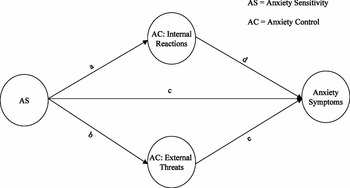
The present study extends Weems et al. (Reference Weems, Costa, Watts, Taylor and Cannon2007) by investigating the relation between AS and AC within the context of a (partially) mediated conceptual model in the prediction of anxiety symptoms in a sample of 6 to 16-year-old children and adolescents referred to an anxiety disorders specialty research clinic. This model is depicted in Figure 1. Whereas Weems et al. used the ACQ-C total score in their analyses, the present study used scores from the two ACQ-C subscales, anxiety control over Internal Reactions and anxiety control over External Threats, thereby providing a more comprehensive investigation of the influence of AC on anxiety symptoms.Footnote 2
Partially mediated model of the relations among youth anxiety sensitivity, anxiety control, and anxiety symptoms

Of further note is that the present study's conceptual model was guided, in part, by Chorpita and Barlow (Reference Chorpita and Barlow1998, p. 5) who posited that a key pathway to the development of anxiety involves the processing of “events as not within one's control.” Accordingly, in the present study, it was hypothesized that youths who believe their anxious physical reactions will have aversive consequences also will perceive having less control over Internal Reactions. In addition, youths who believe their anxious physical reactions will have aversive consequences will perceive having less control over External Threats, which elicit these anxious physical reactions. It was further hypothesized that youths who perceive having less control over Internal Reactions and having less control over External Threats will report high levels of anxiety symptoms. Finally, it was hypothesized that youths who believe their anxious physical reactions will have aversive consequences will report high levels of anxiety symptoms. As such, youths' perceptions of AC over Internal Reactions and AC over External Threats would partially mediate the relation between AS and anxiety symptoms.
The conceptual model tested in the present study also included youth sex as a potential moderator of the relations among AS, AC, and anxiety symptoms using a multiple groups procedure via structural equation modeling (SEM; Arbuckle, Reference Arbuckle2006a). Although the literature on participant sex and anxiety symptomatology is sparse (see Silverman and Carter, Reference Silverman, Carter, Worell and Goodheart2006), the general pattern that has emerged, including in Weems et al. (Reference Weems, Costa, Watts, Taylor and Cannon2007), is that females rate themselves higher on anxiety and AS relative to males. In terms of AC, Weems et al. found that females rate themselves lower on this construct than males. In subsequent hierarchical multiple regression analyses, Weems et al. (Reference Weems, Costa, Watts, Taylor and Cannon2007) evaluated youth sex as a moderator of the respective relations between AS and anxiety, and AC and anxiety, and found no moderating role. No research in the youth anxiety area has yet to investigate whether there are differences between males and females with respect to perceptions of control over AC Internal Reactions versus perceptions of control over AC External Threats. As a result of this absence of research, it was viewed premature to formulate specific hypotheses with respect to the moderating role of youth sex.
Method
Participants
Participants consisted of 333 youth (48.6% girls) ages 6 to 16 years of age (M = 10.27 years; SD = 2.40). In terms of ethnicity, 89 (26.7%) were European American, 220 (66.1%) were Latino, 17 (2.1%) were African American, and 7 (5.1%) were of other ethnic backgrounds. With respect to family income, 50 families (15.0%) reported annual incomes of $20,000 or less; 70 (21.0%) reported incomes between $20,001 and $40,000; 115 (34.6%) reported incomes over $40,001; and 98 (29.4%) families did not report income.
All youth were referred to an anxiety disorders specialty research clinic for treatment due to difficulties with excessive fear and/or anxiety. Primary referral sources were school counsellors and health professionals. Participants were included if their parent reported them to have difficulties related to anxiety symptoms during an initial telephone screen. Exclusionary criteria for participation in this study were developmental delays (e.g. Asperger's syndrome, mental retardation, autism) or severe psychopathology (e.g. schizophrenia). Of the 283 youth for whom diagnoses were obtained, 91.5% of youth met DSM-IV diagnostic criteria for an anxiety disorder anywhere in their diagnostic profile, with the majority of youth (86.3%) meeting criteria for a primary anxiety disorder based on the Anxiety Disorders Interview Schedule for DSM-IV: Child and Parent Versions (ADIS-IV: C/P; Silverman and Albano, Reference Silverman and Albano1996). Of the remainder 8.5% that did not meet criteria for an anxiety disorder anywhere in their diagnostic profile, 3.9% met criteria for other disorders and 4.6% did not meet criteria for any psychopathological condition.Footnote 3 The most common primary diagnoses were separation anxiety disorder (25.8 %), specific phobia (23.3%), generalized anxiety disorder (17.0%), and social phobia (16.3%), with the remainder (17.6%) being other anxiety disorders and other psychopathological conditions. The majority of participants (70.3%) had at least one comorbid disorder.
Measures
Anxiety Disorders Interview Schedule for DSM-IV: Child and Parent Versions (ADIS-IV: C/P; Silverman and Albano, Reference Silverman and Albano1996). The ADIS-IV: C/P is a semi-structured diagnostic interview schedule designed specifically for the diagnosis of anxiety disorders in children and adolescents and other related disorders. Test-retest reliability of the ADIS-C/P has been reported to be in the good to excellent range (Silverman, Saavedra and Pina, Reference Silverman, Saavedra and Pina2001). To determine diagnoses, clinicians conducted separate interviews using the child and parent versions, respectively, of the ADIS–IV: C/P. The information obtained from the child and the parent interviews were combined to reach a combined diagnosis. In the case of a discrepancy between the child and parent interviews, if one or both interviews yielded a diagnosis with an interference rating of four or more (on a 0–8 point rating scale), the child received the diagnosis and was assigned the higher of the two interference ratings. In cases of multiple diagnoses, the relative impact or interference of each specific diagnosis was used as the basis for assigning the primary diagnosis, the secondary diagnosis, etc. This includes diagnoses for all disorders – not just anxiety, which can be reliably differentiated using the ADIS-C/P interviews (Silverman and Albano, Reference Silverman and Albano1996).
Childhood Anxiety Sensitivity Index (CASI; Silverman et al., Reference Silverman, Fleisig, Rabian and Peterson1991). The CASI consists of 18 items that assess the extent that youth view the experience of anxiety related physiological symptoms as aversive (e.g. “It scares me when I feel shaky”). Respondents rate their agreement to each item along a scale of 1 (None) to 3 (A lot). Total scores range from 18 to 54, with higher scores indicating higher levels of anxiety sensitivity. Silverman et al. (Reference Silverman, Fleisig, Rabian and Peterson1991) reported an internal consistency (alpha) coefficient of .87 for the total score.
Anxiety Control Questionnaire for Children (ACQ-C; Weems et al., Reference Weems, Silverman, Rapee and Pina2003). The ACQ-C consists of 30 items that assess youths' perceived control over negative Internal Reactions associated with anxiety (e.g. fast-beating heart, shaking) and anxiety related External Threats (e.g. fear provoking objects, events, or situations). Respondents rate their agreement to each item along a scale of 0 (None) to 4 (Very, very much). In this study, both the Internal Reactions and External Threats subscales were used. Internal Reactions scores range from 0 to 56; External Threats scores range from 0 to 64. The higher the score on both subscales, the higher the individual's perceived control. Weems et al. (Reference Weems, Silverman, Rapee and Pina2003) reported an alpha coefficient of .89 for the Internal Reactions subscale and .87 for the External Threats subscale.
Revised Children's Manifest Anxiety Scale (RCMAS; Reynolds and Richmond, Reference Reynolds and Richmond1978). The RCMAS consists of 37 items that assess youths' anxiety symptoms. Respondents rate each item as either Yes or No. Total Anxiety scores range from 0 to 28, with higher scores indicating higher levels of anxiety. Reynolds and Richmond (Reference Reynolds and Richmond1985) reported an alpha coefficient of .80 for the Total Anxiety scale.
Procedure
Parents of youth first contacted the clinic via telephone and were administered a screen by a staff member at the clinic. After the screen was completed, based on the child's presenting problem described over the telephone, a determination was made whether the child would be scheduled for an initial evaluation. For children whose presenting problems were not anxiety-related, information was provided to the parents over the telephone for appropriate referral sources in the community.
Upon arrival at the clinic, parents and children were told about the assessment procedures of the clinic and informed consent/assent was obtained. This was followed by the administration of an assessment battery consisting of the ADIS-C/P and questionnaires, including the CASI, ACQ-C, and RCMAS. While youth were being administered the child version of the interview schedule, parents were administered the questionnaires; and while parents were administered the parent version of the interview schedule, youths were administered the questionnaires.
The questionnaires were administered by trained graduate or advanced undergraduate research assistants. Prior to completion of each questionnaire, directions were read aloud. Because of the wide age range of the present study's sample, individual questionnaire items were read aloud to younger children as well as youth with reading difficulties, with the youth reading along with the research assistant (who was instructed not to view the youth's responses to reduce possible demand). After the youths completed the questionnaire battery, the trained research assistant checked the questionnaire battery for response sets and answer omissions.
Results
Preliminary analyses
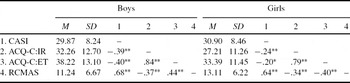
The model in Figure 1 was evaluated using a multiple group solution via SEM, with boys and girls representing the two groups. The fit of the model was evaluated with AMOS 7.0 (Arbuckle, Reference Arbuckle2006a) using the sample covariance matrix as input and a maximum likelihood solution. The model is statistically overidentified. The correlation matrix between the model indicators and their means and standard deviations for boys and girls are presented in Table 1.
Means, standard deviations and correlations of study variables

Note: CASI = Children's Anxiety Sensitivity Index; ACQ-C: IR = Anxiety Control Questionnaire for Children: Internal Reactions Subscale; ACQ-C: ET = Anxiety Control Questionnaire for Children: External Threats Subscale; RCMAS = Revised Children's Manifest Anxiety Scale. **p < .01, *p < .05
Prior to analysis and within each group, the data for the continuous variables were evaluated for multivariate outliers using both model and non-model based analyses. Non-model based analyses revealed one outlier for girls and another outlier for boys. Both outliers were checked for accurate coding and no coding errors were found. The two outliers proved to be inconsequential for the analysis (i.e. all major conclusions remained intact when they were omitted from the analysis). Results are reported so as to include the outliers.
Evaluation of skewness and kurtosis values as well as Mardia's index of multivariate normality indicated that all the variables in the model were normally distributed. Missing data were minimal, occurring sporadically and never exceeding more than 7.5% of the cases for any given variable. Only 10.2% of the total number of cases provided at least one missing data point. No meaningful or significant bias was observed in any instance. For the few cases where missing data occurred, this study employed a full-information maximum-likelihood (FIML) estimation method for use with missing data (Arbuckle, Reference Arbuckle, Marcoulides and Schumacker1996) using AMOS 7.0. This method is highly recommended for use with SEM analyses (Arbuckle, Reference Arbuckle2006b).
Primary analyses
The first model tested had no equality constraints across boys and girls (referred to as the equal-form model) with this model yielding a good fit to the data. The overall chi square test of model fit was not statistically significant (χ2 (8) = 15.34, p > .05). The Root Mean Square Error of Approximation (RMSEA) was .05. The p value for the test of close fit was .40. The Comparative Fit Index (CFI) was .99. More focused tests of fit revealed no theoretically meaningful or sizeable modification indices, nor were any of the absolute standardized residuals larger than 1.96.
The final model tested the equal-form model but with across group equality constraints, namely that multiple path coefficients were constrained to be equal in both groups (referred to as the path equivalence model). The constrained paths were as follows: the path coefficients from the AS variable to the AC variables (a, b), the path coefficient from the AS variable to the anxiety variable (c), and the path coefficients from the AC variables to the anxiety variable (d, e) (see Figure 1). This model yielded an overall chi square that was statistically significant (χ2 (13) = 28.92, p < .01). The RMSEA was .06. The p value for the test of close fit was .25. The CFI was .97. A nested chi square test was performed and yielded a statistically significant difference (χ2 diff (5) = 13.58, p < .05). This leads to the rejection of the null hypothesis that these path coefficients were equal for boys and girls.
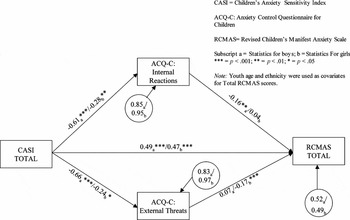
Figure 2 presents relevant coefficients for boys and girls obtained from the equal-form model. The residuals indicate the proportion of unexplained variance in the endogenous variables. For boys, AS was able to account for 15% of the variance in Internal Reactions, and 17% of the variance in External Threats. For girls, AS was able to account for 5% of the variance in Internal Reactions, 3% of the variance in External Threats. For boys, AS, Internal Reactions, External Threats, age and ethnicity were able to account for 48% of variance in RCMAS scores. For girls, these variables were able account for 51% of variance in RCMAS scores.
Relevant path coefficients (unstandardized) for boys and girls for the equal forms model

As Figure 2 shows, high AS predicted high RCMAS scores for boys (B = .49, SE = .05, p < .001, 95% CI = .39 to .59) and girls (B = .47, SE = .05, p < .001, 95% CI = .39 to .56) holding age and ethnicity constant. AS was also a significant predictor of Internal Reactions for both boys (B = −.61, SE = .11, p < .001, 95% CI = −.83 to −.39) and girls (B = −.28, SE = .11, p < .01, 95% CI = −.49 to −.07). For both boys and girls, high AS predicted low perceived control over Internal Reactions to anxiety. AS also was a significant predictor of External Threats for both boys (B = −.66, SE = .12, p < .001, 95% CI = −.89 to −.43) and girls (B = −.24, SE = .11, p < .05, 95% CI = −.45 to −.03). For both boys and girls, high AS predicted low perceived control over External Threats related to anxiety.
Figure 2 also shows that Internal Reactions was a significant predictor of anxiety (holding age and ethnicity constant) for boys (B = −.16, SE = .06, p < .01, 95% CI = −.27 to −.05), but not girls (B = .04, SE = .06, p > .05, 95% CI = −.07 to .14). Specifically, for boys only, low perceived control over Internal Reactions to anxiety predicted high anxiety. All together, these findings demonstrate boys' perceived control over Internal Reactions partially mediates the relations between their AS and anxiety symptoms. Given these findings, the total effect of AS on anxiety for boys was .54. External Threats was a significant predictor of anxiety (holding age and ethnicity constant) for girls (B = −.17, SE = .05, p < .001, 95% CI = −.27 to −.07), but not boys (B = .07, SE = .06, p > .05, 95% CI = −.04 to .18). Specifically, for girls only, low perceived control over External Threats to anxiety predicted high anxiety. All together, these findings demonstrate girls' perceived control over External Threats partially mediates the relations between their AS and anxiety symptoms. Given these findings, the total effect of AS on anxiety for girls was .50.
Discussion
Consistent with the body of literature that has accumulated on AS in child and adolescent samples, the study's findings demonstrate once again a significant role for AS in the prediction of anxiety symptoms in children and adolescents. Although Weems et al. (Reference Weems, Costa, Watts, Taylor and Cannon2007) found AS and AC were significantly and negatively correlated in a nonclinic sample of youth, the present study extends Weems et al. by examining the relations between AS and each of the two facets of AC, Internal Reactions and External Threats, in a clinic sample of youth referred for anxiety disorders. The study's findings showed that AS and each of the two AC facets are significantly and negatively related.
More importantly, the present study is the first to provide evidence for a partial mediational role of both AC Internal Reactions and AC External Threats on the relation between AS and anxiety symptoms in a clinic sample of children and adolescents referred to an anxiety disorders specialty research clinic. Moreover, the study is the first to empirically demonstrate that AC Internal Reactions and AC External Threats predict anxiety symptoms in these youth, though interestingly, the pattern is different for boys and girls. Specifically, whereas low perceived control over Internal Reactions predicted anxiety symptoms for boys, low perceived control over External Threats predicted anxiety symptoms for girls. Thus, boys, but not girls, who believe their anxious physical symptoms will result in aversive consequences (i.e. high AS) are likely to perceive that they have low control over their Internal Reactions of anxiety (i.e. low AC Internal Reactions). This perception of low control over internal anxiety reactions leads the boys, in turn, to having high levels of anxiety symptoms. In contrast, girls, but not boys, who believe their anxious physical symptoms will result in aversive consequences (i.e. high AS) are likely to perceive that they have low control over external anxiety provoking events or objects (i.e. low AC External Threats). This perception of low control over external anxiety provoking events or objects, in turn, leads to the girls having high levels of anxiety symptoms.
As this is the first study to investigate youth sex within the context of a conceptual model involving anxiety sensitivity, perceived anxiety control over Internal Reactions, perceived anxiety control over External Threats and the prediction of anxiety symptoms, it will be important to determine whether these findings replicate in future studies. Interestingly, in a related research area, locus of control in adults, males and females have been found to differ with respect to how they attribute internality versus externality of their locus of control beliefs (i.e. females endorse an external locus of control; males endorse an internal locus of control) (e.g. Rao and Murthy, Reference Rao and Murthy1984; Richert, Reference Richert1981; Rubinstein, Reference Rubinstein2004). For example, Richert (Reference Richert1981), in his investigation of sex differences on the relation between external locus of control and anxiety symptoms in college students, found that males with an internal locus of control are likely to feel anxious about physiological symptoms of anxiety (akin to internal reactions of anxiety). In contrast, females with an external locus of control are likely to feel anxious about interpersonal events (akin to external anxiety-related threats). To help explain these observed sex differences, Richert (Reference Richert1981) drew upon the literature on sex role stereotypes, which posits that women are portrayed as emotionally expressive and socially oriented while males are portrayed as physiologically responsive (e.g. Hoyenga and Hoyenga, Reference Hoyenga and Hoyenga1979; Maccoby and Jacklin, Reference Maccoby and Jacklin1974). Perhaps a similar explanation may also hold for the present findings. Further research is needed to explore this possibility.
The findings may hold some interesting clinical implications in terms of potential differential refinements of CBTs for boys and girls. For boys, for example, it may be useful to target AS, as well as their perceptions of control over internal anxious reactions (e.g. fast beating heart, dizziness). For girls, it may also be useful to target AS. However, rather than targeting girls' perceptions of control over internal anxious reactions, it may be useful to target their perceptions of control over anxiety provoking external events or objects (e.g. reading aloud in class, separation from parents). Of course, this too awaits further verification.
Limitations and future directions
The present study has several limitations. First, the study employed a cross-sectional design; as such, conclusions cannot be drawn regarding the prospective relations among AS, AC, and anxiety symptoms. It would be helpful for future studies to employ prospective research designs to help ascertain the directional relations that may exist among these variables over time. Second, a single informant, the youth, was used to assess the study's variables. Future studies might consider broadening the assessment to include parents. However, youth self-report of internalizing states and youth self-report of their cognitions, the variables assessed in this study, are usually viewed to be more reliable than parent report (e.g. Edelbrock, Costello, Dulcan, Conover and Kalas, Reference Edelbrock, Costello, Dulcan, Conover and Kalas1986; Weems et al., Reference Weems, Costa, Watts, Taylor and Cannon2007). Third, although the present study employed an ethnically diverse sample of youth, ethnicity was treated as a covariate for total anxiety symptom scores, not as a moderator of the relations among anxiety sensitivity, anxiety control, and anxiety symptoms. The influence of ethnicity within the context of the study's conceptual model will be important to test in future studies, focusing particularly on whether the interesting sex differences that were found in this study emerge in different ethnic groups.



Comments
No Comments have been published for this article.