INTRODUCTION
Species of the poriferan class Hexactinellida (glass sponges) are found in marine communities worldwide, in some regions in high diversity (e.g. Ijima, Reference Ijima and Weber1927). However, the main occurrence of glass sponges is restricted to deep waters (e.g. Reiswig, Reference Reiswig2004; Leys et al., Reference Leys, Mackie and Reiswig2007), where these sponges are one of the most important megafaunal benthic components and make up a substantial proportion of benthic biomass since they often occur abundantly and in large individual sizes (Barthel, Reference Barthel1992; Cattaneo-Vietti et al., Reference Cattaneo-Vietti, Bavestrello, Cerrano, Gaino, Mazzella, Pansini, Sarà, Faranda, Guglielmo and Ianora1999; Reiswig, Reference Reiswig2004). It has been shown that hexactinellid species, reach high individual age of several 100 years (Gatti, Reference Gatti2002). Moreover, hexactinellid sponges are considered to play an important structuring ecological role by providing shelter, habitat, food and nursery ground for a huge variety of associated faunal components (Konecki & Targett, Reference Konecki and Targett1989; Kunzmann, Reference Kunzmann1992; Barthel, Reference Barthel1995, Reference Barthel1997). Hexactinellida are probably the oldest living metazoans with fossil records known from the lowermost Cambrian, or even Late Proterozoic (Reitner & Mehl, Reference Reitner and Mehl1995). Currently the class contains more than 600 recent species, which make up more than 7.5% of all known poriferan species (van Soest et al., Reference Van Soest, Boury-Esnault, Hooper, Rützler, de Voogd, Alvarez de Glasby, Hajdu, Pisera, Manconi, Schoenberg, Janussen, Tabachnick, Klautau, Picton, Kelly, Vacelet, Dohrmann and Cristina Díaz2013). However, according to estimations by Reiswig (Reference Reiswig, Hooper and van Soest2002a) it is likely that the total number of species will exceed 1000 after the revision of present collections and the survey of vast unsampled deep-sea areas.
Contrary to their importance, glass sponges are the most poorly investigated poriferan class with an incomplete taxonomy and unknown phylogenetic relationships. The currently accepted classification within the class Hexactinellida still complies with the one erected by Schulze (Reference Schulze1899) who erected two subtaxa, namely Hexasterophora Schulze 1886 and Amphidiscophora Schulze 1886. This subdivision was justified by the presence of hexaster microscleres in the Hexasterophora and their absence in the latter. Apart from other skeletal characteristics, species of the Amphidiscophora are characterized by the presence of amphidisc microscleres or derivates of them. All sponges belonging to this taxon are clearly assigned to respective families according to the distinctness of choanosomal megascleres and body morphology. Currently the subclass Amphidiscophora consists of one order and three families (Reiswig, Reference Reiswig, Hooper and van Soest2002b), whereas the Hexasterophora are divided into five orders composed of 17 families (van Soest et al., Reference Van Soest, Boury-Esnault, Hooper, Rützler, de Voogd, Alvarez de Glasby, Hajdu, Pisera, Manconi, Schoenberg, Janussen, Tabachnick, Klautau, Picton, Kelly, Vacelet, Dohrmann and Cristina Díaz2013). Although the separation of the two subclasses is well supported by both morphological studies on fossils and recent Hexatinellida, and also by molecular methods (Mehl, Reference Mehl1992; Mehl-Janussen, Reference Mehl-Janussen1999; Tabachnick & Menshenina, Reference Tabachnick and Menshenina1999; Reiswig, Reference Reiswig2006; Dohrmann et al., Reference Dohrmann, Janussen, Reitner, Collins and Wörheide2008), the classification on a lower taxonomic level such as families and genera has still not been adequately resolved. This is especially true for the Hexasterophora, with sparse information on phylogenetic relationships in the classical point of view. However, recent molecular investigations indicated discordances within several important hexasterophoran taxa, e.g. Hexactinosida Schrammen, 1912 and Euretidae Zittel 1877, which were shown to be non-monophyletic according to their present definitions (Dohrmann et al., Reference Dohrmann, Collins and Wörheide2009). Others such as the Farreidae Gray, 1872 and Rossellidae Schulze, 1885, were or are currently subject to major revisions (Dohrmann et al., Reference Dohrmann, Janussen, Reitner, Collins and Wörheide2008, Reference Dohrmann, Göcke, Janussen, Reitner, Lüter and Wörheide2011, Reference Dohrmann, Haen, Lavrov and Wörheide2012b). So far, only one phylogenetic systematic tree of the Hexactinellida has been published by Mehl (Reference Mehl1992), who presented a number of (in many cases weakly) supported hypotheses based on selected, presumably representative taxa. Clearly, a consistent cladistic analysis of morphological characters is needed to further elucidate the phylogeny of glass sponges. In this paper, we present the first comprehensive, morphology-based analysis of families and genera within the Hexasterophora and of the sponge class Hexactinellida.
MATERIAL AND METHODS
For the purposes of this study, 157 morphological characters were included according to the information mainly given in Hooper & van Soest (Reference Hooper and van Soest2002), but also through the concrete input by one of the co-authors (D.J.). Character state information were obtained with respect on importance for family to genus- level taxonomy of hexactinellid sponges. The characters were coded as present (1) and absent (0). Genera were a priori assumed to be monophyletic. Outgroups were selected from the a priori hypothesis of presumably nearest related outgroup taxon. Data were assembled with Nexus Data Editor (Page, Reference Page2001).
The datasets were analysed with PAUP* 4.0b10 (Swofford, Reference Swofford2002) under the maximum parsimony criterion. Since a dataset consisting of all taxa did not compute in a reasonable time, four subsets where analysed separately: families of the order Hexactinosida with Euplectella Owen, 1841 as outgroup, Rossellidae with Euplectella as outgroup, Euplectellidae Gray, 1867 with Rossella Carter, 1872 as outgroup, and finally representatives of both subdivisions of Hexactinellida with Geodiidae Gray, 1867 as outgroup. In addition a dataset with representative taxa from each of those three families was compiled and analysed. A heuristic search with 1000 search replicates (n reps = 1000) and random addition of taxa (addseq = random) was performed for each dataset. In all cases with multiple equally parsimonious trees, a 50% majority rule consensus tree was computed from these trees. All characters were treated as unweighted and unordered.
RESULTS
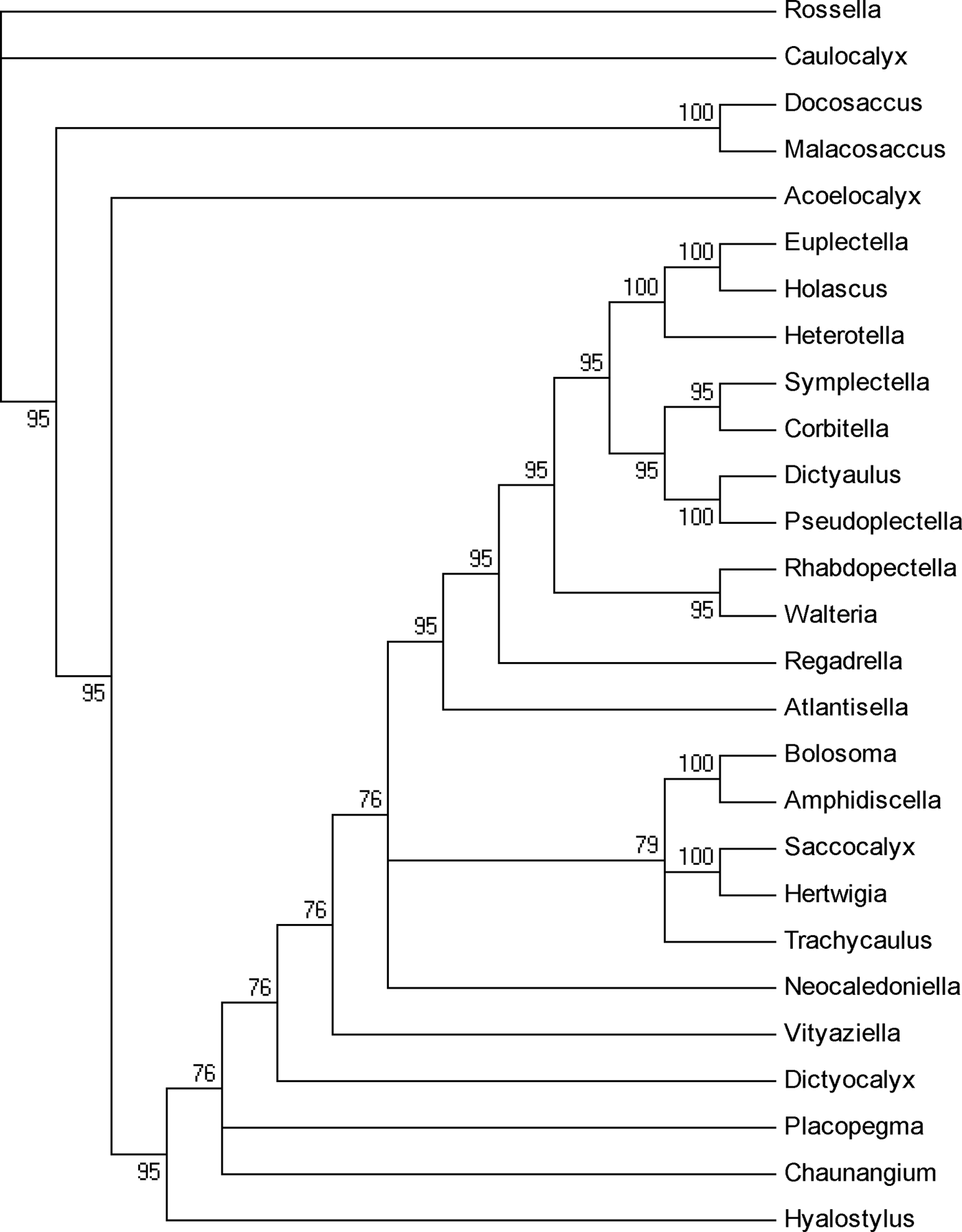
Figure 1 shows the well supported clade Euplectella Owen, 1841–Atlantisella Tabachnick 2002, which corresponds to the traditional taxonomy of the Euplectellidae sensu stricto, Euplectellinae, as erected by Schulze (Reference Schulze1886a) and Mehl (Reference Mehl1992). Clade Euplectella–Heterotella comes out in 100%, and the others in 95% of all trees suggested. Another clade, supported by 79%, is Bolosoma–Trachycaulus which corresponds largely to the subfamily Bolosominae described by Tabachnick (Reference Tabachnick, Hooper and van Soest2002a); it includes the 100% clades, Bolosoma–Amphidiscella, corresponding to the ‘amphidiscs-bearing’ Euplectellidae, and the Saccocalyx–Herzwigia clade. Another 100% clade is Docosaccus–Malacosaccus which are lophophytose Euplectellinae with similar hexaster microscleres. Due to lack of synapomorphies, a considerable number of genera (e.g. Placopegma, Chaurangium, Caulocalyx and Hyalostylus), cannot be attributed to any specific euplectellid cluster.
Family Euplectellidae: maximum parsimony tree: 50% majority rule consensus, computed from 237 equally parsimonious trees. Numbers indicate frequency of each clade (%). Rooted with Rossella.

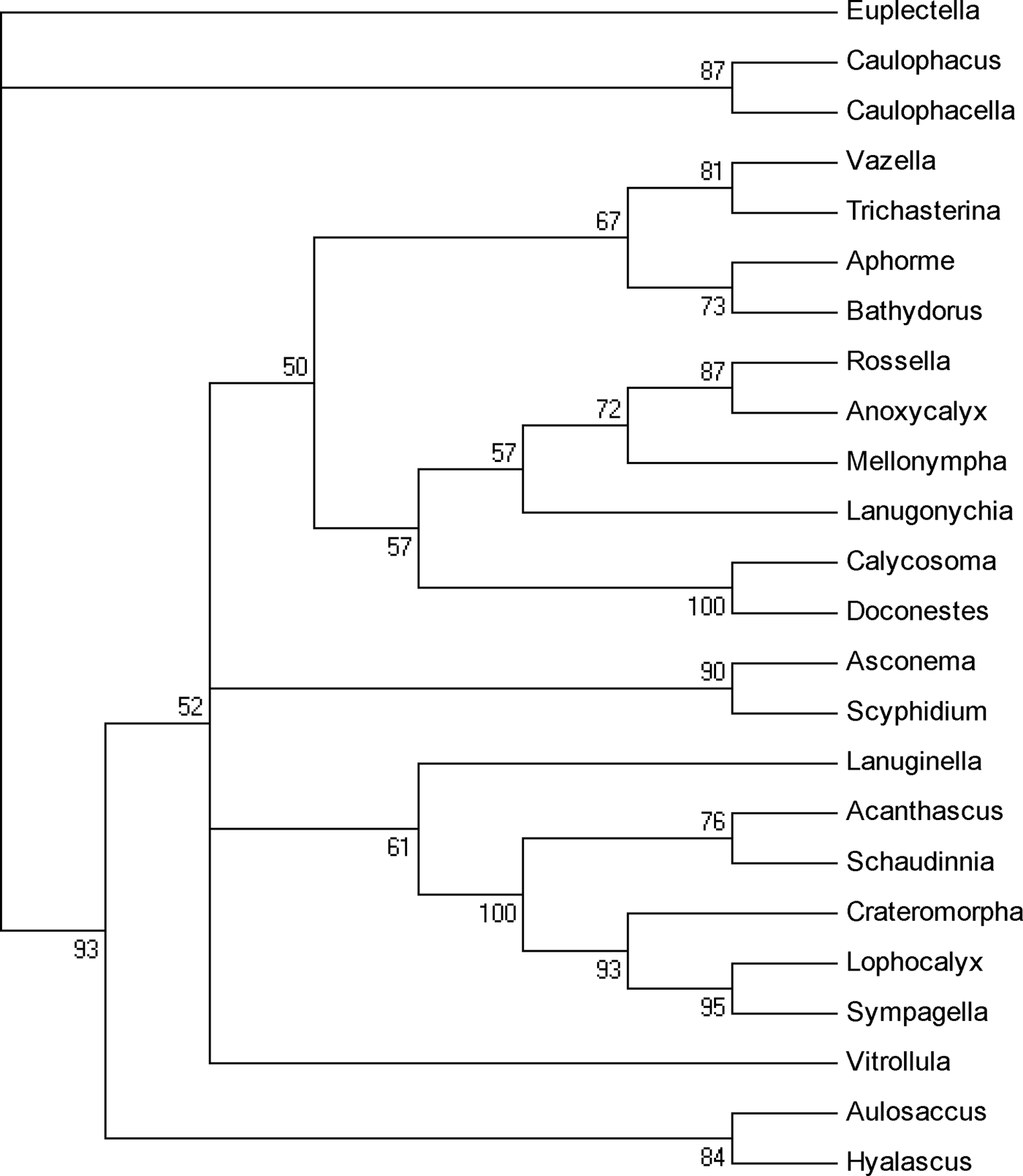
As indicated in Figure 2. most Rossellidae clades are not well supported on the basis of morphological characters. Traditionally, this family is defined by its hypodermal hexactins and lophophytous mode of fixation (Schulze, Reference Schulze1886a), these are characters which apply to a large number of lyssacinosan (non-rigid) hexasterophorids with few or no other synapomorphies. Surprisingly, the only well-defined rossellid subfamily, the Lanuginellinae (Tabachnick, Reference Tabachnick, Hooper and van Soest2002b) is torn apart and its genera (Mellonympha, Lanugonychia, Calycosoma, Doconestes, Lanuginella, Lophocalyx and Sympagella). Although some of them cluster with each other, they come out non-monophyletically all together. The Caulophacus–Caulophacella clade shows no obvious affinity to any of the other Rossellidae clusters.
Family Rossellidae: maximum parsimony tree: 50% majority rule consensus, computed from 184 equally parsimonious trees. Numbers indicate frequency of each clade (%). Rooted with Euplectella.
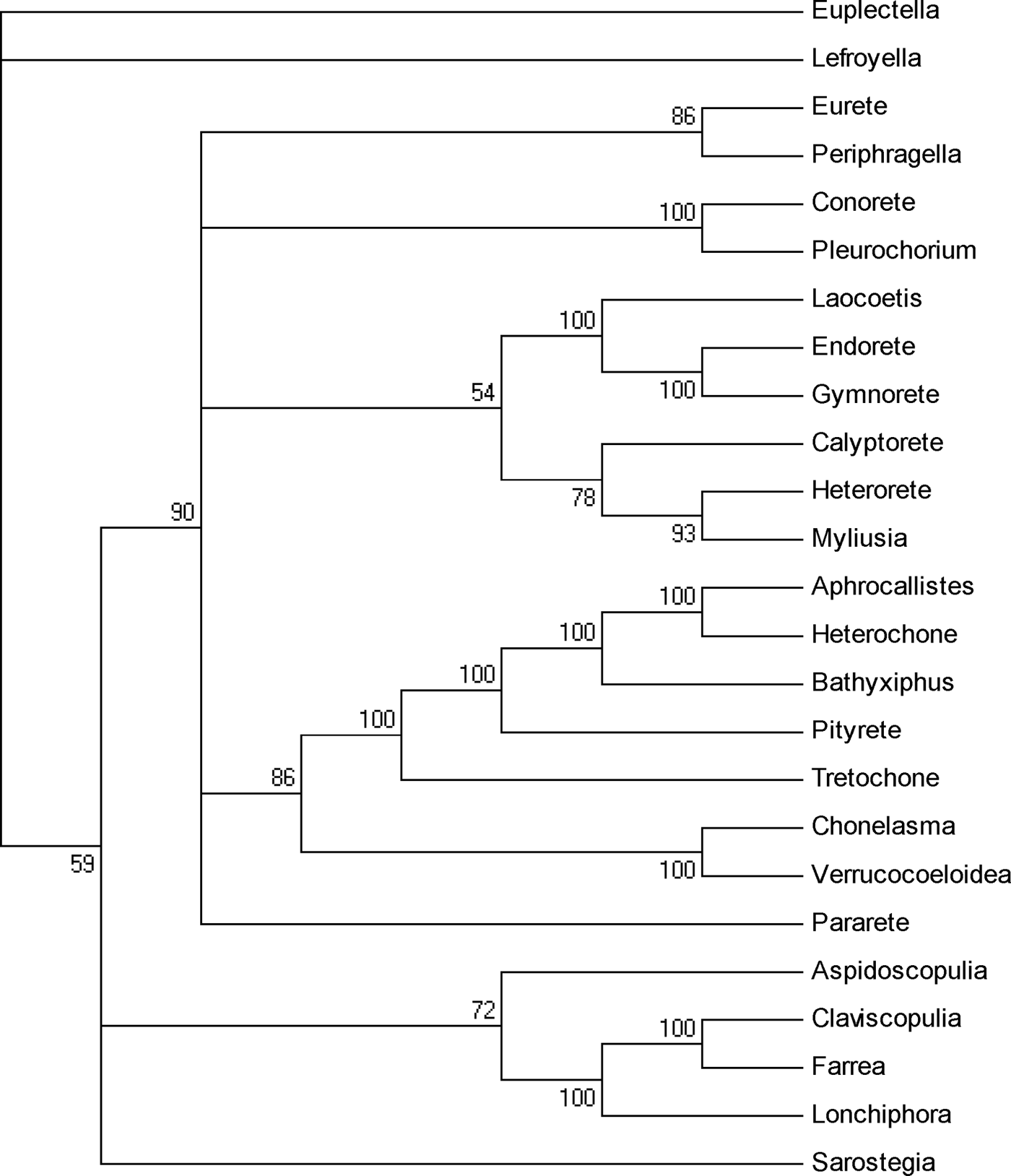
The Hexactinosida tree shows high resolution and strong support to most clades and therefore demonstrates that the sister-groups are well established at a genus level (Figure 3). However, most of the nodes between families and higher taxa are not well supported. Monophyly of the Farreidae sensu stricto (Farrea–Claviscopulia–Lonchiphora) is corroborated by 100%, whereas Aspidoscopulia is supported by 72%, and Sarostegia cannot be definitely attributed. The family Aphrocallistidae (Aphrocallistes–Heterochone) is confirmed, and its clade is nested within the ‘Euretidae’. The latter and biggest family is polyphyletic, with its genera scattered between the major taxa of Scopularia, which are all taxa indicated between Lefroyella and Pararete. Some of the ‘Euretidae’ constitute monophyletic, well-established clusters: Eurete–Periphragella, Conorete–Pleurochorium, Endorete–Gymnorete (with Laocoetis, Craticulariidae, as sister group) and Chonelasma–Verrucocoeloidea.
Order Hexactinosida: maximum parsimony tree: 50% majority rule consensus, computed from 197 equally parsimonious trees. Numbers indicate frequency of each clade (%). Rooted with Euplectella.
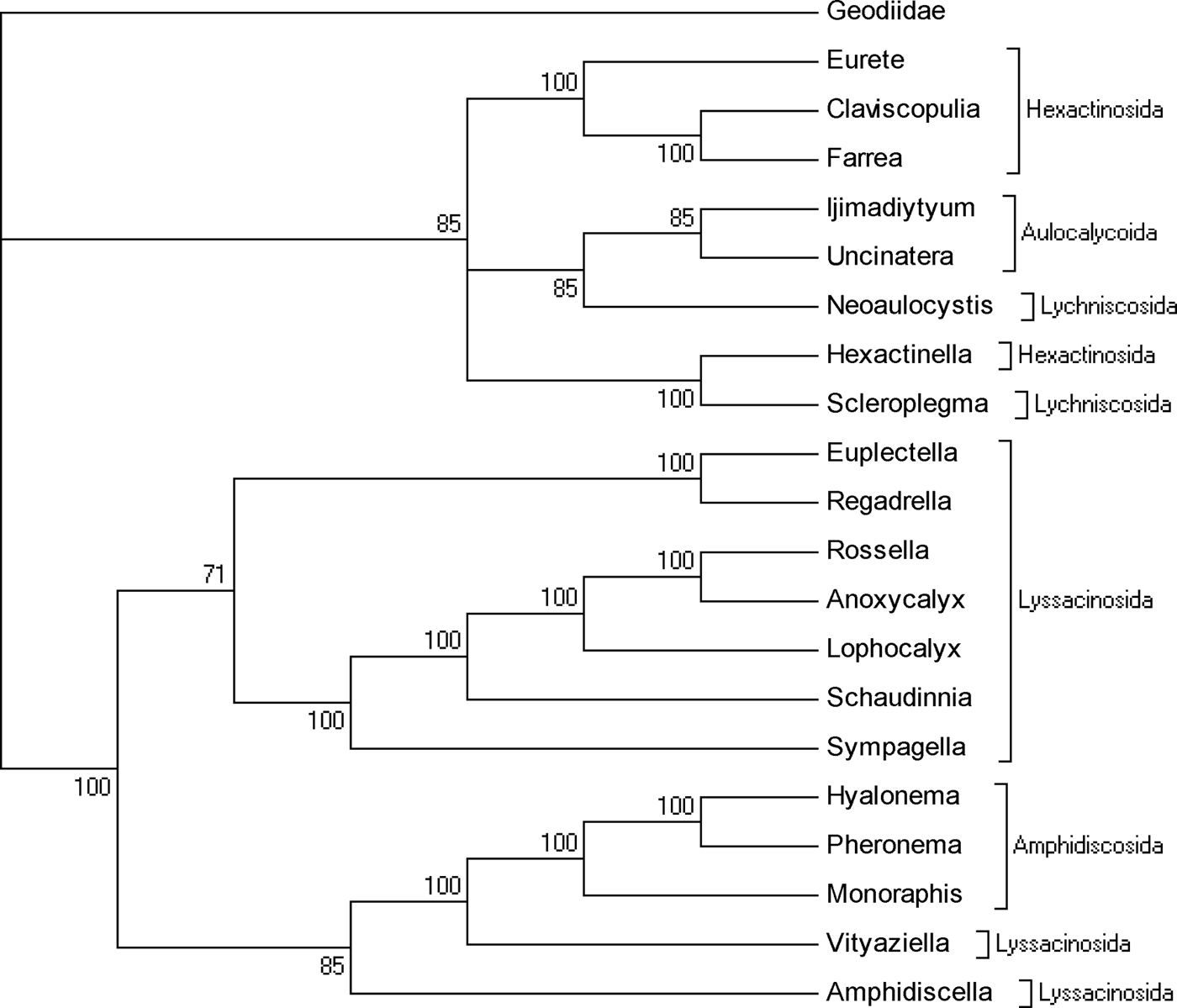
The tree presented in Figure 4 is based on representative genera of main taxa of the Hexactinellida showing good resolution and high support at both generic and higher taxonomic levels. However, by this unweighted cladistics approach, major orders of the traditional taxonomic classification (such as Hexactinosida and Lychniscosida) appear non-monophyletic. The families Farreidae (Claviscopulia–Farrea), Euplectellidae (Euplectella–Regadrella), Rossellidae (Rossella–Sympagella), as well as the Aulocalycoida and the Amphidiscosida are corroborated.
Class Hexactinellida: maximum parsimony tree: 50% majority rule consensus, computed from seven equally parsimonious trees. Numbers indicate frequency of each clade (%). Rooted with Geodiidae.
DISCUSSION
Clade Euplectella–Atlantisella supports earlier concepts (e.g. Mehl, Reference Mehl1992) of the taxon Euplectellinae, rather than the widely accepted taxonomy presented in Tabachnick (Reference Tabachnick, Hooper and van Soest2002a). These are the Euplectellidae sensu stricto showing several diagnostic characters of the type genus Euplectella, such as a tubular thin-walled body, floricome-hexasters and/or sigmatocomes. Some genera (Placopegma, Chaurangium) which in our tree show no affinity to other euplectellid taxa, are currently attributed to the Euplectellinae (Tabachnick, Reference Tabachnick, Hooper and van Soest2002a), although they show none of these obvious euplectellide characters. It can be assumed that the functional character used for classification (mode of fixation lophophytous or basiphytous) is very liable to homoplasy and not suitable for subfamily division. Due to their different modes of fixation, the basiphytous Regadrella, in spite of numerous synapomorphies in terms of body shape and microscleres with the lophophytous Euplectella, placed outside the subfamily Euplectellinae (Tabachnick, Reference Tabachnick, Hooper and van Soest2002a). According to recent molecular results (Dohrmann et al., Reference Dohrmann, Haen, Lavrov and Wörheide2012b) Euplectella and Regadrella cluster together as sister taxa. A combination of characters, e.g. types of microscleres and body morphology, we consider to be diagnostically more conclusive. Some of the genera, which are currently, exclusively due to the presence of hexactine dermal megascleres, attributed to the Euplectellidea (e.g. Caulocalyx, Placopegma and Hyalostylus), were formerly classified as Rossellidae (e.g. Schulze, Reference Schulze, Tizard, Moseley, Buchanan and Murray1886b), which may in fact be more adequate according to their microscleres and body morphology. However, the poor support to most larger clades of the Rossellidae indicates the existence of multiple homoplasies within this taxon. As shown by recent investigations, hexaster microscleres which were formerly thought to be reliable synapomorphies for rossellid genera, e.g. calycocomes within the genera Rossella and Nodastrella, have been proven to be subject of convergent evolution (Dohrmann et al., Reference Dohrmann, Göcke, Reed and Janussen2012a). Therefore molecular methods are crucial, particularly concerning phylogenetic systematics of those sponge taxa in which taxonomy relies on only a few morphological synapomorphies. So far, the trees that are based on molecular phylogenetic data support the monophyletic status of the families Euplectellida and Rossellidae within the hexactinellids, whereas some of their subfamilies are still controversal (Dohrmann et al., Reference Dohrmann, Janussen, Reitner, Collins and Wörheide2008, Reference Dohrmann, Haen, Lavrov and Wörheide2012b).
The fact that the Hexactinosida shows high resolution and most of its sister groups at genus level are well established indicates that the diagnostic characters, used for generic diagnosis within this order mainly based on the type of aquiferous system and combination of microscleres (sceptrules + hexasters), are reliable criteria for their taxonomic classification. This is according to suggestions made by Mehl (Reference Mehl1992). Monophyly is corroborated, at least for the Sceptrulophora Mehl, Reference Mehl1992 (= Scopularia + Clavularia), also by molecular results (Dohrmann et al., Reference Dohrmann, Göcke, Reed and Janussen2012). ‘Euretidae’ comes out polyphyletic, which is not surprising considering the few morphological synapomorphies available for this family, and which was confirmed in studies by Dohrmann et al. (Reference Dohrmann, Janussen, Reitner, Collins and Wörheide2008, Reference Dohrmann, Collins and Wörheide2009). Clavularia (= Farreidae) shows a comparably high number of synapomorphies in terms of skeletal morphology. Therefore, it comes out monophyletic. The monophyletic status of the family Farreidae is also supported by molecular studies (Dohrmann et al., Reference Dohrmann, Göcke, Janussen, Reitner, Lüter and Wörheide2011). However, results of Dohrmann et al. (Reference Dohrmann, Göcke, Janussen, Reitner, Lüter and Wörheide2011) indicated that the genus Aspidiscopulia forms a paraphyletic grouping with other ‘Euretidae’.
By considering all hexactinellid taxa, our results revealed the weakness of our unweighted cladistic approach for high taxonomic level classification, as important orders (Hexactinosida, Lychniscosida) established by Schrammen (Reference Schrammen1903) and confirmed by Dohrmann et al. (Reference Dohrmann, Janussen, Reitner, Collins and Wörheide2008, Reference Dohrmann, Göcke, Reed and Janussen2012) are not confirmed in this study. This is probably due to the fact that many of the diagnostic characters (mainly types of hexaster microscleres) are either symplesiomorphic, or multiple homoplastic. For practical classification, taxonomy more or less automatically relies on a few easily recognizable, reliable characters of the main skeleton (such as types of channel system, anastomosing branching, presence/absence of lychniscs) for the attribution to orders and then continue with classification of sceptrules and hexaster microscleres, which work well for family and genus identification.
CONCLUSIONS
For the first time, we proposed a cladistic analysis of the Hexactinellida that includes all hexasterophoran genera and that is exclusively based on a wide spectrum of morphological characters. Our phylogenetic trees largely support the systematic classification proposed by Schulze (1886) and Mehl (2002). However, some families (e.g. Euretidae) are not corroborated. For others (e.g. Euplectellidae) our cladistics approach is at odds with the system proposed by Tabachnick (Reference Tabachnick, Hooper and van Soest2002a). However, our results indicated the need for revision of the classification features used in Tabachnick (Reference Tabachnick, Hooper and van Soest2002a). Our results further support the earlier conclusions of studies based on both molecular evidences (Dohrmann et al., Reference Dohrmann, Janussen, Reitner, Collins and Wörheide2008, Reference Dohrmann, Göcke, Reed and Janussen2012, Reference Dohrmann, Vargas, Janussen, Collins and Wörheide2013) and the fossil records (Mehl, Reference Mehl1992; Mehl-Janussen, Reference Mehl-Janussen1999).
ACKNOWLEDGEMENTS
The authors would like to thank Joana Xavier and other organizers of the SpongeDeep workshop in San Miguel, Azores, for the invitation to participate in an interesting meeting and the possibility to contribute to this volume.
FINANCIAL SUPPORT
The authors are indebted to Deutsche Forschungsgemeinschaft (DFG) for financing the Project ‘Phylogeny of the Hexactinellida’ (JA-1063/11 and JA-1063/13).