Substantial research has focused on the effects on pregnant women and their children of disaster, which is defined by the United Nations as “A serious disruption of the functioning of a community or a society causing widespread human, material, economic, or environmental losses which exceed the ability of the affected community or society to cope using its own resources.” 1 The large majority of these studies addressing birth weight after disaster or terrorist attacks were conducted in the United States and Canada,Reference Xiong, Harville and Mattison 2 - Reference Eskenazi, Marks and Catalano 11 Europe,Reference Neuberg, Pawlosek and Lopuszanski 12 - Reference Smits, Krabbendam and de Bie 15 or Asia (China,Reference Tan, Li and Zhang 16 Taiwan,Reference Chang, Chang and Lin 17 Japan,Reference Sekizuka, Sakai and Aoyama 18 and ThailandReference Sanguanklin, McFarlin and Park 19 ). Only 3 were conducted in South American settings (ColombiaReference Camacho 20 and ChileReference Torche and Kleinhaus 21 , Reference Torche 22 ) and none, to our knowledge, in Africa or the Caribbean, although one recent study addressed the relationship between ethnic violence in Kenya and birth weight.Reference Bell, Prata and Lahiff 23 Generally, studies find that disaster is associated with lower birth weight, with effect sizes ranging from 9 to 175 g for absolute birth weightReference Holstius, Reid and Jesdale 7 , Reference Maric, Dunjic and Stojiljkovic 13 , Reference Smits, Krabbendam and de Bie 15 , Reference Sanguanklin, McFarlin and Park 19 , Reference Camacho 20 , Reference Torche 22 - Reference Lederman, Rauh and Weiss 24 and relative risks of 1.2 to 3.3 for low birth weight (<2500 g).Reference Xiong, Harville and Mattison 2 , Reference Lauderdale 3 , Reference Neuberg, Jakubowska-Szwed and Neuberg 25 , Reference Tong, Zotti and Hsia 26 However, the evidence is mixed, with some studies finding no effect or a reduction in riskReference El-Sayed, Hadley and Galea 4 , Reference Endara, Ryan and Sevick 27 and some showing conflicting findings for the same disaster.Reference Xiong, Harville and Mattison 2 - Reference El-Sayed, Hadley and Galea 4 , Reference Hamilton, Sutton and Mathews 10 , Reference Endara, Ryan and Sevick 27 , Reference Berkowitz, Wolff and Janevic 28 In addition, some studies show effects in one trimester only, and the studies do not agree on which trimester is most vulnerable.Reference Holstius, Reid and Jesdale 7 - Reference Simeonova 9 , Reference Torche 22 The few studies conducted in low- and middle-income countries have reported reductions in birth weight associated with disaster or mass violence.Reference Sanguanklin, McFarlin and Park 19 , Reference Camacho 20 , Reference Torche and Kleinhaus 21 , Reference Bell, Prata and Lahiff 23
Concerns about the vulnerability of pregnant and postpartum women to the effects of disaster are particularly heightened in a developing world setting, where resources are limited.Reference Nour 29 Women’s place in society may render them more vulnerable to injury, sexual violence, and sexually transmitted diseasesReference Carballo, Hernandez and Schneider 30 in addition to disaster-related economic impacts. Post-disaster medical care, where available, is often not geared to women’s specific needs; for instance, there may not be private areas for pelvic exams or translators may be exclusively male.Reference Bloem and Miller 31 Women may not be able to access their regular sources of family planning services;Reference Kissinger, Schmidt and Sanders 32 contraception is often not part of the health relief provided.Reference Carballo, Hernandez and Schneider 30 , Reference Onyango, Hixson and McNally 33 For example, a survey after the Sumatran earthquake found that contraceptive services were the slowest form of health care to recover with the most-effective forms of contraception returning the most slowly.Reference Djafri, Chongsuvivatwong and Geater 34 Furthermore, difficulties in accessing contraception were found to be associated with increased unplanned pregnancies after an Indonesian earthquake.Reference Hapsari and Widyawati, Nisman 35 Consequently, after a disaster, women may have to rely on less-effective contraceptive methods, which contributes to the increased likelihood of having an unplanned pregnancyReference Hapsari and Widyawati, Nisman 35 and may lead to short interpregnancy intervals among women who already have children.
Occasionally, disaster research has focused attention on pregnancy outcomes in developing countries. Where evidence exists, the impact of a disaster on pregnancy outcomes is both immediate and long-lasting. A study in Sumatra found that improvements in maternal and infant mortality were stalled by an earthquake and that child mortality and stillbirth rose.Reference Djafri, Chongsuvivatwong and Geater 34 High rates of spontaneous abortion, but not congenital anomalies, were reported after the Bhopal gas release in India.Reference Kapoor 36 An increase in neural tube defects was also noted after Hurricane Gilbert, which was thought to be due to decreased folic acid intake after crop destruction.Reference Duff and Cooper 37
Disasters can worsen pregnancy outcomes in several ways. Women may become pregnant unintendedly, or a wanted pregnancy may become unwanted. Wanted and intended pregnancies are generally healthier for the mother and child: mothers are more likely to care for themselves, and be cared for, when a pregnancy is wanted, and the economic and medical resources are more likely to be available and accessed for an intended pregnancy.Reference Tsui, Wasserheit and Haaga 38 Infant and maternal morbidity and mortality are also more common with short interpregnancy intervals.Reference Brown, Allen and Torkelson 39 Birth weight could also be affected by a disaster through several mechanisms. If a disaster is severe, it may lead to malnutrition and fetal growth restriction; even if not actively malnourished, women may not gain enough weight for optimal pregnancy health. In countries where women smoke, tobacco use may be a coping mechanism. Stress has been associated with early delivery and growth restriction via their associations with stress hormones, inflammation, or restricted placental blood flow.Reference Dunkel Schetter 40 The results of studies conducted after the Three Mile Island and Chernobyl accidents have led mothers of young children to be labeled a particularly high-risk group for mental health consequences of disaster,Reference Bromet, Litcher and Havenaar 41 but this was not seen after the Asian tsunami,Reference Wickrama and Wickrama 42 which again suggests variation by population.
In early 2010, a magnitude 7.0 earthquake hit Haiti, resulting in nearly $14 billion in damage, the deaths of over 200,000 people, and extensive damage to infrastructure and economy.Reference Cavallo, Powell and Becerra 43 Reports from the field relief hospital indicated that there were increases in pregnancy complications and gynecological conditions such as discharge or bleeding; gender-based violence was also common.Reference Bloem and Miller 31 Before the earthquake, Haiti had one of the highest maternal mortality ratios in the world and progress had been slow: maternal mortality was 670 per 100,000 live births in 2005, declined, and then stagnated around 350 to 370 in 2010-2012. 44 There was also little progress in several other indicators related to maternal and newborn health: for example, until 2010 just over half of pregnant women had 4 or more antenatal care visits, skilled birth attendance hovered around 25%, and the contraceptive prevalence rate was less than 40%. 44 Previous studies on maternal health have pointed to the limited ability of the Haitian government to provide health services and maintain adequate care where services are available.Reference Barnes-Josiah, Myntti and Augustin 45 - Reference Caymittes 49 Service availability, costs, and actual and perceived quality of care are major barriers to using maternal health services among pregnant women.Reference Barnes-Josiah, Myntti and Augustin 45 , Reference Gage and Guirlene Calixte 46 , Reference Mensch 50 In this analysis, we examined 2 indicators of unmet reproductive need, pregnancy wantedness and short interpregnancy interval, as well as a pregnancy outcome, self-reported birth weight, in families in Haiti before and after the earthquake.
Methods
This study used data from the Haiti 2012 Demographic and Health Survey (DHS), which were downloaded from the DHS Program website with their approval. The DHS collected information on population health from a nationally representative sample via the Household, Women, and Men Questionnaires. In the Haiti 2012 DHS, additional modules were included in the Household Questionnaire to assess the population’s experience with the 2010 earthquake. The Women Questionnaire, the data from which were used in this study, asked women of reproductive age questions on pregnancies, pregnancy outcomes, and childbirths within the 5 years before the survey.
Multistage stratified sampling was employed to obtain a sample representative of 12 sampling domains, including 10 regions, the metropolitan area, and refugee camps. All women of reproductive age in each of the 13,181 interviewed households were selected for interview with the Women Questionnaire, resulting in the final sample of 14,287 women of reproductive age. Of these, 7280 births were recorded with information on “size of child at birth” (too small, average, too big), whereas for 1607 singleton live births, specific birth weight information was also available. Fifty-nine multiple births were also excluded from the analysis.
Exposure to the earthquake was defined in 3 ways: timing (births that occurred before or after the earthquake), geography (living in a hard-hit region of the country [defined as having more than 50% of houses damaged by the earthquake] vs. elsewhere), and reporting major damage to the house in which the respondent was living at the time of the earthquake. For the second measure, women living in camps because they were displaced after the earthquake were classified as living in a hard-hit region. Three binary variables were used to indicate these types of exposure to the earthquake.
Information on the outcome measures came from the pregnancy and birth history in the Women Questionnaire, which recorded the timing, wantedness, and outcome of each live birth that occurred in the 5 years before the survey. Unwanted pregnancy was based on the woman’s response to the question, “When you were pregnant with NAME [the index child], did you want to get pregnant then, later, or not at all?” If the woman wanted to get pregnant then, the child was classified as “wanted”; all other responses were classified as unwanted. Short interpregnancy interval was defined as <1 year between births. Low birth weight was defined in 2 ways. First, for women who could remember and report the baby’s birth weight, low birth weight was defined as a birth weight of less than 2500 g. Second, all women were asked if they thought their baby was too small, average, or too large at birth. For women who had both measures, children of women who reported “smaller than average” babies weighed 2536 g at birth, “average” babies weighed 3414 g, and “bigger than average” babies weighed 4 grams at birth (P<0.001).
We controlled for a number of characteristics of children and women potentially associated with earthquake experience and outcome in the multivariate analyses. Sex of the index child was controlled for in all regression models. In models on birth weight and size of the index child, the index pregnancy wantedness and interpregnancy interval were also controlled for because they were hypothesized to be associated with birth weight. In the model on pregnancy wantedness, we controlled for interpregnancy interval. We hypothesized that pregnancies with shorter preceding intervals may be less likely to be wanted at the time the woman became pregnant.
Women’s characteristics included women’s age at the time of the first birth included in the analysis, urban or rural residence, household wealth, mother’s education, and current marital status. Current marital status was used as a proxy for marital status at the time of birth. Household wealth came from information obtained with the Household Survey: a composite score was constructed by the DHS program by using principal components analysis based on household ownership of a number of assets and floor, wall, and roof materials. The sample was then divided into 5 quintiles, from poorest to richest, based on the composite score. All other women’s characteristics came from information obtained with the Women Questionnaire.
Descriptive analyses were conducted to assess variations in the pregnancy and childbirth outcomes by household and regional experience with the earthquake. F-tests were used to examine the statistical significance level of the variations in binary outcomes; t-tests were used to examine differences in the continuous outcome (birth weight). Multivariate logistic regressions were implemented to assess the influence of household and regional experience with the earthquake on the reproductive and birth outcomes. Sampling weights and clustering were taken into account by using the survey set of command svy in Stata version 12. 51
Results
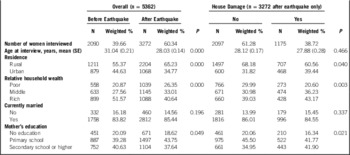
The characteristics of the sampled mothers in this study differed somewhat before and after the earthquake (Table 1). After the earthquake, women in the study who had given birth in the past 5 years were an average of 3.0 years younger and were more likely to be rural (P<0.001). Those reporting house damage were somewhat more likely to be urban (P<0.05) and in the middle wealth group (P<0.01) (this is consistent with the earthquake’s epicenter, which was near a metropolitan area.Reference Eberhard, Baldridge, Marshall, Mooney and Rix 52 )
Study Sample of Women With at Least One Childbirth in the 5 Years Before the Survey, Haiti

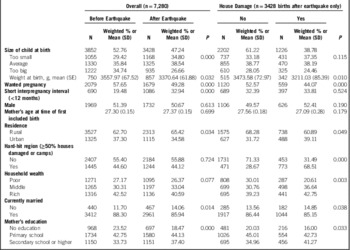
Table 2 shows the distribution of singletons born within the 5 years before the survey before and after the earthquake (for all births) and by level of house damage (post-earthquake births only). On average, babies born after the earthquake were significantly less heavy than were those born before the earthquake (P<0.05). Higher proportions of post-earthquake babies were also reported as “too small” or “average” compared with pre-earthquake babies (P<0.01). Whereas 19.5% of pre-earthquake childbirths occurred after a short interpregnancy interval, 32.9% of post-earthquake childbirths did so (P<0.001). A significantly higher proportion of post-earthquake births took place in rural compared with urban settings, which is consistent with the distribution of the mothers’ sample (P<0.05). Among post-earthquake births only, significant differences in birth weight were also found between level of house damage: babies born to women who reported house damage were less heavy than were babies born to women who reported no earthquake damage (P<0.05). Post-earthquake babies born to women who reported house damage were also more likely to be in urban than in rural areas (P<0.05), and they were particularly more likely to be in a hard-hit region (P<0.001). However, they were less likely to be born to women in a poor household, compared to post-earthquake babies born to women who reported no earthquake damage (P<0.01).
Study Sample of Children Born in the 5 Years Before the Survey, Before and After the Earthquake and by Level of House Damage, Haiti

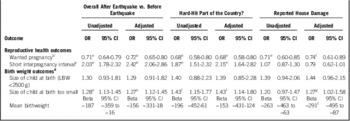
Table 3 shows the results of the bivariate and multivariate analyses of the associations between the earthquake experience and the outcomes. In general, the multivariate results were consistent with the bivariate results, which suggests that experience with and damage due to the earthquake played a part in explaining the differences in outcomes. The first panel of Table 3 shows the results with regard to the index pregnancy. Compared with pre-earthquake births, the odds of a post-earthquake birth being wanted was only 0.72 (95% confidence interval [CI]:0.65-0.80), whereas the odds of it following a short interpregnancy interval was doubled at 2.42 (95% CI: 2.06-2.86). A similar odds ratio (OR) was observed when comparing births in the hard-hit region with other regions: the adjusted OR was 2.15 (95% CI: 1.64-2.82) for births in the hard-hit region to occur after a short interpregnancy interval.
Experience With the Earthquake and Reproductive Health and Birth Weight Outcomes in HaitiFootnote a

a Abbreviations: CI, confidence interval; OR, odds ratio.
b Model was controlled for sex of child, preceding birth interval, mother’s age at the time of first included birth, urban residence, household wealth, mother’s education, and current marital status.
c This model was limited to 857 second and higher order births and was controlled for sex of child, mother’s age at the time of first included birth, urban residence, household wealth, mother’s education, and current marital status.
d Controlled for sex of child, whether child was wanted, preceding birth interval, mother’s age at the time of first included birth, urban residence, household wealth, mother’s education, and current marital status. Current marital status was used as a proxy for marital status at the time of birth.
e P<0.001.
f P<0.01.
g P<0.05.
Similar differences were observed with birth outcomes (shown in the bottom panel of Table 3). For example, the adjusted odds ratio (aOR) for the child to be reported as “too small” in the comparison of before and after the earthquake was 1.27 (95% CI: 1.12-1.45), 1.43 (95% CI: 1.14-1.80) for the hardest-hit region relative to the rest of the country, and 1.27 (95% CI: 1.02-1.58) for those reporting house damage. Mean birth weight was consistently 150 to 300 g lower in those exposed to the earthquake. Results did not differ on the basis of trimester of exposure (data not shown).
Discussion
This study examined reproductive and birth outcomes in Haiti and their associations with experience and damage due to the 2010 earthquake. Our findings that unwanted pregnancy and a short interpregnancy interval were more common after the earthquake are consistent with unmet contraceptive need, which has been reported anecdotally and confirmed in previous studies of disasters,Reference Djafri, Chongsuvivatwong and Geater 34 , Reference Hapsari and Widyawati, Nisman 35 as well in as these data (Do et al, unpublished observations). This finding may be due in part to the lack of availability of family planning services after the earthquake. For example, 2 of 3 PROFAMIL clinics, a major source of contraceptives before the earthquake in the metropolitan area, were destroyed by the disaster. 53 It is also plausible that a formerly wanted pregnancy might become unwanted owing to more pressing needs after a disaster. Expanded familial duties, less support and fewer resources for women, along with increased responsibility of caring for children and the elderly were additional stresses that Haitian women had to bear after the earthquake.Reference Nour 29 Other health services for mothers and children were also seriously lacking after the earthquake, even with the Soins Obstétricaux Gratuits and Soins Infantiles Gratuits schemes established in 2008 and 2010 to provide free health care to women, newborns, and children under 5.Reference Amibor 54 A year and a half after the earthquake, women’s needs were still excluded from rebuilding efforts: most women who lived in camps reported not knowing what and where services were available or not being able to afford prenatal care, even though it was free. 55
The magnitude of effect for birth weight (OR between 1.3 and 1.6 for low birth weight, estimated difference in birth weight between 150 and 300 g) is comparable or a bit higher than that found in other studies. For instance, Tan et alReference Tan, Li and Zhang 16 reported a 169-g difference with exposure to an earthquake in China, with a relative risk of 1.35 for low birth weight. Tong et alReference Tong, Zotti and Hsia 5 reported an OR of 1.18 for low birth weight in flood-affected areas in the United States. Studies in Chile after an earthquake found exposure in the first trimester associated with an OR of 1.38 and a 51-g lower birth weight.Reference Torche 22
The strengths of the present study include the use of large-scale, population-based survey data. The survey took place 2 years after the 2010 earthquake and collected information on childbirths that took place both before and after the earthquake, as long as they occurred within 5 years of the survey. Information on damage due to the earthquake at the household and regional levels also allowed comparisons of the outcomes by level of earthquake damage. Although we are not aware of a data quality assessment that was conducted after 2012, in 2008 PullumReference Pullum 56 reported the quality of 81 DHS conducted between 1993 and 2003 to be very high: for example, on questions on childbirths within 5 years prior to the survey, the level of missing cases was only 0.2% across surveys. It is possible that the quality of the Haiti 2012 DHS may have been affected by the disaster; however, on the question of the size of the child at birth, only 0.3% of the sample was missing,Reference Cavemittes, Busangu and JdD 57 which is comparable with the surveys reviewed earlier. In addition, special efforts were made to interview people living in refugee camps and to collect information on the earthquake. It is therefore reasonable to believe that the earthquake had minimal, if any, negative effect on the quality of the data.
Limitations
Limitations of the present study included that the analysis was limited to births for which birth weight information was recorded, which was a large proportion of the data for exact birth weight. There were some differences between births with and without exact birth weight data: those without the data were more likely to be born after the earthquake (p<0.01), in hard-hit regions or camps (p<0.001), and to have mothers who were more highly educated (p<0.001) and from a better-off household (p<0.001). This potential selection bias might result in an underestimate of the effects of experience with the earthquake on birth outcomes, if post-earthquake births were less heavy than pre-earthquake births. However, because higher education and household wealth are generally associated with a higher birth weight, the amount and direction of selection bias is unpredictable. Recall of size of child at birth and wantedness of births are subject to error. For example, mothers may be more likely to recall babies that were too small or too big, although generally mothers recall their babies’ birth weights accurately.Reference Adegboye and Heitmann 58 , Reference Tate, Dezateux and Cole 59 , Reference O’Sullivan, Pearce and Parker 60 (For example, a study in Uganda found that mothers generally reported birth weight within 0.1 kg.Reference Lule, Webb and Ndibazza 61 ) Overall, there is no reason to think that reporting errors would vary by region. We also do not have any data on gestational age and so cannot differentiate growth restriction from shortened gestation. The analysis was limited to women who became pregnant and gave birth and thus provides no information on women who did not become pregnant or did not carry to term—earthquakes have been associated with infertility and fetal death.Reference Lin 62 We also have no information on previous pregnancy complications or history, although there is no reason to think that women with poor pregnancy histories would be differentially exposed to the earthquake. Numbers precluded a more extensive analysis, such as a sibling comparison.
Finally, our indicators of earthquake exposure were relatively crude; exposures such as direct injury, loss of a family member, or being in danger often have stronger effects on health outcomes than does home damage.Reference Harville, Xiong and Smith 63 Some of our measures were also ecological (residence in a hard-hit region). People who lived in camps are those who lost their homes as a result of the earthquake, but misclassification is possible if those living in camps were not from a hard-hit region. Although the effects of this misclassification are not clear, housing and health conditions for those in camps were not different, and possibly worse, than for those who remained in the hard-hit regions but outside of camps. 55 , Reference Bradley 64 Therefore, it is unlikely that the effects of the earthquake damage were overestimated for this reason.
Conclusions
It is expected that the number of disasters will increase over the next century, due in part to climate change, and that developing countries will be particularly vulnerable.Reference Patz, Frumkin and Holloway 65 The results of this study underscore the need for reproductive health services to be provided as part of relief efforts, including the provision of obstetric and gynecological care,Reference Nour 29 and the development of local obstetric and gynecology service infrastructure. Assessment and service tools, such as the Reproductive Health After Disaster toolkitReference Zotti and Williams 66 and the Minimum Initial Service Package for reproductive health in crisis settings,Reference Onyango, Hixson and McNally 33 have been developed, and their use may need to be accelerated. The lack of such services increases the burden on women in the affected areas and slows both reconstruction and development efforts.