Implications
An accumulation of acid produced during ruminal fermentation of carbohydrate (CHO) can cause a detrimental decrease in pH. Although epithelial absorption and salivary buffering have been reported to play a central role in acid clearance, information on the relative contribution of each of these pathways to pH regulation under different dietary conditions is scarce. In the current study, increasing fermentable CHO intake in beef cattle led to a decrease in ruminal pH as there was an increase in acid concentration and a decrease in saliva production that were not counteracted by an upregulation in epithelial absorption of acid.
Introduction
Clearance of ruminal acid through epithelial absorption and salivary buffering is important in preventing a decrease in pH that could ultimately compromise animal health and performance. Although absorption and salivation are estimated to eliminate 53% and 37% of total acid in dairy cattle, respectively (Allen, Reference Aschenbach, Bilk, Tadesse, Stumpff and Gäbel1997), changes in fermentable CHO intake could alter the relative contribution of each of these pathways (Dijkstra et al., Reference Dijkstra, Ellis, Kebreab, Strathe, López, France and Bannick2012). For example, Schwaiger et al. (Reference Schwaiger, Beauchemin and Penner2013) noted a decrease in the rate of short-chain fatty acid (SCFA) absorption (134 mmol/h) in beef heifers 2 days after an acidosis challenge that was accompanied by an increase in saliva secretion, which contributed an estimated 125 mmol/h of bicarbonate (HCO3 −). This finding suggests that there may be plasticity in the buffering response, which may be dependent on dietary factors or ruminal pH status. However, information on ruminal acid clearance in beef cattle, especially the relative contribution of each of the buffering pathways under different dietary conditions, is limited.
Salivary buffering is expected to be greater in forage- than concentrate-fed cattle because of the longer time spent chewing (Maekawa et al., Reference Maekawa, Beauchemin and Christensen2002). Conversely, the buffering capacity arising from SCFA absorption is predicted to be greater in low-forage (LF) than high-forage (HF)-fed cattle (Dijkstra et al., Reference Dijkstra, Ellis, Kebreab, Strathe, López, France and Bannick2012) due to the SCFA-induced growth and proliferation of ruminal papillae (Malhi et al., Reference Malhi, Gui, Yao, Aschenbach, Gäbel and Shen2013) and an upregulation of SCFA transporter activity (Gäbel et al., Reference Gäbel, Martens, Suendermann and Galfi1991). However, information on the relative importance of passive and protein-mediated transport of SCFA to pH regulation when ruminal fermentable CHO supply is altered remains scarce (Dijkstra et al., Reference Dijkstra, Ellis, Kebreab, Strathe, López, France and Bannick2012).
We hypothesized that an increase in rapidly fermentable CHO intake would enhance SCFA absorption and this would counteract the decrease in saliva secretion, thereby limiting a decrease in ruminal pH. Therefore, our objective was to investigate the effects of altering the ruminal supply of rapidly fermentable CHO on absorptive function and salivation in beef cattle.
Material and methods
Animal use for this experiment was pre-approved by the Institutional Animal Care and Use Committee of the Lethbridge Research Centre, Lethbridge, Alberta, and was in accordance with the guidelines of the Canadian Council on Animal Care (Reference Care, Brown, Farrar and Pickard2009).
Animals and experimental design
Eight continental crossbred heifers previously fitted with flexible permanent ruminal cannulas (10 cm i.d. opening, number 9C; Bar Diamond Inc., Parma, ID, USA) were assigned by BW to two blocks. Blocks were then staggered by 2 weeks to facilitate experimental measurements. The mean±SD BW at the start of blocks 1 and 2 were 410±14.1 and 434±25.3 kg, respectively. The heifers within each block were randomly assigned to one of two dietary treatments in a crossover design. Each period lasted 37 days, consisting of 16 days for adaptation to the diet (days 1 to 16), followed by 21 days for collection and measurement (days 17 to 37). A 12-day interval between the feeding periods was used to transition the animals to their respective treatment diets. All heifers were housed in individual tie stalls that were equipped with mattresses bedded with wood shavings and were released to an outdoor pen for 2 to 3 h of exercise daily depending on sampling schedule and weather conditions.
Dietary treatments
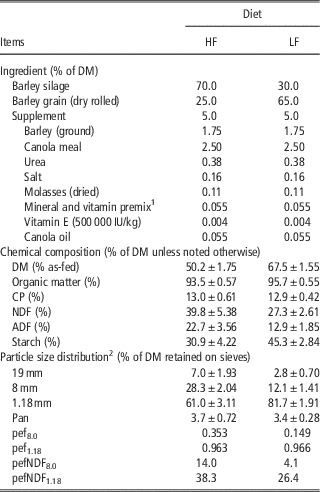
Before beginning the study, heifers were fed a barley-based total mixed ration (TMR) consisting (dry matter (DM) basis) of 60% silage and 40% concentrate. At the start of the first period, heifers were randomly allocated to two experimental treatments, which were two levels of forage (30% v. 70% of the diet DM as barley silage; Table 1). The remainder of the diet consisted of barley grain (65% v. 25% on a DM basis) and a constant level (5%) of supplement. The choice of experimental diets was driven by the need to achieve substantial differences in dietary starch and fiber composition that would ensure a greater intake of starch and a lower intake of fiber for animals fed the LF compared with the HF diet. All rations were formulated to provide sufficient metabolizable energy and protein for 400 kg growing beef cattle gaining 1.0 kg/day (National Research Council, 2000). TMRs were prepared (Data Ranger; American Calan Inc., Northwood, NH, USA) and offered once daily at 1100 h for ad libitum intake (5% orts). Fresh water was available at all times throughout the experiment. During the 12-day transition interval, the level of forage was gradually adjusted upwards or downwards as appropriate.
Ingredient and chemical composition of the high-forage (HF) and low-forage (LF) diets

DM=dry matter.
1 Feedlot premix provided an additional 14 g/kg Ca, 103 mg/kg Zn, 26 mg/kg Cu, 47 mg/kg Mn, 1 mg/kg I, 0.50 mg/kg Se, 0.33 mg/kg Co, 17 187 IU/kg vitamin A, 859 IU/kg vitamin D3 and 24 IU/kg vitamin E to the diet DM.
2 Particle size distribution of total mixed ration (TMR) measured using the Penn State Particle Separator (Kononoff et al., Reference Kononoff, Heinrichs and Buckmaster2003); pef8.0 and pef1.18=physical effectiveness factor determined as the proportion of particles retained on two sieves (19 and 8 mm; Lammers et al., Reference Lammers, Buckmaster and Heinrichs1996) and three sieves (19, 8 and 1.18 mm; Kononoff et al., Reference Kononoff, Heinrichs and Buckmaster2003), respectively; peNDF8.0 and peNDF1.18=physically effective NDF determined as NDF content of TMR multiplied by pef8.0 and pef1.18, respectively.
Data and sample collection
DM intake (DMI)
Feed intake was measured daily. TMR and refusal samples were also collected daily and composited for each 4-day dietary step during the 12-day diet transition period. Thereafter, weekly TMR and refusal samples were collected over 2 and 5 consecutive days, respectively. Barley silage, barley grain and supplement samples were collected once weekly. All samples were analyzed for DM by oven drying at 55°C for 48 h. Weekly silage DM content was used to adjust the forage inclusion level (as-fed basis) if it deviated by >3% from the average. All weekly samples were composited by period for each heifer and stored at −20°C.
Ruminal pH
Ruminal pH was measured continuously from day 17 to day 23 of each period using the indwelling Lethbridge Research Centre Ruminal pH data logger system (LRCpH; Dascor, Escondido, CA, USA; Penner et al., Reference Penner, Aschenbach, Gäbel and Oba2006).
Ruminal liquid passage rate and SCFA concentration
To determine ruminal liquid passage rate, a background sample (0 h) was initially collected from three ruminal sites (reticulum, dorsal and ventral sac) at 1030 h on day 23. This was followed by dosage of 500 ml of Cr-ethylenediaminetetraacetic acid (Cr-EDTA) solution into multiple ruminal sites through the cannula at 1100 h. Ruminal digesta samples were collected at 2, 4, 6, 8, 12, 16 and 20 h post-dosing and immediately squeezed through polyester monofilament fabric (Pecap 7-335/47 mesh opening-335 μm; Tetko Inc., Scarborough, Ontario, Canada) to obtain a 40 ml aliquot for Cr analysis. A 5 ml ruminal fluid sub-sample was also collected (0, 2, 4, 6, 8, 12, 16 and 20 h post-dosing) and mixed with 1 ml of 25% (wt/vol) metaphosphoric acid for SCFA analysis. Samples were stored at −20°C until analyzed.
Saliva production and rumen liquid volume
Eating salivation was measured on days 28 and 29 (two heifers on each day) of each period as described by Maekawa et al. (Reference Maekawa, Beauchemin and Christensen2002). Briefly, the rumen was partially evacuated at 1040 h such that the anterior pillar was exposed. Heifers were then left undisturbed for 5 min, fed and then left undisturbed for another 5 min. Ingested feed and swallowed saliva were then collected at the cardia using a collection apparatus (50×18 cm plastic bag with the opening sewn to a wire hoop with a 9 cm circumference) inserted through the rumen. A total of six ingesta (feed+saliva) samples were collected over a 2-min duration that was interspaced with 5-min intervals during which heifers were left undisturbed. Samples of the TMR offered to heifers were also collected. To determine DM content, all samples were oven-dried at 55°C for 72 h. Saliva production was calculated as the difference in moisture content between the TMR (as-fed basis) offered, and the collected ingesta samples. To determine ensalivation rate, saliva production was expressed as a proportion of the amount of TMR ingested.
To measure resting salivation, reticulo-ruminal contents were completely evacuated through the cannula 4 h before feeding on days 30 and 31 (two heifers on each day), and were stored in pre-warmed, insulated, covered plastic containers. To prevent eating and drinking, feed was removed and water turned off, respectively. The collection apparatus described previously was then used to collect four saliva samples using 5-min periods that were interspaced with 2-min periods during which heifers were left undisturbed. Following collection of each sample, saliva volume was measured, and resting salivation rate was calculated as the amount of saliva produced divided by the length of the collection period. Evacuated ruminal contents were also weighed. Thereafter, contents were thoroughly mixed before two 1 kg sub-samples were collected and oven-dried (55°C for 48 h) to determine ruminal liquid volume.
SCFA absorption
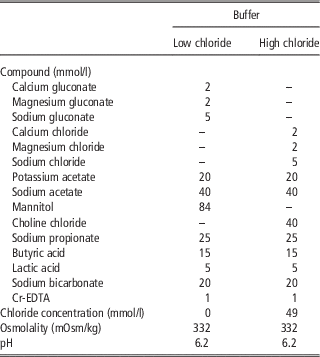
Following measurement of resting salivation on days 30 and 31, the temporarily isolated and washed reticulo-rumen (WRR) technique (Care et al., 1984) was used to determine ruminal SCFA absorption. Methodology for the WRR technique has been previously described by Chibisa et al. (Reference Chibisa, Gorka, Penner, Berthiaume and Mutsvangwa2015), and similar wash (100 mmol/l of NaCl, 25 mmol/l of NaHCO3 and 30 mmol/l of sodium acetate), and low and high Cl− (0 v. 49 mM) experimental buffers containing Cr-EDTA (1 mM) as a volume marker (Table 2) were used to measure epithelial permeability in this study.
Formulated composition of experimental buffers

EDTA=ethylenediaminetetraacetic acid.
Laboratory analyses
At the end of the study, a 1 kg sub-sample of the composited ingredient and TMR samples was used for particle distribution analysis using the Penn State Particle Separator (Table 1) as described by Kononoff et al. (Reference Kononoff, Heinrichs and Buckmaster2003). Another 1 kg sub-sample was oven-dried (55°C for 48 h) and sequentially ground through a 4 mm (cutter mill) and 1 mm screen (Wiley mill, standard model 4; Arthur H. Thomas Co., Philadelphia, PA, USA) for subsequent chemical analysis. Ground feed samples were analyzed for DM (Association of Official Analytical Chemists (AOAC), 1995; method 930.15), ash (AOAC, 1995; method 942.05), ADF and NDF (Van Soest et al., Reference Van Soest, Robertson and Lewis1991). In preparation for CP (N×6.25) and starch analyses, samples were pulverized using a ball mill (Mixer Mill MM2000; Retsch, Haan, Germany). For quantification of total N, flash combustion with gas chromatography and thermal conductivity detection (Carlo Erba Instruments, Milan, Italy) were used. To measure total starch, an enzymatic method that involved hydrolysis of starch using amylase, reaction of the resultant free glucose with glucose oxidase/peroxidase (No. P7119; Sigma, St Louis, MO, USA) and dianisidine dihydrochloride, and measurement of absorbance at 540 nm using a plate reader (SpectraMax 190; Molecular Devices Corp., Sunnyvale, CA, USA) was used.
The SCFA concentration in ruminal fluid and buffer samples was determined using a Hewlett Packard model 5890A Series Plus II gas liquid chromatograph (Hewlett Packard Co., Palo Alto, CA, USA) fitted with a Zebron capillary column (ZB-FFAP; 30 M×0.32 mm i.d.×1.0 μm phase thickness; Phenomenex, Torrance, CA, USA). Crotonic acid was used as an internal standard. Ruminal fluid and buffer samples were centrifuged (20 000×g; 15 min; 4°C), with the resultant supernatant analyzed for Cr (AOAC, 1990) by inductively coupled plasma emission spectrometry (SpectoCirosCCD; Specto Analytical Instruments, GmbH & Co., Kleve, Germany). Osmolality (mOsm/kg) of ruminal fluid samples was determined by freezing point depression (μOsmette model 5004; Precision Systems Inc., Natick, MA, USA).
Calculations
Ruminal pH data for each heifer were summarized as daily mean, minimum and maximum pH. In addition, the duration (h/day), area (pH×h/day) and acidosis index (pH×h/kg DMI) were calculated using pH thresholds of 5.8 and 5.5.
A log-linear regression as described by Grovum and Williams (Reference Grovum and Williams1973) was used to calculate liquid fractional passage rate (kpL) and rumen liquid pool based on Cr concentrations in ruminal fluid samples.
To determine the actual volume of ruminal buffer during the WRR procedure, the Cr concentration of buffer samples collected following 5 and 50 min of incubation were used relative to that in the sample before incubation. The disappearance or absorption rates of acetate, propionate and butyrate were then calculated according to the following formulas:
 $$\eqalignno{ & {\rm Absolute}\,{\rm SCFA}\,{\rm absorption}\,{\rm rate}\,{\rm (mmol/h){\equals}}\left[ {V_{{{\rm 5}\:{\rm min}}} {\rm {\times}}C_{{{\rm 5}\:{\rm min}}} }\right \cr \left{\quad\quad{\rm {\minus}}V_{{{\rm 50}\:{\rm min}}} {\rm {\times}}C_{{{\rm 50}\:{\rm min}}} } \right]{\rm {\times}60/45} \cr & {\rm Fractional}\,{\rm SCFA}\,{\rm absorption}\,{\rm rate}\,{\rm (\,\%/h){\equals}(}V_{{{\rm 5}\:{\rm min}}} {\rm {\times}}C_{{{\rm 5}\:{\rm min}}} \cr & \quad\quad{\rm {\minus}}V_{{{\rm 50}\:{\rm min}}} {\rm {\times}}C_{{{\rm 50}\:{\rm min}}} {\rm )/(}V_{{{\rm 5}\:{\rm min}}} {\rm {\times}}C_{{{\rm 5}\:{\rm min}}} {\rm ){\times}60/45{\times}100} $$
where V is the volume of buffer and C the concentration of acetate, propionate or butyrate at the respective time.
Statistical analysis
The MIXED procedure of SAS (SAS Institute Inc., Cary, NC, USA) for a crossover design was used to analyze DMI, SCFA absorption, saliva production and liquid passage rate data. The model included the fixed effects of treatment, period and sequence, and the random effect of cow within sequence. Temporal data (ruminal SCFA and osmolality) were analyzed accounting for repeated measures through the inclusion of additional terms for time (hour or day) and treatment×time interaction in the model previously described. For each response variable, the variance–covariance structure of the repeated measures was modeled separately, with an appropriate structure fitted using the lowest values of the fit statistics based on the Bayesian information criteria. Data are presented as least square means. Significance was declared at P<0.05 and trends at 0.05⩽P⩽0.10.
Results
Diet composition
Dietary ingredient and chemical composition are presented in Table 1. Although statistical analysis was not conducted on the dietary chemical composition, diets differed in composition, at least numerically. Because barley grain contains more starch than barley silage, dietary starch content was greater for the LF compared with the HF diet (45.3% v 30.9% of diet DM; Table 1). Similarly, the NDF content of the HF diet was greater than for the LF diet (39.8% v. 27.3% of diet DM) because of differences in NDF content between barley silage and grain. In addition, the physically effective NDF (peNDF) content of the HF diet was also greater than that of the LF diet (Table 1).
DMI and ruminal fermentation characteristics
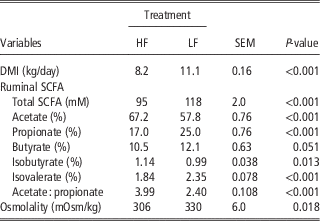
DMI, ruminal total SCFA concentration, osmolality, and the molar proportions of propionate and isovalerate were greater (P⩽0.018) in cattle fed LF compared with HF (Table 3). Feeding LF also resulted in a tendency for an increase (P=0.051) in the molar proportion of butyrate, and a decrease (P⩽0.013) in the molar proportions of acetate and isobutyrate and the acetate : propionate ratio (Table 3).
Dry matter intake (DMI) and ruminal fermentation characteristics in beef cattle fed a high-forage (HF) or low-forage (LF) diet (n=8)

SCFA=short-chain fatty acid.
Ruminal pH
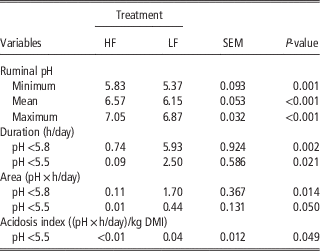
Beef cattle fed LF had a lower (P⩽0.001) minimum, mean and maximum ruminal pH compared with those fed HF (Table 4). In addition, feeding LF resulted in a longer duration (P⩽0.021) that pH was below 5.8 and 5.5, and a larger area (P=0.014) that pH was below 5.8. The area that pH was below 5.5 tended to be larger (P=0.050) and the acidosis index (area pH<5.5/kg DMI) was greater (P=0.049) for cattle fed LF compared with HF.
Ruminal pH in beef cattle fed a high-forage (HF) or low-forage (LF) diet (n=8)

DMI=dry matter intake.
Ruminal SCFA absorption and saliva production
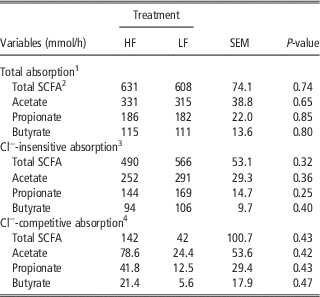
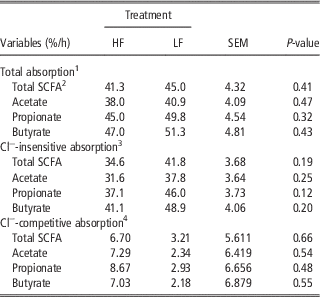
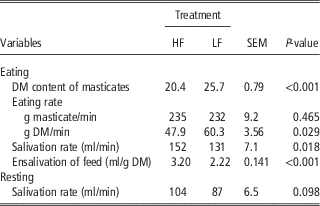
There was no diet effect (P>0.05) on the absolute (mmol/h; Table 5) and fractional (%/h; Table 6) rates of total, chloride-insensitive and Cl−-competitive absorption of acetate, propionate, butyrate and total SCFA. The DM content of masticates was greater (P<0.001) in LF- than HF-fed cows (Table 7). As a result of a faster eating rate (g DM/min; P=0.029) and slower salivation rate (ml/min; P=0.018), the ensalivation of feed (ml/g DM) during eating was lower (P<0.001) in cattle fed LF compared with HF. Resting salivation also tended to be less (P=0.098) in cattle fed LF.
Absolute short-chain fatty acid (SCFA) absorption across the temporarily isolated and washed reticulo-rumen in beef cattle fed a high-forage (HF) or low-forage (LF) diet (n=8)

1 Total absorption=SCFA absorption measured with the low chloride buffer.
2 Total SCFA=acetate+propionate+butyrate.
3 Cl−-insensitive absorption=SCFA absorption measured with the high chloride buffer.
4 Cl−-competitive absorption=total absorption−Cl−-insensitive absorption.
Fractional short-chain fatty acid (SCFA) absorption across the temporarily isolated and washed reticulo-rumen in beef cattle fed a high-forage (HF) or low-forage (LF) diet (n=8)

1 Total absorption=SCFA absorption measured with the low chloride buffer.
2 Total SCFA=acetate+propionate+butyrate.
3 Cl−-insensitive absorption=SCFA absorption measured with the high chloride buffer.
4 Cl−-competitive absorption=total absorption-Cl−−insensitive absorption.
Saliva production during eating and resting in beef cattle fed a high-forage (HF) or low-forage (LF) diet (n=8)

DM=dry matter.
Ruminal volume and fluid fractional passage rate
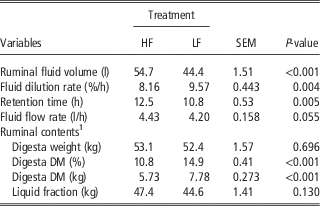
Ruminal fluid volume and retention time were greater (P⩽0.005) in cattle fed HF compared with those fed LF (Table 8). Moreover, the fluid dilution rate (%/h) was greater (P=0.004) and the flow rate (l/h) tended to be slower (P=0.055) in LF-fed cattle. Although there was no diet effect (P>0.05) on the weight of fresh ruminal contents and ruminal liquid, the DM content and digesta dry weight were greater (P<0.001) in cattle fed LF than those fed HF.
Ruminal volume and fractional passage rate in beef cattle fed a high-forage (HF) or low-forage (LF) diet (n=8)

DM=dry matter.
1 Determined following total evacuation of the ruminal contents.
Discussion
Absorption of SCFA from ruminal fermentation of CHO contributes up to 80% of caloric requirements in beef cattle (Bergman, Reference Bergman1990), but an increase in the rate of SCFA production that exceeds the rate of clearance through absorption, neutralization and passage can result in ruminal acidosis (Allen, Reference Aschenbach, Bilk, Tadesse, Stumpff and Gäbel1997). In the current study, ruminal total SCFA concentration, which does not necessarily reflect the rate of production as absorption and passage are not accounted for (Dijkstra et al., Reference Dijkstra, Boer, Van Bruchem, Bruining and Tamminga1993), was greater (118 v. 95 mM) in cattle fed LF compared with HF. In addition, the greater ruminal osmolality in LF- than HF-fed cattle reflected the changes in total SCFA concentration that could be attributed to a greater ruminal supply of rapidly fermentable CHO as a result of higher dietary starch content and DMI. Feeding cattle an LF diet also resulted in a tendency for an increase in the molar proportion of butyrate (12.1% v. 10.5%) and an increase in the molar proportion of propionate (25.0% v. 17.0%). Similar changes in the ruminal SCFA profile when concentrate intake increases have been reported by Penner et al. (Reference Penner, Beauchemin and Mutsvangwa2009b).
A major objective of our study was to determine whether changes in the ruminal SCFA profile when the supply of rapidly fermentable CHO in beef cattle is altered has an effect on ruminal epithelial permeability to SCFA. Passive diffusion of protonated (HSCFA) and protein-mediated transport of anionic SCFA (SCFA−) are thought to be the major pathways for absorption of ruminal acid (Aschenbach et al., Reference Amat, McKinnon, Penner and Hendrick2011). Compared with passive diffusion, limited research has been carried out to characterize the different protein-mediated transport systems involved, and their functional relevance to pH regulation. One such system is the SCFA−/HCO3 − exchanger. Besides showing its functionality with the temporarily isolated and WRR in sheep, Gäbel et al. (Reference Gäbel, Martens, Suendermann and Galfi1991) also suggested that the SCFA−/HCO3 − exchanger could stabilize ruminal pH by increasing net secretion and absorption of HCO3 − and SCFA−, respectively. To measure total absorption (passive diffusion+protein-mediated transport) of acetate, propionate and butyrate, and the contribution of the SCFA−/HCO3 − exchanger, we used two experimental buffers formulated to be similar in composition except for their Cl− concentration (i.e. a low (0 mM) v. high (40 mM) chloride buffer; Table 2). Ruminal Cl− concentration usually ranges from 19 to 24 mmol/l (Duffield et al., Reference Duffield, Plaizier, Fairfield, Bagg, Vessie, Dick, Wilson, Aramini and McBride2004), and in a study with sheep (Aschenbach et al., Reference Allen2009), inclusion of Cl−⩾40 mM in the buffers used to determine epithelial permeability was shown to reduce acetate and propionate, but not butyrate absorption. Therefore, measuring WRR disappearance rates using a low chloride buffer gives non-inhibited absorption estimates for acetate, propionate and butyrate, and allows for the calculation of total, Cl−-competitive (i.e. HCO3 −-dependent) and Cl-independent absorption. This technique enabled us to determine whether increasing the ruminal supply of rapidly fermentable CHO would result in measurable differences in epithelial adaptation.
Despite changes in SCFA profiles, the increased ruminal supply of rapidly fermentable CHO in LF-fed cattle had no effect on epithelial permeability as indirectly indicated by the similar total absorption rates (mmol/h and %/h) for acetate, propionate, butyrate and total SCFA (acetate+propionate+butyrate) across diets. In addition, the pH conditions in the rumen of cattle fed the LF compared with HF diet were indicative of a greater degree of moderate acidosis (pH<5.5; Penner et al., Reference Penner, Aschenbach, Gäbel and Oba2006). This greater depression in the ruminal pH of LF-fed cattle could possibly be explained by an increase in the rate of SCFA production that was not matched by an increase in the rate of absorption and, therefore, acid accumulation in the rumen.
The absorption rates of total SCFA and acetate, estimated using the valerate-CoEDTA method (Resende Júnior et al., Reference Resende Júnior, Pereira, Bôer and Tamminga2006), were also reported not to differ in dairy cattle fed diets containing either 92% (HF) or 36% forage (LF; Penner et al., Reference Penner, Beauchemin and Mutsvangwa2009b). Similarly, Ussing chamber-derived estimates of ruminal tissue capacity for ion transport were also not different in goats fed a low (30% barley grain and 70% hay) compared with a high barley diet (60% barley grain and 40% hay; Klevenhusen et al., Reference Klevenhusen, Hollmann, Podstatzky-Lichtenstein, Krametter-Frötscher, Aschenbach and Zebeli2013). In addition, ruminal pH was lower in animals fed more concentrate in both studies (Penner et al., Reference Penner, Beauchemin and Mutsvangwa2009b; Klevenhusen et al., Reference Klevenhusen, Hollmann, Podstatzky-Lichtenstein, Krametter-Frötscher, Aschenbach and Zebeli2013). On the other hand, Amat et al. (Reference Aschenbach, Penner, Stumpff and Gäbel2013) reported an increase in the fractional rates of absorption of acetate, propionate and butyrate in beef cattle fed 4% compared with 51% of diet DM as forage. A similar increase in epithelial permeability was also reported when hay-fed sheep were transitioned to 64% and 90% concentrate diets (Gäbel et al., Reference Gäbel, Bestmann and Martens1987). Gäbel et al. (Reference Gäbel, Bestmann and Martens1987) attributed this increase in absorption rates to a 200% to 400% increase in the surface area of papillae that was potentially induced by changes in the ruminal profile of SCFA, particularly, butyrate. This finding is supported by Malhi et al. (Reference Malhi, Gui, Yao, Aschenbach, Gäbel and Shen2013), who documented an increase in the absorptive surface area (82%; papillae size and density) and the rate (%/h) of SCFA absorption following ruminal infusion of butyrate an hour before feeding in goats.
Although morphology of papillae was not measured, it is plausible that our diets failed to elicit substantial differences in absorptive surface area despite the noted changes in butyrate, propionate and total SCFA concentrations. Bannink et al. (Reference Bannink, Gerrits, France and Dijkstra2012) also did not observe differences in ruminal papillae size or fractional rates of acetate, propionate and butyrate absorption in post-parturient cows subjected to either a rapid or gradual increment in concentrate allowance per day. Besides ruminal surface area, epithelial blood flow, which has been shown to be modulated by luminal butyrate (Barnes et al., Reference Barnes, Comline and Dobson1983), also has an impact on SCFA absorption (Storm et al., Reference Storm, Hanigan and Kristensen2011). Although there is a paucity of information on the impact of changing the dietary supply of rapidly fermentable CHO on reticulo-ruminal epithelial blood flow, the available evidence (Barnes et al., Reference Barnes, Comline and Dobson1983; Storm et al., Reference Storm, Hanigan and Kristensen2011) suggests that increasing concentrate intake could potentially result in an increase in SCFA absorption driven in part by an increase in epithelial blood flow (not measured in our study).
Although the stimulatory effect of low pH on ruminal SCFA absorption is well documented (Dijkstra et al., Reference Dijkstra, Boer, Van Bruchem, Bruining and Tamminga1993; Aschenbach et al., Reference Allen2009), acidotic conditions can also reduce epithelial permeability (Gäbel and Martens, Reference Gäbel and Martens1988; Schwaiger et al., Reference Schwaiger, Beauchemin and Penner2013) as a result of tissue damage and, ultimately, parakeratosis. Ruminal pH in the current study (6-day average) was <5.5 for 2.50 v. 0.09 h/day for cattle fed the LF v. the HF diet, respectively. Although speculative, it is possible that a greater degree of parakeratosis could have occurred in cattle fed LF compared with HF, which in turn could have impeded the anticipated increase in the rate of SCFA absorption.
Besides the importance of morphological surface enlargement as the ruminal supply of rapidly fermentable CHO increases (Gäbel et al., Reference Gäbel, Bestmann and Martens1987; Malhi et al., Reference Malhi, Gui, Yao, Aschenbach, Gäbel and Shen2013), there is increasing evidence suggesting that functional adaptation in ruminal epithelial cells, which is characterized by changes in ion transport systems, also plays a critical role in pH regulation (Gäbel et al., Reference Gäbel, Martens, Suendermann and Galfi1991; Aschenbach et al., Reference Allen2009 and Reference Amat, McKinnon, Penner and Hendrick2011). Our study focused on the SCFA−/HCO3 − exchanger because an SCFA-induced upregulation of this system in concentrate- compared with hay-fed sheep was reported to elevate ruminal pH by increasing both the luminal appearance of HCO3 − and disappearance of SCFA (Gäbel et al., Reference Gäbel, Martens, Suendermann and Galfi1991). In addition, a decrease in pH was also shown to increase the rate of SCFA absorption by the SCFA−/HCO3 − exchanger, especially for acetate (Aschenbach et al., Reference Allen2009). Therefore, changes in both ruminal SCFA profile and pH in cattle fed the LF compared with the HF diet in our study were favorable for an increase in the rate of HCO3 −-dependent uptake of SCFA. However, we did not observe any effect of diet on the Cl−-competitive absorption rates (mmol/h and %/h) of SCFA for reasons that are not clear. To avoid their confounding effects when measuring epithelial adaptation in our study, the SCFA concentration and pH of our experimental buffers were similar across diets. Therefore, it is plausible that the changes in luminal SCFA profile and pH we observed when feeding LF compared with HF could have increased epithelial permeability under physiological conditions, albeit not measurable using the buffer conditions we imposed. In addition, HCO3 −-dependent absorption was determined by difference (non-inhibited – Cl-independent absorption), and it is possible that this indirect method might not have been sensitive enough to potentially detect changes in epithelial permeability, which was highly variable in our study. Bannick et al. (Reference Bannink, Gerrits, France and Dijkstra2012) also reported high variation in measures of proliferative changes in ruminal papillae and estimates of epithelial permeability to SCFA absorption. In addition, Penner et al. (Reference Penner, Taniguchi, Guan, Beauchemin and Oba2009a) also noted substantial differences in the innate capacity for epithelial protein-mediated transport of SCFA− and, thus, luminal HCO3 − secretion in sheep, and this was suggested to explain differences in susceptibility to acidosis. Therefore, given this documented high variation in measures of proliferative changes and epithelial permeability, a larger number of animals than used in our study may be necessary for further studies on ruminal pH regulation.
In addition to the SCFA−/HCO3 − exchanger, other ion transport systems, including the HCO3 −-independent and nitrate-sensitive uptake of acetate, and HCO3 −-independent uptake of butyrate, have been reported (Aschenbach et al., Reference Allen2009; Penner et al., Reference Penner, Taniguchi, Guan, Beauchemin and Oba2009a). Although not measured in our study, the activity and relative contribution of these different SCFA absorption pathways could have been affected by the changes in rapidly fermentable CHO intake. Additional research is needed to fully characterize the ion transport systems that contribute to pH regulation, and to determine the potential impact of ruminal CHO supply on their relative importance.
Besides the ruminal acid load potential of a diet as determined by both DMI and fermentable CHO content, dietary peNDF content also has an impact on ruminal pH (Zebeli et al., Reference Zebeli, Aschenbach, Tafaj, Boguhn, Ametaj and Drochner2012). Provision of less than the recommended 14.9% of dietary peNDF8 for dairy cattle consuming a high amount of rapidly fermentable CHOs will increase the likelihood of sub-acute ruminal acidosis occurring, which is partially attributed to a decrease in chewing activity, in particular rumination, as reticulo-rumen contractions also decrease (Zebeli et al., Reference Zebeli, Aschenbach, Tafaj, Boguhn, Ametaj and Drochner2012). As expected, the faster eating rate of cattle fed LF compared with HF resulted in less ensalivation of ingested feed in the current study. In addition, the resting salivation rate in cattle fed LF diet was slower than in cattle fed HF. Maekawa et al. (Reference Maekawa, Beauchemin and Christensen2002) made similar observations in concentrate- compared with forage-fed cattle. In addition, the total time spent eating (218 v. 272 min/day; P<0.001) and ruminating (483 v. 553 min/day; P<0.001) was shorter in cattle fed LF compared with HF. Therefore, it is likely that the LF diet had a limited stimulatory effect on saliva secretion during chewing (eating+rumination) as a result of the peNDF8 content being >10% lower than the recommended level for optimal rumen function. However, the gains in saliva output as a result of the longer chewing time in forage- compared with concentrate-fed cattle, could be reversed by the smaller saliva output due to the shorter resting time or total time spent not chewing (Maekawa et al., Reference Maekawa, Beauchemin and Christensen2002). Taking into account total time spent eating, ruminating and resting per day, eating and resting salivation rates, and assuming that the salivation rate during rumination is 1.8× the rate during resting (Cassida and Stokes, Reference Cassida and Stokes1986), total daily saliva production estimated according to Allen (Reference Aschenbach, Bilk, Tadesse, Stumpff and Gäbel1997) was less (164 v. 205 l; P=0.037) in LF- than HF-fed cattle. As a result, the estimated daily buffer (HCO3 −+HPO4 2−) flow and, thus, salivary buffering, was also 20% less in cattle fed LF compared with HF (24 888 v. 31 238 mEq; P=0.037) because saliva secretion during the longer resting time failed to fully compensate for the smaller output of saliva during eating and rumination. Therefore, the limited peNDF supply and concomitant decrease in salivary buffering coupled with the potentially greater ruminal acid load and lack of an increase in epithelial permeability to SCFA for cattle fed the LF possibly resulted in the significantly longer time that pH was below 5.8 compared with cattle fed the HF diet.
Saliva production is also one of the major factors that determines fluid outflow rate from the rumen (Cassida and Stokes, Reference Cassida and Stokes1986), and the bulk of the estimated 7% of ruminal acid removed through passage to the omasum is associated with the fluid fraction (Allen, Reference Aschenbach, Bilk, Tadesse, Stumpff and Gäbel1997). Therefore, the greater saliva flow in HF- compared with LF-fed cattle in our study could also possibly explain the greater rate of fluid outflow from the rumen that could have also increased SCFA outflow to the omasum.
Conclusion
Results from this study indicate that although increasing CHO intake increased the ruminal concentration of butyrate, propionate and total SCFA, there were no changes in epithelial permeability and hence no increase in total (passive diffusion+active transport) and Cl−-competitive (indirect measure of protein-mediated transport) absorption (mmol/h and %/h) of acetate, propionate and butyrate and total SCFA (acetate+propionate+butyrate). Furthermore, cattle fed the LF diet secreted less saliva during eating and resting than cattle fed the HF diet.
Acknowledgments
Funding for this study was from the Alberta Livestock and Meat Agency (Project No. 2012R035R) and Agriculture and Agri-Food Canada. The authors thank B. Farr, R. Roth, A. Furtado, D. Vedres and B. Tovell for sampling and laboratory assistance, and the staff at the Metabolism Unit of the Lethbridge Research Centre (Agriculture and Agri-Food Canada, Lethbridge, Alberta, Canada) for animal care.