Introduction
Laryngeal carcinoma is the second most common head and neck cancer after oral cancers. There were 2360 new cases of laryngeal cancers in the UK in 2011, with a male-to-female ratio of 45:10. It accounted for approximately 1 per cent of all new cases in men and 0.3 per cent of all new cases in women.1 Squamous cell carcinoma is the most common histological type, seen in 90 per cent of laryngeal cancers.Reference Ferlito, Silver, Bradford and Rinaldo2 Small cell carcinoma of the head and neck region is a rare neuroendocrine tumour.Reference Renner3 It is relatively aggressive and has a greater propensity for regional and distant failure, leading to a worse prognosis. Because of its rarity, therapeutic management principles have mainly been extrapolated from experience and published evidence for small cell lung cancer. Large randomised control trials are lacking; therefore, case reports, case series and reports of single-centre experiences have had a significant impact on defining treatment and sharing the treatment experience.Reference Hatoum, Patton, Takita, Abdel-Wahab, LaFave and Weed4 This retrospective study aimed to describe our experience in managing this rare disease at our centre over a 10-year period.
Materials and methods
The local departmental database was searched and patients with histologically proven small cell neuroendocrine neoplasms of the larynx were identified; their case notes were reviewed retrospectively. The search period was limited to a 10-year period (May 2004 to April 2014). All patients underwent pre-treatment clinical evaluation and staging investigations by the otolaryngology–surgical team, followed by case discussions in Head and Neck Multidisciplinary Team meetings comprising otolaryngologists, clinical oncologists, radiologists, pathologists, maxillofacial surgeons, clinical nurse specialists, dieticians, and speech and language therapists. The best management plan was determined on an individual basis.
Information was collected on patient demographics, disease characteristics and the treatment plan sequence. Recurrence patterns in terms of either locoregional or distant metastasis were recorded, and overall survival from the time of diagnosis to the time of death was calculated.
Ethical approval
This study was registered with the local hospital clinical effectiveness register as a service review project (number 5801).
Results
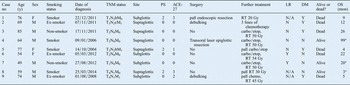
Nine patients (six men and three women) were identified within this study period. The median age was 69 years (range 49–85 years). Six patients (66 per cent) had a World Health Organisation (WHO) performance status of 0 and three patients (33 per cent) had a WHO performance status of 2. Most of the patients (55 per cent) had no co-morbidity, as shown by an Adult Co-morbidity Evaluation 27 (‘ACE-27’) score of 0. Seven patients were either smokers or ex-smokers, and two had never smoked. The most common site was the supraglottis (five out of nine), with the subglottis being affected in four out of nine. In three patients (33 per cent), the diagnosis of laryngeal small cell carcinoma related to a second primary tumour within a previously irradiated field. Of these three patients, two had previously undergone treatment for conventional squamous cell carcinoma of the head and neck, and one patient had received radiotherapy for malignant histiocytic lymphoma. The period from previous irradiation to the development of the second primary was 1, 3 and 37 years, respectively. Study results are summarised in Table I.
Summary of patient characteristics

*Patient is still alive. No = number; y = years; TNM = tumour–node–metastasis; PS = World Health Organisation performance status; ACE-27 = Adult Co-morbidity Evaluation 27; LR = local recurrence; DM = distant metastases; OS = overall survival; mon = months; F = female; RT = radiotherapy; M = male; carbo/etop = carboplatin and etoposide chemotherapy; pall = palliative; N/A = not applicable
Eight patients presented with local symptoms i.e. hoarseness of voice, sore throat, dysphagia or a palpable neck mass. One patient who presented with breathlessness and tiredness was found to have lung and liver metastases. All patients underwent computed tomography (CT) imaging of the neck, thorax and abdomen for tumour staging, and one also underwent CT positron emission tomography imaging. Their clinical presentation was no different from that of patients with conventional squamous cell carcinoma of the larynx regarding symptoms; there were no symptoms suggesting they had neuroendocrine tumours.
One patient (case 4) underwent radical transoral laser epiglottic resection for a tumour–node–metastasis (TNM) stage T2 tumour. This was followed by 6 cycles of carboplatin and etoposide chemotherapy and consolidation radiotherapy (50 Gy in 25 fractions). This patient was alive 99 months after the initial diagnosis, with no evidence of locoregional or distant metastasis.
Of the remaining five patients with non-metastatic tumours, three were treated with radical intent. They received six cycles of carboplatin and etoposide chemotherapy, followed by radical high-dose radiotherapy: two patients received 50 Gy in 25 fractions and one patient received 54 Gy in 30 fractions because of previous neck irradiation. Of these 3 patients, one (case 3) developed widespread liver, lung and para-aortic lymph nodal metastases 19 months after the initial diagnosis. There was no evidence of local recurrence. He could not tolerate re-challenge carboplatin and etoposide chemotherapy and died of progressive disease seven months later. In the second patient (case 6), disease recurred in trachea (1 cm above the carina) after 12 months. She was treated with re-challenge carboplatin and etoposide chemotherapy and palliative radiotherapy (30 Gy in 10 fractions given to the mediastinum); unfortunately, her disease slowly progressed and she died with an overall survival period of 20 months. The third case was of a relatively young patient (case 7) with an early stage (T1N0M0) small cell cancer of the supraglottis. He was treated with 6 cycles of carboplatin and etoposide chemotherapy, followed by radical radiotherapy (50 Gy dose in 25 fractions). Eleven months after the initial diagnosis, there was marginal recurrence just below the lower border of the radiotherapy field. He was then treated with 6 cycles of second-line vincristine, doxorubicin and cyclophosphamide chemotherapy, again followed by radical radiotherapy (50 Gy dose in 25 fractions) partially overlapping the previous radiotherapy field. Unfortunately, the disease recurred inside the radiotherapy fields within three months of radiotherapy completion.
Three patients (33 per cent) had metastatic disease at the time of diagnosis. Of these, one (case 2) was treated aggressively with three different chemotherapy regimens (first-line carboplatin and etoposide, second-line oral topotecan and third-line vincristine, doxorubicin and cyclophosphamide) but the disease progressed throughout chemotherapy. This patient died 12 months after his initial diagnosis.
Discussion
Small cell neuroendocrine carcinomas are highly aggressive malignancies that occur most commonly in the lung.Reference Lobins and Floyd5 Extrapulmonary small cell carcinomas comprise 2.5–5 per cent of all small cell carcinomas, with the oesophagus being the most common site.Reference Ferlito and Rinaldo6, Reference van der Heijden and Heijdra7 Neuroendocrine tumours are the most common non-squamous type of laryngeal malignancy.Reference Mikić, Zvrko, Trivić, Stefanović and Golubović8 These tumours represent a heterogenous group of neoplasms. The WHO has characterised them into four subtypes: typical carcinoid tumours, atypical carcinoid tumours, small cell neuroendocrine tumours and paragangliomas.Reference Barnes, Eveson, Reichart and Sidransky9 A primary small cell neuroendocrine carcinoma of the larynx is quite rare, representing about 0.5 per cent of all laryngeal cancers.Reference Ferlito and Rinaldo6 The first case was described by Olofsson and van Nostrand in 1972,Reference Olofsson and Van Nostrand10 and approximately 200 cases were reported up to 2008.Reference Ferlito and Rinaldo6 This is a biologically aggressive malignancy, with an increased tendency to metastasise. Hence, it is best regarded as a systemic disease,Reference Gripp, Risse, Leverstein, Snow and Meijer11 in which the absence of regional or distant metastasis does not preclude the existence of micrometastasis.Reference Ferlito and Rinaldo6 About half of patients present with cervical lymph node metastasis, and over 90 per cent eventually develop systemic metastatic disease.Reference Gnepp12 Consistent with the published data, five out of nine patients in our series presented with lymph nodal metastases and a similar number developed distant metastatic disease.
The disease can involve any subsite of larynx, but the supraglottis is most common.Reference Mikić, Zvrko, Trivić, Stefanović and Golubović8 Most patients are men aged 50–70 years, with a history of smoking.Reference Mikić, Zvrko, Trivić, Stefanović and Golubović8 Presenting symptoms and clinical signs vary according to the site and extent of the disease, with dysphonia being the most common presenting complaint.
A correct diagnosis and comprehensive staging are absolutely essential for choosing the most suitable therapeutic approach. The diagnostic investigation should include obtaining a full detailed medical history, a clinical examination, panendoscopy, biopsy and a CT scan of the neck, chest and abdomen. Light microscopic and immunohistochemical analyses are helpful for diagnosis.
In general, radical surgery is not usually the primary treatment; however, in some highly selected cases where there is a chance of rapid recovery, minimally invasive approaches may be used to remove the primary site. The argument for avoiding major surgery is the recognised poor outcome, with a high risk of distant metastasis and local recurrence. Concurrent or sequential chemoradiotherapy is the treatment of choice. In view of the rarity of the disease and the absence of randomised trials, evidence has mainly been extrapolated from small cell lung cancer. Combination chemotherapy with cisplatin, carboplatin and etoposide is commonly used to treat small cell lung cancer.Reference Jiang, Yang, Guan, Mi and Wang13 In a study of extrapulmonary small cell carcinoma, Galanis et al. reported a higher response rate to platinum-based chemotherapy (72 per cent, with a median survival time of 8.5 months) than to a doxorubicin-based regimen (57 per cent, with a median survival time of 4.5 months) for extensive or recurrent extrapulmonary small cell carcinomas.Reference Galanis, Frytak and Lloyd14
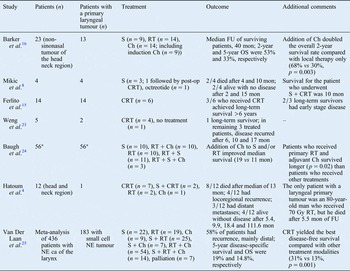
Ferlito et al. reported achieving long-term survival of more than 6 years in 3 out of 14 laryngeal small cell carcinoma patients following combination treatment with a multidrug chemotherapy regimen and radiotherapy.Reference Ferlito, Pesavento, Recher, Caruso, Dal Fior, Montaguti, Carraro, Narne and Pennelli15 However, these three patients were diagnosed with early stage tumours, i.e. two patients with stage I and one with stage II. Barker et al. reported the M.D. Anderson Cancer Center experience of managing 23 patients with non-metastatic, non-sinonasal neuroendocrine carcinomas who were treated between 1984 and 2001.Reference Barker, Glisson, Garden, El-Naggar, Morrison and Ang16 Thirteen of the 23 patients had primary laryngeal tumours with a subsite distribution of 11 supraglottic, 1 glottic and 1 subglottic. In this series, the use of cisplatin and etoposide combination chemotherapy doubled the overall two-year survival rate compared with that achieved with local therapy only (68 per cent vs 30 per cent, p = 0.003). It also significantly reduced the rate of two-year distant metastasis from 79 per cent to 39 per cent. The authors concluded that the addition of combination chemotherapy to local treatment was the single most important factor in improving the treatment outcome. The authors also advocated the use of sequential chemoradiotherapy (i.e. induction chemotherapy followed by radiotherapy) and consideration of prophylactic cranial irradiation because of the large incidence of intracranial metastases (25 per cent and 44 per cent after two and five years, respectively). However, in another study, Baugh et al. reported that only 7.7 per cent of laryngeal small cell carcinomas metastasised to the central nervous system.Reference Baugh, Wolf and McClatchey17Table II summarises the findings of published literature, highlighting the patient outcome for laryngeal small cell carcinoma.
Summary of studies describing the experience of managing small cell carcinoma of the larynx or head and neck

*The study included a survey of the long-term follow up from 56 previously reported cases of the small cell carcinoma of larynx. S = Surgery; RT = radiotherapy; Ch = Chemotherapy; CRT = chemoradiotherapy; FU = follow up; OS = overall survival; mon = months; post-op = post-operative; NE = neuroendocrine; ca = carcinoma
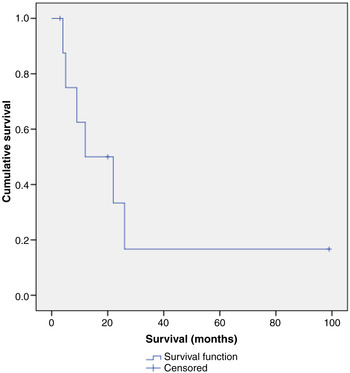
In our study, most patients (seven out of nine) were either current smokers or ex-smokers; this was consistent with published literature.Reference Mikić, Zvrko, Trivić, Stefanović and Golubović8 Although most patients (five out of nine) presented with supraglottic primary tumours, the incidence of subglottic primary disease was higher (in four out of nine): one patient presented with a stage I (T1N0M0) tumour and one presented with a stage II (T2N0M0) tumour. This was an unusual finding because subglottic carcinomas are rare, constituting approximately 1 per cent of laryngeal cancers and usually presenting only at advanced stages.Reference Bahar, Nageris, Spitzer, Popovtzer, Mharshak and Feinmesser18 Although three patients in our study developed small cell laryngeal carcinoma as a second primary tumour in a previously irradiated field, these are unlikely to be radiotherapy-induced malignancies because published evidence for this is lacking. As in other published reports, the treatment modality was primarily a combination of chemotherapy and radiotherapy and outcomes were consistent with those of previous publications. Less than 50 per cent of patients (4 out of 9) received radical treatment; unfortunately, in 3 of these patients, the disease recurred 11, 12 and 19 months after the initial diagnosis. Only one patient was a long-term survivor (more than eight years). To date, six patients have died, with a median overall survival period of 10.5 months (range 4–26 months), representing a dismal prognosis (see Figure 1). None of the patients developed intracranial metastases.
Graph showing Kaplan–Meier estimates of overall survival of patients with small cell carcinoma of larynx.

Gnepp et al. reported a mean survival time of 9.8 months (range 1–26 months), with 73 per cent of patients dying of widespread metastasis.Reference Gnepp, Ferlito and Hyams19 The two- and five-year survival rates have been reported as 16 per cent and 5 per cent, respectively.Reference Gnepp12 Soga et al. reported a five-year overall survival rate of 7.7 per cent.Reference Soga, Ferlito and Rinaldo20 These figures are similar to those for small cell lung cancer patients.Reference Ferlito and Rinaldo21 Turrisi et al. reported significantly improved outcomes for small cell lung cancer patients treated with more intense hypofractionated radiotherapy and chemotherapy.Reference Turrisi, Kim, Blum, Sause, Livingston and Komaki22 Given the small number of cases, randomised control trials for small cell laryngeal carcinoma are not realistic; however, it may be possible to extrapolate the improved outcome for small cell lung cancer patients to treating small cell laryngeal carcinoma.
• Small cell neuroendocrine carcinoma of larynx is a rare and aggressive malignancy
• Management principles are extrapolated from evidence for small cell lung cancers
• Radical surgery is generally best avoided
• Concurrent or sequential chemoradiotherapy is the treatment of choice
• Platinum and etoposide combination chemotherapy provided the best results
• Although logistically challenging, there is a need for international multicentre trials
Conclusion
Our relatively small number of patients reflects and confirms the experiences of other centres. Small cell carcinoma of the larynx is an uncommon but aggressive tumour. The present UK standard of care is to use platinum and etoposide combination chemotherapy with consolidation radiotherapy if the patient is fit enough. Even with this treatment, local and distant metastases are common, and there appears to be little response to second-line treatments. Although the logistics would be challenging, there is a need for international multicentre trials in this disease modelled on those performed for other cancers, for example paediatric malignancies.