Over the last decade, the discipline of political science has engaged in renewed—and contentious—debate about the value and practices of “research transparency.” Research transparency refers to disclosing in publications the processes used to generate and analyze the data underpinning claims and conclusions, and potentially sharing (when ethically and legally possible) those data (APSA 2012). Discussions about the benefits, opportunities, challenges, and costs of transparency have played out in disciplinary conference panels and presentations, as well as in print. Those discussions have often recreated the disciplinary divide between scholars whose work employs quantitative analysis and data and those whose work is more qualitative. Calls for transparency have also divided the community of scholars who employ qualitative evidence and approaches in their work.Footnote 1
Political science inquiry that entails scholars interacting directly with people has been at the center of disciplinary debate about transparency. Much of what political scientists study is fundamentally about people—their beliefs and preferences, their values and perspectives, their actions and inaction, their reactions and interactions, their collective action, and their silence. A great deal of the empirical evidence that underpins our work, from public opinion data, to descriptions of corruption and conflict, to observations of rallies and rituals, is drawn from or based on people. Scholars who collect evidence using ethnography, interviews, focus groups, surveys, experiments, and other interactive methods pursue research transparency to varying degrees, in different ways.
Our discipline has also recently seen lively debate over what comprises ethical research practices. A central theme in these discussions has been how the imperative to ethically conduct and disseminate research involving direct interaction with people intersects with calls for greater transparency. These discussions have also considered the ethical obligations of researchers to the broader set of people who participate in or are affected by the research beyond “human subjects” narrowly defined, such as local communities, those exposed to experimental interventions, and research assistants. And since the Perestroika movement re-highlighted the issue of methodological pluralism in the early 2000s, political science has also been in implicit and explicit debate about how we value different forms of research and ways of knowing. These discussions have also intersected with those concerning transparency, as distinct epistemological approaches entail different conceptualizations of—and ways of creating and analyzing—evidence, and therefore imply different understandings of and approaches to transparency.
In this essay, we analyze the relationship between research ethics, epistemological commitments, and transparency as practiced by political scientists who conduct research that directly engages with human participants. In taking on these issues, we follow other scholars in broadening the focus of the debate in three ways.
First, similarly to QTD Working Group (WG) I.2, we consider “research transparency” to comprise part of “research openness,” and focus on the latter. As noted earlier, transparency refers to revealing information about how data were produced and analyzed, and potentially sharing those data (when ethically and legally possible) with a scholar’s research community. Research openness, which is more expansive, involves sharing information about a project’s epistemological approach, research methods, and evidence; about its purpose, funding, and commitment to the protection of identities and sensitive information; and about problems and dilemmas encountered in its conduct. Further, in contrast to transparency’s audience of other scholars, openness may involve other audiences as well, including human participants and their communities, research collaborators, research communities beyond those to which a scholar belongs, practitioners, governmental and non-governmental entities and actors, and the broader public. These groups may face choices about involvement in the project, or may act based on its findings, thus scholars should help them to comprehend, evaluate, and learn from the project’s aims, foundations, and evolution.
Second and relatedly, calls for “data” sharing overlook varied notions of what comprises the evidence on which scholars’ arguments draw, an epistemological difference with implications for what it means to be appropriately open about our inquiries’ empirical basis. We thus use the term “evidence” rather than “data” when considering the empirical basis of research generated through interaction with people, as the former term better captures the full range of research.
Third, following new norms approved by the American Political Science Association (APSA) in 2020 (Principles and Guidance for Human Subjects Research), we do not limit our analysis to “human subjects research” as regulated by the U.S. government’s “Common Rule” (United States Federal Government 2018). First, we follow the affirmation in the APSA Principles that researchers “should respect autonomy [and] consider the wellbeing of participants and other people affected by their research,” not just those considered “subjects” under the Common Rule’s definition of “human subjects.”Footnote 2 Our discussion focuses on “human participants,” whom we define as persons we directly engage in research as respondents, including those whom we expose to experimental interventions. (Our definition excludes those indirectly affected by research but not directly engaged by the researcher.) Human participants in a research project include, for instance, expert witnesses (who convey their expertise rather than their experience), but not research assistants, staff, or respondents’ broader community. The term “human participants” rightly recognizes the important role our respondents play in research and their agency in agreeing to help produce the evidentiary, and sometimes theoretical, basis of our work. Further, we also follow the assertion in the APSA Principles (echoed in other recent work on research ethics) that scholars’ obligations to respect and protect the people they involve in their work hold no matter whether that work is captured by the Common Rule’s formal definition of “research.”Footnote 3
Our core contribution is to offer an integrated account of how the actions that scholars who conduct human participant research take to respect ethical principles (which vary by research substance and settings), those scholars’ epistemological commitments, and the interaction between the two, affect their positions on and practices of openness.Footnote 4 In this context, “ethical principles” are the values that govern research with human participants, which stem fundamentally from respect for them as persons. By “epistemological commitments” we mean scholars’ position on what constitutes evidence, knowledge, and knowledge production. We contend that these principles and commitments mandate, guide, and also constrain how open scholars who conduct human participant research can be, and how they can be open, resulting in variation in openness across projects and scholars. We do not claim that these are the only factors affecting how such scholars pursue openness, but we show that they influence that pursuit in particularly important ways.
Just how scholars’ adherence to ethical principles and epistemological commitments can affect how they pursue transparency has been a focus of disciplinary discussions (see the third section). Our account of openness in human participant research draws and builds on these interventions, but differs in two ways. First, we systematically consider how both ethical principles and epistemological commitments—simultaneously, both independently and in concert—influence openness. We contend that these principles and commitments serve as a prism through which multiple features of a research project are refracted, resulting in a scholar’s inclination and ability to pursue openness in different ways and to different degrees with the audiences of her work. They influence scholars’ pursuit of openness both directly and indirectly, and they may reinforce or be in tension with each other, with different implications for scholars’ openness practices. Second, we show how both types of factors can not only constrain and prevent openness, but also animate and require it.
Our account helps to substantiate the view, long voiced by transparency’s skeptics and some of its advocates, that it is inappropriate, indeed impossible, to develop blanket rules for pursuing transparency. We hope that a better appreciation of how ethics and epistemology affect scholars’ views on and pursuit of openness will help to address disciplinary contention over transparency and offer paths towards learning across disciplinary divides.
A second contribution is to offer ideas for how scholars should pursue openness in research with human participants. In doing so, we reflect on current practices and encourage consideration of additional aspects of openness. We offer an aspirational framework for openness in such work, and discuss concrete strategies for pursuing openness ethically, and in ways that honor scholars’ epistemological commitments. To date the debate regarding transparency in qualitative research has mainly focused on whether scholars should pursue transparency, and if so, what materials they can provide in doing so (Kapiszewski and Karcher Reference Kapiszewski and Karcher2021). The framework and strategies we discuss encourage a more deliberate focus on how to pursue openness in research with human participants ethically, and in epistemologically appropriate ways.
We first summarize in more detail what we mean by ethical principles in human participant research, epistemological commitments, and research openness. We next trace the ways in which ethical principles require and constrain, and epistemological commitments shape and guide, scholars’ pursuit of openness with human participants and research communities. We focus on two types of human participant research, ethnography and elite interviewing, though our discussion is relevant to other types as well, and on openness with two key audiences: human participants and research communities. We suggest that pursuing openness in light of ethical dilemmas, via ethical practices, and in epistemologically appropriate ways, represents good social science, offering authors an opportunity to make their work more intelligible so others can understand and assess its achievements and limitations. We then discuss strategies that scholars might adopt to pursue openness with both their research participants and their scholarly community while adhering to ethical principles and honoring their epistemological commitments. In the concluding section, we consider some implications of our argument for the discipline.
Throughout, we emphasize two themes. First, we underscore the importance of reflexivity for the ethical conduct of research, including the ethical sharing of evidence and information on its generation and analysis. By reflexivity we mean sustained reflection on how the researcher and her positionality affect evidence generation, on the implications of ethical principles in the research setting, and on the consequences of both for research practices and the research process (QTD WG I.2 Reference MacLean, Posner, Thomson and Wood2018). Second, given what our argument implies about the impossibility of blanket rules for pursuing openness, we stress the importance of different epistemic communities working together to discern how to make our work more open in ways that adhere to ethical principles, honor our diverse epistemological commitments, and showcase the power of our inquiry.
Ethics, Epistemology and Openness in Research with Human Participants
In this section we briefly discuss the individual elements—ethical principles, epistemological commitments, and openness—of our analysis of human participant research.
Ethical Principles in Human Participant Research
We contend that scholars’ choices about how and how much to pursue openness vis-à-vis any audience should be directed by shared ethical principles (particularly the protection of human participants and respect for their preferences). As we consider in more detail in the next section, ethical principles can both require scholars to be open about some aspects of their research project and limit the type and amount of information about the project that they share.
As noted earlier, our discussion of ethics draws on APSA’s new Principles and Guidance for Human Subjects Research. Footnote 5 The Principles are the ethical foundations of all kinds of research with human participants, to which all researchers should adhere. What adherence means differs across research projects, and scholars interpret and apply the twelve foundational principles differently. The preamble emphasizes that the intent is to promote ethical reflection across the discipline. The document concerns not just “human subjects” as defined by the U.S. Common Rule, but any persons whom researchers directly engage in, or who could be affected by, the research process. Thus in some aspects the Principles extend beyond requirements put in place by “Institutional Review Boards” (hereafter IRBs), i.e., committees that review “human subject research” at most institutions of higher learning in the United States.
Ethical research with human participants is founded on three general principles (APSA 2020, 2). Researchers are obliged to respect the autonomy and consider the wellbeing of participants and other people affected by their research, and to be open about the ethical issues that arise in research and the decisions they take. Researchers bear sole responsibility to consider the ethics of their research-related activities and cannot delegate that responsibility to review boards or other entities. Deviations from the standards of conduct and reflexive openness described in the Principles must be acknowledged and justified in scholarly presentations and publications.
Briefly summarizing the more specific principles that follow, researchers should be aware of power differentials, taking particular care to respect the autonomy of low-power or vulnerable participants. Researchers should consider the potential harms (psychological, social, economic, and physical) associated with their research. They should generally avoid harm when possible, minimize it when avoidance is not possible, and not conduct research when harm is excessive. Researchers should generally seek participants’ informed and voluntary consent; in some settings, consent must be renewed as conditions change. However, when researchers investigate “powerful parties … covert or deceptive research with more than minimal harm may sometimes be ethically permissible” (Principle 4, APSA 2020 2-3). Researchers should carefully consider whether deception is necessary and whether it involves more than minimal risk of harm and must disclose the use of deception in publications and presentations. Researchers should generally keep participant identities confidential; in some settings they should not document participant identities, and in others they may not need to know them at all. Researchers should consider the broader social impacts of their work and should seek consent for compromising the integrity of political processes from those directly engaged in those processes. Researchers should be aware of relevant laws and regulations and acknowledge in publications and presentations whether they complied. Finally, the responsibility to promote ethical research goes beyond researchers to advisors, teachers, editors, and reviewers.
Epistemological Commitments in Human Participant Research
The degree to which and ways in which scholars pursue openness are shaped and guided by their epistemological commitments. By “epistemological commitments” (Wedeen Reference Wedeen2010; Jacobs and Büthe Reference Jacobs and Büthe2021), we refer to a scholar’s core beliefs about what comprises knowledge and knowledge production, evidence supporting knowledge claims, and persuasive explanation. Scholars choose epistemological commitments, learning them as they are trained in particular epistemic communities.
Scholars’ epistemological commitments have implications for how they conduct research. Those commitments lead them to choose a specific logic of inquiry—i.e., to consider certain projects as valuable contributions to knowledge, to adopt as promising particular approaches to conducting research, and to use particular methods to gather and analyze evidence. These choices, in turn, influence what information about, and evidence produced by, a project they share and how they do so. In short, epistemological commitments are reflected in both the logic of inquiry underlying research practices, and the “logic of openness” underpinning the pursuit of openness.
Discussions in our discipline about scholars’ epistemological commitments often place them in two broad categories: positivist and interpretivist. In very general terms, scholars with more positivist leanings understand the information conveyed to them by human participants (typically captured in coded responses, recordings, transcripts, or detailed notes) as constituting concrete evidence on which objective truth claims can be based (or partially based). Often as a separate step after collecting that evidence, they analyze it to draw descriptive and causal inferences (Bleich and Pekkanen Reference Bleich, Pekkanen and Mosley2013; Martin Reference Martin and Mosley2013), and deploy it to make arguments about empirical phenomena.Footnote 6 Such scholars, of course, recognize that respondents may present information in idiosyncratic ways, embellish what they know, or suppress relevant information, and they take their knowledge or suppositions about these intentions into account when evaluating the evidentiary value of that information (see, e.g., Tansey Reference Tansey2007). Given these understandings and goals, scholars with positivist epistemological commitments are often content with brief, limited interactions with any particular human participant (although see, e.g., Read Reference Read2018).
Interpretivist approaches draw on decidedly different epistemological commitments, with correspondingly distinct logics of inquiry, openness, and explanation (Frazer Reference Frazer2020). Many scholars who engage in ethnography, for instance, have a sensibility focused on the nuances of meaning and meaning making and seek to chronicle aspects of lived experience (Wedeen Reference Wedeen2010). Ethnography therefore requires immersion in a “community, cohort, locale, cluster, or related subject position” (QTD WG III.3 Reference Smith, Schwedler and Simmons2018, citing Schatz Reference Schatz2009) as a logic of inquiry. As the scholar learns through immersion, her fieldnotes record her evolving understanding and interpretation of her observations and interactions as well as more structured encounters such as interviews and oral histories (QTD WG III.3 Reference Smith, Schwedler and Simmons2018). Fieldnotes are therefore not intended and cannot function as “raw data” on which ethnographic analysis draws (QTD WG II.2 Reference Arriola, Pollack and Shesterinina2018); they reflect the experience of a particular ethnographer in a specific setting and time and mirror her categories and concerns. Moreover, for scholars with interpretive epistemological commitments, the processes of evidence gathering and interpretation are interwoven and inseparable.
We acknowledge that this binary is imprecise and insufficient. Focusing on two ideal types obscures heterogeneity within each epistemological category in practices relevant to our discussion, and implicitly neglects approaches that bridge the two (Wedeen Reference Wedeen2010). For instance, ethnographic work sometimes shares with positivist research a commitment to causal explanation. As Wedeen (Reference Wedeen2010, 268) argues, “Ethnography can demonstrate that previous generalizations were wrong (thereby producing new ones), replicate findings (but not necessarily encounters), explicate mechanisms that can have wide-ranging application, and bring new ways of seeing and understanding into plain view.” Further, each set of commitments accommodates various methods for gathering and analyzing evidence; for example, a scholar with positivist commitments might use both process tracing and regression analysis. Moreover, both sets of commitments accommodate some of the same methods for gathering evidence (e.g., interviews). We nonetheless draw on the dichotomy and positivism and interpretivism’s contrasting logics of openness to organize what follows.
Openness in Human Participant Research
By “research openness” we refer to authors sharing information about the key parameters, conduct, and results of scholarly inquiry with a range of potential audiences. In broadening our focus beyond research transparency, we do not seek to diminish transparency’s importance: sharing information about evidence generation and analysis—and the evidence itself—with scholarly audiences (when this can be done ethically) helps researchers to demonstrate the rigor and facilitates the evaluation of their research. However, researchers also have ethical obligations to be open about other aspects of their research with other audiences. Doing so can help them to accomplish their intellectual goals, no matter the epistemological commitments that underlie them.
We focus here on two audiences: the human participants whom scholars directly involve in their research and research communities. While the term “audiences” connotes passive recipients of information about a research project, some audiences—research participants in particular—may actively contribute to the formulation of a project’s methods or evidence.
Our baseline position is that it is often better for scholars to be more rather than less open with a broad range of audiences—as ethically and epistemologically appropriate—when conducting, describing, and sharing the empirical results of human participant research. Doing so holds the potential to produce more intellectual, ethical, and practical benefits than does simply being transparent about one’s research. However, openness should not be fetishized. Openness is only valuable for what it potentially produces—stronger participant understanding and more meaningful informed consent, better quality evidence as a result, better comprehension of research practices and of the empirical underpinnings of scholarly work by research communities, and greater evaluative potential.Footnote 7 Openness is beneficial when it leads to these outcomes, is pursued in epistemologically appropriate ways, and helps to fulfill and does not undercut ethical obligations to human participants and research communities. How and how much authors pursue openness should be considered in this light, and should not define how scholarship is evaluated or how decisions regarding its publication are made.
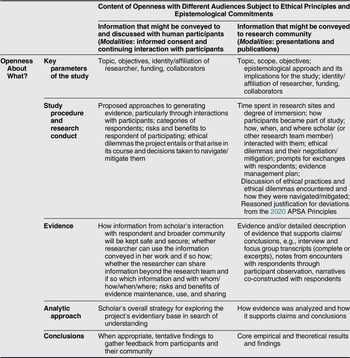
Table 1 proposes a framework for openness in human participant research, outlining how scholars who conduct such research should pursue and demonstrate openness with two audiences. The table is simultaneously descriptive and prescriptive: many researchers are open in some of the ways outlined in the table, and we believe more researchers should be open in more of the ways that the table highlights, as ethically and epistemologically appropriate. The left column concerns the information scholars might provide and discuss when being open with human participants—i.e., respondents and, in more immersive research, other people in the setting within which a researcher is working. The right column concerns information scholars might convey when being open with their research communities. The items in the table comprise the “content” of each aspect of openness vis-à-vis each audience.
Framework for openness in research with human participants
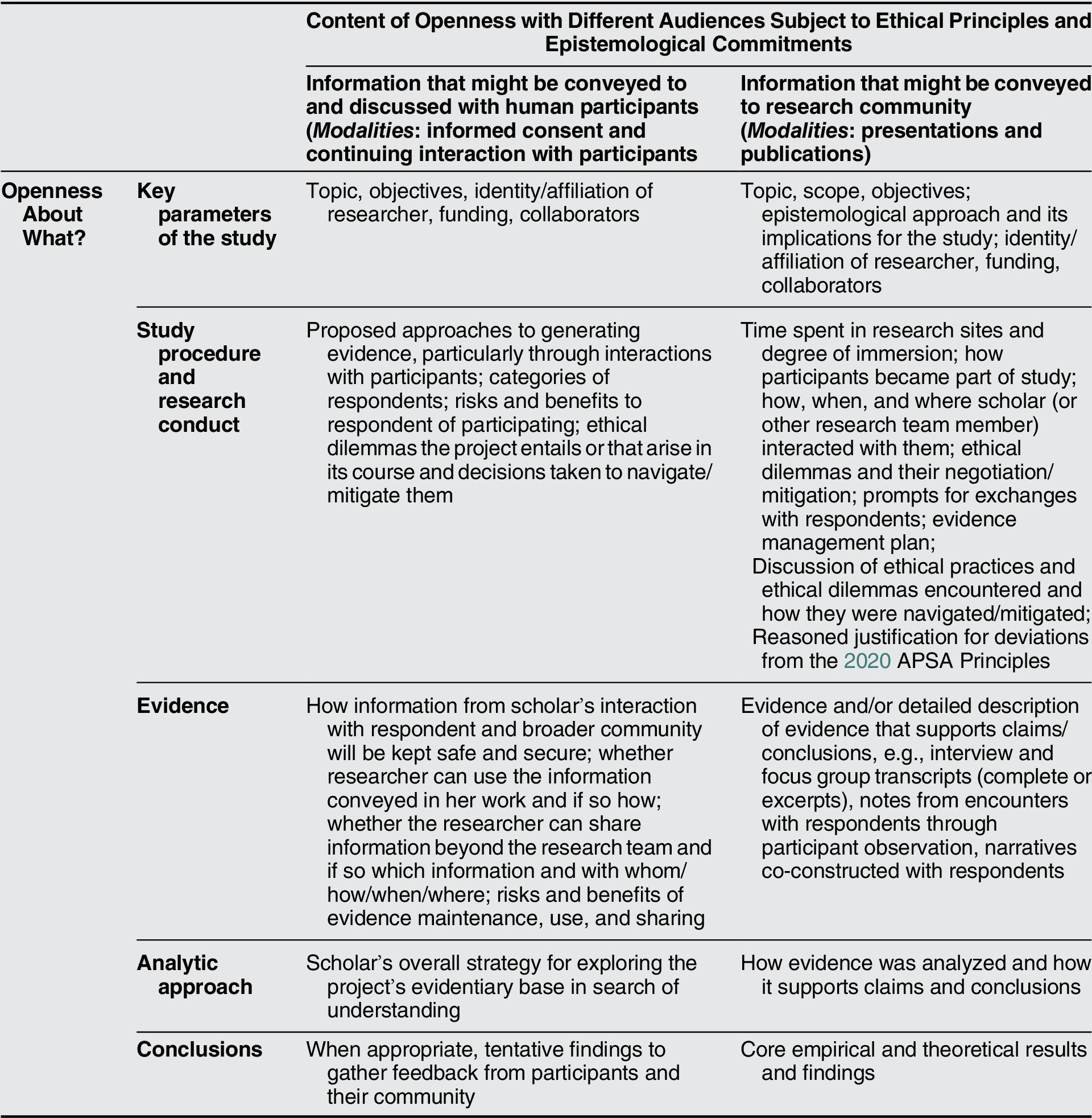
As noted at the top of the table, and discussed further in the article’s next section, ethical principles and epistemological commitments should and do shape how scholars pursue openness, and thus impinge on the “content” of openness. In particular, when ethics and openness conflict, conducting research in an ethical way must be prioritized over conducting research in an open way.
Pursuing openness in human participant research entails researchers asking themselves questions about each aspect of openness in table 1, making careful and nuanced choices (based on ethical principles and their epistemological commitments, often in consultation with human participants), and potentially reconsidering those choices over time. As this process suggests, openness cannot and should not be an all-or-nothing proposition: scholars make choices not between being fully open about their research or not being open at all, but rather about which aspects of the work to be more open or less open, how, when, and with whom. Scholars answer these questions in very different ways when conducting research, leading to significant variation in openness across research projects.
How Ethical Principles and Epistemological Commitments Influence Openness in Human Participant Research
Ethical principles and epistemological commitments influence both how scholars design and conduct research involving human participants, and how they pursue openness. The effects that these principles and commitments have on the pursuit of transparency have been a focus of disciplinary discussions. Some scholars show how abiding by ethical principles limits transparency.Footnote 8 Others emphasize how scholars’ epistemological commitments affect their pursuit of openness.Footnote 9 A few scholars consider the effects of both.Footnote 10
Building on these discussions, we offer an integrated account that illustrates how ethical principles and epistemological commitments—independently and through their interaction—influence openness. We suggest that they serve as a “prism” through which scholars’ descriptions of the research process and evidence gathered are refracted, leading to decisions about which aspects of their work to cast light on, and how much light to cast (i.e., how and how much to pursue openness). We do not contend that these are the only factors shaping the conduct of research and pursuit of openness; professional incentives, journal editors’ expectations, and journal word-count limits may also affect both, for example. Nonetheless, we hold that scholars’ adherence to ethical principles and epistemological commitments affect how they pursue openness in particularly fundamental ways.
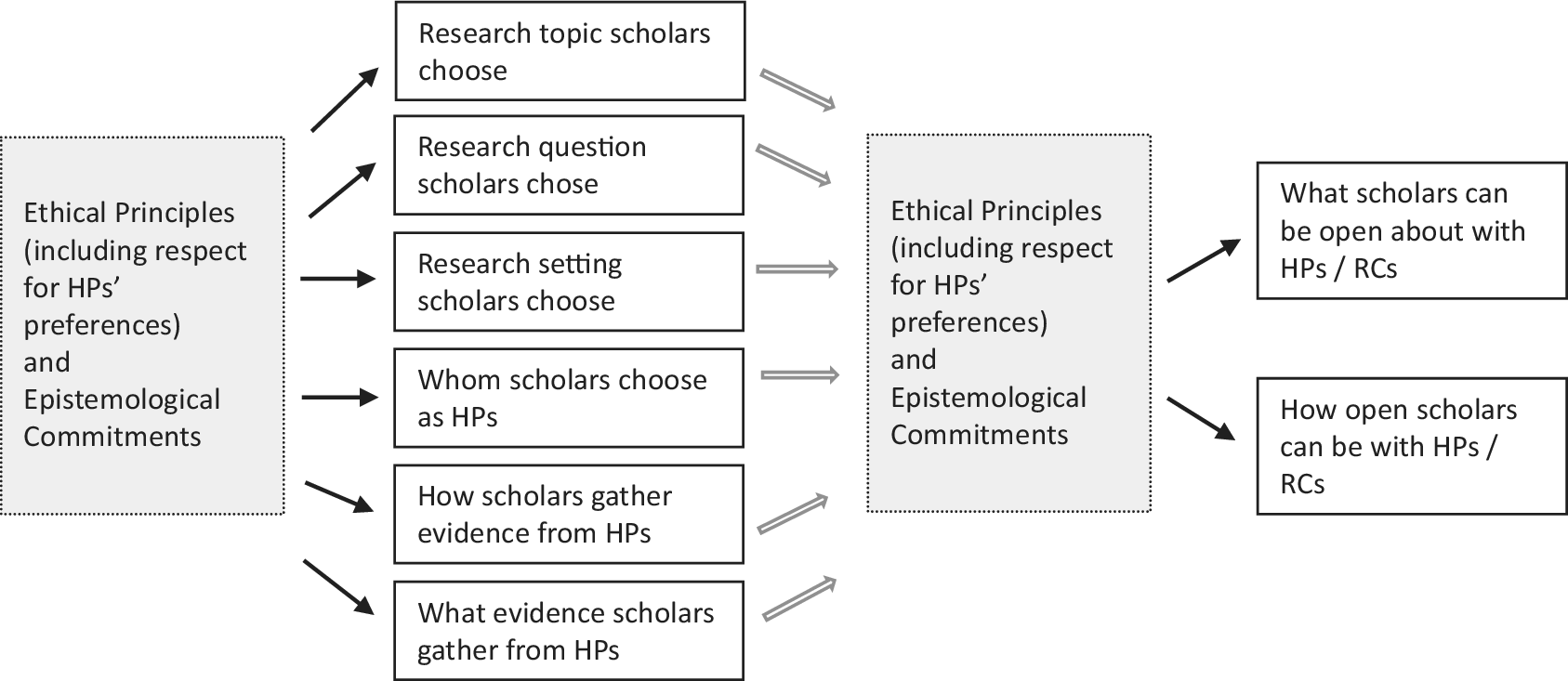
Figure 1 offers a stylized model of these dynamics. Ethical principles (including respect for human participants’ preferences about their interactions with a researcher) and the researcher’s core epistemological commitments influence (darker arrows) her research from the very start. They lead her to prioritize particular topics, investigate those topics by asking certain questions, and rule out others as unanswerable or unethical. They also lead her to carry out the study in particular settings, and structure whom she invites to participate in her project and how she interacts with them, shaping how she gathers evidence and what evidence she gathers. The contours and content of the resulting research project are then refracted through (lighter arrows) ethical principles (now including participants’ preferences with regard to the researcher sharing the information they convey) and epistemological commitments, which in turn direct (darker arrows) what the researcher will be open about, how open she will be, when, and with whom.
How ethical principles and epistemological commitments shape openness toward human participants (HPs) and research communities (RCs)
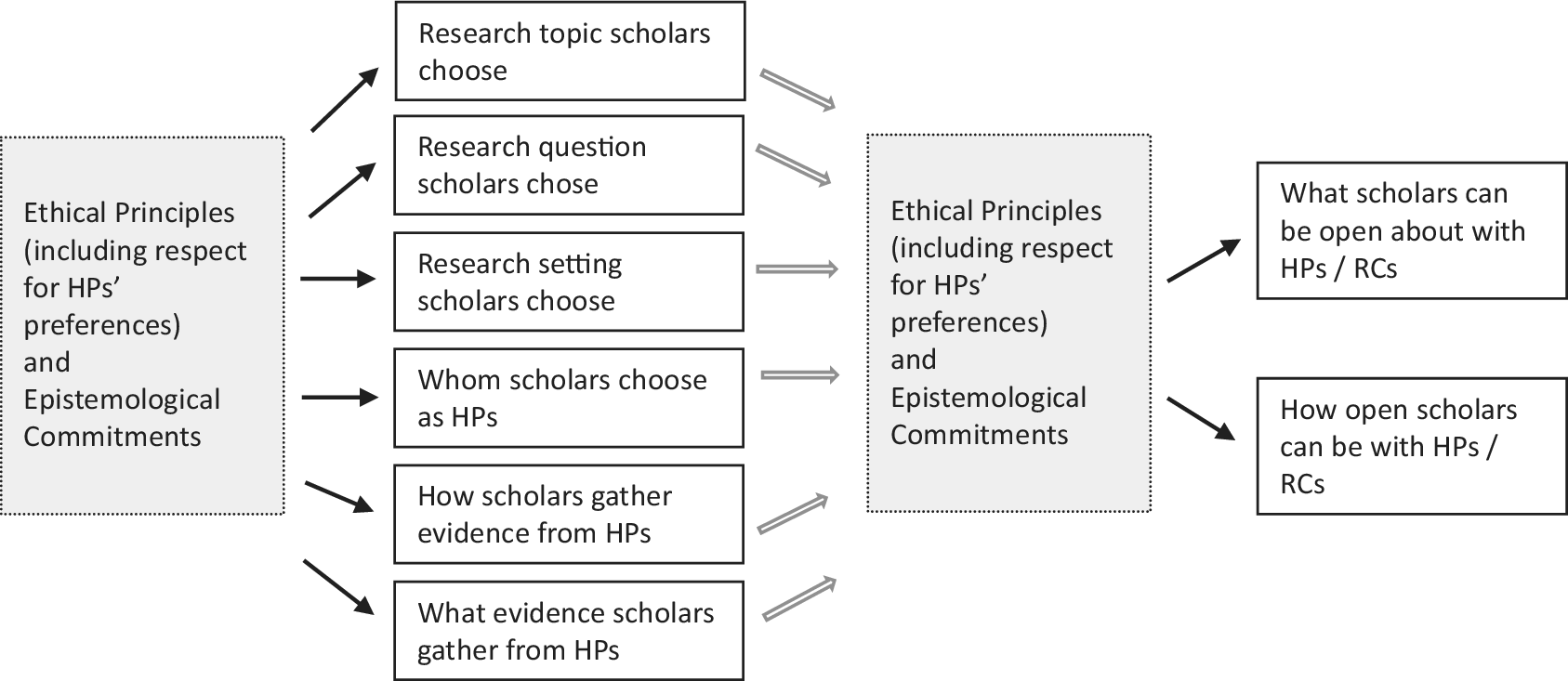
Ethical principles and epistemological commitments affect research practices both directly and indirectly, and both independently and in concert. They may reinforce or be in tension with one another, with different implications for research. Of particular relevance to this article (and as we discuss later), they may require, shape, guide, or constrain openness, leading to variation in openness across researchers and projects. None of these dynamics automatically emerges: as the figure suggests, what ethical principles call for with regard to, and what epistemological commitments imply for, openness depend on the topic and question, the setting, the nature of the research and, importantly, human participants’ preferences with regard to what information can be shared.
Just how ethical principles and epistemological commitments influence openness also varies due to their very different nature. Ethical principles are normatively prior to epistemological choices (QTD WG I.2 Reference MacLean, Posner, Thomson and Wood2018): they should structure the entire research process, serving as the foundation on which scholars design and execute research (or perhaps abandon it if it cannot be conducted ethically), and the backdrop against which they make choices concerning what to be open about and how open to be. Directly involving human beings in our work implies a responsibility to shield them from risk resulting from our research; keep the information that they provide safe and secure; and consult with them about how that information will be handled, used, and disseminated. The risks inherent in a research project may inhibit or prohibit engaging in certain aspects of openness, preventing scholars from being fully open about their work.
Epistemological commitments—particularly scholars’ understandings of what constitutes evidence and how it is constructed—influence the process of conducting research with human participants, and the possibilities of being open about it, within the context of shared ethical principles. Epistemological commitments are not given, but rather developed by particular communities of scholars, and adopted by those who join those epistemic communities. Such commitments thus vary across political scientists, while respect for ethical principles should not.
How Ethical Principles Require and Constrain Openness
Ethical principles can require scholars to be open about multiple aspects of their research (in the ways described in table 1) and can also curtail the type and amount of information that scholars share about their work. These relationships are more complicated than they may seem. For instance, we might initially assume that adhering to ethical principles would lead a scholar to be very forthright about most features of her project with her research participants, and comparatively cautious about openness with her research community. However, adhering to ethical principles both requires and constrains openness with both audiences.
Ethics and openness toward human participants. With some exceptions (noted earlier), ethical principles require that researchers communicate to human participants basic information about their project, including the potential risks and benefits that attach to researchers’ proposed practices (refer to table 1). At the core of this requirement is the principle of informed consent.
Questions of consent have been addressed most carefully for settings where participants may risk significant harm should their participation in a research project or their specific contributions become known, e.g., conflict, post-conflict, or authoritarian settings (Wood Reference Wood2006; Program on Middle East Political Science Studies 2014; Cronin-Furman and Lake Reference Cronin-Furman and Lake2018; QTD WG IV.1 and IV.2 Reference Arriola, Pollack and Shesterinina2018; Thaler Reference Thaler2019). However, actors in other settings may also suffer harm should their participation or contributions become known—for instance, in the form of attacks on their social reputation, psychological stress, or violations of their privacy.
With the growing emphasis on sharing the evidence that underpins research, soliciting potential research participants’ informed consent has become more complicated. In addition to securing consent to participate in the project, and to the researcher’s strategies for keeping the information they offer safe and secure and for using it, now the researcher must also solicit consent to share that information more broadly, discussing what, when, how, where, and with whom. Further, as technology advances, a researcher must help participants understand increasingly sophisticated arrangements for keeping that information safe and secure, and for sharing it. It is ethically incumbent upon researchers to ensure that participants fully understand how they plan to manage, use, and share the information participants offer despite these challenges. Doing so makes consent truly informed and provides participants a meaningful opportunity to influence scholars’ research choices, including those concerning openness.
Moreover, as we discuss in more detail in the next section, in some settings ethical principles require that researchers continue to communicate about the research project with human participants far beyond the initial moment of their interaction. Doing so affords participants ongoing opportunities to reaffirm (or retract) their consent to participate, and to influence how the information they provide will be preserved, used, and shared.
In some instances, however, adhering to ethical principles may restrict openness with human participants, e.g., when less openness is necessary to protect research participants. Sometimes participants having more information about the project could place them at greater risk of harm than knowing less about the project and potentially retaining deniability about its procedures or goals. Also, in some settings, a scholar being open about specific aspects of her research project with certain social groups might undermine the protection of other participants.
Ethics and openness toward research communities. Recent disciplinary discussions have focused on how scholars adhering to ethical principles may limit their pursuit of the “transparency” facet of openness, emphasizing that a scholar sharing evidence gathered through interactions with human participants without their consent, or when doing so could place participants at risk, is unethical. However, adhering to ethical principles can require as well as limit openness with research communities.
As noted earlier, participants’ openness with researchers, and their preferences about how researchers use and share the information they provide, set an upper limit on how open researchers can ethically be with their research community. Researchers failing to adhere to participants’ wishes betrays participants, implicitly suggests it is acceptable to do so, complicates their own and other scholars’ research going forward, and obfuscates the complexity of human participant research.
Participants may consent to a researcher disclosing only segments of a conversation or only certain types of information, or to her sharing the information they offered only with particular audiences or without attribution. The normative priority of ethical principles dictates that scholars strictly adhere to participants’ wishes, potentially restricting openness.
Participants’ choices about sharing information are often driven by the sensitivity of the topic of study and the research questions being asked; participants’ degree of social, political, or economic marginalization, or other forms of vulnerability (see, e.g., QTD WG I.2, II.2, and IV.3 Reference Arriola, Pollack and Shesterinina2018); and attributes of the research setting. Research participants living in unstable, violent, or authoritarian settings, or who have experienced, for example, violence, conflict, illegality, marginalization, or discrimination, may only consent to the information they provide being used and shared in limited ways.
Of course, there is not an inverse correlation between, on the one hand, the sensitivity of a research topic, the dangerousness of a research setting, and the vulnerability of respondents, and on the other, respondents’ willingness for the information they offer to researchers to be shared more broadly. Some marginalized populations may wish for their accounts or experiences to be known more widely: researchers can give broader voice to people who have been silenced, or otherwise unheard. Indeed, some human participants may only agree to discuss difficult or traumatic phenomena or events with a researcher if she pledges to share their story. Ethical principles demand that researchers comply with participants’ wishes. Conversely, some elites may only offer sensitive information to a researcher if she assures them that she will shield their identities in her work, and not share her notes from their conversation.
Participants themselves are generally best positioned to assess the potential risk they may run from a scholar sharing the information conveyed during a research interaction. However, in some settings, even when participants grant permission for some or all of the information they convey to be shared, the researcher may decide that the potential risk to respondents is too great to do so—or may limit access to shared information to reduce the likelihood that harm may come to participants—despite the ethical dilemma that diverging from participants’ wishes and thus attenuating their agency presents. For instance, Morgenbesser and Weiss (Reference Morgenbesser and Weiss2018, 14), discussing their work in authoritarian Southeast Asia, recount how they concluded it was in the best interest of the safety of the young activists they interviewed to disregard their request that their names be used in publications resulting from the research.
Importantly and conversely, ethical principles may encourage scholars to be open—or ethical concerns may arise about scholars not being open—about human participant research with their research communities (and others), when openness can be pursued ethically and in epistemologically appropriate ways.Footnote 11 For instance, when researchers share with their scholarly communities (with participants’ consent) information that participants offer about sensitive topics, other researchers who wish to study similar dynamics with similar respondents can draw on it. Doing so helps prepare them to interact with human participants in a thoughtful way, perhaps allowing them to avoid asking participants to discuss sensitive issues once again.
Broadening the scope from research ethics to ethics more generally: if research was paid for with public funds, might it be unethical not to share the evidence it produced, and information about their generation and analysis—if ethically and epistemologically appropriate? If social science is a communal, cumulative endeavor in which scholars learn from each other, are researchers ethically bound to responsibly share the evidentiary base of their work and information about how they produced it, thereby enabling intellectual progress and the accumulation of knowledge? Finally, if one goal of political science research is to produce accurate and actionable information relevant to a wide range of social concerns, under what conditions would not being open about how we developed that work and about its empirical underpinnings be considered unethical by rendering our work less persuasive, understandable, and useful to policy makers and activists?
How Epistemological Commitments Shape and Guide Openness
The epistemological commitments that scholars who conduct human participant research hold also influence the content, form, and degree of openness they pursue with both their human participants and their research community, and whether and how they can do so.
Epistemology and openness toward human participants. No matter a scholar’s epistemological commitments, being more open about her research with participants who share her goal of understanding can build trust, encouraging and empowering those participants to offer more relevant, helpful information. For instance, carefully evaluating potential participants’ reactions to recruitment can facilitate critical updating of interview and experimental protocols. Helping sympathetic or neutral respondents to grasp the research can also lead to greater access, deeper participant-researcher relationships, increased safety, and methodological innovation; can improve the evidentiary basis of the inquiry and increase scholars’ confidence in their evidence; and ultimately can lead to better-supported arguments. For example, Davis (Reference Davis2020) demonstrates how including local actors in the development, design, and dissemination of her research in Africa helped to strengthen its scholarly contribution.
Yet epistemological commitments may also attenuate a scholar’s desire to be open with human participants if she worries that openness about some aspects of a research project might diminish the quality or quantity of the information they convey. She may be concerned, for instance, that potential participants will decline to participate if they are uneasy about the project’s funding or methods, or about her proposed strategy for sharing the information they convey, fearing their participation and contributions could be “written all over the internet” (Cramer Reference Cramer2015). Likewise, a scholar may believe that openness about, for example, her hypotheses or the theoretical underpinnings of her project, or about other participants, could bias the information that those who do agree to participate in the project offer. Alternatively, she may worry that participants will agree to her proposed evidence-sharing strategy but then significantly limit their responses; or she may fear that even if she and participants carefully devise arrangements for the limited or partial sharing of the information participants offer, the prospect of that information being shared at all will lead them to alter their responses (with or without her knowledge). In short, a scholar who is concerned that openness about some attributes of a project with potential or actual research participants will affect the sample of respondents or the evidence she collects, potentially biasing her analysis and findings, may be inclined to limit openness accordingly.
Yet ethical principles shape scholars’ openness practices in tandem with their epistemological commitments. These principles dictate that researchers should be open with potential participants (and faithfully honor their requests concerning the sharing of the information they convey) despite the possible (or actual) effect that doing so has on their participation, on gaining the understanding toward which her epistemological commitments orient her, or on her ability to pursue openness with research communities. We offer some strategies in the next section that scholars can use to begin to address this tension.
In experimental research in particular, scholars’ beliefs about how knowledge is produced may motivate them away from openness with participants and toward deception (providing participants with incomplete or misleading information about a project or their participation). Deception is generally employed in an effort to increase experimental control and minimize the likelihood that participants’ responses will be biased by their knowledge of some aspect of the project—or, indeed, their knowledge that they are participating in a research project.
Again, however, epistemological commitments and ethical principles interact as they affect how scholars pursue openness with human participants. Ethical principles mandate that researchers be open with those whom they expose to experimental intervention, or clearly justify why they are not. Principle 6 of the APSA Principles (APSA 2020, 7-8) identifies different types of deception and strategies for respecting participant autonomy despite deception (e.g., by “debriefing” after participation). Moreover, it calls on researchers engaging in deception to justify in scholarly presentations and publications their exception to the principle of consent, including why they judged the research to pose no more than minimal harm and how they mitigated its potential harm.Footnote 12 If a scholar cannot publicly justify deception, the project should be modified appropriately, or abandoned.
Epistemology and openness toward research communities. Most scholars are deeply invested in other scholars being able to comprehend their work and assess its power, rigor, and limitations. Epistemological commitments guide what it makes intellectual sense for a scholar to be open about with her research community in pursuit of those goals. Scholars with different epistemological commitments have distinct understandings of what constitutes evidence and how it is constructed and analyzed; they thus pursue openness in different ways and to different degrees.
As noted earlier, scholars with more positivist epistemological commitments are more likely to consider the information conveyed by respondents as data that serve as inputs to their analysis. They are concomitantly more likely to believe that sharing those data—for instance, as captured in coded survey responses or interview transcripts—will help other scholars to see the rigor of, comprehend, and assess their work. Of course, not all positivist scholars pursue openness in the same ways. Some scholars—perhaps experimentalists in particular—pre-register their research plan prior to initiating their study, and then generate and analyze data according to that plan (although amendments may be possible); others see more merit in being open about their research design once a project is complete so they can describe how it evolved as they carried it out (Kapiszewski, MacLean, and Read Reference Kapiszewski, MacLean and Readn.d.; see also Yom Reference Yom2014). Yet even scholars in the latter group can conceptually distinguish between the data-gathering and data-analysis processes, and describe how they influenced each other as the project unfolded (see, e.g., Abers and Keck Reference Abers and Keck2013). In short, scholars who subscribe to a more positivist epistemology hold that providing systematic information to their research community about how they generated and analyzed data is desirable, facilitating comprehension of their study and trust in its results.
In contrast, scholars who conduct immersive ethnographic research consider the entire research experience to be the empirical basis of their analysis, including the information shared by participants, their own positionality, researcher-participant interactions, the trajectory of their own misconceptions and reactions to interactions in their field site, participants’ reactions to their presence, and their evolving analysis of those interactions (Pachirat Reference Pachirat2015). Two consequences follow. First, that empirical basis cannot be reduced to transcripts and field notes. The narrow interpretation of “data” often associated with “transparency” can implicitly—and sometimes explicitly—undermine non-positivist epistemological approaches by failing to understand the distinct nature of ethnographic evidence (Jacobs and Büthe Reference Jacobs and Büthe2021; QTD WGs II.2, III.2, III.3 Reference Arriola, Pollack and Shesterinina2018). Second, because the generation and analysis of evidence are not two distinct steps, offering a discrete description of each is difficult. Rather, ethnographers construct their authority as ethnographers by analyzing carefully chosen encounters and exchanges with particular participants and the activities observed and participated in, as well as by detailing their reflexive process, including the trajectory of insights and misconceptions, the challenges encountered and mistakes made, and how they were addressed. Providing such ethnographic evidence rather than sharing transcripts and fieldnotes is to be open in epistemologically appropriate ways.
In sum, ethical principles and epistemological commitments combine to influence how scholars pursue openness toward human participants and their research community, leading to significant variation in the form and degree of openness across research projects. The fact that scholars honoring their epistemological commitments produces significant differences in how they pursue openness suggests the impossibility of blanket rules for addressing the tensions that can arise between ethical and open research practices. It also highlights the importance of each epistemic community developing consensual norms and practices for ethical openness in the type of research in which they engage. We discuss this idea further in the article’s conclusion.
Strategies for Pursuing Openness in Human Participants Research in Ethical and Epistemologically Appropriate Ways
In this section, we describe some strategies that scholars whose research involves human participants can employ in order to be open—in ethically necessary and epistemologically appropriate ways—with those research participants, and with their scholarly community.
APSA’s new Principles represent an important advance for the discipline and offer critical assistance to scholars as they face ethical conundra in their work. However, they cannot address all ethical dilemmas, including those that arise when ethical principles conflict with scholars’ pursuit of openness with research participants and communities. Scholars are thus obligated to engage in ongoing reflexivity—sustained reflection on ethical principles, their own positionality, and how both influence their research practices and processes (QTD WG I.2 Reference MacLean, Posner, Thomson and Wood2018). Such sustained reflection extends far beyond scholars obtaining IRB approval of their project or respondents’ consent to participate: it should undergird, inform, and shape every aspect of the conduct and dissemination of research. In particular, it should guide researchers’ choices about how open to be with their participants and their research community, allowing and encouraging reassessment of both as a project unfolds and circumstances change. Carefully managing evidence gathered, and meticulously documenting research practices and processes, flow naturally from reflexivity. Greater reflexivity helps scholars to conduct their research creatively, ethically, and systematically.
Strategies for Openness with Human Participants
To prepare to address the challenges inherent in human participant research, scholars should seek to understand the research context as best they can, consulting with local experts and scholars to learn about norms and practices (QTD WG I.2 Reference MacLean, Posner, Thomson and Wood2018). Thinking from the start about what ethical principles require for research in particular settings helps scholars to develop appropriate processes to elicit potential respondents’ informed consent to participate in a project, and for scholars to keep safe and secure, analyze, and share the information produced through a research encounter in particular ways. Scholars should also engage as productively as possible with their IRB, seeking both to learn from the insights of its personnel and to teach them about ethical challenges in the relevant setting.
Informed consent. For consent to be meaningful, it must be informed: respondents must understand to what they are agreeing. Translating the abstract legal language and complicated technical verbiage of consent scripts to local terms and metaphors can help researchers to ensure that the consent process is intelligible to potential participants. Further, in order to achieve understanding without biasing responses or (in some settings) endangering participants, scholars might discuss with them the topic, nature, and purpose of the research project in general terms, rather than conveying their specific hypotheses and methods. Also, in some settings, oral (rather than written) consent is more ethically or practically appropriate, as when written consent would endanger or alienate participants.Footnote 13
Researchers should always emphasize to potential respondents that they may decline to participate in a study, or may agree to participate but place their own stipulations on when and how the researcher may use or share the information they convey—and that they may change their mind about information sharing over time. Researchers should stress that these are real options, despite any power differentials between participants and researcher based on, for instance, ethnicity, class, and gender. Ensuring that consent is fully voluntary in environments that are inherently coercive—because of such differentials, or because of recent or potential discrimination, violence, or other circumstances—is difficult but must be attempted.Footnote 14 The agreements researchers and respondents reach on these questions should be clear and specific, and researchers should keep careful track of all guarantees they make to respondents.
In discussing the nature and extent of respondents’ participation, the researcher should help respondents to see how the different facets of consent—proposed plans for keeping safe and secure, using and sharing conveyed information—interact. For example, respondents may not consent to answering particular questions if the researcher wishes to share all of the information they offer, but may consent to answering those questions if the researcher agrees not to share those particular responses, or pledges to de-identify respondents’ answers before sharing them, and/or limit access to the shared information.
It can be productive for researchers and respondents to openly and collaboratively discuss these issues until they reach or reaffirm an agreement.Footnote 15 Insight towards doing so comes from understanding the research process as relational (Fujii Reference Fujii2017). Approaching encounters with participants as opportunities to co-produce meaningful evidence, thereby conveying respect and attentiveness, can help a researcher to enhance the conditions for informed and voluntary consent, minimize power asymmetries, build trust, and lead to better quality evidence. Some researchers transform the consent process into one of mutual obligation, with both participant and researcher signing and exchanging documents outlining their shared understanding of how the information the respondent offers will be kept safe and secure, used, and shared.
Ethical considerations may require scholars to solicit informed consent (and thus be open about a research project) from people beyond those directly participating in the project, or to renew consent with participants over time. In ethnography, soliciting consent is often a complex issue and process: the permission of a respondent’s supervisor or commander, or the consent of community elites, may be legally or practically necessary, and ethically important if participants may run additional risk without it. Further, because ethnography is (almost always) immersive, ethnographers may interact with specific participants on a daily basis and participants may occasionally need to be reminded that the researcher’s purpose is not merely friendship and interaction, but research—and consent renewed. In contrast, scholars who conduct interviews are more likely to interact with respondents just once or a few times, lessening the need for renewed consent.
Ongoing harm mitigation. When political science research is carried out in volatile contexts, the potential for harm to human participants may change over time. Risks may recede or intensify as conflict abates or advances, and unforeseen risks may arise. Identifying, avoiding, and mitigating evolving risks and dilemmas require ongoing reflexivity about the project, its embeddedness in the local social and political fabric, and perceptions of its embeddedness by powerful actors.
Ongoing exchanges with human participants about evolving risks and benefits and other changes that are relevant to informed consent, and about ethical dilemmas that arise and options for navigating them, can be essential to harm mitigation. For instance, researchers should be continuously open regarding dilemmas encountered in implementing mutually agreed on research processes (e.g., breaches in confidentiality, the inadvertent or forced disclosure of human participants’ identities, or the loss of material gathered); the reaction of hostile authorities such as the labelling of a researcher or project as threatening; or the emergence of political, social or economic actors who simply oppose the project or the presence of the researcher.
If risks increase or benefits decrease, consent should be renewed, rather than inferred to continue based on ongoing interaction. Scholars should respect any changes in participants’ preferences regarding their participation, or how the information they offered is managed, analyzed, and shared. If the risk of harm cannot be sufficiently mitigated, and the researcher suspends or cancels the project, she must carefully assess how public to be about that development. If human participants who have agreed to the researcher sharing the information they offer to her later change their mind, the researcher should do everything she can to curtail access; for instance, she should remove the information from any venues through which it was shared, and contact those who have accessed the materials (if known) to advise them of their increased sensitivity and enjoin them to treat the materials accordingly.Footnote 16
Strategies for Openness with Research Communities
As we have emphasized, scholars who conduct human participant research are obliged to respect all assurances they give to participants concerning the confidentiality of participants’ identity and the treatment of information they provide. This obligation holds even if researchers judge the risks of harm to participants to be minimal, or if abiding by those pledges poses professional challenges.
Fortunately, political scientists and information scientists have begun to develop excellent options for the ethical sharing of information gathered from human participants. This sub-section considers how some of those developments can help scholars to address dilemmas and choices that arise as they pursue openness with research communities in ethical and epistemologically appropriate ways; we also discuss how scholars can capitalize on the opportunities openness offers, and optimize the time and energy they invest in pursuing it. Specifically, we discuss whether and what information to share, with whom, where, when, and how. We urge scholars to begin to consider these questions early in the life of a research project.
With regard to what information to share, scholars should share—if ethically permissible and as epistemologically appropriate—the evidence provided by human participants, and the information about its generation and analysis, that will best allow other scholars to comprehend and evaluate the research. If the evidence itself cannot be ethically shared (for lack of consent or for posing undue risk), scholars can pursue openness by describing that evidence. If sharing all evidence gathered is epistemologically inappropriate, as in ethnography, scholars can again describe the information gathered and analyze their evolving understanding of it. In addition, scholars should acknowledge and offer a reasoned justification for any deviations from the 2020 APSA Principles.
The questions of with whom and where evidence offered by human participants and information about its production and analysis can be ethically shared are inter-related. We first emphasize that sharing those materials does not mean making them public or open access. Scholars who wish to control who may see the evidence they have gathered can share it via an institutionalized venue such as a data repository. Doing so affords scholars the ability to devise and apply “access conditions”—clear rules about who may and may not view and retrieve the information. For example, scholars might require potential users to submit a research plan or secure prior approval for secondary analysis from the potential users’ IRB; alternatively scholars may review requests for access before it is granted by the repository.Footnote 17 Such venues often require all users to agree to strict rules before accessing holdings (for instance, pledging not to seek to re-identify respondents or re-distribute the information), and may require that users sign additional agreements at the point of accessing certain evidence. Of course, these important precautions cannot completely prevent the secondary sharing of files, which may occur inadvertently. If the risk of harm from sharing any evidence and information outweighs the potential benefits of that sharing, the researcher must decline to share.
When scholars can share their evidence and information about its generation and analysis depends on the purpose for which they are sharing it. If they are doing so to illustrate the rigor and facilitate the evaluation of their scholarship (rather than so the evidence can be analyzed by others or used in teaching), doing so in tandem with its publication is optimal.
In terms of how, and in what form, to share evidence and information about its generation and analysis, scholars can pursue various strategies, guided by ethical principles and epistemological commitments. As noted previously, ethnographers often discuss the evidence gathered and their evolving understanding in the text of their work. Scholars can also provide such information in footnotes (QTD WG II.2 Reference Arriola, Pollack and Shesterinina2018, citing Parkinson Reference Parkinson2013). They may also create digital annotations to their published work, employing “active citation” (Moravcsik Reference Moravcsik2020) and creating a Transparency Appendix (TRAX); they may also use “annotation for transparent inquiry” (ATI), a similar but more technologically advanced technique that employs “open annotation” allowing for the generation, sharing, and discovery of digital annotations across the web (Karcher and Weber Reference Karcher and Weber2019). Alternatively, scholars can create a research appendix offering a reasoned justification of the ethical aspects of the research and considering how epistemological commitments guide it (as discussed in the next section), describing interview procedures and including interview protocols, depicting participant observation sites, and/or discussing analytical procedures such as coding processes (see, e.g., Shesterinina Reference Shesterinina2016; Bleich and Pekkanen Reference Bleich, Pekkanen and Mosley2013; Fuji Johnson, Burns, and Porth Reference Johnson, Genevieve and Porth2017). Another fruitful strategy is to write a stand-alone piece discussing the research practices employed in a project and offering methodological guidance (see, e.g., Fujii Reference Fujii2012, Reference Fujii2017); pursuing openness in this way offers a publishing opportunity.
In any of these scenarios, if privacy has been promised to participants, a researcher may need to de-identify the information they conveyed (i.e., remove information that can disclose their identity, including to well-informed readers), prior to sharing it.Footnote 18 Scholars should keep in mind that what constitutes sufficient de-identification may change over time as research contexts evolve; consider, e.g., how the euphoria of the Arab Spring gave way to the repression of a subsequent dictatorship (Lynch Reference Lynch2016; QTD WG I.2 Reference MacLean, Posner, Thomson and Wood2018). When privacy must be protected, de-identification is critical even if it diminishes the analytic value of the evidence.
Conclusions and Implications
Openness in human participant research is multi-faceted. It entails sharing information about the key parameters, conduct, and results of scholarly inquiry with multiple audiences, in particular with people whom scholars involve in their work, and with scholars’ research community. We have shown how ethical principles (the implications of which vary across research projects and contexts), epistemological commitments (which vary across scholars), and the interaction of the two influence how scholars should and do pursue openness. These principles and commitments serve as a prism through which various features of a research project are refracted, leading scholars to pursue openness in different ways and to different degrees with the audiences of their work. The primacy of ethics in the pursuit of openness means that researchers must engage in reflexivity in all stages of a research project.
Scholars who conduct research with human participants know how generative and illuminating—and how difficult and time-consuming—such work can be. These qualities are very good reasons for scholars to share the information such work generates with scholarly communities when they can do so ethically, and in epistemologically appropriate ways. Openness represents good social science; highlights the strengths, contributions, limitations, and rigor of our research; facilitates comprehension and evaluability; and strengthens our work’s credibility. Openness can also help to inform other scholars who pursue related research, and benefit those who lack the resources to engage in research with human participants.
The benefits of openness notwithstanding, scholars and the discipline face two core challenges in pursuing openness toward research communities ethically and in epistemologically appropriate ways, to which we now turn.Footnote 19
First, increased emphasis on openness with research communities should not lead to the inappropriate shifting of responsibility for decisions about openness away from researchers. Researchers are best positioned to judge what information conveyed by human participants, and what details about its collection and analysis, it is epistemologically appropriate and ethically responsible to share. Researchers have unique knowledge of their work and the research context, the ethical challenges and dilemmas that arose as they conducted their research, the preferences of their respondents, the sensitivity of the information their project produced, and the possible consequences of sharing that information. The final responsibility for any consequences—positive or negative—that result from openness lies with researchers themselves.
Editors should consider carefully and defer to researchers’ judgement, which is informed by their expertise and research experience. If authors and editors differ with regard to these issues, they should engage in thoughtful discussion, potentially calling on informed and knowledgeable reviewers to arrive at a solution. Ethically justified withholding of evidence and information about its generation or analysis should never be the basis for an editor rejecting an article – and cannot be without dire consequences for multiple forms of political science inquiry. Scholars who feel pressured to engage in practices “disrespectful or potentially harmful to participants” should contact the APSA Committee on Professional Ethics, Rights and Freedoms (APSA 2020, Principle 11, guidance section).
To encourage scholars who conduct human participant research to more actively reflect on—and assist readers and editors to understand—how ethical principles and epistemological commitments guide the conduct of their work and their pursuit of openness with scholarly communities, they should consider including in their presentations and with their published work a brief statement addressing these issues.Footnote 20 The statement should discuss the ethical dimensions of their research practices (as affirmed in other recent work, e.g., QTD WG I.2 Reference MacLean, Posner, Thomson and Wood2018; Jacobs and Büthe Reference Jacobs and Büthe2021), describing steps taken to navigate any ethical dilemmas encountered, offering a reasoned justification for any deviation from the 2020 APSA Principles, and discussing how ethical principles underpin their pursuit of openness.Footnote 21 It should also discuss how scholars’ epistemological commitments motivated the logic of inquiry and logic of openness for the relevant project. Throughout, it should consider how their contextual knowledge and judgment influenced their choices. The appendix to Shesterinina (Reference Shesterinina2016) is an excellent example of such openness.
Second, greater stress on openness with research communities should not bias scholars toward using research methods and studying substantive topics simply because doing so facilitates openness. Such redirection would undermine the exploration of critically important subjects, places, or people, and the use of research methods, about which it may be more difficult to be open, significantly impoverishing political science scholarship and the discipline as a whole (see Jacobs and Büthe Reference Jacobs and Büthe2021). Researchers’ primary and core obligation is and must continue to be asking normatively, empirically, and theoretically compelling questions, and conducting ethical research to answer them. If doing so comes into tension with being fully open, scholars should nonetheless conduct ethical and compelling research in pursuit of accurate answers to hard and important questions. Pursuing openness should not forestall innovative inquiry.
To avoid such a counter-productive shifting of research foci, we emphasize the importance of each epistemic community developing clear, epistemologically appropriate norms and expectations for ethical openness, in particular for sharing evidence, in their type(s) of research. The QTD laid solid groundwork, both substantively and sociologically, for the construction of such norms for qualitative research (see, e.g., Jacobs and Büthe Reference Jacobs and Büthe2021, QTD WGs III.3 and IV.3 Reference Smith, Schwedler and Simmons2018). We hope those critical conversations continue, deepen, broaden, and become even more inclusive, strengthening the ethical judgment of all researchers, and that emerging norms remain open to reconsideration and creative contestation. Epistemic communities developing and disseminating such norms should both empower researchers to engage in openness in ethical and epistemologically appropriate ways, and inform journal editors’ and reviewers’ considerations of how authors have pursued their ethical obligations and also openness. We reiterate, however, that the ultimate responsibility for ethical decisions lies with the researcher.
We also recommend that faculty discuss with graduate students the relationships among ethics, epistemological commitments, and openness, including their tensions and complementarities, throughout their studies (see Principle 12, APSA 2020). Research ethics should represent a cornerstone of and a repeated theme in graduate education. Faculty should help graduate students to develop ethical, epistemologically suitable, and setting-appropriate processes for conducting human participant research, for managing and using the evidence it produces, and for openness with research participants and research communities. Departments should consider developing a course on research ethics or embedding discussion of ethics in all methods courses.
To close, we offer a thought that reflects the spirit in which this piece was written. We believe that scholars who engage in different forms of human participant research will be better equipped to develop, adopt, and adapt strategies for conducting research as openly as possible within ethical limits, and according to epistemological commitments, if they think and work together. Deepening discussion among scholars who conduct different types of research with human participants would enhance ongoing debates about openness, in part because at least some disagreements spring from scholars using their own research as a referent. We urge all scholars whose research rests on interactions with people to engage in thoughtful discussion and conversation about how to make our work open in ways that reflect ethical principles, respect our diverse epistemological commitments, and reinforce the power of the kinds of inquiry in which we engage.
Acknowledgements
The authors would like to thank Tasha Fairfield, Veronica Herrera, Alan Jacobs, Diana Kim, Rose McDermott, Sarah Parkinson, Jennifer Peirce and other participants in the CUNY Graduate Center’s Comparative Politics Workshop (November 5, 2019), Anastasia Shesterinina, Nicholas Rush Smith, Kathleen Thelen, Susan Thomson, Lisa Wedeen, and Deborah Yashar, as well as various anonymous reviewers, for astute and helpful comments and suggestions on earlier drafts of this essay. All remaining errors and omissions are their own.