Introduction
It is vital to have a correct dietary mineral intake for maintaining life. Minerals have involvement in a myriad of metabolic and physiological processes, which are critical to human and animal health and general well-being. Concerning mineral nutrition and detection capabilities, emphasis is put on the importance of consuming adequate amounts of macro minerals (Ca, P, Na, Cl, Mg, K and S) and micro minerals (Co, Cu, F, I, Fe, Mn, Mo, Se and Zn). There are well established deficiency/toxicity syndromes of most minerals (Leeson et al., 2008). Furthermore, there is the importance of minerals for optimising livestock and poultry performance. Initial symptoms of mineral imbalances, subclinical inadequacies, or severe deficiencies include depressed growth, body weight gain, feed utilisation and reproductive efficiency. The prioritisation of nutrient use in animals primarily involves homeostatic maintenance of body systems and health, and, as secondary importance, growth and reproduction. Defining adequate dietary supplementation of minerals can be critical for balancing maintenance and performance requirements for high-producing animals (Pappas et al., 2006). As the literature illustrates, the primary focus of the effect of mineral supplementation on growth and meat quality concerns inorganic sources, however responses to organic minerals will be highlighted where available. This review focuses on selenium, highlighting its role in meat quality. Beyond that, this review will discuss the role of selenium in muscle cell antioxidant protection and changes in cell water dynamics (Wang et al., 2009).
Selenium and meat quality
There is a significant impact of trace elements on animal performance and immunity. Dietary trace elements, particularly selenium, are able to induce physiological changes in muscle tissue, and can alter meat quality in poultry. When it comes to the conversion of muscle to meat, dynamic physiological and biochemical processes are required to facilitate the change in muscle tissue properties. Meat quality influences the palatability, taste, nutrient contributions, and consumer acceptance of the final product. Quality of meat can be defined as the following attributes; colour, flavour, aroma, texture (tenderness), juiciness (water-protein interactive states), microbial growth and nutrient levels (Ryu et al., 2005). There are numerous inherent and exogenous factors during meat production, including genetics, age, sex, diet, live animal management and pre-/ post-slaughter handling, and these can alter product quality. Significant focus is needed when exploring the interaction between diet and meat quality. Selenium has several functions, but as the primary function of selenium in animal systems, the Se-dependent glutathione peroxidase (GSH-Px), a plasma and cytosolic enzyme, needs to be highlighted as it is responsible for destroying potentially damaging hydrogen peroxide and organic hydroperoxides in animal tissues (Burk, 1989; Omaye and Tappel, 1974; Rotruck et al., 1973). Going beyond its role as a component of GSH-Px, selenium is also involved in other enzyme systems where it regulates energy metabolism, spermatozoa function, prostaglandin synthesis and essential fatty acid metabolism, purine and pyrimidine base synthesis, and animal immunity (McDowell, 1992). It can be stated that a discussion of selenium would be incomplete without bearing in mind the interrelationship between selenium and vitamin E. Vitamin E, which is a fat-soluble vitamin found in cellular and organelle membranes, is the first line of defence against cellular damage that results from membrane phospholipids peroxidation. As a component of GSH-Px, Se acts as a second line of defence against cellular peroxide damage due to the inability of vitamin E to destroy all metabolic peroxides. Vitamin E and selenium are mutually replaceable (except at low levels) and each acts as a sparing mechanism for the other (McDowell, 1992; Combs, 1981). The highest concentrations of selenium are found in kidney, liver, spleen, and pancreatic tissues. Several factors influence on tissue storage and retention of selenium, including animal selenium status and the supplemental selenium source. Cantor et al. (1982) and Osman and Latshaw (1976) showed an increase of selenium concentrations in the gizzard, breast muscle, and pancreas when turkey poults and chicks were fed organic selenomethionine instead of using inorganic sodium selenite. Research conducted at Auburn University showed the increase of Pectoralis major (breast fillet) selenium levels as a response to an organic selenium source and compared to an inorganic source or negative control (Downs et al., 2000) (Figure 1). It has been reported that, in selenium deficient animals, there is increased selenium absorption (McDowell, 1992).
Effect of selenium source on selenium level in broiler breast fillet tissue (Downs et al., 2000).
Control feed had no added selenium, while each of the other treatments had 0.30 ppm added selenium.

Muscle tissue water dynamics and selenium
Water in muscle tissue is found in three associated states: extracellular, interfacial, and constitutional (Honikel and Hamm, 1994). Extracellular water (90 to 95% of total tissue water) is in the extracellular spaces, interfacial water (5 to 10% of total tissue water) is bound at muscle protein surfaces, and constitutional water (0.1% of total tissue water) is bound within muscle protein molecules. Extracellular water is lost (or expressed) much more easily than interfacial and constitutional bound water (Wang et al., 2009).
Excessive muscle tissue water loss is unappealing to meat processors and consumers. A variety of quantitative measures, including waterholding capacity, imbibition methods, capillary volumetry, cooking loss and drip loss, have been used to assess differences in muscle tissue water properties. Three major factors contribute to the dynamics of muscle tissue water loss, including (a) compartmentalisation within cellular and sub-cellular structures, (b) water state in meat, and (c) post-mortem tissue changes (Honikel and Hamm, 1994).
Selenium, as a component of intracellular GSH-Px, acts with vitamin E to reduce cellular oxidative stress. Selenium may also contribute to maintaining meat quality. Several reports have suggested a link between antioxidant intake and increased or maintained meat quality parameters for poultry and pork (Mahan et al., 1999; Higgins et al., 1998). Vitamin E supplementation of turkey diets increased the oxidative stability of processed, packaged raw turkey patties (Higgins et al., 1998). Dietary supplementation of vitamin E reduced peroxidative damage of dark chicken meat and also reduced oxidative damage of dark meat through dietary selenium supplementation. The impact of antioxidant supplementation was much less pronounced in white meat due to lower fat content and less lipid peroxidation (Kim et al., 2010).
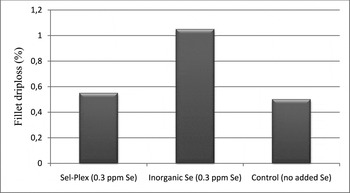
Beyond the role of selenium as protection from cellular damage and meat quality maintenance, dietary selenium source seems to affect meat quality, with particular reference to excessive muscle tissue water loss. Mahan et al. (1999) reported a reduction in poultry and pork meat quality respectively, when supplemental dietary sodium selenite was replaced with organic selenium in the form of Se-enriched yeast. When added to supply between 0.05 and 0.30 ppm Se in the diet, this form of selenium reduced drip loss of pork loin by 13.7% when compared with sodium selenite. Downs et al. (2000) showed lower drip loss in breast muscle fillets of broilers fed Se-enriched yeast as compared to supplementation with an inorganic source (Figure 2).
Broiler breast fillet drip loss in response to selenium level and form (Downs et al., 2000).

An interesting physiological phenomenon observed in poultry is the condition of pale, soft and exudative (PSE) meat. This condition is caused by a variety of factors including nutrition, genetics, preslaughter animal handling and management. The cellular mechanism of PSE meat is similar to the oxidative tissue damage associated with normal drip loss. Dietary factors may influence PSE occurrence (Wang et al., 2009), as vitamin E and Se deficiencies exacerbate the incidence of PSE meat. Feeding high levels of vitamin E (200 IU/kg) and adequate Se reduced PSE turkey meat. The importance of nutrition in modulating the PSE condition lies in optimising vitamin E-membrane antioxidant activity and enzyme systems designed to reduce peroxide, superoxide, or hydroxide radical cellular damage (Wang et al., 2009).
Other selenium effects
Bearing in mind the role selenium plays in the quality of meat produced, limited research has focussed on the association between selenium and skin quality. In a study where the skin collagen content of Japanese quail was evaluated, increased dietary levels of selenium, up to 2.0 ppm as sodium selenite, increased collagen content to 40% and GSH-Px activity in the skin (Babu et al., 1986). Low dietary selenium levels cause a reduction of skin collagen cross-linking, with a predominance of the monomeric form of collagen. Trials have reported an increase in the incidence of alopecia (areas of missing feathers) and nail epithelial necrosis (O'Toole and Raisbeck, 1997), when male mallard ducks were fed toxic levels of selenium as L-selenomethionine, Even with limited data, the interaction between skin health and selenium seems evident. This can be considered important with processed poultry, bearing in mind that some portion of poultry products are marketed with the skin intact. Product grading and/or sensory characteristics can be affected by the skin quality and appearance (Stanaćev et al., 2006).
Other minerals
Going beyond their metabolic roles as cofactors in enzyme systems and their importance in cellular function, it can be noted that there has been insufficient interest regarding the impact of other minerals on meat quality. There is an involvement of microminerals in other physiological processes, besides redox reactions, that can ultimately affect meat quality characteristics. An example of this is the reported reduced drip loss of pork Longissimus thoracis and Biceps femoris muscles by supplementing control diets with magnesium aspartate (1300 to 2300 mg magnesium/kg diet) (D'Souza et al., 1998) and organic magnesium (D'Souza et al., 2000). This response is due to the tranquilizing (stress reduction) effect of magnesium and not antioxidation. One more interesting study presents improved carcass quality (quality grade) of beef steers in the case when dietary zinc was supplied as organic zinc methionine versus Zn oxide (Greene et al., 1988). Again, this response comes out of altering in carcass fat deposition and lipid metabolism, not a change in the functional property of the muscle tissue. More research is required to see if these effects occur in poultry.
Conclusions
There are many factors that have an influence on muscle food quality. Nutritional manipulations that are used for reduction of meat quality losses may be important. Of particular importance is Se and vitamin E, through their antioxidative roles in cell membranes and cytoplasm. This functionality holds the greatest promise for prevention of losing muscle tissue integrity during meat processing and storage.