‘Change life!’ ‘Change society!’ These precepts mean nothing without the production of an appropriate space… New social relationships call for a new space, and vice versa.'Footnote 1
‘The Library is a growing organism.’Footnote 2
Since 1876, OCAD University OCAD University has cultivated a studio-based educational environment that strives to remain at the forefront of art and design research then translate these aesthetic principles to the Canadian context. In 1922, a library was formally incorporated into the campus infrastructure and has since grown to become a vibrant, specialized art and design collection.Footnote 3 A recent email message from a faculty member, however, highlights issues of concern:
I visit the library a fair amount, I try to instill how great it is to the students in my classes, but pretty much any time I'm in there it seems it's in use for the computers, not the books and journals. In fact I asked my Internships class last night—these are 4th year students who must achieve a 70% average to take the course—how many regularly use the library. Out of the 16 students there, about 3 put their hands up.
I think there's a perception issue with the library and its use.Footnote 4
How does a librarian respond when such commentary identifies issues that transcend the limitations of an individual library and exposes wider societal shifts? Rather than enacting new programing or services, the appeal has prompted a re-visioning of current information literacy practices in an attempt to realign students’ perceptions of libraries, particularly in using studio-based learning models.
The production of space
A recent OCLC Perceptions of Libraries survey provides insight into this broader ‘perception issue’: when college level students were asked to compare libraries, both online and physical, with other information sources, a resounding 69% found libraries more accurate while an astonishing 76% found them more trustworthy.Footnote 5 Seventy-eight per cent of respondents claimed that librarians add value to the research process. It is tempting to cite these statistics as evidence contradicting the OCAD University instructor's anecdotal observations; however, when the same college-level OCLC respondents were asked where they start researching for any information need - whether academic, professional or personal - 83% reported beginning with ‘a search engine’ and 7% with Wikipedia. According to the report, none started with a library website. Finally, when asked about the library's primary ‘brand,’ 72% claimed that it was books.Footnote 6
Such disjunctions between thought and action seem truly indicative of a ‘perception issue with the library and its use.’ To untangle these concerns, it is incumbent on librarians to look beyond library science theory in an attempt to decode external societal patterns. Theorist Henri Lefebvre offers a compelling model qualifying how people navigate human environments by positing a ‘spatial triad’ structured by three domains: conceived, perceived and lived spaces.Footnote 7 Each have physical vestiges, but are essentially psychological, if not philosophical narratives used to make sense of built spaces.
Conceived space is the abstracted domain of maps, floor plans, rules, regulations, controlled vocabularies, standards and the myriad other bureaucratic frameworks that govern social environments. Although rarely seen in physical form, these official edicts - largely structured by empirical data and statistical analysis - form a tangled infrastructure, akin to ‘dark matter,’ that surrounds our daily lives in our daily spaces.
Embedded in this web lies the perceived domain, or how we feel in a space, with potential reactions ranging from fear and intimidation to a sense of freedom and purposefulness.
Lefebvre envisions a final layer: the space of daily activities; our lived spaces. Here is located the pathways of daily rituals, habits, patterns and routines; most of which are executed unconsciously by rote. A person's interactions within the spatial triad is called ‘spatial practice,’ and these processes lead to the ‘production of space.’Footnote 8
The production of place
Spaces are elevated to the status of ‘place’ when a seamless flow occurs between layers of the spatial triad, creating a ‘multitude of intersections’ similar to the connectivity of the creative process.Footnote 9 Mismatches between domains, where one area overrules others, lead to dysfunctional territories that become sites of intimidation, hostility or apathy depending on which layer is dominant. Using Lefebvre's interpretation, the OCLC report hints at flawed connections between the three domains in students’ spatial practice. The average user claims to value the authority and accuracy of library collections; however, instead of functioning as conceived knowledge bases, these beliefs become perceived ones, serving solely as fondly emotive impressions of libraries. As proof, one might point directly to students’ lived research spaces where libraries are simply not used when starting an inquiry.Footnote 10 What, then, becomes the conceived understanding of student library users? In one word, ‘books’; which might be read as a coded reference for notions of the library as a charming, though anachronistic holdover from a bygone era. Without question, books are an integral facet of collection development; however, to confuse perceived space for conceived ultimately leads to confusion, disappointment, even alienation.Footnote 11
The production of place at OCAD University
To address these issues the OCAD University library is working to re-envision spatial practice for students through information literacy. In a studio-based environment, where knowledge is derived through the inductive practice of interacting with an artistic medium, the lived spaces of students offers fertile grounds for re-visioning perceptions of libraries.
One ongoing interaction with the curriculum has been the library's site interventions program which, since 2007, has sought to use studio learning models to inform library instruction.Footnote 12 In the most recent iteration of the program, students enrolled in the course ‘Painting in the Expanded Field’ were offered the OCAD University library as a potential site. This inter-disciplinary course requires students to look to the history and theory of site-specific and installation art, then launch ‘pictorial and spatial investigations in the pursuit of contemporary painting practice.’Footnote 13 After an introductory presentation on library theory, Lefebvre's triad was referenced as a model to build new spatial understandings of a traditional library. Although five works were eventually installed in the library space, two case-study examples will be discussed in detail to profile new understandings of a library's spatial practice, as seen through the students’ own spatial triad. Material from the studio critique, which was held in the library, will be presented using Lefebvre's model to decode the artworks in the form of an exhibition review; a primary mode of peer-to-peer communication for artists.
Case Study #1: Kate Rogers. Untitled (2017)
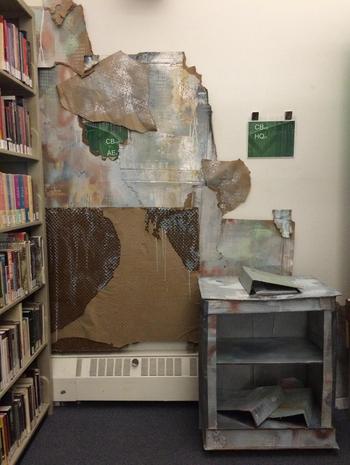
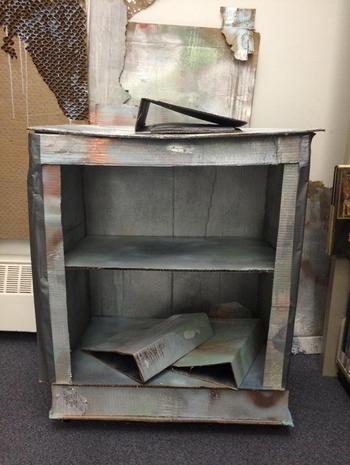
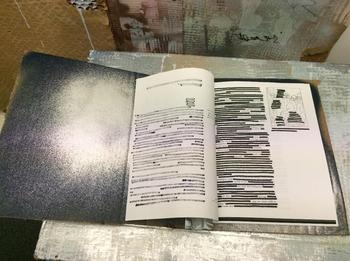
Positioned in an open space between Library of Congress main classes C (history of civilization) and D (world history), the work featured cardboard panels affixed to the library's wall with a false cardboard encyclopedia stand situated in front (Figs. 1, 2). A three-ring binder was placed on the desk containing photocopied pages from books where the majority of text had been censored using strikethrough lines (Fig. 3). Few words were left legible; however, short phrases were decipherable that indicated problematically gendered concepts. Several pages included images of women that also have been censored using horizontal crosshatched lines. Two other binder covers were included, but these false books had no interior content, containing only blank pages.
Kate Rogers, Untitled. 2017. Cardboard panels (approx. 2.5 × 1 m), acrylic spray paint, mixed media, cardboard encyclopedia stand, artists’ book (image credit, Lindsay Gibb, Dorothy H. Hoover Library).

Kate Rogers, Untitled. Detail of encyclopedia stand (121 × 45 × 45 cm). (image credit: Lindsay Gibb).

Kate Rogers, Untitled. Detail of artists’ book (21 × 30 cm). (image credit: Lindsay Gibb).

Conceived space: Although not immediately apparent to the viewer, this installation references issues of information equity and how, traditionally, women and minorities have been erased from history texts. The work is untitled, conveying a powerful message of the countless untold stories of women of the past, whose histories, writings or artistic creations have been hidden, appropriated or otherwise denigrated through arbitrary hierarchical distinctions between art and craft; high art and low culture; literature and ‘dabbling’ in writing.Footnote 14
Lived space: The message of Rogers's installation could easily be overlooked; it is only through directly interacting with the work by opening the binder that its meaning can be discerned. This imposition on the viewer to interact with her artwork serves as an appeal to move beyond passive observation and instead fully engage - using both mind and body - with the conceptual ideas encoded in the art piece. Likewise, the fact that the full message of the work cannot be understood without the ‘directions’ hinted at in the physical, albeit ‘fake,’ book offers a resounding endorsement for the enduring power of print information objects. Yet, conversely, is Rogers also critiquing the fetishization of the book as object by creating a crude simulacrum version of a text?
Perceived space: Such a reading of the work inevitably hearkens to the theories of Jean Baudrillard whose belief that the modern ‘simulation society’ has become so comfortable with and in fact reliant on fabricated, recreated models of reality that people have lost the ability to understand the real world unless it is filtered through a mimetic product of technology.Footnote 15 Moving this concept beyond a single text to the entire collection creates a disturbing view of the library as an esoterically abstracted version of the world; one that is powerful in its ability to codify historical, scientific or literary voices through print collections, but ultimately is a space that can only offer a refracted distortion of reality.
Spatial reading: The subtlety of Rogers's feminist message is purposeful, in that the artist seeks to critique assumptions so deeply entrenched in a cultural viewpoint that they are - as Michel Foucault so cogently describes in the Order of things - seen as natural laws.Footnote 16 The use of torn scraps of cardboard, spray-painted randomly as if vandalized, is a visual cue to this sense of decay in traditional modes of academic inquiry.
The cardboard encyclopedia stand solidifies this scepticism with its blurred distinction between podium, lectern and pulpit; each object potentially serving as a site of proselyting and other monologic discourses.Footnote 17 Direct associations made with the encyclopedia stand, however, evoke the works of the Encyclopédistes of the Enlightenment in their attempts to encode all human knowledge in one consolidated information object. The empirical rationalism of these early theorists was couched in a lexicon of scientific terminologies, yet these discursive practices often became patriarchal means of silencing alternate histories. The printed book, by proxy, becomes an unwitting forum for propagating and disseminating such disingenuous ideologies, raising uncomfortable truths as to the library's implication in this oppressive Enlightenment endeavour.
Case Study #2: Sylvester Teszeri. Boo-k Wurms (2017)
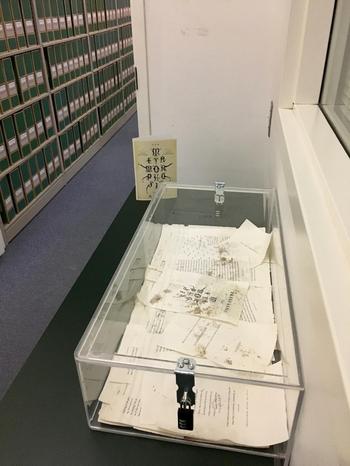
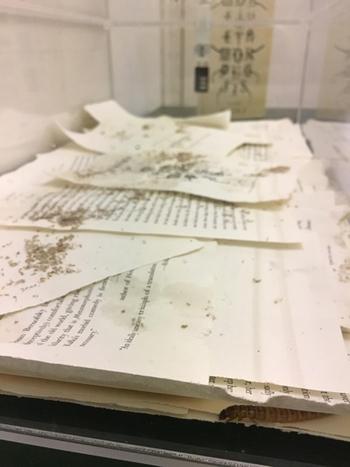
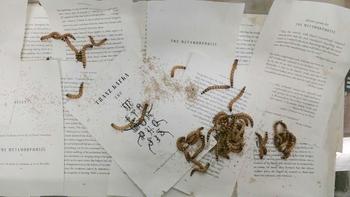
A Plexiglas box was installed in the library containing a dis-bound print copy of Franz Kafka's The Metamorphosis Footnote 18 and approximately seventy beetle larvae; one for each page of the book. The box featured a firmly secured lid with air holes and an armature to affix the box to the supporting table. Two padlocks were installed on either side (Figs. 4,5,6).
Sylvester Teszeri. Boo-k Wurms. 2017. Plexiglas box (90 × 30 × 15 cm), copy of Franz Kafka's The Metamorphosis (trans. Susan Bernofsky; intro. David Cronenberg. New York: W.W. Norton & Company, 2014), beetle larvae, padlocks and metal clasps. (image credit: Lindsay Gibb).

Sylvester Teszeri. Boo-k Wurms. Detail (image credit: Sylvester Teszeri).

Sylvester Teszeri. Boo-k Wurms. Detail (image credit: Sylvester Teszeri).

Conceived space. Containing Kafka's book in what appears to be a specimen box impels viewers to observe the installation clinically and, almost instinctually, to focus on the material properties of the book as object. The disturbing presence of the larvae, however, forcefully reminds the onlooker to consider relationships between information object and the artistic concepts contained within. In essence, Teszeri presents Marshall Mcluhan's dictum ‘the medium is the message,’Footnote 19 yet in this case the message is consuming the medium! The Metamorphosis documents protagonist Gregor Samsa's inexplicable transformation into an insect and, in the process, his gradual loss of identity within the framework of the capitalist nuclear family structure. Discomforting associations might be drawn between the closed conceived library spaces of bibliographic controls used to order collections. By focusing so intently on managing information, are libraries unwittingly destroying the message of its mediums?
Lived space: In installing the work, the approvals required from Campus Facilities Planning & Management, the course instructor, the library director, head of instructional services, even - as a precaution over concerns in using live organisms - the school's Research Ethics Board was a procedure that can only be described as Kafka-esque. Teszeri's perseverance, however, was an essential and necessary element of the process used to create the artwork. Any compromises required did not work towards the detriment of the artistic message; in fact, quite the opposite process occurred: the conceptual message conveyed was strengthened through this dialogic consultation.
Perceived space: In its materiality, the work achieves a most powerful perceptual message. The voyeuristic quality of watching insect larvae - normally hidden in dark, rotting environments - through the lens of an austere, minimalist Plexiglas box seems almost scientifically clinical. Yet, as one observer noted, there is a meditative aspect of watching the larvae slowly eating away at the pages of the book, despite the adverse reactions one might feel in observing its destruction or, even more viscerally, in confronting one's own entomophobia! The complex juxtaposition of visual cues evokes emotions of empirical curiosity, fascination, disgust, perhaps even horror, ensuring that the work leaves a lasting emotive resonance.
Spatial reading: Using the literal metaphor of a bookworm, the installation begins with a simple premise to explore profoundly complex issues of entropy and the ephemerality of information objects, both of which ultimately impacts - perhaps in reference to Jane Jacob's Dark age ahead Footnote 20 - the ability to create or preserve knowledge. The gradual consumption of Kafka's literary work by the insect larvae demonstrates, almost painfully, the fragility of information objects despite the best efforts of institutions such as the library in preserving these works of cultural significance. Usually librarians rely on containers to protect, maintain and organize information; however, the gesture of using a box to contain the very entities that are intently destroying the book moves well beyond a merely ironic statement. There is almost a poignant futility in the library's attempt to contain that which is intended, by its very nature, to decompose.
The production of place through visual communication
Although both these student works convey rather stark critiques of organizational schemata and institutionalized bureaucracy, the depth of reflection concerning libraries as multidimensional places offers an endorsement of such site-specific engagements with students’ spatial readings. No formal quantitative analysis was collected; however, taking the qualitative aesthetic clues presented in the artworks and scrutinizing them in the form of an exhibition review offered fertile grounds for meaningful visual communication. Likewise, no central conceived information literacy outcomes were imposed on participating student artists. The ability, however, to have the conceptual models of librarians interact, even clash with those of students served to realign both stakeholders’ spatial practices in an evocative manner. Students may not have learned the full complexities of subject analysis, controlled vocabularies or information literacy threshold concepts, but they certainly learned that libraries are complex spatial entities.
Ultimately, the most forceful impression conveyed was that students were given the liberty to both physically and conceptually critique the library, directly experiencing the powerful message of the Canadian Federation of Library Associations’ ‘Statement on intellectual freedom,’ which serves as the most vital conceived planning document for all libraries in Canada.Footnote 21 A literal reading of artist Sylvester Teszeri's Boo-k Wurms might be used to highlight this stance: if students think libraries are only about books, then it is time to deconstruct this myth. Although in making such an aesthetic statement, he may have taken S.R. Ranganathan's fifth law of library sciences a little too literally!