Introduction
In many parts of Southern Africa and Asia the population is rural-based and involved in agricultural production. Chickens are the most popular and the most democratic livestock species raised by households. However, according to Wethli (Reference WETHLI1995), Buza and Mwamhehe (Reference BUZA and MWAMHEHE2001) and Alexander et al. (Reference ALEXANDER, BELL and ALDERS2004), high mortality, often due to Newcastle disease (ND), which appears every year at approximately the same time killing most of the chickens, is seen as ‘normal’ and prevents owners from investing in improvements. Other diseases, such as fowl cholera and duck plague, occur throughout the year. More recently Highly Pathogenic Avian Influenza (HPAI) has become recognised as a major threat.
Saito and Spurling (Reference SAITO and SPURLING1992) explain that the ‘woman’ and ‘man’ factor influences the type of involvement in the farming or breeding activity, the type of constraints to productivity, the division of labour as well as the access, control and benefits from resources Each species of reared animal plays a specific role, and is owned and cared for by different individuals in the household. Niamir-Fuller (Reference NIAMIR-FULLER1994) and the UN Economic and Social Council (Reference UN ECONOMIC AND SOCIAL COUNCIL2002) have determined that women generally have a larger share than men in small livestock responsibility. While women generally have the responsibility for the care and management of chickens and ducks, men are more likely to be responsible for the management of pigs, goats or cattle and any large flocks of chickens and ducks.
A number of Asian and African economies have considerable sections of their rural population living below the poverty line. Alexander et al. (Reference ALEXANDER, BELL and ALDERS2004) highlighted that livestock rearing represents an important contribution to the livelihoods of these large segments of the population. Chickens are often essential elements in households led by women or children. The impact of any change in the size of flocks mostly affects the poorest of the population, and particularly women because they rely on income from chickens to provide for their basic needs, such as food, hygiene, clothing, medications and schooling. In Southern Africa, chickens are sold or bartered to meet essential family needs such as medicine, clothes and school fees. Regrettably, they seldom provide animal protein in the form of meat and eggs. They are often required for special festivals and are essential for many traditional ceremonies. Alders et al. (2007b) mention that chickens can also play an important role in providing households with people living with HIV/AIDS with additional resources.
In Asia, village chickens provide manure and feed for fish when raised on top of ponds as part of an integrated system. They also have an important cultural value and are used in many festivals and ceremonies. Birds can also be kept as pets, controlled by different members of the family, or as fighting cocks, where they are under the control of a male family member.
According to UNICEF (Reference UNICEF2000), although women constitute most of the labour force in agriculture, their role is still not yet fully acknowledged. Little investigation has been done on poultry husbandry in general, the role of poultry in small farmers’ production systems, and particularly, gender issues in the sector. There is, therefore, a pronounced lack of data on these matters. Agricultural extension services frequently deal mostly with prosperous farmers concerned with crop and ruminant production systems. Thus, the current knowledge of how poultry raising activity is integrated in the farming system is extremely low.
The veterinariansFootnote 1 and extension staff are usually male, who deal mostly with male farmers, and are often not trained to assist women and poor farmers. Extension workers are not fully aware that women have different needs and perspectives about raising chickens and need to be listened to within a same sex group. Moreover, village leaders, who make most of the decisions around matters concerning the whole community, are also essentially male. Consequently the activities, the solutions developed, the messages and the communication material are often inappropriate to female farmers’ needs. This paper examines why women, who are the main village poultry keepers, should be the specific targets for poultry improvement programmes as suggested by Alders et al. (Reference ALDERS, BAGNOL and YOUNG2007a).
Collecting information on family poultry rearing
This paper is based on qualitative work carried out in Mozambique, Zambia and Tanzania in Southern Africa and in Laos, Vietnam and Indonesia in Asia over the last fifteen years using a participatory rural appraisal approach, as presented by Bagnol (Reference BAGNOL2005a, Reference BAGNOL2005b, Reference BAGNOL2007a). The methods used have been described by Bagnol (Reference BAGNOL2007b), and are based on individual interviews and focus group discussions. They also include participatory methods, such as drawing of agricultural and poultry calendars, ranking exercises, identification of access, control and benefit of activities carried out by men and women in same sex groups through the use of drawings. The objectives included evaluation of farmers’ willingness to initiate Newcastle disease control through vaccination, analysis of its impact, identification of local aetiology of ND and HPAI, assessment risk perception to these diseases or studying the appropriateness of communication materials.
Gender and agro-ecological systems
In Asian and African rural households, gender roles vary according to the agro-ecological system, types of farming systems and opportunities for off-farm occupations. These realities are complex and gender relations vary from country to country, province to province and even from village to village. Two examples, one from Vietnam and the other from Mozambique, can illustrate how men's and women's roles and ownership of poultry are shaped by the socio-economical situation.
Tu (Reference TU1998) explained that, in Vietnam, about 66% of the duck population of the country is located in the Mekong Delta, with flocks of 4 to 3000 birds. The size of the flocks varies according to whether they consist of layer birds (up to 500 birds) or meat producers (up to 3000 birds). It also changes according to the period of the year, as duck flocks expand when scavenging after the rice harvests in May and October. The provincial livestock census carried out in September 2000 indicated a population of 2 million ducks. Outbreaks of duck plague generally occur in September, which is a period of flooding. In this period, flock sizes are small but start increasing to reach a peak in October. The other peak is in May when the first harvest occurs. It is estimated that the population of ducks during these two peaks is around 4 million. Because duck rearing, unlike chickens, does not require a big investment (as there is no need for housing and feeding) it is a good alternative income stream for poor people. In Dong Thap Province, while small ducks flocks are usually managed by women, medium duck farms and big flocks are generally managed by male farmers as it is necessary to go with the flock from field to field, far from home to accompany the flock as a ‘shepherd’. In contrast to ducks, Bagnol (Reference BAGNOL2001) explains that large flocks of chickens can be under the management of women as well as men.
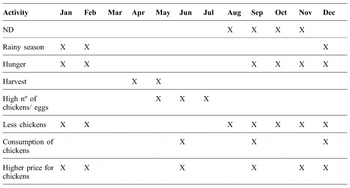
In Mozambique the size of the flocks owned by male and female farmers in the central part of the country (Manica Province), evolves according to harvest and incidence of ND as shown in Table 1. Chickens are very important as a strategy to maintain family livelihood as, during the period of hunger from September to February, they are sold to buy staple food.
Agricultural and chicken-breeding activity in Nhamatanda (Manica Province).

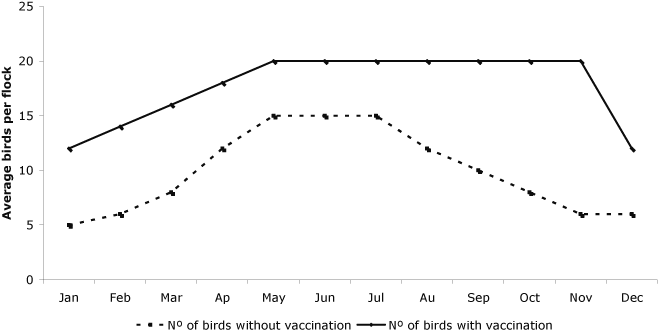
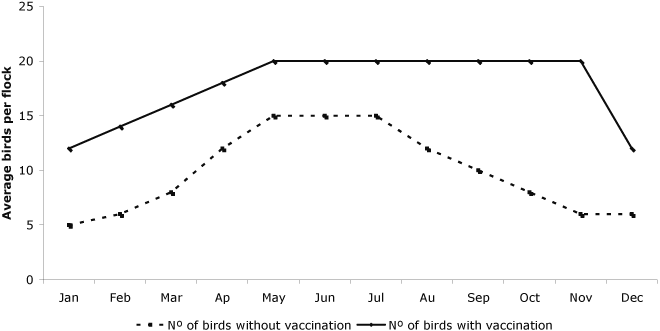
Based on Wethli's (1995) study on people's assessment of the evolution of the flock of chickens and on the fact that up to 90% of the flock is wiped out by ND every year, a chart has been developed (Figure 1) with the help of farmers and ND community vaccinators to illustrate the importance of vaccinating before ND outbreaks. The same table shows that the flocks reach their lowest levels between Christmas and New Year. It is during this period of celebration of the festive season that most rural families eat chicken for the one and only time in the whole year. This is also a period when hunger generally occurs, hence the importance of chicken vaccination to improve households’ cash availability to buy staple food at this time. With ND vaccination the size of the flock can be maintained, sales are more regular with a high increase in the sale and consumption around Christmas, and a subsequent drop in the size of flocks. With ND control, the role of chickens as a buffer in time of hunger (before the harvest of April/May) increases.
Evolution of size of flocks during the year with and without ND vaccination Nhamatanda (Manica Province).
A research study reported by Mata et al. (Reference MATA, BAGNOL, DOS ANJOS, DIAS, DIAS and ALDERS2000) and carried out in two provinces of Mozambique. This survey included a total of 525 questionnaires to men and women, and the collection of qualitative data showed that ownership followed somewhat different patterns in the South (Gaza) and in the North (Nampula) of the country. Men tended to have less control of chicken production in the South as they had more access to paid employment and because the ecological conditions were more favourable for them to raise goats and cattle. Correspondingly, women were more likely to be involved in chicken raising activity in the South than in the North of the country.
In addition to ecological reasons as shown in both examples above, factors such as socio-cultural attitudes, and group and class-based obligations influence men and women's roles, responsibilities and decision-making functions. Cultural beliefs and practices limit women's mobility, social contact, access to resources, and the types of activities they can pursue. Institutional arrangements can also create and reinforce gender-based constraints, or conversely, foster an environment in which gender disparities can be reduced. All these factors affect women's and men's adoption of biosecurity measures and their participation in decision-making related to ND and HPAI control.
Gender at community and at the household level
Bui Thi Tham, a female farmer interviewed in Mi Qui Ward, Mi Nam village, Huyên Tháp Múòí District in Dong Thap Province in the Mekong Delta (Vietnam) explained the role that poultry has in her household, and the difficulty she encounters in accessing technical information to enlarge her flock. In Bui Thi Tham's household, rice production is the most important resource, followed by her husband's activity as a carpenter (he is hired to build houses), and lastly, the two pigs and small flock of poultry (10 birds and 5 chicks) she raises and cares for. She prefers to raise chickens rather than ducks because it is easier. For her, keeping poultry is equivalent to having savings: "I put aside some quantity of rice every day and it grows. It is like a bank". During the high period in January/February she may have up to 30 chickens. Her husband is a member of the farmers' Association where he receives training. She also would like to receive training from the Women's Union to improve her poultry production. Bagnol (Reference BAGNOL2001) reported that her goal is to have up to 50 chickens.
As the interview above shows, the household is not constituted by a single economic unit with common objectives, resources and benefits, as confirmed by Moser (Reference MOSER1993). The different members of the household can have different, sometimes contradictory, interests with regard to agricultural production and livestock. The processes of decision-making in households and in communities are complex and dynamic. Although male and female farmers have a lot in common, they often have different interests in relation to animals they have access to and control over, and experience different problems.
Usually, village chickens are characterised by a very low input systems: they scavenge for food around their owners’ houses and do not have proper housing. Consequently, raising chickens is cheap and does not involve major husbandry inputs. Although an effective biosecurity measure, housing the birds changes the production system as it implies that women will have to feed, provide water and clean out the flock, thus complicating and enlarging women's tasks. Moreover, feeding requires using part of the harvest or buying appropriate feed, with financial consequences for the household. Therefore, women may have to abandon poultry production leading to a loss in their households’ income and coping mechanisms. This kind of recommendation has a profound impact on women and needs to be considered carefully. In the same vein, a decision to cull chickens might be taken without the women's agreement or, when it occurs, compensation might be given to men without consideration for the ownership of the birds, thereby increasing the financial disparity. Variations in the size of poultry flocks, due to culling or to policies tending to reduce poultry production, can influence access to food, school, and health for the families involved. It is likely that a decrease in the size of flocks will affect girls more severely than boys. There is anecdotal evidence that in Turkish villages affected by HPAI, school enrolment of girls decreased as families no longer had resources to send both boys and girls to school. As the examples given above show, to date, most of the policies and interventions developed to control HPAI have not included a gender analysis.
Although certain general patterns can be identified, women and men do not constitute a homogeneous category. Factors such as age, marital status, race and class considerably modify the range of problems faced by men and women. A single woman can own poultry and pigs on her own and be responsible for all their management, even housing. Lough et al. (Reference LOUGH, MORGAN, WALLS, ESCRIVÃO and FERRÃO2001) explain that the type and range of animals owned by different households, and by men and women within the households also vary according to their level of poverty. Poor women can have different livelihood strategies and needs depending on the agro-economical area or the community they belong to, but also within the same community. For example, the need for cash to deal with economic transactions can drive commercialization of subsistence production with women selling their home produce, small livestock and home-based food in local markets and urban centres.
In relation to the age influence, it has been noted that women over the age of 50 spend most of their time doing housework, since physical labour in the fields is considered too taxing. Middle-aged women play a key role, both at home and in the fields, in sharing crop and livestock activities with men. Younger women prefer alternatives to farming. In addition to age difference, seasonal variations mould the lives of people in rural areas. According to Rahman (Reference RAHMAN1995), eight to ten hours can be dedicated to fieldwork during the busiest agricultural season, whereas during the rest of the time people undertake other income generating activities. These aspects need to be taken into consideration when discussing alternatives to increase the farms biosecurity.
The understanding of gender relations and its implications for livestock rearing are important to promote adequate interventions. When analysing poultry production, several aspects need to be taken into consideration. First, men and women or different groups in the community can have different interests (e.g. semi commercial farmer versus village farmers). Secondly, as in the household, interests might be different between different people according to their gender and age.
Extension services and communication
Gender inequalities in access to land, education and credit put women in a disadvantageous position and contribute to women's lack of confidence. Merkelbach (Reference MERKELBACH2000) mentions that this situation and their lack of mobility limits women's choices and their ability to have access to information, technologies and skills. Written information is often less suitable for them. For example, in Dodoma (Tanzania), in 2003, while the female group had never heard of ND vaccine, the male group had. This illustrates that women are often less exposed to extension messages even when related to activities that they are in charge of, as in the case of poultry keeping as described by Bagnol (Reference BAGNOL2005b). The United Nations, (Reference UNITED NATIONS1998) acknowledges that this situation creates a handicap, negatively affecting production improvement and preventing the finding of suitable strategies. Access to technologies and information depends on a set of factors such as availability of time, meeting place, issues to be discussed, language used, the sex of the facilitator, the sex of the participants, etc. People under severe financial constraint often do not have the motivation, time, or money to adopt new technologies. Thus, most rural women are trapped in a series of vicious circles that prevent them from escaping poverty. Most improvements designed to ensure better control of HPAI - such as segregation of the flock - tend to increase women's workloads. As underlined by Niamir-Fuller (Reference NIAMIR-FULLER1994), appropriate technologies must be designed to take into account not only women's workload but also the potential impact of technology on their status and economic control over resources and property.
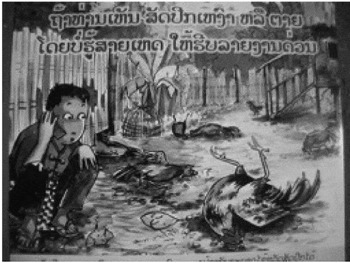
In an attempt to underline the importance of understanding the poultry systems as well as identifying the owner of the poultry (sex, age, etc.), a poster with the message: “Report chicken deaths to authorities” (Figure 2) was discussed with a group of women in Laos. The discussion was interesting and showed that female farmers did not identify with the situation drawn on the poster. They indicated that the drawing represented a commercial farm, as it was fenced, and that the owner was a man despite the fact that he had a young face and that he was wearing adult clothes. They also could not understand how a young boy could be speaking on a cell phone. The women further said that this did not represent their own reality of houses which are close to each other, without fencing, and that when their poultry die, they do not all die at once. In addition they stressed that in their house when chickens die they are the first ones to notice it and not the young boys or adult men.
First poster prior to evaluation.

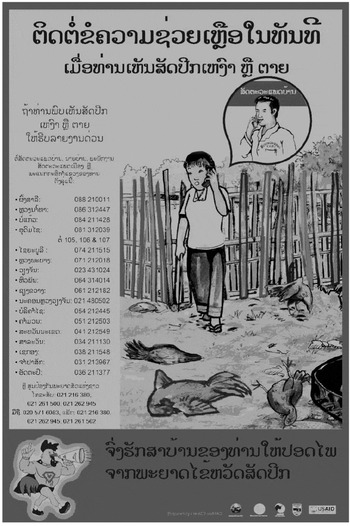
The following year a new poster was developed (Figure 3). An adult woman was now handling the cell phone making the scene more realistic although the fence and the high number of chickens were not significantly modified.
The poster developed the year following pre-test.

The example given shows the importance of knowing the people for whom the messages or materials are produced and stresses the importance of producing them in conjunction with the intended audience allowing for a continuous dialogue to take place, including adequate pre-testing. Policy-makers, agriculture and livestock staff generally see communities and households as homogeneous bodies, and ignore the existence of distinct and sometimes contradictory needs and interests between men and women and also between different groups. Gender issues tend to be sidelined from discussions, and gender disparities in economic and decision making matters are often neglected. Most of the time, people in powerful positions and who dominate the community are men. They are generally in a position to express and support their interests and thus, their interests are seen as community interests. Training and meetings on poultry issues are mostly attended by men. Women are often not consulted or their opinions are neglected. According to Alders and Bagnol (Reference ALDERS and BAGNOL2007), developing extension messages and communication material with farmers, pre-testing it with them and evaluating the impact of the campaign after a few months promotes a more effective communication process and increases the possibility of developing awareness and behaviour change.
Conclusions
Up until now, most technical solutions in the poultry sector have ignored women's needs, despite the fact that they were notionally designed to address the concerns of the poultry's owner. It seems that often staff, technicians and policy-makers do not clearly know who owns or manages small flocks of poultry. It is assumed that scavenging chickens are owned by men. They also behave as if men and women had similar interests and needs, and by speaking with one person in the household (often the man) this will lead to an increase of awareness of the poultry's owner (often a woman). This has dramatic consequences on the overall programmes, as it introduces a bias due to gender blindness. As a matter of fact, most improvements designed to ensure better control of HPAI tend to increase women's workloads or to transform the scavenging system into a semi-commercial system with dramatic consequences on women and mainly poor women.
Understanding poultry's role in the production and subsistence system as well as who raises village chickens is of foremost importance for the fight against ND and/or HPAI to succeed. Understanding gender dynamics and how gender relates with other socio-economic and ecological factors is also important in developing adequate biosecurity alternatives for the control of ND and HPAI control with stakeholders. Appropriate technologies need to be developed, which will take into account not only women's workload but also the potential impact of the technology on their status and economic control over resources and property. This situation raises the need for the development of a participatory strategy involving technicians in a bottom-up approach to understand the constraints and the needs of the people in contact with poultry, and to study the different alternatives that they can suggest and adopt.