1 Introduction
The cross-linguistic investigation of the acoustic realization of stress has provided fertile ground for phonetic research since the seminal work on English stress correlates by Fry (Reference Fry1955, Reference Fry1958). Typological phonetic studies have shown that the acoustic manifestations of stress vary from language to language with stressed syllables typically being associated with one or more of the following properties: raised fundamental frequency, increased loudness, greater duration, and different vowel qualities, e.g. English (Fry Reference Fry1955, Reference Fry1958; Beckman Reference Beckman1986), Polish (Jassem, Morton & Steffen-Batóg Reference Jassem, Morton and Steffen-Batóg1968), Mari (Baitschura Reference Baitschura1976), Indonesian (Adisasmito-Smith & Cohn Reference Adisasmito-Smith and Cohn1996), Tagalog (Gonzalez Reference Gonzales1970), Dutch (Sluijter & van Heuven Reference Sluijter and van Heuven1996), Pirahã (Everett Reference Everett1998), Chickasaw (Gordon Reference Gordon2004), Turkish (Levi Reference Levi2005). Despite the recent increase in cross-linguistic acoustic studies of stress, the majority of the languages of the world have not been subject to instrumental studies of stress. Furthermore, there are entire language families and language areas, most notably in Asia, the Pacific and the Americas, for which there is no published quantitative research on acoustic correlates of stress. There is thus a need to expand the breadth of our cross-linguistic knowledge about the manifestations of stress.
One of the interesting issues in the typological phonetic study of stress is the question of whether the relative importance of different acoustic correlates is predictable from independent characteristics of languages. Based on existing studies, the availability of potential correlates of stress in a given language appears to be constrained by their role in the expression of other phonological properties in that language. For example, the use of F0 as a cue to stress might be limited in a language in which F0 is used contrastively to signal lexical tone. In support of this prediction, Everett (Reference Everett1998) found that duration and intensity are more reliable correlates of stress than F0 in Pirahã, an Amazonian language in which tone is phonemic. Potisuk, Gandour & Harper (Reference Potisuk, Gandour and Harper1996) make a similar finding in their study of Thai, another tone language. Similarly, stressed vowels are often shorter than unstressed vowels in languages with phonemic vowel length contrasts in unstressed syllables, e.g. Finnish and Czech.
The present study of stress in Kabardian seeks to contribute to our phonetic understanding of stress correlates in two ways. First, as the first quantitative study of stress in a Northwest Caucasian language, it promises to expand our knowledge about the cross-linguistic correlates of stress. Second, the typologically unusual nature of its vertical three vowel system allows for further testing of the hypothesis that the realization of stress is conditioned by other phonological properties of a language.
2 Background
Kabardian is a Northwest Caucasian language spoken predominantly in the Kabardino-Balkar Republic of Russia (443,000 speakers according to the online Ethnologue at www.sil.org) and Turkey (550,000 according to the Ethnologue), although small groups of speakers are scattered throughout many countries, including Syria, Jordan, Lebanon, and the United States. Kabardian belongs to the Circassian branch of the Northwest Caucasian language family. The Circassian languages are commonly divided into two branches: East Circassian, including Kabardian and closely related Besleney, and West Circassian, including Adyghe and its associated dialects. The present study focuses on the variety of Kabardian spoken in Turkey.
2.1 Consonants
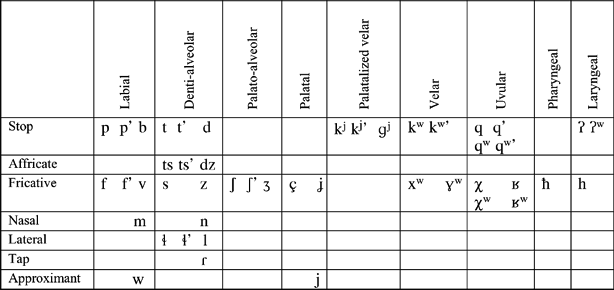
Turkish Kabardian features the consonant phonemes in table 1 (see Gordon & Applebaum Reference Gordon and Applebaum2006 for description of phonetic attributes of Kabardian consonants and vowels).
The consonant phonemes of speakers examined in this paper.

2.2 Vowels
Kabardian possesses a so-called ‘vertical vowel system’ in which vowel height but not backness is contrastive. Most sources assume two short central vowels /ɐ ə/ as well as a third central but lower vowel /a/ that has either been regarded as a third short vowel (Catford Reference Catford, Higgs and Thelwall1984) or as a long vowel (Choi Reference Choi1991, Wood Reference Wood1994). Duration measurements by Choi (Reference Choi1991) indicate that the lowest vowel is indeed a long vowel, since it is nearly twice as long as the next lowest vowel quality /ɐ/.
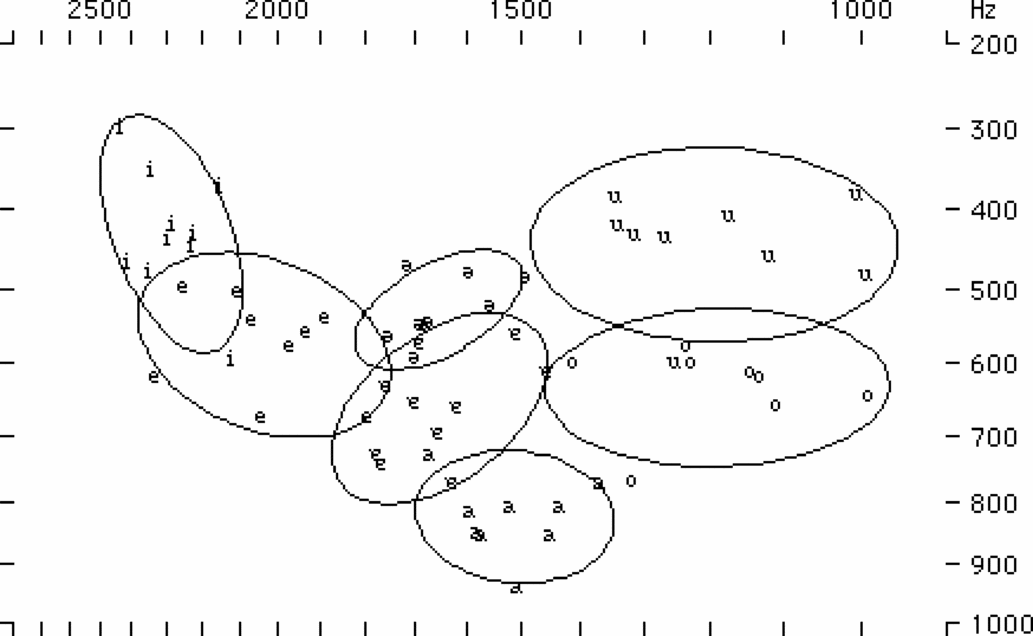
On the surface, there are many additional vowel qualities triggered by surrounding consonants. For example, rounded allophones occur next to rounded consonants and retracted allophones occur next to velar and uvular consonants (see Catford Reference Catford, Higgs and Thelwall1984, Colarusso Reference Colarusso1988, Choi Reference Choi1991, and Wood Reference Wood1994 on these allophones in Kabardian and Vogt Reference Vogt1963 on vowel allophones in closely related Ubykh). The most peripheral of these vowel qualities occur before a following glide. Thus, the vowel /ɐ/ is realized as [o] before /w/ and as [e] before /j/, while the vowel /ə/ is realized as [u] before /w/ and as [i] before /j/. These sequences of short vowel plus glide are often realized as long monophthongs on the surface, i.e. as [oː], [eː], [uː], [iː]. Figure 1 plots the three vowel phonemes /ɐ ə aː/ and the most peripheral allophones, i.e. those before glides, of the two short vowels as produced by five female speakers of Kabardian from Turkey (from Gordon & Applebaum Reference Gordon and Applebaum2006). In the plot, each vowel symbol represents a single token of that vowel.
Plots of the first two formants for five female speakers of Turkish Kabardian (from Gordon & Applebaum Reference Gordon and Applebaum2006). Ellipses indicate two standard deviations from the mean.

2.3 Stress in Kabardian
Phonological descriptions of Kabardian are in agreement that stress characteristically falls on either the penultimate or the final syllable of a word (Turchaninov & Tsagov Reference Turchaninov and Tsagov1940; Yakovlev Reference Yakovlev1948; Abitov et al Reference Abitov, Balkarov, Desheriev, Rogava, El'berdov, Kardanov and Kuasheva1957; Colarusso Reference Colarusso1992, Reference Colarusso2006): the final syllable if it is heavy, i.e. contains either a long vowel (CVV) or a coda consonant (CVC), and the penult if the final syllable is light. Words illustrating these stress generalizations appear in (1).
(1)


Colarusso (Reference Colarusso1992: 16) observes that stress fails to fall on nominal suffixes, although he also notes that certain suffixes can carry a secondary stress. Verbal suffixes, on the other hand, can carry primary stress as long as they ‘are of a purely verbal character’ (p. 17).
There is virtually no literature on the acoustic manifestation of stress in Kabardian other than Colarusso's (Reference Colarusso1992: 16) statement that ‘stress is a mixture of strong percussion and a slight rise in pitch’. To the best of our knowledge, there are no published descriptions of the acoustic differentiation of primary and secondary stress.
3 Present study
The present study seeks to confirm published descriptions of the location of stress and to determine the acoustic properties that signal stress, both primary and secondary. Besides representing the first quantitative study of stress in a Northwest Caucasian language, the present work addresses the question of whether acoustic correlates of stress are constrained on a language-specific basis by phonological properties. Lengthening of vowels is potentially constrained (but see Taff et al. Reference Taff, Rozelle, Cho, Ladefoged, Dirks and Wegelin2001 on Aleut) by the contrastive status of vowel length on the surface. We thus might expect duration to be used less to signal stress in Kabardian than F0, which is not used contrastively at the lexical level in Kabardian.
Another interesting issue is the potential relationship between the vowel inventory and the availability of vowel reduction as a cue to stress in Kabardian. Manuel (Reference Manuel1990) has shown that vowel-to-vowel coarticulation is less extensive in languages with many phonemic vowels than in languages with fewer vowels. We might hypothesize that, because Kabardian possesses a small number of phonemic vowels, there is the possibility of employing different vowel qualities in stressed and unstressed syllables with a minimal threat of obscuring phonemic contrasts. Thus, we might predict Kabardian to use vowel quality alternations as a cue to lack of stress.
Two types of vowel reduction patterns have been identified by Crosswhite (Reference Crosswhite2001) in her typological investigation of reduction. One type involves centralization of unstressed vowels. For example, most vowels in English reduce to a schwa-like vowel when unstressed. This type of reduction is typically linked to articulatory factors. Unstressed vowels are shorter than stressed vowels, which allows less time for articulators to reach more peripheral targets in the articulatory space. Crosswhite (Reference Crosswhite2001) also points out that this type of reduction has the advantage of reducing the intrinsic prominence of unstressed vowels.
The other type of vowel reduction involves vowels becoming more rather than less peripheral in unstressed vowels. This increase in peripherality can be manifested as either vowel raising or lowering depending on the language. For example, the phonemic mid vowels /e o/ raise to the high vowels [i u] when unstressed in Luiseño (Munro & Benson Reference Munro and Benson1973) and unstressed /ɛ ɔ/ raise to [e o] in standard Italian (Maiden Reference Maiden, Smith and Maiden1995). In Belorussian, on the other hand, the unstressed mid vowels /e o/ lower to [a] (Kryvitskii & Podluzhnyi Reference Kryvitskii and Podluzhnyi1994). Crosswhite (Reference Crosswhite2001) attributes this superficially less intuitive raising type of reduction to the goal of maximizing the perceptibility of contrasts in unstressed contexts, where they are more vulnerable. Either raising mid to high vowels or lowering mid to low vowels in unstressed syllables creates greater acoustic dispersion, hence increased perceptual distinctness, of different phonemic vowel qualities in the face of the shorter duration and reduced intensity associated with lack of stress.
Kabardian is described as having at least one type of vowel quality alternation dependent on stress, a centralizing variety. The lower short central vowel /ɐ/ lowers and lengthens to /aː/ when stressed in the first syllable of disyllabic nouns and adjectives of the shape CVCɐ and less consistently in compounds resulting from concatenating two CV roots (Colarusso Reference Colarusso1992). For example, the root /ʃ’aːlɐ/ ‘boy’ (/ɕ’aːlɐ/ in the variety of literary Kabardian spoken in Russia) is realized as [ˈʃ’aːlɐ] phrase-finally, but [ʃ’ɐlɐ] when another root follows within the same noun phrase, e.g. [ʃ’ɐˈlɐf’] ‘good boy’, [ʃ’ɐlɐ ˈts'əkʷ’] ‘little boy’. Because there are some CVCV roots that have a long /aː/ in the first syllable when unstressed, e.g. [saːˈbəj] ‘baby’, the alternating vowel in roots like /ʃ’aːlɐ/ is analyzed as underlyingly /ɐ/ with the long [aː] occurring in stressed syllables derived through fortition under stress. The fact that non-alternating /aː/ and [aː] in alternation with /ɐ/ are transcribed identically in published sources and the orthography suggests that fortition of /ɐ/ neutralizes an underlying phonemic distinction. This prediction has not been verified, however, through instrumental analysis.
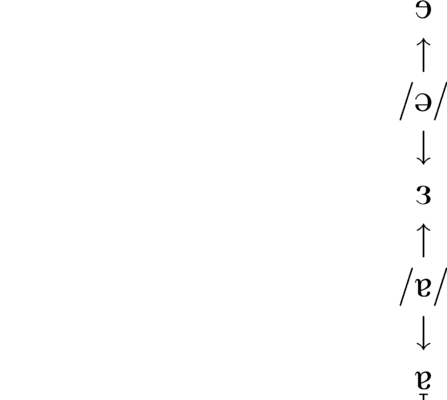
Furthermore, because the lowering and lengthening of stressed /ɐ/ is positionally restricted, this still leaves open the possibility that /ɐ/ occurring in other contexts might also undergo a qualitative alternation conditioned by stress. For example, the two phonemic /ɐ/ in the word [tɐpˈʃɐkʲ] ‘plate’ might differ, with the unstressed variant in the first syllable predicted to be either higher if the centralizing type of reduction applies or lower if the contrast enhancing variety is observed. Furthermore, although the phonemic /ə/ already occupies the center of the vowel space and would thus not be prone to the centralizing type of reduction, either raising or lowering is possible if it undergoes the contrasting type of reduction, i.e. schwa could raise in the direction of [ɘ] or lower in the direction of [ɜ] when unstressed.
The predictions for Kabardian vowel alternations according to the centralizing reduction pattern and the two types of contrast enhancing reduction (raising and lowering) are schematically depicted in figure 2. Arrows connect each stressed vowel to its unstressed allophone. The alternation between unstressed /ɐ/ and stressed [aː] is not shown since it unambiguously belongs to the centralizing type of pattern.
Stress-dependent vowel alternations classed according to the contrast enhancing vs. centralizing taxonomy of Crosswhite (Reference Crosswhite2001).

If the strengthening of unstressed /ɐ/ to stressed /aː/ is neutralizing as published sources suggest, then it is clear that vowel reduction in Kabardian is not completely constrained by the goal of preserving phonemic contrasts. However, this does not preclude the possibility that contrast maintenance exerts an influence on other potential reduction patterns. If reduction patterns are constrained by the goal of preserving phonemic contrasts, we would expect the raising type of reduction rather than the lowering type to apply to schwa, since lowering of schwa would infringe on the acoustic space occupied by /ɐ/. As figure 1 showed (section 2.2), there is a sizable open portion of the vowel space above schwa into which schwa could move when unstressed. In the case of /ɐ/, on the other hand, both centralizing and contrast enhancing reduction could threaten neutralization with other phonemic vowels, schwa in the case of centralizing reduction and /aː/ in the case of contrast enhancing reduction.
4 Methodology
4.1 Corpora and measurements
Two corpora were examined in the present study, both of which consisted of words elicited in isolation. Data were collected in .wav format at a sampling rate of 44.1 kHz using a portable solidstate recorder (Edirol R09) via a unidirectional head-worn microphone (Shure SMS10A). All elicitation was conducted in Turkish in Turkey by the second author, except in the case of one speaker, F6 (the second author), whose recording was made in the United States.
The first elicited corpus was designed to explore the acoustic correlates of stress in vowels with differing degrees of stress. All of the words in this corpus varied in length from two to five syllables and contained at least one stressed vowel and one unstressed vowel. The vowel /ə/, the most commonly attested vowel in Kabardian, was targeted for measurement in order to control for intrinsic effects of vowel quality on the measured acoustic parameters. Because impressionistic examination of the data did not indicate a clear distinction between primary and secondary stress, vowels were at first conservatively divided into two groups, stressed and unstressed, where the location of stressed vowels adhered closely to published descriptions (section 2.3). However, the possibility of distinguishing primary and secondary stress was also explored in the analysis. Words included in the first corpus appear in appendix A.
Measurements taken for the first corpus include vowel duration measured from the onset to the offset of a visible second formant, the average intensity of the vowels, and the average F0 of the vowels. In several tokens (12 of 861 total measured vowels across speakers), reliable F0 values could not be taken due to the presence of non-modal phonation, either creakiness attributed to final position (three cases) or breathiness attributed to an adjacent voiceless consonant (nine cases). Two speakers, the male speaker and one of the female speakers (FS2) accounted for all but one of the instances of non-modal phonation. Five repetitions of each word in this corpus were targeted for measurement. All measurements were made using Praat (www.praat.org).
The second corpus was designed to look at vowel quality as a potential correlate of stress. Words in this corpus belonged to nominal paradigms based on the roots /bəsəm/ ‘host’, /ʃ’alɐ/ ‘boy’ and /tɐpʃɐkʲ/ ‘plate’, where each root was elicited in its bare form and then followed by adjectives which pulled stress off its original position. The number of syllables following the target vowel was varied such that stress was distanced progressively farther from its original location in the bare form of the root. Five repetitions of each word in this corpus were targeted for measurement. The first and second formant values were calculated using the Get Formant function in Praat for a window encompassing the entire target vowel. This window was chosen (rather than a shorter window that would reduce microprosodic effects on formant structure induced by the flanking consonants) since the consonants surrounding the measured vowel were the same across all instances of the same target vowel quality regardless of differences in distance from the stress. Thus, the target schwa always occurred between /s/ and /m/ even though the location of stress was systematically shifted across words containing the schwa. Similarly, the target /ɐ/ always occurred between /ʃ/ and /kʲ/ and the targeted alternating vowel occurred consistently between /ʃ’/ and /l/. Words in the second corpus appear in appendix B.
4.2 Consultants
Seven speakers (six female and one male) of Kabardian served as subjects in the study. All speakers hailed from Turkey and were bilingual in Turkish and Kabardian, with some possessing proficiency in English to varying degrees. The speakers grew up in the village of Fındık in the Kahraman Maraş region of southeast Turkey before moving to Ankara as adults. All speakers reported using Kabardian on a daily basis with family members.
5 Results
5.1 Duration, intensity, and fundamental frequency
5.1.1 Duration
Results collapsed over all speakers show that stressed vowels were longer than unstressed vowels: 77 ms for stressed vowels and 55 ms for unstressed vowels. A series of statistical tests were conducted to assess the robustness of this difference. First, a multivariate analysis of variance (MANOVA) was performed in SPSS with stress level (stressed vs. unstressed), speaker, and word length as independent variables, and duration as the dependent variable. Word length was included as a variable due to the cross-linguistic tendency for the duration of individual segments to decrease with an increase in the number of syllables in a word (Lindblom & Rapp Reference Lindblom and Rapp1973). Because of the large number of tokens measured, effect sizes expressed as η2 values were used to evaluate the relative reliability of different independent variables as a predictor of duration values (Levine & Hullett Reference Levine and Hullett2002). Since SPSS does not provide η2 values, they were calculated manually by dividing the between-groups sum of squares by the total sum of squares, both of which are reported by SPSS. Larger η2 values associated with a given independent variable indicate more robust effects of that variable on the phonetic parameter examined in the analysis. Values for η2 greater than .01 may be regarded as reflecting a small effect, values greater than .06 a medium effect, and those greater than .14 a large effect.
Results of the analysis of variance for duration indicated a number of significant effects, the largest of which involved the effect of stress level on duration: F(1,807) = 122.231, p < .001, η2 = .102. A smaller effect on duration was exerted by word length (F(3,807) = 30.970, p < .001, η2 = .078) and speaker (F(6,807) = 4.846, p < .001, η2 = .025). The effect of word length on duration values was due to a slight lengthening effect observed in vowels in words with five syllables. There was a minor interaction between stress and speaker (F(6,807) = 3.722, p < .001, η2 = .019), which was attributed to interspeaker variation in the degree to which each relied on duration as a marker of stress (see below for discussion). There was also an interaction between stress and word length: F(3,807) = 13.865, p < .001, η2 = .058. This result was due to there being greater variation in duration values as a function of word length in stressed than in unstressed syllables. Duration values in unstressed syllables all hovered between 49 and 59 ms on average, whereas those in stressed syllables varied from a high of 108 ms in five-syllable words to a low of 61 ms in two-syllable words. The fact that duration values were longer in five-syllable words relative to two-syllable words indicates that the expected inverse correlation between segment duration and word length did not hold in the examined data. There was a moderate interaction between speaker and word length: F(17,807) = 2.346, p = .002, η2 = .055, which was attributed to interspeaker variation in duration patterns as a function of word length. There was also a slight three-way interaction between stress, speaker and word length: F(17,807) = 2.554, p = .001, η2 = .037.
A paired samples t-test was also conducted for the paired variables of stress level and speaker using mean values for stressed and unstressed syllables for individual speakers. This test confirmed the overall robustness in duration differences between stressed and unstressed syllables: t(6) = 5.066, p = .002.
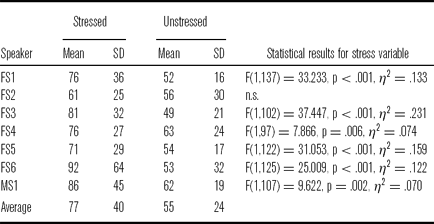
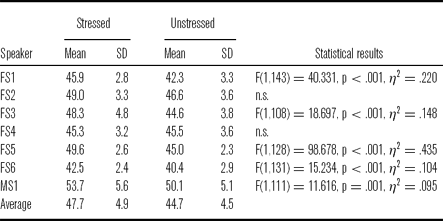
As the interaction between stress and speaker discovered in the MANOVA indicated, not all speakers used duration equally reliably as a signal of stress. This is evident in the individual speaker mean duration values for stressed and unstressed syllables in table 2. For each speaker, a two-factor MANOVA was conducted with stress level and word length as independent variables. Results for the variable of stress level (the primary variable of interest) appear in table 2. Results for word length and the interaction between stress level and word length are reported in the text below.
Average by speaker duration and standard deviations (in ms) for stressed and unstressed vowels and statistical results for the stress level variable according to analyses of variance.

For one speaker, FS2, there was no effect of stress on duration values. All of the other speakers displayed an effect of stress on duration. All of the speakers except for FS3 and FS4 also evinced an effect of word length on duration paralleling results in the pooled speaker analysis: for FS1, F(3,137) = 13.858, p <.001, η2 = .163; for FS2, F(3,117) = 3.732, p = .013, η2 = .088; for FS5, F(3,122) = 15.319, p <.001, η2 = .238; for FS6, F(3,125) = 11.884, p < .001, η2 = .173; for MS1, F(2,107) = 4.193, p = .018, η2 = .061. Some speakers (FS1, FS3, FS5, FS6) also showed an interaction between word length and stress in keeping with the overall pattern for vowel length to vary more in stressed than in unstressed syllables: for FS1, F(3,137) = 16.765, p <.001, η2 = .204; for FS3, F(3,102) = 3.840, p = .012, η2 = .066; for FS5, F(3,122) = 6.272, p = .001, η2 = .095; for FS6, F(3,125) = 7.393, p <.001, η2 = .109.
Because many of the stressed vowels occurred in final syllables, a common locus of lengthening cross-linguistically (Wightman et al. Reference Wightman, Shattuck-Hufnagel, Ostendorf and Price1992), additional statistical tests were conducted excluding final vowels.
A paired samples t-test was performed for the paired variables of stress level and speaker using mean duration values for stressed and unstressed syllables in non-final syllables for individual speakers. Results indicated a significant, though weaker in comparison to results pooled across final and non-final syllables, difference between stressed and unstressed vowels: t(6) = 2.485, p = .047. In individual speaker analyses of variance with stress level as the independent variable, four speakers were found to differentiate stressed and unstressed vowels in non-final syllables: for FS3, 64 ms vs. 42 ms; F(1,79) = 51.818, p <.001, η2 = .400; for FS4, 62 ms vs. 54 ms; F(1,74) = 5.845, p = .018, η2 = .077; for FS5, 60 ms vs. 49 ms; F(1,94) = 14.180, p <.001, η2 = .143; for FS6, 81 ms vs. 42 ms; F(1,101) = 20.688, p <.001, η2 = .168. Three speakers did not distinguish stressed and unstressed vowels in duration: speaker FS1 (53 ms vs. 49 ms), speaker FS2 (52 ms vs. 47 ms), and speaker MS1 (56 ms vs. 56 ms).
It is also worth noting that pretonic vowels were deleted in many tokens. For example, a common pronunciation of /bəsəməf’/ ‘good host’ was [bəsˈməf’] with a deleted penultimate vowel. Unstressed /ə/ in certain contexts, however, was never deleted. For example, vowel deletion failed to apply if it would produce an initial consonant cluster.
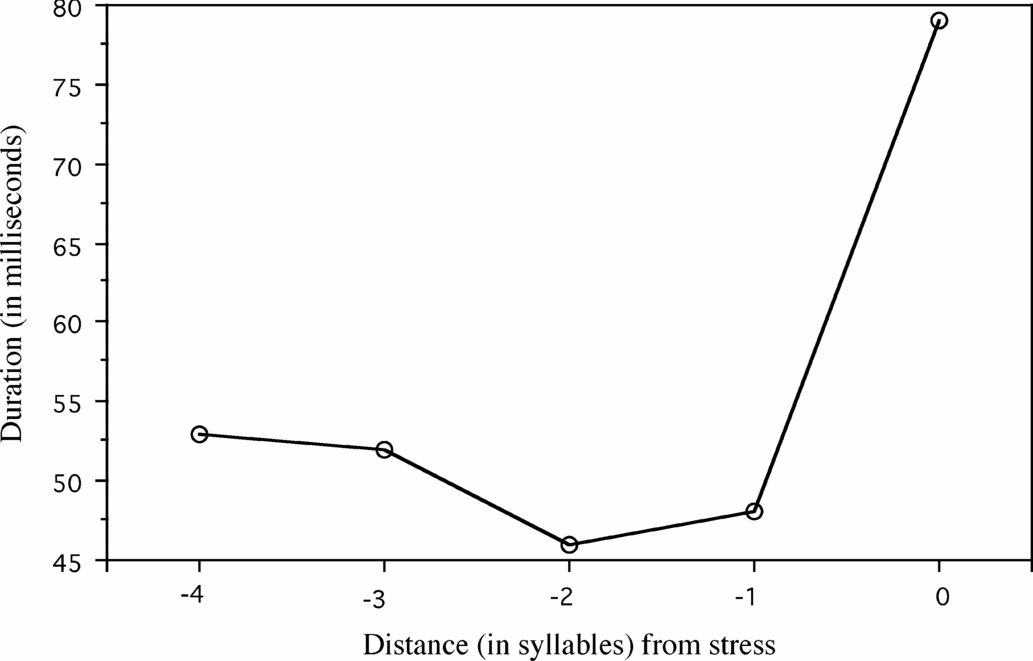
The data were also examined for evidence of secondary stresses occurring before the primary stress. Duration values across speakers are plotted as a function of the distance in number of syllables between the target vowel and the primary stressed vowel in figure 3. The primary stressed vowel is indicated by ‘0’, with ‘–1’ indicating the immediately pretonic vowel, ‘–2’ the vowel two syllables before the primary stress, ‘–3’ the vowel three syllables before the primary stress, and ‘–4’ the vowel four syllables before the primary stress.
Duration of vowels (averaged across seven speakers) as a function of proximity to the stressed syllable.

A series of paired (by speaker) samples t-tests was conducted to compare, first, the duration of stressed vowels with unstressed vowels differing in distance from the stress and, second, the duration of unstressed vowels with other unstressed vowels in different positions. Results indicated that stressed vowels were longer than unstressed vowels in all pretonic syllables: stressed vowel vs. the immediately pretonic vowel, t(6) = 9.825, p < .001; stressed vowel vs. the unstressed vowel two syllables to its left, t(6) = 6.830, p < .001; stressed vowel vs. the unstressed vowel three syllables to its left, t(6) = 5.327, p = .002; stressed vowel vs. the unstressed vowel four syllables to its left, t(4) = 3.772, p = .02. A few of the differences between unstressed syllables, though small, reached significance: the immediately pretonic vowel vs. the one three syllables to the left of the stress, t(6) = 2.492, p = .047; the vowel two syllables to the left of the stress vs. the one three syllables to the left of the stress, t(6) = 5.552, p = .001; the vowel two syllables to the left of the stress vs. the one four syllables to the left of the stress, t(4) = 5.039, p = .007.
5.1.2 Intensity
There was a slight difference in intensity between stressed and unstressed vowels averaged over all speakers: 47.7 dB for stressed vowels and 44.7 dB for unstressed vowels. A paired samples t-test was conducted for the paired variables of stress level and speaker using mean intensity values for stressed and unstressed syllables for individual speakers. Stressed and unstressed vowels differed from each other in intensity according to this analysis: t(6) = 4.737, p = .003. An analysis of variance was performed with stress level (stressed vs. unstressed) and speaker as independent variables. Both factors exerted a significant effect on intensity levels: for stress, F(1,847) = 112.225, p < .001, η2 = .071; for speaker, F(6,847) = 87.975, p < .001, η2 = .332. The effect of stress, the factor of interest, was attributed to the overall difference between stressed and unstressed vowels in intensity. There was also a weaker interaction between the two factors: F(6,847) = 4.921, p < .001, η2 = .019. The interaction between speaker and stress reflects interspeaker variation in the robustness of intensity as a correlate of stress (see table 3). Five of the seven individual speakers had a robust difference in intensity between stressed and unstressed vowels according to one-factor ANOVAs (stress level) conducted for individual speakers: speaker FS1, FS3, FS5, FS6 and MS1. Neither speaker FS2 nor speaker FS4 reliably employed intensity as a correlate of stress.
Average by speaker intensity values and standard deviations (in decibels) for stressed and unstressed vowels and statistical results for the stress level variable according to analyses of variance.

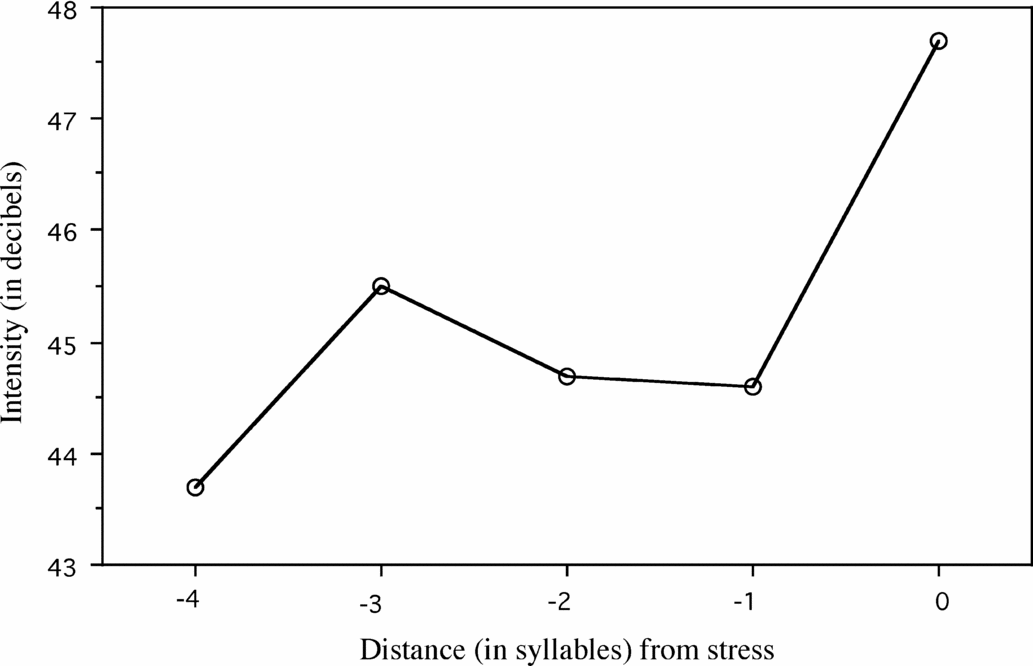
The data were also examined for evidence of secondary stresses occurring before the primary stress. Intensity values across speakers are plotted as a function of the distance in number of syllables between the vowel and the primary stressed vowel in figure 4. The primary stressed vowel is indicated by ‘0’, with ‘−1’ indicating the immediately pretonic vowel, ‘−2’ the vowel two syllables before the primary stress, ‘−3’ the vowel three syllables before the primary stress, and ‘−4’ the vowel four syllables before the primary stress.
Intensity of vowels (averaged across seven speakers) as a function of proximity to the stressed syllable.

A series of paired (by speaker) samples t-test was conducted to compare, first, the intensity of stressed vowels with unstressed vowels differing in distance from the stress and, second, the intensity of unstressed vowels with other unstressed vowels in different positions. Results indicated that stressed vowels had greater intensity than unstressed vowels in all pretonic syllables except for the one three syllables to the left of the stressed syllable: stressed vowel vs. the immediately pretonic vowel, t(6) = 4.553, p = .004; stressed vowel vs. the unstressed vowel two syllables to its left, t(6) = 3.202, p = .019; stressed vowel vs. the unstressed vowel four syllables to its left, t(4) = 3.395, p = .027. None of the unstressed vowels differed from each other as a function of proximity to the stress.
5.1.3 Fundamental frequency
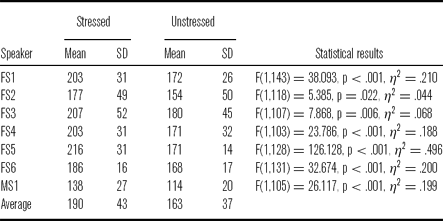
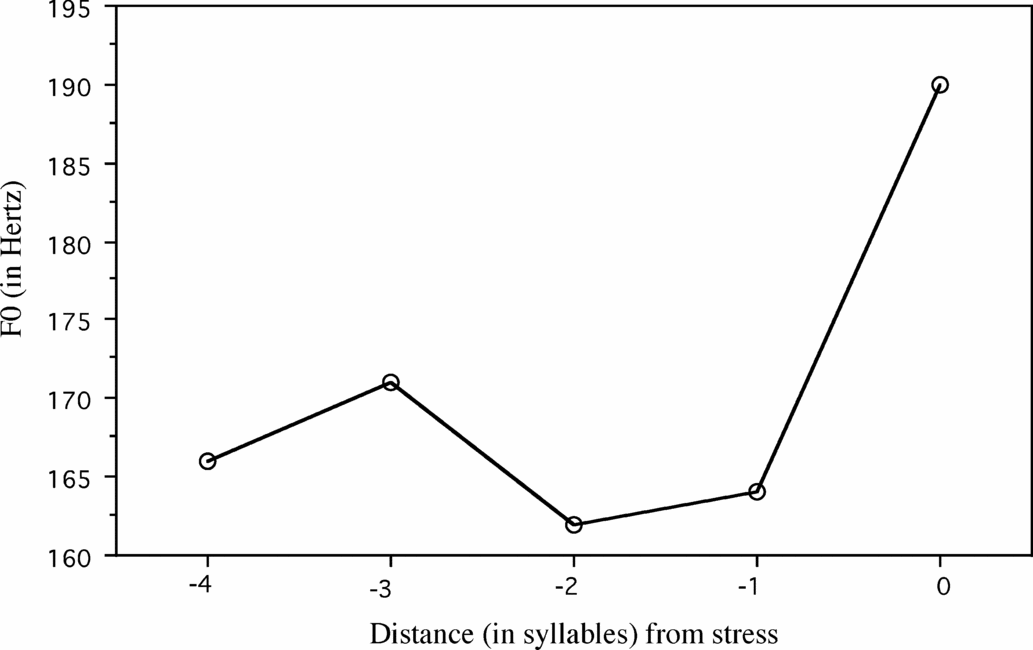
A comparison conducted on the pooled speaker data indicated that stressed vowels were associated with considerably higher average F0 values than unstressed vowels: 190 Hz for stressed vowels vs. 163 Hz for unstressed vowels. A paired samples t-test was performed for the paired variables of stress level and speaker using mean F0 values for stressed and unstressed syllables for individual speakers. Stressed and unstressed vowels differed from each other in F0 according to this analysis: t(6) = 8.693, p < .001. An analysis of variance was performed with stress level (stressed vs. unstressed) and speaker as independent variables. Both factors exerted a significant effect on F0 levels: for stress, F(1,835) = 137.228, p < .001, η2 = .104; for speaker, F(6,835) = 53.612, p < .001, η2 = .244. The effect observed for stress is consistent with the results of the t-test showing a difference in F0 between stressed and unstressed vowels. The result for speaker reflects individual differences in F0, including gender-dependent differences between subjects. According to individual speaker ANOVAs with stress level as the independent variable and F0 as the dependent property, all speakers used F0 to differentiate stress level, although they varied in the extent of the difference between stressed and unstressed vowels (see table 4).
Average by speaker F0 values and standard deviations (in Hertz) for stressed and unstressed vowels and statistical results for the stress level variable according to analyses of variance.

The data were examined for evidence of secondary stresses occurring before the primary stress. F0 values across speakers are plotted as a function of the distance in number of syllables between the vowel and the primary stressed vowel in figure 5. The primary stressed vowel is indicated by ‘0’, with ‘−1’ indicating the immediately pretonic vowel, ‘−2’ the vowel two syllables before the primary stress, ‘−3’ the vowel three syllables before the primary stress, and ‘−4’ the vowel four syllables before the primary stress.
Fundamental frequency of vowels (averaged across seven speakers) as a function of proximity to the stressed syllable.

A series of paired (by speaker) samples t-test was conducted to compare, first, the fundamental frequency of stressed vowels with unstressed vowels differing in distance from the stress and, second, the fundamental frequency of unstressed vowels with other unstressed vowels in different positions. Results indicated that stressed vowels had higher F0 than unstressed vowels in all pretonic syllables: stressed vowel vs. the immediately pretonic vowel, t(6) = 8.049, p < .001; stressed vowel vs. the unstressed vowel two syllables to its left, t(6) = 8.429, p < .001; stressed vowel vs. the unstressed vowel three syllables to its left, t(6) = 3.939, p = .008; stressed vowel vs. the unstressed vowel four syllables to its left, t(4) = 4.121, p = .015. None of the unstressed vowels differed from each other as a function of proximity to the stress.
5.1.4 Summary: Duration, intensity, and F0
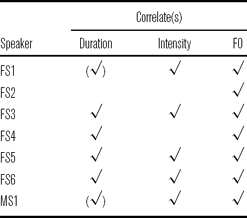
Table 5 summarizes for each speaker the properties that statistically (according to the ANOVAs discussed in sections 5.1.1–5.1.3) differentiated stressed and unstressed vowels. In the case of duration, results refer to non-final syllables. Two speakers (FS1 and MS1) differentiated stressed and unstressed vowels in the expanded duration data set including final vowels; hence, the parentheses in table 5.
Acoustic correlates of stress for individual speakers.

Fundamental frequency is the most consistently employed marker of stress as all speakers show higher F0 on stressed vowels relative to unstressed vowels. Intensity is employed by five of the seven speakers, all except FS2 and FS4, to cue stress, while duration is a correlate of stress for four speakers in non-final syllables and two additional speakers when data is pooled across both final and non-final syllables. Five of the seven speakers make use of at least two properties to signal stress, while one speaker (FS2) utilizes only F0 in the realization of stress.
5.2 Vowel quality
The second phase of the study involved the examination of vowel quality as a potential marker of stress. The two short vowels /ɐ ə/ and another vowel which is reported to alternate between /ɐ/ in unstressed syllables and [aː] in stressed syllables were examined. This alternating vowel is positionally restricted (see section 3).
The corpus for this phase of the study consisted of roots appearing in their bare form and with systematically varying numbers of morphemes following within the same phrase that pull stress farther from the root (see corpus in appendix B).Footnote 1 The target vowel /ə/ was the stressed second vowel in the root /bəsəm/ ‘host’, the non-alternating /ɐ/ was the second vowel in /tɐpʃɐkʲ/ ‘plate’ and the alternating /ɐ ~ aː/ occurred in the first syllable of /ʃ’aːlɐ/ ‘boy’. The distance between the stress and the target vowel varied from one to four syllables for the target vowels. Seven speakers (the same as those participating in the first phase of the study) provided data on /ə/. Six speakers (all except the male speaker) contributed data on non-alternating /ɐ/ and on alternating /ɐ ~ aː/.
The study aimed to determine whether /ə/ and the non-alternating /ɐ/ vary in quality as a function of stress and also to confirm quantitatively the alternation between /ɐ/ and [aː] observed in roots. Unstressed vowels occurring at different distances from the stress were compared in order to determine whether any observed alternations in quality vary gradiently as a function of distance from the stress or whether there is a more categorical, even if perceptually subtle, division between stressed and unstressed vowels of the type described for the [ɐ ~ aː] alternation. The duration of vowels was also measured in order to assess possible correlations between duration and vowel quality that may be attributed to coarticulation with adjacent consonants.
5.2.1 Results
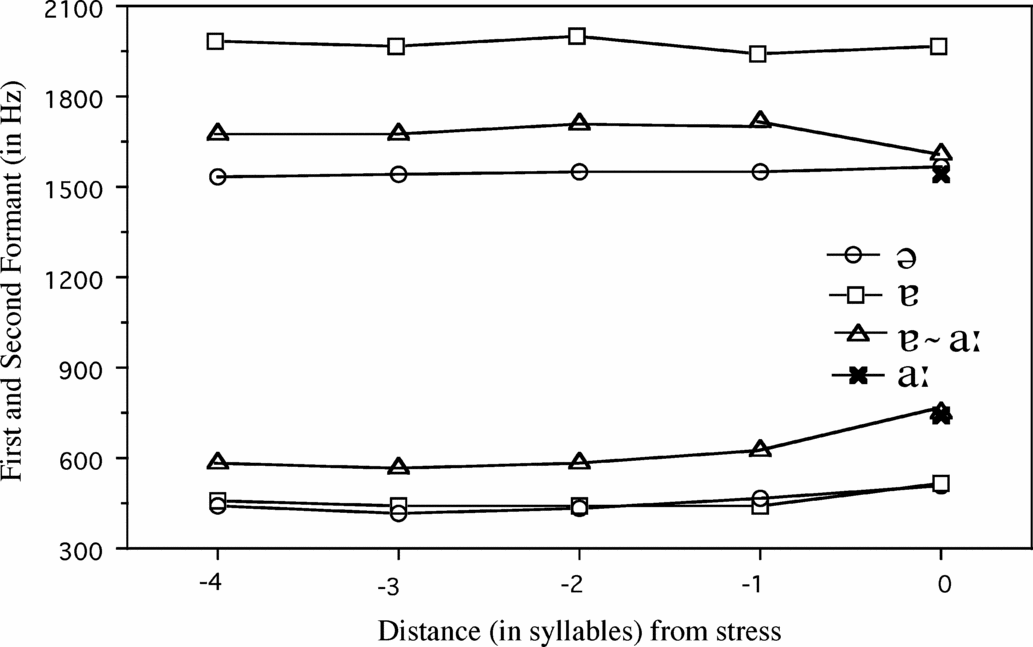
In figure 6, mean first and second formant values averaged over all the tokens produced by the six female speakers are plotted for the three target vowels differing in their proximity to the stressed syllable. In addition, the first two formants for the non-alternating /aː/ occurring in the word [saːˈbiː] ‘baby’ are plotted on the right (completely overlapped with the symbol for alternating [aː]) as a reference point to indicate the neutralizing nature of the [ɐ ~ aː] alternation. The stressed vowel is indicated by ‘0’, with ‘–1’ indicating the immediately pretonic vowel, ‘–2’ the vowel two syllables before the stress, ‘–3’ the vowel three syllables before the stress, and ‘–4’ the vowel four syllables before the stress.
First and second formant values for the vowels [ə], [ɐ], [ɐ ~ aː] and [aː] for six female speakers as a function of distance from the stress.

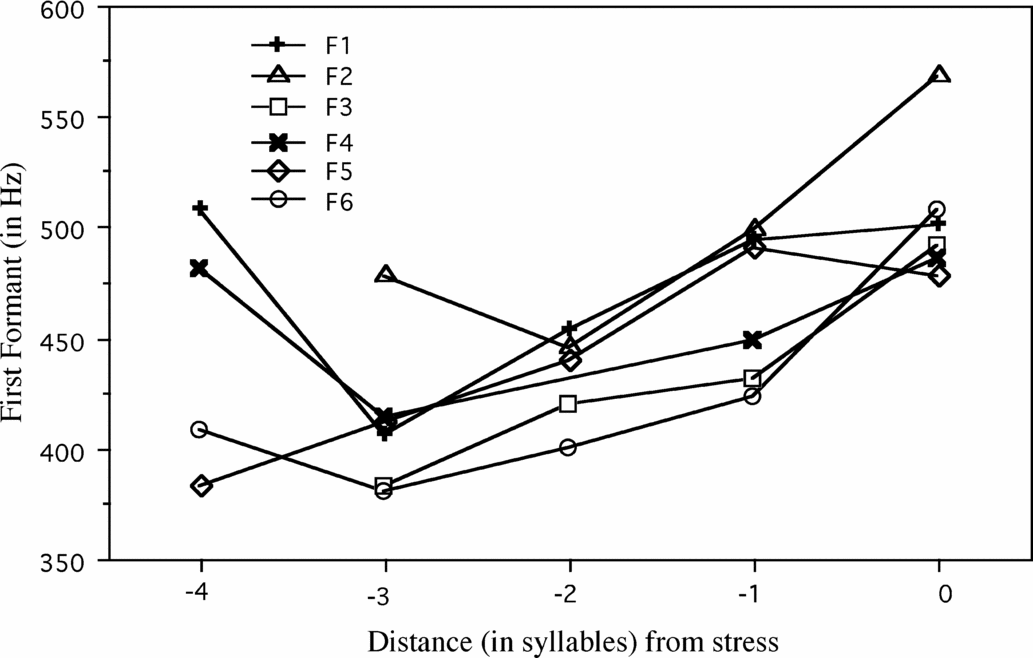
Looking first at the vowel /ə/, paired (by speaker) t-tests did not indicate any significant effect of distance from the stress on second formant values. There was, however, an effect of proximity to the stress on first formant values for several female speakers. First formant values for schwa in different contexts for the female speakers are plotted in figure 7.
Average first formant values for [ə] for six female speakers as a function of distance from the stress.

According to paired (by speaker) t-tests, the first formant for the stressed vowel was higher than the first formant for the preceding three pretonic vowels (but not the vowel four syllables to the left of the stress): stressed vowel vs. pretonic vowel, t(6) = 2.871, p = .028; stressed vowel vs. unstressed vowel two syllables to the left of the stress, t(4) = 4.737, p = .009; stressed vowel vs. unstressed vowel three syllables to the left of the stress, t(5) = 9.874, p < .001. Most speakers (FS2, FS3, FS4, FS6) showed salient lowering of the first formant in unstressed syllables, but others (FS1, FS5 and the male speaker, not shown in the figure) either had no lowering or only negligible lowering of the first formant. In addition, first formant values for the immediately pretonic vowel were higher than those for the unstressed vowel two syllables from the stress (t(4) = 4.385, p = .012) and those for the unstressed vowel three syllables from the stress (t(5) = 4.918, p = .004). This pattern is found for all of the speakers, though the size of the differences varies between speakers. Another pattern found for some speakers (FS1, FS2, FS4, FS6) is for first formant values to increase slightly in the vowel farthest from the stress, the vowel four syllables from the stress for FS1, FS4 and FS6, and three syllables from the stress in the case of FS2.
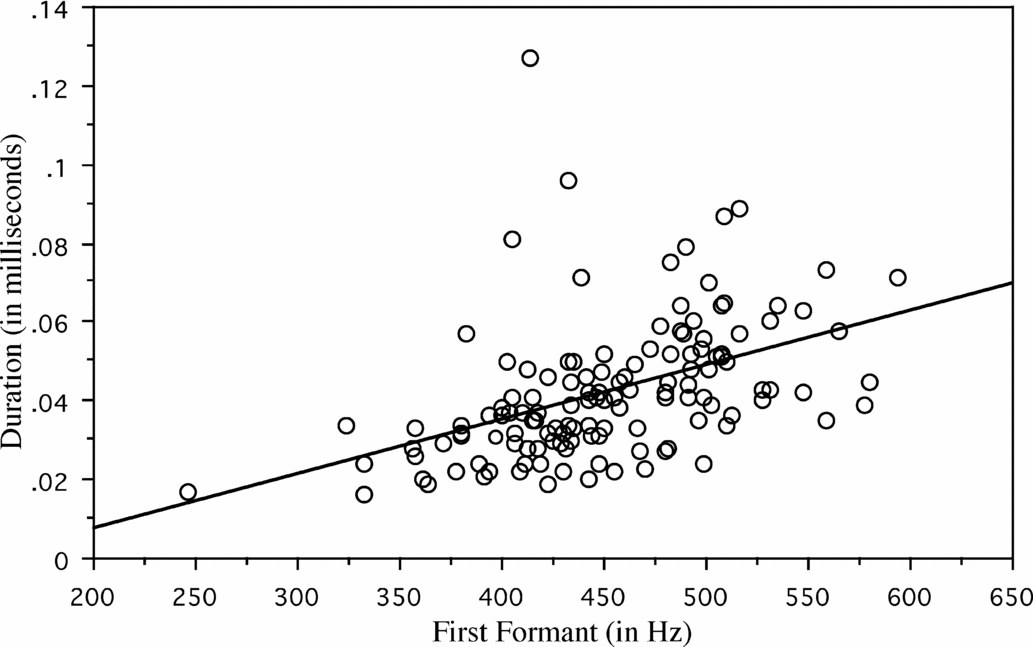
A linear regression analysis (see plot in figure 8) was conducted over all tokens across speakers with the first formant as the dependent variable and duration as the independent variable. There was a moderate correlation (p < .001, r = .459) between duration and first formant values for /ə/, such that increased length was associated with higher first formant values, which indicate a lower tongue position. No correlation was found between duration and the second formant. The correlation between duration and the first formant is consistent with the slight raising of F1 observed for some speakers in the vowel farthest from the stress relative to the immediately following vowel. For these speakers, there is slight lengthening of the vowel farthest from the stress compared to its neighbor: 5 ms (17% longer than its neighbor) for speaker FS1, 12 ms (32%) for FS2, 15 ms for FS4 (43%), 6 ms (29%) for FS6. In contrast, the two female speakers who do not show this pattern have smaller lengthening of the vowel: 3 ms for speaker FS3 (11%) and 3 ms (9%) for FS5.
Duration (y-axis) vs. first formant values (x-axis) for [ə] as produced by seven speakers.

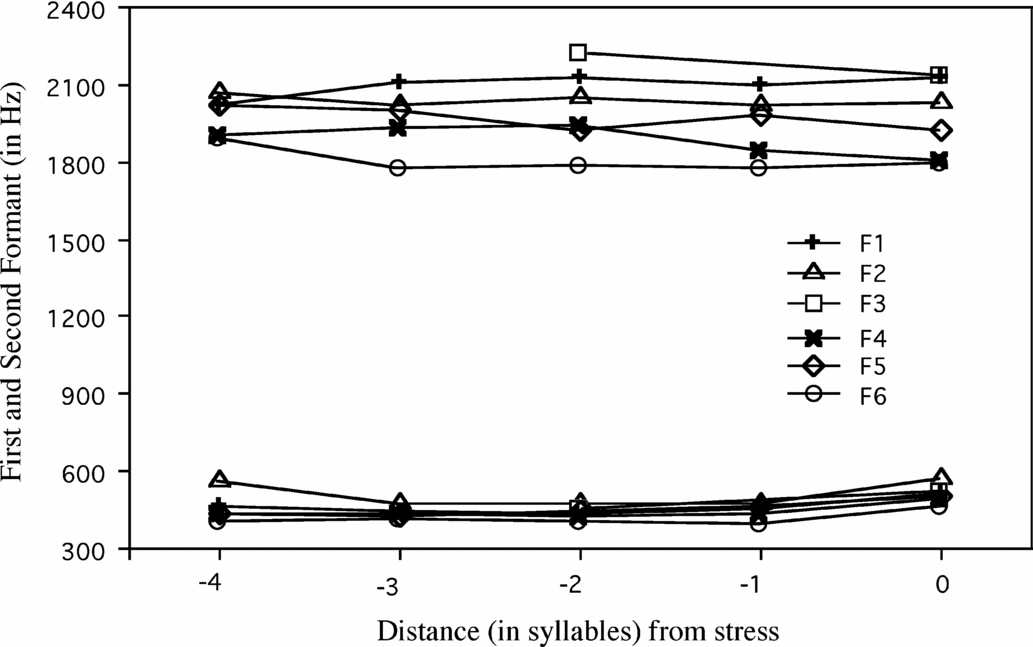
For the non-alternating vowel /ɐ/, a paired samples t-test indicated a significant (though small) lowering effect on the first formant of unstressed vowels relative to the stressed vowel: stressed vowel vs. the immediately pretonic vowel, t(4) = 7.237, p = .002; stressed vowel vs. the unstressed vowel two syllables to the left of the stress, t(5) = 12.596, p < .001; stressed vowel vs. the unstressed vowel three syllables to the left of the stress, t(4) = 8.471, p = .001; stressed vowel vs. the unstressed vowel four syllables to the left of the stress, t(4) = 5.161, p = .007. There were not any differences between the pretonic vowels. Second formant values did not differ as a function of proximity to the stress. It is interesting to note, however, that second formant values for /ɐ/ vary considerably from speaker to speaker but are generally consistent with a transcription of this vowel as a fronter vowel such as /ɛ/.Footnote 2 Figure 9 shows mean values for speakers plotted individually. (Note that speaker FS4 only provided data from stressed vowels and the syllable two syllables to the left of the stress.)
First and second formant values for [ɐ] for six female speakers as a function of distance from the stress.

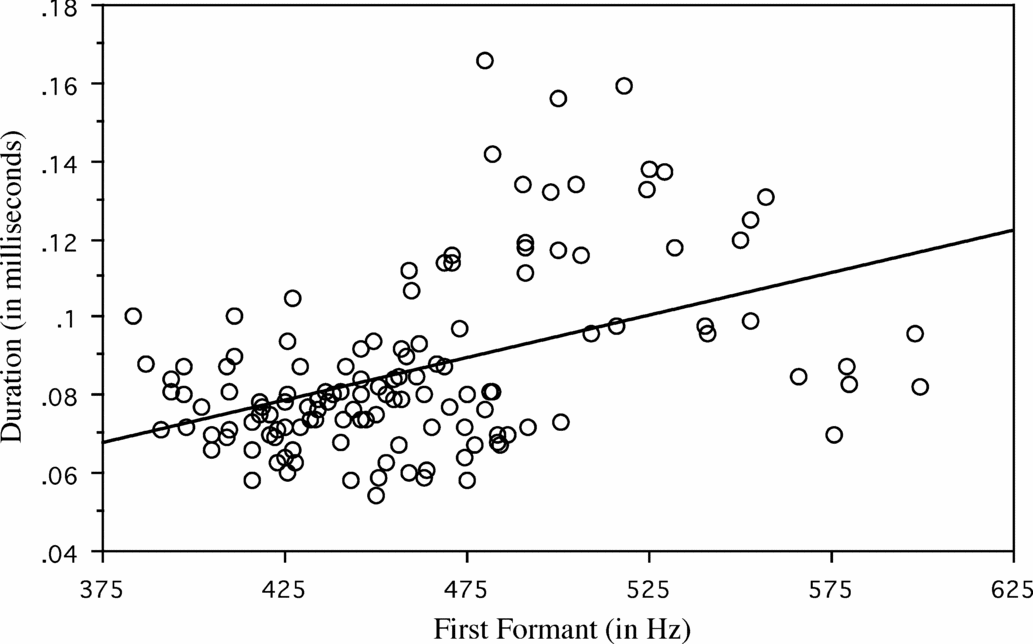
Linear regression analyses showed a moderate correlation between first formant values (see figure 10) and duration (p < .001, r = .446) but no correlation between second formant values and duration. The positive correlation between duration and the first formant parallels the results for schwa seen earlier.
Duration (y-axis) vs. first formant values (x-axis) for [ɐ] as produced by six female speakers.

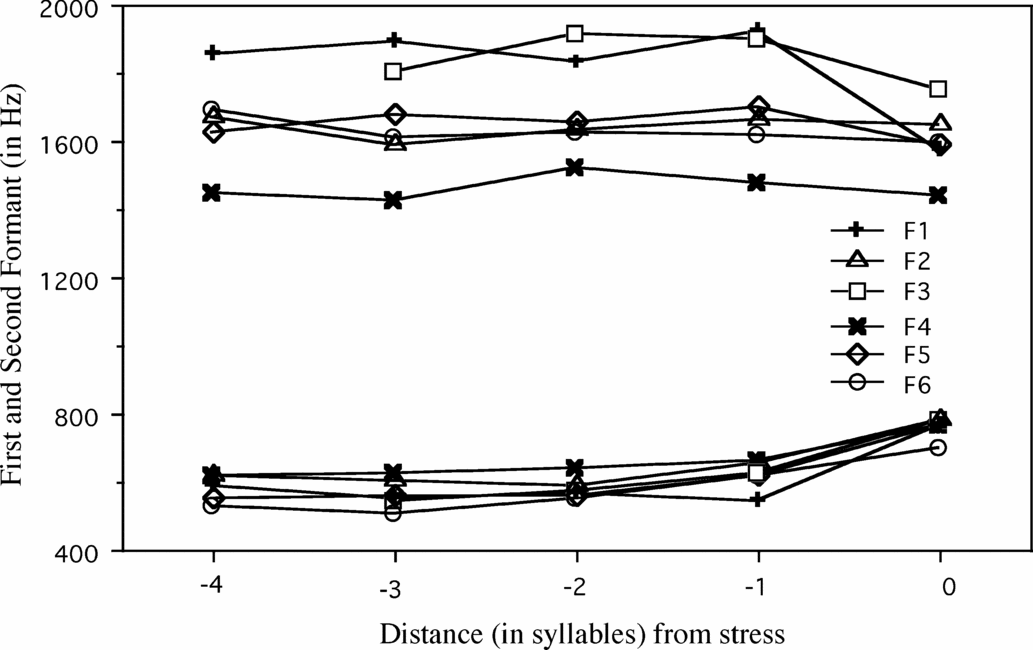
Turning to the alternating vowel, the dominant pattern (see individual speaker results in figure 11) is for first formant values to be higher in the stressed syllable than in unstressed syllables, where the sharpness of the change depends on the speaker. As figure 6 above showed, however, the unstressed allophone remains backer and lower than the non-alternating /ɐ/. For certain speakers (most clearly FS6), there is also a tendency for first formant values to continue to fall slightly as distance from the stress increases. Paired t-tests showed that first formant and second formant values differed between the stressed vowel and all its unstressed counterparts: stressed vowel vs. the pretonic vowel, t(5) = 6.835, p = .001; stressed vowel vs. the unstressed vowel two syllables to the left of the stress, t(5) = 13.120, p < .001; stressed vowel vs. the unstressed vowel three syllables to the left of the stress, t(5) = 15.857, p < .001; stressed vowel vs. the unstressed vowel four syllable to the left of the stress, t(4) = 16.470, p < .001. In addition, first formant values were marginally higher for the immediately pretonic vowel relative to its counterparts two (t(5) = 2.882, p = .035) and three (t(5) = 3.263, p = .022) syllables to the left of the stress.
First and second formant values for [ɐ ~ aː] as produced by six female speakers as a function of distance from the stress.

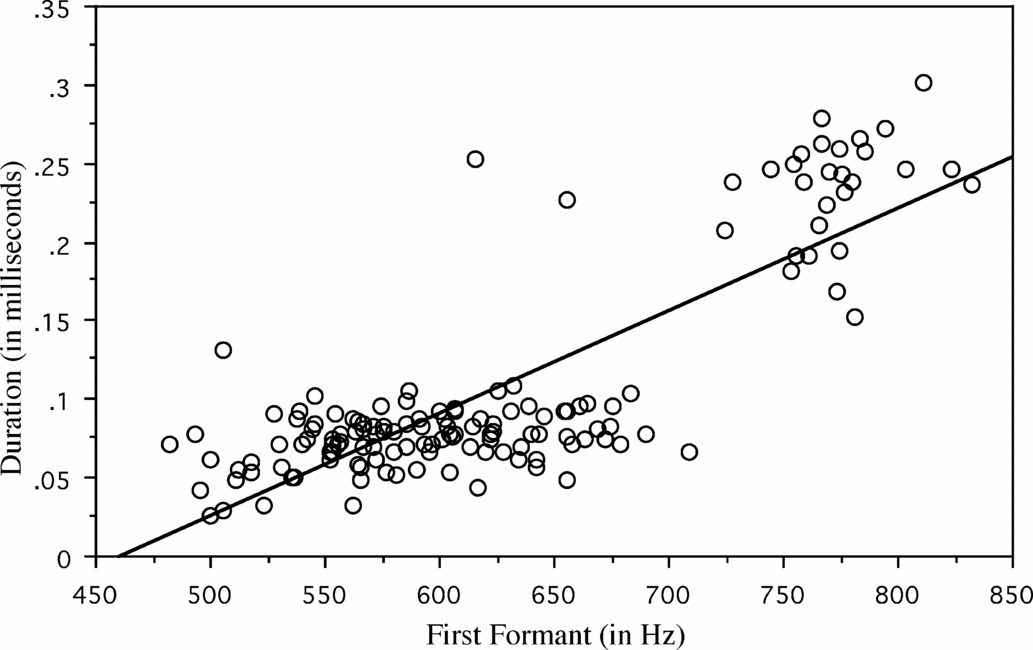
A linear regression analysis (with first formant as the dependent variable and duration as the independent variable) pooled over all speakers indicated a very strong positive correlation (p < .001, r = .825) between duration and first formant values as is apparent in figure 12. Duration displays a bimodal distribution in keeping with descriptions analyzing the lower variant found in stressed syllables as a phonemic long vowel in contrast to the phonemic short vowel occurring in unstressed syllables.
Duration (y-axis) vs. first formant values (x-axis) for [ɐ ~ aː] as produced by six female speakers.

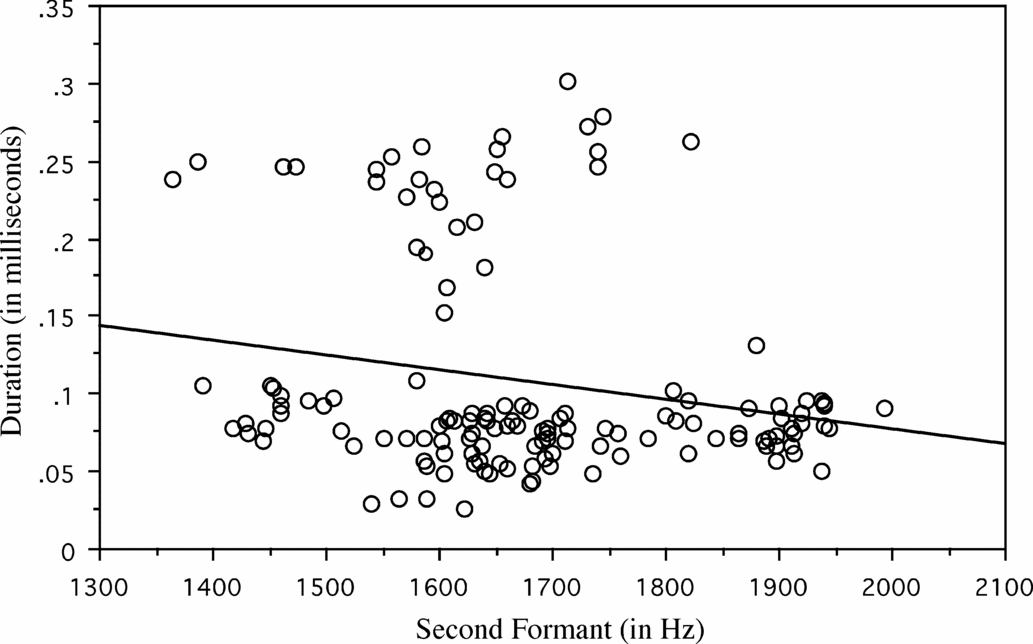
A slight negative correlation (p = .014, r = .207) between duration and second formant values was found in a linear regression analysis with increased duration being associated with lower second formant values (see figure 13). The longer variant occurring in stressed syllables has lower second formant values indicating a slightly retracted tongue position.
Duration (y-axis) vs. second formant values (x-axis) for [ɐ ~ aː] as produced by six female speakers.

However, if the long allophone [aː] occurring in stressed syllables is excluded, the correlations between duration and both first and second formant values disappear. This indicates that the correlations between duration and the first two formants for the vowel alternating between /ɐ/ and [aː] are primarily artifacts of the bifurcation of the vowel space between two principal allophones: [ɐ] in unstressed syllables vs. [aː] in stressed syllables.
5.2.2 Summary: vowel quality
Results suggest the existence of two types of relationship between stress and vowel quality in Kabardian. First, for the majority of speakers, there is a categorical shift in quality between more central unstressed /ɐ/ and more peripheral stressed /aː/, which is manifested as a lowering of the first formant and, less consistently across speakers, a raising of the second formant in unstressed syllables relative to the stressed syllable. The extent of this shift in quality is greater than that observed for either the vowel /ə/ or the non-alternating /ɐ/ under a change in stress. In fact, the stressed counterpart of /ɐ/ is qualitatively identical to /aː/ that does not alternate.
The second type of effect of stress on vowel quality is the more gradient variety observed for /ə/ and less strongly for /ɐ/, both of which display slightly lowered first formant values in unstressed syllables. This lowering is correlated with vowel duration such that shorter vowels are associated with lowered first formant values, which are suggestive of a higher tongue position. Superficially, the lowered first formant values might suggest contrast enhancing reduction of the raising type according to Crosswhite's (Reference Crosswhite2001) taxonomy. However, the gradient and small nature of the raising effect is more plausibly explained by the same articulatory mechanism driving the centralizing type of reduction. The lowering of the first formant in schwa and /ɐ/ when they are unstressed and thus shorter is suggestive of coarticulation with surrounding consonants, in particular, adjacent consonants with a coronal primary or secondary articulation: /s/ preceding the target schwa in the root /bəsəm/ and /ʃ/ preceding and /kʲ/ following the target /ɐ/ in the root /tɐpʃɐkʲ/. The tongue is raised for the coronal and must lower to assume the canonical position for both schwa and /ɐ/. As the vowel shortens, as occurs in unstressed syllables, however, there is insufficient time for the tongue to reach its target position. The result is articulatory undershoot of the vowel. The data for Kabardian schwa essentially mirror those of Lindblom (Reference Lindblom1963) for Swedish non-high vowels and are driven by the same articulatory considerations that plausibly motivate the centralizing type of vowel reduction.
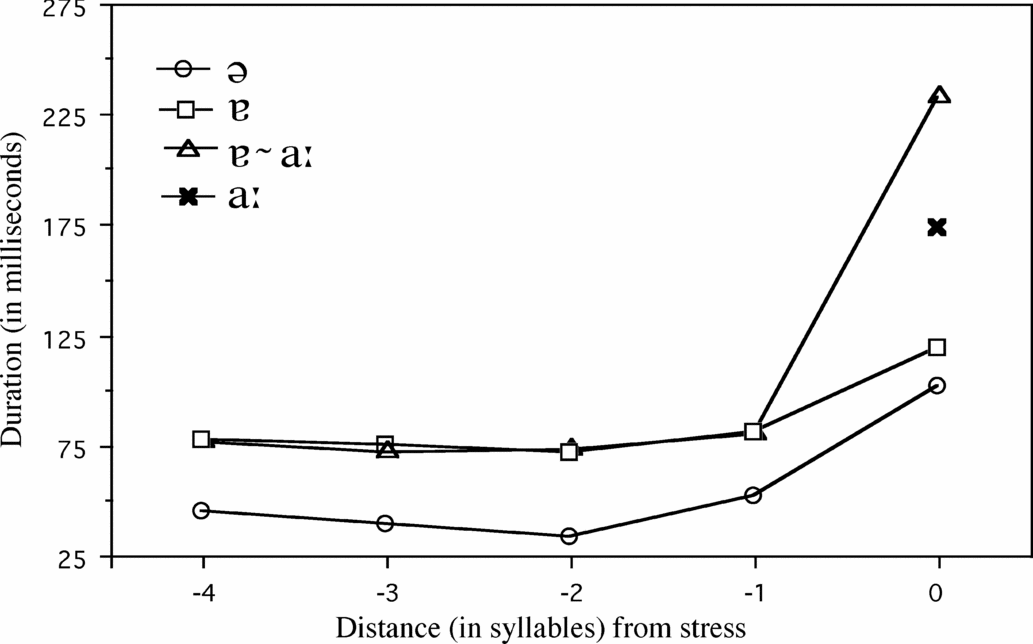
It is interesting to note that the raising of /ɐ/ in unstressed syllables is less than that observed for unstressed schwa and that the correlation between the first formant and duration is weaker for /ɐ/ than for schwa. There is a relatively simple explanation for this difference between schwa and /ɐ/. The vowel /ɐ/ is considerably longer than /ə/ in all contexts. This difference is apparent in figure 14, which plots duration for the vowels [ɐ], [ə], and [ɐ ~ aː] in different contexts relative to stress for the six female speakers. The non-alternating long /ɐ/ in [saːˈbiː] ‘baby’ is also plotted to show that it is durationally shorter than its qualitatively identical alternating counterpart in stressed syllables.
Duration of the vowels [ə], [ɐ], [ɐ ~ aː] and [aː] as produced by six female speakers as a function of distance from the stress.

Presumably, the greater duration of /ɐ/ makes it less susceptible to coarticulatory effects from adjacent consonants which would affect the entire vowel. Another potential contributing factor to the difference between schwa and /ɐ/ in the examined data might be the difference in consonantal context in which the vowels occurred. Differences in surrounding consonants could also account for the failure of alternating /ɐ/ in unstressed syllables to display any correlation between duration and first formant values even though it is durationally equivalent to non-alternating /ɐ/.
6 Conclusions
Like many other more thoroughly studied languages, the Northwest Caucasian language Kabardian distinguishes stress acoustically through a combination of properties, including higher fundamental frequency, greater overall intensity and increased duration. Of these properties, fundamental frequency is the most robust correlate of stress, a feature shared with closely related Ubykh (Vogt Reference Vogt1963: 32). In the data examined here, duration and intensity are used less consistently across speakers as a cue to stress. The lesser reliance on duration relative to F0 supports the hypothesis that the manipulation of duration as a marker of stress could potentially be constrained by the use of duration to signal phonemic contrasts in vowel length. Nevertheless, the fact that some speakers did use increased duration to signal stress indicates that a phonemic length contrast does not necessarily preclude the use of duration as a stress correlate, in keeping with Taff et al.'s (Reference Taff, Rozelle, Cho, Ladefoged, Dirks and Wegelin2001) findings for Aleut.
The greater reliability of F0 as a stress correlate in Kabardian relative to duration and intensity mirrors results for English (Fry Reference Fry1955, Reference Fry1958) with the caveat that the present study does not attempt to tease apart phrase-level intonational prominence (see Applebaum & Gordon Reference Applebaum and Gordon2007 and Applebaum Reference Applebaum2008 on Kabardian intonation), which hinges on fundamental frequency, from word-level stress, which is characteristically more reliant on duration and intensity (see Sluijter & van Heuven Reference Sluijter and van Heuven1996 for discussion of phonetic aspects of this distinction). It may also be noted that the greater reliance on F0 in Turkish Kabardian parallels results for Turkish (Levi Reference Levi2005), the language in which all of the speakers providing the data for the current research are bilingual. It is thus possible that the importance of F0 as a cue to stress in Turkish Kabardian could be due to influence from Turkish. Phonetic study of stress correlates in varieties of Kabardian spoken in countries with different superstratum languages would be necessary to determine whether the results observed in the present work reflect a transfer of phonetic characteristics of Turkish into Kabardian.
Kabardian also displays a salient alternation in vowel quality between /ɐ/ and [aː] that is dependent on stress. This alternation is accompanied by a large difference in duration, far greater than the differences in duration between stressed /ə/ and /ɐ/ and their unstressed counterparts. Not coincidentally, the vowels /ə/ and /ɐ/, which differ only slightly in duration between stressed and unstressed syllables, also show only minor differences in quality as a function of stress. These differences are likely attributed to coarticulation with adjacent consonants that varies in inverse proportion to duration: the shorter the duration of the vowel, the greater the degree of coarticulation.
The characterization of the alternation between /ɐ/ and [aː] as neutralizing was only partially confirmed by the present study. The allophone [aː] occurring in stressed syllables is qualitatively identical to its non-alternating counterpart but longer. On the other hand, the allophone [ɐ] is quantitatively equivalent to its non-alternating counterpart but is qualitatively lower and backer. The investigation of neutralization deserves further study using data in which surrounding consonant context is controlled for across phonemic vowel categories.
The occurrence of the coarticulation-driven gradient raising of schwa as opposed to the categorical raising of mid vowels in unstressed syllables found in many languages suggests that vowel reduction in Kabardian is driven primarily by the goal of increasing articulatory ease rather than maximizing the perceptual distinctness of vowel contrasts in unstressed syllables. Colarusso (Reference Colarusso1992) alludes to this motivating force in his discussion of schwa in Kabardian, when he suggests that schwa provides the ‘shortest possible sonorant path’ to transition between consonants (p. 28). The phonemic short vowels of Kabardian both occupy a relatively central vowel space, meaning that they require relatively little tongue movement beyond the rest position. For this reason, durational shortening associated with lack of stress is less likely to induce a shift in vowel quality beyond that induced by coarticulatory effects of adjacent consonants.
A further factor potentially explaining the limited role of vowel reduction as a cue to stress relates to the functional role of stress in Kabardian. Stress is non-phonemic at the lexical level and its role in differentiating minimal pairs on a morphological basis is extremely limited. Pairs such as [ˈməʃɐ] ‘bear’ vs. [məˈʃɐ] ‘this milk’, where the first word is monomorphemic and the second word consists of the root /ʃɐ/ ‘milk’ plus the stress-rejecting prefix /mə/ are quite rare. For this reason, it may be less crucial in Kabardian from a functional perspective to signal stress through changes in vowel quality.
Yet another reason for the limited role of vowel quality in signaling stress might be its role in identifying adjacent consonants. Vowels, particularly the two phonemic short vowels /ə/ and /ɐ/, have several different allophones depending on the surrounding consonants. These allophones occupy much of the available vowel space, as the phonetic literature on Kabardian demonstrates (Catford Reference Catford, Higgs and Thelwall1984; Colarusso Reference Colarusso1988, Reference Colarusso1992, Reference Colarusso2006; Choi Reference Choi1991; Wood Reference Wood1994; Gordon & Applebaum Reference Gordon and Applebaum2006). These allophonic shifts in vowel quality potentially assist in identifying the numerous consonantal contrasts of Kabardian. It is conceivable that there is less room for signaling stress, which carries a low functional load, through changes in vowel quality because most of the available vowel space is exploited by consonantally-conditioned changes in vowel quality. The Kabardian data thus suggest that predictions about the phonetic realization of stress potentially hinge not just on the functional role of stress but also on other factors, including the complexity of the consonant system and, perhaps more crucially, a language's weighting of the often antagonistic goals of minimizing articulatory effort and maximizing perceptual distinctness.
Acknowledgements
The authors gratefully acknowledge comments from three reviewers and John Esling on earlier drafts of this paper as well as the meticulous editorial assistance of Ewa Jaworska. A tremendous debt of gratitude is owed to the Kabardian speakers (Emel Bozkurt, Gönül Bozkurt, Melahat Sezgin, Nedret Vatanartıran, Hacı Aslan Rauf and Mücella Arıkan) providing the data analyzed in this paper; without their generosity this study would have been impossible. The research presented here was funded by NSF grant BCS0553771 to the first author and by a Hans Rausing Foundation grant to the second author.