


I. INTRODUCTION
In the last few years the intriguing concept of very-high-performance reconfigurable radar transmitter is becoming feasible, mainly thanks to the introduction in radar application of technological development such as optical signal generation distribution and processing, photonic radio frequency (RF) up/down conversion, optical sampling, and beamforming. Photonics technologies applied to the microwave radar signal generation guarantees a high level of phase coherence and very good potential in terms of tunability and flexibility of the RF generation.
In this scenario, a digital approach could have a lot of advantages with respect to the classical radar architecture in terms of transceiver module size (avoiding the intermediate frequency up/down conversion stage) and cost (using commercial optical and optoelectronic devices), instantaneous pulse bandwidth, software-based capability, low phase noise for coherent radar processing such as moving target indicator (MTI) and moving target detector and finally for multi-functional radar systems.
In addition, the demand of a new generation of surveillance radar, satellite communications, remote sensing and ground penetrating radar, as well as biomedical imaging, automotive and security systems, has driven the technology development in this direction [Reference Peacock and Pearson1, Reference Chan and Lim2]. For this new kind of radar, the adaptivity of the microwave RF generation according to a variable scenario is one of the most important requirement, together with high operating frequencies, spectral purity, and flexible baseband signal generation.
Therefore, both high-frequency oscillators with very low phase noise for up/down conversion, and direct RF analog to digital converters are required.
In a conventional radar system, the spectral purity of the microwave signal also depends on the frequency stability of a STAble Local Oscillators and COHerent Oscillators. In order to satisfy the microwave regime and to improve the RF signal stability, the combination of different type of oscillators (i.e. acoustic and electrical) is necessary. Some of the weaknesses of this implementation is the usage of low-frequency resonant modes, the necessity of a great number of multiplication stages, and the strongly frequency-dependent performance of microwave signal in terms of amplitude and phase jitter [Reference Dispenza3].
This instability can induce a large phase noise on the target and clutter echo and can modify the signal spectrum, masking the presence of a small moving target echo. Moreover, it can produce ambiguity on the target radial distance and Doppler frequency estimation, constraining the time delay clutter canceller in the MTI processing and reduce the maximum signal to noise ratio in the data converter [Reference Song and Hong4, Reference Brooker5].
In this paper we propose a photonic technique for realizing a reconfigurable microwave signal generation based on the beating of two laser modes coming from a stable regenerative fiber mode-locked laser (FMLL) and by means of an integrated interferometric structure. Thanks to its excellent stability and high repetition, this architecture has also been proposed as an electro-optical sampler for the received signal [Reference Pierno, Dispenza, Tonelli, Bogoni, Ghelfi and Potì6].
The proposed architecture, based on the use of just one device for both transmitter and receiver chain, also represents a cost-effective solution for microwave signal generation and guarantees the same performance up to ultra-high frequencies.
The aim of the proposed paper is to give an alternative approach for a flexible microwave signal generation suitable for high frequencies and in this direction results are shown for the photonic RF generation to demonstrate the effectiveness of the proposed approach. The results at 10 GHz show excellent spectral purity above 5 kHz if compared to a state of the art Agilent synthesizer even though the timing jitter increases for integration time greater than 10 ms. In order to achieve the same stability performance at both high and low frequencies, a phase locked loop between the laser and a synthesizer could be used.
In this work we extend the results obtained at the X band by evaluating the time jitter at 40 GHz and comparing it to the 10 GHz RF generation. Results show that the time jitter appears to be constant for the frequency detuning and make the proposed photonic microwave generation suitable for the new generation of radar applications exploiting high frequency.
II. RECONFIGURABLE MICROWAVE RADAR TRANSMITTER ARCHITECTURE
The architecture of the reconfigurable full digital radar transmitter is shown in Fig. 1. The generation of the RF carrier frequency is realized by beating two laser modes coming from a fiber mode locked laser into a photodiode. The FMLL is a fiber laser with excellent stability, thanks to the auto-regenerative feedback. It is able to produce very stable narrow optical pulses with repetition rate in the range from 1 to 40 GHz.
Reconfigurable radar transmitter architecture.

The optical spectrum is composed of a number of modes, whose spacing is equal to the pulse repetition rate. All the laser modes are phase locked with each other, thanks to the mode locking condition and the regenerative feedback that keeps the modes well locked [Reference Ghelfi, Serafino, Berizzi and Bogoni7, Reference Goldberg, Taylor, Weller and Bloom8].
The selection of the two beating modes is realized by splitting the optical signal emitted by the FMLL in two arms by an optical splitter with a 50% splitting ratio. Each replica of the signal is filtered by an optical filter in order to select only one mode from the spectrum. In order to achieve a stable RF signal after the photodiode, the two arms of the scheme should be mechanically stable. The RF up conversion system can be realized by means of an electro-optical modulator (EOM), such as a Mach Zehnder interferometric modulator biased along its quadrature point [Reference Cox9], into one of the two arms.
The EOM is driven by a baseband signal generation block which addresses the digital synthesis of arbitrary waveforms – such as pulse trains, coded waveforms, frequency modulated waveforms such as chirp – with an adaptive bandwidth optimized according to the targets of interest and the environment. For example some of the key features of the baseband signal generation are the frequency, phase and amplitude sweeping capability, the number of bits of the digital to analog convert, and so on.
The two modes, the modulated and the unmodulated ones, are then combined together in a coupler and then sent in a photodiode which realizes the heterodyning, generating the final microwave signal. Finally, the RF amplification stage or a single high power amplifier (HPA) provides the necessary power for transmission [Reference Bogoni and Berizzi10]. Under this assumption, the concept of reconfigurable transmitter becomes feasible. As a matter of fact, it possible to tune the optical filters changing the operative wavelength by means of an electrical control. We are therefore able to select different laser modes with specified tuning frequency (i.e. a multiple of the laser repetition rate) according to the optical filter bandwidth. Therefore, exploiting a single photodetector, we can easily generate a modulated radar signal at different RF carriers up to W band and achieve frequency flexibility and reconfigurability.
Obviously, in order to make the proposed architecture operatively flexible, we should make use of a wideband direct digital synthesizer able to realize different type of radar signals (such as unmodulated pulses, chirp, and Barker codes). Moreover, an amplification stage composed of RF filters and power amplifiers capable of dealing with wide bandwidth are necessary.
Referring to Fig. 1, a mathematical expression of the transmitted signal is detailed in the following equations.
Under the assumption of ω0 = c/υ0, where c is the speed of light, υ0 is the central wavelength, and Δ ω = 2πΔf. The FML laser signal o(t) can be represented by a superposition of 2N + 1 sinusoidal functions which represent the different modes propagating in the cavity:

According to the mode locked condition, each mode is locked with each other because they have the same phase relation. Therefore equation (1) can be rewritten changing the term ϕq in ϕ:

The two selected adjacent laser modes with a detuning equally to the laser repetition rates Δω are:


The EOM output signal y(t) represents the modulated radar signal obtained through the electro-optical modulator and can be written as

The modulator transfer function is defined with the term T EOM, x(t) is the baseband radar signal, V π is a characteristic parameter of the Mach Zehnder modulator, and V bias is the selected voltage useful to drive the modulator in a quadrature point.
The signal v(t), before the photodetection process, can be written as
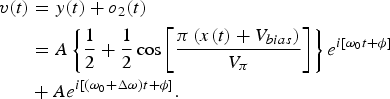
The photodiode realizes the beating between the modulated and the unmodulated signal and the output is given by

Some higher frequency terms, on the order of hundreds of THz, such as the ones at 2ω0 and 2ω0+2ω0+2Δω have been filtered out by the photodetector with an analog bandwidth of the order of GHz. Therefore, the photodetector output signal can be written as

The signal r(t) is then amplified by the HPA and the transmitted signal is given by

where hHPA(t) represent the HPA transfer function.
As previously stated, the proposed scheme offers the capability of reconfigurable transmission. As a matter of fact, by tuning the filters, it is possible to select laser modes at different detuning frequencies at any multiple of the laser repetition rate (i.e. the mode at frequency 2πω0 and the mode at frequency 2πω0+2πNΔω, where N represents the mode spacing). Moreover, the use of a digital baseband signal generator allows to match the RF signal modulation to the target and the environment.
III. X BAND SIGNAL GENERATION EXPERIMENT
A) Single carrier experiment
The architecture set up of the single-carrier experiment (Fig. 2) consists of a FMLL provided by PhoTrix operating at 10 GHz and able to emit 4 ps very stable pulses centered at 1550 nm. An erbium-doped fiber amplifier is used before the filtering process to guarantee sufficient optical power at the photodiode and a band pass filter with a 3 dB bandwidth of 0.15 nm and steep edges has been used to select two adjacent laser lines.
Single-carrier experiment setup.

Figure 3 shows the filtered optical spectrum taken by an optical spectrum analyzer with a resolution bandwidth of 0.01 nm (corresponding to 1.25 GHz), compared with the original spectrum of the FMLL. The undesired modes are suppressed more than 20 dB. The two selected modes are then injected in an amplified photo-detector with a 3 dB bandwidth of 11 GHz. Since the photodiode realizes a quadratic function of its optical input, the two inserted laser modes beat together generating a RF signal at a frequency that is equal to their detuning frequency (i.e. 10 GHz).
Optical spectrum of the FMLL and the two selected adjacent modes.

The microwave signal thus generated is analyzed by means of a signal source analyzer (Agilent E5052A). The obtained results are shown in Fig. 4, where the phase noise of the beating signal is compared with other RF sources, namely a VCO at 10 GHz (Narda FFCM), a state of the art synthesizer (Agilent E8257D), and the Anritsu RF generator. The performances of the heterodyning of two distributed-feedback (DFB) lasers with a detuning frequency of 10 GHz (EXFO IQS-2400 modules) have been presented in [Reference Ghelfi, Serafino, Berizzi and Bogoni7].
Comparison of phase noise levels for different RF sources at 10 GHz.

The comparison represented in Fig. 4 is realized for a frequency offset in the range 100–40 MHz. These range limits are due, respectively, to the usual time duration of the radar measurements (generally longer than 1 ms), and to the intrinsic limitation of the measurement instruments.
It should be noted from Fig. 4 that the proposed architecture (black line) and the state of the art RF synthesizer provided by Agilent (light gray line), show comparable behaviors, whereas the other RF generation methods present the worst performance, with phase noise levels tens of dB higher along most of the analyzed frequency range.
The proposed RF generation technique works better than the synthesizer in a wide range of frequency, from about 5 kHz up to 1 MHz. For offset frequencies above 1 MHz, even though the synthesizer shows less phase noise, both the RF sources perform well. On the other hand, for offset frequencies lower than 5 kHz, the state-of-the-art synthesizer shows extremely low phase noise, whereas our proposed photonic RF generation becomes more instable, although its behavior is still better than other RF sources.
Integrating the phase noise curve reported in Fig. 4 it is possible to calculate the timing jitter of the RF signal. The numerical equation used to calculate the signal time jitter is shown below [11]:

The terms f 0 and f k in equation (10) represent, respectively, the carrier frequency (equal to 10 GHz) and the frequency interval between two adjacent values of frequency offset (where the frequency offset axis has been divided into K − 1 values used for the numerical integration).
Instead the terms ν k and s k represent, respectively, the phase noise value at a frequency offset f k and the relative slope in the same point (the term Φ represent the phase noise level expressed in dBc/Hz) [12]:


The integration interval should be chosen accordingly with the observation time related to the radar application (i.e. the phase coherence must be maintained for the whole observation time necessary to obtain a coherent detection of the target) and due to the limits of the measurement device.
We performed the calculation for different frequency intervals starting for example from 100 Hz up to 40 MHz, from 1 kHz up to 40 MHz and so on. The results comparing the proposed RF generation method and the Agilent synthesizer are reported in Fig. 5.
Time jitter values for filtered MLL and Agilent E8257D synthesizer at 10 GHz.

When the phase noise is integrated starting from 1 kHz up to 40 MHz, the obtained jitter for the filtered MLL decreases with respect to the time jitter of the Agilent RF synthesizer (i.e. between 1 kHz and 40 MHz, the obtained jitter is 12.1 fs for the filtered MLL and 15 fs for the Agilent synthesizer).
On the other hand, when the integration time starts from 500 Hz the timing jitter from the photonic architecture is larger than the microwave state of the art source (27.3 fs for the filtered MLL and 15.1 fs for the Agilent synthesizer).
The electrical spectra have been calculated, with a resolution bandwidth of 100 Hz, for the proposed technique and the RF Agilent synthesizer. The results have been presented in a previous work showing the same value of signal to noise floor ratio (above 80 dB) for both the signals and presenting very narrow line widths [Reference Banchi, Rossi, Ferianis, Bogoni, Potì and Ghelfi13].
B) Multicarrier generation experiment
For the multicarrier RF generation experiment, we exploit integrated optics technology and specially designed dual-wavelength fiber Bragg gratings (DFBG) which allow to select two different laser modes from a FMLL.
Under this assumption we do not separate the physical paths of the two modes avoiding any additional reciprocal phase fluctuations due to mechanical vibrations of the structure. The DFBGs are designed in order to reflect two narrow bands with a detuning frequency, respectively, of 20 and 30 GHz and so on, up to 100 GHz [Reference Serafino14].
Therefore, the two selected modes are then injected into an amplified photo-detector with a given 3 dB bandwidth. Figure 6 shows the before mentioned optical spectrum measured by an optical spectrum analyzer with a resolution bandwidth of 0.01 nm (corresponding to 1.25 GHz), compared with the original spectrum of the FMLL. The undesired modes are suppressed more than 20 dB.
Optical spectrum of the FMLL and the selected modes at multiple frequencies.

The relative phase noise measurements are shown in Fig. 7, where the phase noise values are compared between the 10 and 40 GHz RF generation for both optical and electrical carrier. The 40 GHz phase noise level increases for lower frequencies and, as expected it is slightly higher for higher carrier frequencies and shifted up of few dBs. In this case the frequency interval starts from 1 kHz in order to better distinguish each line. Each curve decreases rapidly with the offset frequency, reaching very low levels from around 5 kHz.
Phase noise levels at different carrier frequencies (10 and 40 GHz) for the FMLL and for Agilent synthesizer.

In this experiment the two carriers are simultaneously generated. Accordingly, this set-up shows a non-perfect equalization of the selected modes and the loss of responsivity of the photodiode. As a consequence, a phase noise degradation at higher frequencies has been experimented. As shown in Fig. 7 the optical microwave generation performs better than the classical electrical generation in particular starting from 5 kHz.
The time jitter analysis has been carried out separately for each RF generated carrier when the others have been switched off. Under this assumption, the evaluated time jitter (see equation (10)) appears to be constant for the multicarrier generation, with frequency integration upper limit fixed to 40 MHz, where the thermal noise is dominant (Fig. 8). It should be noted that considering an integration interval starting from 100 Hz up to 1 MHz (where the thermal noise is not dominant), the time jitter values for 10 and 40 GHz generated carrier are still comparable [Reference Ghelfi, Serafino, Berizzi and Bogoni7]. Therefore, the proposed RF generation based on photonic techniques allows to generate high stable signals up to the W band suitable for the new generation of radar applications.
Time jitter evaluation for a filtered MLL at 10 and 40 GHz.

IV. CONCLUSION
The architecture of a photonic microwave radar transmitter based on the beating in a photodiode of two laser modes coming from a FMLL has been presented in this paper. The stability performance in terms of time jitter of the RF source have been evaluated at 10 and 40 GHz. The results, at 10 GHz, show excellent spectral purity above 5 kHz for the proposed technique compared to a state of the art Agilent synthesizer even though the time jitter increases for integration time greater than 10 ms. This architecture offers the capability for reconfigurable transmission, as a matter of fact by tuning the filters it is possible to select laser modes at different detuning frequencies, thus generating into the photodiode an RF carrier at any multiple frequency of the laser repetition rate. Moreover, the evaluated performances are guaranteed up to ultra-high frequencies (an example at 40 GHz have been presented) differently from conventional microwave sources whose performance strongly deteriorates with increasing frequencies. The proposed technique represents a cost-effective solution for microwave signal generation and has also been proposed for digitizing the received signal via an electro-optical sampling.
ACKNOWLEDGEMENT
This work is partially supported by the 7th FWP EU project PHODIR.
 Francesco Laghezza was born in Taranto, Italy in 1982. He received M.S. degree in telecommunication engineering in April 2009 from the University of Pisa, Italy. From 2009 to 2010 he was a post-graduate research assistant for the National Interuniversity Consortium for Telecommunications (CNIT). He is actually a Ph.D. student in Remote Sensing at the University of Pisa. He currently works as a researcher on full digital electro-optical radar design, space debris radar detection, and array processing.
 Fabrizio Berizzi was born in Piombino, Italy, in November 1965. He received the Ph.D. degree from the University of Pisa, Italy, in 1994. He is currently a full professor with the Department of Information Engineering, University of Pisa. He is the principal investigator of several research projects funded by Italian radar industries, Italian Minister of Defense and European Agencies. He also cooperates with several researches. He is the author or coauthor of more than 100 papers published in prestigious international journals, book chapters, and IEEE conference proceedings. His main research interests are in the fields of synthetic aperture radar (SAR) and inverse SAR, HF-OTH sky- and surface-wave radar, target classification by wideband polarimetric radar data, and hybrid waveform design for HRRP radar.
 Amerigo Capria was born in Pisa, Italy in June 1977. He received the Italian Laurea degree (M.S.) in telecommunication engineering in March 2004 from the University of Pisa, Italy. In March 2008 he received the Ph.D. in remote sensing at the University of Pisa. He is currently a CNIT researcher under contract. His major research interests are in the field of OTH radar systems, array processing, passive radar, and synthetic range profile reconstruction.
 Andrea Cacciamano was born in Pisa, Italy in October 1976. He received the Laurea degree in telecommunication engineering and the Ph.D. degree in remote sensing from the University of Pisa, Pisa, in 2006 and 2010, respectively He is currently a CNIT researcher under contract working on the realization of a fully digital radar transceiver prototype based on photonic technologies. His major research interests are in the field of synthetic range-profile reconstruction, signal processing, and polarimetric ISAR.
 Giovanni Serafino received the bachelor's degree in telecommunications engineering from University of Pisa, Italy in 2008 and the master of science degree cum laude in telecommunications engineering from the same university in 2009. From November 2009 he is a Ph.D. student in Scuola Superiore Sant'Anna of Pisa, Italy. His research activity is in the area of fiber optic transmissions with particular interest in all-optical signal processing, ultra-short optical pulse sources, and their RF applications and ultra-fast OTDM systems.
 Paolo Ghelfi received the M.S. degree in electronics engineering from the University of Parma, Italy in 2000. Since 2002 he works with CNIT (Consorzio Nazionale Interuniversitario per le Telecomunicazioni), as researcher at the IRCPhoNet Laboratory in Pisa. In January 2006 he co-founded PhoTrix Srl, a spin-off company of the Integrated Research Center. His research interests are in the areas of fiber-optic transmission, all-optical processing, and reconfigurable optical networks. He is author or coauthor of 10 papers on international journals and of more than 30 papers on conference proceedings. He is also coauthor of four patents.
 Antonella Bogoni was born in Mantova, Italy in 1972. She received the M.S. degree in electronics engineering in 1997 and the Ph.D. degree in 2004 from University of Parma, Italy. From 2000 to 2006 she was researcher of CNIT at the Parma University up to 2001 and then at Photonic Networks National Laboratory in Pisa, Italy. Currently, she is head of research of CNIT at the Integrated Research Center for Photonic Networks and Technologies. From 2006 she is CEO of PhoTrix. She is coauthor of about 60 papers on international journals, 140 contributes for international conferences, and 38 international patents. She participated to revision committees of international conferences and she is reviewer for international journals and for the European Commission within FP7. Her research interests are in the area of fiber optical transmissions, especially in ultra-fast all-optical signal processing and pulsed source generation.



