

Introduction
The recognition of large igneous provinces (LIPs) older than Phanerozoic in age can be difficult. A combination of poor preservation and the absence of good geochronological control can hamper the correlation of units/intrusions over a large area. The Umkondo LIP of southern Africa has been dated in the interval 1108–1112 Ma, it can be traced over large parts of the Kalahari Craton and was emplaced synchronously with widespread intraplate magmatism in Laurentia (Hanson et al. Reference Hanson, Crowley, Bowring, Ramezani, Gose, Dalziel, Pancake, Seidel, Blenkinsop and Mukwakwami2004). An even wider extent for the Mesoproterozoic Umkondo LIP has been proposed, several workers (e.g. Krynauw et al. Reference Krynauw, Hunter and Wilson1988, Bullen et al. Reference Bullen, Hall and Hanson2012) have suggested that the province extends into present day East Antarctica (Dronning Maud Land) based on similar geological relationships between the sills and the sedimentary successions, as well as similar geochronology (Moyes et al. Reference Moyes, Krynauw and Barton1995, Grosch et al. Reference Grosch, Bisnath, Frimmel and Board2007). However, there has been very little geochemistry reported on the mafic sills from Dronning Maud Land. The purpose of this paper is to interpret the geochemistry of the Borgmassivet intrusions and related dykes and sills of the Ahlmannryggen, and to compare them to the extensive Mesoproterozoic sill complexes of southern Africa.
Umkondo large igneous province
The Umkondo dolerites of eastern Zimbabwe form massive sills and dykes, and intrude the Proterozoic Umkondo Group sedimentary rocks. This sedimentary succession (> 3.5 km thickness) of siliclastic and carbonate rocks may represent an offshore basin of the Umkondo continental margin (Stocklmayer Reference Stocklmayer1981). There is evidence from parts of the province that the magmatism and sedimentation were penecontemporaneous with field examples of sill emplacement into wet, partially lithified sediments (e.g. Krynauw et al. Reference Krynauw, Hunter and Wilson1988, Curtis & Riley Reference Curtis and Riley2003). The Umkondo intrusive rocks are reported from elsewhere across southern Africa (Botswana, South Africa and Mozambique; Hanson et al. Reference Hanson, Martin, Bowring and Munyanyiwa1998) and are seen to intrude both Archaean and Proterozoic basement and supracrustal units.
Tholeiitic basaltic lavas, which are the extrusive equivalents of the Umkondo dolerites (Munyanyiwa Reference Munyanyiwa1999), are rare in the province but have been identified from isolated parts of the Umkondo Group stratigraphy and are thought to have formed part of a much more extensive province. The sills are the most striking aspect of the Umkondo LIP, with individual intrusions up to 300 m in thickness (Bullen et al. Reference Bullen, Hall and Hanson2012). The sills are associated with minor granophyre zones, which have been dated by Hanson et al. (Reference Hanson, Martin, Bowring and Munyanyiwa1998) as a proxy for dating the emplacement of the mafic intrusives. They reported a uranium-lead (U-Pb) zircon age of 1105 ± 2 Ma for the sills from eastern Zimbabwe, which is in close agreement with the U-Pb zircon and baddeleyite ages of 1108–1112 Ma reported by Hanson et al. (Reference Hanson, Crowley, Bowring, Ramezani, Gose, Dalziel, Pancake, Seidel, Blenkinsop and Mukwakwami2004) for sills from eastern Zimbabwe, as well as intrusions from South Africa and Botswana.
Geological setting of western Dronning Maud Land
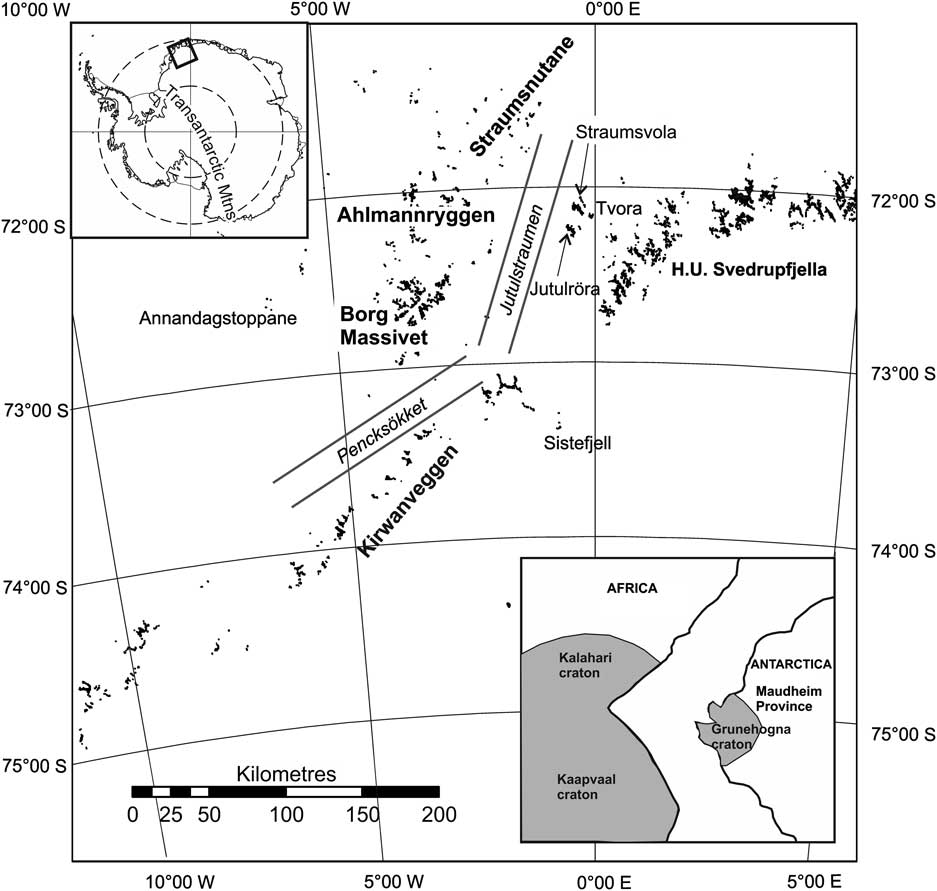
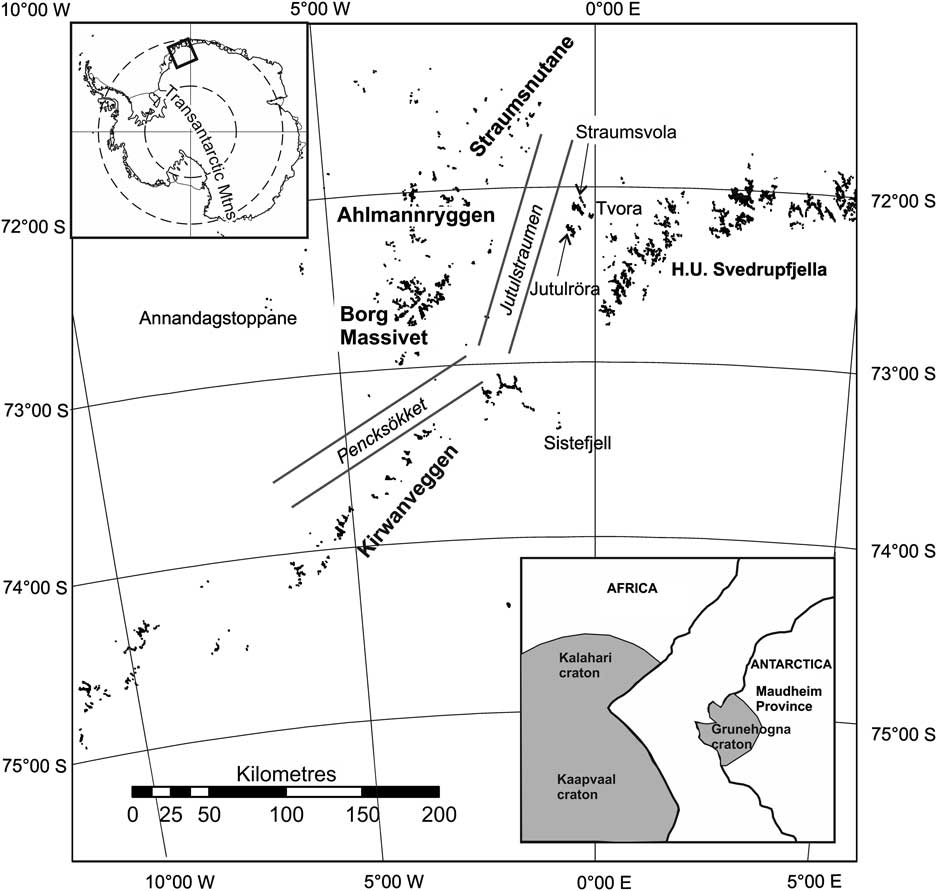
The geography of western Dronning Maud Land is summarized in Fig. 1. It can be subdivided into two distinct geological provinces: the Grunehogna province, which includes the Ahlmannryggen, Borgmassivet and Straumsnutane areas (Fig. 1), together with outlying nunataks to the west, is characterized by weakly metamorphosed and deformed sedimentary, and volcanogenic rocks of the Ritscherflya Supergroup that have been extensively intruded by large-scale tholeiitic sills and dykes of the Borgmassivet intrusions (Wolmarans & Kent Reference Wolmarans and Kent1982). The basement to the Ritscherflya Supergroup is thought to be Archaean-age granitoids, whilst the Grunehogna Craton is interpreted as part of the Archaean Kaapvaal Craton of southern Africa prior to Gondwana break-up (Martin & Hartnday Reference Martin and Hartnady1986). The basement of the Grunehogna Craton is exposed only within a small area at Annandagstoppane, in the form of an S-type granite, which has been dated (U–Pb zircon) at 3067 ± 8 Ma (Marschall et al. Reference Marschall, Hawkesworth, Storey, Dhuime, Leat, Meyer and Tamm-Buckle2010), an age that is coeval with the granitoids and volcanic rocks in the Swaziland and Witwatersrand blocks of the Kaapvaal Craton (Schoene et al. Reference Schoene, de Wit and Bowring2008). The close similarity of basement and supracrustal geology between the Grunehogna and Zimbabwe-Kaapvaal (southern Africa) provinces suggest that both areas formed part of a contiguous crustal province from Archaean time until the Mesozoic break-up of Gondwana (Groenewald et al. Reference Groenewald, Grantham and Watkeys1991). To the south and east of the Grunehogna province lie the Kirwanveggen and H.U. Svedrupfjella regions (Fig. 1) that form part of the Mesoproterozoic Maud province, an extension of the Namaqua-Natal metamorphic province of southern Africa (Jacobs et al. Reference Jacobs, Thomas and Weber1993), which is formed of amphibolite to granulite facies gneisses of the Svedrupfjella Group (Groenewald et al. Reference Groenewald, Moyes, Grantham and Krynauw1995). Adjacent to the inferred boundary of the Grunehogna Craton, the Svedrupfjella Group is dominated by hornblende biotite orthogneiss of the Jutulrøra Formation. The crustal boundary between these two distinct geological provinces lies unexposed beneath the Pencksokket and Jutulstraumen ice streams (Fig. 1). However, a recent high-resolution aerogeophysical survey suggests that this boundary has been reactivated along the Jutulstraumen ice stream by a continental rift that was either amagmatic along its axis or contains a thick sedimentary succession (Ferraccioli et al. Reference Ferraccioli, Jones, Curtis and Leat2005a, Reference Ferraccioli, Jones, Curtis, Leat and Riley2005b).
Location map of rock outcrops in western Dronning Maud Land (Antarctica) from Vestfjella to H.U. Svedrupfjella. The inset is a pre-break-up Gondwana reconstruction of Africa and Antarctica showing the extent of the Kaapvaal-Grunehogna Craton and the outcrop of Early–Middle Jurassic Karoo igneous rocks.
The Ritscherflya Supergroup consists of c. 2 km thickness of relatively undeformed sedimentary and volcanogenic rocks of the Ahlmannryggen and Jutulstraumen groups. The Ritscherflya Supergroup has been interpreted as a sedimentary sequence of shallow marine, tidal flat, braided stream and alluvial fan deposits (Wolmarans & Kent Reference Wolmarans and Kent1982). The volcanogenic sedimentary rocks of the Jutulstraumen Group, which form the upper part of the Ritscherflya Supergroup have been correlated geochemically with the Borgmassivet intrusions (Moyes et al. Reference Moyes, Krynauw and Barton1995). Moyes et al. (Reference Moyes, Krynauw and Barton1995) attempted to date the lithification age of the Högfonna Formation of the Ritscherflya Supergroup using a combination of rubidium-strontium (Rb-Sr) and samarium-neodymium (Sm-Nd) whole rock geochronology. Assuming a homogenized source region, they obtained ages of 1085 ± 27 Ma (Rb-Sr) and 1180 ± 367 Ma (Sm-Nd). Direct dating of the Borgmassivet intrusions has also proved difficult with Rb-Sr and Sm-Nd whole rock geochronology yielding ages in the range 842 ± 15 to 1429 ± 124 Ma (Moyes et al. Reference Moyes, Krynauw and Barton1995), although Wolmarans & Kent (Reference Wolmarans and Kent1982) produced a Rb-Sr whole rock isochron of 1073 ± 40 Ma based on seven mafic sills from the Ahlmannryggen. A further emplacement date of the mafic sills has been obtained from the granitic zone at the sill-sediment interface; the granite-granophyre-syenite units (Nils Jörgennutane suite) are interpreted to be the result of contact melting under hydrous conditions (Moyes et al. Reference Moyes, Krynauw and Barton1995). These contact melts have also been dated by Moyes et al. (Reference Moyes, Krynauw and Barton1995), who obtained Rb-Sr whole rock ages in the range 939 ± 29 to 1008 ± 16 Ma. More recently, a U-Pb zircon age of c. 1107 Ma (no error published) for a mafic sill from the Borgmassivet intrusions has been reported by Frimmel (Reference Frimmel2004), whilst a U-Pb age of 1130 ± 7 Ma (Frimmel Reference Frimmel2004) for detrital grains from tuff beds at the base of the Ritscherflya Supergroup is a good indication of the age of onset of sedimentation. There are also several reports of zircon overgrowth ages and leucosome development in the interval 1098–1112 Ma (Grosch et al. Reference Grosch, Bisnath, Frimmel and Board2007), which are interpreted to be the result of thermal metamorphism associated with Umkondo/Borgmassivet age magmatism. Therefore, the age for the intrusion of the Borgmassivet intrusive mafic sills is considered to be close to 1100 Ma, which is coeval with the Umkondo LIP of southern Africa (1100 Ma; Hanson et al. Reference Hanson, Martin, Bowring and Munyanyiwa1998). This date is also close to the inferred lithification age of the Ritscherflya Supergroup sedimentary rocks (1085 ± 27 Ma; Moyes et al. Reference Moyes, Krynauw and Barton1995) and, therefore, supports the field observations of Krynauw et al. (Reference Krynauw, Hunter and Wilson1988) and Curtis & Riley (Reference Curtis and Riley2003) that the Borgmassivet intrusions were emplaced into wet, partially lithified sediments. This interpretation was based on several observations, for example, destruction of sedimentary structures, large-scale soft-sediment deformation (including sediment balls and flame structures), pegmatites at the sedimentary-igneous contact, and fusion of sedimentary rocks. Many of these features are typical of the establishment of a fluidized system (Kokelaar Reference Kokelaar1982). Krynauw et al. (Reference Krynauw, Hunter and Wilson1988) interpreted the wet sediment-sill interaction to have taken place at shallow crustal levels (< 1.6 km or ≤312 bar) with stationary fluidization of the host sediments occurring within a 3 m zone of the sill contact. Not all of the Ritscherflya Supergroup sedimentary rocks in contact with the Borgmassivet intrusions have been fluidized, for example, the Schumacherfjellet Formation, which may have been completely lithified at the time of intrusion and indicates that wet sediment only occurred in pockets.
Intrusive history of western Dronning Maud Land
Mafic intrusions are widespread across western Dronning Maud Land and several generations of emplacement have been documented (Grantham Reference Grantham1996, Zhang et al. Reference Zhang, Luttinen, Elliot, Larsson and Foland2003, Riley et al. Reference Riley, Leat, Curtis, Millar, Duncan and Fazel2005, Reference Riley, Curtis, Leat and Millar2009), although from field observations alone it remains difficult to identify different dyke generations. At least five separate intrusive episodes have been identified in western Dronning Maud Land.
176–178 Ma
At least two distinct episodes occurred at c. 178 Ma. A high concentration (> 500 dykes over 10 km2) of basanite/tephrite dykes were emplaced at c. 178 Ma associated with the Straumsvola nepheline syenite pluton (Fig. 1; Riley et al. Reference Riley, Curtis, Leat and Millar2009). There is also an event at c. 178 Ma of north-south trending dolerite dykes from the Ahlmannryggen region, intruding metasedimentary rocks of the Ritscherflya Supergroup, which were interpreted to form part of the later stages of the Karoo magmatic province (Riley et al. Reference Riley, Leat, Curtis, Millar, Duncan and Fazel2005). The dykes are parallel to the Jutulstraumen ice stream, which occupies a major crustal lineament (Fig. 1).
190 Ma
A suite of east-west trending dolerite dykes have been recognized from the Ahlmannryggen region where they intrude Ritscherflya Supergroup metasedimentary rocks (Riley et al. Reference Riley, Leat, Curtis, Millar, Duncan and Fazel2005). The dykes are parallel to the Pencksokket subglacial trough (Fig. 1), which also represents a major tectonic feature of the area (Ferraccioli et al. Reference Ferraccioli, Jones, Curtis and Leat2005a). The dykes include a geochemically depleted group and have been interpreted as one of the earliest expressions of the Karoo magmatic province. However, there is a degree of doubt regarding the c. 190 Ma age given that several of the 40Ar-39Ar ages do not fulfil all criteria for a reliable plateau age (Riley et al. Reference Riley, Leat, Curtis, Millar, Duncan and Fazel2005).
204 Ma
A swarm of dolerite dykes cut the Mesoproterozoic Svedrupfjella Group orthogneisses at Jutulrøra, Straumsvola and Tvora (Fig. 1). The dykes are typically parallel to the Jutulstraumen subglacial rift (north-south) and are steeply dipping, with thicknesses often in excess of 10 m. They have been dated in the interval 202–206 Ma and do not correspond to any other recognized magmatic event in western Dronning Maud Land (Riley et al. Reference Riley, Curtis, Leat and Millar2009).
1100 Ma
The Mesoproterozoic dykes and sills of the Borgmassivet intrusions only crop out in the Ahlmannryggen and Borgmassivet region of western Dronning Maud Land, to the west of the Jutulstraumen ice stream and north of the Pencksokket, situated on the Grunehogna Craton (Fig. 1). No Mesoproterozoic intrusions are located in the neighbouring Maudheim province. This suite of intrusions is the subject of this paper.
Previous work
Several workers have investigated the Mesoproterozoic Borgmassivet intrusions of western Dronning Maud Land, making links between the exposures in Antarctica and southern Africa (Groenewald et al. Reference Groenewald, Grantham and Watkeys1991), and also with the relative timings of the intrusions and the deposition of the Ritscherflya Supergroup (Krynauw et al. Reference Krynauw, Hunter and Wilson1988). However, there has been only a limited number of publications on the geochemistry of the Borgmassivet intrusions. Moyes et al. (Reference Moyes, Krynauw and Barton1995) presented Rb-Sr and Sm-Nd whole rock data, but only representative whole rock geochemistry was provided. Grosch et al. (Reference Grosch, Bisnath, Frimmel and Board2007) presented geochemical data on several intrusions from the Grunehogna Craton, but this work was mostly focussed on amphibolites from the metamorphic Maud Belt complex, although they did recognize the Umkondo geochemical signature in several of the intrusive rocks.
Sample descriptions
Samples from 25 dykes and sills from the Ahlmannryggen region were selected for analysis. The samples are mostly fine grained dolerite intrusions that typically have glassy-aphyric chilled margins, but more vesicular, rubbly centres. Unlike the Mesozoic dyke suites of western Dronning Maud Land the Mesoproterozoic dykes do not exhibit a preferred strike orientation but show significant variation, although those dykes > 3 m in thickness are often close to north-south in orientation (008°–022°). Eight of the samples are from sills which are mostly fine grained sill tops or minor (< 3 m thickness) intrusions. However, three samples (Z.1804.2, Z.1818.2, Z.1824.1) were taken from the more ‘classic’ Borgmassivet intrusions. These gabbroic sills are typically subophitic, medium crystalline with clinopyroxene, plagioclase, biotite and magnetite. The dolerite sills and dykes are typically fine grained and feldspar-phyric. The plagioclase phenocrysts are set in a groundmass of smaller plagioclase, augite and iron-titanium (Fe-Ti) oxides. Minor amounts of apatite and biotite are occasionally present. The dykes typically have an intergranular or subophitic texture involving euhedral plagioclase and subhedral augite crystals. Olivine was not identified in the Mesoproterozoic sample suite described here.
Geochemistry
Analytical techniques
Powders for geochemical analysis were prepared from 2–3 kg of fresh rock. Samples were reduced to pass a 1700 μm sieve using a hardened steel fly press. The powders were produced using an agate Tema-mill. Sr and Nd isotope compositions were measured at the NERC Isotope Geosciences Laboratory (Keyworth, UK) on a Finnegan-MAT 262 mass spectrometer. Rb-Sr and Sm-Nd analysis followed procedures described by Riley et al. (Reference Riley, Leat, Curtis, Millar, Duncan and Fazel2005). Sr isotope composition was determined in multidynamic peak-jumping mode. During the period of analysis, 22 analyses of the Sr isotope standard NBS987 gave a value of 0.710259 ± 0.000008 (2 sigma errors). Nd isotope composition was determined in static collection mode. Twenty-four analyses of the in-house J&M Nd isotope standard gave a value of 0.511196 ± 0.000022 (2 sigma errors). Reported 143Nd/144Nd values were normalized to a value of 0.511130 for this standard, equivalent to 0.511864 for La Jolla.
Major and selected trace element whole rock analysis was by standard XRF techniques at the Department of Geology, University of Keele following the methods described in Floyd (Reference Floyd1986). Higher precision trace element abundances were determined by ICP-MS at the University of Durham. The analytical methods, precision and detection limits are detailed in Ottley et al. (Reference Ottley, Pearson and Irvine2003).
Classification
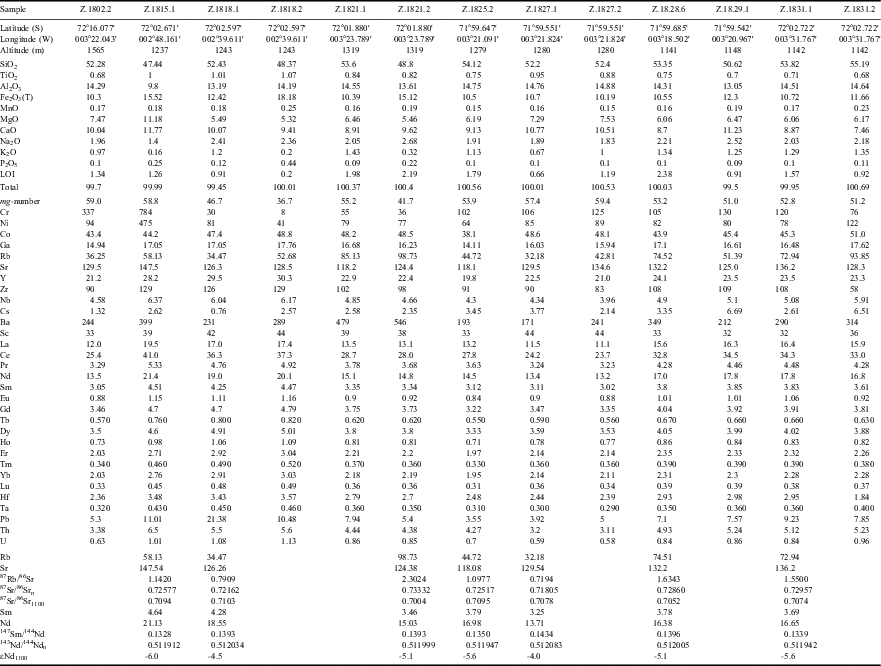
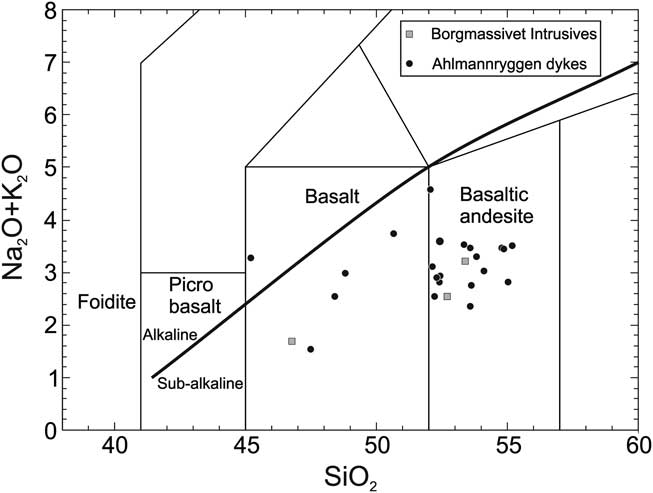
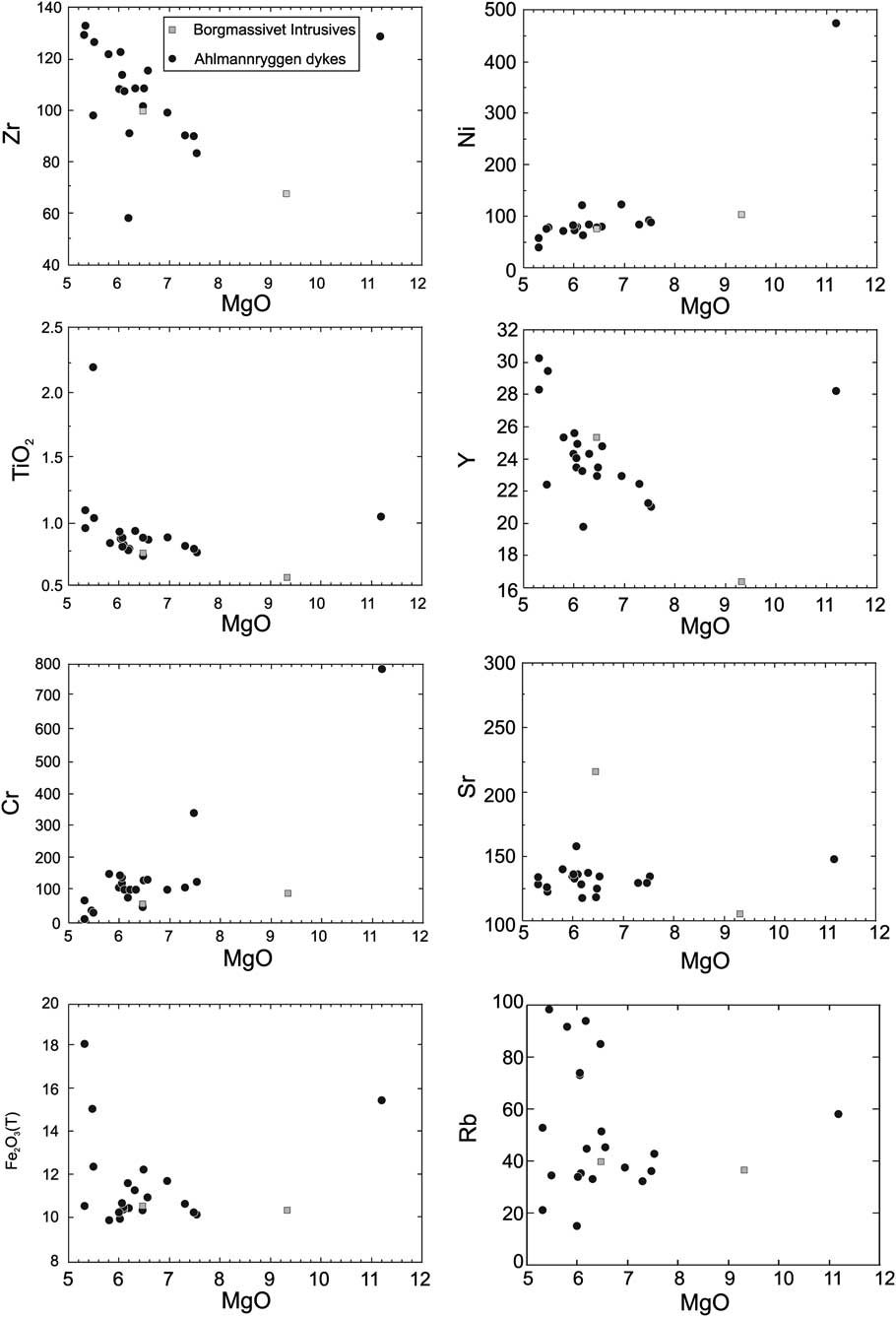
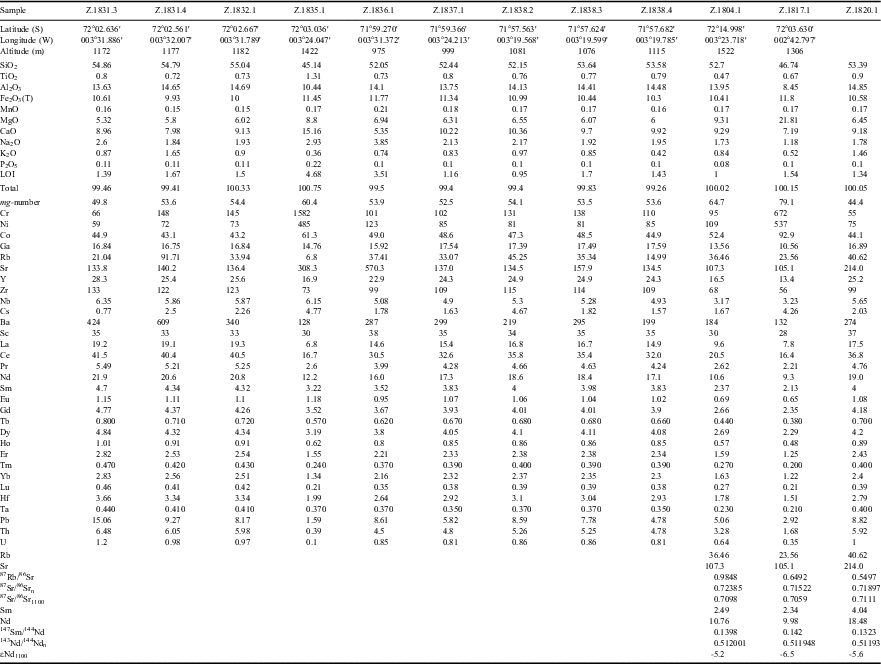
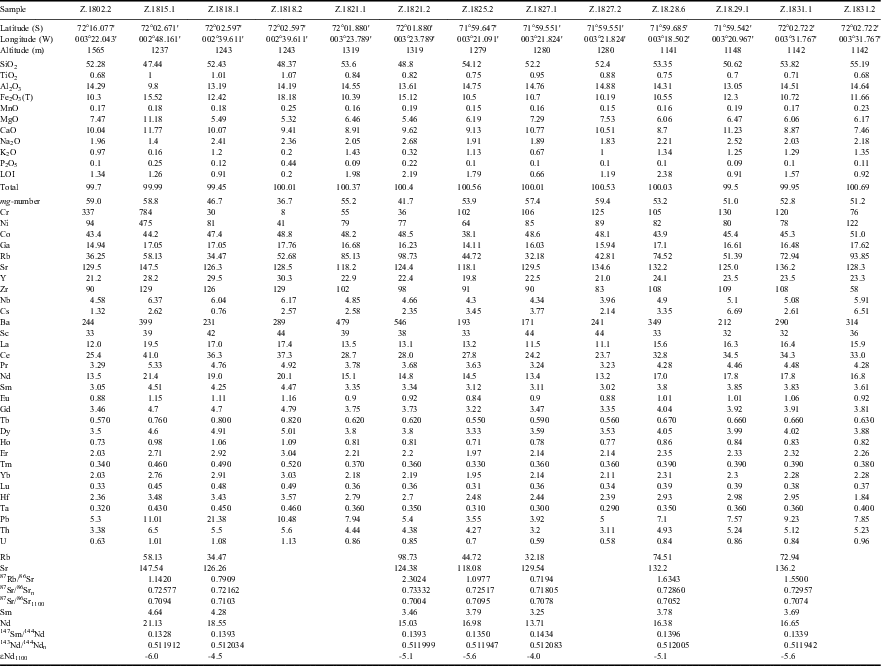
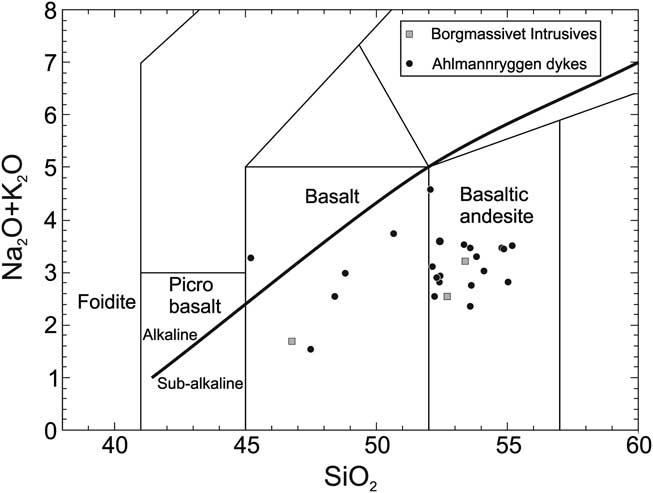
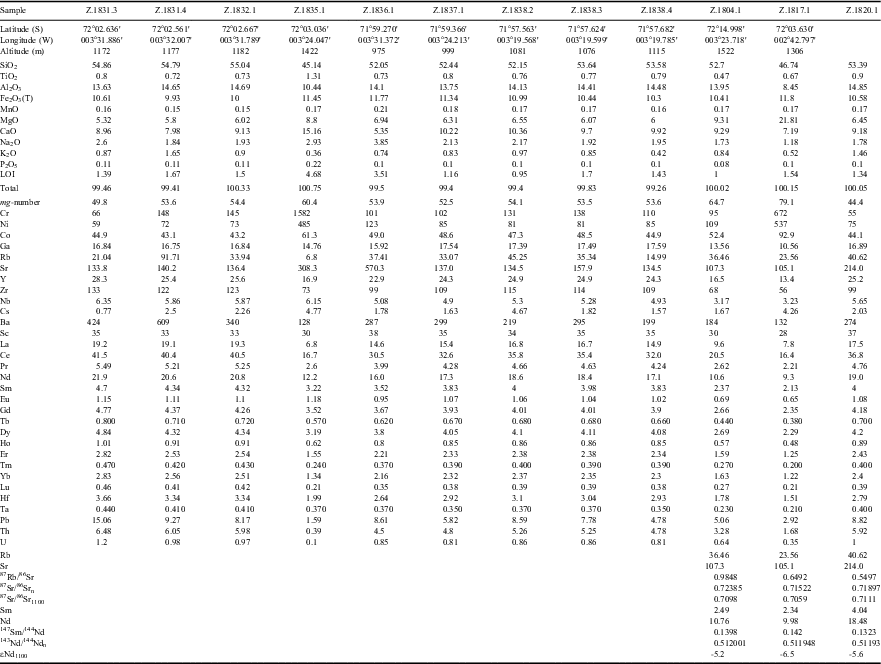
Major and trace element data, as well as Sr-Nd isotope data, from the Ahlmannryggen intrusive rocks are reported in Table I. The analysed samples are subalkaline and range in composition from basalt to basaltic andesite (Fig. 2). On the basis of the CIPW norms, the samples can be classified as quartz tholeiites, with the exception of two samples (Z.1815.1 and Z.1835.1) which are olivine tholeiites. In the quartz tholeiites, the silica (SiO2) content ranges from 48.4–55.2 wt% and the magnesia (MgO) content ranges from 5.3–7.5 wt%, indicating the fractionated nature of the Ahlmannryggen intrusive rocks. The data from the Ahlmannryggen intrusions were plotted against MgO (wt%) as an index of differentiation (Fig. 3). Nickel (Ni) is weakly correlated with MgO suggesting at least some control of olivine during differentiation, although olivine was not identified in any of the samples. Aluminium oxide (Al2O3) increases as MgO decreases, until around 7 wt% MgO when plagioclase fractionation becomes important. Many of the major and trace elements exhibit compositional trends typical of tholeiites, showing negative correlations with MgO for iron (III) oxide (Fe2O3(T)), titanium oxide (TiO2), zirconium (Zr) and yttrium (Y).
Whole rock analyses of dolerite dykes/diorite sills from Ahlmannryggen, Dronning Maud Land.
Total alkali vs SiO2 diagram (wt%) for the Ahlmannryggen dykes and Borgmassivet intrusions. The samples are basalt or basaltic andesite and are classified as quartz tholeiites based on their CIPW norms, with the exception of two samples which are olivine tholeiites (Z.1815.1 and Z.1835.1).
Variations in Zr, TiO2, Cr, Fe2O3(T), Ni, Y, Sr and Rb vs MgO for the Ahlmannryggen dykes and Borgmassivet intrusions. Major oxides in wt% and trace elements in ppm.
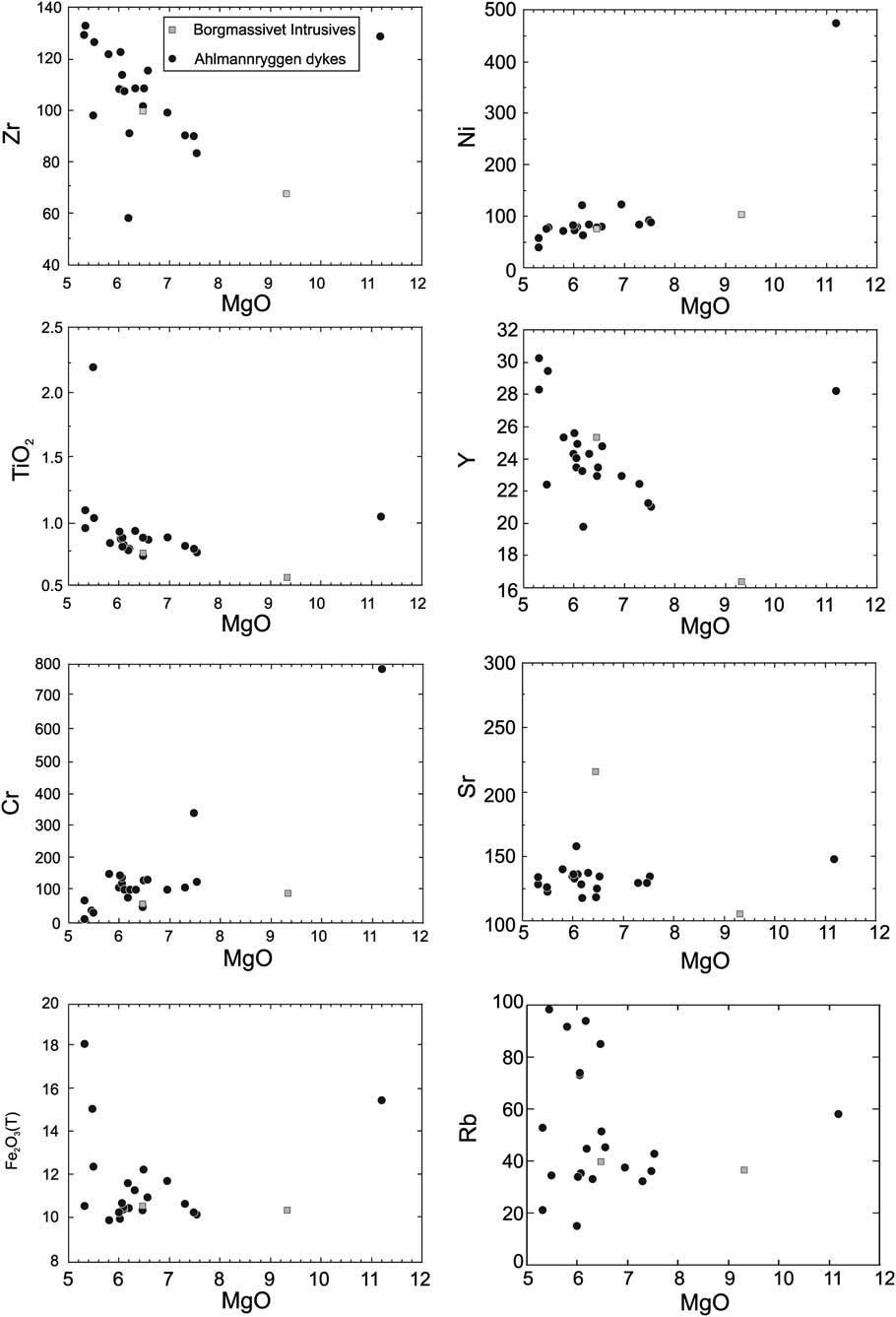
Continued.
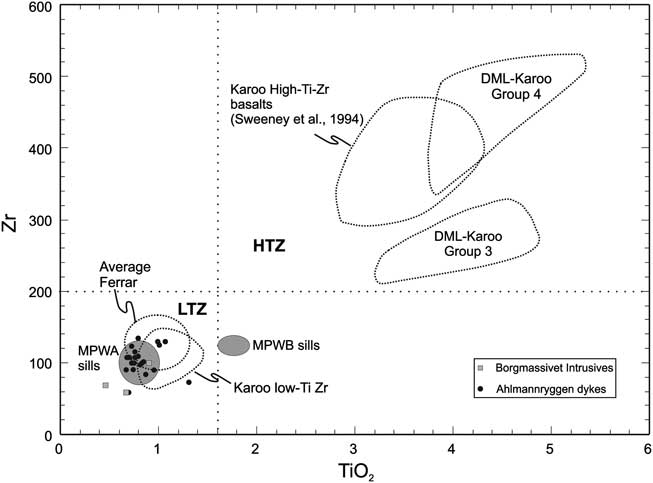
The use of incompatible high field strength elements (HFSE; Ti, Zr, Y, Nb) as discriminants between magma types are effective because these elements are largely immobile during low temperature alteration processes (Peate Reference Peate1997) and ratios between them are not significantly modified by moderate amounts of fractional crystallization or susceptible to variations in the degree of partial melting. Zr can be used as an effective index of differentiation in magmas that do not crystallize zircon. These discriminants are subsequently supported by variations in 87Sr/86Sr, εNd, rare earth elements (REE) and other major and trace elements and their ratios.
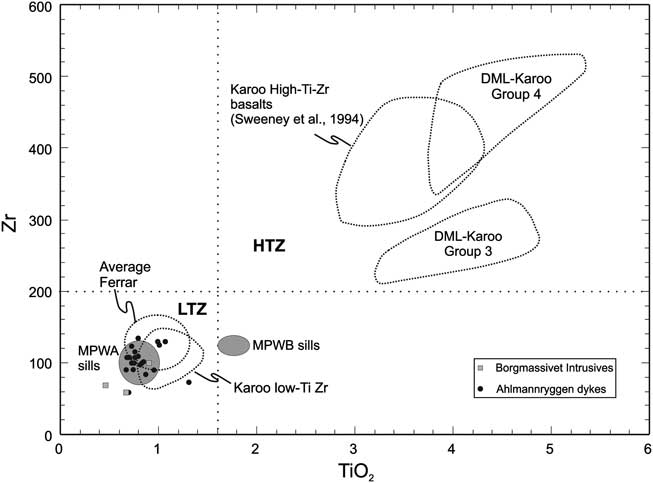
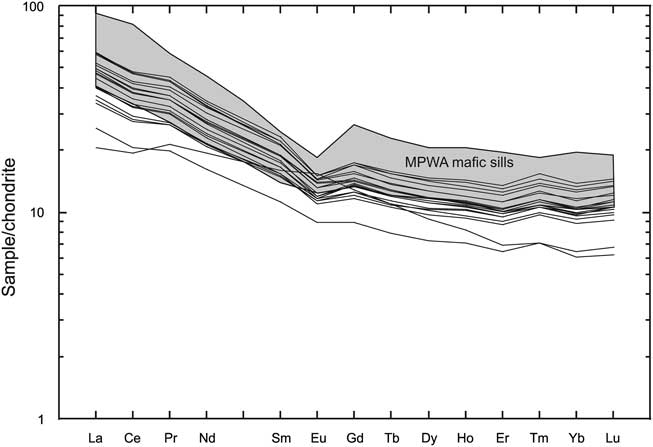
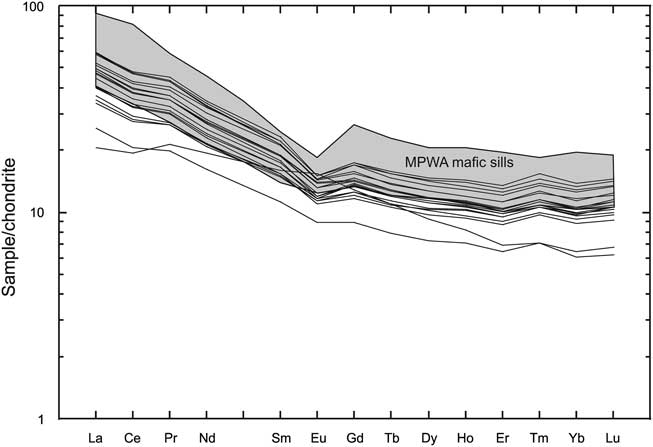
The Ahlmannryggen Mesoproterozoic intrusions are all low Ti-Zr (LTZ) tholeiites with TiO2 < 1.5 wt% and Zr < 150 ppm (Fig. 4), similar to the Karoo low Ti magma type of Sweeney et al. (Reference Sweeney, Duncan and Erlank1994). The intrusive rocks from the Ahlmannryggen chemically overlap with the LTZ Mesoproterozoic post-Waterburg sills (MPWA) of the Umkondo province (southern Africa) (Bullen et al. Reference Bullen, Hall and Hanson2012). However, they are distinct from a secondary group of Umkondo dolerite sills (MPWB) which have a slightly higher TiO2 content (c. 2 wt%) and similar Zr values resulting in Ti/Zr ratios of 75–100, compared to Ti/Zr ratios of < 50 for the MPWA sills and the Ahlmannryggen intrusive rocks (Bullen et al. Reference Bullen, Hall and Hanson2012). The Ahlmannryggen rocks contain SiO2 in the range of 45.1–55.2 wt% and have typically low Mg numbers (36.7–60.4; mean 52.8). The intrusive rocks are all light rare earth element (LREE) enriched, with (lanthanum (La)/lutetium (Lu))N ranging from 3.3–4.8, with La enrichment up to 60 times chondrite (Fig. 5). The samples all have pronounced negative Europium (Eu) anomalies resulting from plagioclase fractionation, but have relatively unfractionated heavy rare earth elements (HREEs), around 10 times chondrite. The REE profiles are almost identical to the MPWA sills of the Umkondo province (Bullen et al. Reference Bullen, Hall and Hanson2012), but are quite distinct from the MPWB samples, which are also LREE enriched but lack the flat HREE patterns and negative Eu anomaly.
Variation in Zr vs TiO2 for Ahlmannryggen dykes and Borgmassivet intrusions shown in comparison to MPWA and MPWB sills (Bullen et al. Reference Bullen, Hall and Hanson2012), Karoo-age dykes from the Ahlmannryggen (Dronning Maud Land (DML) groups 3–4; Riley et al. Reference Riley, Leat, Curtis, Millar, Duncan and Fazel2005), Karoo low Ti-Zr (LTZ) and high Ti-Zr (HTZ) basalts (Sweeney et al. Reference Sweeney, Duncan and Erlank1994) and average Ferrar (Antonini et al. Reference Antonini, Piccirillo, Petrini, Civetta, D'Antonio and Orsi1999).
Chondrite normalized (Nakamura Reference Nakamura1974) rare earth element (REE) diagrams for Ahlmannryggen dykes and Borgmassivet intrusions in comparison to the MPWA sills (Bullen et al. Reference Bullen, Hall and Hanson2012).
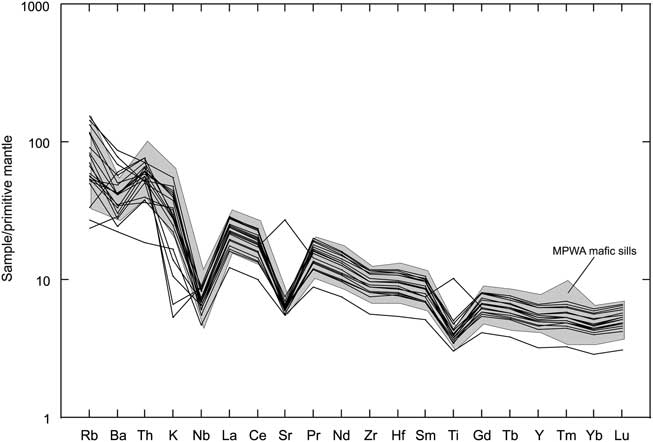
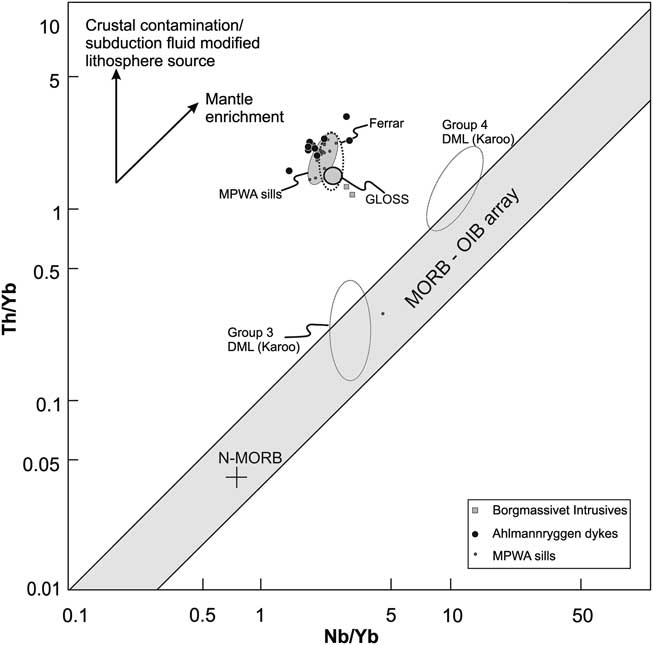
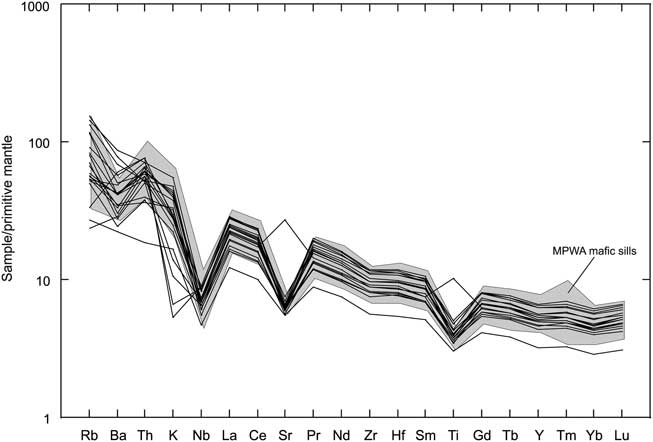
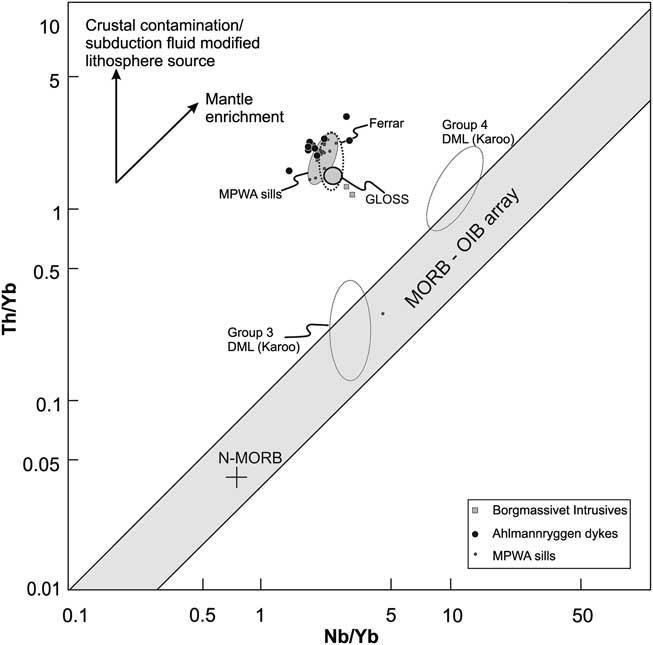
The multi-element variations, when normalized to primitive mantle, for the Ahlmannryggen intrusive rocks are characterized by distinct troughs at Nb, Sr and Ti (Fig. 6), although there are some minor deviations in several of the samples. The MPWA mafic sills are plotted for comparison (Bullen et al. Reference Bullen, Hall and Hanson2012), indicating almost identical abundances and variation. The Ahlmannryggen intrusions exhibit a tight cluster in the thorium/ytterbium (Th/Yb) vs Nb/Yb plot (Fig. 7), where they are plotted relative to the mid-ocean ridge basalt-ocean island basalt (MORB-OIB) array (Pearce & Peate Reference Pearce and Peate1995). Data are shown in comparison to the MPWA and MPWB sills (Bullen et al. Reference Bullen, Hall and Hanson2012), and relative to dyke and lava suites from the geographically related 180 Ma Karoo and Ferrar igneous provinces of Antarctica (Molzahn et al. Reference Molzahn, Reisberg and Wörner1996, Riley et al. Reference Riley, Leat, Curtis, Millar, Duncan and Fazel2005). The Ahlmannryggen intrusive rocks and Borgmassivet sills plot close to the field of Ferrar magmatic province dolerites at relatively high Th/Yb values. They also have very similar ratios to the field of MPWA sills from the Umkondo province, although these have marginally lower Nb/Yb values. The samples at high Th/Yb values are close in composition to the field of average global subducting sediment (GLOSS; Plank & Langmuir Reference Plank and Langmuir1998) indicating a significant contribution from continental crust or partial melts of subduction-modified lithosphere.
Primitive mantle normalized incompatible element diagrams for the Ahlmannryggen dykes and Borgmassivet intrusions in comparison to the MPWA sills (Bullen et al. Reference Bullen, Hall and Hanson2012). Normalizing values are taken from Sun & McDonough (Reference Sun and McDonough1989).
Variations in Th/Yb vs Nb/Yb showing the composition of basic dykes from the Ahlmannryggen dykes and Borgmassivet intrusions relative to the MORB-OIB array (Pearce & Peate Reference Pearce and Peate1995). With comparisons to the Karoo-Dronning Maud Land (DML) fields from the Ahlmannryggen (Riley et al. Reference Riley, Leat, Curtis, Millar, Duncan and Fazel2005), average Ferrar (Molzahn et al. Reference Molzahn, Reisberg and Wörner1996), MPWA and MPWB sills (Bullen et al. Reference Bullen, Hall and Hanson2012) and average global subducting sediment (GLOSS; Plank & Langmuir Reference Plank and Langmuir1998).
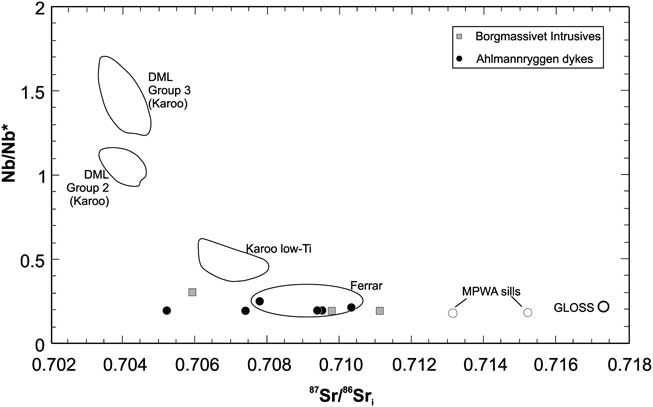
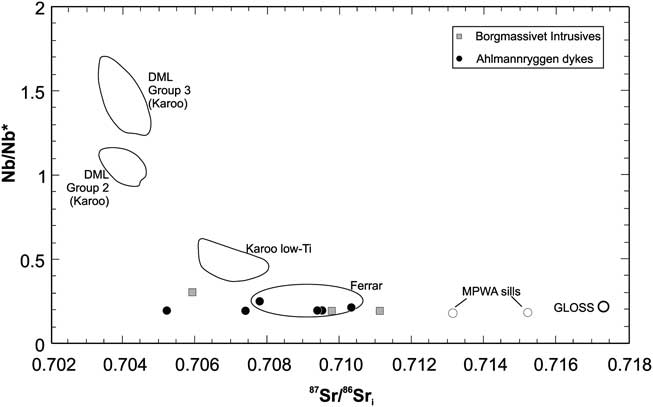
The Ahlmannryggen intrusive rocks show a range in both 87Sr/86Sr and εNd (at 1100 Ma). The 87Sr/86Sri ratios range from 0.705–0.711, similar to the MPWA samples (0.708–0.715), although one sample (Z.1821.2) has an initial ratio of 0.700 with a very high Rb/Sr ratio. The εNdi values range from -4.0 to -6.5, also similar to the values from the MPWA sills (-2.8 to -4.9). The isotopic composition of the Ahlmannryggen intrusions is similar to the dyke and sill complex of the Ferrar magmatic province (Riley et al. Reference Riley, Curtis, Leat, Watkeys, Duncan, Millar and Owens2006) and indicates a significant contribution from the continental crust or melting of subduction-modified lithosphere. The Nb anomaly (Nb/Nb* = NbN
 $$\[--><$>\vskip-3pt\root<$><!--$$
(ThN x LaN) vs
87Sr/86Sri (Fig. 8) has been plotted to test the role of sediment contamination in mantle-derived magmas. As in previous plots, the Ahlmannryggen intrusive rocks overlap with the field of the Ferrar magmatic province at low Nb/Nb* values (< 0.3) and at 87Sr/86Sri values of 0.708–0.710.
Nb anomaly, Nb/Nb* (=NbN√(ThN x LaN)) vs 87Sr/86Sr. The Nb anomaly can be used to test the role of sediment contamination in mantle-derived magmas. With comparisons to the Karoo-Dronning Maud Land (DML) group 2 and 3 fields (Riley et al. Reference Riley, Leat, Curtis, Millar, Duncan and Fazel2005), the MPWA sills (Bullen et al. Reference Bullen, Hall and Hanson2012), the Ferrar field (Molzahn et al. Reference Molzahn, Reisberg and Wörner1996) and average global subducting sediment (GLOSS; Plank & Langmuir Reference Plank and Langmuir1998). 87Sr/86Sr = 0.7173, Sr = 327 ppm, Nb/Nb* = 0.22.
Discussion
One of the key questions concerning the petrogenesis of almost all continental flood basalts is the relative contribution from sublithospheric mantle sources (mantle plume, ambient asthenosphere), lithospheric mantle and continental crust. The predominant rock type throughout many Proterozoic and Phanerozoic flood basalt provinces are LTZ tholeiites, which are chemically and isotopically distinct from oceanic basaltic compositions. This finding has led many workers to highlight the important role of the sub-continental lithospheric mantle in continental flood basalt (CFB) petrogenesis (e.g. Hawkesworth et al. Reference Hawkesworth, Marsh, Duncan, Erlank and Norry1984).
The intrusions of the Ahlmannryggen and Borgmassivet region are all LTZ rock types with high SiO2, high 87Sr/86Sri and low εNdi, indicating that the magmas were probably extensively contaminated by continental crust or were derived from an enriched lithospheric mantle source, where the enrichment was related to earlier subduction.
The lack of geochemical variation in the Mesoproterozoic intrusions is unusual. The intrusive record of a CFB province often exhibits a much broader geochemical range compared to the extrusive record which is often emplaced over a much shorter interval (e.g. Riley et al. Reference Riley, Leat, Curtis, Millar, Duncan and Fazel2005).
Interaction between an ascending mafic magma and the surrounding continental crust is almost inevitable at some point prior to eruption or intrusion, although in some cases the chemical changes to the magma may be insignificant. There is no significant correlation between 87Sr/86Sri and MgO in the Ahlmannryggen intrusive rocks suggesting that combined assimilation and fractional crystallization was not the primary process for the observed variations.
The trace element patterns of the Ahlmannryggen intrusions are characterized by pronounced negative anomalies in the HFSE, typical of arc-related basalts but also typical of many Phanerozoic CFBs. The Ahlmannryggen intrusive rocks are far removed from the MORB-OIB array (Fig. 7) and plot at elevated levels of Th/Yb (> 2), consistent with derivation from subduction-modified lithosphere. Furthermore, the MPWA sills from southern Africa were interpreted to be the product of melts of spinel lherzolite which had incorporated material from subduction-modified lithospheric mantle (Bullen et al. Reference Bullen, Hall and Hanson2012).
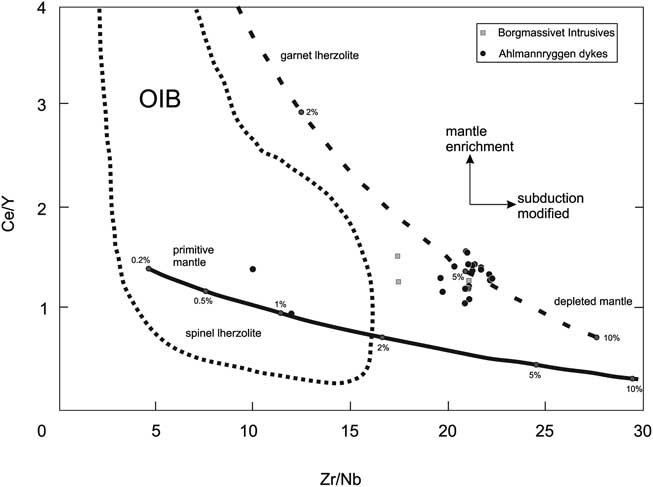
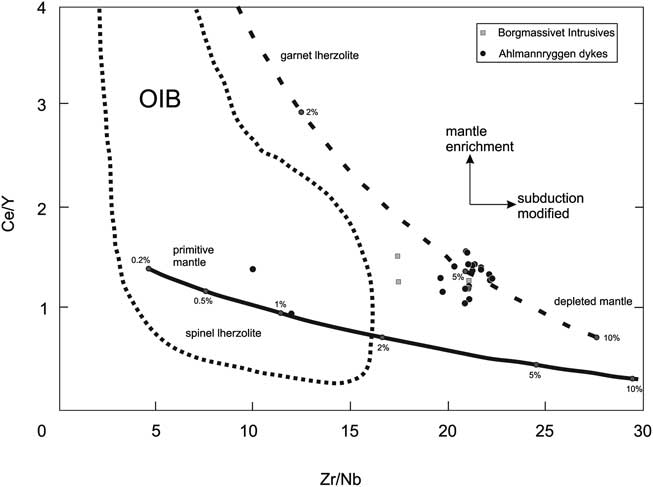
Distinguishing between a purely lithospheric source and a deeper source which has been contaminated by shallower melts is difficult. Ratios of Zr/Nb and cerium/yttrium (Ce/Y) (Fig. 9) indicate a source region in the garnet lherzolite field, but such ratios will be strongly influenced by any lithospheric contribution, and the flat HREE pattern (Fig. 5) is not supportive of a deeper origin. The grouping of the intrusive rocks at approximately 5% partial melting in the garnet lherzolite field implies a restricted source region, although two samples (Z.1831.2, Z.1835.1) indicate derivation from a shallower source. However, the data from this plot are limited as it is assumed that all of the melting was sub-lithospheric. There remains no overall consensus on the precise role of the lithospheric mantle in the generation of many low Ti tholeiites. Arndt & Christensen (Reference Arndt and Christensen1992) proposed that the ubiquitous negative Nb anomalies in CFBs are the result of sub-lithospheric melts acquiring their ‘lithospheric signatures’ through partial reaction and chemical exchange with lithospheric mantle wall rocks.
Ce/Y vs Zr/Nb plot for basic dykes/sills from the Ahlmannryggen and Borgmassivet intrusions. Non-modal equilibrium melting curves (Shaw Reference Shaw1970) for primitive mantle (solid line) and depleted mantle (dashed line) (compositions calculated from the average N-MORB composition given by Sun & McDonough Reference Sun and McDonough1989). Full details of the distribution coefficients are in Upton et al. (Reference Upton, Rämö, Heaman, Blichert-Toft, Kalsbeek, Barry and Jepssen2005). OIB = ocean island basalt.
In conclusion, the Ahlmannryggen and Borgmassivet intrusions, as well as the MPWA sills, are very limited in their geochemical range, despite cropping out over a broad geographical area. This lack of geochemical variation is not consistent with significant levels of crustal contamination, whilst melting of an entirely lithospheric source would also lead to a broader compositional range given the predicted source heterogeneities (Bullen et al. Reference Bullen, Hall and Hanson2012). Therefore, a primary source in the sub-lithospheric mantle with the melts having undergone some degree of interaction with lithospheric wall rocks and gabbroic fractionation, to account for the low MgO levels observed in the sill/dyke rocks, is the favoured petrogenesis.
Acknowledgements
The field and air operations staff at Halley Research Station are thanked for their support. This paper has benefited from the considered reviews of Chris Harris and Dean Bullen. Chris Ottley supplied the ICP-MS analyses and Dave Emley carried out the XRF analyses.