Introduction
Many surgical modalities are available for adenotonsillectomy, which is one of the most commonly performed surgical procedures in paediatric populations. A recent survey conducted among members of the American Society of Pediatric Otolaryngology indicated that monopolar electrocautery was the most common surgical modality used for both tonsillectomy and adenoidectomy.Reference Walner, Mularczyk and Sweis1
While considered generally safe, paediatric adenotonsillectomy can cause complications, like any other surgical procedure. Pain, uvular oedema and dehydration occur more commonly and are considered less severe, while airway obstruction and post-tonsillectomy bleeding are less common but life-threatening complications.Reference Randall and Hoffer2
Post-tonsillectomy bleeding has an overall rate of 3–5 per cent. Primary post-tonsillectomy bleeding occurs within 24 hours of surgery and is considered to result from ineffective bleeding control during surgery, while secondary post-tonsillectomy bleeding occurs later than 24 hours after surgery and is thought to be due to exposed blood vessels during healing of the tonsillar fossa.Reference Mitchell and Parikh3 While primary post-tonsillectomy bleeding can be prevented with meticulous bleeding control during surgery, effective methods to prevent secondary post-tonsillectomy bleeding have yet to be reported.Reference Elinder, Söderman, Stalfors and Knutsson4 The unpredictable nature of post-tonsillectomy bleeding may generate anxiety among parents and surgeons.
Although surgeons are trained and expected to perform under difficult situations, any form of anxiety or distress may have negative effects on them and their patients.Reference Balch, Freischlag and Shanafelt5
This study assessed the preferences regarding surgical modalities used for adenotonsillectomy among ENT surgeons mostly based in European countries. We also examined the anxiety levels of surgeons during surgery and in the post-operative period, as well as factors that may affect their anxiety levels and preferences.
Materials and methods
Ethical considerations
This was a survey of clinical practice completed by specialist ENT surgeons. No direct patient information was collected and no ethical issues were raised.
Methods
A 10-question survey developed by the authors included questions about the surgeons’ country of origin, place of work (public healthcare system, private hospital or private practice), years of experience, preference of instruments and techniques for tonsillectomy and adenoidectomy, number of patients with post-operative bleeding, technique and extra measures for haemostasis, and anxiety level scores (ranging from 0 = no anxiety to 10 = maximum level of anxiety) during surgery and in the 10-day post-operative period.
A total of 413 ENT specialists attending the 4th Congress of Otorhinolaryngology Head and Neck Surgery, which was held in October 2017, in Barcelona, Spain, were included in the study. Responses were collected by the first author both on-site and online. Congress participants had the opportunity to complete the survey electronically after the event. A total of 224 survey results were collected on-site, and 189 results were collected online. Trainee surgeons were excluded from the study.
Outcome parameters
The data were used to assess: the preferred techniques and instruments for adenoidectomy and tonsillectomy, estimated numbers of patients with post-operative bleeding, the preferred means of achieving haemostasis during surgery, and extra measures taken for haemostasis. Surgeons’ anxiety levels during the procedure and the 10-day period following surgery were also examined.
The survey further examined associations between the surgeons’ anxiety levels and their level of experience and preferred haemostasis technique.
Statistical analysis
Statistical analyses were performed using SPSS for Windows version 22.0 (IBM, Armonk, New York, USA). Descriptive statistics are expressed as the mean ± standard deviation (SD), median and range, frequency, and rate. The Kolmogorov–Smirnov test was used to determine whether the variables had a normal distribution. Quantitative independent data were compared using the Kruskal–Wallis test and Mann–Whitney U test, and qualitative dependant variables were compared using the Wilcoxon signed-rank test. The Spearman test was used for the correlation analysis. The data are expressed as the means ± SD or number and percentage. In all analyses, p < 0.05 was taken to indicate statistical significance.
Results
Demographic data
A total of 413 ENT surgeons participated in this survey. Given the particular design of the study, in which 224 survey results were collected on-site and 189 results were collected online, a single response rate was not available. The participants were asked their country of origin. Most participants were from Turkey (n = 40), Spain (n = 36), Germany (n = 34), the UK (n = 32) and France (n = 31). The participants’ country of origin data are presented in Table 1.
Participants’ countries of origin

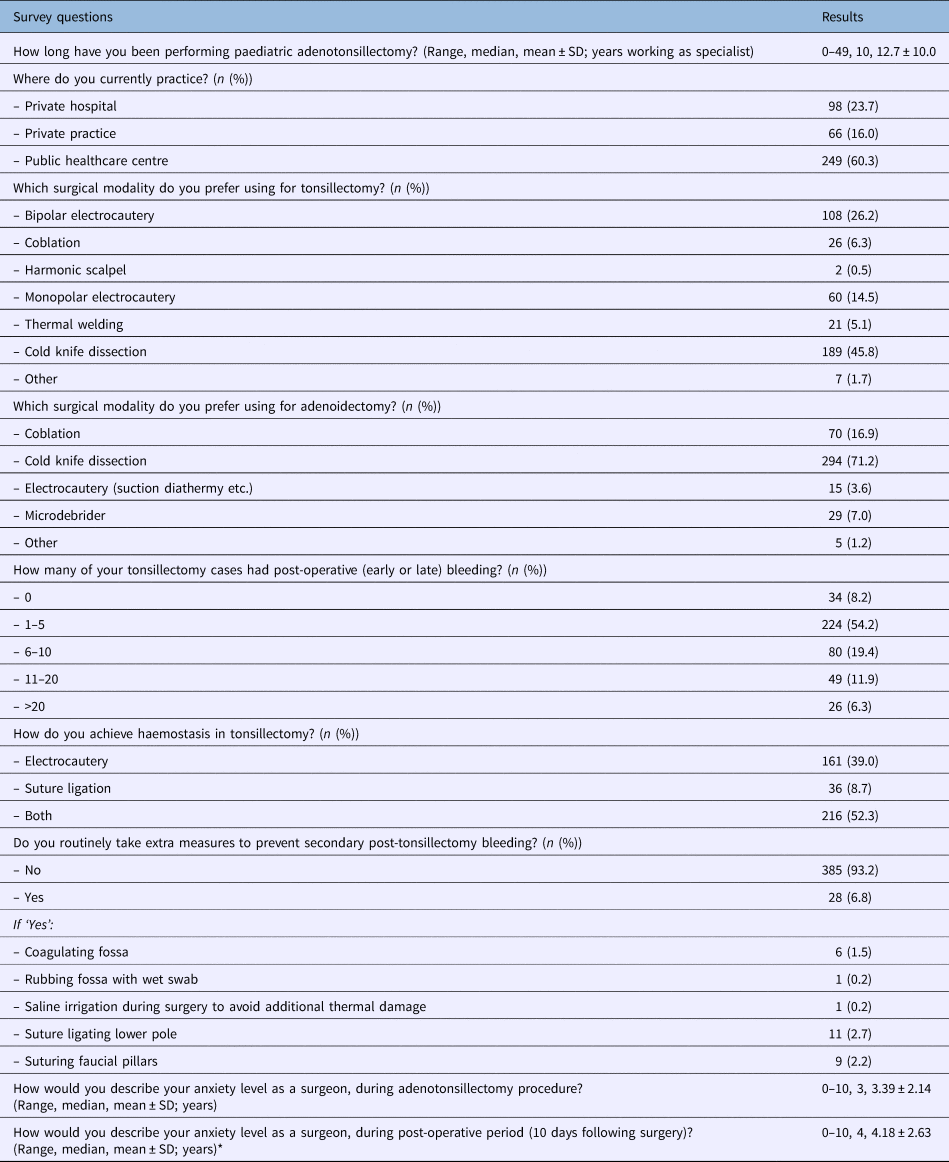
The mean number of years of experience as a specialist was 12.7 ± 10.0 (range, 0–49 years). The majority of the participants (60.3 per cent) reported their place of work as a public healthcare centre (e.g. university hospital or state hospital). The remaining participants worked in private hospitals (23.7 per cent) and private practices (16 per cent) (Table 2).
Breakdown of survey results

*The Wilcoxon signed-rank test revealed a significant increase in surgeons’ anxiety level during the 10-day post-operative period, compared with anxiety levels during the procedure (p < 0.001). SD = standard deviation
Adenotonsillectomy preferences
The participants were asked to specify their preferred choice of surgical modality to perform paediatric adenotonsillectomy. Cold knife dissection (45.8 per cent) was the preferred surgical modality to perform tonsillectomy among the participants, followed by bipolar electrocautery (26.2 per cent) and monopolar electrocautery (14.5 per cent). The preferred surgical modality to perform adenoidectomy was cold knife dissection or curettage (71.2 per cent), followed by coblation (16.9 per cent) (Table 2).
Post-operative bleeding and haemostasis
The participants were asked to estimate the number of patients with primary or secondary bleeding after tonsillectomy that they had encountered over their entire career. The results were as follows: n = 0, 8.2 per cent; n = 1–5, 54.2 per cent; n = 6–10, 19.4 per cent; n = 11–20, 11.9 per cent; and n > 20, 6.3 per cent (Table 2).
Most participants (52.3 per cent) reported a preference for applying both electrocautery and suture ligation to achieve haemostasis in tonsillectomy, while 39 per cent and 8.7 per cent preferred electrocautery or suture ligation alone, respectively. Only 28 surgeons (6.8 per cent) reported preferring extra measures to prevent secondary bleeding after tonsillectomy, with the majority preferring to ligate the lower pole (n = 11) and suture the faucial pillars together (n = 9). The remaining 385 surgeons (93.2 per cent) did not prefer to take any extra measures for haemostasis (Table 2).
Surgeons’ anxiety
The means levels of surgeon anxiety during surgery and the post-operative period were 3.39 ± 2.14 and 4.18 ± 2.63, respectively (Table 2). The results indicated a significant increase in the surgeons’ anxiety level during the 10-day post-operative period (p < 0.05). Anxiety levels during both surgery and the post-operative period were significantly negatively correlated with surgeon experience (Table 3).

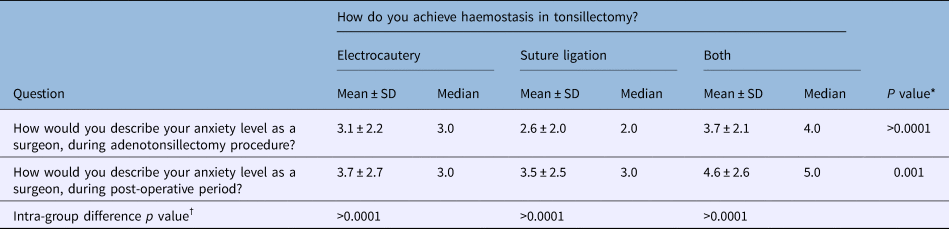
Anxiety levels were compared between participants who applied both electrocautery and suture ligation to achieve haemostasis and those who applied electrocautery or suture ligation alone. The mean anxiety levels during surgery were 3.7 ± 2.1, 3.1 ± 2.2 and 2.6 ± 2.0, respectively, and those in the 10-day post-operative period were 4.6 ± 2.6, 3.7 ± 2.7 and 3.5 ± 2.5, respectively. The results indicate a significant increase in anxiety level in participants who preferred to use both methods for haemostasis (Table 4).
Effect of different haemostasis techniques on surgeons’ anxiety levels

*Kruskal–Wallis (Mann–Whitney U test); †Wilcoxon signed-rank test. SD = standard deviation
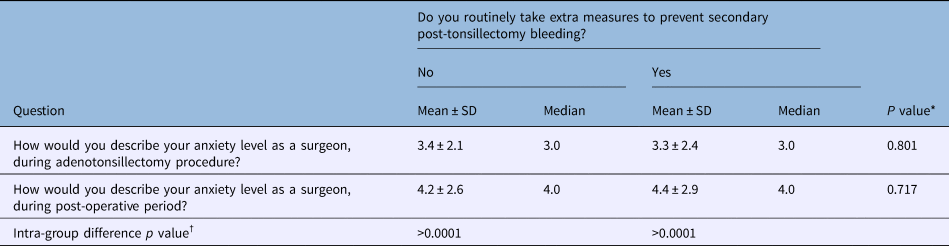
We also compared anxiety levels in surgeons who reported a preference for taking extra measures to prevent secondary post-tonsillectomy bleeding with those who did not take such measures. The anxiety levels during surgery were 3.3 ± 2.4 and 3.4 ± 2.1, respectively, and during the 10-day post-operative period were 4.4 ± 2.9 and 4.2 ± 2.6, respectively. The differences between the two groups were not statistically significant in either period (p > 0.05) (Table 5).
Effect of extra measures to prevent secondary post-tonsillectomy bleeding on surgeons’ anxiety levels

*Mann–Whitney U test; †Wilcoxon signed-rank test. SD = standard deviation
Discussion
Although numerous surgical modalities are available for paediatric adenotonsillectomy, cold knife dissection remains the preferred technique for both adenoidectomy and tonsillectomy among ENT surgeons.Reference Hinton-Bayre, Noonan, Ling and Vijayasekaran6 Walner et al.Reference Walner, Mularczyk and Sweis1 conducted a survey of American Society of Pediatric Otolaryngology members, and found that the preference shifted from cold dissection toward monopolar electrocautery among surgeons in the USA. Another audit of tonsillectomy practices in Australia indicated that monopolar diathermy (45.5 per cent) and cold steel (36 per cent) are the most common techniques used for tonsillectomy dissection, with cold steel dissection being more common among older surgeons.Reference MacFarlane, Nasser, Coman, Kiss, Harris and Carney7 Our participants were mostly based in European countries, and the results of our survey indicate that cold knife dissection is the most preferred surgical modality for both adenoidectomy and tonsillectomy.
• Cold dissection is still the preferred modality for adenotonsillectomy; both suture ligation and electrocautery are commonly used for haemostasis
• ENT specialists do not commonly employ extra measures (e.g. suturing faucial pillars) to prevent secondary post-tonsillectomy bleeding
• Paediatric adenotonsillectomy can generate anxiety in ENT surgeons
• The possibility of secondary post-tonsillectomy bleeding increases surgeons’ anxiety levels in the post-operative period
• Younger surgeons experience more anxiety during surgery and the post-operative period
The incidence of post-tonsillectomy bleeding reported in the literature is about 3–5 per cent.Reference Mitchell and Parikh3, Reference Windfuhr, Verspohl, Chen, Dahm and Werner8 As our survey design did not allow the collection of post-tonsillectomy bleeding rates, we asked the participants to estimate the number of cases of post-tonsillectomy bleeding that they had encountered during their entire career. The majority of participants (54.2 per cent) reported between one and five patients with post-tonsillectomy bleeding. As only 8.2 per cent of our participants reported no post-tonsillectomy bleeding and 37.5 per cent reported more than five cases, post-tonsillectomy bleeding remains an issue for all paediatric ENT surgeons.
Suture ligation and electrocautery are the most frequently used basic methods to control bleeding during surgery.Reference Elinder, Söderman, Stalfors and Knutsson4, Reference Lowe, van der Meulen, Cromwell, Lewsey, Copley and Browne9 Most of our participants stated that they utilised both of these methods during the procedure. A number of different extra measures to prevent secondary post-tonsillectomy bleeding have been described in the literature, including suturing the faucial pillars together.Reference Mitchell and Parikh3, Reference Cetiner, Cavusoglu, Duzer, Sakallioglu, Susaman and Yildirim10 However, the benefits of these measures are controversial.Reference Matt, Krol, Ding and Juliar11, Reference Senska, Schröder, Pütter and Dost12 In our survey, only 6.8 per cent of the participants reported utilising such extra measures for haemostasis, with the majority preferring suturing faucial pillars and lower pole ligation.
Anxiety and distress constitute problems for the well-being of surgeons. Continuous stress and anxiety could lead to burnout, and it has been shown that physician burnout can adversely affect patient safety and contribute to medical errors.Reference Balch, Freischlag and Shanafelt5 Our results indicate that surgeons’ anxiety levels increased significantly in the 10-day post-operative period, which may be associated with the possibility of secondary post-tonsillectomy bleeding. This was supported by the observation that anxiety levels were higher in our survey participants who used both suture ligation and electrocautery, rather than only one of these methods for bleeding control during surgery. Moreover, anxiety levels did not differ between those who took extra measures to prevent secondary post-tonsillectomy bleeding and those who did not adopt any specific extra measures.
Marrelli et al.Reference Marrelli, Gentile, Palmieri, Paduano and Tatullo13 compared stress levels in junior and oral surgeons during surgical procedures, and reported that more experienced surgeons showed greater stress management ability. Experience and increased time spent in the profession could benefit the surgeons in overcoming critical situations. The skills that experienced surgeons use to prevent stress are mostly self-taught through trial and error.Reference Wiggins-Dohlvik, Stewart, Babbitt, Gelfond, Zarzabal and Willis14 In our survey, we found a negative correlation between anxiety level and number of years of experience.
The main limitations of this study are that we measured anxiety levels with a simple scoring parameter and our survey design did not allow the measurement of post-tonsillectomy bleeding rates (we used only the estimated number of post-tonsillectomy bleeding cases during the participants’ entire career). However, post-tonsillectomy bleeding rates are well established in the literature, and confirming these numbers would be of little additional value. More extensive studies focusing on stress and anxiety in ENT surgeons using more sophisticated anxiety and stress scales may provide additional insight.
Conclusion
This was the first survey to measure surgeons’ anxiety levels during and after paediatric adenotonsillectomy. This was also the first survey to assess the surgical preferences of surgeons in different European countries. Our results indicate that cold dissection is still the preferred surgical modality for adenotonsillectomy, while both suture ligation and electrocautery are commonly used for haemostasis. Although different extra measures to prevent secondary post-tonsillectomy bleeding have been reported, the lack of evidence regarding their benefits seems to have affected surgeons’ preferences regarding their application.
Although paediatric adenotonsillectomy is a minor surgical procedure in ENT practice, our survey indicates that the procedure can generate anxiety in ENT surgeons. The possibility of secondary post-tonsillectomy bleeding increases surgeons’ anxiety levels in the post-operative period. Our results indicate that experience reduces the anxiety level. Given the long careers of physicians, proper guidance on reducing stress and anxiety, as well as new methods to reduce secondary post-tonsillectomy bleeding, could help to mitigate anxiety among younger surgeons and improve their well-being.
Competing interests
None declared