What did James, 3rd duke of Chandos (1731–89) and premier peer of the realm, have in common with Sarah Harman and Sarah Stephens, two Bristol grutt-makers in 1775, following a distinctly obscure occupation? Outwardly, not much. Yet Harman and Stephens were sufficiently prominent businesswomen to appear in Bristol's first trade directory, whilst ‘His Grace James Duke of Chandos’ was not too grand to appear in Winchester's listing for 1784, where he featured as one of the city's five aldermen – and, interestingly, not in first place.Footnote 1 In other words, these three were publicly known as urban ‘persons of consequence’. It was a distinction which they shared with thousands of their fellow townsmen and townswomen.
This article analyses these listings to explore further what they can tell historians. Evidence has been extracted from 16 different British town directories in the 1770s and 1780s, drawn from all urban centres which had at least one local directory in these decades. Most of the early issues were one-offs, since annual updatings were as yet uncommon. But London and Birmingham both had more than one compilation, so for this survey the earliest substantial volume was chosen.
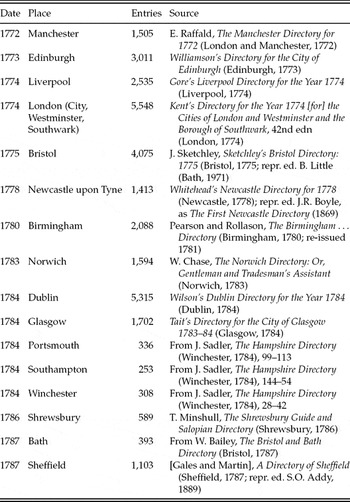
Table 1 documents the chosen directories from: three capital cities (Dublin, Edinburgh, London); four international ports (Bristol, Glasgow, Liverpool, Newcastle upon Tyne); four manufacturing centres (Birmingham, Manchester, Sheffield, Norwich); two small county capitals (Shrewsbury, Winchester); one large resort (Bath); one small port-cum-resort (Southampton); and one dockyard town (Portsmouth).Footnote 2 The thoroughness of the sources was notably variable. In particular, the Bath entries in Bailey's Bristol and Bath Directory (1787) noted only c. 400 names (from a city of some 20,000 residents). They were probably included simply as a marketing ploy to assist sales of what was basically a Bristol publication. Similarly sparse were the Portsmouth, Southampton and Winchester listings, which appeared within a general directory for Hampshire. So these relatively restricted sources have been used for their informative details rather than for an aggregative overview.
Identifying 16 early town directories 1772–87

Sources: For locations, see C.W.F. Goss (ed.), The London Directories 1677–1855 (London, 1932), and J. Norton (ed.), Guide to the National and Provincial Directories of England and Wales, Excluding London, Published before 1856 (London, 1950).
Collectively, the 16 directories identified almost 32,000 town residents and firms. They included 26,277 men and a much smaller total of 2,466 women, the remainder (found mainly in the Shrewsbury listing) being gender-anonymized without a specified first name. Between them, these people shared 9,039 family surnames, ranging from the rarest Nightingales (1) to the commonest Smiths (335; including no fewer than 58 John Smiths). Next in popularity came the Browns (186) and the Joneses (184). Other local concentrations included numerous Kellys in Dublin, many Buchanans and Campbells in Glasgow and a subsidiary cluster of Scottish surnames in Newcastle upon Tyne.
These ‘persons of consequence’ were drawn from the urban business leadership, broadly defined, plus a number of leisured families, constituting the ‘town gentry’. The directory population thus ranged from a few aristocrats, plutocrats and rentiers to many middling traders, manufacturers and professional men. Together, they were urban ‘notables’, being noteworthy enough to appear in these listings. By the nineteenth century, such town leaders were often taken to represent a ‘middle-class’, non-agrarian interest group, in contrast to the traditional landed aristocracy.Footnote 3 However, the actual urban notables had varied social backgrounds, about which the directories provide rich information.Footnote 4
Viewed closely, these sources highlight three interlinked themes. The first marks the collective role of the directories as an urban resource within the burgeoning ‘knowledge economy’ and ‘knowledge culture’. The second theme relates to the overwhelming practice of identifying individuals (and the nascent firms) in terms of one single occupation, many of those being highly specialized.
Thirdly, the data within these sources also permit some interesting aggregate analysis. By classifying the directory occupations, the range of economic specialisms among the business leadership can be reviewed. There were significant differences between the manufacturing centres, the ports and the capital cities, as presented below. Of course, there were some common features as well. All towns generated some basic employment in ‘maintenance’ occupations, to feed, house and clothe their local populations. But they also had different specialist roles, attracting congregated groups of specialist workers. Indeed, it was the variant fortunes of these different trades, industries and services which accounted for the differential patterns of growth between one town and another.
Following that logic, the argument here rejects the revisionist proposal from Jon Stobart and Leonard Schwarz, that Britain's provincial towns should be re-envisaged, not primarily within a specialist economic typology, but instead as ‘residential leisure towns’.Footnote 5 Stobart and Schwarz rightly draw attention to the growth of cultural ‘overhead investment’ in urban entertainment facilities and improvement societies, as well as the urban location of numerous affluent consumers. And they reject the old aristocratic prejudice that Britain's provincial towns were culturally blighted.Footnote 6 Such contemporary criticisms tended to come from non-townees, who preferred an idealized ‘country’ alternative.Footnote 7
However, Stobart and Schwarz take revisionism too far. Genuine socio-economic distinctions, as shown in the directories, are blurred if all large towns are merged into one ‘hold-all’ category. It is perverse not to acknowledge, as contemporaries would, the differences between (say) Manchester as a textile centre and regional hub; Liverpool as an international port; Birmingham as the capital of the Black Country metalware region; and Bath as a spa and resort city. All these towns were ‘residential’ in the most obvious sense, as having a resident population; but not all were equally attractive to visitors seeking leisure and entertainments. Yet it was true, at the same time, that the urban network was generating a shared urbanism. By listing aristocrats and gentlemen alongside the business leaders, the directories endorsed the towns’ ecumenical appeal – which was built upon world of specialist work.
Directories as an urban resource
Of course, it was not new in the 1770s and 1780s for the spotlight to fall upon the urban grandees. In traditionally incorporated towns in earlier periods, there were regular displays of civic power in the form of public processions of municipal rulers and trade guilds. One magnificent example is seen in Denis van Alsloot's Procession of the Guild Masters through Brussels (1616), reproduced in Figure 1. The serried ranks of master traders and craftsmen conveyed instant information about their identity, whilst simultaneously underlining their cohesion. By the eighteenth century, however, the old guilds, with their system of trade regulation, had disappeared almost everywhere.Footnote 8
Denis van Alsloot's Procession of the Guild Masters through Brussels (1616), showing confident economic leadership in public view for all to see. Prado Museum, Madrid, c/o Bridgeman Art Library.

Residents and visitors, however, still needed information. Gradually, printed directories emerged to complement the traditional sources of information by direct witness and word-of-mouth report. The first solitary resource of this kind appeared in 1677, serving merchants in the City of London.Footnote 9 And 100 years later, trade directories were becoming standard in all places with urban pretensions. Thus in 1786 the publisher Thomas Minshull ‘almost blushed’ to admit that Shrewsbury – then a modest commercial capital with some 12,000 inhabitants – lacked such a resource, before himself hastening to fill the market gap.Footnote 10
Individuals were listed alphabetically, accompanied by information about their occupations and their personal and professional titles (if any). Some directories further grouped their listings under the headings of different trades, as in the case of the 1787 Directory of Sheffield.Footnote 11 One or two handbooks also provided further information about their urban context. For instance, Sketchley's 1775 Bristol Directory supplied a short history of the city and corporation, as well as comparative town populations, so that attentive readers could rank Bristol against sundry European capitals.Footnote 12 Another example came from Norwich. There, Chase's 1783 Directory offered ‘Hints for Public Improvements’ of the urban environment. His suggestions included removing the city's ancient but crumbling flint-stone walls – a policy that was adopted in the following decades to the long-term detriment of Norwich's tourist trade.Footnote 13
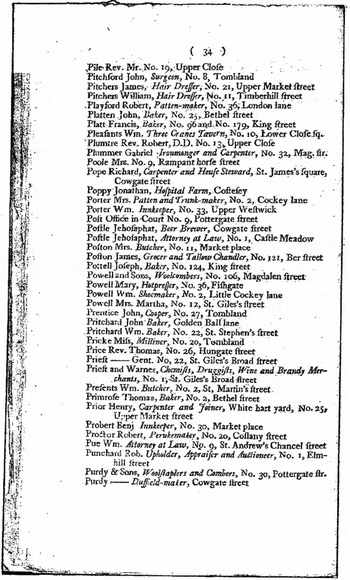
In general, however, these publications stuck to their core business. Their lists of serried names were undoubtedly dull to view, as indicated in Figure 2. They lacked the striking immediacy and colour of a pageant. Yet the town directories, eschewing passion and partisanship, were available year-round as accessible, checkable, durable, portable, lendable and (tolerably) authoritative guides to the urban ‘persons of consequence’. And these social and business leaders in turn meshed into other networks, as they interacted with their fellow townsmen and women, who were, of course, far from simply the ‘led’.Footnote 14
A page from William Chase's Norwich Directory (Norwich, 1783), listing the city's social and business leaders on public record for all to contact. British Library C104.dd.20.

Frequently, the directory compilers were local publishers or booksellers, seeking popular works for secure sales. Many conducted or commissioned their own surveys. For example, the compiler Elizabeth Raffald advertised in Manchester her intention of sending ‘proper and intelligent Persons round the Town, to take down the Name, Business, and place of Abode of every Gentleman, Tradesman, and Shop-keeper, as well as others whose Business or Employment has any tendency to public Notice’.Footnote 15 The job of collecting such information, albeit not well paid, thus began ‘on the doorstep’.Footnote 16 Of course, there was always the problem of obsolescence, as people moved home or changed businesses or died. Hence compilers often solicited corrections and updates.
Imperfect as were the details, the combined data provided ‘snapshot’ research leads. With their aid, enquirers could find people quickly and/or launch further enquiries by consulting others who had similar occupations or who lived in the same neighbourhoods or who shared the same family name. The commercial expansion of the genre thus indicated that there was sufficient contemporary demand, even though readers rarely commented upon their use of these volumes.Footnote 17
Charlotte Matthews was, however, an exception. She was a London businesswoman, who was asked in 1794 to assess a fellow trader's credit-worthiness. Her tactic was to check the relevant directory, before reporting critically of the individual in question that he was ‘not in the directory . . . and only lodges’.Footnote 18 She had found enough to reach a verdict about his public persona. In her case, her search was systematic and intentional but others might also use directories fleetingly and casually.
Economically, socially and geographically, the towns’ leading individuals were ‘on the map’ within the grid of print culture, for all to see or to trace, if further research was required. The directory compilers were certainly confident in the usefulness of their product as points of first guidance, as expressed with lofty satisfaction by the Plymouth, Stonehouse, and Devonport Directory in 1830:
Of the utility of a general Directory to Towns of magnitude and vast Populations, it is presumed, there can be no dissent. By its light, the community at large are made known in their various avocations, while the stranger and the visitor can readily find, by its guidance, the residences of all; thereby obviating that unpleasantness so often arising from irksome enquiries, and erroneous directions.Footnote 19
All publications like these fell into the category of what the contemporary bibliophile Charles Lamb defined as ‘biblia-a-biblia’: books that were not books. Footnote 20 The new directories, like the growing shelves of encyclopaedias, almanacs, atlases, dictionaries, guide-books and town histories,Footnote 21 were not designed to be read consecutively. They offered instead access to the consolidated stock of knowledge in print. Such resources together formed the basis of what Joel Mokyr has dubbed the expanding ‘knowledge economy’.Footnote 22 As Britain was developing, with the nearby Dutch Republic, into Europe's most densely urbanized region,Footnote 23 as well as becoming one of the world's greatest imperial powers with an unrivalled spread of international trading networks,Footnote 24 it was no surprise to find that the increasingly literate and urbanized Britons needed ready access to data about their own town communities. It then took alert users to absorb such information and turn it into living knowledge.
Occupational identity
Accompanying the lists of names and addresses, the main point of the directories was to identify people in terms of their occupations and status. And, overwhelmingly, it was the first of these that was used. Thus, within these 16 directories, there were 31,768 separate entries, of which as many as 93.6 per cent (29,733 individuals and firms) were identified by one main line of business. That factor, and the range of specialist occupations thereby revealed, constitutes the second big theme for analysis.
Signalling an occupation was an established form of public styling that had emerged over many centuries. Indeed, a number of family surnames began by borrowing from core work designators. Obvious examples included Baker, Miller, Smith, Thatcher or Turner, alongside less obvious ones like Backhouse (Bakehouse) and Malthus (Malthouse). By the eighteenth century, a reliance upon occupation as an identifier was well established. It was used, whether an individual was actually in work or not, as a short-hand guide to socio-economic standing. Thus, when parliamentary electors voted at the open polls, they publicly called out their names and occupations.Footnote 25 Moreover, the growth of these trade directories further strengthened the practice, as did the collection of data for the nineteenth-century occupational censuses from 1841 onwards.
Actual working practices, meanwhile, were often variegated. Some merchants, for example, acted as financiers for their clients, which was how Norwich's Gurney's Bank evolved, the family switching from one specialism to another.Footnote 26 Or smaller shopkeepers and alehouse-keepers acted as de facto pawnbrokers for needy customers.Footnote 27 And a number of urban craftsmen hosted drinking rooms, which operated as informal employment exchanges or ‘houses of call’, where people went to seek work in the same trade.Footnote 28
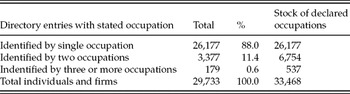
Nonetheless, in most cases, a single job label sufficed, as Table 2 clearly demonstrates. Among the almost 30,000 individuals and firms within these 16 directories, 88 per cent simply recorded one central occupation.
Single and multiple occupations in 16 early town directories 1772–87

Source: Occupations within all directories listed in Table 1.
‘Merchant’ was the most frequently recurrent business label (8.4 per cent of all entries). That generic term referred to wholesale traders, whether dealing locally, nationally or internationally. After them came the urban inn-keepers (aggregated with alehouse-keepers and publicans), followed by grocers, lawyers, shoemakers, tailors and drapers. Between them, these seven most frequently found categories accounted for 27 per cent of all occupations – over one quarter – within these sources.
Most occupational labels came from a nationally recognizable vocabulary of work, incorporating all legally accepted ways of making a living. (The black economy remained excluded, as it did from the later censuses.) There were some regional variants. The Bristol ‘grutt-makers’, Sarah Harman and Sarah Stephens, have already been mentioned for their apparently obscure calling.Footnote 29 Their occupation featured neither in the eighteenth-century dictionaries nor the nineteenth-century censuses. However, these businesswoman were oatmeal makers (grutt = groats), as described locally. Another linguistic variant, found in Newcastle upon Tyne, was the Geordie term ‘raff’ meaning timber, as in the ‘raff-fitter’ and ‘raff-yard keeper’. Scotland too had some traditional Scotticisms, such as the baxter (baker), flesher (butcher), grieve (bailiff) and room-setter (lodgings-keeper).
Yet the directories generally deployed a standard terminology. Hence, their plethora of specialist terms reflected the eighteenth-century's growing sub-division of labour and business rather than a reliance upon regional vocabularies.Footnote 30
At the same time, a small but not insignificant minority of these directory notables recorded a greater diversity. Almost 3,400 individuals (11.4 per cent of the total) listed two occupations, as shown in Table 2. Most were closely linked roles: ‘grocer and tea dealer’; ‘tailor and stay-maker’; ‘carpenter and joiner’; ‘painter and glazier’; or ‘surgeon and man-midwife’. Another example was the ‘clock- and watch-maker’, following two similar tasks within an expanding craft industry.Footnote 31 But there were unlikely combinations too. London in 1774 had four hatters who were sword cutlers. Elsewhere, two hair-dressers doubled as keepers of circulating libraries. One jeweller was simultaneously a clothier. And an Edinburgh room-setter was a grave-cloth-maker. In such unusual combinations, the individual probably had one main business, whilst supervising another as a sideline, quite possibly as a family concern.
Meanwhile, it was really rare to list three or more occupations. As Table 2 indicates, no more than 179 people (0.6 per cent of the directory listings) were attributed with so many. When multiple businesses appeared, they were usually linked, such as the 19 ‘plumbers, painters and glaziers’ in Norwich in 1783. Only very few showed extreme versatility. A jeweller in Liverpool in 1774 was simultaneously a miniature-painter and a hair-worker. In Norwich, again in 1783, two wine- and brandy-merchants had a third occupation, one as a dentist, the other as an attorney-at-law – both well primed with alcohol to soothe nervous clients.
Easily leading the occupational pluralists, however, was the Bristol glover, James Bazley, who lived near the Avon dockside. The 1775 directory listed him as a glover, hosier, parchment-maker, orange-merchant and undertaker (business broker).Footnote 32 He was, however, the intriguing exception to the overwhelmingly general rule.
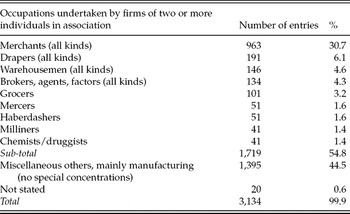
Many of these directory notables, like James Bazley, headed their single or multiple occupations on their own account. A significant minority, however, heralded a new trend towards business corporatism. Among those with listed occupations, 3,134 entries (10.5 per cent of the total) were marked as firms. They were specified either by two or more names yoked together or by designations such as ‘& Company’ or ‘& Sons’. Two examples came from metropolitan London in 1774, which hosted just over half (50.2 per cent) of all these directory firms. One was Golightly & Hill, distillers; and the other was Ann Coward ‘& Comp.’, running a wholesale glass-and-china warehouse.Footnote 33
Typical businesses to adopt this formula were those with large-scale commitments, requiring the attention and often the capital of more than one individual. Thus wholesale merchants accounted for 30.7 per cent of the total of all firms. They were followed by sundry grocers, mercers, haberdashers and milliners. In addition, there were also plenty of firms in manufacturing, across a wide spectrum of industries (see Table 3); and a few in the professions, such as joint legal practices.
Occupations undertaken by firms of two or more individuals in 16 early town directories 1772–87

Source: Aggregated occupations from all directories listed in Table 1.
Throughout this period, the contractual obligations of such business associations still remained highly flexible. Often but not invariably they were family concerns, relying upon goodwill. Any resultant disputes were tested by case-law rather than by a national regulatory framework.Footnote 34 Nonetheless, these firms’ presence indicated that structural changes were preceding legal ones. Concentrated occupations were thus being matched by an intensification and eventual formalization of business organization.
The range of specialist occupations
Another key dimension of the occupational theme was the impressive range of specialisms that were revealed by the directories. Such evidence corroborated a key insight from a famous contemporary witness. In The Wealth of Nations (1776), Adam Smith dwelt upon the apparently ‘trifling manufacture’ of pins in the Black Country. Each tiny end-product was the fruit of as many as 18 separate but interdependent production stages. ‘In some manufactories’, Smith explained, ‘[these operations] are all performed by distinct hands, though in others the same man will sometimes perform two or three of them.’Footnote 35
Birmingham's gun industry was accordingly shown as being organized by separate gun-barrel-makers, gun-lock-makers, gun-rod-makers and gun-stock-makers, as well as by all-purpose gunsmiths. In Sheffield, meanwhile, there were silver-casters, silver-cutlers, silver-button-makers, silver-refiners, silver-platers, silver-rollers and silver-turners, not to mention silverers of looking-glasses. Such experts heightened Sheffield's reputation for skilled craft labour, which brought more business to town.Footnote 36
Other specialists were button-makers who worked in (variously) gilt, glass, enamel, horn, metal, pearl, plate, steel, silver, tin, twist or Vigo wool. And there were real rareties, including one artificial tooth-maker, located in Edinburgh in 1773; one maker of black-lead sliding-pencils, working in Dublin in 1784; and one water-closet manufacturer, also in Dublin – one of the unsung pioneers in an industry with a great future.Footnote 37
Commerce as well as manufacturing also generated numerous intricate specialisms. For example, many traders concentrated upon one core commodity apiece. Thus there were different dealers in oil-stones, mill-stones and grinding-stones respectively, while yet more merchants traded (variously) in pearl ash; blistered steel; faggot steel; Newcastle glass; copperas (copper sulphates used in dyeing and tanning); Flanders-thread; indigo (blue powdered dye); oranges; ostrich feathers; rabbit-fur; whalebone; diamonds; ‘old Hock and Rhenish wine’; ‘foreign spirits’ (indicating brandy); or, for the patriotic drinker, ‘British spirits’ (gin).
Wholesale trading warehouses were also located in most major urban centres. Interested enquirers could thus locate individual stores for (variously) Birmingham metalwares; Staffordshire china and pottery; ‘Scotch lawn’ (linen); and textiles from, respectively, Coventry, Manchester, Norwich and Yorkshire. Yet more warehouses stockpiled childbed linen; hooped petticoats; lace; handkerchiefs; burial crape; bunting; Turkish rugs; Kidderminster carpets; turpentine; mineral-water; distilled-water; vinegar; iron hoops; fire-buckets; human hair (for wig-making) and the fashionable new umbrellas. Notable too was the London emporium for Stoughton's Elixir, a popular patent medicine, belonging in 1774 to a female-headed firm, ‘Jane Kitteridge and Comp.’, which supplied retail outlets in 50 provincial towns.Footnote 38
Wares from all parts of Britain were being traded across the country and internationally, with the towns acting as nodal hubs. European links were revealed by the presence in London of agents for the Hanse towns and for Danzig, while both Dublin (1784) and Liverpool (1774) housed a resident Danish consul. British merchants also concentrated upon specific areas of the world, trading (variously) with Ireland, Africa, the Americas, the West Indies, Spain, Scandinavia, Turkey or Russia.
While markets integrated and expanded, so did the range not only of wholesale traders but also of specialist retailers.Footnote 39 Amongst the butchers, the directories listed separate chicken-, hog- and pork-butchers as well as ham-curers, ham-and-tongue merchants, bacon dealers and tripe-dressers. General ‘bakers’ were distinguished from specialist sugar-bakers, confectioners, pastry cooks, gingerbread-makers and muffin men. Ordinary drink coopers were everywhere plentiful. But so too were oil-coopers, rum-coopers, brandy-coopers, sugar-coopers, white-coopers and the many wine-coopers. Indeed, the drink trades spawned a range of dealers in arrack (fermented coconut), beer, cider, porter, punch and rum, as well as the spirits traders already mentioned.
Numerous interesting specialisms were also found in the service industries. Thus, ‘number-sellers’ sold serialized books in separate ‘numbers’, hot from the press. A ‘chimney doctor’ repaired flues. One medical man was a specialist ‘operator for the ears’. Education offered further opportunities for special expertise. Commercial tutors provided instruction in (variously) classics, European languages, music, dancing, writing, natural history, accountancy and book-keeping. Numerous schools featured in the directories as well, not least a Mercantile Academy for young men in Dublin in 1784. That city also boasted a professor (teacher) of stenography, while Edinburgh in 1773 housed a professor of Hebrew. Moreover, among these almost 30,000 urban notables there were nine men with listed occupations as scientists: four living in Dublin, four in Edinburgh and the remaining one in Manchester.Footnote 40
Overall, these 16 directories provided instances of 1,964 separate occupational designations. It was a notably high total. By comparison, a 1747 handbook to metropolitan occupations noted a much smaller number of 367 separate avocations.Footnote 41 This source was not directly comparable with the later directories. But the very much higher figure in the 1770s and 1780s does suggest an active process of change. Indeed, the directories’ total considerably out-trumped the 877 separate designations recorded by Britain's first national census of occupations in 1841.Footnote 42 Again, too much cannot be made of this comparison. The census-takers deliberately grouped many specialisms together for ease of aggregative analysis. But the directories’ detailed accounting certainly confirmed the work specialization of which Adam Smith wrote. Such sub-division of labour provided a fertile context for continuing change, aiding not only subtle product variations to stimulate consumer demand,Footnote 43 but also the continual refining, and eventual mechanization, of production methods.Footnote 44
Urban businesswomen
Before leaving the theme of specialist occupations, it is worth noting too that numerous businesswomen among these urban notables were engaged in a not dissimilar range of specialisms. Quietly, old expectations were being subverted. Traditionally, women were supposed to be economically dependent upon a male patriarchy,Footnote 45 or at most confined within low-paid ‘female’ occupations. Positions that did not shock public opinion were those in millinery or haberdashery, or work as midwives; nurses; inn-keepers; lodging-keepers; or proprietors of schools for young ladies – all found in the directories. Yet even such roles confuted the strictest stress upon complete female subordination. And, by this period, the range of female economic participation was broadening to include employers as well as employees. Thus, the old stereotypes were being quietly subverted, as recent research has shown,Footnote 46 even while the old patriarchal rhetoric lingered long in the cultural repertoire.
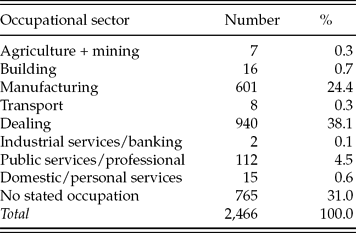
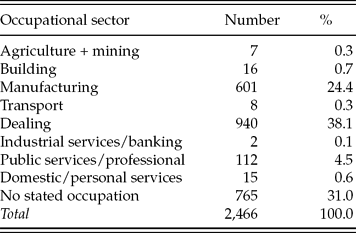
Among the 2,466 notable women in the directories (7.8 per cent of all entries),Footnote 47 those with occupations tended to concentrate in commerce. Accordingly, 40 per cent of them were classified as ‘dealers’, as shown in Table 4. At the same time, as many as 24.4 per cent (virtually one quarter) had occupations in manufacturing. It should be noted too that of the 3,134 collaborative firms in the directories, 104 (3.3 per cent of all firms) were female-headed, confirming the business visibility of females.
Women in the early town directories 1772–87
Source: Aggregated female occupations from all directories listed in Table 1.
‘Unexpected’ occupations (in the view of traditionalists) were manifest everywhere. In Southampton, in 1784 there was a woman blacksmith, while Birmingham in 1780 had a woman thumb-latch-maker, a woman tinplate-worker and a woman maker of clock dials. In Bristol in 1775, there was a female trader in ship's ballast; a female saddle- and harness-maker; and a female sexton. Meanwhile, Dublin in 1784 recorded a woman funeral undertaker, as well as other women in business as stampers, wire-workers, brass-makers and cutlers. Edinburgh in 1773 had a female furniture-auctioneer; Liverpool in 1774 a female pilot;Footnote 48 Newcastle in 1778 a female hackney-horse keeper; London in 1774 a female coal merchant;Footnote 49 and Norwich in 1783 a female butcher: Mrs Poston at 11 Market Place (as shown in Figure 2).
Generally, women ‘dealers’ in these directories outnumbered women ‘makers’. However, in the industrial centres of Birmingham, Sheffield and Norwich (although not in Manchester), the reverse was the case. For example, the ruggedly ‘male’ cutlery trades showed how the old conventions were being flouted. Hence, the 1787 Sheffield Directory listed nine women scissor-manufacturers and ten female steel-cutlers. Some had family connections with industry, including widows and women in firms with their sons. But that did not apply in every case. For example, two Sheffield scissor-makers, Mary Redfearn (trademark PARIS) and Ann Drabble (trademark a small diamond) appeared as single women, as did a further three women steel-cutlers. Needless to say, these leading ladies, like their male counterparts, were industrial owners and managers rather than physical workers at the forges. They were, however, publicly named as the prime movers in their respective businesses.
Tellingly, in terms of female economic activism, one compiler of these 16 directories was Elizabeth Raffald, who was aged 39 when she published the Manchester Directory in 1772. Her business career was a testament to versatility. After employment as a housekeeper to various landed gentry families, she moved to Manchester where she traded at different times as a confectioner, inn-keeper, provider of a servant registry and proprietor of a cookery school.Footnote 50 In that last role, she also published a best-selling recipe book, The Experienced English Housekeeper for the Use . . . of Ladies, Housekeepers, [and] Cooks (1769).
Equally tellingly, however, Raffald did not include herself in her own directory. Footnote 51 Perhaps her name on the titlepage sufficed as publicity. Instead, she listed her husband John Raffald, a confectioner and seedsman, whose 1780 bankruptcy undermined her efforts and may have contributed to her early death, aged 48, in 1781.Footnote 52 Yet Elizabeth Raffald demonstrated how a determined woman could seek a livelihood by trying many business stratagems, while also producing 16 daughters (only 3 of whom survived her). And her career signalled too that the fast-expanding Manchester – a regional hub and textile centre that had become (with the contiguous Salford) England's second city by 1801 – offered diverse job opportunities in commerce and services as well as in manufacturing.
Urban specialisms
That point about the variety within all urban economies is an important one. Yet the leading towns and cities also had their own specialist roles, which is the third big theme arising from a study of these directories. A macro-urban analysis of the occupational data has been undertaken to investigate systematically what eighteenth-century readers could glean only impressionistically. But they would not have been surprised at the outcome. The different core specialisms of the different urban centres – some, like the great metropolitan region, had more than one – were well known. Indeed, it was the success or otherwise of such particular roles which accounted for differentials in the patterns of urban growth or, in a relatively few cases, of relative decline.Footnote 53
Leading business sectors were established by adopting criteria from the Booth–Armstrong occupational classification (so named in reference to its nineteenth-century devisor and twentieth-century adaptor).Footnote 54 The system has potential flaws, as do all sectoral distributions. That is because some occupations overlapped between the secondary (manufacturing) sector and the tertiary (service) sector. A noted example was the craftsman hatter who both made and retailed hats.Footnote 55 However, by following contemporary terminology systematically, key occupational groupings can still be identified. Hence all named as ‘makers’ were classified as manufacturers, while those in commerce were classified as ‘dealers’.
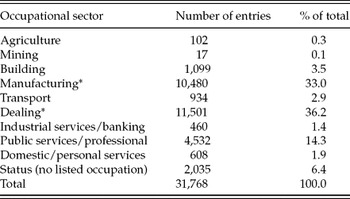
Immediately, the central importance of these two big categories became apparent, together constituting well over two-thirds of all entries. Table 5 records the details. Manufacturing occupations engaged 33.0 per cent of all the business leaders, and commercial ‘dealing’ an even larger 36.2 per cent. The importance of this latter role was noted by no less an observer than Adam Smith, who learned much economic lore from debating with merchants in Glasgow's Political Economy Club.Footnote 56 In 1776, he described Britain's expanding global empire of customers as being a project fit for a ‘nation of shopkeepers’.Footnote 57 Indeed, the dictum gained sufficient currency to be famously recycled by the Emperor Napoleon.Footnote 58
Sectoral distribution of occupations in 16 early town directories 1772–87

* In practice, some craftsmen-vendors straddled the division between makers and dealers. For purposes of classification, the core terminology was followed, with ‘makers’ being classified within manufacturing and all traders, dealers, merchants and so forth being classified within dealing. In cases such as ‘hatters’, where the terminology gives no outward clue, a considered decision was taken and then followed systematically: in this particular case, hatting went into manufacturing, unless clearly indicated to the contrary as in ‘hat-shop’.
Source: Aggregated occupations from all directories listed in Table 1.
Britain's trading strength, moreover, was encouraged not only by its array of manufactured goods for sale but also for its ‘invisibles’, such as financial, professional and administrative services. These facilities helped to prime the economy, catering for consumers at home and abroad. Hence, the professional and public service sector engaged another significant contingent (14.3 per cent) of the urban notables. No other occupational groupings, among the business leaders, had anything like the same impact. Mining was not an urban pursuit. Agriculture engaged only a handful of urban market gardeners. In this era, the heterogeneous category, known as ‘industrial services’ (1.4 per cent) was also small, comprising a few bankers and bankers’ clerks. And the three remaining sectors were also modest: these were building (3.5 per cent), transport (2.9 per cent) and the provision of domestic services (1.9 per cent). Of course, these sectors were substantial employers of many relatively unskilled menFootnote 59 and womenFootnote 60 but that was at ‘lower’ levels among the wider workforce, beyond the remit of the eighteenth-century directories.
As this occupational profile of the business leadership indicates, the directory compilers did not provide (or seek to provide) a full census of employment. For any wider survey, other partial sources can be pressed into use, where those survive. For example, insurance records afford information about those businessmen and women who were wealthy or canny enough to take precautions against fire hazards.Footnote 61 And poll-books listed occupations of numerous (male) artisan and ‘middling’ townsmen, in the few urban constituencies pre-1832 which had popular franchises.Footnote 62 Those sources, however, move the focus from the business leadership, whose aggregative profiles remain the subject of analysis here.
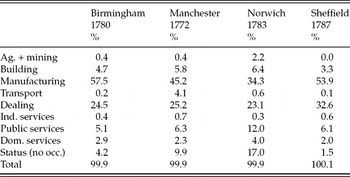
Turning to the four manufacturing centres in this survey, their industrial specialisms were immediately apparent. Table 6 shows the result. Manufacturers accounted for 57.5 per cent of the business leaders in Birmingham (metalwares);Footnote 63 53.9 per cent in Sheffield (cutlery);Footnote 64 45.2 per cent in Manchester (cotton and related textiles);Footnote 65 and 34.3 per cent in Norwich (worsted stuffs).Footnote 66 After them came the commercial ‘dealers’, invariably providing the second largest group. They accounted for another quarter of the listings in Birmingham, Manchester and Norwich, rising to 32.6 per cent in Sheffield.
Occupational sectors in early directory listings for four manufacturing towns

Source: Aggregated occupations from four directories listed in Table 1.
Indeed, in that celebrated cutlery town, marked with the ‘continued smoke of the forges, which are always at work’ (as Defoe noted in 1724),Footnote 67 the manufacturers and traders together constituted an overwhelming 86.5 per cent of all directory notables. In Sheffield in particular, there were very few ‘town gentry’ of independent means: no more than 1.5 per cent of the directory notables fell into that category.Footnote 68 The concentration of special skills in the metal-manufacturing urban regions was, moreover, a matter of note by contemporary observers. Thus Josiah Tucker in 1757 saluted especially Birmingham, Wolverhampton and Sheffield: ‘those Parts of England, in which these Things [inventions] are to be seen’, he explained, ‘exhibit a Specimen of practical Mechanics scarce to be paralleled in any Part of the World’.Footnote 69 Hence, it is implausible to label such industrial nodal points as primarily ‘residential leisure centres’, when their crucial business focus lay elsewhere.
Significantly, however, there was a variant pattern in the case of Norwich. While it was a major textile-producing centre, famed for the worsted ‘stuffs’ which were named after the city, it was also a traditional county capital. Its industry was not a smoky, noisy one that would discourage polite society. Hence it also functioned as a place of resort and organized sociability.Footnote 70 Its dual appeal to status and workday trade appeared in the sub-title of the 1783 Norwich Directory as The Gentleman and Tradesman's Assistant. And the city's traditional role was demonstrated by its relatively larger proportion of directory notables engaged in public services/professional occupations (12 per cent) and its striking number of ‘town gentry’ with no stated occupation (17.0 per cent). Thus Norwich was a textile centre which was able to sustain a subsidiary role as a ‘residential leisure town’ – a factor which gave ballast to its long-term survival when its core industry later declined.
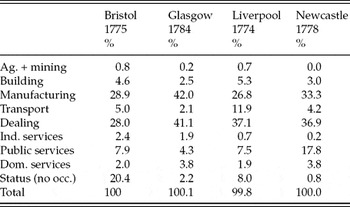
By contrast, the four international ports of Bristol, Glasgow, Liverpool and Newcastle generated a different picture (as shown in Table 7). As might be expected, commercial occupations in the ‘dealing’ sector constituted a substantial bloc. Thus in Bristol, the merchants, traders and shopkeepers accounted for 28 per cent of the directory notables; in Newcastle 36.9 per cent; in Liverpool 37.1 per cent; and in Glasgow a substantial 41.1 per cent. But these places were also locations for the industrial processing of imported raw materials. Examples were sugar refineries at Bristol and tobacco-curing in Glasgow. So the manufacturing leaders in those two places were level-pegging with the commercial sector: 28.9 per cent in Bristol (compared with 28.0 per cent in dealing) and 42 per cent in Glasgow (compared with 41.1 per cent in dealing). Liverpool too had over one fourth of all entries (26.8 per cent) in associated manufacturing, whilst its core commercial specialism triggered substantial employment in shipping/transport (another 11.9 per cent).Footnote 71
Occupational sectors in early directory listings for four international ports

Source: Aggregated occupations from four directories listed in Table 1.
Special features were also revealed within each urban centre. For example, Newcastle, like the other great ports, had a considerable bloc of manufacturers (33.3 per cent). But its traditional role as a regional capital was acknowledged by a robust 17.8 per cent engaged in public services and professional occupations. The contrast with Glasgow was particularly striking. There, the professional and public service sector among the directory notables was tiny (4.3 per cent).Footnote 72 Instead, it was Glasgow's urban ‘pair’ and rival, Edinburgh, which specialized in such services.Footnote 73
Bristol too had a historic importance as a regional resort and social capital, being the unofficial ‘metropolis of the West’.Footnote 74 And it too had a high proportion of directory notables who lacked any stated occupations. These Bristolians may indeed have included retired businesspeople as well as others of landed gentry status.Footnote 75 Together, they constituted just over one in 5 (20.4 per cent) within its local directory in 1775, recording the highest proportion in any of these 16 directories. The closest comparison was with the city of Norwich, ‘the Athens of East Anglia’, with 17 per cent of its notables being ‘town gentry’ (as already noted), and with Shrewsbury, a much smaller but still traditional country town. Its modest directory had no more than 589 entries but they included fully 15.6 per cent as ‘town gentry’. That feature is worth especial emphasis, because Shrewsbury was the county capital which first generated the descriptive accolade from its historian Alan McInnes as a ‘residential leisure town’.Footnote 76
Visitors to Bath, by contrast, were still in these decades dependent upon word-of-mouth recommendations to learn about the majestic new amenities of Britain's premier resort.Footnote 77 The very sparse details within the 1787 Bristol Directory were far too exiguous for systematic analysis, as already noted above. Nonetheless, when Bath's first detailed listing did follow in 1801, it predictably incorporated, alongside ‘every person in business’ (many being doctors), an appendix naming all its aristocratic and landed gentry visitors.Footnote 78 This snobbish flag-flying had a real rationale, boosting recruitment for the resort's specialist economy as Britain's ‘residential leisure town’ par excellence. On that basis, its rapid growth was indeed propelling it up the urban rankings to become England's tenth largest provincial town, with almost 35,000 inhabitants in 1801.Footnote 79
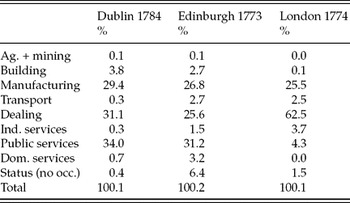
Capital cities within the three British kingdoms, meanwhile, had their own distinct roles and their own requirements from the directories. London in 1774, Edinburgh in 1773 and Dublin in 1784 all revealed a solid phalanx of notables engaged in manufacturing (see Table 8): 25.5 per cent in London; 26.8 per cent in Edinburgh; and 29.4 per cent in Dublin. Commercial ‘dealing’ was also significant. That sector accounted for another 25.6 per cent in Edinburgh, 31.1 per cent in Dublin and a massive 62.5 per cent in London. Indeed, the directories in the national capital began specifically as City commercial listings, with Lee's 1677 Names of the Merchants. Footnote 80 By contrast, the London listing virtually ignored the glittering social life of the metropolis. Its directory allocated only 1.5 per cent of all entries to the ‘town gentry’. Such was the market gap that, within a few years, smart society gained its own resource, in the form of Boyle's Fashionable Court Guide: Or, Town Visiting Directory (first published in 1792 and annually thereafter until 1924).Footnote 81
Occupational sectors in early directory listings for three capital cities

Source: Aggregated occupations from three directories listed in Table 1.
Elsewhere, in the semi-independent, semi-dependent capital cities of DublinFootnote 82 and Edinburgh,Footnote 83 the professional and public sector featured strongly. Government and law were especially important. So in Dublin, 34.0 per cent of the directory notables were engaged in public services; and in Edinburgh, 31.2 per cent, including many experts in the distinctive ‘Scots law’. There were also 105 medical men in the Scottish capital, reflecting its growing pull as a medical training centreFootnote 84 – a good number in comparison with 46 doctors among the Liverpool notables and 24 in Manchester. It was in this period, moreover, that the developing professions began to publish their own directories, complementing the all-purpose urban handbooks. Thus, Browne's General Law List was pioneered in 1777,Footnote 85 followed in 1779 by the Medical Register,Footnote 86 and emulated in 1817, less hastily but durably, by the Clerical Guide to Anglican clergy, later renamed as the classic Crockford's.Footnote 87
Differentiations between one type of occupation and another, as in the case of similar differentiations between rival urban economies, were all signals of specialization. And one result was the need for information as to where and how to find each set of services. Here, the directories came into their own, by providing research leads. Their evidence showed that the clustering of specialist occupations were not random but made economic sense, within an interlocking and internationalizing economy.
Nothing, of course, prevented an urban centre from developing and sustaining more than one main socio-economic function. The metropolitan region of London was a case in point, with different areas specializing in commerce, the professions (notably law and medicine), government and, in the famous West End, leisure services and entertainment. Another example was the city of Norwich, as a textile centre which retained its subsidiary role as a regional county hub.
Returning therefore to definitions of urban roles, it remains helpful to retain a typology that can explain the varied rise and relative decline of different urban centres. Birmingham, which had overtaken Bristol to become England's second city by the 1770s, did not grow through any function as a ‘leisure town’. It was a metalware centre, dependent upon a favourable context that enabled that role to flourish. Hence William Hutton, one of its ardent sons, exclaimed sapiently in 1781: ‘It is easy to see, without the spirit of prophecy, that Birmingham has not yet arrived at her zenith . . . Her increase will depend upon her manufactures; her manufactures will depend upon the national commerce; national commerce will, also, depend upon a superiority at sea; and this superiority may be extended to a long futurity.’Footnote 88
The nomenclature of ‘residential leisure town’ is thus best applied to places with significant socio-economic functions as ‘resorts’. Such a usage has the advantage of compatibility with eighteenth-century practice. It also means that small and developing seaside resorts like Weymouth and Scarborough can be recognized as leisure towns, whereas Stobart and Schwarz confusingly allocate them, for analytical purposes, into a ‘non-leisure control group’.Footnote 89 When revisionism leads to such anomalies, it suggests that the revisionist terminology is itself the cause of confusion.
Having said that, it can be agreed that Britain's growing town populations were collectively generating and diffusing a shared and confident urbanism. The greater the occupational and urban specialization, the greater the concomitant commercial – and hence cultural – networks needed to sustain them. Successful towns and cities were increasingly drawing traditional landed society into the orbit of an urbane and competitive town culture – as witnessed by the urban assemblies, concerts, clubs, societies, libraries and other social amenities which Stobert and Schwarz have stressed.Footnote 90 Hence, a Birmingham patriot like William Hutton could write without irony that: ‘When the word Birmingham occurs, a superb picture immediately expands in the mind, which is best explained by the other words grand, populous, extensive, active, commercial and humane.’Footnote 91 Nothing ‘direful’ here. Instead, a bounding confidence in urban benefits and a readiness either to gloss or to overcome urban problems.Footnote 92
Town gentry
Hence, mingling with the business leaders was another category of directory notables: the 3,768 people defined by some indicator of personal status. In these 16 sources, they comprised 1,272 women and 2,496 men, constituting together just under 12 per cent of all entries. As already noted, the directories were not uniformly consistent in recording such individuals. But those who were included merit attention.
Known as the ‘town gentry’, using an eighteenth-century phrase,Footnote 93 these people were socially heterogeneous. De facto, they bridged across the potential gulf between aristocratic and middle-class society.Footnote 94 They embraced not only landowners who had migrated to town but also ‘genteel’ urbanites, often retired from office or business. Many were rentiers, living off unearned income from rentals and investments. In the nineteenth-century censuses, they were collectively denoted as people of ‘independent means’,Footnote 95 although some did also have occupations, as will be seen. Overall, it was significant that all towns harboured some individuals defined by titles or status. At the same time, it was equally noteworthy that such ‘town gentry’ were particularly clustered in the traditional county towns which functioned as places of resort – such as Norwich, Bristol and Shrewsbury (as already noted above).
Some of these social leaders held aristocratic titles. Table 9 reveals that 23 ‘Ladies’ (with a capital L), including one countess and two countess dowagers, featured in these 16 directories, as did another 20 male peers. What such august personages thought of their inclusion in these workaday handbooks, alas, remains unknown. They were certainly unusual among their fellow peers in this respect. However, no public comment was made about their dual signalling as aristocratic urbanites. Certainly, the 3rd duke of Chandos, whose first wife brought him a mercantile fortune,Footnote 96 lived the lifestyle of a titled town grandee. His time was divided between his elegant London town-house (Chandos House, built by the Adam Brothers in 1769–71) and his family seat at Avington near Winchester, for which he was first MP and then alderman.Footnote 97
Individuals designated by status in the early town directories 1772–87

* The title of Lady was accorded to wives of knights and baronets and has been so classified here. It should be noted, however, that ‘Lady’ was also an honorific for daughters of the titled peerage; and ‘lady’ without the capital letter was used as a descriptor for spouses of gentlemen, as in ‘ladies and gentlemen’. The classification here is thus indicative rather than conclusive.
Source: Aggregated status designations from all directories listed in Table 1.
Few could match his level of social fame. For example, one Norwich gentleman in 1783 was identified only by surname as Prior, — gent (see Figure 2), which indicated a distinctly muffled celebrity. Nonetheless, the inclusion of such names marked a concern to record local status. Interestingly, quite a few of these ‘town gentry’ were women, listed in their own right as social presences. Again Norwich in 1783 provides two instances in Mrs Poole and Mrs Martha Powell (see Figure 2). Possibly, they were widows with money to lend, since that was a historic role played by wealthy townswomen.Footnote 98 No further details were offered, however, their names and addresses being deemed sufficient information.
Implicitly, by such signals, the worlds of status and of work were taken as co-residing. Indeed, some individuals fell into both categories. Thus, while 2,035 urban notables were designated by status alone (see Table 5), there were another 1,733 ‘town gentry’ who also had occupations. Many of these were working ‘gentlemen’. This title was an unofficial one, not granted by the monarch. Once ‘idleness’ and the avoidance of ‘dirty’ work were considered as qualifications for this personal accolade.Footnote 99 But those days were long gone. In fact, almost 6 in 10 of the 1,462 urban gentlemen and esquires in these sources had listed businesses. Their ranks included 582 professional men, including many lawyers and government officials. There were also 180 gentlemen in commerce and banking, plus 7 gentlemen in manufacturing and 5 miscellaneous others. And their range was sufficiently eclectic to include George Leonard Barrett, Esquire, manager of Norwich's Theatre Royal.Footnote 100
Aristocrats and commoners were thus appearing as co-urbanites in the town directories. In real life, too, they increasingly shared business associations, family intermarriages and social meetings (all good research themes which merit further exploration). It is true that, in contemporary novels, landed aristocrats were often depicted as being hostile to people ‘in trade’ and the lower professions.Footnote 101 Yet if Jane Austen's Lady Catherine de Burgh remained obdurate to the end, liberal characters were shown as bowing to social realities. For example, the proud Mr Darcy came to accept Elizabeth Bennett's ‘low’ relatives – and not least her admirable uncle Gardiner, who was a City wholesaler living, as Jane Austen specified, ‘by trade and within view of his own warehouses’.Footnote 102
Eventually, the two men respected each other. Moreover, had Mr Darcy taken a town-house, both men might have featured in the same urban directory, without shocking any contemporary readers.
Coda
History, it is argued, has three great intermeshing strands: of continuity, of slow change and, at times, of turbulent upheaval.Footnote 103 The directories can thus be tested against those three elemental features. In terms of deep continuity, these urban handbooks might initially seem not to qualify. The directories were ‘instant’ snapshot sources, made for the moment. Yet they stood testament to a continuing deep need for information. In the quest for understanding, there was no simple shift from oral enquiries to printed records. Instead, the directories complemented and enhanced the old requirement for news-gathering and interpretation – a continuing human need that is continually updated with every change in communications technology.Footnote 104
Slow changes were, nonetheless, visible as well. The growing total of specialist occupations, in comparison with earlier listings dating from the 1740s, was strikingly apparent – confirming the key insight of Adam Smith. Clear differences in the aggregate economic specialisms of Britain's leading towns were also identifiable, the whole interlocking in an inter-dependent grid. This streamlining urban economy was part cause and part effect of Britain's commercial and imperial expansion.Footnote 105 It also underpinned and aided the multiplication of professional and other specialist services.Footnote 106 And this economic streamlining both promoted and reflected Britain's manufacturing and technological advancement, in a long-span process of industrialization.Footnote 107
Finally, therefore, the complex processes of urbanization, to which the directories attested, were part of a turbulent macro-transformation – eventually occurring on a world-wide scale. Urban populations are now the global majority. In 2009 there were over 470 mega-cities, each housing more than one million inhabitants apiece.Footnote 108 Collectively, the urban way of life is becoming ever more hegemonic.Footnote 109 So while the early directories did not in themselves mark a revolution, they were portents of the specialist, interlinked, information-dependent urban world to come. All that, as they listed local eminences – from dukes to grutt-makers – and flourished their collective calling cards.