




No CrossRef data available.
Article contents
Desistance from persistent serious delinquency in the transition to adulthood
Published online by Cambridge University Press: 01 December 2004
Abstract
Many delinquent youth stop offending sometime in late adolescence or early adulthood. However, little is known about individual differences in desistance and which factors promote or inhibit desistance. In the current study, young males in the oldest sample of the Pittsburgh Youth Study were followed from ages 13 to 25. About one-third became persistent serious delinquents between ages 13 and 19. Out of that group, almost 40% desisted in serious offending between ages 20 and 25. Significantly more of the desisters, compared to the persisters in serious delinquency, had been employed or in school. Bivariate analyses demonstrated many predictors of desistance of serious delinquency in early adulthood in the domains of individual, family, and peer factors measured from early adolescence onward. Multiple regression analyses showed that the following promotive factors were associated with desistance: low physical punishment by parents in early adolescence and being employed or in school in early adulthood. The following risk factors were inversely associated with desistance during early adulthood: serious delinquency during late adolescence, hard drug use, gang membership, and positive perception of problem behavior in early adulthood. The article discusses the implications of promotive and risk factors for preventive interventions.This article was prepared under Grant 96-MU-FX-0012 from the Office of Juvenile Justice and Delinquency Prevention and Grant 050778 from the National Institute of Mental Health. The points of view in this document are those of the authors and do not necessarily represent the official position or policies of the US Department of Justice. We acknowledge Rebecca Stallings for assistance in preparing the data files. Our coauthor, Evelyn Wei, has unfortunately died in a car accident.
Information
- Type
- Research Article
- Information
- Copyright
- © 2004 Cambridge University Press
The transition from adolescence to adulthood is for many young men accompanied by a reduction in delinquency. The age–crime curve indicates that the prevalence of delinquent behavior peaks by late adolescence (ages 17–18 for arrests for nonviolent and violent crimes) after which it decreases (Bushway, Piquero, Broidy, Cauffman, & Mazerolle, 2001; Farrington, 1986).
In the study of delinquency careers, much attention has been paid to the onset and duration of offending. Less attention has been paid to explaining desistance from crime (Laub & Sampson, 2001). Instead, many studies have been descriptive and attempted to capture the phenomenon of desistance in mathematical models, primarily using official crime data rather than self-reported delinquency (Piquero, Farrington, & Blumstein, 2003).
Desistance is defined here as an individual's stopping the commission of crime. A significant portion of desistance from criminal behavior appears to take place in late adolescence and early adulthood, although there is later desistance as well. Those who persist are generally the more seriously and frequently delinquent males, who also have an early onset of offending (Loeber, 1982; Loeber & Farrington, 1998; Moffitt, 1993; Moffitt, Caspi, Harrington, & Milne, 2002; Tolan, 1987). Because these persisting individuals contribute greatly to the crime burden, it is important to examine factors that differentiate patterns of desistance and persistence of criminal behavior across the transition to adulthood. Such predictors may illuminate the processes that could be targeted in intervention efforts to increase or accelerate desistance.
In their review of the literature, Laub and Sampson (2001) summarized six plausible explanations of desistance from delinquency, which have been postulated by different researchers. (a) Individuals mature, and desistance takes place because of physical and mental changes (e.g., Glueck & Glueck, 1940). (b) Crime naturally declines with age, that is, it is normative in adolescence and normally decreases from late adolescence to adulthood (e.g., Gottfredson & Hirshi, 1990). (c) Individuals undergo developmental changes, such as identity changes, that accompany aging (e.g. Neugarten, 1996) or biological, physiological, or sociological changes. Moffitt's (1993) developmental model of early and late onset offenders falls under this heading. (d) In studies with a life-course focus, a decrease in offending is attributed to the formation of informal social controls or bonds with others, continuity and change in historical and other contextual features of life, independent of age. For instance, the emerging developmental tasks of romantic relationships and work in adolescence and early adulthood may lead young people away from crime (Sampson & Laub, 1993). (e) Rational choice theories consider the cessation of crime as a result of a decision by the person (e.g., Cusson & Pinsonneault, 1986). Although it is stressed that this decision can be made at any time, it should be clear that the capacity for such a decision is developmentally based. (f) Social learning approaches consider that the basic variables that explain initiation also account for desistance (e.g., Akers, 1990). Thus, if a high score on a variable (e.g., lack of parental supervision) is related to initiation, a low score may be related to desistance. In summary, a variety of biological, sociological, and psychological explanations have been proposed, but their empirical underpinnings have remained slim. Moreover, the explanations clearly overlap and consider similar processes or variables and thus often differ from each other mainly in emphasis. Most of the explanations for desistance assume that there are key changes taking place in individuals, relationships, contexts, or opportunities that are related in some way to the transition to adulthood (either developmentally or coincidentally) and serve to increase behaviors approved by society and decrease delinquent behaviors. Yet there is so little empirical data to guide theory building and hypothesis testing that it may be premature to narrow the focus to studies testing specific processes. The selection of the factors included in the study was governed to some extent by variables used in existing theories of desistance. There is, however, no meta analysis on variables relating to desistance; therefore, we have also included variables in the meta analyses relating to delinquency (Hawkins, Herrenkohl, Farrington, Brewer, Catalano, & Harachi, 1998; Lipsey & Derzon, 1998; Loeber & Stouthamer–Loeber, 1986). Therefore, the goal of this study was to identify differential predictors and correlates of desistance versus persistence of delinquency/criminality in the transition to adulthood, as a first step toward building a more integrative model of desistance from serious delinquency.
To advance the empirical study of desistance, several key methodological issues need to be addressed. One problem that has plagued the research in this area is how to operationally define desistance. How long does a person have to not engage in a particular behavior? A person not committing a crime in one year may commit one in the next year. Therefore, it is necessary to stipulate how large the window needs to be to consider a person as having desisted. Further, is desistance only counted if delinquency rates fall to zero, or if delinquency has dropped substantially in seriousness? There is no standard operationalization of desistance. Consequently, researchers have defined desistance in different ways, dependent on the type and frequency of their data collection and other practical concerns.
A second issue concerns the use of self-reports or official delinquency records to define crime or desistance. Some studies have defined desistance on the basis of official records, while other studies use self-reports of delinquency. Because official records of crime usually underestimate actual crime, the use of official records may overrepresent desistance compared to studies where self-reported delinquency is used (Farrington, 1989; LeBlanc & Fréchette, 1989).
A third issue for the study of desistance is whether to focus solely on the negative risk factors and outcomes (offending) or to include indicators of behavior that may reflect positive change and positive predictors. Generally, longitudinal studies of delinquency have focused on predictors and correlates of an array of negative behaviors comprising delinquency in its various forms. Many “risk factors” that predict onset, escalation or persistence of delinquency have been studied over the years, and comorbidity of other negative behaviors with delinquency has also been examined. Much less attention has been focused on predictors of avoiding delinquency, or of the deceleration or desistance from delinquency once it has begun. Similarly, there has been little attention to how the onset and offset of delinquency may be related to positive experiences or behaviors in other domains of functioning, such as success in age-salient developmental tasks.
Some “risk” studies of negative behaviors related to the course of delinquency could be reinterpreted in terms of positive predictors and outcomes. Many of the risk variables and correlates of delinquency actually reflect a continuously distributed variable, or a multiple category status variable that measures both ends of a dimension or aspect of human behavior or experience. For example, the absence of a risk factor or a low score on a risk variable such as deviant peer affiliations or low parental monitoring could be viewed as an indication of a promotive or protective influence (e.g., bonding with prosocial peers, appropriate monitoring by parents). However, the strength of the relationship of the risk end and of the protective end may vary. In addition, specific measurements of positive attributes are rare in this literature.
Longitudinal studies of delinquency also have neglected to focus on positive outcomes in adulthood. This is particularly salient in the study of desistance where it is important to explain not just how and why delinquency ceases, but also how and why positive adaptation develops, because the decline in delinquency may be causally related to the improvements in other domains of adjustment (Farrington, Gallagher, Morley, St. Leger, & West, 1988; Gottfredson & Hirshi, 1990; Shover, 1996; Weitekamp & Kerner, 1994).
The study of positive outcomes in adulthood is thriving, but usually not in delinquency studies. Some studies focus on competence and well-being in the general population (Bornstein, Davidson, Keyes, & Moore, 2003; Pulkkinen & Caspi, 2002; Roisman, Masten, Coatsworth, & Tellegen, 2004), while other studies focus on resilience in individuals who have experienced adversities or disadvantages (Cicchetti & Garmezy, 1993; Garmezy, 1985; Luthar, 2003; Masten, Best, & Garmezy, 1990; Masten & Coatsworth, 1998; Rutter, 1979, 2000; Werner & Smith, 1982, 1992, 2001). Potentially, this literature can help to enlarge our understanding of processes of desistance from delinquency.
Studies of promotive or protective and risk or vulnerability factors over the last few decades have illustrated alternative conceptualizations to define positive and negative predictors of individual adaptation and development (Garmezy, Masten, & Tellegen, 1984; Glantz & Johnson, 1999; Luthar, 1993; Luthar, Cicchetti, & Becker, 2000; Masten, 1989, 2001; Masten, Garmezy, Tellegen, Pellegrini, Larkin, & Larsen, 1988; Rutter, 1979, 1985, 1990, 2000; Sameroff, 1999; Stouthamer–Loeber, Loeber, Farrington, Zhang, van Kammen, & Maguin, 1993; Stouthamer–Loeber, Loeber, Wei, Farrington, & Wikstrom, 2002; Zimmerman & Arunkumar, 1994). Negative life events are generally viewed as pure risk factors. However, it is not clear in many cases whether negative conditions such as poverty or harsh parenting should be viewed only as risk factors, when the “good” end of the distribution could be seen as an asset or resource that predicts better outcomes. There is also ambiguity about variables that are associated with better and worse outcomes within high-risk groups. Garmezy et al. (1984) distinguished between “compensatory factors” that are simple predictors or correlates of better outcomes in high-risk samples, and “protective or vulnerability factors” that moderate the association of risk with outcome. Sameroff (1999) recommended the term “promotive” factors to denote the positive end of a risk dimension associated with better outcomes under all conditions (low or high risk). Stouthamer–Loeber et al. (1993, 2002) and also Farrington (1995) have noted the possibility that the positive and negative ends of a promotive/risk variable may have differential significance for dependent variables of interest. This implies a nonlinear association between promotive/risk ends of variables and outcomes. It is conceivable that in a given period of development, the positive end of a variable has greater potency as a predictor, while the negative end has little or no predictive validity or vice versa.
The term “protective factor” has also been used in inconsistent ways. A number of investigators reserve the term “protective” for a variable that shows a larger positive effect under high adversity/risk conditions than under low-risk conditions (tested by way of a statistical interaction effect), see, for example, Masten (2001) and Rutter (1990). Others use “protective factor” more broadly to encompass promotive or compensatory effects (Luthar et al., 2000). In this article, “promotive/risk” variables refer to bidirectional correlates or predictors of both good and poor outcomes. Promotive refers to presumed associative strength at the positive end of such a variable. Risk factor refers to a negative predictor of a poor outcome, or presumed associative strength at the negative end of a bidirectional variable.
Because of the scarcity of longitudinal studies with regular, uninterrupted measurement intervals, researchers have sometimes focused more on concurrent, rather than predictive, promotive/risk factors. For example, Laub and Sampson (2001) found that desistance was concurrently related to a positive relationship in marriage, a good job, or a change in neighborhood residence by joining the military. Yet it is important to address the question of which factors positively or negatively predict future desistance. For example, several studies have indicated that early age of onset, level of seriousness, or frequency of delinquency in adolescence are negative predictors of desistance (e.g., Loeber, 1982; Moffitt 1993).
Life course developmental studies of successful adjustment and well-being generally point to early, rather than later, foundations for adult adjustment (Bornstein et al., 2003; Pulkkinen & Caspi, 2002). Secure relationships with caregivers (Grossmann, Grossmann, Winter, & Zimmerman, 2002) and good social or cognitive skills in childhood have been implicated as long-term predictors of adult success (Coleman, 1988; Eisenberg, Fabes, Shepard, Murphy, & Guthrie, 1997; Lösel & Bender, 2002; Masten & Powell, 2003). However, recent attention to developmental turning points during the transition to adulthood (see other articles in this issue) suggest that there may be unique predictors or correlates of change that emerge later in life.
Finally, for delinquency prediction, another key issue concerns the prediction of onset of delinquency versus offset or desistance (Rutter, 1988). It is possible that the same variables could be involved in both the increases and decreases in behavior represented by onset and desistance (e.g., peer association). However, it is also conceivable that onset, maintenance, and desistance all represent different processes occurring in different time frames. Thus, desistance may be associated with factors that have changed or emerged sometime after the onset of offending. Farrington and Hawkins (1991) found that several factors, such as family income, verbal IQ, and family constellation were associated with both onset and desistance (in opposite directions). Other variables, such as early troublesome behavior and parents' poor childrearing skills were related to onset but not to desistance. Loeber, Stouthamer–Loeber, van Kammen, and Farrington (1991), using a narrower time window of 2 years in which to measure desistance (up to age 15), found that “initiation and desistance appear to reflect positive and negative aspects of a similar process” (p. 81). On the other hand, Laub, Nagin, and Sampson (1998) and Nagin, Farrington, and Moffitt (1995) found that many early individual difference factors and background factors had a limited capacity to predict desistance.
In the present study, we have addressed each of these methodological issues. Drawing on longitudinal data from the Pittsburgh Youth Study beginning at age 13, we examined predictors and correlates of desistance versus persistence in serious offending during the transition to adulthood, from ages 20 to 25. In a previous article (Stouthamer–Loeber et al., 2002), we examined the promotive/risk effects of factors related to persistent serious delinquency during adolescence. In the present study, we extend our analysis into adulthood to consider promotive and risk effects related to persistence and desistance as the same cohort enters adulthood. We also considered the concomitant attainment of positive adjustment in relation to delinquency. Because this was our first comprehensive attempt to identify promotive/risk factors for desistance, we have elected to include a wide array of potential variables measuring factors implicated in the literature.
The questions and hypotheses addressed in this article are as follows:
- What is the prevalence of young males' persistent serious delinquency in adolescence and what proportion of them desists in early adulthood? Given the well-replicated age–crime curve we expected a substantial proportion of serious delinquents to desist.
- To what extent do those who desist from serious delinquency differ on positive outcomes (education, work, and relationships) in early adulthood from those who persist in offending? Desistance is expected to cooccur with positive outcomes in salient domains of adjustment in early adulthood.
- Which promotive/risk factors measured in adolescence predict desistance in early adulthood, and can we begin to ascertain promotive and risk effects? We expected that a wide array of potential predictors would show potential as predictors of desistence or persistence, particularly those strongly associated with higher or lower risk in the past literature on persistence, and also those qualities of individuals or their relationships that predict improvements in adaptation from adolescence to early adulthood in the limited literature on positive adjustment. The possible predictors of desistance/persistence included individual, family, peer, and neighborhood variables, reflecting multiple levels of the ecological systems in which individual development unfolds (Bronfenbrenner, 1979).
- Which of the potential promotive/risk variables are concurrently associated with desistance in early adulthood? We expect that there is some continuity of promotive/risk factors from adolescence to early adulthood and, therefore, that concurrent measures of salient predictors would also be correlates of desistance. We are also interested in exploring the possibility that certain predictors are more or less important at different developmental periods.
These questions were addressed with data drawn from the oldest sample of the Pittsburgh Youth Study, a longitudinal study of an urban sample of young males who have been regularly followed up 16 times between the ages of 13 and 25 and have been assessed with a wide variety of assessment instruments covering a large number of variables. The length of the study, the regular follow-up, and the extensive assessment domains are improvements over many of the previously mentioned studies.
Method
Participants
Participants in the Pittsburgh Youth Study were young males in three samples randomly drawn from the first, fourth, and seventh grades of public schools in the city of Pittsburgh in 1987. Of the selected boys and their caretakers (93.5% of whom were biological mothers), 84.7% consented to participate in a screening assessment. From each sample, the top 30% of boys with the highest rates of antisocial behavior (about 250 from each grade) were selected, along with an equal number of boys randomly selected from the remaining 70%. This resulted in three samples of about 500 boys.
This study focuses on the boys in the oldest sample (N = 506), who were first assessed in the seventh grade when they were an average of 13 years old. About half of the boys were African American and half were Caucasian, reflecting the racial composition in Pittsburgh public schools. About 40% of the boys lived with a single parent, and about 40% of the caretakers received public assistance. Further details about participant selection and demographics are described elsewhere (Loeber, Farrington, Stouthamer–Loeber, & van Kammen, 1998). Since the start of the study, the participants have been interviewed every 6 months for the first six follow-up assessments and yearly thereafter for a total of 16 assessments covering 13 years of data, which, on average, reflects ages 13–25. For the present study, data from 6-month assessments were combined to reflect behaviors occurring in 1 year. Information was collected from the boys, their caretakers, and teachers. At the last data collection phase, the participation rate was 83.2%, and the overall average follow-up rate was 90.0%, reflecting very low attrition.
Measures
Constructs related to Question 1 concern delinquency in adolescence and early adulthood. Information on delinquent behaviors was based on the boys' Self-Reported Delinquency Scale (SRD; Elliot et al., 1985; Loeber et al., 1998), and the Teacher Report Form (TRF; Edelbrock & Achenbach, 1984) administered to teachers until boys were age 17. The dependent variable was desistance from serious delinquency in early adulthood by young males who had engaged in persistent serious delinquency during adolescence. The outcome groups were formed from those who were persistent serious delinquents during adolescence (ages 13–19). Participants were classified as serious delinquents if they had ever engaged in the following behaviors during adolescence: auto theft, breaking and entering, strong-arming (robbery based on information from the SRD and the TRF), attacking to seriously hurt or kill (assault), and rape or forced sex. The selection of these behaviors was based on delinquency severity ratings developed by Wolfgang, Figlio, Tracy, and Singer (1985). Persistence was defined as reporting serious delinquency for at least 2 out of the 7 assessment years up to age 19 (i.e., until the end of their teen-aged years).
Serious delinquent behavior during early adulthood was assessed over the last six assessments (ages 20–25). Those who were persistent serious delinquents in adolescence and who did not commit serious delinquency during early adulthood were considered desisters. In contrast, young males who engaged in persistent serious delinquency in adolescence and who committed one or more serious delinquent acts during early adulthood were considered persisters. The third, remaining group of participants who were not persistent serious delinquents in adolescence are referred to as the “non/lesser delinquents,” and include those who reported no, minor, or moderate delinquency during adolescence, or those who engaged in serious delinquency only once during adolescence.
To reduce the chance of misclassification, we excluded from the analyses participants who were not classified as persistent serious delinquents in early adolescence and who had more than 30% missing data (i.e., missed three or more out of the first 7 yearly assessments, n = 46). For the same reasons, we excluded those participants who were not classified as persisters in early adulthood and who had more than 30% missing data during early adulthood (i.e., missed two or more out of the last 6 yearly assessments, n = 23). The excluded participants (N = 69, 13.6%) did not significantly differ from those included in the analyses in terms of race, socioeconomic status (SES), single-parent status, neighborhood background, or high-risk status at Screening.
Constructs related to Question 2 concerned positive outcomes in adulthood. Specifically, we examine successes in the areas of education, employment, and romantic relationships. All of these variables were drawn from the early adulthood time period, and were based on self-report.
Information about participants' education and employment was collected every year from ages 20 to 25, and included highest job type obtained (coded according to the 1975 Hollingshead occupational prestige categories), employment/unemployment status, student status, and highest level of education obtained. Highest job type obtained dichotomized participants into those who had scored in the professional job levels versus those who had not. The employment variable separated those who had been employed for 95% of the time versus those had been employed less than that. The variable employed or in school combined the employment status variable and the student status variable. Other positive outcome constructs formed natural dichotomies. In addition, we measured whether participants had been institutionalized (mental hospitals and/or prisons) during early adulthood.
Romantic relationships were assessed at age 25 by the Conflict Resolution/Partner Violence Questionnaire (Magdol, Moffitt, Caspi, & Silva, 1998; Straus, Hamby, Boney–McCoy, & Sugarman, 1996). Participants were first asked whether they had a girlfriend or wife. Those who did were asked whether they lived with their partner, whether they were caring for children with their partner, their use of negative conflict resolution tactics (36 items measured on a 5-point scale), and their happiness with the relationship (one question, measured on a 4-point Likert scale).
Potential promotive and risk factors were organized to capture three age periods: 13–16 and 17–19 (predictors) and 20–25 (concurrent correlates). The first two age periods provide the information for the prediction of desistance (Question 3) and the last age period concerns correlates of desistance (Question 4). Data from yearly assessments were combined to form an average score for each time period, accounting for missing data (i.e., the sum of the yearly scores was divided by the number of years assessed during that time period).
Most measures and constructs have been described in earlier publications (see Loeber et al., 1998, 1991; Stouthamer–Loeber et al., 1993, 2002). The promotive and risk constructs cover individual, family, peer, and neighborhood factors. Because there are many factors included in this article, they are summarized in Table 1 (additional details are available upon request). Information from multiple informants was combined whenever possible. Parent and teacher reports were not available at ages 17–19 and early adulthood, as they were no longer interviewed. Several other constructs were added as the participants grew older, to capture attributes of growing importance during development (e.g., job skills).
Constructs tested for potential promotive and/or risk factors

Analyses
To correct for the initial oversampling of high-risk boys, we weighted the sample to reflect the general population of inner city boys who attended public schools. The oversampling was accomplished by constructing a risk score of antisocial behavior based on information from the first assessment phase (N = 856). We randomly selected 257 boys from the top 33% (N = 282) most antisocial boys and another 249 boys from the remainder (N = 574). The weight applied to the most antisocial group was 0.6485 and for the remainder was 1.3626. These weights adjusted to the original sample distribution without increasing the N of the actual interviewed sample (N = 506).
Question 1 required the calculation of prevalences of persisters and desisters, expressed in percentages.
Question 2 compared three groups (non/lesser delinquents, desisters, and persisters), on indicators of positive adulthood adjustment. Many of the positive outcomes we assessed could have been affected by participants being in prison, thus not having an equal amount of “street time” as nonincarcerated participants, and having less opportunity to experience positive outcomes. For this reason, we excluded n = 23 participants who had been in prison for 3 or more years between ages 20 and 25. The exception was educational outcomes; those in prison were included because it is possible to earn a diploma or degree in prison. Chi-square tests were performed to test for overall group differences in the proportion having positive outcomes. If the overall chi-square value was statistically significant, we tested for differences in positive adult outcomes between specific groups by conducting post hoc 2 × 2 chi-square tests.
Questions 3 and 4 used the constructs measured during the three time periods to identify promotive and risk factors for desistance by comparing the 66 desisters with the 101 persisters. We employed an empirical method of variable selection to determine whether a variable's effect on desistance was driven by the promotive and/or the risk end (Stouthamer–Loeber et al., 1993, 2002). For example, the variable “accountability” can have either a promotive and/or risk effect. It could be that those who are most accountable (promotive end of the distribution) have a significantly higher probability of desistance, or that the least accountable (risk end of the distribution) have a significantly lower probability of desistance. Thus, we first tested each variable to see whether it had a significant promotive effect, a significant risk effect, or both. Each variable was trichotomized at 25–50–25%, to isolate the 25% of participants at the potentially promotive end, a 50% potentially neutral group, and in the 25% at the potentially risk end. Tests for significant promotive and/or risk effects for desistance were conducted by cross-tabulating the promotive end (lower 25%) with the 50% neutral (setting aside those in the risk end), and then cross-tabulating the risk (upper 25%) end with the 50% neutral (setting aside those in the promotive end), using chi-square tests.
Once it was determined whether a variable had a significant promotive and/or risk effect, the variable was dichotomized 25 of 75 (i.e., 25% promotive end vs. 75% remainder, or 25% risk vs. 75% remainder). Chi-square analyses (2 × 2) and odds ratios (ORs) were then calculated with variables based on the entire sample (i.e., 25 vs. 75% rather than 25 vs. 50%), and ORs are reported. Cross-tabulations of promotive factors by desistance status generated ORs (and 95% confidence intervals) greater than 1, reflecting a greater likelihood of desistance. Conversely, cross-tabulations of risk factors by desistance status generated ORs less than one, reflecting a decreased likelihood of desistance (or greater likelihood of persistence). Some independent variables were treated as dichotomies to reflect the presence or absence of the risk factor (e.g., gang membership and psychiatric diagnoses).
Promotive and risk factors significantly associated (p < .05) with desistance were selected for multivariate analyses. Multivariate models were developed using logistic regression with a forward selection procedure. Before we undertook logistic regressions we examined multicollinearity among the independent measures. The overall strategy of model building was to identify predictors of desistance from each of the three developmental time periods, and then form a final model that simultaneously accounts for all time periods.
For the first regression model, promotive and risk factors measured at ages 13–16 that were significantly associated with desistance at the univariate level were entered simultaneously. Predictors measured at ages 17–19 were modeled in a second logistic regression. To control for prior serious delinquency, serious delinquency status at ages 13–16 and at ages 17–19 were also included as covariates, given they were significantly associated with the outcome of desistance at the univariate level. Next, the promotive and risk factors identified in the above two models were entered simultaneously to generate a model of significant predictors from those measured in adolescence—at ages 13–16 and 17–19.
In the subsequent regression analysis, promotive and risk factors from early adulthood, along with significant positive outcomes during that period, were entered into a regression to identify a model of correlates of desistance. The final regression model was based on significant predictors from adolescence, together with the significant correlates from early adulthood to predict desistance.
Adjusted ORs and 95% confidence intervals are presented. Model fit was assessed by examining the model chi square, the −2 log-likelihood statistic, the R2 statistic, and the percentage of cases correctly classified.
Results
Question 1 concerns the prevalence of adolescent persistent serious delinquents, and how many of them desisted or persisted into their early twenties. Of the total (N = 506), 190 (37.5%) were classified as adolescent persistent serious delinquents (Figure 1). Out of that group, 101 (60.5%) persisted in committing serious delinquency in early adulthood. A considerable proportion of the persisters committed serious delinquency in 3 or more of the 6 years (40%). The 66 who desisted in early adulthood (39.5%) were fairly evenly divided between those who desisted completely (N = 29, 43.9%), and those who still committed some delinquency but at a lower seriousness level (N = 37, 56.1%). For our analyses we combined complete and partial desisters. More than half of the desistance took place at ages 19 and 20.

The group sizes (weighted).
Question 2 examined the prevalence of positive outcomes (education, work, relationships) in early adulthood for the whole sample and among desisters, persisters, and those who were not adolescent persistent serious delinquents (non/lesser delinquents; Table 2). The N for these analyses was 437. Of the total sample, close to half (46.0%) had professional jobs. Almost one-third of the sample (30.1%) had been employed for 95% or more of the time from ages 20 to 25; however, some of the unemployed may have been pursuing education because 54.2% were employed or in school. Most participants had completed high school (87.2%), and 11.9% had attained a college or advanced degree by age 25. Most participants (86.2%) had not been in an institution (prison or mental institution). Two-thirds (67.4%) had a girlfriend or wife at age 25 and, of those who had a partner (N = 250), almost half (46.1%) were caring for children with the current partner (their own children and/or the partner's children). About two-thirds of the young men reported they did not engage in negative conflict resolution in the past year (61.5%), and 68% reported they were very happy with their current relationship.
Positive outcomes in adulthood (ages 20–25, weighted, N = 437)

Table 2 shows that more desisters, compared to persisters, were classified as having higher professional level jobs (46.9 vs. 29.5%). Desisters were more likely than persisters to have been employed 95% or more of the time (19.7 vs. 7.7%) and were more likely to be either employed or in school (43.9 vs. 21.3%). Thus, twice as many of the desisters as the persisters had these positive outcomes, but no differences were found with regard to romantic relationships.
The desisters did not differ significantly from the non/lesser delinquents in terms of having a professional job, being a high school graduate, having a girlfriend or wife, caring for children, refraining from negative conflict resolution toward partner, and happiness with current relationship. They did differ, however, on a number of outcomes related to academic and work achievement, such as employed 95% or more of the time (19.3 vs. 39.8%), employed or in school (43.9 vs. 67.3%), and college graduate (4.5 vs. 16.7%). This is not a result of parental SES because baseline SES did not differ significantly between the groups (32.2 vs. 35.6%). It is clear that, compared to the non/lesser delinquents the desisters had some economic disadvantages. In addition, desisters differed significantly from non/lesser delinquents on not having been in an institution (76.9 vs. 95.6%). The fact that 23% of the desisters had been institutionalized can be explained by the fact that for half of the desisters, their delinquency did not drop down to zero. In addition the institutionalization may have taken place for crime, drug treatment, or mental health treatment.
In summary, socioeconomic outcomes followed a linear pattern whereby the prevalence of positive outcomes was lowest among persisters, higher among desisters, and highest among the non/lesser delinquents. However, having a girlfriend or wife, and caring for children did not follow a linear trend among groups. The duration of relationships did not significantly differ between the groups (non/lesser = 4.1 years, desisters = 4.5 years, and persisters = 3.6 years). Thus, in general, the prevalence of positive outcomes among desisters was in between that of the non/lesser delinquents and the persisters.
Question 3 concerned which factors at different age assessment periods (ages 13–16, and 17–19) positively or negatively related to desistance in early adulthood, whereas Question 4 examined correlates of desistance in early adulthood (ages 20–25). The total number (N) for comparing desisters and persisters was 167. The first construct we considered (on its own) was serious delinquency status in adolescence because of its theoretical link with later delinquent behavior. Desisters and persisters did not differ in terms of serious delinquency at ages 13–16 (93.3 vs. 94.5%). However, compared to persisters, desisters were significantly less likely to be serious delinquents at ages 17–19 (66.7 vs. 90%, OR = 0.2).
We also checked whether race was related to desistance. Although African Americans were significantly more likely than Caucasians to have been persistent serious delinquents in adolescence (55.1% of African Americans vs. 33.3% of Caucasians, p < .001), race was not significantly related to desistance.
Factors at ages 13–16
Table 3 shows which factors were significantly related to desistance. At ages 13–16, promotive factors associated with desistance were observed in the individual, family, and peer domains. Being accountable (OR = 4.7), believing one is likely to be caught (OR = 2.5), low physical punishment from caretaker (OR = 2.7), having a good relationship with peers (OR = 5.3) and low peer substance use (OR = 2.7) were all associated with a greater likelihood of desistance. Several risk factors were associated with a lower probability of desistance: being manipulative (OR = 0.5), high peer delinquency (OR = 0.4), and having a positive attitude to delinquency (OR = 0.5).
Significant promotive and risk factors for desistance from serious delinquency

Many individual factors measured at ages 13–16 did not distinguish between desisters and persisters, such as various antisocial behaviors (nonphysical aggression, serious delinquency, cruelty, gang membership, trustworthiness, attention deficit hyperactivity, oppositional behavior, conduct problems, callous/unemotional behavior, violent victimization), several cognitions and beliefs (such as lack of guilt, attitude toward school, school motivation, religiosity, aspirations, and prosocial self-perception), substance use (frequent alcohol use, frequent marijuana use, hard drug use), affective states (depressed mood, anxiety, shy/withdrawn), and high number of sex partners, academic achievement, belonging to organizations, and doing chores. Nonsignificant family factors included several caretaker factors (such as supervision, positive parenting, caretaker–child relationship, caretaker–child communication, caretaker antisocial attitude, mother/father criminal history), the boy's negative reaction to caretaker discipline (called counter control), and the boy's relationship with siblings. Nonsignificant peer factors included conventional friends and number of close friends. Perception of neighborhood disadvantage was also not significant.
Factors at ages 17–19
We next examined which factors measured at ages 17–19 were associated with desistance. Significant promotive factors included low nonphysical aggression (OR = 2.6), believing one is likely to be caught (OR = 3.2), having many skills for getting jobs (OR = 1.8), low peer substance use (OR = 5.0), and having positive interactions with interviewers (OR = 2.6). Risk factors associated with a lower probability of desistance were: cruelty (OR = 0.3), frequent use of alcohol, marijuana or hard drugs (ORs = 0.4, 0.3, and 0.4, respectively), being a victim of violence (OR = 0.5), being a gang member (OR = 0.2), having a positive perception of antisocial behavior (OR = 0.4), having a positive attitude to delinquency (OR = 0.5), and high peer delinquency (OR = 0.3). Two of the four significant promotive factors measured at ages 13–16 also served as promotive factors measured at ages 17–19, but with higher odds (believes likely to be caught, and low peer substance use). High peer delinquency was a significant risk factor in both periods, and again, the effect was stronger at ages 17–19. The following factors measured at ages 17–19 were not associated with desistance, including affective states (depressed mood, anxiety, shy/withdrawn behavior), cognitions and beliefs (aspirations, lack of guilt, and prosocial self-perception), associations with adults (adults/relatives he likes, people to get advice from), and number of sexual partners. In addition, relationship with siblings and perception of neighborhood disadvantage were nonsignificant.
Adult correlates of desistance
Table 3 also shows the correlates of desistance. Most of the predictors of desistance from ages 17 to 19 were also correlates of desistance in early adulthood. A low level of nonphysical aggression continued to be associated with desistance (OR = 4.2), and the effect was larger than before. Low peer substance use continued to be significant, for the third time (OR = 5.3). Risk factors associated with a lower likelihood of desistance were cruelty (OR = 0.5), frequent use of alcohol, marijuana or hard drugs (ORs = 0.3 for each), gang membership (OR = 0.1), positive perception of antisocial behavior (OR = 0.2), and high peer delinquency (OR = 0.4). In addition, having a high number of sex partners (OR = 0.3) was also a risk factor for not desisting. Several psychiatric diagnoses, such as antisocial personality disorder (OR = 0.2), alcohol abuse/dependence (OR = 0.3), and cannabis abuse/dependence (OR = 0.3) were all negatively related to desistance. For two variables, the strength of the relationship regarding the promotive versus risk effect appeared to shift. Having a positive attitude to delinquency at ages 17–19 decreased the chances of desistance (OR = 0.5); however, in early adulthood, having a negative attitude to delinquency was associated with desistance (OR = 3.5). Although at ages 17–19 the participant's having positive interactions with interviewers was promotive (OR = 2.6), in early adulthood having negative interactions with interviewers was associated with a lower chance of desistance (OR = 0.4). Many factors measured in early adulthood were not associated with desistance, including affective states (depressed mood, anxiety, shy/withdrawn), several psychiatric diagnoses (drug abuse/dependence, depressive disorders, panic/anxiety disorders, and posttraumatic stress disorder), associations with adults (adults/relatives he likes, people to get advice from), several positive behaviors and cognitions (number of skills for getting a job, aspirations, prosocial self-perception), violent victimization, relationship with siblings, and perception of neighborhood disadvantage.
Prediction of desistance
Table 4 summarizes the results of five logistic regression analyses predicting desistance from serious delinquency. The analyses were done by age block and by combining ages (13–16, 17–19, 13–16 and 17–19, 20–25, and all ages). All significant factors by age from Table 3 were included in the analyses, and significant positive outcomes (Table 2) were added as correlates of desistance. To avoid problems of multicollinearity, factors such as the diagnoses of alcohol and cannabis abuse/dependency were deleted because of their high correlation with self-reported frequency of alcohol and marijuana use.
Logistic regression predicting desistance from serious delinquency

Which factors, measured at ages 13–16, best predicted desistance in early adulthood? The logistic regression (Table 4) showed that the following four promotive factors remained statistically significant: believes likely to be caught, low physical punishment, good relationship with peers and low peer substance use. The combination of these factors correctly classified 71% of the desisters and persisters in early adulthood and explained about 23% of the variance.
Which factors, measured at ages 17–19 best predicted desistance in adulthood? The logistic regression (Table 4) of the factors from ages 17 to 19 showed a different picture than that from ages 13 to 16. Because prior serious delinquency was significantly related to desistance at the univariate level, it was also entered into the model. Only one promotive factor (having many skills for getting a job) and four risk factors (cruelty, hard drug use, gang membership, and serious delinquency status) entered the equation. These factors correctly classified 72% of the desisters and persisters in early adulthood and explained 31% of the variance. Although more proximal to the outcome, there was essentially no improvement in percent correctly classified, compared to the regression with factors measured at ages 13–16.
The third logistic regression combined factors from ages 13 to 16 and ages 17 to 19 (Table 4). Three promotive factors from ages 13 to 16 (believes likely to get caught, low physical punishment, and good relationship with peers) and three risk factors from ages 17 to 19 (cruelty, hard drug use, and serious delinquency status) remained in the model, raising the percent correctly classified to 76% and the variance explained to 37%. This shows that the desistent/persistent status in early adulthood can be predicted with a fair amount of accuracy using information from adolescence.
The fourth logistic regression only included factors from early adulthood, such as positive adult outcomes. The following promotive factors entered the model: negative attitude to delinquency and being employed or in school. Risk factors contributing to the model were hard drug use, gang membership, and positive perception of antisocial behavior. This model correctly classified 78% of the participants and explained 44% of the variance.
Fifth, we examined whether factors measured in adolescence predicted desistance when accounting for concurrent factors measured in early adulthood. For that purpose, significant factors from previous regressions were entered simultaneously in a final regression analysis (Table 4). Three promotive factors were related to desistance: low physical punishment (ages 13–16), and being employed or in school (early adulthood). Two risk factors measured at ages 17–19 (cruelty and serious delinquency status), and three from early adulthood (hard drug use, gang membership, and positive perception of problem behavior) contributed to the final model as well. This regression resulted in 79% of the participants being correctly classified and almost half (48%) of the variance explained. It is noteworthy that two promotive and two risk factors from earlier ages, in the presence of concurrent factors, made unique contributions to the prediction of desistance of serious delinquency in early adulthood.
Discussion
The proportion of adolescents who were classified as persistent serious offenders was quite high in this sample. These were young men who in at least 2 years had committed serious offenses such as burglary, robbery, attempt to seriously harm or kill, or rape. The prevalence of serious delinquency decreased at ages 17–19 and in early adulthood. Less than half of those who were persistent serious delinquents in adolescence continued to commit serious offenses in early adulthood. Because there are no studies that we can compare our data to, we cannot say with certainty if this is unusual or not. One potential reason why both the proportion of persistent serious delinquents in adolescence and of persisters in early adulthood may be high in this sample may be that the sample was “caught” in the crime wave of 1993 when crime, particularly violence, peaked in Pittsburgh, Pennsylvania (US Department of Justice, 2002).
Overall, participants did well on positive adult outcomes. Compared to the national average of 89% who complete high school (Department of Education, 2003), this sample was only 1.5% lower.
Although the desisters did not reach as high a level of positive outcomes as did those who were never persistent serious delinquents in adolescence, those who desisted experienced more positive outcomes than those who persisted in offending, in such areas as work, education, and relationship. Thus, desistance appears to be part of a larger picture of improving adjustment. A notable exception, however, was found for educational attainment. Desisters and persisters did not differ in rates of high school graduation, and very few from either group had attained a college or advanced degree by age 25, suggesting there may be an educational “cost” to persistent serious crime occurring during the window when youth typically begin to pursue higher education. Thus, desistance may be associated with some gains in the economic or employment domain, but not in terms of higher education or occupational prestige. Because a college degree and professional job status predict future employment prospects (Caspi, 1993), this finding indicates that young males who desist from serious delinquency may continue to be disadvantaged over the long term (Farrington et al., 1988; Shover, 1996).
Some studies have found the formation and quality of romantic relationships to be associated with desistance (i.e., the “Good Marriage Effect,” Laub, Nagin, & Sampson, 1998). This could be the case for some individuals in this study; however, overall, desisters and persisters were fairly similar in terms of having a steady girlfriend or being married, the duration of their relationship, and whether they were raising a family together. One explanation for this finding could be that our measures may not have been sensitive to key aspects of relationships, particularly with regard to the quality of the relationships or key attributes of the partner's behavior. In addition, it may have been too early developmentally to evaluate the good marriage effect in a modern cohort. Krohn and Thornberry (2003) suggest that some adult tasks seem to be shifting to a later age (employment and family), which may lead to later desistance. Our analyses did not address the temporal order between the two processes of forming relationships and of desistance.
Predictive analyses were organized into three developmental time periods and allowed us to explore which predictors were most important, at which end of bipolar variables, what type (promotive or risk), and when (ages 13–16 and 17–19). Strong promotive factors denoted believing it likely to be caught, low physical punishment, and good relationship with peers. In contrast, being cruel, gang and serious delinquency involvement, and hard drug use were strong risk factors for continuing serious criminal behavior.
In early adulthood, endorsing an antisocial lifestyle and being employed or in school were closely related to patterns of persisting or desisting in crime. Hard drug use and gang membership were risk factors related to reduced chance of desistance. The profile of risk factors associated with lack of desistance (or maintenance of criminality) lends developmental support to the notion of “career criminals” (Blumstein, Cohen, & Farrington, 1988), as well as Moffitt's (1993) concept of “life course persistence,” although it will be important to follow these persisters further along into adulthood. It is conceivable that desistance patterns in modern societies have been extended longer into adulthood. Young adults appear to be taking on adult roles later than other times in history (Arnett, 2000).
In a previous article (Stouthamer–Loeber et al., 2002) we studied which promotive or risk factors were related to being a persistent serious delinquent in adolescence. We identified 28 variables, measured at baseline (ages 13–14), to be related to persistent serious delinquency measured up to age 19. Of the longer list of potential promotive and/or risk factors we tested in the current article, we checked which of the significant factors in the Stouthamer–Loeber et al. (2002) article were also inversely related to later desistance in the current article. The overlap was very small. Specifically, unaccountability predicted persistent serious delinquency, while the opposite, accountability, predicted desistance. Having a positive perception of problem behaviors and having delinquent peers predicted persistent serious delinquency in adolescence as well as a lack of desistance/continuation in serious delinquency.
Thus, we did not find much evidence that the same factors that predict onset also predict desistance. Onset, acceleration, maintenance, and desistance all could have different predictors, reflecting different processes. However, comparisons between the two articles should be interpreted with caution. Predictor variables from the previous article represented only 1 year of data, whereas they span the whole age 13–19 period in the current article. Also, the previous analysis was based on the whole sample (persistent serious delinquents vs. non/lesser delinquents). The current article contrasted persisters versus desisters, two patterns drawn from the larger group of persistent serious delinquents in adolescence; thus, the two groups for comparison were smaller and more homogeneous. This restriction in range, starting out with only those who were persistent serious delinquents in adolescence, accounts for why some commonly found effects were not present in these analyses. Fewer promotive and risk factors are associated with desistance in an already high-risk group.
The results of our multivariate analyses indicated that early, more distal promotive and risk factors still predicted desistance even when early serious delinquency and, later, more proximal promotive and risk effects were taken into account. In particular, the promotive effect from ages 13 to 16 of low physical punishment was influential. In contrast, individual's risk effects (cruelty, hard drug use, and positive perception of problem behavior) were more influential at ages 17–19 and early adulthood. Some of the early predictors of desistance, believing one is likely to be caught, and good relationships with peers, did not show a unique effect once the later variables were entered, suggesting that the influence of earlier social skills may be mediated by later achievements (e.g., success in the workplace). The final model appeared to be robust, explaining nearly half of the variance. One of the implications of this study is that even among adolescents who are persistent serious delinquents, there are promotive and risk factors across multiple domains and time points that, in addition to prior delinquency, are related to later desistance versus persistence.
Earlier, during the window when adolescent persistence was defined, future desisters already differed in some ways from future persisters. This suggests that processes related to desistance/persistence were already underway during the period when delinquency was reaching its peak. It also seems likely that some of the individuals desisted earlier than the desistance window of ages 20–25 used in this analysis.
An important next step will be to examine individual growth curves with these data, to examine the timing of desistance more closely in relation to potential promotive and risk influences. We could use a hierarchical linear model with yearly data. In addition we could use latent trajectory models to sort out if the effect of the constructs of age 13–16 is direct or via constructs in the age 17–19 period. Results also suggest that the interplay of criminal behavior and positive accomplishments in life bear closer examination. Desisters may be improving across multiple domains of behavior, and it is important to ascertain whether gains in one area influence positive change in another area, as this has important implications for intervention. More fine-grained analysis of timing, change, and corresponding predictors should be quite informative for building better models of change.
Considering that the theories mentioned in the introduction had overlapping constructs, it is not surprising that no single theory about desistance in delinquency garnered unique support in findings. Rather, a variety of constructs emphasized in different theoretical perspectives were related to desistance. It should be clear, however, that even though we measured a large number of variables, we did not set out to systematically assess and compare all aspects of the different theories.
It is encouraging to find promotive factors present early in adolescence, which further justifies the benefits of early intervention. Intervention addressing deviant peer affiliations seems especially important for promoting desistance. Another encouraging finding is that the participant's believing that he is likely to get caught may have a deterring effect (Nagin, 1998).
This study had a number of strengths and limitations. Strengths include the longitudinal design and high retention of a community based sample of boys, regular assessments covering all of adolescence and early adulthood, assessment of multiple factors from various domains, multiple informants, and self-reports of delinquency. In addition, promotive and risk effects were empirically identified. Limitations include the focus on boys in a single urban setting. A large, prospective study of girls is now underway in the same city, utilizing many of the same measures. In addition, our definition of desistance may not denote permanent desistance, although we know the desisters remained so for at least 6 years in a row from ages 20 to 25. Relapse could occur in the future.
For this study of desistance in the transition to adulthood, we have treated desistance as an outcome state, rather than a process or pattern over time, an approach suitable for gaining an overall grasp of key promotive or risk factors. However, increasingly, investigators in developmental psychopathology are shifting from the prediction of group change and interindividual differences to intraindividual patterns of behavior over time, with an eye to predicting developmental change (e.g., Loeber, Wung, Keenan, Giroux, Stouthamer–Loeber, & van Kammen, 1993; Magnusson, 1988). In life-span studies of criminal behavior, there is also a shift toward the study of individuals and processes that account for individual change in offending (Laub & Sampson, 2001; Piquero et al., 2003). This requires tracking of intraindividual change in seriousness and frequency of delinquent behaviors and of the short- and longer term independent variables related to these changes. It may be important to pinpoint and center analyses around the exact time that the individual's course of offending begins to change direction, utilizing person-based analytic strategies (Nagin et al., 1995).
Finally, our study, like most of the longitudinal delinquency studies established at the time, was not designed to measure promotive factors and positive adult outcomes in the best ways possible. We are planning, however, additional assessments in this cohort that will focus more on positive outcomes. Future research should examine the intermediary steps to desistance, which may involve not only those factors we have found to be promotive, but a variety of processes linked to successes in age-salient developmental tasks (Roisman et al., 2004). Desistance probably reflects a complex array of processes, at many levels and points in time of system interaction (from genes to society). Further analyses of the data set tracking desistance more closely in time and examining intermediary steps may yield useful information for intervention.
References
REFERENCES
Achenbach, T. M., &
Edelbrock, C. S.
(1979).
The child behavior profile: II. Boys ages 12–16 and girls
ages 6–11 and 12–16.
Journal of Consulting and Clinical Psychology
47,
223–233.Google Scholar
Achenbach, T. M., &
Edelbrock, C. S.
(1983).
Manual for the Child Behavior Checklist and Revised Child Behavior
Profile.
Burlington, VT:
University of Vermont, Department of Psychiatry.
Achenbach, T. M., &
Edelbrock, C. S.
(1987).
Manual for the Youth Self-Report and Profile.
Burlington, VT:
University of Vermont, Department of Psychiatry.
Akers, R. L.
(1990).
Rational choice, deterrence, and social learning in criminology:
The path not taken.
Journal of Criminal Law and Criminology
81,
653–676.Google Scholar
Angold, A.,
Erkanli, A.,
Loeber, R.,
Costello, E. J.,
van Kammen, W., &
Stouthamer–Loeber, M.
(1996).
Disappearing depression in a population of boys.
Journal of Emotional and Behavioral Disorders
4,
95–104.Google Scholar
Arnett, J. J.
(2000).
Emerging adulthood: A theory of development from the late teens
through the twenties.
American Psychologist
55,
469–480.Google Scholar
Blumstein, A.,
Cohen, J., &
Farrington, D.
(1988).
Criminal career research: Its value for criminology.
Criminology
26,
1–35.Google Scholar
Bornstein, M. H.,
Davidson, L.,
Keyes, C. L. M., &
Moore, K. A.
(2003).
Well-being. Positive development across the life course.
Mahwah, NJ:
Erlbaum.
Bronfenbrenner, U.
(1979).
The ecology of human development. Experiments by nature and design.
Cambridge, MA:
Harvard University Press.
Bushway, S. D.,
Piquero, A. R.,
Broidy, L. M.,
Cauffman, E., &
Mazerolle, P.
(2001).
An empirical framework for studying desistance as a process.
Criminology
39,
491–515.Google Scholar
Caspi, A.
(1993).
Why maladaptive behaviors persist: Sources of continuity and
change across the life course. In
D. C. Funder,
R. D. Parke,
C. Tomlinson–Keasey, &
K. Widaman (Eds.),
Studying lives through time, personality and development (pp.
343–376).
Washington, DC:
American Psychological Association.
Cicchetti, D., &
Garmezy, N.
(1993).
Prospects and promises in the study of resilience
[Editorial].
Development and Psychopathology
5,
497–502.Google Scholar
Coleman, J.
(1988).
Social capital in the creation of human capital.
American Journal of Sociology
94,
95–120.Google Scholar
Costello, A.,
Edelbrock, C.,
Kalas, R.,
Kessler, R., &
Klaric, S. H.
(1982).
The Diagnostic Interview Schedule for Children, Parent
Version—Revised.
Worchester, MA:
University of Massachusetts Medical Center.
Costello, E. J., &
Angold, A.
(1988).
Scales to assess child and adolescent depression—Checklists,
screens, and nets.
Journal of the American Academy of Child and Adolescent Psychiatry
27,
726–737.Google Scholar
Costello, E. J.,
Edelbrock, C., &
Costello, A. J.
(1985).
The validity of the NIMH Diagnostic Interview Schedule for Children
(DISC): A comparison between pediatric and psychiatric referrals.
Journal of Abnormal Child Psychology
13,
579–595.Google Scholar
Cusson, M., &
Pinsonneault, P.
(1986).
The decision to give up crime. In
D. B. Cornish &
R. V. Clarke (Eds.),
The reasoning criminal: Rational choice perspectives on offending
(pp.
72–82).
New York:
Springer.
Department of Education.
(2003).
Digest of education statistics 2002.
Washington, DC:
National Center for Education Statistics.
Edelbrock, C. S., &
Achenbach, T. M.
(1984).
The teacher version of the Child Behavior Profile: I. Boys ages six
through 11.
Journal of Consulting and Clinical Psychology
52,
207–217.Google Scholar
Eisenberg, N.,
Fabes, R. A.,
Shepard, S.,
Murphy, B. C., &
Guthrie, I. K.
(1997).
Contemporaneous and longitudinal prediction of children's
social functioning from regulation and emotionality.
Child Development
68,
642–664.Google Scholar
Elliot, D. S.,
Huizinga, D., &
Ageton, S. S.
(1985).
Explaining delinquency and drug use.
Beverly Hills, CA:
Sage.
Farrington, D. P.
(1986).
Age and crime. In
M. Tonry &
N. Morris (Eds.),
Crime and justice: An annual review of research
(Vol. 7, pp.
189–250).
Chicago:
University of Chicago Press.
Farrington, D. P.
(1989).
Self-reported and official offending from adolescence to
adulthood. In
M. Klein (Ed.),
Cross-national research in self-reported crime and delinquency (pp.
399–423).
Dordrecht:
Kluwer.
Farrington, D. P.
(1995).
The challenge of teenage antisocial behavior. In
M. Rutter (Ed.),
Psychosocial disturbances in young people: Challenges for
prevention (pp.
83–130).
New York:
Cambridge University Press.
Farrington, D. P.,
Gallagher, B.,
Morley, L.,
St. Leger, R. J., &
West, D. J.
(1988).
A 24-year follow-up of men from vulnerable backgrounds. In
R. L. Jenkins &
W. K. Brown (Eds.),
The abandonment of delinquent behavior: Promoting the turnaround (pp.
155–173).
New York:
Praeger.
Farrington, D. P., &
Hawkins, J. D.
(1991).
Predicting participation, early onset, and later persistence in
officially recorded offending.
Criminal Behavior and Mental Health
1,
1–33.Google Scholar
Garmezy, N.
(1985).
Stress-resistant children: The search for protective factors. In
J. E. Stevenson (Ed.),
Recent research in developmental psychopathology (pp.
213–233).
Oxford:
Pergamon Press.
Garmezy, N.,
Masten, A. S., &
Tellegen, A.
(1984).
The study of stress and competence in children: A building block
for developmental psychology.
Child Development
55,
97–111.Google Scholar
Glantz, M. D., &
Johnson, J. L.
(1999).
Resilience and development: Positive life adaptations.
New York:
Kluwer Academic/Plenum Press.
Glueck, S., &
Glueck, E. T.
(1940).
Juvenile delinquents grown up.
New York:
Commonwealth Fund.
Gottfredson, M. R., &
Hirshi, T.
(1990).
A general theory of crime.
Stanford, CA:
Stanford University Press.
Grossmann, K. E.,
Grossmann, K.,
Winter, M., &
Zimmerman, P.
(2002).
Attachment relationships and appraisal of partnership: From early
experience of sensitive support to later relationship
representation. In
L. Pulkkinen &
A. Caspi,
Paths to successful development. Personality in the life course
(pp.
73–105).
Cambridge:
Cambridge University Press.
Hawkins, D. J.,
Herrenkohl, T.,
Farrington, D. P.,
Brewer, D.,
Catalano, R., &
Harachi, T. W.
(1998).
A review of predictors of youth violence. In
R. Loeber &
D. P. Farrington (Eds.),
Serious and violent juvenile offenders.
Thousand Oaks, CA:
Sage.
Hollingshead, A. B.
(1975).
Four factor index of social status.
Unpublished manuscript,
Yale University, Department of Sociology.
Krohn, M. D., &
Thornberry, T. P.
(2003).
Common themes, future directions. In
T. P. Thornberry &
M. D. Krohn (Eds.),
Taking stock of delinquency. An overview of findings from
contemporary longitudinal studies (pp.
313–325).
New York:
Kluwer Academic/Plenum Press.
Laub, J. H.,
Nagin, D. S., &
Sampson, R. J.
(1998).
Trajectories of change in criminal offending: Good marriages and
the desistance process.
American Sociological Review
63,
225–238.Google Scholar
Laub, J. H., &
Sampson, R. J.
(2001).
Understanding desistance from crime. In
M. Tonry (Ed.),
Crime and justice: A review of research
(Vol. 28, pp.
1–76).
Chicago:
The University of Chicago.
LeBlanc, M., &
Fréchette, M.
(1989).
Male criminal activity from childhood through youth: Multilevel and
developmental perspectives.
New York:
Springer.
Lipsey, M. W., &
Derzon, J. H.
(1998).
Predictors of violent or serious delinquency in adolescence and
early adulthood: A synthesis of longitudinal research. In
R. Loeber &
D. P. Farrington (Eds.),
Serious and violent juvenile offenders.
Thousand Oaks, CA:
Sage.
Loeber, R.
(1982).
The stability of antisocial and delinquent child behavior.
Child Development
53,
1431–1146.Google Scholar
Loeber, R., &
Farrington, D. P.
(1998).
Serious and violent juvenile offenders: Risk factors and successful
interventions.
Thousand Oaks, CA:
Sage.
Loeber, R.,
Farrington, D. P.,
Stouthamer–Loeber, M., &
van Kammen, W. B.
(1998).
Antisocial behavior and mental health problems.
Mahwah, NJ:
Erlbaum.
Loeber, R., &
Stouthamer–Loeber, M.
(1986).
Family factors as correlates and predictors of juvenile conduct
problems and delinquency. In
M. Tonry &
N. Morris (Eds.),
Crime and justice: An annual review of research
(Vol. 7, pp.
219–339).
Chicago:
University of Chicago Press.
Loeber, R.,
Stouthamer–Loeber, M.,
van Kammen, W., &
Farrington, D. P.
(1991).
Initiation, escalation, and desistance in juvenile offending and
their correlates.
Journal of Criminal Law and Criminology
82,
36–82.Google Scholar
Loeber, R.,
Wung, P.,
Keenan, K.,
Giroux, B.,
Stouthamer–Loeber, M., &
van Kammen, W.B.
(1993).
Developmental pathways in disruptive child behavior.
Development and Psychopathology
5,
101–132.Google Scholar
Lösel, F., &
Bender, D.
(2002).
Protective factors and resilience. In
D. P. Farrington &
J. Coid (Eds.),
Prevention of adult antisocial behavior (pp.
130–204).
Cambridge:
Cambridge University Press.
Luthar, S. S.
(1993).
Annotation: Methodological and conceptual issues in research on
childhood resilience.
Journal of Child Psychology and Psychiatry
34,
441–453.Google Scholar
Luthar, S. S. (Ed.).
(2003).
Resilience and vulnerability: Adaptation in the context of
childhood adversities.
New York:
Cambridge University Press.
Luthar, S. S.,
Cicchetti, D., &
Becker, B.
(2000).
Research on resilience: Response to commentaries.
Child Development
71,
573–575.Google Scholar
Lynam, D. R.
(1997).
Pursuing the psychopath: Capturing the fledgling psychopath in a
nomological net.
Journal of Abnormal Psychology
106,
425–438.Google Scholar
Magdol, L.,
Moffitt, T. E.,
Caspi, A., &
Silva, P. A.
(1998).
Developmental antecedents of partner abuse: A
prospective-longitudinal study.
Journal of Abnormal Psychology
107,
375–389.Google Scholar
Magnusson, D.
(1988).
Individual development from an interactional perspective.
Hillsdale, NJ:
Erlbaum.
Masten, A. S.
(1989).
Resilience in development: Implications of the study of successful
adaptation for developmental psychopathology. In
D. Cicchetti (Ed.),
The emergence of a discipline: Rochester Symposium on Developmental
Psychopathology
(Vol. 1, pp.
261–294).
Hillsdale, NJ:
Erlbaum.
Masten, A. S.
(2001).
Ordinary magic: Resilience processes in development.
American Psychologist
56,
227–238.Google Scholar
Masten, A. S.,
Best, K. M., &
Garmezy, N.
(1990).
Resilience and development: Contributions from the study of
children who overcome adversity.
Development and Psychopathology
2,
425–444.Google Scholar
Masten, A. S., &
Coatsworth, J. D.
(1998).
The development of competence in favorable and unfavorable
environments: Lessons from successful children.
American Psychologist
53,
205–220.Google Scholar
Masten, A. S.,
Garmezy, N.,
Tellegen, A.,
Pellegrini, D. S.,
Larkin, K., &
Larsen, A.
(1988).
Competence and stress in school children: The moderating effects of
individual and family qualities.
Journal of Child Psychology and Psychiatry
29,
745–764.Google Scholar
Masten, A. S., &
Powell, J. L.
(2003).
A resilience framework for research, policy, and practice. In
S. S. Luthar (Ed.),
Resilience and vulnerability: Adaptation in the context of
childhood adversities (pp.
1–25).
New York:
Cambridge University Press.
Moffitt, T. E.
(1993).
Adolescence-limited and life-cycle-persistent antisocial behavior:
A developmental taxonomy.
Psychological Review
100,
674–701.Google Scholar
Moffitt, T. E.,
Caspi, A.,
Harrington, H., &
Milne, B. J.
(2002).
Males on the life-course-persistent and adolescent limited
antisocial pathways: Follow-up at age 26 years.
Development and Psychopathology
14,
179–207.Google Scholar
Nagin, D.
(1998).
Criminal deterrence research at the outset of the twenty-first
century. In
M. Tonry (Ed.),
Crime and justice: An annual review of research
(Vol. 23, pp.
1–42).
Chicago:
University of Chicago Press.
Nagin, D.,
Farrington, D. P., &
Moffitt, T. E.
(1995).
Life-course trajectories of different types of offenders.
Criminology
33,
111–139.Google Scholar
Neugarten, B. L.
(1996).
The meanings of age: Selected papers of Bernice L. Neugarten.
Chicago:
University of Chicago Press.
Piquero, A. R.,
Farrington, D. P., &
Blumstein, A.
(2003).
The criminal career paradigm. In
M. Tonry (Ed.),
Crime and justice: An annual review of research
(Vol. 27, pp.
137–283).
Chicago:
University of Chicago Press.
Pulkkinen, L., &
Caspi, A.
(2002).
Paths to successful development. Personality in the life course.
Cambridge:
Cambridge University Press.
Robins, L.,
Cottler, L.,
Bucholz, K., &
Compton, W.
(1995).
Diagnostic Interview Schedule for DSM-IV.
Unpublished manuscript,
Washington University.
Roisman, G. I.,
Masten, A. S.,
Coatsworth, J. D., &
Tellegen, A.
(2004).
Salient and emerging developmental tasks in the transition to
adulthood.
Child Development
75,
123–133.Google Scholar
Rutter, M.
(1979).
Protective factors in children's responses to stress and
disadvantage. In
M. W. Kent &
J. E. Rolf (Eds.),
Primary prevention of psychopathology: Vol. 3. Social competence in
children (pp.
49–74).
Hanover, NH:
University Press of New England.
Rutter, M.
(1985).
Resilience in the face of adversity: Protective factors and
resistance to psychiatric disorder.
British Journal of Psychiatry
147,
598–611.Google Scholar
Rutter, M.
(1988).
Longitudinal data in the study of causal processes: Some uses and
some pitfalls. In
M. Rutter (Ed.),
Studies of psychosocial risk: The power of longitudinal data (pp.
1–28).
Cambridge:
Cambridge University Press.
Rutter, M.
(1990).
Psychosocial resilience and protective mechanisms. In
J. Rolf,
A. Masten,
D. Cicchetti,
K. H. Nuechterlein, &
S. Weintraub (Eds.),
Risk and protective factors in the development of psychopathology
(pp.
181–214).
Cambridge:
Cambridge University Press.
Rutter, M.
(2000).
Resilience reconsidered: Conceptual considerations, empirical
findings, and policy implications. In
J. P. Shonkoff &
S. J. Meisels (Eds.),
Handbook of early intervention
(2nd ed., pp.
651–681).
New York:
Cambridge University Press.
Sameroff, A. J.
(1999).
Ecological perspectives on developmental risk. In
J. D. Osofsky &
H. E. Fitzgerald (Eds.),
Infant mental health in groups at high risk. WAIMH handbook of
infant mental health
(Vol. 4, pp.
233–248).
New York:
Wiley.
Sampson, R., &
Laub, J.
(1993).
Crime in the making: Pathways and turning points through life.
Cambridge:
Harvard University Press.
Shover, N.
(1996).
Great pretenders: Pursuits and careers of persitent thieves.
Boulder, CO:
Westview Press.
Stouthamer–Loeber, M.,
Loeber, R.,
Farrington, D. P.,
Zhang, Q.,
van Kammen, W., &
Maguin, E.
(1993).
The double edge of protective and risk factors for delinquency:
Interrelations and developmental patterns.
Development and Psychopathology
5,
683–701.Google Scholar
Stouthamer–Loeber, M.,
Loeber, R.,
Wei, E.,
Farrington, D. P., &
Wikstrom, P.-O.
(2002).
Risk and promotive effects in the explanation of persistent serious
delinquency in boys.
Journal of Consulting and Clinical Psychology
70,
111–123.Google Scholar
Straus, M. A.,
Hamby, S. L.,
Boney–McCoy, S., &
Sugarman, D. B.
(1996).
The Revised Conflict Tactics Scales (CTS2).
Journal of Family Issues
17,
283–316.Google Scholar
Tolan, P. H.
(1987).
Implications of age of onset for delinquency risk.
Journal of Abnormal Child Psychology
15,
47–65.Google Scholar
US Department of Justice. Federal Bureau of Investigation.
(2002).
Uniform crime reports. Index of Crime, United States,
1983–2000. Crime in the United States.
Washington, DC:
US Government Printing Office.
Weitekamp, E. G. M., &
Kerner, H.-J.
(1994).
Epilogue: Workshop and plenary discussions, and future
directions. In
E. G. M.Weitekamp &
H.-J. Kerner (Eds.),
Cross-national longitudinal research on human development and
criminal behavior (pp.
439–449).
Dordrecht:
Kluwer.
Werner, E. E., &
Smith, R. S.
(1982).
Vulnerable but invincible: A longitudinal study of resilient
children and youth.
New York:
McGraw–Hill.
Werner, E. E., &
Smith, R. S.
(1992).
Overcoming the odds: High risk children from birth to adulthood.
Ithaca, NY:
Cornell University Press.
Werner, E. E., &
Smith, R. S.
(2001).
Journeys from childhood to midlife: Risk, resilience and recovery.
Ithaca, NY:
Cornell University Press.
Wolfgang, M. E.,
Figlio, R. M.,
Tracy, P. E., &
Singer, S. I.
(1985).
The National Survey of Crime Severity.
Washington, DC:
U.S. Government Printing Office.
Zimmerman, M., &
Arunkumar, R.
(1994).
Resiliency research. Social Policy Report, Society for Research in
Child Development
8.
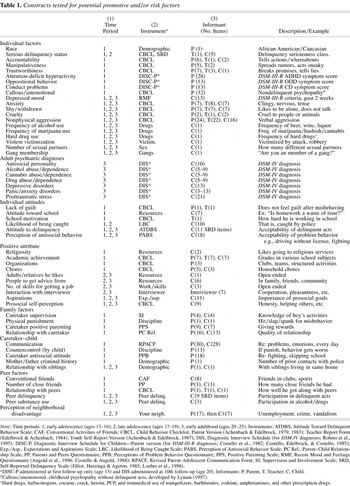
Constructs tested for potential promotive and/or risk factors
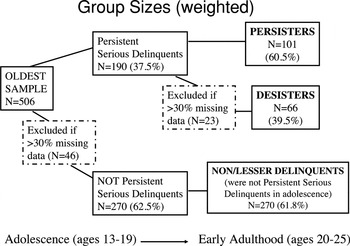
The group sizes (weighted).
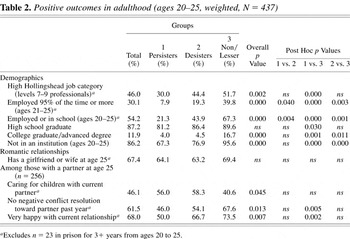
Positive outcomes in adulthood (ages 20–25, weighted, N = 437)
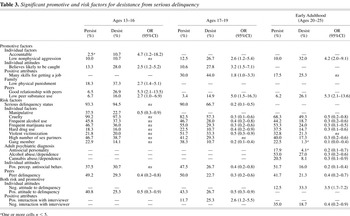
Significant promotive and risk factors for desistance from serious delinquency
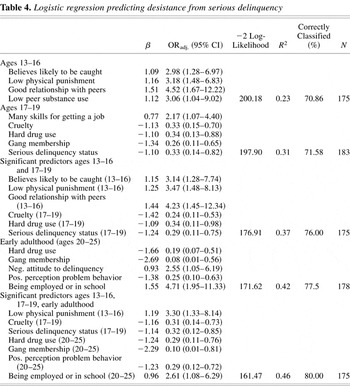
Logistic regression predicting desistance from serious delinquency
 You have
Access
- 139
- Cited by