

Introduction
Head and neck cancers (HNC) account for a global burden of more than 550,000 cases and 380,000 deaths annually. 1 It is the 6th most common cancer worldwide. In India it is emerging as a major public health problem due to its distinct demographic profile, food habits and lifestyle. In India HNC contributes one-third of total cancer burden. It is in contrast to the developed world where its incidence is 4–5%. This variation is mostly due to widespread tobacco addiction in India.Reference Shah, Sharma and D’Cruz 2 The majority of patients present in advanced stages of disease in which a multimodality approach is used for their treatment. If the tumour is operable, surgery is the primary treatment in HNC followed by adjuvant radiotherapy or chemo-radiotherapy depending on the presence of the high-risk features. In patients with locally advanced cancers, inaccessible tumours or for organ preservation, radical chemo-radiation or radiotherapy is only the treatment of choice.Reference Cognetti, Weber and Lai 3 HNC cause significant morbidity by involvement of vital structures involved in swallowing, speech, respiration and aesthetics of a person’s facial form, that may further worsen by surgical treatment.Reference Kulkarni 4 Hence precision radiotherapy is used to reduce treatment-related toxicities. We had previously published our data on the clinical outcomes for adaptive radiotherapy in HNC and also in elderly patients treated with modern radiotherapy techniques.Reference Kataria, Gupta and Bisht 5 – Reference Kataria, Gupta and Goyal 6 In this study, we have analysed the survival outcomes and toxicities experienced by non-metastatic (HNC) patients receiving modulated radiotherapy at our Institute.
Materials and Methods
Patient’s data were collected from the electronic hospital information system for consecutive patients from March 2010 till December 2014. All patients underwent pre-treatment evaluation including detailed history, general physical examination, dental examination/prophylaxis, diet counselling, baseline laboratory, radiological investigations [contrast-enhanced CT scan (CECT), MRI CXR, USG] and an incision biopsy. Positron emission tomography and endoscopic evaluation were carried out in selected cases. Patients were staged according to the TNM 7 staging system (AJCC Cancer Staging Manual, 7th edition).Reference Edge, Byrd, Compton, Fritz, Greene and Trotti 7 After a written and informed consent, all patients underwent mould room procedure by immobilisation in a thermoplastic S frame cast and thereafter CECT scan (initial scan) with 3-mm slice thickness. Intensity-modulated radiotherapy (IMRT) or volumetric-modulated arc therapy (VMAT) without simultaneous integrated boost (i.e., with a sequential schedule) was planned with conventional fractionation at 2 Gy/fraction to a dose of 60–70 Gy based upon the risk stratification. A simultaneous integrated boost was avoided as the gross tumour volume (GTV) was substantial in stages III–IV, that formed a large proportion of our study group and the patients were receiving concurrent chemotherapy as well. The incidence of acute mucositis is higher in concurrent chemo-radiation cases as well as there is a dose rate co-relation.
Plans were generated on CMS MONACO® v. 3.0 (Elekta®), Crewley, UK. Target volume and normal structures were delineated as per Grégoire V et al.Reference Grégoire, Levendag and Ang 8 – Reference Grégoire, Coche, Cosnard, Hamoir and Reychler 11 and Kataria et al.Reference Kataria, Gupta and Goyal 6 GTV for primary and lymph nodes were delineated as per clinical and radiological findings on simulation CT. The primary clinical target volume (CTV) was generated by expanding the GTV for primary tumour by 1·5–2 cm including all high-risk regions. The high-risk nodal CTV was contoured by expanding the GTV for lymph nodes by 1 cm, and the low-risk nodal CTV included the nodal levels at risk.Reference Grégoire, Levendag and Ang 8 – Reference Grégoire, Coche, Cosnard, Hamoir and Reychler 11 The planning target volume (PTV) was generated by giving a 5-mm expansion in all directions to CTVs. At the time of immobilisation, a wax bolus was prepared individually for T4 buccal mucosa cancers that involved the skin.
The treatment plans were verified and authorised after cross-sectional and dose–volume histogram analysis of the PTV and organs at risk. Radiation therapy was delivered by 6-MV photon beams on a linear accelerator (Elekta Synergy® or Elekta Infinity™). Patient alignment was checked on-line before treatment by using cone beam CT on the 1st day of radiotherapy and then subsequent verification done either daily or on a weekly basis.
Patients were treated by IMRT from March 2010 till August 2011 and VMAT was introduced in September 2011, after the commissioning and regulatory approval was undertaken. Subsequent to optimisation and gaining experience, HNC were planned with VMAT from November 2011 onwards. Radical radiotherapy dose ranged from 66 to 70 Gy in 33–35 fractions and in patients receiving adjuvant radiotherapy, the dose was 60–64 Gy over 30–32 fractions.
A dental, nutritional, auditory and swallowing evaluation was done before simulation and patient and the family/caregivers were appropriately counselled. Dietary intake was monitored by a dietician during the course of treatment. A diet of 2,500–3,000 kcal, 2-g protein/kg per day (to a maximum of 100 g/day) and 0·5 g fat/kg per day along with micronutrients was prescribed from the beginning of the treatment. Patients were offered symptomatic and supportive care in the form of intravenous fluids, parenteral nutrition, nasogastric (NG) tube or percutaneous endoscopic gastrostomy (PEG) as required before (especially for dysphagia at presentation-PEG), during and following the treatment. The requirement of PEG or NG tube was discussed and applied if the patient agreed (for the base of the tongue and hypopharyngeal cancers), before commencement of radiotherapy. Dental extraction if any, were performed 4–7 days before 1st day of radiation. The time between CT simulation and first treatment was 4–7 days (preferably 4 days to minimise any volume change from simulation to treatment).
Chemotherapy
Concurrent chemotherapy was administered to patients with ECOG performance status ≤2 who were planned for definitive chemo-radiation or in patients with positive margins or extracapsular disease, positivity in a single lymphnode or ≥2 lymphnode involvement based upon postoperative histopathology report.Reference Cooper, Pajak and Forastiere 12 – Reference Bernier, Domenge and Ozsahin 13 In total, 391 patients received chemotherapy or immunotherapy. Most commonly used agent was an injection of cisplatin (35 mg/m2) in 255/391 patients (65·2%). For patients with borderline serum creatinine level or glomerular filtration rate <50 ml/min an injection of carboplatin (AUC 2) was administered. Either of two agents was administered concurrently with radiation therapy, starting on D1, D8, D15, D22, D29, D36, D43. For patients with ECOG PS≤2 or age >70 years biological therapy with cetuximab or nimotuzumab were given concurrently as 200 mg/m2 iv weekly with a loading dose of 400 mg/m2 at 5–7days before starting radiotherapy.
Response, toxicity evaluation and survival
All the patients were reviewed weekly during treatment for assessing treatment-related toxicities using CTCAE version 4.0 criteria.Reference Eisenhauer, Therasse and Bogaerts 14 Patients on concurrent chemotherapy had their hemograms done twice a week and kidney functions once a week. In case the absolute neutrophil count was <1,500/cmm or serum creatinine and electrolytes were deranged, chemotherapy was deferred and only radiation was continued for such cases. Response was assessed 6–8 weeks after completion of treatment using the RECIST criteria 1.1.Reference Eisenhauer, Therasse and Bogaerts 14 Acute toxicities were graded according to the National Cancer Institute Common toxicity criteria version 4.0, especially highlighting oral pain, oral mucositis, dysphagia, dry mouth, skin changes and haematological parameters accounting for changes in blood counts. 15 Disease-free survival (DFS) and overall survival (OS) were estimated using Kaplan–Meier method.
Statistical analysis
All patient data were analysed for survival outcomes (primary endpoint) and radiation toxicities (secondary outcome). The statistical analysis was performed using SPSS version 20.0 and Kaplan–Meier method was used for calculation of 2 years and 3 years OS and DFS. Acute and late toxicity was recorded as per CTCAE version 4.0 criteria. 15 Patients who were lost to follow-up were censored.
Results
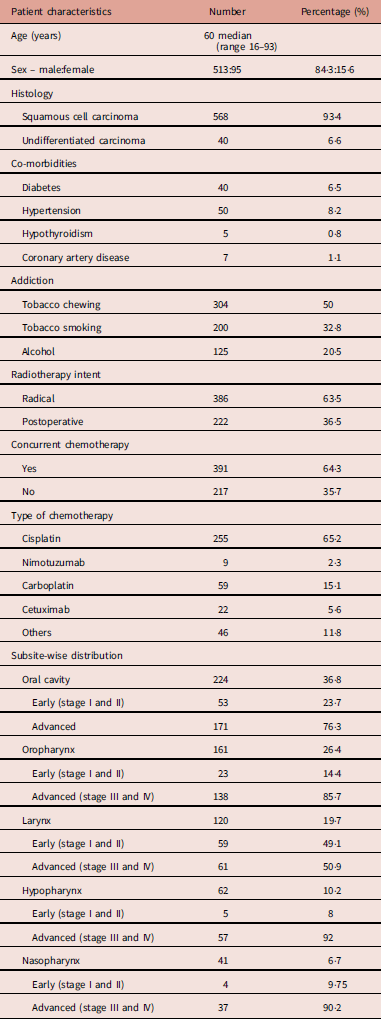
A total of 608 HNC patients were treated from March 2010 to December 2014. Age at presentation ranged from 16 to 93 years (median age 60 years). HNC was more prevalent in male population with male:female ratio 5·4:1. More than 80% patients received pre-treatment imaging using either a PET-CT or contrast-enhanced MRI of face and neck.
At our centre, the oral cavity was the most common site of involvement 224/608 (36·8%) followed by oropharynx 161/608 (26·4%), larynx 120/608 (19·7%), hypopharynx 62/608(10·2%) and lastly nasopharynx 41/608 (6·74%).
Around 144/608 (23·7%) patients presented in early stages of the disease (I and II) whereas remaining 464/608 (76·3%) were in locally advanced stages (III and IV). Out of the total 608 patients, 222 patients (36·5%) received postoperative radiotherapy and 386 patients (63·5%) received definitive chemo-radiotherapy or radiotherapy alone. Out of 391 patients who received concurrent chemotherapy, 65·2% (255/391) patients received concurrent weekly cisplatin, 15·1% (59/391) patients received weekly carboplatin, 5·6% patients received cetuximab and 2·3% (59/391) patients received nimotuzumab. In total, 241/391 patients (61·6%) received ≥5 cycles (Table 1).
Patient demographics

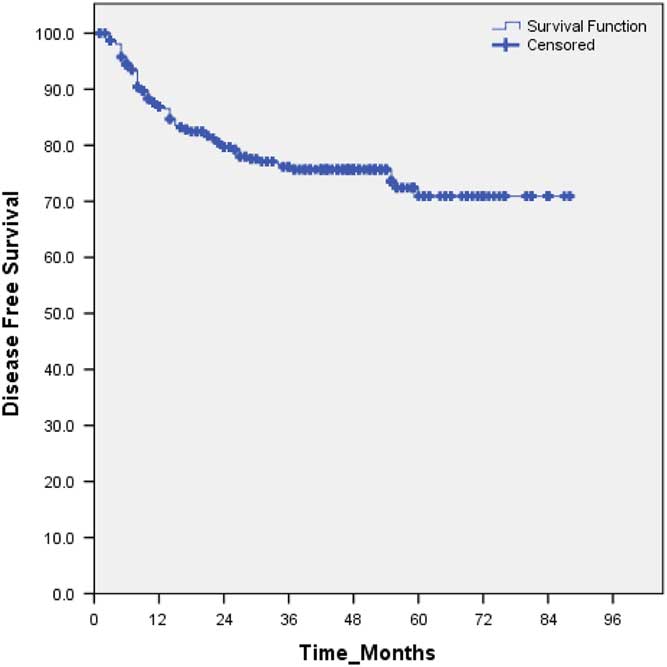
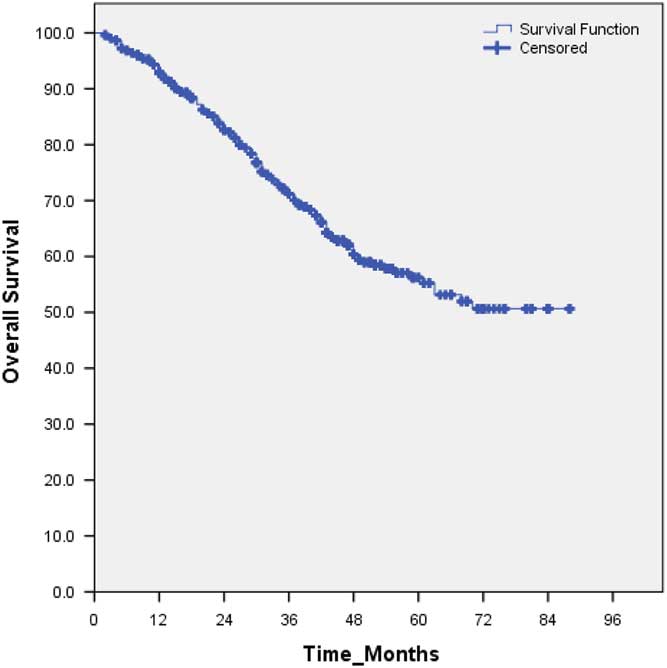
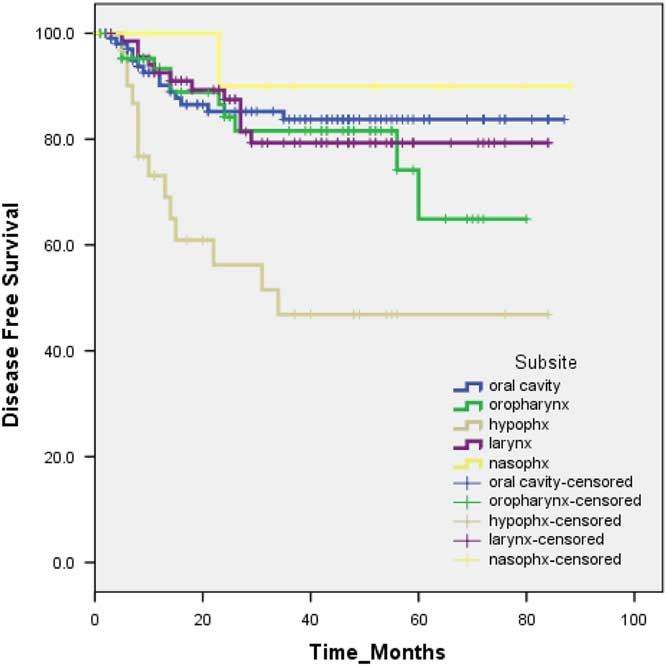
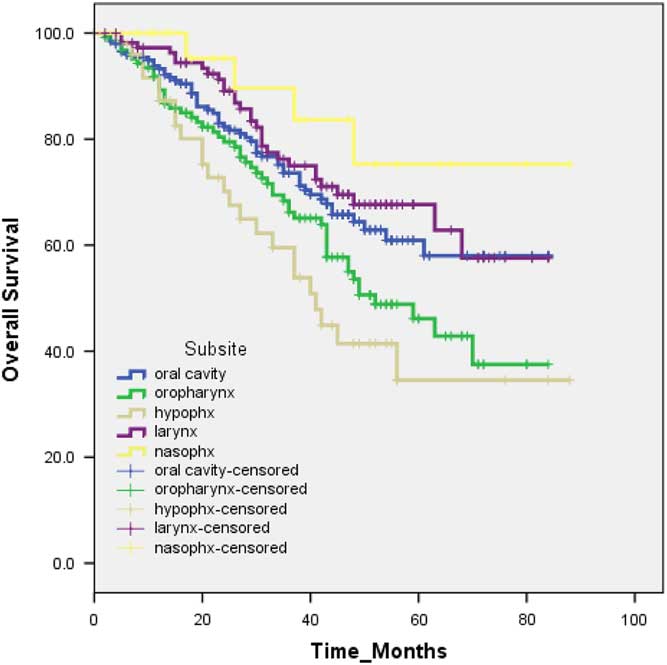
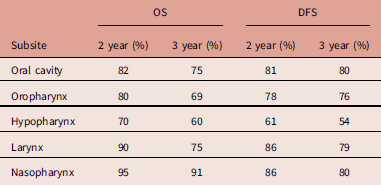
At last follow-up, 439 (72·2%) patients were alive, 169 (27·8%) patients were dead and 120 (24·6%) patients had recurrent disease. Out of 120 recurrent cases loco-regional recurrence, nodal recurrence and distant metastases were seen in 62 (51·7%), 25 (20·8%), 33 (27·5%), respectively. In the entire study cohort at 2 year follow-up, OS and DFS were 82% and 79% whereas at 3 year follow-up, OS and DFS were 70% and 75%, respectively (Figures 1 and 2). In terms of site of primary tumour, at 3 years follow-up, OS and DFS, nasopharyngeal cancer patients had the best outcomes (90 and 80%). At 3 years follow-up, OS and DFS in other sites were carcinoma larynx (75 and 79%), carcinoma oral cavity (75 and 80%) and oropharynx (69 and 76%). The worst outcomes were seen in hypopharyngeal primaries (60 and 54%) (Table 2, Figures 3 and 4).
Disease-free survival of entire study cohort.

Overall free survival of entire cohort.

Disease-free survival subsite specific.

Subsite specific overall survival.

Subsite-wise distribution of disease-free survival (DFS) and overall (OS) survival

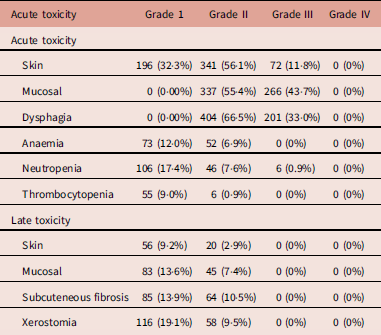
Acute toxicity was recorded as the maximum grade of toxicity observed during the treatment, while late toxicity was defined as effects observed after 6 months of completion of treatment. In total, 72/608 (11·8%) patients developed moist desquamation of the irradiated skin whereas 266/608 (43·7%) patients had grade III or higher mucositis and 201/608 patients (33·1%) had grade III or higher dysphagia that resolved within 2–4 weeks after treatment. In total, 6/608 (0·9%) of patients develop grade III neutropenia. Grade I xerostomia in 19·1% of patients, was the most commonly observed late toxicity. Other common late toxicities were mucositis and submucosal fibrosis with grade I severity. However, no late grade III or IV reactions were seen (Table 3).
Toxicity profile

Discussion
The HNC in India carry a major health burden with significant morbidity due to the disease itself and also due to treatment-related complications.Reference Shah, Sharma and D’Cruz 2 Fletcher and Evers first reported benefits of combining radiotherapy and surgery in 1970.Reference Fletcher and Evers 16 Conventional radiotherapy resulted in permanent xerostomia with its associated complications and poorly impacting on the patient’s quality of life (QOL).Reference Eisbruch, Rhodus and Rosenthal 17 – Reference Eisbruch, Ship and Martel 18 Dysphagia, a complication of head and neck radiotherapy also has devastating effect on QOL and can lead to life-threatening complications, such as aspiration pneumonia.Reference Hammerlid, Silander, Hornestam and Sullivan 19 – Reference Almi, Horowitz and Bedrin 21
IMRT/VMAT has the ability to sculpt the doses to targets thereby optimising the radiation delivery to irregularly shaped volumes. It is possible to produce concave distribution of dose in radiation treatment volumes.Reference Veldeman, Madani, Hulstaert, De Meerleer, Mareel and De Neve 22 – Reference Guerrero Urbano and Nutting 25 IMRT/VMAT has the advantages of (A) greater sparing of normal structures like salivary glands, mandible, pharyngeal constrictors, oesophagus, optic nerves, brainstem and spinal cord, (B) delivery of simultaneous integrated boost, (C) eliminates the need for multiple field matching. VMAT is an advanced form of IMRT, which delivers IMRT-like distributions in a single rotation of the gantry, varying the gantry speed and dose rate during delivery, in contrast to standard IMRT, which uses fixed gantry beams (step and shoot or dynamic MLC shaping).Reference Otto 26 – Reference Teoh, Clark, Wood, Whitaker and Nisbet 27 Planning studies using VMAT as a mode of delivering radiation therapy demonstrate shorter planning and treatment time, fewer monitor units for treatment delivery and better dose homogeneity and normal tissue sparing.Reference Vanetti, Clivio and Nicolini 28 – Reference Verbakel, Cuijpers, Hoffmans, Bieker, Slotman and Senan 29
This is a single institutional study to assess survival and toxicity profile in HNC following treatment with adjuvant or radical IMRT/VMAT in India. In our study, the median age at presentation of HNC is 60 years. This corresponds to the age data published in various population-based studies reporting that incidence of HNC increases with increasing age.Reference Dobrossy 30 – Reference Albano, Lumang-Salvador and Orosa 32 Tobacco chewing and smoking is the most common associated risk factor observed in HNC patients except the recent reporting of human papillomavirus associated oropharyngeal cancers which are seen more in a younger age group.Reference Chaturvedi, Engels and Pfeiffer 33 – Reference Gillison 34
In the present analysis around 77·8% patients had advanced disease status (stage III/IV) at presentation. There was a significant decline in 3 year OS with advancing stage from 97·9% in stage I to 62·1% in stage IV. This decline in treatment outcomes in locally advanced disease was either due to the tumour related factors like close margins to critical structures or involvement of infratemporal fossa, masticator space or the lymph nodes or due to the toxicities of multimodality treatment incorporating surgery, radiotherapy and chemotherapy. Our results were in accordance to the study published by Henrik et al., 2011. In this study of 127 locally advanced HNC patients treated by chemo-radiation (2DCRT+3DCRT) the 3 year OS was ~39%.Reference Hauswald, Simon, Hecht, Debus and Lindel 35 In a recent study by Norohna V et al., 2 year loco-regional control rate was 58·5% in once weekly cisplatin arm but in our study control rates are higher in comparison. One reason for this observation is a higher concurrent cisplatin weekly dose at 35 mg/m2 and another reason, in our study, we included patients with all stages of disease, although around 77·8% patients had advanced disease status (stage III/IV) in our study which may act as a confounding factor.Reference Noronha, Joshi and Patil 36
Different anatomical subsites have different survival outcomes. In our study, outcomes of nasopharyngeal cancers had the highest 2 year and 3 year OS whereas hypopharyngeal primaries had the worst survival outcomes. The results of the population-based cancer registry of England from year (2009–2013) showed carcinoma larynx had the best OS with 66·8% at 5 years and carcinoma hypopharynx had the worst 5 year OS 27·8%.Reference Muller, Belot and Morris 37 When compared with meta-analysis MACH-NC and MAC-NPC; 3 year OS in our study population is either comparable or even better in subsites of oral cavity, oropharynx, larynx and hypopharynx, respectively, 44·4, 41·1, 57·7, 39·5% for MACH-NC study versus 75, 69, 75, 60% in our study.Reference Blanchard, Baujat and Holostenco 38 – Reference Blanchard, Lee and Marguet 39
In the pre IMRT era the incidence of acute toxicity increased significantly with combination CRT as compared with RT alone. Grade III–IV toxicity was reported as high as 50% in terms of mucositis, dysphagia and dermatitis.Reference De Castro, Snitcovsky and Gebrim 40 However the late toxicities were usually under-reported, and apparently no difference between isolated radiotherapy and CRT except for the incidence of xerostomia was reported. In a multicentre randomised controlled trial (PARSPORT) by Nutting CM et al., 2011, xerostomia was the most common late side effect of radiotherapy in HNC patients seen in ~29% patients at 24 months undergoing modulated radiotherapy versus 83% patients undergoing conventional radiotherapy. Nutting’s study concluded that sparing the parotid gland with IMRT significantly reduces the incidence of xerostomia and leads to recovery of saliva secretion and improvement in associated quality of life thus strongly supporting IMRT in squamous cell histologies of HNC.Reference Nutting, Morden and Harrington 41 In our patient cohort xerostomia was the most common late effect of radiation therapy observed in19% patients at 2 years. We did not observe any delayed grade III or IV dermatitis, mucositis and dysphagia which is comparable with existing literature.
Conclusion
In our study, 2 years and 3 years OS and DFS rates are found comparable with the international data with acceptable toxicity profile with the use of modulated radiotherapy. It seems to be possible because of stringent departmental protocols and good medical physics support. Our data re-validates need and benefit of advanced radiotherapy techniques like IG-IMRT and VMAT for both postoperative and radical HNC treatment at the cost of minimal long-term side effects. Future stringent follow-up and QOL issues are being considered in a prospective manner. This is the largest study of HNC patients treated uniformly with modulated radiation therapy from Indian subcontinent.
Acknowledgements
The authors thank the entire team of Division of Radiation Oncology, Medanta, The Medicity.