One of the most testing challenges facing Da Ponte as he worked on Le nozze di Figaro was how to order Act 3. Up to that point, he had been able to follow Beaumarchais quite closely, but now it was necessary to make sense of the series of interlocking intrigues which characterize La folle journée as the ‘crazy day’ approaches its final hours. A great deal happens in a short space of time after the plan to cross-dress Cherubino to entrap the Count has to be abandoned. Setting in motion a new deception, the Countess instructs Susanna to agree to an assignation to which she intends to go herself in disguise. There is a subplot involving Cherubino and Barbarina, while the comic centrepiece is the discovery that Marcellina is Figaro's mother. Adding further to the complexity of the task, Da Ponte had to identify two locations in which arias for the Count and Countess could be inserted. Beaumarchais had included a soliloquy for Almaviva in which he expresses his perplexity at the turn of events, but there is no equivalent moment for his wife to reflect on her failing marriage. All these strands had to be interwoven in the scenes leading up to the Act 3 finale, in which the public festivities for the double wedding conceal undercurrents of the new plot against the Count.
In 1965, Robert Moberly and Christopher Raeburn published an article which gave voice to the general feeling that Da Ponte had failed to construct an effective sequence: ‘[Act 3] somehow seems inferior to the preceding acts […]. Commentators nearly always argue that there are too many loose ends, too many unrelated comings and goings.’Footnote 1 In questioning its coherence, they drew attention to aspects of its chronology, especially an unexplained element in the new intrigue against the Count: why Susanna delays for so long before informing her mistress of the outcome of the meeting. They suggested that there was a late change of plan, an unforeseen consequence of the double casting of Francesco Bussani as Bartolo and Antonio. In the order originally envisaged, he would have had to be onstage as the former in one scene (Act 3, scene v) and then come on immediately as the latter in the next (scene viii; see Table 1). As this would have required an impossibly fast change of costume, something had to be interposed, and the decision was taken to transfer the Countess's aria and another short recitative from an earlier location to provide two scenes (Act 3, scenes vi and vii) during which he would have time to change. This ingenious theory was taken seriously, and a consensus began to develop that the hypothetical first order, irrespective of its historical status, makes for a more coherent dramatic structure.Footnote 2

When the article appeared in 1965, the autograph of Act 3 was unavailable for study. Only in 1977 was it retrieved from the secret location in which it had been preserved during the Second World War, its re-emergence in the Biblioteka Jagiellońska in Cracow sparking some interest as to whether evidence for the proposed reordering would come to light.Footnote 3 Alan Tyson, by then a leading authority on Mozart's autographs, investigated this question with scrupulous attention to detail. It did not seem to him likely that major clues would be discovered, if only because nineteenth-century editors had seen ‘nothing to arouse their suspicion that the third act had been rearranged at a late stage’.Footnote 4 Nevertheless, it was certainly not out of the question that seemingly insignificant palaeographical traces might have been overlooked by earlier investigators who knew nothing of this hypothesis. Tyson failed to find any hints of this kind and indeed his examination pointed firmly in the direction of the traditional order. In the autograph, the recitative ‘È decisa la lite’ (leading to the sestetto) is positioned after ‘Vedrò mentr'io’ through its continuity instruction ‘dopo l'aria del Conte’. Even though there seemed to be no residual indications of any Moberly–Raeburn reshuffle, Tyson acknowledged that his investigation did not disprove their hypothesis – it merely failed to provide any corroboration for it.
An opportunity to re-examine the matter came several years later, following Dexter Edge's discovery of the original orchestral parts in Vienna.Footnote 5 After a careful examination, he concluded that they too offer ‘no support for the theory of a change in the order of the third act’.Footnote 6 The physical structure of the first-desk violin 1 part, for example, demonstrates that the Countess's aria must have been placed after the sestetto, as the two pieces share (unbroken) bifolia. In all the parts, the regularity of the gathering structure points to ‘Dove sono’ always having been where it is now. Nothing has emerged since then to contradict this assessment, and in the musicological introduction to the recently published facsimile of the opera, Edge reiterates his original conclusion: ‘None of the earliest sources for the opera […] lends any compelling support to the notion of a late revision in the ordering of Act III.’Footnote 7 Yet while a last-minute shuffle in response to an unforeseen problem of casting now seems unlikely, an absolute refutation of the underlying idea remains elusive. Given the complexity of the plot, it is highly likely that changes of mind earlier in the compositional process, especially over ordering, occurred. Even with its non-proven status, the Moberly–Raeburn hypothesis remains influential in practice and it is not infrequently adopted faute de mieux, as John Eliot Gardiner, one of several conductors to prefer this order, put it.Footnote 8
In this article, I shall propose a different explanation for the survival of awkward junctures in Act 3: that the primary difficulty facing Da Ponte was how to manage the interaction between Susanna and the Countess; and that the most problematic piece to locate was ‘Che soave zeffiretto’. As we shall see, the organization of Act 3 was not just a technical matter of coherent plotting; it went to the very heart of how Da Ponte and Mozart viewed the developing relationship between the two women. The survival of a significant number of sources of their duettino as it was being developed allows for an unusually detailed investigation into the working partnership between poet and composer. The beauty of the music goes without saying, but there are indications that this was one of those occasions on which Da Ponte felt it necessary to urge upon Mozart the vis comica – the power of comedy.
Before scrutinizing the early sources of the opera, it will be helpful to summarize how this strand of the plot develops in the original play. Beaumarchais provided Mozart with a wonderful imbroglio for the Act 2 finale, but this splendid climax is followed by a quieter postlude in which the Countess and Suzanne reflect on what they have just witnessed and its implications for their designs on the Count. The section of La folle journée which concerns us thus runs from this point at the end of Act 2 through to the letter scene in Act 4. The dealings between the two women during this sequence are summarized in Table 2. Setting the new plan in motion requires a good deal of interaction between the two women: (1) they first have to agree the details of their new initiative; (2) Suzanne then approaches the Count to indicate that she will accede to his demands; (3) the results of this meeting are communicated back to the Countess; and (4) she instructs her maid to write a letter proposing a specific time for the assignation. While all this is going on, Suzanne is also required to play a part in the comic scene following the trial. That she enters with a dowry obtained from the Countess posed a dilemma: how to manage the sequence of onstage and presumed offstage meetings between maid and mistress.Footnote 9
| Act, scene | Interaction between Countess and Suzanne |
|---|---|
| 2, xxiv | Following the failure of the plan for Chérubin to take part in an assignation with her husband, the Countess comes up with a new idea: she will go in disguise herself. Suzanne must therefore see the Count to let him know that she will agree to his proposition. |
| 2, xxv | Alone, the Countess muses on her plan. Her thoughts turn unbidden to Chérubin. She cannot bear to be parted from his ribbon, but she wonders what she is getting into. |
| 2, xxvi | Suzanne returns with a mask for use in the forthcoming deception. The Countess requests her not to tell Figaro about the new plot. |
| 3, ix | Suzanne meets the Count, who is adamant: in the absence of an assignation, there will be no dowry for her and thus no marriage. Suzanne agrees to a meeting and the Count leaves. She must now tell the Countess. |
| 3, xvii | Following the revelation of Figaro's parentage, Suzanne rushes in with enough money to pay his debt, unaware that it is no longer necessary. This is the dowry promised by the Countess. |
| 3, xviii | Learning the happy truth, Suzanne tosses down her purse of money. Now Figaro (and she) will in effect enjoy two dowries: the write-off of his debt as well as this gift from her mistress. |
| 4, i | Figaro urges Suzanne not to turn up at the assignation, not knowing that the Countess has already decided to take her place. |
| 4, ii | The Countess enters and informs Figaro that everyone is waiting for him. As he leaves, she holds Suzanne back for a moment. |
| 4, iii | A brief misunderstanding ensues, following Suzanne's admission that Figaro has asked her not to take part in the new plot. The Countess suspects that she is being deceived, but almost instantly realizes that she is mistaken about this. With Suzanne's good faith restored, she instructs her to write to the Count naming a time and place for the meeting. She dictates a cryptic letter which both women are certain will be understood: ‘a new song to this tune: How fine it will be tonight beneath the tall chestnut trees’. |
The chronology of the dealings between the two women remained a problem throughout the period of composition. The crux of the difficulty was their meeting scene. There is some evidence to suggest that it was first positioned early in the act before being moved to its current location, as shown in Table 3. The ongoing attempts to come up with a workable order, both for this piece and for the Countess's scena, left clear traces in the autograph and the Italian libretto.Footnote 10 An important and underused third source of evidence is the German prose translation on sale at the première on 1 May 1786.Footnote 11 It must predate the first performance by at least a day or two, and perhaps as much as a week. Its independent readings, often associated with stage directions, may represent ideas rejected before the Italian libretto was printed or, conversely, ideas adopted too late to be included.Footnote 12 Analysis of the manner in which Mozart changed scene numbers is a useful tool for investigating compositional history. This category of evidence offers little support for the idea that the structure of the drama was settled before he started work. Da Ponte later recalled a parallel process: ‘I therefore set to work, and as I wrote the words, so he set them to music.’Footnote 13 In Act 2, a decision to add an extra scene at the start led to alterations to the numbering of several ensembles already composed: the terzetto ‘Susanna or via sortite’ went from scene ii to scene iii; the duettino ‘Aprite’ from scene iii to scene iv; and the start of the finale from scene v to scene vi.Footnote 14 On the other hand, no changes were made to numbers added to the recitatives, which were evidently not copied until the order was fixed.Footnote 15

As work on Act 3 progressed, a decision was taken that a scene should be added to its first section. Ensembles composed before this change of plan similarly ended up with wrong numbers, written in the ink of their initial particella.Footnote 16 The misnumbering of ‘Crudel! perchè finora?’ (as scene i) and ‘Riconosci in questo amplesso’ (as scene iii) is shown in Table 4. The Count's solo scene was incorporated only after this change and is thus correctly numbered. The reason for the decision to include a scene for the Countess early in Act 3 is that she has to set in motion the new intrigue against her husband.

The legacy of the changes made to the ordering of the first part of Act 3 lies above all in inconsistencies in the stage directions and continuity instructions. Details relating to Act 3, scene i are given in Table 5. In the Italian libretto, the throne room in Act 3 of La folle journée is conflated with the gallery nominated for the Act 4 celebrations. The German translation omits reference both to the thrones and to the wedding preparations.
| Italian libretto | German translation | Autograph |
|---|---|---|
| Sala ricca, con due troni e preparata a sena nuziale | Ein sehr prächtiger Saal | |
| Il Conte solo che passeggia | Der Graf allein, der auf und abgehet | Il Conte solo che passeggia |
This was straightforward enough, but in Act 3, scene ii the dramatic apparatus had to cope with a more elaborate piece of stage business when the Countess and Susanna enter. The Count is too preoccupied with his continuing soliloquy to notice them, and the two women are similarly engrossed in their conversation. There are significant differences in the primary sources, as shown in Table 6. In the German translation, the stage instruction for the two women to remain out of sight of the Count is placed after the opening words, rather than at the head of the scene. When it is time for the Countess to withdraw, both the translation and the autograph give the surprising instruction for her to hide. As Susanna approaches the Count, she overhears his threat to make Figaro ‘marry the old woman’ (‘sposar la vecchia’) and she cannot stop herself from exclaiming ‘Marcellina!’ Because the Count is not supposed to hear this, it is set as an aside, but the Italian libretto omits the brackets as well as the exclamation mark. On the other hand, it alone has the direction ‘seriously’ when the Count asks what Susanna wants. This is curious, as his previous comments have scarcely been flippant. Indeed, his grave demeanour directly contradicts that specified by Beaumarchais (Act 3, scene ix), who has Suzanne out of breath (‘essoufflée’) and the Count addressing her with humour (‘avec humeur’). A final disagreement among the sources comes at the end of the scene, after the duettino. In Beaumarchais, the Count's triumphant claim to have achieved success with Suzanne (‘Elle est à moi’) is marked as an aside with no indication that she hears it. The German translation – the only source of the opera to have a stage direction here – appears to indicate that this remark does register with Susanna.
| Italian libretto | German translation | Autograph |
|---|---|---|
| Il sudetto, la Contessa, e Susanna. S'arrestano in fondo alla scena, non vedute dal Conte | Der Graf, die Gräfin, und Susanna | Il sudetto. La Contessa, e la Susanna in fondo |
| (Sie bleiben in der Tiefe des Zimmers stehen, und werden von dem Gr. nicht gesehen.) | ||
| (verbirgt sich) | |:si nasconde:| | |
| Sus. Marcellina … | (Marzellina!) | |:Marcellina!:| |
| Il Con. Serio | ||
| (für sich aber Sus. bleibt rückwärts stehen, und hört ihn zu) |
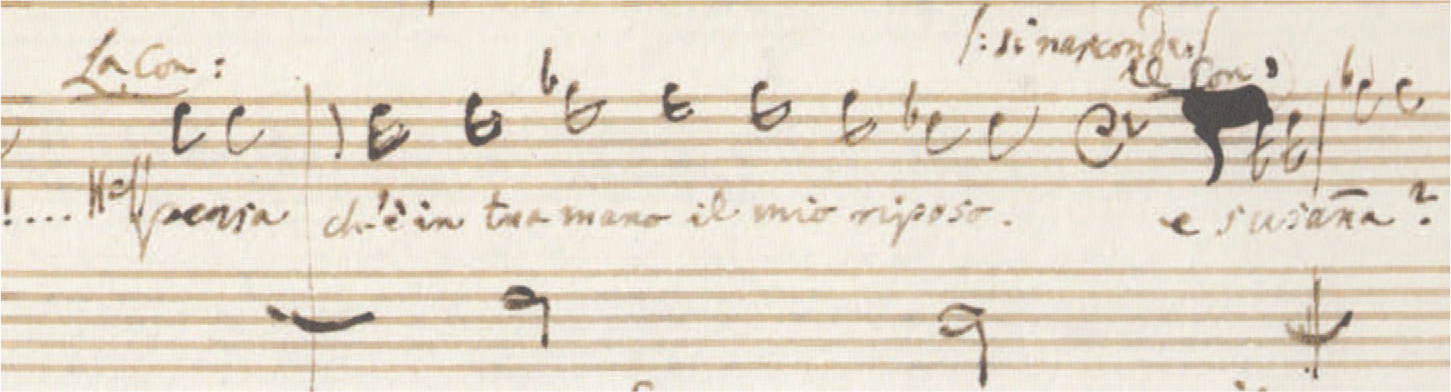
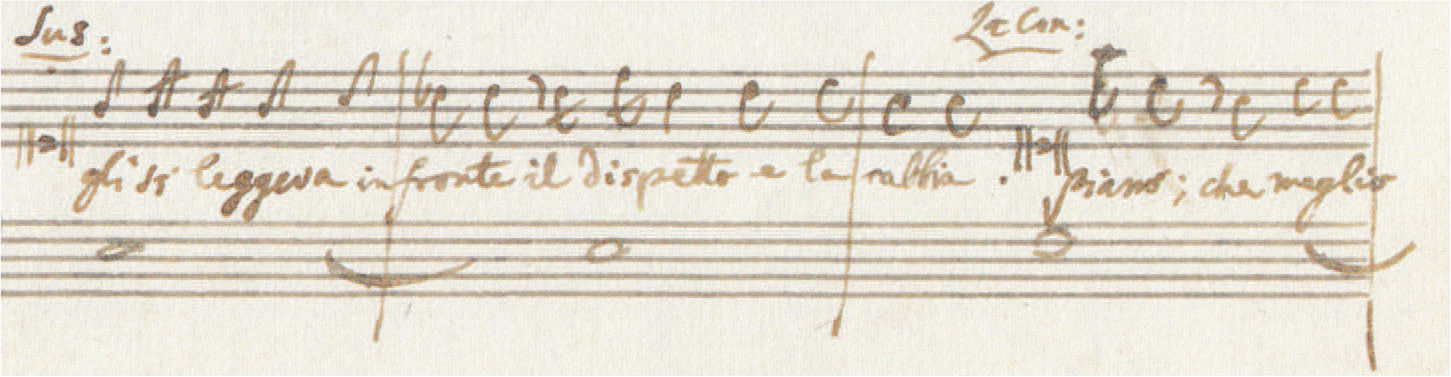
The puzzling direction for the Countess to hide (see Figure 1) would make better sense if ‘Che soave zeffiretto’ were to follow the opening duettino. Such an instruction – there are quite a few in Figaro – usually implies that the concealed character will re-emerge. In Act 1, scene v, Cherubino hides (‘si nasconde dietro la sedia’), and he is followed by the Count (‘Il Conte vuol nascondersi dietro il sedile’). In Act 2, scene iii, Susanna hides (‘Susanna si nasconde entro l'alcova’), while in Act 4, scene ix, it is the Countess who conceals herself (‘si nasconde’). This is not the equivalent of requiring an exit from the stage, for which ‘parte’ was the standard indication. The re-entry is often dramatic if the character in hiding has overheard something not intended for their ears. In the sequence of events finally chosen for Act 3, the Countess does not return for a considerable time and she can hardly still be in hiding. The oversight thus appears to be a survivor from an earlier conception in which she conceals herself in order to observe her husband's encounter with Susanna.
The Act 3 autograph of Le nozze di Figaro, p. 336 (page numbers refer to the facsimile). Detail showing the stage instruction for the Countess to hide in the recitative ‘Via fatti core’. Reproduced with permission from the Biblioteka Jagiellońska, Cracow.

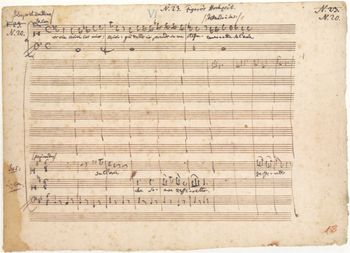
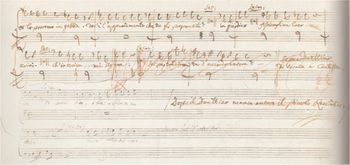
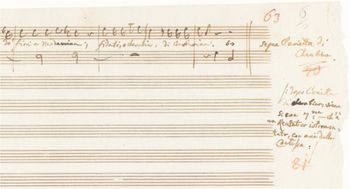
In such a sequence, any report from Susanna would be superfluous. Once the Count has left, his wife emerges from her hiding place intent on setting the new plot in motion without delay. This is what seems to happen in an autograph version of a small recitative leading into ‘Che soave zeffiretto’ which was put to one side.Footnote 17 The original layer of this very revealing sheet is in Mozart's formal hand. There is no scene indication, but a continuity instruction ‘after the duettino’ (‘|:Dopo il Duettino:|’) is supplied. Three bars of recitative, ‘Or via scrivi cor mio’ (‘Write, my heart, write!’), connect to the first six bars of a particella of ‘Che soave zeffiretto’ (see Figure 2). The incorporation of a passage of secco recitative at the head of a full score of an aria or ensemble was unusual, but could occur if the clear demarcation between the text of a recitative and that of a concerted piece was blurred. Here, it is because the dictation gets under way before the start of the duettino. The opening words of the recitative act as a neat foil to the Count's earlier demand: ‘Susanna or via sortite, sortite io così vo’ (‘Susanna come out! I order you to come out’). Whereas the Count is brusque, using the formal pronoun and repeating the order directly, the Countess is more relaxed, addressing her maid with noteworthy familiarity as ‘cor mio’.
The autograph of an abandoned recitative, ‘Or via scrivi cor mio’, leading into six bars of a particella of ‘Che soave zeffiretto’ and continuing with a sketch. Reproduced with permission from Salzburg, Internationale Stiftung Mozarteum, Bibliotheca Mozartiana: Autogr 492-1. (The verso is shown in Figure 13.)

Previous discussions of this sheet have assumed that it was intended for use where ‘Che soave zeffiretto’ was eventually positioned, notwithstanding the continuity instruction at its head. Tyson, rejecting the possibility of a lost duettino, argued that this stray page was once part of a bifolium, attached to the single sheet in the autograph preceding ‘Che soave zeffiretto’.Footnote 18 Although not itself paginated, the abandoned page would represent the missing numbers in the sequence, 83–4 (red crayon) and 416–17 (pencil). For this theory to work, one would have to assume that Mozart wrote ‘Dopo il Duettino’ at the top left-hand corner, but then for some reason failed to cancel it when he worked on the recitative as a precursor to the duettino. Tyson's belief that ‘Or via scrivi cor mio’ was a new ending to ‘Cosa mi narri?’ has not been questioned.Footnote 19 At first sight, this is a very logical assumption, as the rejected fragment contains subject matter – the command to start writing – cancelled in the main autograph, but the layout at the head of the sheet remains a problem, because the inclusion of both a time signature and a continuity instruction seems to indicate that it was envisaged as a complete, albeit short, piece.Footnote 20 As a follow-on to ‘Crudel! perchè finora?’, it would place the elements of the new conspiracy to trap the Count directly in sequence. This is not how Beaumarchais arranged the plot, but following the decision to axe the trial scene, a major reorganization was inevitable anyway.Footnote 21
Once the decision had been taken not to place ‘Che soave zeffiretto’ here, Da Ponte was able to revert to the dialogue as in Beaumarchais, but the result was not entirely satisfactory, because it failed to take account of the fact that ‘Crudel! perchè finora?’ functions musically as a quasi-seduction duet, decisively resolving the issue of trust, at least as far as the Count is concerned. Da Ponte's reliance on the text of the play is shown in Table 7. Missing in Beaumarchais but required on musical grounds at the climax of the duettino are the Count's mellifluous expressions of joy (‘Mi sento dal contento / Pieno di gioia il cor’). The prolongation of the scene in ‘E perchè fosti meco’, in which he continues to quiz Susanna until he is reassured that she is sincere, is more effective in the play than in the opera.Footnote 22
| Character | French text | Libretto | Italian text |
|---|---|---|---|
| Suzanne | Et n'est pas mon devoir d’écouter son Excellence. | last line of recitative | E quel di sua eccellenza è il mio volere. |
| Le Comte | Pourquoi donc, cruelle fille! ne me l'avoir pas dit plutôt? | duettino | Crudel! perchè finora? |
| Suzanne | Est-il jamais trop tard pour dire la verité? | ||
| Le Comte | Tu te rendrais sur la brune au jardin? | ||
| Suzanne | Est-ce que je ne m'y promène pas tous les soirs? | ||
| Le Comte | Tu m'as traité ce matin si durement! | first line of recitative | E perchè fosti meco / stammatina si austera? |
In Act 3, scene iii, the Count embarks upon his tirade, but before this a potentially awkward piece of stage business had to be managed: a series of rapid entries and exits, with Figaro coming in for a few seconds to hear Susanna's claim of victory, only for the two of them to leave immediately, allowing the Count (who in turn has heard the remark) to work himself up into a fury. This is achieved in the three-bar recitative ‘Ehi Susanna ove vai’, which in the autograph is copied directly after ‘E perchè fosti meco’ on the recto of a single leaf. It is labelled ‘Scena III’. In K.T.315, the Court Theatre score of Acts 3 and 4, ‘Scena 3za’ was instead inserted at the head of the first of this pair of recitatives, even though neither character leaves the stage following the conclusion of the duettino.Footnote 23 In the autograph there is a small inconsistency at the end of ‘Ehi Susanna ove vai’, where there is a tie sign below the final semibreve in the bass line (see Figure 3). The Count's accompagnato (started on a new sheet) begins with a rest in the bass line, rendering the tie redundant.Footnote 24
The Act 3 autograph of Le nozze di Figaro, p. 349. Detail showing the tie in the bass line at the end of the recitative ‘Ehi Susan[n]a ove vai’. Reproduced with permission from the Biblioteka Jagiellońska, Cracow.

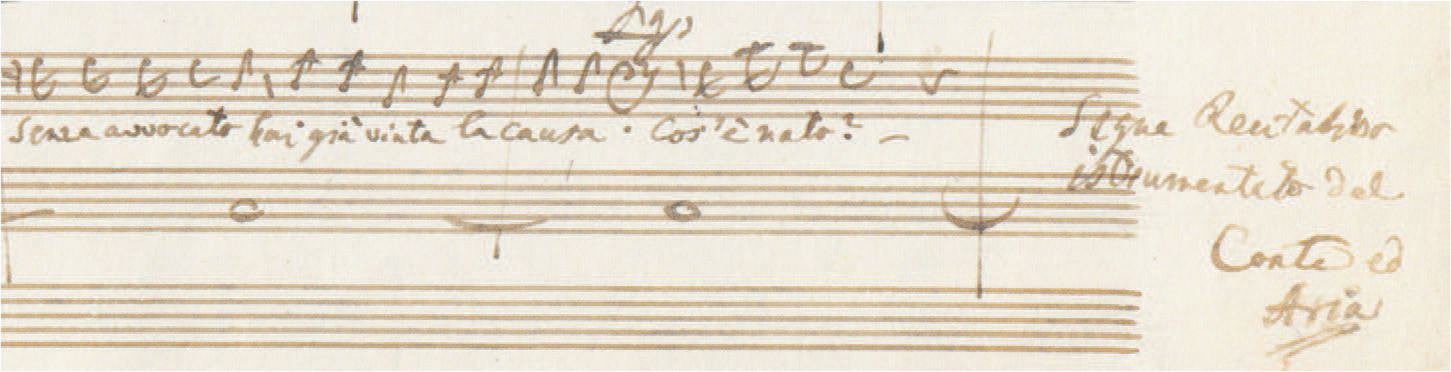
In La folle journée, the stage instructions for this encounter are unambiguous: after his meeting with Suzanne (Act 3, scene ix), the Count rushes out (‘Il s'enfuit’); she indicates that she must hasten to tell the Countess; she is met by Figaro (Act 3, scene x), who wants to know where she is going; she reports her success before leaving (‘Elle s'enfuit’); Figaro (Act 3, scene xi) follows her (‘la suit’); the Count re-enters alone (‘rentre seul’), having overheard Suzanne's crucial claim. The directions for this quick-moving sequence in the opera are given in Table 8. The entry of a character into a new scene, however briefly postponed, would usually be represented in a stage direction simply by ‘poi’. At the end of Act 3, scene ii, the Italian libretto does not specify what the Count should do, and his ‘reappearance’ to overhear Susanna's claim to have won the case without the help of a lawyer (‘senza avvocato / hai già vinta la causa’) is heralded in the autograph (at the beginning of scene iv in the NMA, which allocates a separate number to the Count's soliloquy ‘Hai già vinta) by the use, unorthodox in a continuity direction, of the musical term ‘subito’: ‘Fig. Susan[n]a, e subito il Conte’ (see Figure 4). The German translation follows this reading, rendering ‘subito’ as ‘gleich’.
The Act 3 autograph of Le nozze di Figaro, p. 349. Detail showing the use of ‘subito’ in the heading for scene iii. Reproduced with permission from the Biblioteka Jagiellońska, Cracow.

| Italian libretto | German translation | Autograph |
|---|---|---|
| Figaro, la Susanna, e il Conte | Figaro, Susanna und gleich darauf der Graf. | Fig. Susan[n]a, e subito il Conte |
| (entra) | (gehet ab) | |
| (la segue) | (folgt ihr nach) |
These minor but accumulating inconsistencies point to an inescapable conclusion: that the ordering of the first part of Act 3 remained in a state of flux until quite late in the compositional process. Assisted by the fact that the plot at this juncture consists of a series of interlocking strands rather than a single chronological progression, there were several sharp twists to the kaleidoscope of possible orders. Until the sequence was settled, it was prudent to leave some matters undecided. The duettino ‘Crudel! perchè finora?’, for example, was at first left incomplete – the ending was eventually added, using the remaining space and an additional sheet of the late paper (Type 82).Footnote 25 In the case of an aria, a delay in the copying of its conclusion could facilitate revisions to the climax requested by a singer. The uncertain factor with regard to ‘Crudel! perchè finora?’ was perhaps that a decision had yet to be taken as to whether one or both of its singers should exit.
The comic centrepiece of Act 3, the sestetto ‘Riconosci in questo amplesso’, brought the problem of chronology caused by the postponement of the letter scene to a head. Mozart would probably not have wanted to tamper with this wonderful ensemble, reputedly one of his favourite pieces, but the appearance of Susanna with her dowry introduces a conundrum: she must have met her mistress in order to obtain the money, but cannot have done so as she has not yet made her report. The framing recitatives both show signs of late revision. The new phase of the plot dealing with the aftermath of the trial is set in motion by ‘È decisa la lite’. Written on a single sheet of the late paper (Type 82) headed ‘Scena IV’, it leads into the previously composed sestetto marked (now erroneously) ‘Scena III’.Footnote 26 At this point in the autograph, the red-crayon pagination continues unbroken, but two numbers in the pencil pagination (370 and 371) are missing. In the similar case before ‘Che soave zeffiretto’, there is a gap in both sequences, as shown in Table 9. Clearly a sheet was removed after ‘Io vi dico’ – quite possibly a bifolium, as the page on which the recitative is written may itself have been a replacement. The red crayon used to write 81 and 82 has more definition than that in the surrounding numbers, while the pencil 414 and 415 marks are fainter than the ones in the sequence on either side.Footnote 27 The inconsistent numbering before the sestetto could be accounted for if the first sheet only of a bifolium had been used when the pencil sequence was put in. When this page was discarded, the remaining blank (but numbered) page would have been available for the revised version. If this is the explanation, then the red-crayon numbers, perhaps the whole sequence, must have been added at a later time.

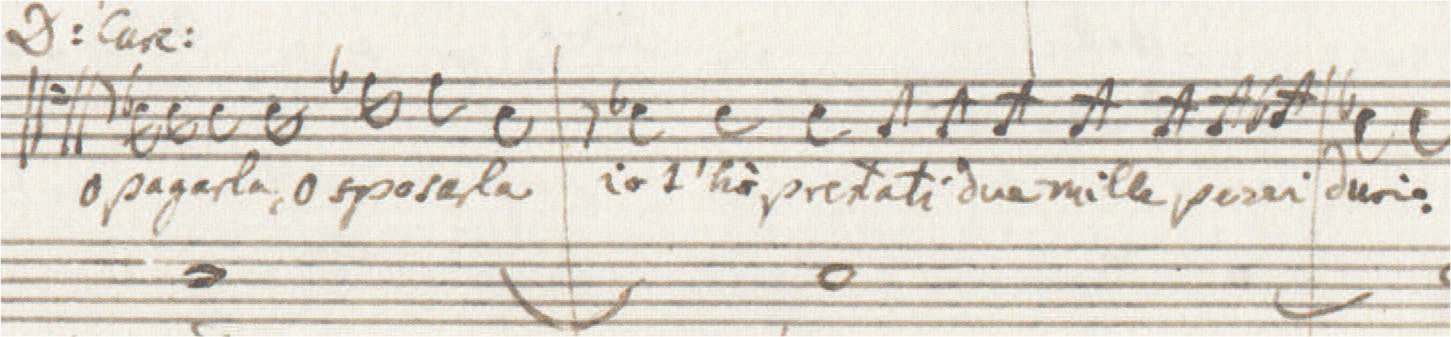
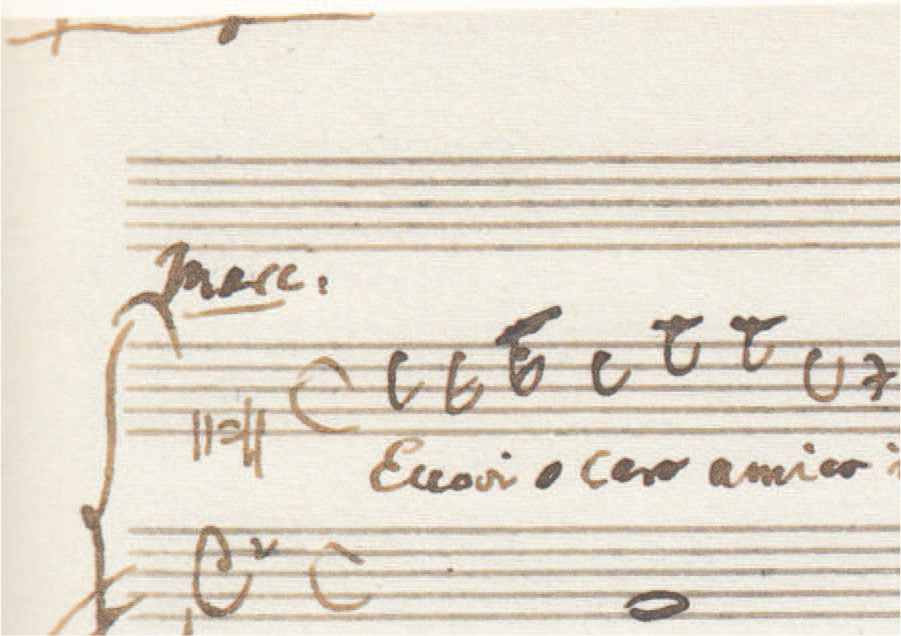
An unusual mistake suggests that Mozart may have recopied this recitative. In the libretto, the phrase ‘I lent you two thousand pieces of silver’ (‘Io t'hò prestati / Due mila pezzi duri’) is attributed to Marcellina.Footnote 28 The composer, however, set these words as a continuation of Don Curzio's judgment, but without the grammatical revision necessary for a third-person observation: ‘She lent you […]’ (‘Lei t'ha […]’) (see Figure 5). In K.T.315, this was corrected by adding a new part label and clef and by transposing the musical line up an octave. The part label (‘Marc.’) could have been omitted from the draft libretto, although it was unusual for Mozart (the composer) not to spot this kind of error. But no one is immune from making certain types of slip which are characteristic of the act of copying itself, when the gaze is repeatedly transferred from original to new version.Footnote 29 If he was making use of a pre-existing draft, Mozart (the copyist) would occasionally make a surprising error.Footnote 30
The Act 3 autograph of Le nozze di Figaro, p. 373. Detail showing Don Curzio (rather than Marcellina) referring to the dowry in the recitative ‘È decisa la lite’. Reproduced with permission from the Biblioteka Jagiellońska, Cracow.

That there may have been a change of plan following the sestetto is suggested by the inaccurate stage direction ‘parte’ in the Italian libretto, which seems to indicate that only one character should leave, without specifying which. A misunderstanding of one of the standard abbreviations ‘par.’ or ‘part.’ is possible, but if the intended direction was ‘partono’, then everyone was to leave, as would have happened if the next piece was to be the Countess's solo scena. The German translation supplied the correct instruction that the Count and Don Curzio are the only ones to go: ‘(Der Gr. und D. Curz gehen ab.)’. This alternative location for ‘E Susan[n]a non vien! / Dove sono’ may have been under consideration, but a potentially decisive piece of evidence was destroyed when its continuity instruction in K.T.315 (‘Segue Scena / della Contessa’) was written over something else comprehensively scratched out. If this mandated a different continuation, then clearly the Countess's scena must have been incorporated from elsewhere.
At the start of ‘Eccovi, o caro amico’, the recitative following the sestetto, the changing ink colours and the alterations to the barring in bars 4–5 suggest that the writing process was at least briefly rather disjointed. In bar 12, there are signs of a change of plan. During the course of his career, Mozart wrote many hundreds of recitative phrases ending with the characteristic pair of stressed/unstressed quavers. He did so with the previous phrase sung by Figaro which ends ‘[og]-nora’, but this together with Susanna's response results in a bar with four and a half beats. An attempt was made to rectify the error by turning Figaro's final quaver into a semiquaver, but because the semiquaver rest separating the two phrases was not cancelled, the bar was still a quarter of a beat too long. Later, pencil strokes were added above the stave to clarify the beat divisions (see Figure 6).Footnote 31 This type of error characterizes the reworking of pre-existing material. Susanna's words ‘Voliamo ad informar d'ogni avventura Madama’ (‘Let us go and tell my lady all this’) may originally have been intended to start a recitative before being added as the continuation of a new beginning.Footnote 32
The Act 3 autograph of Le nozze di Figaro, p. 395. Detail showing a bar of four and a quarter beats in the recitative ‘Eccovi, o caro amico’ with partial pencil clarifications. Reproduced with permission from the Biblioteka Jagiellońska, Cracow.

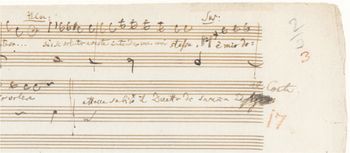
As this comment would be better addressed to Figaro alone (there being no particular reason why Marcellina and Bartolo should tag along to see the Countess), it is conceivable that a duet for the two lovers was to have come here. A tiny clue that this may have been considered is the trimmed continuity instruction at the head of this recitative (see Figure 7). One might expect it to read ‘dopo il sestetto’. The descending streamer of the ‘p’ of ‘dopo’ is where it should be, but further on is what appears to be the lower loop of a ‘g’ or an ‘f’. Of all the character names and genre titles that might appear, only ‘Figaro’ has either letter. An aria is unlikely, but a duet would represent the important scene between Suzanne and Figaro at the start of Act 4 of La folle journée. This encounter was by no means an inevitable casualty of Da Ponte's efforts to abbreviate and simplify the play. Figaro begins by asking his bride-to-be if she is now happy (‘Hé bien! amour, es-tu contente?’), and the scene ends with a theatrical cliché in which two lovers argue over the degree of their love, almost to the point of quarrelling about it: ‘Fig. Et tu m'aimeras un peu? Suz. Beaucoup. Fig. Ce n'est guère. Suz. Et comment? Fig. En fait d'amour, vois-tu, trop n'est pas même assez’ (‘Fig. Will you love me a little? Suz. A lot. Fig. That's not very much. Suz. How so? Fig. In love, too much is not enough’). In the opera, this sprightly but essentially tender scene survives briefly in the awkward concluding bars of the recitative. Following the Italian libretto, Mozart set the response to Susanna's words ‘Chi al par di me contento!’ (‘Who could be happier than I?’) as ‘Io’ three times. The German translation, however, gives this as a tutti response: ‘Die übrigen zu 3. Ich’ (‘The others, a3: “I”’). An intimate moment for the two lovers in La folle journée becomes a general expression of delight at the thought of how furious the Count is becoming.Footnote 33 An odd slip at the start of Act 3 suggests that a duet for Figaro and Susanna was at least at the back of Mozart's mind. A continuity instruction leading into ‘Crudel! perchè finora?’ originally read ‘attacca subito il Duetto di Susan[n]a e Figaro’. The words ‘e Figaro’ were corrected, probably on the spot, to ‘ed il Conte’, but the genre identification ‘duetto’ was not changed to ‘duettino’ (see Figure 8). Located here, a duet would mirror its position in Beaumarchais at the start of Act 4. But it could not, of course, have expressed their relief at the favourable outcome of the trial, as this episode has yet to take place in Le nozze di Figaro.
The Act 3 autograph of Le nozze di Figaro, p. 395. Detail showing a trimmed continuity instruction at the head of the recitative ‘Eccovi, o caro amico’. Reproduced with permission from the Biblioteka Jagiellońska, Cracow.

The Act 3 autograph of Le nozze di Figaro, p. 337. Detail showing the continuity instruction at the end of the recitative ‘Via fatti core’. Reproduced with permission from the Biblioteka Jagiellońska, Cracow.

Susanna's suggestion that her mistress and uncle be told what has just happened is preceded by a small skit on the proliferating dowries. Possibly as a way of distracting attention from the inconsistency of her possession of a gift of money from the Countess, Da Ponte enhanced the humour of the moment. In La folle journée (Act 3, scene xviii), Marcellina returns Figaro's memorandum to him as his dowry and Suzanne throws him the purse (‘lui jette la bourse’), to which he replies ‘grand merci’. In Le nozze di Figaro, Bartolo joins in: ‘Sus. Prendi ancor questa borsa. Bar. E questa ancora!’ (‘Sus. Take this bag as well. Bar. And this one!’).Footnote 34 Figaro delivers the punchline, something that Francesco Benucci always excelled at: ‘Gittate pur chi'io piglia onora’ (‘I'll take all I can get!’).
A curious aspect of the Moberly–Raeburn hypothesis is its supposition that in order to give Bussani a chance to change costume, two scenes were imported where one would have been sufficient. The first of these was ‘Andiam, andiam bel paggio’, representing the Cherubino–Barbarina subplot. Of all the elements Da Ponte was juggling with, this scene was probably the easiest to move around. Barbarina suggests to Cherubino that he should dress up in order to join the girls presenting flowers to the Countess. In Beaumarchais (Act 4, scene iv), Fanchette is not identified as the author of this scheme; she merely appears with the disguised Chérubin and the other girls carrying bouquets. Da Ponte's addition could thus be viewed as an unnecessary complication, but for the fact that the scene was to have culminated in an arietta for Cherubino.Footnote 35 The text of ‘Se così brami’ remained in the libretto and the translation, and the continuity directions for it in the autograph were never cancelled.Footnote 36 At some point, the whole recitative was cut, possibly when the arietta was abandoned, but the amended cue in the original violin 1 part giving effect to this cannot be dated precisely.Footnote 37
The loss of this recitative is unlikely to have stemmed from difficulties in ordering the plot, as it could have been placed almost anywhere in Act 3 before the finale. Even if it was performed at the première, it is likely soon thereafter to have become a casualty of a major revision undertaken to address the impropriety of the Count's behaviour towards the young daughter of his gardener, the result of which was that Barbarina was cut from Act 3 of the opera altogether. The removal of this role is seen both in the Monza librettoFootnote 38 and in revisions applied to K.T.315. In considering how censorship affected Le nozze di Figaro, insufficient attention has been paid to the possibility of a post-première review. Such interventions were sometimes newsworthy enough to warrant a report in the press. After the first performance of Schiller's Die Verschwörung des Fiesko, the emperor demanded changes. The consensus was that these had not damaged the piece.Footnote 39 In the case of the opera, an early notice stating that it had only ‘half pleased’ and that (unspecified) changes were being made is particularly intriguing.Footnote 40 If Joseph II's first reaction, whether expressed directly or indirectly, had been that elements remained that were ‘anstöβig’ (‘scandalous’) in character,Footnote 41 they would have been removed without delay.
An indirect source of evidence is the libretto of Carl Ditters von Dittersdorf's Die Hochzeit des Figaro.Footnote 42 An intelligent, very well-informed observer of the musical scene, Dittersdorf was resident in Vienna throughout the first performance run of Le nozze di Figaro, and he probably started work on his own setting soon after returning to Silesia in the early spring of 1787. As a Singspiel, his opera would have to be submitted to the censor for approval, and there was thus every incentive to ensure that any post-première criticisms were addressed. Dittersdorf took the hint that references to the Count's treatment of Barbarina were unacceptable, and he removed them all. His (spoken) scene between aristocrat and naive maidservant – she is being recruited to deliver his reply to Susanna – is thoroughly comic in tone, with no hint of impropriety. He also removed any reference to the issue of the ius primae noctis. He distanced the Countess from active participation in the plot until it becomes absolutely necessary. Notwithstanding the débâcle of the first intrigue, she persists with Figaro's idea of sending Cherubino to the rendezvous: ‘So muβ den unser Plan doch noch ausgeführt werden. – (nach einer Pause) Cherubin muβ die Kleider, die Sie [Susanna] izt anhaben anziehen’ (‘Our scheme must go ahead after all. – (after a pause) Cherubin must put on the clothing that Susanna is wearing’; Act 2, scene xi). Only when Cherubin is revealed to the Count, rendering his participation impossible, is the Countess forced to disguise herself. In Dittersdorf's reworking of Beaumarchais, several provocative elements remaining in Le nozze di Figaro were thus sanitized.
Whether the scene between Cherubino and Barbarina fell victim to post-première censorship or not is irrelevant to the Moberly–Raeburn hypothesis. Their main argument identified the Countess's scena as the solution to the problem thrown up by the double casting of Bussani. A radical suggestion as to where it might have started out has been made by Gardiner:
It is significant that Da Ponte developed the Countess's recitative and aria and her previous conversation with Susanna from a small scene at the end of Act II of Beaumarchais’ play; in other words, originally it may have preceded Susanna's encounter with the Count. Quite possibly, Mozart in his earliest stages of planning set ‘Dove sono’ in C major to open the act to be followed by the A minor opening of the Susanna/Count duet, thereby balancing the A minor Fandango and C major chorus which bring the act to its close.Footnote 43
No such plan can have been in force when the opening recitative of Act 3 was copied, but the possibility that the location of ‘Dove sono’ remained undecided for a significant length of time should not be dismissed. A free-standing expression of its character's deepest feelings, it was not directly attached to any particular moment in the unfolding drama.Footnote 44 That is not to say that the aria lacks ‘psychological action’, only (as Frits Noske pointed out) that the accompagnato is critical in forming its meaning.Footnote 45 Particularly crucial to its character was its timing relative to the meeting scene. Placed after her encounter with Susanna, it would connect directly to ongoing events; placed before, it would lose the immediacy of this link.
The Countess begins her soliloquy in anxious mood, waiting to hear from Susanna how the set-up for the new intrigue against her husband has gone. The original plan to trap the Count was Figaro's, devised as a way of forcing his master to agree to his marriage. In La folle journée (Act 2, scene xxiv), the Countess initiates a new plot. Chérubin has been ruled out as a conspirator, but rather than ask Suzanne, the Countess will go herself: ‘Attends … Au lieu d'un autre, ou de toi, si j'y allais moi-même!’ Suzanne will still have the task of approaching the Count to arrange the meeting (Act 3, scene ix). In the play, this decision comes at the end of Act 2. Da Ponte's problem was where to impart this information. He did so in the added scene (Act 3, scene ii), at the start of which the Countess enters with Susanna, encouraging her to agree to the Count's request for a tryst: ‘Via fatti core; digli / Che ti attenda in giardino’ (‘Have courage; tell him to wait for you in the garden’). As in Beaumarchais, she will undertake the actual assignation herself: ‘Invece tua / voglio andarci io medesma.’ At this point, she is calling the shots, scheming with the best of them in this nest of plotters. Indeed, in La folle journée (Act 2, scene xxiv), she positively revels in the shamelessness of her project: ‘Il est assez effronté mon petit projet!’ At the start of the accompagnato, however, a more timid woman takes the stage, one who pointedly fails to assume ownership of the plot; she refers to it merely as ‘la proposta’ – ‘the’ or ‘her’ (that is, Susanna's) proposal.Footnote 46 If anything, the need to disassociate herself from the scheme intensifies. In the Italian libretto, she next describes the plan as ‘Il progetto’. At least in the German translation it is ‘our’ plan (‘unser Vorschlag’), but nowhere is it ever ‘my’ plan. She expresses the opinion that it is ‘rather daring’ (‘alquanto ardito’), as though it is an idea to which she has assented with reluctance. In furtherance of this train of thought, she recalls, perhaps without making the connection, the objection that was her response to Figaro's original scheme, the worry over the Count's jealous temper: ‘ad un uom si geloso!’ (in Act 2); ‘e ad uno sposo si vivace e geloso’ (in Act 3). Indulging in a measure of self-deception, she is gradually recasting herself as a critic of the new intrigue.
At this point, she decides to go over the scheme in detail. It will involve: ‘changing my clothes with those of Susanna’ (‘cangiando i miei vestiti / Con quelli di Susanna’); ‘hers with mine’ (‘i suoi co’ miei’); and proceeding ‘under cover of darkness’ (‘al favor de la notte’). In the satire Anti-Da Ponte, the poet was accused of the fault of describing what the audience already knows: ‘indem ein guter Dichter nur das erzählen laße, was nicht vorgestellt werden könne’ (‘in that a good poet only narrates that which cannot be shown’).Footnote 47 This might seem to be a case in point, but a new element has crept into the plot. As outlined in Act 3, scene ii, the ruse implicitly assumes that the Countess will go to the rendezvous dressed as Susanna, but there is no mention of the further humiliation to which her husband will be subjected: being tricked into identifying Susanna as his wife on the basis of her disguise. No one but the Countess, despite her protestations, can have come up with this cunning addition to the basic scheme. In Noske's reading, it is the prospect of dressing up that provokes her anguish.Footnote 48
That Da Ponte felt it necessary for her to review details of the plot at all suggests a further possibility: that her participation in Act 3, scene ii had already been cut from the opera. In K.T.315, this passage is heavily crossed out, the recitative beginning instead with Susanna's salutation ‘Signor’ and the Count's response ‘Cosa bramate’.Footnote 49 If the red-crayon deletions in the Court Theatre score are observed, then Susanna approaches the Count as in La folle journée without the encouragement of her mistress in the wings, the result of which will be that no indication remains as to who is responsible for initiating the new intrigue. As always, there are rival explanations for this undatable revision: that the cut was made merely for the purpose of abbreviation; or that there was an underlying issue of coherence. Da Ponte's most significant change to a character as delineated by Beaumarchais was the transformation of the Countess. The first phase, predating the publication of the libretto, was the strategic decision not to allow her to harbour feelings for Cherubino other than as a child. A further series of revisions, possibly implemented very close to the première, removed any suggestion that she was even aware of the page's infatuation. The elimination of her active role in instigating the new deception could be seen as a further stage in this process.
In addressing the possibility that the Countess's appearance in Act 3, scene ii may have been cut, we have to face up to uncomfortable limitations in the source evidence. Thanks to the seminal discoveries of Edge, we are gradually coming to terms with the idea that the version of Figaro given at the première may have differed considerably from the standard text. Of all the last-minute and post-première changes, the most problematic to identify and assess are cuts made to recitatives. Once rehearsals were under way, changes of this kind were not usually marked in the autograph, while commercial copies sold on the open market tended to ignore minor revisions made for the Vienna production. Last-minute alterations could have been entered in the vocal role-books, but none has survived. The only reason for amending the orchestral parts would be if a cue (the final words of a recitative) had to be changed.Footnote 50 If there was time, the libretto would be edited, but any changes that missed the deadline for its production would be lost, as it was not the practice in Vienna to republish the text, even in the case of a major revival. There remains only the evidence of K.T.315. It goes against the grain to accept the possibility that the unattributable red-crayon scrawls in this manuscript may provide a better source of the text of the opera given at the première than a high-status document such as the autograph, but that may well be the case. Furthermore, the absence of such revisions cannot be used to provide a refutation of an otherwise plausible argument. A case in point is the removal of ‘Conoscete Signor Figaro’ from the Act 2 finale, probably before the première. It represents the climax of a letter subplot, set in motion at the start of Act 2, when Figaro proposes to ask Basilio to pass a note to the Count which will alert him to the fact that his wife has agreed to a rendezvous with a lover.Footnote 51 If the reason for its removal was that even gossip of the Countess's supposed infidelity had been ruled unacceptable, then one might expect allusions to the letter in recitatives to be similarly cut. That there happens to be no sign of this in K.T.315 does not constitute a decisive piece of evidence either way.
After she has put on record an outline of her new scheme, the Countess's soliloquy takes a turn that has proved controversial in the modern era because it seems at odds with her character as we would like it to be. At the crux of the accompagnato, it emerges that what is troubling her most is not her husband's betrayal per se, but the fact that this has reduced her to seeking the help of a servant to repair the damage: ‘e alfin tradita, / fammi or cercar da una mia serva aita’. (The German translation has ‘domestic servant’ – ‘Dienstbothe’.) It is a disappointing moment for those who follow Wye J. Allanbrook's reading of the opera as a ‘radiant romantic comedy’ in which the growing warmth of the relationship between the two women transcends and thus subverts their wide difference in class.Footnote 52 In mitigation, Kristi Montesano-Brown points out that Susanna is not present to hear these wounding sentiments.Footnote 53 All that said, Mozart had no qualms about reinforcing Da Ponte's point with perhaps the most powerful musical climax of the entire opera. The accompagnato builds up with vivid if conventional strokes, while the Countess engages in typically high-flown rhetoric, abandoning herself to exaggerated introspection. At the end, her feelings run out of control, and her resentment at having to rely on Susanna brings forth a dramatic augmented-sixth chord cadencing on V of A minor. Accompanying this heightened harmonic vocabulary is an arching melodic climax: an unprepared leap onto the highest note of the recitative, followed by a descent spanning an octave, fully outlining the four notes of the chord. Mozart even changed his mind about the degree of melodic impact that this outburst should have. He originally wrote f ″ for the first note of the Countess's explosive final phrase, but changed it to a″, a sixth rather than a fourth above her previous note (see Figure 9). Whatever we may think about the reason for her anguish, there is no doubting its sincerity: this cliché – a combination of an augmented-sixth chord and a striking melodic peak – is seen time and again at moments of pain.Footnote 54 Brief though this moment is, Jane Glover sees it as symptomatic, with the mask slipping: ‘At this moment of utter desolation, the Countess can see her [Susanna] only as an underling, to whom begging for help constitutes the worst social solecism. Truly, this Countess has only one foot in the new world of egalitarianism; the other is still planted firmly in the ancien regime.’Footnote 55 The author of the German translation concurred with the idea of ‘utter desolation’. Rather touchingly, the scene heading is ‘Die Gräfin ganz allein’ (‘The Countess quite alone’), whereas all the other solo scenes are simply ‘allein’.
The Act 3 autograph of Le nozze di Figaro, p. 401. Detail showing a change to the Countess's highest note in ‘E Susanna non vien!’ from f ″ to a″. Reproduced with permission from the Biblioteka Jagiellońska, Cracow.

Once the Countess has geared herself up to fight for the renewal of her marriage, she leaves the stage.Footnote 56 There follows a short scene between the Count and Antonio, ‘Io vi dico’, in which the former is forewarned of Cherubino's continuing presence in the castle disguised as a country girl. This was Da Ponte's idea. In La folle journée, Antonio does not impart this information until the actual moment of Chérubin's discovery (Act 4, scene v): ‘Moi je vous dis, Monseigneur, qu'il y est.’ As things stand in the autograph, the recitative lacks a continuity instruction locating it after the Countess's aria, though one could have been lost when the page was trimmed. If, as proposed in the Moberly–Raeburn hypothesis, it was preceded not by the Countess's scena but by ‘Eccovi, o caro amico’, the double casting would certainly have caused a problem; Bartolo sings the last note of the former and Antonio the first note of the latter. But one could stand this idea on its head by suggesting that ‘Io vi dico’, inessential to the plot and not even in the play, was conceived only after the location of the Countess's scena and the letter duettino had finally been settled, precisely as a mechanism to allow her time to exit before returning with Susanna. In K.T.315, there are multiple signs – all undatable – that ‘Io vi dico’ was cut. Its first side is crossed out heavily in red crayon and there are signs of paste patches indicating that it was later obliterated more completely. Yet, as is so often the case with scores in use over a long period of time, indications of removal are counterbalanced by signs of restitution (‘resta’).Footnote 57 My interpretation is that this short recitative was introduced to solve a continuity problem: the succession of the Countess's scena and the letter duettino after one or both had been repositioned. Had it instead been the cause of one, a very simple solution was to hand: cut it altogether.Footnote 58
Indecision over the placement of ‘Che soave zeffiretto’ may have stimulated attempts to reshuffle the middle of Act 3 in other ways. Two continuity instructions in K.T.315 appear to suggest alternative sequences, although in neither case is there any indication that the implied change was actually carried out. At the end of the Count's aria, lightly written in red crayon and smudged out, is the direction ‘alla scena 9’ (that is, leading to the letter scene). With the duettino positioned here, Susanna and the Countess would reconvene after the Count's soliloquy. As noted above, the instruction ‘alla scena 9’ also appears after the recitative ‘Eccovi, o caro amico’. Some kind of link is indicated by a small red x at the top right-hand corner of this page, which matches one in a similar place at the start of Act 3, scene ix itself. If the duettino were to follow here, Susanna's suggestion ‘Voliamo ad informar […] madama’ would be acted upon in a timely fashion.Footnote 59
The delayed decision as to where to place ‘Che soave zeffiretto’ left several traces. Clues concerning changes of order often survive in numbering systems. In Act 1, Mozart made use of a single sequence of bifoliation numbers, apparently in the belief that this segment of the opera had achieved a settled order.Footnote 60 In Act 2, matters were evidently not so straightforward, and so he reverted to his other typical procedure: each concerted piece was supplied with an individual bifoliation, while the connecting recitatives received a separate continuous sequence. A potential sign of late composition is when an aria lacks bifoliation altogether, as is the case with ‘Porgi amor’ and ‘Voi che sapete’ in Act 2. In Act 3, which makes use of separate sequences, the pieces without bifoliation numbers are ‘Che soave zeffiretto’ and the following chorus, ‘Ricevete, oh padroncina’. The recitative sequence was numbered separately in the form 1/3, 2/3, 3/3, identifying the act. The only unnumbered recitative is ‘Piegato è il folio’, copied at the end of ‘Che soave zeffiretto’, to which it is directly connected as an attacca. There is no obvious physical sign that this recitative was added later, but when the pages containing the recitatives of Act 3 were being put in order, it had yet to be copied, a fact strikingly demonstrated by Mozart's comment at the end of the previous recitative: ‘The short recitative after the duettino is still lacking’ (‘Dopo il Duettino manca ancora il piccolo Recitativo’). The delay in incorporating it is in itself suggestive of a last-minute decision to place the duettino here; the recitative fixes its position by means of the final line connecting it to the chorus: ‘I hear people coming’ (‘Io sento venir gente’). Perhaps the unusual note-to-self was necessary because Mozart had yet to receive the text of this link.
Around the time that ‘Che soave zeffiretto’ was being integrated into its final position, there was a change of mind over the link from the short introductory recitative ‘Cosa mi narri?’ Da Ponte and Mozart evidently regarded this as a pivotal moment in the drama, and they were at great pains to get it exactly right. The recitative uses the time-honoured operatic device of having characters enter in mid-conversation. The Countess begins by asking how her husband reacted. Susanna's reply, that he was manifestly furious, sidesteps the issue of the missing report on her meeting with the Count by indicating that the outcome of the trial is under discussion. The new plot to entrap him must now be set in motion, and the dialogue quickly switches to the arrangements for the proposed assignation. Again, the Countess is careful to distance herself from responsibility for the original idea, even asking Susanna: ‘Where is the rendezvous that you [emphasis added] suggested?’: ‘Dov’è l'appuntamento / Che tu gli proponesti?’ (In Act 3, scene ii, the Countess suggests the garden herself.)
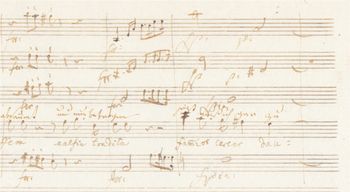
The revision of the junction between ‘Cosa mi narri?’ and the duettino in the main autograph was a significant one (see Figure 10). The first version in Mozart's hand represents a notably different conception of this moment. Susanna is instructed to write (‘Scrivi’), but she responds with an objection (‘ch'io scriva … ma signora’) seen in Beaumarchais (‘Lui écrire!’). This derives from the small dispute at the start of Act 4, scene iii, when the Countess accuses Suzanne of deceiving her: ‘Vous me trompez.’ For a fleeting instant, she thinks she has been betrayed before coming to her senses.Footnote 61 Mozart's lead-in to the letter duettino reflects this outburst, making use – atypically for the conclusion of a secco recitative – of the climactic musical gesture seen at the end of the Countess's accompagnato. Already in bar 4, the composer was thinking ahead to its conclusion. He first set the interjected word ‘piano’ to the notes c ″, f ′ but then changed it to f ″, c″, a rhetorically heightened depiction of the exclamation, somewhat at odds with the musical associations of the word (see Figure 11). Despite herself, the Countess is getting worked up. The final melodic flourish matches the rhetorical gesture of ‘È Susanna non vien!’ in its descent of a full octave.Footnote 62 The language, too, is that of ‘betrayal’, a strong term considering that in La folle journée this was merely a passing shadow: ‘tradirmi’ in the recitative (with Susanna present); ‘tradita’ in the accompagnato (with her absent). In both cases, the augmented-sixth chord represents the culmination of a brief but intense rant. Its inclusion in the first version of this link reflects the importance that Mozart attached to the darker shading in the Countess's character. The essential calmness of her persona, at least as refashioned by Da Ponte, was slightly at odds with the operatic stereotype which expected a seria character (especially a woman) to ‘blow her top’ at least once. A temporary loss of self-control would not only demonstrate depth of feeling, it would also greatly enhance the power of the resolution.
The Act 3 autograph of Le nozze di Figaro, p. 416. The end of the recitative ‘Cosa mi narri?’ showing a revision in the hand of a copyist and Mozart's note that the recitative ‘Piegato è il foglio’ was not yet in place. Reproduced with permission from the Biblioteka Jagiellońska, Cracow.

The Act 3 autograph of Le nozze di Figaro, p. 415. Detail showing a revision of the setting of the word ‘piano’ in the recitative ‘Cosa mi narri?’. Reproduced with permission from the Biblioteka Jagiellońska, Cracow.

The revised ending eliminates the Countess's rather petulant response in favour of a placid transition to the idyllic duettino. She merely repeats her request with emphasis: ‘Write, I say’ (‘Eh scrivi dico’). This returns to Beaumarchais, who also has the Countess reply to Suzanne's objection with an insistence that she complies (‘Il le faut’) rather than with the momentary irritation expressed earlier in the scene. In making this change, Mozart could well have been worried about the effect of two such outbursts in quick succession, plausible for an Elvira perhaps, but not a Rosina. As there is no equivalent eruption in ‘Or via scrivi cor mio’ in the abandoned particella, Mozart probably conceived this more dramatic lead-in to the duettino when it was in its final position. In turn, this suggests that the late transfer of the Countess's soliloquy from somewhere earlier in Act 3 was the reason for the rethink, as it brought two versions of this ear-catching musical gesture into too close a proximity. Moberly and Raeburn may after all have been right about the late repositioning of her scena, albeit for the wrong reasons! Also suggestive of a last-minute decision as to where to place ‘E Susanna non vien! / Dove sono’ is that it is the subject of a second note-to-self at the end of ‘Andiam, andiam’, again taking the form of a double continuity instruction (see Figure 12). A sign of how late this instruction concerning the location of the Countess's scena (‘|:dopo l'arietta di Cherubino, viene Scena 7ma: – ch’è un Recitativo istromentato, con arie della Contessa:|’) was added is that it describes ‘Dove sono’ as an aria. Mozart removed the prestigious title of ‘rondò’, possibly to placate Storace, only at the final moment; up to that point, it was in all the orchestral parts, including duplicates, but in most cases it was then obliterated.Footnote 63
The Act 3 autograph of Le nozze di Figaro, p. 397. Detail showing two continuity instructions at the end of the recitative ‘Andiam, andiam’. Reproduced with permission from the Biblioteka Jagiellońska, Cracow.

Once the climactic augmented sixth of the first version was removed, the way was open for the end of the recitative to set the mood of the concerted piece, with mellifluous Italian and limpid orchestration transforming the atmosphere into one of serene tranquillity. The revised conclusion that provides this transition represents an unusual situation in Mozart editing: a reading in the hand of an unknown copyist having to be preferred to two autograph versions. It was transmitted in early scores and on this authority its text is given in the Neue Mozart Ausgabe.Footnote 64 Its authenticity is confirmed by the cue ‘Canzonetta su l'aria’ in the original first-desk violin 1 part. In its detail it does not entirely convince. The demisemiquavers used in the little rhythmic motif in the bass line lie outside Mozart's normal range of note values in recitatives. The setting of the words ‘Canzonetta su l'aria’ is rather static, with two quavers for ‘Canzo-’; the abandoned particella is more fluid, with two semiquavers.Footnote 65 The rejected bars of the recitative in the main autograph were cancelled with red crayon. A circle with an X at the start of the crossing out appears to be a directional sign, perhaps implying that there was once an autograph correction, but if so the sheet is lost. Red crayon was also used to delete the ‘Dopo il Duettino’ reminder, presumably once it was no longer necessary, while the ‘Segue’ instruction is circled twice to confirm its validity.
Thanks to the survival of several contemporary sources of its text, ‘Che soave zeffiretto’ provides a rare chance to investigate in depth how one of the most inspired creations of this celebrated operatic partnership came into being. After the original play, the earliest source of relevance is the German translation by Johann Rautenstrauch entitled Der närrische Tag, which introduces a key dramatic concept: the multiple repetitions of the dictation, an idea that is only latent in Beaumarchais.Footnote 66 Next came the Italian and German versions of the libretto, which, as we have already seen, have a significant number of variant readings, especially towards the end of Act 3. The main autograph of the duettino was preceded by the abandoned particella containing a different version of its opening bars. Its own text was subsequently replaced by material in the hand of a copyist presumed to be authentic. What emerges from a comparison of these sources is the painstaking care that went into getting the detail right. The sequence of texts is presented in the Appendix, aligned as far as possible.
Beaumarchais begins this episode with the two women discussing plans for a rendezvous with the Count. The Countess instructs Suzanne to start writing the letter, then, having reassured her that she will take full responsibility, gives her the title as a vaudeville: ‘a new song to the tune of … ’. A vaudeville was a pre-existing tune, identified by its title or timbre, to which new words were put: ‘Authors counted on the audience's instantaneous recognition of a melody upon hearing it, and on their grasping the double entendre – often humorous, salacious or malicious – between the title and the air's new words.’Footnote 67 There are several vaudevilles in La folle journée, notably Chérubin's romance. What sets the duettino apart is that its genre is explicitly identified by the Countess: ‘a new song’ (‘chanson nouvelle’) ‘to the tune of … ’ (‘sur l'air … ’).
The issue in the opera was not so much the requirement for an allusive text – after all, the idea that the Count should be expected to read between the lines was the whole point – but rather whether it was appropriate to retain the overt genre categorization, since Mozart's sublime setting made no pretence at evoking a pre-existing tune. As the composer himself came up with the idea that the genre identification should itself be repeated as part of the dictation, it seems reasonable to infer that he had no significant objection, yet there was evidently a change of heart; the words ‘Canzonetta su l'aria’ do not appear in the first version of the recitative in the main autograph. Had the idea of the vaudeville not been reinstated, Susanna's fragment ‘su l'aria’ in bars 2–3 of the duettino might well have been cut. As it is, this repetition, tongue in cheek, draws attention to the pre-existing tune, the one aspect of vaudeville not to feature. The phrase ‘Canzonetta su l'aria’ does not appear in the Italian libretto, which was evidently sent to the printers before its restitution.Footnote 68 In the end, it was decided to keep the reference in as part of the dictation. The revision of the end of the recitative in the copyist's hand gave effect to this, and it also restored the stage instruction ‘dettento’ (‘dictating’). In the abandoned particella, this had been given as ‘|:dettando à Sus.:|’. In bar 4, Mozart was about to write ‘dettando’ over the Countess's entry – he got as far as the letter ‘d’ – before realizing that it was redundant. The timing of the production of the German translation – later in this instance – allowed it to incorporate the vaudeville identification as ‘Ein Lied im Tone’, albeit with no indication of the repetition (‘im Tone’).
The first line of the song itself represents the librettist at his considerable best, the image of the little breeze conjuring up a mood with notable economy of means. The gentle wind of classical mythology, the zephyr, was an image much favoured by poets, yet rarely used so felicitously as here. Da Ponte was of course playing with a double meaning.Footnote 69 As with the word ‘air’ in English, the Italian ‘aria’ has both musical and meteorological significance. ‘Che soave zeffiretto’ is thus to be understood in part as a favourable verdict on Mozart's effort. (Da Ponte's treatment of the phrase in L'ape musicale rinnuovata – see further below, p. 126 – also suggests this.) The ensuing main clause contains a small subtlety. Beaumarchais has the direct ‘ce soir’ (‘this evening’), but Da Ponte preferred ‘verso sera’ (‘towards evening’). Mozart chose the former.Footnote 70
The species of tree under which the assignation would take place was carefully considered in all adaptations of the text. The most popular German translation of the play, Der lustige Tag, retained the ‘chestnuts’ of Beaumarchais with several minor variants: ‘Es wird schön werden / diesen Abend unter den grossen Kastanienbäumen’ (Prague, 1785); ‘Wie schön wirds doch heut Abends sein. Dort unter den Kastanien!’ (Berlin, 1785); ‘Wie schön wirds diesen Abend seyn, dort unter den Castanien-Bäumen’ (Kehl, 1785). Rautenstrauch rejected chestnuts in favour of lime trees (‘Linden’), symbolically important for a German-speaking audience. Goethe's Die Leiden des Jungen Werthers, in which a Linden tree features prominently, was banned in Vienna, probably because suicide is a central theme, although the prohibition was to be lifted by Joseph II himself in 1786. On 28 February 1785, the Wienerblättchen, as part of its extended review of Rautenstrauch's translation, summarized this scene.Footnote 71 There is no reference to the darkness of the meeting place in Beaumarchais, and this theme was not taken up by Rautenstrauch, but an ‘alley’ seems to imply a formal layout. A geometrical design, rather than an English ‘wilderness’, is illustrated in his woodcut of the garden scene with Cherubino.Footnote 72
Da Ponte substituted pine trees (‘i pini’) and identified the location as a grove (‘boschetto’). The suggestion that he chose ‘pini’ in order to offer a surreptitious erotic allusion is an interesting one given that innuendo was a fundamental characteristic of vaudeville.Footnote 73 In the satirical trial Anti-Da Ponte, a spokesperson for the Viennese public criticized the librettist's fondness for ‘indecent ambiguities’ (‘unanständige Zweydeutigkeiten’). In his own defence, Da Ponte (the character) does not dispute this, failing conspicuously to respond to the word ‘improper’. He justifies the practice by invoking artistic licence: ‘Wenn ich hie und da einige Zweydeutigkeiten in meinen Opern einfliessen lieβ, so muβ man solches nicht auf Rechnung des Abbate, der geistlich, sondern auf die Rechnung des Dichters, der ganz weltlich ist’ (‘If here and there I allowed double entendres in my operas, that should not be ascribed to the spiritual Abbate, but rather to the Poet, who is completely secular’). Through his ‘free expressions’ (‘freyen Ausdrücken’) and ‘salacious situations’ (‘schlüpfrigen Situationen’), he hoped to demonstrate that he did not belong to the platonic sect.Footnote 74 In sailing close to the wind, Da Ponte could rely on the fact that double entendre makes its effect not on the page but in performance through tone and stress. To a degree, the author could disclaim responsibility for a crudity implied and understood by others. That he intended the word ‘pini’ (and perhaps also ‘boschetto’) to be allusive rather than merely descriptive is evident both in the manner of Mozart's setting and in the early reception of the duettino.
In keeping with the character of vaudeville, Da Ponte needed to come up with a suitable insinuation for his punchline. He could hardly adopt Rautenstrauch's deliberately provocative ending (‘and, without witnesses, find –’; ‘und, ohne Zeugen, finden –’), which leaves the nature of the rendezvous suggestively hanging in the air.Footnote 75 He alighted instead upon something rather less risqué: the intelligibility of the cryptic letter text. In Beaumarchais, the dialogue passes quickly over this issue. Suzanne, taking the dictation, queries whether enough has been said: ‘après?’ The Countess assumes that she is worried that the message will not be understood: ‘Crains tu qu'il ne t'entende pas?’ Suzanne is reassuring: ‘C'est juste.’ Da Ponte developed his climax succinctly, using just one word (‘capirà’; ‘he will understand’), on which a matching pair of lines converges: ‘Ei già il resto capirà. / Certo, certo il capirà.’ This technique, of which he was a master, allowed participants in an ensemble to retain their individuality while ending with some form of agreement. The Countess states her opinion as fact, while Susanna, through the repetition of ‘certo’ has the opportunity to express something else: relief, impatience, knowingness, even outright cynicism (‘Yeah, right, he'll get it’). A double innuendo is set up; the Count will understand the immediate message, but not yet the ultimate lesson. Ambiguity in the punchline was central to humour in opera buffa, and Mozart knew the degree of emphasis expected. In his setting, the word ‘capirà’ appears 19 times, the word ‘soave’, an important mood-defining adjective, but twice.
The German translation of the letter-writing scene matches neither the libretto nor the autograph.Footnote 76 Its textual divergences might stem from reliance on a draft subsequently discarded, or they might constitute an independent reading of the nuances of the drama. Either way, the variants strongly reinforce the idea that in its final incarnation ‘Che soave zeffiretto’ was intended as a comic piece, satirical in tone. A remarkable stage direction suggests the manner in which Susanna should repeat the words of the Countess: ‘(Sus: wiederholt die Worte der Gräf. mit hämischem Tone singend)’. The equivalent Italian stage instruction (‘La Susanna ripete le parole della Contessa’) is located earlier but without an equivalent for the descriptive word ‘hämisch’. The idea that Susanna should repeat the Countess's words in a ‘scornful’, ‘sneering’ or even ‘malicious’ fashion is startling. In modern performance tradition, the timeless beauty of the duettino is granted to be compatible with charming physical acting, but it does not usually allow for the sharper comedy of vocal tone. Yet anyone attending the première who happened to glance at the translation might have anticipated that Susanna would take at least some part of her dictation with venom. The instruction perhaps applied in particular to the concluding phrase: ‘O ja! Er wirds verstehen’ (‘Of course the Count will understand’).Footnote 77
As well as emphasizing the satirical tone, implied by the performance of the piece as though it were a vaudeville, the translation suggests how the musical concord established in ‘Che soave zeffiretto’ might be sealed in stage action. In the autograph, there are several stage directions: ‘dettando’ (‘dictating’), ‘domandando’ (‘asking’), ‘scrivendo’ (‘writing’) and ‘leggono insieme lo scritto’ (‘they read the letter together’).Footnote 78 Such annotations in the score, recording ideas about stage presentation tried out during the rehearsal process, are relatively unusual and may be a sign of late composition.Footnote 79 But only the German text addresses the question of how the scene should be brought to a close. Once the dictation is complete, Susanna observes that the letter is folded up and asks how it is to be sealed (‘Der Brief ist zusammengelegt – – – und wie werden wir ihr versiegelt?’). This is followed by the direction: ‘(Anfangs die Gräf, allein, alsden beide zusammen) / (legt den Brief zusammen)’. While the meaning is not altogether clear, it seems that the Countess alone and then both women together are to engage in folding the letter. In the Italian libretto, Susanna appears to do this alone. She begins the recitative by stating that the sheet is folded (‘Piegato è il foglio’), but this is followed by the instruction ‘she folds the letter’ (‘piega la lettera’). The act of closing up the paper together allows the two women to demonstrate their complicity visually, almost as though shaking hands on the deal. Dictating can be done at some distance; jointly rereading a single script requires closer proximity; but the mutual folding of a sheet of paper requires the two to act as one – or not, if comedy is desired.
The translation also gives the exchanges concerning the pin differently. In the Italian text, the Countess takes out a pin and hands it to Susanna to serve as a seal, but in the German version, she asks her maid for one (‘Gieb mir nur eine Nadel’). Having been struck by the idea of adding a note to the outside of the letter asking for the return of the pin as a sign of receipt, she then appears to have a change of mind, giving a pin to Susanna ‘(Sie nimmt eine Nadel und gibt sie ihr)’. In La folle journée (Act 4, scene iii), this action leads to the discovery that the Countess has been concealing on her person the ribbon covered with Chérubin's blood, which flutters dramatically to the ground. As the representation of this would have been unthinkable on the Vienna stage, a small act of misdirection was in order. Da Ponte ends with Susanna's comment, placed earlier both in the play and in its translation, which compares the seal to that of Cherubino's patent, emphasizing its peculiarity: ‘plus gai’ (Beaumarchais); ‘Lustiger’ (Rautenstrauch); ‘più bizzarro’ (Da Ponte); ‘Wunderlicher’ (German translation).
All this careful work on the libretto set the scene for the creation of a memorable piece of music. In executing its central idea – repetition – Mozart displayed consummate skill as a musical dramatist. A decision of fundamental importance was whether to mimic the verbal repetition required by the dictation in identical musical phrases. The rejection of a parrot-like approach allowed for the development of an ensemble full of dramatic nuance, making good use of the composer's traditional freedom to repeat words given only once in the text. The attention to detail can best be displayed in a commentary on the text repetitions, as given in Table 10. This is by no means simple dictation. The two women are engaging in a subtle comedy of stress, to be heard in performance, not merely seen on the page. With or without the ‘sneering’ tone suggested in the German translation, Susanna hints at her feelings by declining to echo the Countess's languid appoggiatura figures on the words ‘pini’ and ‘boschetto’, electing to render them in a snappier and possibly sarcastic fashion.
| Countess | Susanna | Commentary |
|---|---|---|
| Che soave zeffiretto | ||
| zeffiretto | A one-word repetition is more immediate than the reiteration of phrases in the source texts. | |
| questa sera spirerà | The Countess mitigates the finality of the tronco stress pattern, both with an interrupted cadence and an appoggiatura, not present in the draft particella. | |
| questa sera spirerà | The dictation under way, Susanna is able to take down a complete (seven-syllable) line. She declines to echo the Countess's appoggiatura, ending on the tronco syllable (‘-rà’) without one. | |
| sotto i pini del boschetto | After opening the duettino, the role of the oboe and bassoon is to introduce each vocal phrase, retiring to sound isolated on-the-beat quavers once the voice has entered. The forward momentum engendered by these interjections increases, as successive vocal entries occur more quickly. The Countess stresses the phrase ‘sotto i pini’ in leisurely fashion, with a five-quaver value for ‘sot-’ and a four-quaver value for ‘pi-’ with a long appoggiatura. | |
| sotto i pini [?] | Susanna requests a repetition. The rhythm is meticulously and imaginatively fashioned. Her questioning is represented by her weak-beat entry of ‘sot-’, while her ascending fourth for ‘pini’ amounts to a rejection of the Countess's appoggiatura. | |
| sotto i pini del boschetto | The Countess obliges Susanna by repeating the whole phrase, but she insists on beginning ‘sot-’ on the strong part of the beat. In a nice touch, she further emphasizes the languid quality of the phrase, extending the crotchet to which ‘-schet-’ was set the first time round to a full dotted crotchet's length. | |
| sotto i pini | Susanna ignores the Countess's implicit criticism of her throwaway rendition of ‘sotto i’, but she appears to acknowledge that ‘pi-’ could be given a stronger stress. | |
| del boschetto | Then, rather cheekily, she gives due weight to ‘del bo-’ while tossing off ‘-schetto’ in two quavers. | |
| ei già il resto capirà | The transition between the song text and the final comments of the two women is marked with precision; for the first time there is a sostenuto bass line, and an expressive and sonorous viola. | |
| certo, certo il capirà | Susanna's complete agreement is signalled with her first direct musical imitation of the Countess. | |
| ei già il resto capirà | certo, certo il capirà | The first duet passage seals the agreement. |
| canzonetta su l'aria | Che soave zeffiretto | The rereading of the letter to check it was probably Mozart's idea. The Countess's monotone repeat of the vaudeville title against the opening wind theme is a lovely touch. Susanna sings the words ‘Che soave zeffiretto’ for the first time. The phrases now overlap, maintaining the seamless flow without the assistance of the wind instruments. Susanna adopts the Countess's languid manner for ‘sot-’ but still fails to lengthen ‘-schetto’. |
| questa sera spirerà | sotto i pini del boschetto | |
| ei già il resto capirà | certo, certo il capirà | The final comments are telescoped, now imitating at the distance of one bar. Again the bass is sostenuto. |
| il capirà | il capirà | As intended by Da Ponte, ‘il capirà’ serves as the climactic word. |
| ei già il resto capirà | certo, certo il capirà | |
| ei già il resto capirà | certo, certo il capirà | |
| il capirà | ||
| il capirà | ||
| il capirà | ||
| il capirà | ||
| il capirà | il capirà | |
| il capirà | il capirà |
The sketch of ‘Che soave zeffiretto’, continuing the abandoned opening, is fascinating, a rare example of an almost complete continuity draft (see Figure 13). It records an outline of the structure, with ideas that were later developed more fully. At the same time, though, much was altered before Mozart was satisfied. In common with many pieces written shortly before a performance, there are few signs in the main autograph of obvious layering in the ink colours. Clearly the two wind parts in bars 29–33 and from bar 40 to the end (where they cease to have obbligato material) belong to a completion phase. There are relatively few corrections and none of substance, pointing to the possibility of an intermediate draft, at least of some sections. The interplay between the two vocal lines in the continuity draft is largely as in the final version, but the overlapping phrases when the letter is reread are not yet there. Although there is no sign of the third participant (the exquisite wind duo), the amount of space allocated for its contribution is broadly sufficient. The only instrumental interjection actually notated in the draft is in violin 1 in bars 7–8, where it begins with the melodic response to the Countess but continues by doubling Susanna's line in bars 9–10. This was one way to achieve a seamless melodic flow, but in the final version an even more striking effect results from the way in which the wind instruments at first abstain from direct doubling of this kind, instead connecting the pitches of successive vocal phrases.Footnote 80 Later, from bar 21, they become more intimately involved in a three-way conversation. One of Mozart's most obvious strengths as a composer – his instinctive ability to identify routine first thoughts – is seen in this draft. The melodic contour in bar 8 is tame by comparison with the final version. Similar improvements are seen in the answering phrases in bars 29–30 and 31–2.
An autograph sketch of ‘Che soave zeffiretto’ on the verso of the page reproduced in Figure 2 (see p. 97). Reproduced with permission from Salzburg, Internationale Stiftung Mozarteum, Bibliotheca Mozartiana: Autogr 492-1.

An influence on the final choice of instrumentation may have been Susanna's Act 4 aria ‘Deh vieni’, on which Mozart was working at around the same time. Its scoring with solo flute, oboe and bassoon required a brace of eight staves, but the flute may well have been an afterthought, as it is placed below the bassoon.Footnote 81 On the other hand, the abandoned leaf containing the start of ‘Che soave zeffiretto’ has a nine-stave brace implying that Mozart was leaving open the possibility of including a flute. He may in the end have decided against this in order to differentiate the instrumentation of the two pieces.
It did not take long for ‘Che soave zeffiretto’ to be recognized as an exceptional piece. In an advertisement in the Wiener Zeitung, it was identified as the duet in which the Countess dictates to Susanna: ‘Su l'aria, che soave zeffiretto, Duett (wo die Gräfin der Susanna diktirt)’. Another piece in Act 3 similarly ‘sold’ on the basis of more than its first line was the sestetto: ‘Riconosci in questo amplesso (Sua Madre? Suo Padre?)’.Footnote 82 Both these additions could be taken as positive indicators, drawing attention to the catchy features contributing to their success. During the revival of Le nozze di Figaro in 1789, the duettino won a position as a widely acknowledged favourite. When he attended the second performance of the new run on 31 August 1789, Zinzendorf singled it out for praise: ‘A l'opera. Le nozze di Figaro. Charmant Duo entre la Cavalieri et la ferraresi’.Footnote 83 On 7 May 1790, he observed that the piece always pleased: ‘A l'opera le nozze di Figaro. Le Duo des deux femmes, le rondeau de la Ferraresi plait tousjours.’Footnote 84 His third reference to the duettino, after its performance at a private concert on 18 December 1790 sponsored by the Neapolitan ambassador, identifies it by a new nickname: ‘A peu pres le premier air du concert fut le Duo: Sotto i pini del boschetto’.Footnote 85 This early instance of a popular operatic number acquiring a sobriquet supports the idea that the performance of the word ‘pini’ was attracting attention, for the time being supplanting the obvious ‘letter’ identification.
Its new name was featured by Da Ponte himself in the 1791 edition of the satire L'ape musicale rinnuovata, a collective benefit in which performers could choose their own pieces, probably in reality as well as onstage in character.Footnote 86 Zuccherina (Ferrarese) proposes a duet that Farinella (Bussani) sings – none other than ‘Il Duetto del pini che soave’. With a free choice as to how to refer to his own work, Da Ponte uses its current nickname before its first words, which are underlined for emphasis. It receives extended satirical treatment commensurate with its new status. Zuccherina greets its choice with pleasure, but she will participate only if ‘Madame’ executes it as written. When asked what that might signify, she responds: ‘without making variations on every beat’ (‘senza far variazioni ogni Battuta’). To this her duet partner replies: ‘I will change if she changes’ (‘muterò, s'ella muta’). A double meaning is probably intended, as changing (i.e. reforming by not ornamenting) also implies decorating the music (i.e. ornamenting and thus not reforming). Zuccherina agrees to this and in a welter of negatives proclaims her respect for the musical text: ‘Io non faccio giammai / Che qualche appoggiatura / Qualche piccol gruppetto o volatina / Che non cangia natura all'espressione / Od'alla cantilena del maestro’ (‘I never perform an appoggiatura or a little gruppetto or volatina that does not change the composer's manner of expression or the cantilena’).Footnote 87 The satirical implication seems to be that the ‘cantilena’ of Maestro Mozart has hitherto been ‘improved’ with appoggiaturas, gruppetti and other flights of fancy not necessarily to his liking. In some of the original performing parts, cautionary indications (added pauses and ‘solo’ and ‘colla parte’ markings) alerted players that improvised embellishments could be expected in bar 60, as well as in bar 61, where Mozart allowed for them with a fermata sign. In view of the character of his setting, it is particularly interesting to see appoggiaturas heading the list of questionable practices. It is impossible to guess how Bussani and Ferrarese would have performed the piece during the pasticcio; a competition in ludicrously excessive ornamentation cannot be ruled out. Zuccherina promises to abjure such practices on this occasion; extravagant variations and cock-a-doodle-dooing can be left to those who wish to indulge in them (‘E le veriazioni [sic] strampalate / Ed i chichirichi di tutti i galli / Lascio intanto a chi vuole’).Footnote 88 But a ‘stage’ promise to do one thing often guarantees exactly the opposite.Footnote 89
The text of the duettino is divided between Farinella, who begins ‘Che soave Zaffiretto’ (sic), and Zuccherina, who completes the stanza: ‘Questa sera spirerà / Sotto i pini del boschetto / Ei già il resto capirà’ with no indication of any repetition.Footnote 90 The egregious misspelling of ‘zeffiretto’ was perhaps a satirical dig at Bussani's Italian accent. In the 1792 Trieste version of L'ape musicale, Da Ponte went further in playing up the potential double entendre implicit in the nickname, awarding it a capital letter and an exclamation mark: ‘il Duetto de’ Pini!’ To this, Zuccherina responds suggestively, using the first words of the song as part of the conversation ‘che soave!’Footnote 91 Whether Da Ponte had in mind a crude sexual insinuation is unknowable, but without question the sources show him singling out the word ‘pini’ to be marked in some knowing manner.
There has long been a critical consensus that ‘Che soave zeffiretto’ has a special significance in the context of the wider drama. Montesano-Brown cites a striking passage from Moberly:
Mozart, who enjoys differentiating characters in music, has deliberately gone naïve, by undifferentiating his two heroines. They are blended. Both are Rosina enjoying traditional rituals. Both are the Countess, in the new-found confidence of Dove sono. Both are the Susanna of Deh vieni. It is one of the big moments in the serious inner meaning of Mozart's opera; a shared lyrical moment, tending towards the great moments of forgiveness and reconciliation at the end of Act Four. Footnote 92
In this reading, ‘Che soave zeffiretto’ foreshadows the return of a state of general peace at the end of the opera. Contemporary writers continue to admire the way in which it expresses equality between Susanna and the Countess. Allanbrook lyrically transposes its location out of doors: ‘[Its] pastoral text and music figure the classless, timeless meadow, where two women ordinarily separated by circumstance can meet and stroll quietly together.’Footnote 93 The shadow that passes over this idyll had to be dispersed immediately, and what better ‘antidote’, as Montesano-Brown put it, than ‘Che soave zeffiretto’.Footnote 94 Yet in the process of establishing an unassailable position as one of the most beguiling moments in the operatic canon, the duettino – at least in modern performance traditions – has tended to lose sight of the sharper comic vision of Beaumarchais, with its darker sentiments: suppressed anger at the Count; cynicism at the ease with which he will ‘read’ the innuendo in the cryptic message; and glee at his forthcoming discomfiture.
At least there is no dispute about its representation of class equality. In La folle journée, Suzanne is a match for her mistress from the start. Beaumarchais viewed her as a wholly admirable person: honest about her predicament; devoted to her mistress; and unwilling to engage in low deception on her own behalf. He rated her role as almost the most substantial in the play: ‘presque le plus long de la pièce’. But Da Ponte's contribution in developing the relationship between the two women should not be underestimated. Beaumarchais preserved the formalities of social rank throughout; Suzanne addresses the Countess as ‘Madame’ six times in the letter-writing scene alone. Even allowing for the much sparer text of an opera buffa libretto, it is striking that the maid uses ‘Madama’ only three times in direct address and not once in this scene. (There are also five occasions on which Susanna refers thus to her mistress in conversation with another person.)
A more interesting signal of equality – very probably a subconscious one – is the adoption of the convention of referring to prestigious women singers with a combination of the definite article and the surname, as in ‘La Ferrarese’. In part, this objectified the woman, yet it also recognized the high status accompanying a successful career. Da Ponte fell into the habit of referring to ‘La Susanna’, thereby establishing an exact match between ‘La Con.’ and ‘La Sus.’ Servants were not routinely accorded this distinction. Don Giovanni, having identified his next conquest, addresses her with a term of endearment (‘cara la mia Zerlina’), but in his ensuing discussion with Leporello and Masetto (Act 1, scene viii) ‘La Zerlina’ is several times referred to as though she were property to be claimed. Despina, a figure of no small consequence, achieves the accolade only at the dénouement of Così fan tutte, when Fiordiligi and Dorabella discover that she has been party to the deception: ‘La Despina! La Despina! / Non capisco come và’ (‘Despina! Despina! I do not understand’). Susanna, however, has the self-confidence to lay claim to this title from the start. In her opening banter with Figaro, she jests: ‘Perch'io son la Susanna e tu sei pazzo’ (‘Because I am Susanna and you are a madman’; Act 1, scene i). Both the men in her life follow suit. Figaro is worried that ‘La Susanna’ is to be recruited as the Count's confidential attachée in London (Act 1, scene ii), while the Count instructs Cherubino to kiss ‘La Susanna’ for the last time. The usage appears frequently in Da Ponte's stage directions (Act 2, scene ii (twice); Act 2, scene iii (twice); Act 2, scene vi; Act 3, scene iii; Act 3, scene ix; and Act 3, scene xii). Appropriately enough, in the letter duettino ‘La Susanna’ repeats the words of the Countess. Mozart tended to avoid this construction, but he slipped into using it once and at a rather telling moment. His continuity direction for Act 3, scene ii reads: ‘Il sudetto. La Contessa e la Susan[n]a in fondo’ (‘The aforesaid. The Countess and Susanna at the back’). The two women thus embark upon their new ruse in a state of linguistic parity.Footnote 95
When Moberly and Raeburn suggested that Act 3 of Le nozze di Figaro might originally have been ordered differently, they were writing at a time when a Mozart opera was still seen as a work with a fixed text, enshrined in an authoritative Gesamtausgabe. If something (musically) different was to be tried out in the theatre, it would need to be justified by more than a claim of objective superiority. Accordingly, they argued that poet and composer had faced a situation of force majeure; they had had no choice but to accept an inferior structure because of the emergence, late in the day, of an unforeseen practical difficulty, the result of the double casting of two minor roles. The opportunity to return to a sequence perhaps preferred by the authors proved very attractive, especially since no music would be lost in the reshuffle, and during the following decades an impressive array of conductors – Karl Böhm, Colin Davis, John Eliot Gardiner, Bernard Haitink, Herbert von Karajan (for whom Raeburn acted as producer), Antonio Pappano and John Pritchard – chose to adopt it. My analysis of the sources suggests that Moberly and Raeburn were not wrong in their belief that an alternative ordering preceded the one finally chosen, but that their hypothesis was couched too narrowly. That Da Ponte and Mozart struggled with the problem of how best to locate the new plot to ensnare the Count is manifest in the high density of revision affecting this material. In all probability, several orderings were given at least some consideration. A sequence with the Countess's scena early in Act 3 may well have been one of these, and modern performances suggest that the change improves the flow of the drama without altering the characterizations. Were the duettino to be selected for a similar relocation, the consequences would be more significant. A series of scenes at the start of Act 3, in which the Countess hides in order to witness the meeting between Susanna and the Count, emerging in a state of indignation to dictate a letter, could be effective, but this intervention would change the character of her subsequent soliloquy, wherever placed. Its reference (in the accompagnato) to the fact that she is waiting to hear from Susanna would have to be removed, and this would have the effect of isolating her from the ongoing action. Such a version could easily be reconstructed, if only as a practical investigation into the problems facing Da Ponte and Mozart as they sought to construct an effective order for this unusually complicated passage in the drama.Footnote 96
Appendix