Global warming, climate change, and increasing global travel have created opportunities for the dispersions of mosquitoes and infectious agents to find new niches. Zika virus (ZIKV) is an arbovirus transmitted predominantly by Aedes aegypti as well as Aedes albopictus, and perhaps Culex quinquefasciatus.Reference Attar 1 Only 15 cases of ZIKV had been reported before 2007, whereas since 2007, 60 countries or territories (46 since 2015) have either reported an indication or autochthonous (local) transmission. Ten countries have reported autochthonous transmission solely, presumably through sexual transmission. Eleven countries or territories have reported clusters of microcephaly, Guillain-Barré syndrome, and a range of neurological disorders suggestive of congenital infection linked to ZIKV.Reference Harris 2 The unabated rapid spread of ZIKV indicates efficient adoption in mosquitoes and humans; the situation can worsen with effective replication in hosts, and disease incidence is expected to increase. With a high intensity in the Americas, the World Health Organization (WHO) estimates about 4 million cases in 2016 and declared a public health emergency of international concern (PHEIC). 3
Although ZIKV transmission occurs predominantly via mosquito vectors, transmission can also be through blood and other body fluids such as semen during sexual intercourse or mother-to-fetus transmission throughout pregnancy (congenital Zika syndrome) associated with the most notable “congenital microcephaly.” ZIKV can also cause “Zika fever.” About 80% is asymptomatic, and mortality is rare or low.Reference Chan, Choi, Yip, Cheng and Yuen 4 Differential diagnosis between other mosquito-borne viral infections is challenging. In the laboratory, serum samples and less commonly other body fluids are used to detect the viral RNA genome through reverse transcriptase–quantitative polymerase chain reaction, whereas detection of ZIKV IgM or IgG antibodies or plaque reduction neutralization tests have low specificity with cross-reactions from other flaviviruses. 5 Currently, there is no vaccine or specific antivirals, but protection against mosquito bites, following travel advisories, and contraception can prevent ZIKV infection.
Viewed collectively, uncertainties and knowledge gaps surround ZIKV infection. These include identification of the reservoirs and competent vectors; ZIKV cycle compared to other virus cycles; spectrum of hosts; association between time of exposure during pregnancy and microcephaly, severity of birth defects, and negative pregnancy outcomes; risk factors, frequency, and severity of neurological deficits; virus longevity in the human body; and the patients immunity.Reference Bell, Boyle and Petersen 6
The population of Bahrain comprises 54% multi-ethnic communities, and the health care workforce encompasses Bahrainis and expatriates. Mainly during the Haj season, but also at other times, many international pilgrims transit Bahrain to visit Mecca and Medina in Saudi Arabia. The WHO Regional Office for the Eastern Mediterranean (EMRO) states that Aedes mosquitoes are found in 8 countries of the region. Among them, Saudi Arabia, Pakistan, and Sudan have reported chikungunya, and Yemen has reported dengue. EMRO has not reported any case of ZIKV so far; nevertheless, vigilance has been emphasized through enhanced surveillance for Aedes mosquitoes, early case detection, and reports of any increase in the numbers of birth defects. 7 Accordingly, Bahrain is building its capacity; however, there is a considerable risk perception, either from infected travelers or getting exposed by traveling to ZIKV hot zones. Therefore, preventing ZIKV in pregnant women is a public health priority. Health care professionals, particularly, midwives and nurses in gynecology/obstetrics (GYOB) and labor wards, must ensure a healthy antenatal period of pregnant women and an uneventful follow-up. Midwives and nurses must deal with an emergent situation of ZIKV infection by early detection, advise the community (especially women) to follow travel alerts, and advise on the risk of pregnancy complications, if infected. A dearth of reports evaluating the awareness and knowledge of midwives and nurses concerning ZIKV infection, and scant studies of other emerging infectious diseases, led us to hypothesize that midwives and nurses have inadequate awareness and knowledge. Therefore, we aimed to appraise the awareness and knowledge levels of midwives and nurses on early screening for ZIKV infection among pregnant women attending health care facilities of Bahrain.
METHODS
Study Population
A cross-sectional, purposely chosen sample of Bahraini and expatriate midwives and nurses, including their supervisors, in GYOB and the labor wards of Salmanya Medical Complex (SMC), the largest government hospital, a maternity hospital, 4 private hospitals and one-third of the health centers in Bahrain were invited to participate in a questionnaire survey to assess awareness and knowledge levels of early screening for ZIKV infection in pregnant women. A random sampling process was followed in selecting one-third of health centers and private hospitals.
Survey Questionnaire
Based on an in-depth literature review of ZIKV infection, the questionnaire was designed and pretested on 30 nurses at SMC who were not part of the main study. The questionnaire had 2 sections. The first section collected demographic data that included nationality, educational level in midwives and nurses, total years of work experience, number of years of work experience in GYOB/labor wards or antenatal care, and duty shift. The second section covered awareness and knowledge of early screening for ZIKV infection (19 items). The first question was on assessing the awareness of ZIKV; if unaware, the respondent was advised to not proceed with the survey. The remaining questions (18 items) were on assessing the knowledge of midwives and nurses on taking travel history, ZIKV infection, disease, diagnosis, treatment, and prevention. A panel of experts affirmed the face and content validity of the questionnaire, which had good reliability (Cronbach’s alpha of 0.78).
The mean knowledge score (MKS) for 18 items in the questionnaire was calculated as follows: correct answers/total answer numbers (%). The total answer numbers in the questionnaire turned out to be 50. For example, if a participant gave only 30 correct answers, the MKS for the participant would be 30/50=60%. The grand MKS is the mean of the means of all individual participant scores for the categorized variable, eg, Bahraini and expatriates.
Data Collection and Analysis
With ethical approval and informed consent, the questionnaire was self-administered by the participants. Confidentiality and anonymity of the data were protected. Data were cleaned and coded in Excel (Microsoft Corp, Redmond, WA) and exported to SPSS Version 21 for Windows (SPSS Inc, Chicago, IL) for descriptive and inferential statistical analysis. Univariate analyses were carried out by using Student’s t-distribution and ANOVA for the differences in the distribution of the grand MKS between categories of participants. A critical p value of 0.05 was regarded as statistically significant.
RESULTS
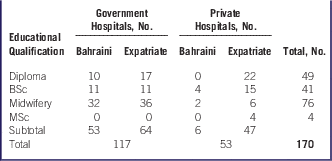
Of 266 midwives and nurses in the chosen study sites, 170 (76 midwives and 94 nurses) participated in the study. They were categorized and cross-tabulated by their employment in government or private and residential status to their qualification as midwives and nurses in descending order of low to high (Table 1). Two-thirds were employed in government, where the number of Bahrainis and expatriates was almost even. One-third were employed in private hospitals, where the expatriates outnumbered that of Bahrainis. A major proportion (45%) of the participants had midwifery qualification, 50% had either a diploma or bachelor of science degree in nursing, and a hand few had a master of science degree in nursing. The mean total work experience was 15.79 years and mean experience in GYOB/labor wards or antenatal care was 12.46 years.
Demographic Data of Participating Midwives and NursesFootnote a

a Abbreviations: BSc, bachelor of science; MSc, master of science. N=170.
Admittedly, 39% of the 170 participants were unaware of ZIKV infection. Of the 61% of participants (n=103) who proceeded with the knowledge assessment in ZIKV infection, two-thirds were from the government health sector; the majority (53%) were on night duty shifts, and midwives (40%) formed a bulk, followed by equal proportions of diploma and bachelor of science nurses.
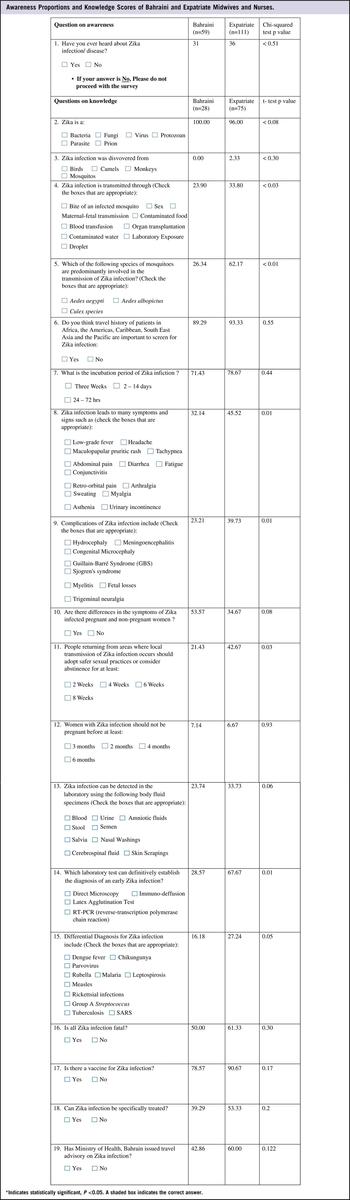
The normality of the distribution was tested by using the Shapiro–Wilk test and was not significant, thus indicating that the data were normally distributed. The grand MKS was 39.07% (range, 2.00-81.50) and the median knowledge score was 37.50 (interquartile range, 27). Expatriates had a better grand MKS (SE) (42.41 [1.76]) than did Bahrainis (30.16 [2.77]) (P<0.001).
Further, the MKS was compared between Bahrainis and expatriate midwives and nurses for each of the questions in the questionnaire (Figure 1). Most of the participants (97%) correctly identified the causative agent of Zika infection, whereas only 7% responded appropriately on the duration a woman should avoid pregnancy if infected with ZIKV. No significant differences were found between the participants’ qualification and grand MKS, yet diploma nurses had the highest MKS (40.28) followed by midwives (39.41) and bachelor of science nurses (38.78). Surprisingly, master of science nurses had poorer scores. Likewise, no significant differences in their location of employment and grand MKS were observed; nonetheless, midwives in maternity hospitals (42.11) and participants in private hospitals (40.52) scored higher. On the other hand, the grand MKS was significantly different between duty shifts (p<0.01), with the evening (43.95) and night shifts (43.98) having higher scores than the day shift (34.80). We did not observe any significant correlation between the MKS and either total work experience or experience in GYOB /labor wards or antenatal care.
Awareness Proportions and Knowledge Scores of Bahraini and Expatriate Midwives and Nurses.

DISCUSSION
This study was prompted on the premise that the threats of infectious diseases are not restricted to certain regions and no nation is immune. With the changed pattern of ZIKV infection from mild to severe public health crisis, epidemic preparedness and response depend on the capacity of the health care institutions and health care personnel. Notably, awareness and knowledge levels of ZIKV infection of midwives and nurses are related to their capacity in preparedness and response, because the fundamental objective of antenatal care for women is to detect early and treat high-risk conditions. With no reports documented yet, this study appraised the awareness and knowledge levels of midwives and nurses on early screening for ZIKV infection among pregnant women in Bahrain.
The purposely chosen sample size of 170 sufficiently represents the target population of midwives and nurses specializing in GYOB and labor wards or antenatal care in Bahrain. Our participants were enrolled from the largest government hospital (SMC), the only maternity hospital, one-third of health centers, and 4 large private hospitals. Although, the number of midwives and nurses attending all pregnant women in Bahrain was not available to us; we corroborated our sample size with Bahrain health statistics from 2014: 59.39% of the deliveries in government hospitals and 51.48% of the deliveries in 4 private hospitals occurred in our chosen study sites; therefore, our study can be considered adequately powered.
Awareness is the basis for knowledge. Whereas awareness is intellectual, knowledge is experiential. 8 Foremost, one-third of the midwives and nurses opted out of participating in the study, which reflected their inexpertness on ZIKV. Among those who participated, 39% were unaware of ZIKV. Furthermore, the grand MKS of 39% supported our hypothesis that midwives and nurses of Bahrain have inadequate awareness and knowledge of ZIKV infection compared with a benchmark of 70% to pass the professional nursing courses in the University of Bahrain. Midwives and nurses are expected to have expertise, promote behavior change, and raise awareness of for a safe pregnancy. However, the meagre 7% correct response for the duration a woman should avoid pregnancy if infected with ZIKV was unforeseen.
A highly significant grand MKS attained by expatriate midwives and nurses and midwives in the maternity hospital was probed further. We found that these midwives and nurses had attended a lecture on ZIKV that had a positive impact. However, none of their grand MKS was sufficient for the required level of a benchmark.
The outbreaks of SARS in 2003 and Ebola in 2014 demonstrated that well-equipped health systems can fail to detect the risks of emerging or reemerging infections early. Today, there are palpable signs of unpreparedness on ZIKV even in an advanced health system such as the United States. In the absence of a vaccine or antivirals and essentially to address current critical evidence gaps, highest vigilance and preparedness is required for ZIKV. Among all the health care professionals attending pregnant women, midwives and nurses play a pivotal role, their responsibility and preparedness for ZIKV hinges on lifelong learning—a voluntary, ongoing, and self-motivated pursuit of knowledge and an element of professionalism.Reference Kosht Novak, Palladino and Ange 9 Our findings emphasize that the causes of and remedies for inadequate awareness and knowledge of ZIKV infection are candid. A solitary lecture on ZIKV was shown to have an impact on higher grand MKS, although not to the level required, and a scope exists to build their capacities for similar emerging infectious diseases. Harnessing modern technology, and good support systems (eg, WHO, the US Centers for Disease Control and Prevention, EMRO, the Program for Monitoring Emerging Diseases, the European Centre for Disease Prevention and Control) a self-paced system of lifelong learning for the midwives and nurses can prevent ZIKV. Matching this, a study among Egyptian military nurses concluded that an educational program raised the awareness of and improved knowledge about selected infectious disease disasters in Egypt.Reference El-Bahnasawy, Labib, Abdel-Fattah, Ibrahim and Morsy 10
Owing to time constraints and access to participants, Bahrain defence forces and King Hamad hospitals, which have lesser bed capacities than SMC were excluded. Nevertheless, this attempt is the first to audit the levels of awareness and knowledge of midwives and nurses on early screening for ZIKV infection among pregnant women.
CONCLUSION
This study appraised the preparedness of midwives and nurses on early screening of ZIKV infection among pregnant women attending public and private health care facilities of Bahrain. Overall, the awareness and grand MKS of midwives and nurses on ZIKV infection were inadequate. A moderate effect on higher grand MKS among those who attended a lecture on ZIKV was observed. To improve health education and promotion among pregnant women, a more proactive rather than responsive approach is required by midwives and nurses to enhance their preparedness. We don’t need working knowledge; rather, for ZIKV, we need knowledge that is working through lifelong learning. This appraisal strategy may be useful for the present and future preparedness on diseases of PHEIC.
Acknowledgments
The authors are grateful to Dr. Aneesa Al-Sindi, Dean, College of Health Sciences, University of Bahrain, for the support and encouragement provided in this work. The authors thank all the participants in the study and their administrative heads in the Ministry of Health, Bahrain, and the private hospitals for the support provided to carry out the study.