Introduction
Spermatogenesis is the cell differentiation process originating at puberty in the male and giving rise to a mature spermatozoon able to fertilize an egg in vitro or in vivo. Spermatogenesis occurs step by step, leading to different cell types such as primary and secondary spermatocytes, spermatids and, finally, mature sperm cells. The latter are produced during spermiogenesis and result from a dramatic morphological and structural change of the haploid spermatids. Among the events associated with spermiogenesis, nuclear compaction is caused by a change in the condensation state of chromatin. This event occurs when protamines bind to nuclear DNA and replace approximately 85% of the DNA-linked histones (Curry & Watson, Reference Curry, Watson, Grudzinskas and Yovich1995; Balhorn et al., Reference Balhorn, Cosman, Tornton, Krishnan, Corzett, Bench, Kramer, Lee IV, Hud, Allen, Prieto, Meyer-Ilse, Brown, Kirz, Zhang, Bradbury, Maki, Braun, Breed and Gagnon1999) with an evidence for the existence of a zinc-dependent chromatin stability (Björndahl & Kvist, Reference Björndahl and Kvist2010).
Protamination appears to be a protection mechanism of the nuclear paternal genome that remains functionally inert; in fact, the highly packaged chromatin structure seems not to be affected by DNA repair and/or apoptotic mechanisms (Aitken et al., Reference Aitken, Koopman and Lewis2004; Oliva, Reference Oliva2006; Johnson et al., Reference Johnson, Lalancette, Linnemann, Leduc, Boissonneault and Krawetz2011). So, a correct degree of nuclear chromatin condensation is associated with sperm maturity (Terquem & Dadoume Reference Terquem, Dadoume and Andre1983; Carrell & Liu, Reference Carrell and Liu2001; Rousseaux et al., Reference Rousseaux, Reynoird, Escoffier, Thevenon, Caron and Khochbin2008).
Many reports in the literature have produced evidence that mammalian sperm chromatin structure and function have important implications for fertilization success, a proper embryonic development and possibly affect spontaneous abortion rates (Chitale & Rathaur, Reference Chitale and Rathaur1995; Evenson et al., Reference Evenson, Jost, Marshall, Zinaman, Clegg, Purvis, de Angelis and Claussen1999; Esterhuizen et al., Reference Esterhuizen, Franken, Lourens, Prinsloo and van Rooyen2000, Reference Esterhuizen, Franken, Becker, Lourens, Müller and van Rooyen2002; Agarwal & Said, Reference Agarwal and Said2003; Virro et al., Reference Virro, Larson-Cook and Evenson2004; Caglar et al., Reference Caglar, Hammadeh, Asimakopoulos, Nikolettos, Diedrich and Al-Hassani2005; Lin et al., Reference Lin, Kuo-Kuang Lee, Li, Lu, Sun and Hwu2008; Kazerooni et al., Reference Kazerooni, Asadi, Jadid, Kazerooni, Ghanadi, Ghaffarpasand, Kazerooni and Zolghadr2009; Aitken & De Iuliis, Reference Aitken and De Iuliis2007, Reference Aitken and De Iuliis2010; Ward, Reference Ward2010). In IVF centres many efforts are made to avoid the use of DNA-damaged spermatozoa in the intracytoplasmic sperm injection (ICSI) procedure, as these latter factors carry the risk of transferring damaged genome into the oocytes. On these bases, laboratory test assessment and scoring the degree of DNA damage in sperm have recently been added to the conventional routine sperm analyses. In particular, the DNA nuclear chromatin decondensation test is used frequently as a diagnostic tool to predict fertilizing ability and possibly the pregnancy outcome in many human fertility clinics (Haidl & Schill, Reference Haidl and Schill1994; Roux et al., Reference Roux, Tripogney, Joanne and Bresson2004).
In order to preserve male fertility, sperm cryopreservation has been widely used in the reproductive centres for over 30 years (Royere et al., Reference Royere, Barthelemy, Hamamah and Lansac1996); however it has been shown that thawing may induce sizable cryo-damage in human sperm, in turn resulting in a decrease of viability and fertilization potential (Said et al., Reference Said, Gaglani and Agarwal2010). In fact, the effect of sperm cryopreservation on the degree of chromatin integrity is less known.
In this study we have used the aniline blue staining techniques on semen samples to determine the effect of the freeze-thawing procedure on human sperm nuclear chromatin condensation.
Materials and methods
Patients and sperm analyses
A total of 103 male patients was selected randomly; individuals gave their written consent to participate in this study between November 2008 and November 2009 at the IDF centre.
The samples were collected by masturbation in a sterile plastic container after 3 days of abstinence. Each semen sample was allowed to liquefy for 30 min, after that time the sample was mixed carefully and divided into three aliquots: the first aliquot was processed for routine semen analysis and submitted to immediate sperm DNA integrity (SDI) test; the second and third aliquots were cryopreserved and thawed after 10 days and 90 days respectively.
pH was measured with pretreated strips (Sigma); sperm concentration/ml and rapid progressive motility were determined by use of the computer-assisted sperm analysis (sperm class analyzer – SCA, Microptic S.L. Spain). Results were reported according to WHO criteria (World Health Organization, 1999). Sperm morphology was evaluated using pre-treated slides TestSimplets (Waldeck, Gmbh, Germany). A total of 100–200 sperm cells was scored for normality according to Krüger strict criteria (Krüger et al., Reference Krüger, Acosta and Simmons1987).
Nuclear chromatin decondensation test
The nuclear chromatin decondensation test as modified by Franken et al. (Reference Franken, Franken, de la Guerre and de Villiers1999) was used and expressed as sperm decondensation index (SDI). Briefly, samples were washed twice by centrifugation (1500 rpm for 5 min) in Ham's F-10 salt solution (PAA Laboratories, Gmbh, Austria). The supernatant was removed and the pellet resuspended in a minimum amount of medium; one drop of resuspended semen was spread on a glass slide that had been washed previously in 70% alcohol and allowed to dry in air. All smears were fixed in 4% (v/v) buffered glutaraldehyde (Sigma, Italy) for 30 min and then rinsed in phosphate-buffered saline (PBS; Sigma, Italy) and in distilled water for 20 s each. Slides were then allowed to dry at room temperature and then stained with 5% (w/v) aqueous aniline blue (Sigma, Italy) 5% mixed with 4% acetic acid (pH 3.5) for 15 min. Slides were then rinsed in distilled water to remove all the aniline excess and air dried.
A total of 100 to 200 sperm cells was evaluated by phase contrast microscopy at magnification × 1000, and the percentage of stained sperm heads was calculated. Three classes of head staining intensities were noted, namely unstained (pale blue), partially stained (pale and intense blue together) and stained (intense blue) (Fig. 1).
Phase-contrast representative photomicrographs of the three classes of sperm head staining intensities. (a) Unstained: pale blue. (b) Partially stained: pale and intense blue together. (c) Stained: intense blue. A colour version of this figure is available in the online article.

Sperm cryopreservation and thawing
Each sample was diluted 1:1 with Sperm Freezing Medium (Medicult, Denmark) in plastic vials and cooled for 20 min at 5°C. The vials were then exposed over liquid nitrogen vapour (4 cm above the vapour) for 20 min and then plunged into liquid nitrogen (–196°C) until freezing. Vials were thawed in a 37°C water bath for 4 min and contents emptied into a sterile Eppendorf tube and immediately processed for the SDI test as above. Sperm survival after thawing was assessed on aliquots of the same sample processed for SDI for at least 24 h after thawing by calculating the % of motile sperm.
Statistical analyses
Differences between peak values of electrical currents were analyzed with the General Linear Model (GLM) procedure of analysis of variance (ANOVA; SAS, 1988). In the case of values expressed as percentages, we proceeded to analyze data after arcsine transformation. Pair-wise comparisons of means were analyzed by the least significant difference (LSD) test. Results were considered to be statistically significant when the P-value was < 0.05; and to be highly significant when P < 0.01.
Results
Sperm nuclear chromatin decondensation rate (threshold value >25%) in the same patient sample, was analyzed at three different intervals: (i) Day 0 (D0) on the freshly produced semen sample; (ii) Day 10 (D10) on the thawed sample after 10 days of cryopreservation; and (iii) Day 90 (D90) on the thawed sample after 3 months of cryopreservation.
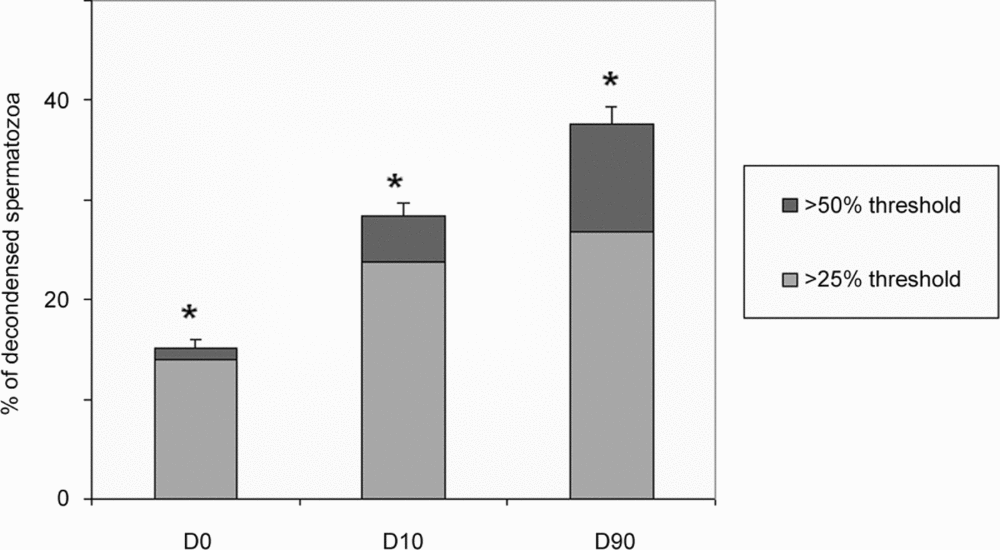
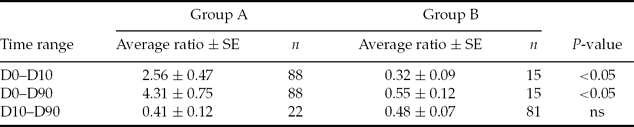
Of the 103 semen samples, 15 ± 1% showed normal SDI rate at D0. A highly significant increase of SDI rate was shown at either D10 or D90 (28.4 ± 1.4% vs. 37.7 ± 1.5%, respectively) (Fig. 2). Furthermore, a significant increase (P < 0.01) in the SDI rate was found, exceeding the 50% values between D0 and D10, D0 and D90 and D10 and D90 respectively (Fig. 2 and Table 1).
Sperm decondensation index rate in semen samples at the time of ejaculation (D0), and cryopreserved for 10 days (D10) and 90 days (D90). Light shading shows the percentage of spermatozoa below 50% decondensation. Dark shading shows the percentage of spermatozoa with greater than 50% decondensation.
Relative increase of chromatin decondensation of spermatozoa
Relative increase of chromatin decondensation of spermatozoa obtained by applying the following formula: (D1 – D0)/D0, where D1 = percentage of decondensed spermatozoa at final time, D0 = percentage of decondensed spermatozoa at initial time.
The group A represents the percentage of spermatozoa with a decondensation <25% at D0, and the group B represents the percentage of spermatozoa with a decondensation >25%. n = number of cases, P-value = significance, ns = not significant.
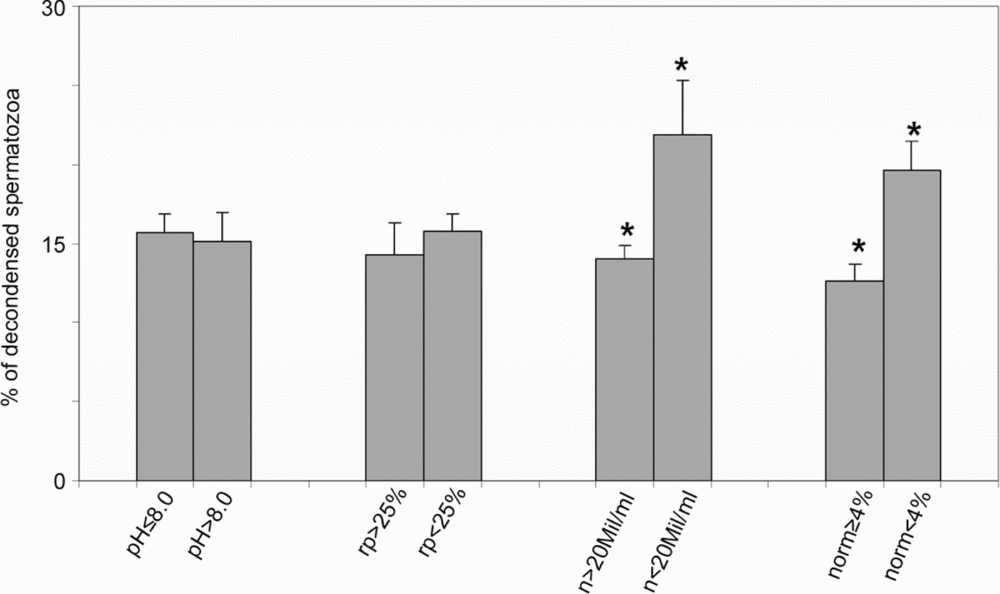
Highly significant differences (P < 0.01) were observed in the SDI rate of sperm samples exhibiting oligospermia (sperm concentration less than 2 × 10⁷/ml) at D0 (21.9 ± 3.4% vs.14 ± 0.9% in the control group, respectively) (Fig. 3). The group of patients that at D0 exhibited a moderate teratospermia (normal sperm morphology between 4% and 14%) and had less decondensed spermatozoa than the group with severe teratospermia (normal sperm morphology below 4%) with the following values: 12.6 ± 1.1% vs. 19.6 ± 1.8%, respectively (Fig. 3).
Sperm decondensation index rate and threshold standard value of the ejaculated sample, according to WHO parameters: pH (standard value: abnormal > 8.0); rp = rapid progression (standard value: abnormal < 25%); n = concentration (standard value: abnormal < 2 × 10⁷/ml); norm = normal morphology (standard value: severe abnormal <4% normal forms). Asterisks indicate highly significant differences (P < 0.01).
In contrast, no significant correlation was observed at D0 between abnormal SDI rate and other semen parameters such as sperm rapid progression and pH alteration (Fig. 3).
Discussion
In this work a significant impact of cryopreservation on sperm nuclear tertiary structure has been demonstrated and, in particular, we observed that prolonged storage time in liquid nitrogen has a further detrimental effect on the state of chromatin packaging.
By using the aniline blue test, the condensation state of nuclear chromatin can easily be recognized as spermatozoa with intensely blue heads, a phenomenon that occurs when the histones are not totally replaced by protamines. The three classes of head staining intensities are related to maturity, i.e. the unstained spermatozoa are considered to be mature whereas partially and totally stained spermatozoa are associated with an incomplete maturation.
Although there are no recognized standard values for chromatin decondensation, some reports have established that a normal semen sample generally contains less than 25% stained spermatozoa (Dadoune et al., Reference Dadoune, Mayaux and Guihard-Moscato1988; Auger et al., Reference Auger, Mesbah, Huber and Dadoune1990). More recent clinical observations identified threshold values from 28 to over than 30%, as no pregnancy was reported following in vitro fertilization and ICSI with semen samples exceeding this percentage. (Evenson et al., Reference Evenson, Jost, Marshall, Zinaman, Clegg, Purvis, de Angelis and Claussen1999, Reference Evenson, Larson and Jost2002; Ménézo et al., Reference Ménézo, Hazout and Panteix2007; Giwercman et al., Reference Giwercman, Lindstedt, Larsson, Bungum, Spano, Levine and Rylander2010).
Semen cryopreservation still constitutes one of the best tools for fertility preservation in men with malignant tumours who must undergo chemotherapy (Lee et al., Reference Lee, Schover, Partridge, Patrizio, Wallace, Hagerty, Beck, Brennan and Oktay2006). Furthermore, some men wish to cryopreserve their semen if this has been collected from the testicles, or simply because of the notion that the semen fertilization potential declines progressively with increasing age. In this paper, sperm samples were cryopreserved with the seminal plasma as that improves post-thaw DNA integrity (Donnelly et al., Reference Donnelly, McClure and Lewis2001) and has been shown to result in a high increase of SDI in spermatozoa kept frozen for 10 days. A further significant increase has also been detected in sperm stored for 90 days, however the differences among groups seem to support the hypothesis that the long storage duration may affect the chromatin damage possibly due to reactive oxygen species (ROS) formation.
It is, in fact, well documented that cryopreservation significantly increases ROS production in mammalian semen (Alvarez & Storey, Reference Alvarez and Storey1992; Bilodeau et al., Reference Bilodeau, Chatterjee, Sirard and Gagnon2000; Ball et al., Reference Ball, Vo and Baumber2001; Pons-Rejraji et al., Reference Pons-Rejraji, Sion, Saez, Brugnon, Janny and Grizard2009). Although low ROS levels have been shown to have a positive effect on spermatozoa by enhancing some functions such as capacitation and acrosome reaction (de Lamirande & O'Flaherty, Reference de Lamirande and O'Flaherty2008), a large volume of literature has shown that high ROS concentrations induce serious DNA damage (Lopes et al., Reference Lopes, Jurisicova, Sun and Casper1998; Bennetts & Aitken Reference Bennetts and Aitken2005; Silva & Gadella, Reference Silva and Gadella2006) and are associated with male infertility (Padron et al., Reference Padron, Brackett, Sharma, Lynne, Thomas and Agarwal1997) when the DNA repair capacity is overwhelmed (Ménézo et al., Reference Ménézo, Hazout, Panteix, Robert, Rollet, Cohen-Bacrie, Chapuis, Clément and Benkhalifa2010). The long exposure to ROS in semen thawed at D90 may possibly explain why a further increase in the SDI rate occurs in this group of patients; in fact SDI exceeding 50% are detected only in post-thawed samples at D90. Alternatively, it has been hypothesized that the generation of spermatozoa with poorly protaminated nuclear DNA creates a state of vulnerability that renders cells susceptible to oxidative attack (De Iuliis et al., Reference De Iuliis, Thomson, Mitchell, Finnie, Koppers, Hedges, Nixon and Aitken2009).
Finally as an alternative pathway responsible for DNA decay, some authors have suggested apoptosis to be one of the possible mechanisms involved in sperm cryoinjury (Paasch et al., Reference Paasch, Sharma, Gupta, Grunewald, Mascha, Thomas, Glander and Agarwal2004; Said et al., Reference Said, Gaglani and Agarwal2010).
Contrasting data exist in the literature on the correlation between sperm nuclear chromatin condensation and semen analysis parameters (Salsabili et al., Reference Salsabili, Mehrsai, Jalalizadeh, Pourmand and Jalaie2006). It has been hypothesized that variation of semen characteristics such as oligospermia and abnormal morphology, over time can theoretically lead to variable levels of ROS and, subsequently, to the variation of sperm DNA damage levels with subsequent poor sperm function. (Aitken et al., Reference Aitken, Buckingham, West, Wu, Zikopoulos and Richardson1992; Ford et al., Reference Ford, Whittington and Williams1997). According to these hypotheses and to other studies (Franken et al., Reference Franken, Franken, de la Guerre and de Villiers1999; Belloc et al., Reference Belloc, Benkhalifa, Junca, Dumont, Bacrie and Ménézo2009; Zini et al., Reference Zini, Phillips, Courchesne, Boman, Baazeem, Bissonnette, Kadoch and San Gabriel2009), in this study we also showed the occurrence of high correlation between severe abnormal morphology (less than 4%) of spermatozoa and DNA damage that is also is correlated with an impaired spermatogenesis. These findings further support the hypothesis that the heterogeneity in nuclear shape may be linked to heterogeneity in chromatin condensation (Curry & Watson, Reference Curry, Watson, Grudzinskas and Yovich1995). In contrast with previous findings (Hammadeh et al., Reference Hammadeh, Strehler, Zeginiadou, Rosenbaum and Schmidt2001), we observed that oligosperm ejaculates at D0 exhibited high significant SDI values, which suggested that the occurrence of low numbers of spermatozoa may also reflect their immaturity.
At present, it is claimed that, due to poor diagnostic methods and no fully effective infertility treatments, the use of new markers of sperm function should be mandatory and associated routinely with conventional semen analysis (Zini et al., Reference Zini, Bielcki, Phang and Zenzes2001; Evenson et al., Reference Evenson, Larson and Jost2002; Lefièvre et al., Reference Lefièvre, Bedu-Addo, Conner, Machado-Oliveira, Chen, Kirkman-Brown, Afnan, Publicover, Ford and Barratt2007), especially when freezing procedures are contemplated in the therapeutic plan (Hammadeh et al., Reference Hammadeh, Askari, Georg, Rosenbaum and Schmidt1999). Notwithstanding reports in the literature, data from the present study, based on 103 men, clearly support the need for evaluation of sperm chromatin/DNA integrity along with other sperm parameters in an attempt to establish a possible correlation with male infertility, ART failure and/or recurrent abortion (Tarozzi et al., Reference Tarozzi, Nadalini, Stronati, Bizzaro, Dal Prato, Coticchio and Borini2009; Kazerooni et al., Reference Kazerooni, Asadi, Jadid, Kazerooni, Ghanadi, Ghaffarpasand, Kazerooni and Zolghadr2009).
The negative bias of freezing on altered chromatin condensation has to be considered particularly for unselected patients who undergo cryopreservation of their seminal plasma before chemotherapy rather than for donors, which are usually highly selected for their sperm quality and cryoresistance. Results of this study suggest that, for unselected patients, assisted reproduction should be performed as soon as possible in order to minimize the deleterious effect of freezing on sperm chromatin stability.
Conclusion
Aniline blue staining to detect sperm nuclear chromatin condensation represents a good indication of sperm function. In this study, DNA integrity was evaluated in frozen–thawed human sperm samples that showed that chromatin stability seems to be seriously affected by cryostorage technique and the length of storage. Although some authors have hypothesized that freeze-thawing may induce a chromatin overcondensation rather than decondensation (Royere et al., Reference Royere, Hamamah, Nicolle, Barthelemy and Lansac1988), the following studies, in agreement with our data, showed the opposite results (Hammadeh et al., Reference Hammadeh, Askari, Georg, Rosenbaum and Schmidt1999; Martin et al., Reference Martin, Sabido, Durand and Levy2004; Fraser & Strzezek, Reference Fraser and Strzezek2007). This study also showed that low sperm counts correlated with nuclear decondensation also corresponded to a high degree of immaturity of sperm.
Recently, many authors have claimed an influence of paternal genome on the reproductive processes and postulated that DNA integrity is necessary for achieving fertilization success and to sustain embryo development (Bungum et al., Reference Bungum, Humaidan, Axmon, Spano, Bungum, Erenpreiss and Giwercman2007). On this basis and according to the general consensus, it seems worthwhile to include the chromatin condensation test as a diagnostic tool in the routine laboratory investigations of semen prior to assisted reproduction and for the assessment of sperm quality after freeze-thawing (Hammadeh et al., Reference Hammadeh, Askari, Georg, Rosenbaum and Schmidt1999; Reference Hammadeh, Strehler, Zeginiadou, Rosenbaum and Schmidt2001). The high negative impact of cryopreservation on DNA integrity demonstrated in this study supports the need to modify cryopreservation protocols in order to compensate for the suboptimal quality of thawed sperm and to optimize sperm cryopreservation especially in cases of cancer patients.
Acknowledgements
We thank Dr Elisabetta Tosti for scientific consulting and Dr Franco Fulciniti for his help in English stylization of the manuscript.