

Analyzing the sources of tafsīr is typically a difficult area of study for a number of reasons. First, and most crucially, Muslim scholars rarely give any indication of them. As Walid Saleh has noted, al-Thaʿlabī is a great exception and one of the few scholars to provide detailed information on his sources.Footnote
2
Tafāsīr tend not to provide references for individual ideas or
 ādīth. Second, the genre of tafsīr is academically ‘conservative’, in that most exegetes wish to present their tafsīr as being part of a long and unwavering tradition of Qurʾānic exegesis.Footnote
3
Being innovative was often regarded with suspicion, as one can see from the experience of al-Biqāʿī (d. 885/1480) and his use of Biblical material in his study of the Qurʾān.Footnote
4
Even tafāsīr which are bold in their approach, such as Fakhr al-Dīn al-Rāzī's Mafātī
 al-ghayb,Footnote
5
continue to maintain - or at least appear to maintain - a sense of continuum with the tafsīr tradition.Footnote
6
Al-Rāzī's extended use of lexicological material frames his more controversial theological-philosophical ideas within traditional exegetical discourse.
The fifteenth century polymath Jalāl al-Dīn al-Suy
 ī (d. 911/1505)Footnote
7
is different. In his magnum opus of tafsīr, al-Durr al-manthūr fī’l-tafsīr bi’l-maʾthūr (The Scattered Pearls in the Exegesis of the Qurʾān with Traditions)Footnote
8
al-Suy
ī notes a source, or multiple sources, for every single
adīth. This presents a great opportunity to understand how al-Suy
ī organised his tafsīr, from where he took his ideas, as well as how he conceived his exegesis.Footnote
9
Thankfully, al-Suy
ī also wrote many other works in the field of tafsīr, which allows for easy comparison and contextualisation.Footnote
10
This article will explore al-Suy
ī's use of sources in al-Durr al-manthūr and will show that a thorough examination of this source data enables a greater understanding of al-Suy
ī's methodology of
adīth compilation and exegetical ideas. There are similarities between the method that al-Suy
ī utlisies in al-Durr al-manthūr with Ibn Taymiyya's ‘radical Qurʾānic hermeneutics’,Footnote
11
and this article will also provide a comparison between al-Durr al-manthūr and the principle example of the use of Ibn Taymiyyan Qurʾānic hermeneutics, Ibn Kathīr's Tafsīr al-Qurʾān,Footnote
12
to assess the extent to which al-Suy
ī's work can be viewed in these terms.
This article is indebted to K. E. Nolin's The Itqān and Its Sources,Footnote
13
which explores al-Suy
ī's use of sources in his K. al-Itqān fī ʿūlūm al-Qurʾān. Nolin illustrates that the Itqān is reliant on al-Zarkashī's K. al-Burhān fī ʿulūm al-Qurʾān,Footnote
14
which al-Suy
ī uses as a basis from which he elaborates and expands material.Footnote
15
Nolin attempts to understand how al-Suy
ī wrote and worked as a scholar,Footnote
16
but there has been little advance on Nolin's ideas and even less in the way of further analysis of al-Suy
ī's use of source material in any of his other works.Footnote
17
More broadly, al-Suy
ī has received attention in the secondary literature, especially his K. al-Itqān,Footnote
18
and numerous other studies have been made of his thought, particularly in the Arab world.Footnote
19
Exegeses based solely on
ādīth are extremely rare in the tafsīr genre. The relatively early exegeses of Ibn al-Mundhir (d. 388/930),Footnote
20
Ibn Abī
ātim (d. 327/938–9),Footnote
21
and the Shīʿī exegesis of al-ʿAyyāshī (d. c. 320/932)Footnote
22
are the main examples of such a methodology. However, the methodology did not catch on and had little impact on the genre of tafsīr.Footnote
23
The method did, however, re-emerge after Ibn Taymiyya wrote his Muqaddima fī
 ūl al-tafsīr,Footnote
24
in which he encourages the use of
ādīth in the interpretation of the Qurʾān. Ibn Kathīr was the first to attempt a complete exegesis of the Qurʾān adopting Ibn Taymiyya's methods, but whilst including a large number of
ādīth, Ibn Kathīr also includes personal statements and analysis. Al-Suy
ī's al-Durr al-manthūr, however, is almost unique in the tafsīr tradition in that it is comprised of only
ādīth, with no direct personal comment being made at all; such that one can only infer his viewpoint indirectly through his selection and organisation of the
ādīth themselves.Footnote
25
Al-Suy
ī employs a large number of sources, mainly from works outside of the main tafsīr tradition, particularly works like al-Bukhārī's
 ī
, that are normally firmly with the discipline of
adīth. Exegetical
ādīth are readily found in the
adīth literature, and many of the canonical collections include a specific Kitāb Tafsīr al-Qurʾān,Footnote
26
but as Marston Speight has commented, the mufassir and the mu
addith have a different agenda:
The mufassir was concerned primarily, if not wholly, with the elucidation of the revealed text, for whatever purpose that might serve, and to achieve that end, he was open to several possible sources of interpretation. The mu
addith, on the other hand, was concerned primarily with reporting the sunna of Mu
ammad, and when the reports he brought involved the Qurʾān text, his effort joined that of the mufassir.Footnote
27
Al-Suy
ī takes this dichotomy between the mufassir and the mu
addith and creates a work which straddles both traditions. However, the role of
ādīth in non-tafsīr works as a vehicle for exegesis or interpretation is an area that is yet to be investigated in any real depth.
Al-Suy
ī's al-Durr al-manthūr is a substantial work and it would be a monumental task to analyse all of the
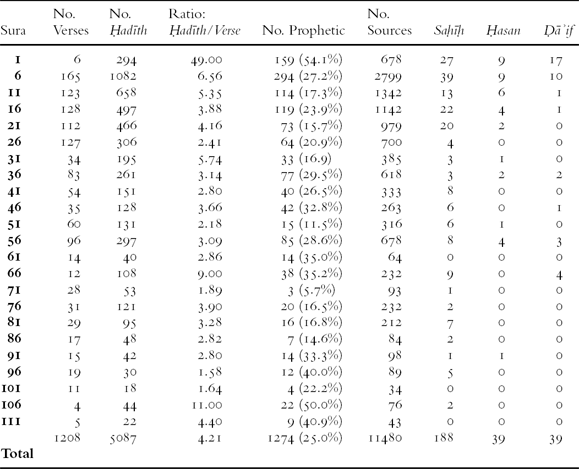
ādīth in the tafsīr, so this study takes a selection of sūras to produce a representative and manageable sample. To make the sample as objective as possible, the analysis has considered all sūras ending in a ‘1’ and a ‘6’ (i.e. Q. 1, 6, 11, 16, 21, 26, 31, 36. . ., 106, 111). This means that the survey includes twenty-three sūras, amounting to a total of 1,208 verses, which is roughly a fifth of the Qurʾānic text (19.37%). In the sample al-Suy
ī includes 5,087
ādīth. Whilst it is always desirable to make the sample as large as possible, it is not feasible to attempt a study of this work in its entirety, but the quantity of data involved produces enough material from which to begin to understand how al-Suy
ī employs his sources.
A General Overview of the Sample Data
The sample data (see Appendix A) show that the number of
ādīth found in the exegesis of each sūra varies quite widely, but the average is two to three
ādīth per verse, with the average of 4.21 in the table being augmented by the large quantity of
ādīth in Q. 1. Within each sūra al-Suy
ī typically treats blocks of verses rather than individual verses, and some of these blocks will generate more
ādīth than others. Verses that have particular theological significance often have a great number of
ādīth associated with them, as one can see from the high ratio of
ādīth to verses in Sūrat al-fāti
ā.Footnote
28
Conversely, some verses will have little or no comment.
The authorities of the
ādīth are not the main focus of this article, but the expected companions can be found readily:Footnote
29
Ibn ʿAbbās is the authority of the greatest number of
ādīth, being an authority for about a fifth of the
ādīth; Qatāda and Mujāhid also feature prominently. This is not surprising, as Qatāda, Mujāhid and especially Ibn ʿAbbās, as early mufassirūn, are often the most cited authorities in tafāsīr.Footnote
30
This indicates that al-Durr al-manthūr is firmly entrenched in the wider tafsīr tradition.
The use of Prophetic
ādīth is also interesting. The data shows that only a quarter of the
ādīth are Prophetic. This is quite a low percentage and much lower than some of al-Suy
ī's other
adīth collections, in which the Prophetic
ādīth usually amount to 40–50% of those included.Footnote
31
A low use of Prophetic
ādīth is not unusual in tafāsīr, as much of the material, such as lexicology, is not necessarily dependent on a Prophetic attribution.Footnote
32
Generally, there also appears to be little concern for authenticity of the
ādīth being cited. In the sample there are only 266
ādīth (5.23%) that have a comment regarding their strength, and these are largely incidental;Footnote
33
of these, most comments are those declaring
ādīth as being sound (
ī
). Al-Suy
ī does not make any statement regarding the soundness of the
ādīth himself, but the comments are given on the authority of another
adīth scholar. The majority of these statements, 163 out of the 266 (61.28%), are attributed to al-
ākim al-Nīsābūrī (d. 406/1016).
The last matter of concern for the general overview is the question of the number of sources used for each
adīth. The average for the sample is 2.26 sources per
adīth,Footnote
34
and large numbers of sources for a single
adīth are rare: there are only twenty-three
ādīth with more than ten sources (0.452%). The
adīth with the highest number of sources, sixteen, is found in Sūrat al-fāti
ā.Footnote
35
The question remains why al-Suy
ī thought that he needed to cite a
adīth from different sources – why did one not suffice? There are number of possible reasons: (i) practicality: al-Suy
ī cites a range of textual sources so that others can find particular
ādīth; (ii) hubris: al-Suy
ī intends to show his prowess in the
adīth literature; (iii) authority: by citing a number of different sources for a
adīth, al-Suy
ī is able to stress the
adīth's place in both the tafsīr and
adīth genres. The second and third possibilities seem to be the most likely. Al-Suy
ī was certainly not known for his modesty,Footnote
36
and a reader does get a sense that a particular
adīth is ‘very sound’ when a long line of sources is given, presenting the
adīth as mutawātir (commonly transmitted).Footnote
37
Looking at the tafsīr in a general way reveals something of the basic premise and function of the work. Al-Suy
ī is attempting to compile an exegesis based not on the tafsīr tradition, but, rather, in the
adīth tradition. Marston Speight comments:
The emergence of a full-blown work of tafsīr, such as the Jāmiʿ al-bayān of al-
 abarī (d. 310/922) [sic], from the same century as that of the great mu
addithūn, is striking evidence of the difference between the concerns of a mufassir and a mu
addith.Footnote
38
In al-Durr al-manthūr, al-Suy
ī blurs the separation between
adīth and tafsīr. Furthermore, there is a sense that al-Suy
ī's wider project for Qurʾānic Studies is to attempt to realign tafsīr with the
adīth sciences. This can be seen particularly strongly in his K. al-Itqān, in which many of the Qurʾānic sciences which he elaborates are intricately related to and dependent on the transmission of
ādīth.Footnote
39
Al-Suy
ī's use of
ādīth has led to an association of the work with Ibn Taymiyyan hermeneutics, and the relationship between
ādīth and tafsīr in al-Durr al-manthūr will be discussed in more detail below.
Data Analysis
The following sections will look at the range of authors mentioned in al-Durr al-manthūr and how al-Suy
ī employs them, through the data taken from the sample.Footnote
40
It will look at various author profiles that can be seen in the exegesis; it will look at why particular authors are cited frequently; and lastly, why certain authors are given limited attention or not cited at all. To achieve a fair comparison between the sūras in the sample, the analysis has been based on the ‘% of
ādīth used in a sūra’ (% used), i.e. the number of
ādīth cited by al-Suy
ī from a particular source in a sūra is represented as a percentage, rather than as the total number of
ādīth. The % used figure makes a comparison between Q. 6 and Q. 106 possible and fair. For example, al-Tirmidhī is cited ten times in Q. 21 and Q. 56, but his when the % used figure is considered, there is a difference in the frequency (2.15% in Q. 21 and 3.37% in Q. 56). Another example can be seen in the use of Ibn Mardawayh in Q. 1 and Q. 96. In Q. 1 he is cited twenty times (6.80%), and although he is cited less often numerically in Q. 96 (ten times), he dominates the exegesis of that sūra (33.3%).
Author Profiles
When analysing al-Suy
ī's al-Durr al-manthūr one of the most striking aspects of the data is that different authors are used in different ways. The data reveal four main author profiles. The first is of authors that are cited in every sūra, or the majority of the sūras in the sample, and who are also authors that are cited frequently in the exegesis of each indivudal sūra. There are four authors that have this profile: Ibn Abī
ātim, ʿAbd b.
amīd, Ibn Jarīr [al-
abarī] and Ibn al-Mundhir.Footnote
41
Taking ʿAbd b.
amīd as an example (see Appendices G-I), the data show that he features in all but one of the sūras, and that in fourteen of the twenty-three sūras he is used as a source for over 20% of the
ādīth. In only four sūras (Q. 11, 31, 106 and 111) is he cited in less than 5% of the material. Each of the four authors in this profile wrote tafsīr works, and al-Suy
ī refers to the exegeses of ʿAbd b.
amīd, along with his Musnad; the exegesis of Ibn Abī
ātim, as well as his al-Baʿth; the tafsīr of Ibn al-Mundhir, with no other work of his being mentioned; and to the Tafsīr of Ibn Jarīr al-
abarī. Al-Suy
ī also cites other exegeses, namely those of al-Firyābī, Ibn Mardawayh, Juwaybir, Mālik, Sufyān b. ʿUyanya and Wakīʿ. However, these are cited much less frequently and there is doubt as to whether some of these were extant in al-Suy
ī's lifetime.Footnote
42
The second group of authors are those who are cited in many or most of the sūras, but who do not feature prominently in each sūra. This is one of the largest groups of authors and includes: al-Bayhaqī, al-
ākim al-Nīsābūrī,
mad b.
anbal, Ibn Abī Shayba, Ibn Mardawayh, ʿAbd Allāh b.
mad, al-Bukhārī, al-Dāraqu
nī, Ibn Saʿd, al-Bazzār, Abū Yaʿla al-Maw
ilī, amongst many others. Al-
ākim al-Nīsābūrī is typical of this profile. The traditionist and critic al-
ākim al-Nīsābūrī is found in all but two of the sūras (Q. 61 and 111), so has a significant presence in the tafsīr as a whole, like those with the first profile. However, unlike the authors with the first profile, al-
ākim's presence in each of the sūras is much more limited, with an average % used of 5.05%, compared to ʿAbd b.
amīd's 25.12%. Whilst al-
ākim does not feature as prominently, he is cited regularly in each sūra, and is named as a source for over 2% of the
ādīth in all of the sūras in which he is found. The authors in the first profile were all mufassirūn (despite some being more readily identified with the
adīth sciences), but the authors in this second profile tend to be distinguished and well-known traditionists. Often these authors wrote works on specific Qurʾānic scienes, such as qiraʾāt, asbāb al-nuzūl and f
 āʾil al-Qurʾān material, which is why they are mentioned in a number of sūras, but only infrequently. These aspects of this author profile are important for understanding the overarching strategy of al-Durr al-manthūr and its reliance on the
adīth sciences along with the tafsīr tradition. One can also see the implementation of the ideas of al-Suy
ī's methodological ideas expressed in his K. al-Itqān, particularly the application of different modes of exegesis (i.e. the ʿulūm al-Qurʾān) to interpret the Qurʾānic text.
The third group of authors with a distinct profile are those who are not cited in many of the sūras, but are the source a large proportion of
ādīth in one or two individual sūras. Abū ’l-Shaykh, al-Nasāʾī, Abū Nuʿaym and Ibn Abī ’l-Dunyā are typical of this profile. For example, Abū ’l-Shaykh does not feature in all of the sūras, and except for four sūras (Q. 6, 11, 51 and 71) his contribution is relatively limited. However, in Q. 6 and Q. 11 he is a major source for al-Suy
ī's commentary, distorting his average % used somewhat: if these two sūras are discounted, his average % used figure drops from 5.98% to 2.63%. The authors with this profile are, in the main, compilers of m
annaf works with particular themes. Ibn Abī ’l-Dunyā typifies this sort of author, writing a number of short to medium length non-canonical collections,Footnote
43
often incorporating non-Prophetic
ādīth. In the sample al-Suy
ī cites twenty-four different works compiled by Ibn Abī ’l-Dunyā.
The last profile describes those authors that are mentioned infrequently, and are present in only one or two of the sūras. Many of these authors are only cited once in the whole sample (i.e. 0.0197% of source entries). In many cases, al-Suy
ī does not name the work from which he has cited these authors, so it is difficult to make any firm conclusions about their genre or specialisation. However, many of the authors are less well-known traditionists, and it is likely that an individual work, of which al-Suy
ī was aware, included a
adīth that was of benefit to his exegesis. It is possible that the sample has not caught some authors, but the size of the sample would suggest that those who are missing are likely to fit this fourth profile. This is, naturally, one of the problems with using a sample rather than looking at the whole text, but the size of the work makes such an approach unavoidable. However, the number of authors absent from the sample is likely to be relatively small.
By analysing the data in the sample closely it is possible to see different trends in al-Suy
ī's use of sources that might not have been apparent without it. The most crucial trend is that the four main author profiles are aligned with specific genres. It should be of no surprise that the principal sources are tafāsīr. As the main sources, they each feature prominently in al-Suy
ī's exegesis, but it should be stressed that there is not a single preferred author. Nolin has shown that al-Suy
ī's K. al-Itqān is based on al-Zarkashī's K. al-Burhān, in this case there appears to be evidence that he based his own work on a single text;Footnote
44
al-Durr al-manthūr is slightly different in that al-Suy
ī selects a quartet of authors instead of a single one. With one of the four often being the Urtext for individual sūras, to which al-Suy
ī adds from the wider
adīth literature, particularly texts from the supplementary genres of tafsīr.
Frequently Cited Authors and Missing Authors
Having seen the presence of four main profiles, it is now helpful to turn to specific authors: which are used the most? It has been seen that ʿAbd b.
amid, Ibn Jarīr al-
abarī, Ibn al-Mundhir and Ibn Abī
atim are the most frequently used authors, but if the scope is widened beyond the first profile, other trends can be seen. The table below shows the ten most cited authors by number of
ādīth and % used;Footnote
45
along with similar data from al-Suy
ī's K. al-Itqān.Footnote
46

Quite expectedly, the four most used authors in al-Durr al-manthūr are in the first author profile. The table also shows the importance of considering the % used figure as Abū ’l-Shaykh becomes less prominent when this is taken into consideration. This reflects the fact that he is used frequently in one or two sūras, but not often in the others. Also Ibn al-Mundhir and Ibn Abī Hātim alter places after this change. The more intriguing questions arise from a comparison with al-Suy
ī's K. al-Itqān. Some authors can be seen to be central in al-Suy
ī's mind, particularly Ibn Abī
ātim and al-Bayhaqī; and although al-
ākim al-Nīsābūrī is not in the list for al-Durr al-manthūr he is also fairly common in both texts. The absence of ʿAbd b.
amid and Ibn al-Mundhir is also interesting, as they become less important in al-Suy
ī's methodological considerations in K. al-Itqān. The differences are quite stark: seven of the ten most used authors in K. al-Itqān are used far less frequently in al-Durr al-manthūr. Ibn al-Anbārī, whilst cited in al-Durr al-manthūr is not a major source, and al-Zarkashī, Ibn al-Jazarī, Ibn al-
āʾigh and al-Zamakhsharī are not even cited at all.
This raises some important questions concerning the sources that al-Suy
ī includes in his exegetical and methodological works. Why does al-Suy
ī exclude some authors in one work, but not in another? Why are some important exegetes, such al-Thaʿlabī and al-Wā
idī, barely featured in al-Durr al-manthūr? These are difficult questions to answer, and, at best, one can only make reasonable suggestions. However, the presence of al-Zamakhsharī is the most illustrative. Al-Zamakhsharī's al-Kashshāf
Footnote
47
was widely studied by scholarsFootnote
48
and formed part of the curriculum in Mamluk colleges; yet was still, because of its heterodox theological positions, regarded with some suspicion.Footnote
49
Given this, references to al-Zamakhsharī are pertinent to a discussion of the Qurʾānic sciences, but not necessarily so in a
adīth-based exegesis. The form of al-Durr al-manthūr and the aims which al-Suy
ī had in composing it determines the types of sources included.Footnote
50
In his study of al-Suy
ī's relatively short work on cosmology, al-Hayʾa al-saniyya fī'l hayʾa al-sunniyya, Anton Heinen places al-Suy
ī's use of sources in a polemic context. For Heinen, al-Suy
ī's al-Hayʾa attempts to move Islamic scholarship on astronomy away from the Greek Ptolemaic tradition towards an orthodox Islamic
adīth-based context.
After the appearance of numerous kutub al-hayʾa. . .which were openly inspired by Ptolemy's Almagest, here at last was a book exclusively based on the traditional Islamic authorities. As such it may have been able to awaken the contemporary scholars to a consciousness of their Muslim heritage.Footnote 51
It is possible to view al-Durr al-manthūr in a similar, anti-tafsīr bi’l-raʾy context (as with Ibn Taymiyya). However, Heinen is, perhaps, a little overcritical of al-Suy
ī's intentions for al-Hayʾa, and there is a sense that Heinen partly blames al-Suy
ī for a stagnation in Islamic astronomical thought.Footnote
52
The motivation does not seem to be necessarily as polemical as Heinen suggests, and, likewise, there is nothing whatsoever to suggest that al-Durr al-manthūr should be seen as an attack on the more established and expected forms of tafsīr. If it were written in that vein, al-Suy
ī does not state that that was his intention for the work; and one would largely expect him to do so, were it the case. It would seem more appropriate to see the tafsīr, as well as his al-Hayʾa, as a more general attempt to realign contemporary academic disciplines with the
adīth literature.
The exclusion of certain, more heterodox exegeses from al-Durr al-manthūr would appear to be the result of an interest in establishing and promoting orthodoxy through the use of
ādīth. Al-Suy
ī generally avoids any works that conflict with his theological and jurisprudential world view, which would account for the absence of the mālikī exegesis of al-Qur
ubī, the
anbalī exegesis of Ibn al-Jawzī,Footnote
53
the muʿtazilī exegesis of al-Zamakhsharī and even al-Ba
 awī's more orthodox revision. Although Ibn Kathīr and al-Suy
ī were both Shāfiʿīs, Ibn Kathīr shows a strong alleigence to his teacher and mentor, Ibn Taymiyya, and is not cited in al-Durr al-manthūr. Furthermore, despite being a Sufi,Footnote
54
there are very few references to Sufi works of exegesis, although al-Qushayrī is mentioned in his K. al-Itqān.Footnote
55
Al-Suy
ī wrote works on Sufism,Footnote
56
including some books verging on mystical exegesis;Footnote
57
but expressly Sufi exegeses are absent from al-Durr al-manthūr. This indicates that al-Durr al-manthūr has a specific outlook and focus: although
ādīth are taken from a wide range of sources, al-Suy
ī appears to avoid works written by authors who approached the Qurʾān with a non-
adīth based hermeneutic. The inclusion of ʿAbd b.
amīd, Ibn Abī
ātim and Ibn al-Mundhir is important since they wrote works in a similar style, and al-Suy
ī utilises them in his own exegesis, despite being relatively unknown in the tafsīr tradition. Footnote
58
Al-Suy
ī obviously found them useful for his project and held them in high regard.Footnote
59
The Temporal Distribution of the Sources
One of the questions that al-Suy
ī's use of sources in al-Durr al-manthūr raises regards the periods from which al-Suy
ī's sources were taken. Does al-Suy
ī draw on early works written during the flourishing of
adīth and Qurʾānic studies, or does he rely on later works? The sample reveals some interesting points.
The centuries from which authors are largely taken are the third, fourth and fifth centuries
ijrī, but when the number of
ādīth are taken into account, the fourth becomes predominant, being the era from which over half of the
ādīth in the sample have been taken. A noticeable drop in the use of authors from the second and fifth centuries can also be seen when
ādīth are taken into account.
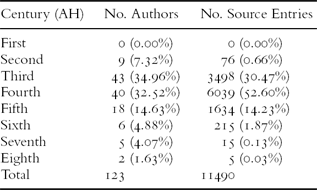
This distribution of al-Suy
ī's textual sources is intriguing. It shows an interest in overlooking more recent scholarship in Qurʾānic exegesis, and returning to earlier works. This would seem partly a result of al-Suy
ī's wish to compose a purely
adīth-based exegesis, rather than the more discursive and debate driven exegeses that can be found in the developed tafsīr tradition. It also reflects al-Suy
ī's greater expertise in the
adīth sciences.
Is such a reliance on material from the fourth century to be expected? In many respects the answer is yes: a great number of highly regarded works were written on the Qurʾān and the
adīth at this time. However, if one turns to al-Suy
ī's K. al-Itqān, he can be seen to engage with sources in quite a different way.

The K. al-Itqān shows a preference for the fourth to fifth centuries
irjī, but it is not as pronounced as in al-Durr al-manthūr, and there is greater parity in the K. al-Itqān over the centuries from which the sources are taken, with the K. al-Itqān relying on many authors dating from later centuries. The data show that al-Suy
ī specifically overlooked more recent scholarship in Qurʾānic exegesis and
adīth, and returned to earlier works. It is only when the data is placed in a wider context that the emphasis on the formative and classical periods of
adīth scholarship is made clearly apparent.
A Comparison of the Sources Employed by Ibn Kathīr and al-Suy
 ī
This article has, thus far, compared the use of sources in al-Suy
ī's al-Durr al-manthūr and his K. al-Itqān. It will also be beneficial to analyse the source material of al-Durr al-manthūr to Ibn Kathīr's Tafsīr. Ibn Kathīr (d. 774/1373) attempted to write a Qurʾān commentary based on the principles established by Ibn Taymiyya. Ibn Taymiyya proposes what Walid Saleh has called a ‘radical hermeneutics’, namely exegesis based on internal Qurʾānic citation, and
ādīth attributed to the companions of the Prophet or his companions.Footnote
60
Whilst Ibn Kathīr is often said to have begun to adopt Ibn Taymiyya's ‘radical hermeneutics’ in his Tafsīr, it did not break free from the tafsīr tradition completely, and, according to Saleh, it is not until al-Suy
ī that an exegesis was written “where only inherited interpretations from the salaf are recorded, with no additions, no editorial comments, and no philological explorations”.Footnote
61
The Ibn Taymiyyan method is an attack on the vast majority, if not all, of the tafāsīr written before him; because, as Norman Calder has argued, the Ibn Taymiyyan method creates the “possibility of tafsīr bi’l-
adīth which retrospectively casts the whole tradition into the shade of al-tafsīr bi’l-raʾy”.Footnote
62
The nature of the relationship between al-Suy
ī, Ibn Taymiyya and Ibn Kathīr needs to be examined in detail, for whilst al-Suy
ī employs a ‘radical hermeneutic’ method, there are a number of elements of al-Suy
ī's worldview that are incompatible with Ibn Taymiyya and Ibn Kathīr. Such a discussion deserves a treatment that cannot be met fully in this article, but the use of sources in al-Durr al-manthūr will begin to highlight differences in the exegetical approaches of al-Suy
ī and Ibn Kathīr.
The way in which Ibn Kathīr wrote his Tafsīr makes a direct statistical comparison with al-Suy
ī's al-Durr al-manthūr extremely difficult. Ibn Kathīr does not always give the sources of his
ādīth,Footnote
63
and he cites his material in a different way. The data sample taken has also been slightly smaller, comprising twelve sūras (all sūras ending in ‘1’, i.e. Q. 1, 11, 21. . . 111).Footnote
64
As with the sample taken from al-Durr al-manthūr, it is likely that some sources have not been captured, but it does provide a general overview of Ibn Kathīr's method and preferred sources.
In the data below one noticeable difference is found in the distribution of the sources between the second and fifth centuries
irjī. In terms of citations, both Ibn Kathīr and al-Suy
ī cite authors who died in the fourth century most frequently. However, Ibn Kathīr shows a greater preference for sources from the second and third centuries, whereas al-Suy
ī relies on later sources:

This trend is largely a result of Ibn Kathīr's preference for citing from the ‘seven books’, that is the
ī
s of al-Bukhārī and Muslim; the Sunans of al-Tirmidhī, al-Nasāʾī, Abū Dāʾūd and Ibn Māja (i.e. the ‘six books’); and the Musnad of
mad b.
anbal. Al-Suy
ī does cite from these works, but to a much lesser degree.

The data show the extent of Ibn Kathīr's reliance on these seven books, making up almost half of the citations in his Tafsīr (43.98%), as opposed to al-Suy
ī's much less frequent reference to them (only 8%). The ratio between the extent of quotation from the seven books by the two authors reveals Ibn Kathīr's preference for the
ī
ayn: roughly a third of the citations from the seven books are from al-Bukhārī and Muslim (30.29%), as opposed to the lower figure of 22.4% in al-Durr al-manthūr. Likewise, al-Suy
ī has a greater preference for al-Tirmidhī, Ibn Māja, Abū Dāʾūd and al-Nasāʾī. The almost identical use of Ibn
anbal (28.93% and 28.52%) shows the importance of the Musnad as source for both authors. These data present a number of questions: first, why does Ibn Kathīr rely far more heavily on the seven books? Second, why does Ibn Kathīr have a greater preference for the
ī
ayn? Last, what do these uses of source material indicate about the hermeneutic methods employed by al-Suy
ī and Ibn Kathīr?
The relationship between Ibn Kathīr and Ibn Taymiyya is much closer than that between al-Suy
ī and Ibn Taymiyya. Ibn Kathīr not only attempted to implement Ibn Taymiyya's ‘radical hermeneutics’, but was closely allied with his theological and epistemological worldviews; al-Suy
ī was not. Many of al-Suy
ī's theological opinions were incompatible with both Ibn Taymiyyan thought and al-Suy
ī's
anbalī contemporaries. For example, al-Suy
ī accepted the Mīlad al-Nabī celebrations,Footnote
66
and campaigned for the orthodoxy of Ibn al-Fār
 and Ibn al-ʿArabī.Footnote
67
It is, therefore, important to see al-Suy
ī's use of Ibn Taymiyya's ‘radical hermeneutics’ as an adoption of a method, but not necessarily hand in hand with a similar worldview.
The use of
ādīth establishes a link between the Ibn Taymiyyan method and al-Durr al-manthūr. However, when the types of
ādīth that are included in al-Durr al-manthūr are considered, a divergence between Ibn Taymiyya and al-Suy
ī can be seen. Ibn Taymiyya does not simply stress a need to return to
ādīth to perform exegesis, but a need to use authentic traditions from the Prophet and the salāf. This preference for authentic traditions can be seen in Ibn Kathīr's exegesis, and the high reliance on the seven books. Al-Suy
ī only uses
ādīth, but, as has been seen above, he is less concerned with authenticity. It would be wrong to suggest that al-Suy
ī was not at all concerned with the issue (and at times he does state whether a
adīth is
ī
,
asan, or
 aʿīf), but there is a far lesser desire to focus on the question of authenticity. Al-Suy
ī's greater reliance on later collections outside of the six ‘canonical’ collections and the Musnad of Ibn
anbal does not mean that the
ādīth were not authentic, but Ibn Kathīr's continual reference to
mad b.
anbal, Muslim and al-Bukhārī creates an image of orthodoxy and ‘soundness’ - something with which al-Suy
ī seems less concerned. As mentioned above, al-Durr al-manthūr does, on occasion, include ‘soundness clusters’, where a
adīth is cited from all or most of the seven books. These are, however, relatively rare, and appear to be a means by which al-Suy
ī can emphasize one particular tradition over others. Ibn Kathīr, on the other hand, is more interested in developing an ‘aura’ of soundness, running throughout his exegesis.
Al-Suy
ī's exegesis is a much longer work, which accounts for the lower utilisation of the seven collections. This is a crucial difference between al-Suy
ī and Ibn Kathīr. Al-Suy
ī includes a great many works from the supplementary genres of tafsīr, i.e. works concerned with f
āʾil al-Qurʾān, asbāb al-nuzūl, qiraʾāt etc. Al-Suy
ī also includes far more
ādīth from non-canonical collections. Whilst Ibn Kathīr does make use of authors such as Ibn Abī ’l-Dunyā, the presence of non-canonical collections is much reduced. The works outside of the seven books also tend to be muʿjam works written by scholars such as Ibn
ajar, al-
abarānī, ʿAbd al-Razzāq and al-Bazzār. Again, al-Suy
ī also makes much use of these works, but, in addition, he frequently consults shorter m
annaf collections, by authors such as Ibn Abī ’l-Dunyā and Abū ’l-Shaykh. It is in these additional sources that al-Suy
ī's hermeneutic method can be seen to markedly different to those of Ibn Taymiyya and Ibn Kathīr. Al-Suy
ī's al-Durr al-manthūr marks a bridge between the ‘traditional’ or ‘main-stream’ classical tafsīr tradition and Ibn Taymiyya's ‘radical Qurʾānic hermeneutics’.
Al-Suy
ī blends a
adīth-based approach with the traditional Qurʾānic sciences, as expounded in his own K. al-Itqān. The work is firmly entrenched in the tafsīr tradition, which is reflected in the types of sources from which al-Suy
ī draws. Comparing Ibn Taymiyya's Muqaddima (along with the introduction to Ibn Kathīr's Tafsīr) and al-Suy
ī's K. al-Itqān, a distinction can be made between the Ibn Taymiyyan reliance and stress on the Qurʾān, the sunna and the salāf being used to understand the Qurʾān, and al-Suy
ī's exposition of the Qurʾānic sciences as the vehicles of interpretation. A number of scholars have noted how Ibn Taymiyya uses ‘radical’ hermeneutic methods to undermine the positions taken by those with whom he disagreed,Footnote
68
and his approach to Qurʾānic studies shows similar objectives in attacking the vast body of tafsīr bi’l-maʾthūr works. The principle that separates al-Suy
ī from Ibn Taymiyyan Qurʾānic hermeneutics is that al-Suy
ī is working within the tafsīr tradition. He is not attacking the tafsīr tradition and this is reflected in his source materials.
Walid Saleh includes al-Suy
ī alongside Ibn Taymiyya and Ibn Kathīr. Perhaps unintentionally, there is the implication that all three presented a united front on how tafsīr should be done. There is much in al-Suy
ī's own worldview that shows that they differed significantly on a number of different issues. Al-Suy
ī was aware of Ibn Taymiyya, and cited him in some of his works. At times he agrees with Ibn Taymiyya (such as his views on logic),Footnote
69
at others they see the world quite differently. Regarding exegetical methods, al-Suy
ī does cite Ibn Taymiyya and Ibn Kathīr in his K. al-Itqān. Al-Suy
ī refers to Ibn Tamiyya infrequently; but he does feature in al-Suy
ī's section on asbāb al-nuzūl (the ‘Occasions of Revelation’).Footnote
70
Al-Suy
ī includes a long citation from Ibn Taymiyya which argues that even if a verse were revealed concerning a specific incident or person, the ruling is not just applicable in that situation or to that individual. Al-Suy
ī follows this with a note, stating the contrary, that there are instances of verses being revealed concerning specific persons (e.g. Abū Bakr in Q. 92:17–18). Al-Suy
ī supports this with evidence from none other than Fakhr al-Dīn al-Rāzī.Footnote
71
Ibn Taymiyya is used here as one source amongst a great many, and his thought does not appear to have had a significant impact on al-Suy
ī's Qurʾānic hermeneutics. In the latter half of this chapter on asbāb al-nuzūl al-Suy
ī exhibits are far more sophisticated approach to utilising this material, examining how to make judgments between competing asbāb;Footnote
72
and teasing out nuances in phraseology: for example, al-Suy
ī points out that the statement ‘and he recited’ in a sabab does not mean ‘and then the verse was revealed’.Footnote
73
Al-Suy
ī's engages with Ibn Kathīr to a greater extent, but, as with Ibn Taymiyya, Ibn Kathīr is one voice amongst many. At times al-Suy
ī agrees with him,Footnote
74
but he often disputes with him.Footnote
75
This indicates two things: first, that al-Suyūtī, despite using a similar hermeneutic method, did not always hold the same views as Ibn Taymiyya and Ibn Kathīr; and second, that al-Suy
ī is thoroughly immersed in the exegetical tradition and the debates within it.
Al-Durr al-manthūr and the Sunnī Tafsīr Tradition
In his recent article on the historiography of tafsīr, Walid Saleh argues that the tafsīr genre is genealogical because of its dependence on preceeding scholarship. He rightly argues that this “inherited corpus constituted a core that was continuously cited or, if not, purposefully discarded; thus even when not present, the core was determinative since it was foundational”.Footnote 76 Importantly, Saleh goes on to comment:
There was, moreover, a constant shuffle in the hierarchy of individuals who were considered authorities. The core of cited material was also added to, refined, reassessed, or simply rejected. We also witness the development of distinctive separate cores of tafsīr material. There was a
ūfī core, a Sunnī inherited core and a Shīʿī inherited core.Footnote
77
It is necessary to view Ibn Taymiyya's Qurʾānic hermeneutics as an attempt to challenge this core. The stress on the Qurʾān being used to interpret the Qurʾān is an attempt to circumvent the ‘core’ in the first instance, with some recourse to the ‘core’ when there is need to do so: “The point is that you should seek the interpretation of the Qurʾan from the Qurʾan itself, and if you do not find it there, then from the Sunna”. Footnote 78
There are problems generated by such a response to interpreting the Qurʾān, which can be seen in the later, more commonly published recension of the tafsīr, where Ibn Kathīr finds it necessary to draw “into his usual orbit the standard classical works of tafsīr (al-Zamakhsharī, al-Qur
ūbī and al-Rāzī)”.Footnote
79
In essence, Ibn Kathīr found it difficult to circumvent the tafsīr tradition in its entirety. It is possible to recognise the emergence of a new core, one which al-Suy
ī develops in his al-Durr al-manthūr. It is in al-Suy
ī's exegesis that one can see the relationship between this new emergent
adīth-orientated core and the wider Sunnī core: al-Durr al-manthūr bridges the gap. Although it is not entirely evident from the form that al-Durr al-manthūr takes, al-Suy
ī is blending two distinct cores: first, the Qurʾān and
adīth-based Ibn Taymiyyan method, seen in the use of scholars such as Ibn Abī
ātim and Ibn Mardawayh; alongside the more mainstream tafsīr tradition, seen particularly in his use of Ibn Jarīr al-
abarī. Al-Suy
ī's four main sources represent both exegetical ‘cores’. However, the main core of the tafsīr tradition is also represented in the use of the supplementary genres of tafsīr, from taʾrīkh to f
āʾil al-Qurʾān and lugha. The traditional Sunnī core and the ‘radical’ hermeneutics in al-Durr al-manthūr draw on a similar range of material.
Walid Saleh views al-Suy
ī's exegetical output as a “triad of works on tafsīr, incorporating the Tafsīr al-Jalālayn, al-Durr al-manthūr and his unfinished
ashiyya on al-Ba
awī”.Footnote
80
However, it is also necessary to read al-Durr al-manthūr in the context of his work on the modes of exegesis, his K. al-Itqān. In the work it is possible to see al-Suy
ī alluding to these two distinct cores (the
adīth-based and tafsīr-based) quite openly. In his introduction to the K. al-Itqān al-Suy
ī lists his principal sources, dividing them into different categories. He refers to
Books of tradition: the Qurʾānic commentaries of Ibn Jarīr, Ibn Abī
ātim, Ibn Mardawayh, Abū ’l-Shaykh, Ibn Habbān [sic], al-Firyabi, Abd al-Razzāq, Ibn al-Mundir, Saʿīd b. Man
ūr (his collection being a part of his Sunan), and al-
ākim (his collection being a part of his Mustadrak); the commentary on the Qurʾān of al-
āf
 Imād al-Dīn b. Kathīr; Fadāʾīl al-Qurʾān by Abū ʿUbayd; F
āʾil al-Qurʾān by Ibn al-
arīs [sic]; F
āʾil al-Qurʾān by Ibn Abī Shaybah; al-Masāhif of Ibn Ashtah, al-Masāhif by Ibn Abī Dawūd; al-Radd alā man khālafa Mishaf [sic] Uthmān by Ibn Abī Bakr al-Anbārī; Akhlāq Hamalat al-Qurāʾn by al-Ājari [sic], al-Tibyān fi Ādāb Hamalat al-Qurʾān by al-Nawawī; Sharh al-Bukhārī by Ibn Hajar; and other collections of traditions and narrations too numerous to be mentioned.Footnote
81
As well as including a final section which cites a number of standard Sunnī exegeses including: al-Zamakhsharī, Fakhr al-Dīn al-Rāzī, al-Isfahānī, al-Hūfī, Abū
ayyān al-Gharnā
ī, al-Qushayrī, Ibn al-Jawzī, Ibn ʿAqīl, al-Wā
idī, al-Māwardī, al-Juwaynī and (interestingly) Ibn Taymiyya.Footnote
82
These two lists are essential for gaining an understanding of what al-Suy
ī is trying to achieve in al-Durr al-manthūr. Notably, al-Suy
ī cites the tafsīr of Ibn Kathīr, listing it under ‘books of tradition’. He also cites Ibn Taymiyya, although only his Qawāʾid al-tafsīr. Between these two groups of exegeses, al-Suy
ī includes sources on: variant readings, philology and linguistics; law; ʿijāz al-Qurʾān; other subjects; orthography; and books ‘comprehensive in nature’.Footnote
83
Al-Suy
ī sandwiches all of these other subjects between works on tafsīr, both standard and
adīth-based. In effect, al-Suy
ī includes all of these supplementary works under the rubric of tafsīr.
Saleh interprets al-Suy
ī's vision of tafsīr as one in which “the place where individual atomised interpretive units are collated from the
adīth literature - tafsīr is just collation of already existing narrated material”.Footnote
84
There is a need, however, to see beyond the form and structure that al-Suy
ī employs in al-Durr al-manthūr, as it does the work some disservice to describe it as ‘just collation’. Saleh implies that collation precludes any argumentation, and that there is little possibility for engagement with the wider Sunnī tafsīr tradition (and the Sunnī ‘core’) and/or the development of nuanced exegetical positions. Al-Durr al-manthūr is much more complex than simply being a regurgitation or rearrangement of
ādīth. There are some notable instances of al-Suy
ī arguing unexpected positions, showing that al-Suy
ī is not simply throwing
ādīth at the Qurʾān to cobble together an exegesis, and that he deploys
ādīth carefully to force the reader to come to particular conclusions,Footnote
85
in much the same way as al-
abarī leads his readers to come to a specific reading - although al-
abarī is often open about his own views, whereas al-Suy
ī is not.
Al-Durr al-manthūr has a number of peculiar characteristics beyond the use of
ādīth only. One of these is the use of prayers and prayer formulae in the work, which are found far more readily than one would normally encounter. Prayers and prayer formulae appear in unusual places in the text, places where no other exegete includes them. One such example is in al-Suy
ī's treatment of the Light Verse (Q. 24:35). The first
adīth that al-Suy
ī includes is a prayer and its location is something that should, perhaps, be seen as being significant. The prayer is a famous one, appearing in al-Bukhārī's
ī
, so it is not surprising that al-Suy
ī should include it in al-Durr al-manthūr; but, it has very little to do with the Light Verse itself, save a reference to God being the ‘Light of the Heavens and the Earth’. Given the long list of God's titles in the prayer, it could have easily been placed elsewhere. The prayer reads:
O God! Praise be to You! You are the Lord of the Heavens and the Earth, and that which is in them! Praise be to You! You are the Light of the Heavens and the Earth, and that which is in them! Praise be to You! You are the Support (qiyām) of the Heavens and the Earth, and that which is in them! You are the Truth; Your voice is Truth; Your promise is Truth; Your meeting (with us) is Truth; the Garden is Truth; the Fire is Truth; the Hour is Truth!. . .Footnote 86
It is extremely rare for a tafsīr of the Light Verse to begin with reference to this or any other supererogatory prayer.Footnote
87
Al-Suy
ī actually includes three different prayers at the start of his exegesis of the Light Verse, before moving into his exegesis proper. Prayers are also readily found elsewhere in al-Suy
ī's exegesis, particularly in his tafsīrs of verses with particular significance, such as Sūrat al-Fāti
a, the Throne Verse and the Muʿawwidhatān.Footnote
88
Although often neglected as a part of his worldview, al-Suy
ī was a shādhilī and an active defender of Sufism. Al-Suy
ī's defence of Ibn ʿArabī is a case in point. From Ibn Taymiyya's assault on Ibn ʿArabī onwards,Footnote
89
the scholarly community had persistent concerns about his orthodoxy; a number of tracts were written in the late Mamluk period which denounced Ibn ʿArabī as a heretic, to which Sufi scholars responded and a relatively heated debate ensued.Footnote
90
Responding to an attack on Ibn ʿArabī by al-Biqāʿī in 888/1483, al-Suy
ī wrote a reply entitled al-Tanbīh al-ghābī fī takh
iʾat Ibn ʿArabī (The Warning to the Idiot concerning the Faulting of Ibn ʿArabī). In this work al-Suy
ī defends Ibn ʿArabī's Sufism and his orthodoxy, concluding that any of his more heterodox statements can be interpreted through allusion and allegory as being orthodox, and not kufr.Footnote
91
He similarly defended Ibn al-Fār
in his Qamʿ al-muʿārid fī n
rat Ibn al-Fārid, which shows al-Suy
ī embroiling himself in a similar public debate about the orthodoxy of Ibn al-Fār
in 875/1470. Al-Suy
ī's al-Durr al-manthūr was written in between these two defences of Sufism in 898/1493.Footnote
92
Is there, then, any trace of Sufism in al-Durr al-manthūr? The inclusion of prayers and prayer formulae suggest that al-Durr al-manthūr has some shādhilī leanings. The Shādhilīs are famed for their particularly strong focus on supererogatory prayers and the use of litanies.Footnote
93
This is not to say that other Sufis did not compose litanies (
zāb), but there is a great proliferation of them amongst the shādhilīs. Indeed, of the few works that have been handed down from al-Shādhilī himself all are litanies, and further litanies were composed by other Shādhilīs, such as Abū ’l-ʿAbbās al-Mur
ī and Ibn ʿA
āʾ Allāh al-Iskandarī. Al-Suy
ī also engaged in the genre, with his K. ʿAmal al-yawm wa’l-layla, a collection of prayers possibly aimed at the Sufi community.Footnote
94
In another work of his on angels, al-
abāʾik fī akhbār al-malāʾik, al-Suy
ī associates set prayers with the angels and with the Prophet.Footnote
95
Prayers, then, are an important part of al-Suy
ī's worldview. Although the inclusion of prayer formulae does not mean that the exegesis is ‘Sufi’, it does suggest that there is some influence of shādhilī ideas on al-Suy
ī's tafsīr.
If it is acknowledged that prayers formed an important part of shādhilī dhikr, al-Suy
ī's treatment of Q. 24:35 takes on a slightly different tone. Just as the prayer-dhikr is used as the entrance to mystical experience by shādhilīs, al-Suy
ī, likewise, begins his exegesis of the Light Verse with a prayer. Al-Suy
ī deploys
ādīth to articulate particular ideas; this may be being done extremely subtly, but it is there nonetheless. Such an employment of
ādīth by al-Suy
ī indicates an intricate engagement with the tafsīr tradition. The exegesis is not simply “collation of already existing narrated material” but a sophisticated manipulation of individual units of
ādīth to generate a specific response to the Qurʾān, with an underlying kerygmatic message hidden within it.
Another example of engagement with the tafsīr tradition can be seen in al-Suy
ī's handling of lexicological material. Al-Suy
ī was well acquainted with linguistic theory, writing a number of highly technical works in the field,Footnote
96
and this knowledge must surely have come to influence the way in which al-Suy
ī arranges the
ādīth he includes for the exegesis of a particular word. It would seem a mistake to presume that al-Suy
ī had no view on what a word meant. Importantly, in some circumstances al-Suy
ī's own view can be seen in the sections of the Tafsīr al-Jalālayn for which he was responsible. The Tafsīr al-Jalālayn presents a summary of lexical material, tending give only a single interpretation of a particular word, but the same word receives a full and explicated treatment in al-Durr al-manthūr. For example, al-Suy
ī only gives the the interpretation of fā
ir in Q. 35:1 as ‘badīʿ (originator)’ in the Tafsīr al-Jalālayn,Footnote
97
but he also gives the alternate reading of ‘khāliq’ in al-Durr al-manthūr.Footnote
98
Al-
abarī and al-Suy
ī often include the same debates about lexicology; it is just that the debates are harder to see in al-Durr al-manthūr. For example, the meaning of the word falaq in Q. 113:1 is discussed in most exegeses, and al-Suy
ī includes all of the main theories about its meaning.Footnote
99
Surely this is a sign of engagement with the tafsīr tradition? There are many other examples, and not simply of his treatment of lexical material, but a full discussion of this cannot be made easily here.
Walid Saleh views the works of Ibn Taymiyya, Ibn Kathīr, al-Suy
ī and al-Shawkānī (d. 1250/1832) as establishing a challenge to the classical Sunnī tradition, and creating a form of exegesis that almost refused to engage with it. Saleh also implies that
adīth-based exegesis cannot be innovative or articulate specific ideas. This is not the case with al-Durr al-manthūr. Although the form of the work implies that it is adopting Ibn Taymiyya's method of exegesis, there is little to suggest that al-Durr al-manthūr is working outside of the tafsīr tradition. Part of the reason for this is the absence of any interpretation of the Qurʾān qua Qurʾān. This is an essential part of the Ibn Taymiyyan-Ibn Kathīrian method and it is not found in al-Durr al-manthūr. Another reason for the differences between al-Durr al-manthūr and Ibn Kathīr's Tafsīr is that by the time al-Suy
ī has widened the scope of the traditions that are included in the exegetical project such a vast body of material is presented that makes the articulation of ideas possible, if not a necessity. With so many different exegetical opinions often being suggested at the same time the work would become unreadable, if there were no authorial input or control over the text. However, the work is readable, and, despite appearing as a gallimaufry of fragmentary exegetical units, provides logical and intelligible interpretations of the Qurʾān.
Conclusions
The relationship between
ādīth and tafsīr has always been complex.
ādīth have a role in tafsīr, and tafsīr plays a part in collections of
ādīth; but they remain quite distinct genres, and were often written by very different types of scholars. The exegete uses
ādīth, but only as part of a range of different methodological tools for explaining and interpreting the Qurʾānic text. The mu
addith was largely focused on the sunna of the Prophet; any Qurʾānic exegesis was subsidiary, almost irrelevant. However, in reality the interaction is even more complex, as many areas of exegesis, such as naskh, asbāb al-nuzūl, qiraʾāt etc., are heavily reliant on
ādīth; to which al-Suy
ī's K. al-Itqān is testament. Al-Durr al-manthūr, however, takes this relationship and makes it symbiotic, rather than distinct. Al-Suy
ī, as in many of his other works, appears to be attempting to reaffirm the primacy of
ādīth in scholarship.
Read in conjunction with another tafsīr one can see the debates contained within the tafsīr tradition, and how such debates are played out in the
adīth literature. Al-Suy
ī's al-Durr al-manthūr neither spurns the predominant Sunnī exegetical tradition, nor lacks the articulation of any nuanced opinions. It is possible to read al-Durr al-manthūr as a supplement to other exegeses, and to the Sunnī tafsīr tradition. A means by which someone reading an exegesis in the Sunnī core, can easily see the relevant
ādīth realted to a particular exegesis.
The use of sources reveal much about al-Suy
ī's aims for the work, and it has been shown that al-Suy
ī has chosen and rejected specific works. Al-Durr al-manthūr has four main sources, Ibn Abī
ātim, Ibn Jarīr al-
abarī, Ibn al-Mundhir and ʿAbd b.
amīd, some of whom are now largely forgotten and unknown, particularly as exegetes,Footnote
100
on top of whom al-Suy
ī adds further layers of exegetical interpretation from different sources. His use of sources shows that al-Suy
ī was using specific texts in particular ways, showing a great deal of care in the shaping and composition of the collection. The fact that a number of authors are missing, or are infrequently cited, is also important. From other works written by al-Suy
ī it is possible to see that he knew of the texts, making their absence from al-Durr al-manthūr all the more noticeable. Likewise, a comparison with al-Suy
ī's K. al-Itqān, shows that al-Suy
ī is specifically taking his
ādīth for al-Durr al-manthūr from texts written in a particular period, namely works of the ‘silver’ age of
adīth scholarship, namely the fourth and fifth centuries
ijrī.Footnote
101
It is also important to acknowledge that late mediaeval and Mamlūk scholarship had moved to a book-orientated culture, to which al-Suy
ī's al-Durr al-manthūr testifies in abundance.Footnote
102
In the Mamlūk period one can see a move to book citation, rather than personal citation; such a shift in academic practice undoubtedly changed the form works took in this period.
There are obvious similarities to the Qurʾānic hermeneutics of Ibn Taymiyya and Ibn Kathīr, but it is necessary to acknowledge that the employment of a similar methodology does not mean that al-Suy
ī shares a similar worldview. There is much in al-Suy
ī's writings to suggest the contrary. Whilst al-Suy
ī's decision to use
ādīth (and
ādīth only) in al-Durr al-manthūr established a link wih Ibn Taymiyya and Ibn Kathīr, it is misleading to suggest that this signals a rejection of the rest of the tafsīr genre. Indeed, al-Durr al-manthūr shows that al-Suy
ī was deeply engaged with the exegetical tradition. There is even a suggestion that al-Suy
ī is taking on the Ibn Taymiyyan method and challenging it: subverting the method from within. Al-Suy
ī takes a methodology that was intended to challenge and critique the Sunnī ‘core’ and makes it part of the Sunnī core itself.
Evidence of al-Suy
ī's debates with the tafsīr tradition in al-Durr al-manthūr may not be overtly apparent. At first sight the work does not appear to be articulating specific kerygmatic message; but, the arrangement of the
ādīth in the work, and the stress on certain themes, do show that it is possible to do so through the arrangement and selection of
ādīth. Just because al-Suy
ī does not say things openly does not mean that they are not being said.
Al-Suy
ī differs from Ibn Taymiyya and Ibn Kathīr in a two siginificant ways. First, al-Durr al-manthūr does not use the Qurʾān to interpret the Qurʾān - one of the principles of Ibn Taymiyya's radical hermeneutics. Second, al-Suy
ī casts the net of sources much more widely, including a significant increase in the number of
ādīth - this enables al-Suy
ī to engage with the exegetical tradition more fully.
It has not been possible to show in any great detail the ways in which al-Suy
ī manipulates the
ādīth in his collection to articulate a kerygmatic message, and much more research is necessary to do so. However, it has been seen that al-Suy
ī does, pace Saleh, engage with the Sunnī exegetical core and the debates found within it. The analysis of the sources of al-Durr al-manthūr reveals the way in which al-Suy
ī composed the work, basing it on four main sources, and adding to them from other works. The source analysis also highlights differences in the exegetical approaches of al-Suy
ī and Ibn Taymiyya-Ibn Kathīr. Above all, it is necessary to read al-Durr al-manthūr with care, as much of the debate and message contained within it can only be understood through an appreciation of the way in which the
ādīth are arranged by al-Suy
ī.
Appendix A – General Overview of the Sample Data
Appendix B – Authorities of the
ādīth
The following table shows the companions who are cited as authorities of ten
ādīth or more. In the sample al-Suy
ī uses over six hundred different authorities and many are just used once. The majority of the
ādīth are given a single authority, but there are occasions where more than one is given.

Appendix C Named Sources in al-Durr al-manthūr
The following is a list of the authors cited by al-Suy
ī in the sample taken from al-Durr al-manthūr. The first item in the list is the name used by al-Suy
ī when he cites an author, followed by the author's full name and date of death. Some of the authors have been difficult to locate in biographical dictionaries,Footnote
104
and, where possible, any references to written works given by al-Suy
ī in al-Durr al-manthūr have been used to corroborate an author's identity (see Appendix D). This has not been possible in all cases, and some attributions remain likely, yet unconfirmed, and in others there has been a degree of informed speculation, and these have been marked (?).Footnote
105
First Century
-
There is none.
Second Century
-
Ibn Abī Malayka; (d. 117/735-6)
-
Ibn Is
āq; Abū ʿAbd Allāh Mu
ammad b. Is
āq b. Yasār (d. 150/767-8) -
Juwaybir; Juwaybir b. Saʿd (d. 150/767)
-
Ibn Jurayj; ʿAbd al-Malik b. ʿAbd al-ʿAzīz b. Jurayj (d. 150/767-8)
-
Mālik; Abū ʿAbd Allāh Mālik b. Anas b. Mālik b. Abī ʿĀmir al-A
b
ī (d. 179/795-6) -
Ibn al-Mubārak; ʿAbd Allāh b. al-Mubārak b. Wādi
al-
a
alī (d. 181/797) -
Sufyān b. ʿUyayna; Sufyān b. ʿUyayna b. Maymūn al-Hilālī (d. 196/811-2 or 198/814)
-
Ibn Wahb; ʿAbd Allāh b. Wahb b. Muslim al-Fihrī al-Qurayshī (d. 197/812-3)
-
Wakīʿ; Wakīʿ b. al-Jarrā
b. Mulay
al-Ruʾāsī Abū Sufyān (d. 197/812-3)

Third Century
-
al-
ayālisī; Abū Dāʾūd Sulaymān b. Dāʾūd b. al-Jārūd al-
ayālisī (d. 203 or 204/818-20) -
al-Shāfiʿī; Abū ʿAbd Allāh Mu
ammad b. Idrīs b. al-ʿAbbās al-Shāfiʿī (d. 204/819-20) -
Dāʾūd b. al-Mu
abbar; Dāʾūd b. al-Mu
abbar b. Q
dham b. Sulaymān b. Shikwān al-
āʾī (d. 206/821-2) -
Is
āq b. Bishr; Abū
udhayfa Is
āq b. Bishr b. Mu
ammad al-Bukhārī (d. 206/821-2) -
al-Farrāʾ; Abū Zakariyyāʾ b. Ziyād b. ʿAbd Allāh b. Ma
ūr al-Daylamī al-Farrāʾ (d. 207/822-3) -
al-Wāqidī; Abū ʿAbd Allāh Mu
ammad b. ʿUmar al-Wāqidī (d. 207/823) -
ʿAbd al-Razzāq; Abū Bakr ʿAbd al-Razzāq b. Hammām b. Nāfiʿ al-
imyārī (d. 211/827) -
al-Firyābī; Abū ʿAbd Allāh Mu
ammad b. Yūsuf b. Wāqid al-Firyābī (d. 212/827-8) -
al-
umaydī; Abī Bakr ʿAbd Allāh b. al-Zubayr b. ʿĪsā al-
umaydī al-Asadī (d. 219/834-5) -
Ādām b. Abī Iyyās; Ādām b. Abī Iyyās Abū ’l-
asan al-Khurasānī al-ʿAsqalānī (d. 220/835) -
Abū ʿUbayd; Abū ʿUbayd al-Qāsim b. Sallām (d. 224/838-9).
-
Saʿīd b. Man
ūr; Abū ʿUthmān Saʿīd b. Man
ūr b. Shuʿba al-Khurasānī (d. 227/841-2) -
Musaddad; Musaddad b. Musarhad al-Asadī (d. 228/842-3)
-
Nuʿaym b.
ammād; Abū ʿAbd Allāh Muʿaym b.
ammad b. Muʿāwiya al-Khuzāʾī (d. 228/ 843) -
Ibn Saʿd; Abū ʿAbd Allāh Mu
ammad b. Saʿd b. Māniʿ al-Ba
rī al-Zuhrī Kātib al-Wāqidī (d. 230/844-5) -
al-ʿAdanī; Abū ʿAbd Allāh Mu
ammad b. Y
yā b. Abī ʿUmar al-ʿAdanī al-Darāwardī (d. 234/848-9) -
Ibn Abī Shayba; ʿAbd Allāh b. Mu
ammad b. ʿAbd Allāh b. Abī Shayba al-ʿAbsī al-Kūfī (d. 235/849-50) -
Ibn Rāhūyā / Ibn Rāhwayh; Abū Yaʿqūb Is
āq b. Ibrāhīm b. Makhlad b. Rāhūya [Rāhwayh] al-
a
alī al-Marwazī (d. 238/852-3) -
mad; Abū ʿAbd Allāh
mad b.
anbal (d. 241/ 855)
-
Hannād b. al-Sarī; Hannād b. al-Sarī b. M
ʿab al-Dārimī al-Kūfī (d. 243/857-8) -
Ibn Manīʿ; Abū Jaʿfar
mad b. Manīʿ b. ʿAbd al-R
mān al-Baghawī (d. 244/858-9) -
ʿAbd b.
amīd; Abū Mu
ammad ʿAbd b.
amīd b. Na
r al-Kissī (d. 249/863-4) -
amīd b. Zanjawayh (or Zanjūyah);
amīd b. Mukhlad b. Zanjuya b. Qutayba al-Azdī al-Nasāʾī (d. 251/865-6)
-
Khushaysh b. A
ram; Abū ʿĀsim Khushaysh b. A
ram b. al-Aswad al-Nasāʾī (d. 253/867) -
al-Bukhārī; Mu
ammad b. Ismāʿīl b. Ibrāhīm b. al-Mughīra al-Bukhārī al-Juʿfī (d. 256/870) -
al-Zubayr b. Bakkār; Abū ʿAbd Allāh al-Zubayr b. Bakkār b. ʿAbd Allāh b. M
ʿab al-Qurashī (d. 256/869-70) -
Ibn ʿAbd al-
akam; Abū ’l-Qāsim ʿAbd al-R
mān b. ʿAbd Allāh b. ʿAbd al-
akam (d. 257/870-1) -
Muslim; Muslim b. al-
ajjāj al-Qushayrī al-Nīsābūrī (d. 261/874-5) -
Sammūya; Abū Bishr Ismāʿīl b. ʿAbd Allāh b Masʿūd al-ʿAbdī Sammūya (d. 267/880-1)
-
Ibn Māja; Abū ʿAbd Allāh Mu
ammad b. Yazīd b. Mājah al-Qazwīnī (d. 273/887) -
Abū Dāʾūd; Abū Dāʾūd Sulaymān b. al-Ashʿath b. Is
āq al-Azdī al-Sijistānī (d. 275/889) -
al-Fāki
ī; Mu
ammad b. Is
āq b. al-ʿAbbās al-Fāki
ī (d. 275/888-9) -
al-Tirmidhī; Abū ʿĪsā Mu
ammad b. ʿĪsā b. Sawra al-
akīm al-Tirmidhī (d. 279/892) -
Ibn Abī ’l-Dunyā; Abū Bakr ʿAbd Allāh b. Mu
ammad b. ʿUbayd b. Abī ’l-Dunyā (d. 281/894) -
al-Dārimī; Abū Saʿīd ʿUthmān b. Saʿīd b. Khāid al-Sijistānī al-Dārimī (d. 282/895-6)
-
al-
ārith b. Abī Usāma; Abū Mu
ammad al-
ārith b. Mu
ammad b. Abī Usāma Dāhir al-Tamīmī al-Baghdādī (d. 282/895-6) -
al-Qālī; Abū ʿAlī Ismāʿīl b. al-Qālī al-Qālī (d. 288/901)
-
al-Jundīsābūrī; Abū Sahl al-Sarī b. Sahl al-Jundīsābūrī (d. 289/901-2)
-
ʿAbd Allāh b.
mad; Abū ʿAbd al-R
mān ʿAbd Allāh b.
mad b. Mu
ammad b.
anbal al-Shaybānī (d. 290/902-3) -
al-Bazzār; Abū Bakr
mad b. ʿAmr b. ʿAbd al-Khāliq al-Ba
rī al-Bazzār (d. 292/904-5) -
Ibn al-
urays; Abū ʿAbd Allāh Mu
ammad b. Ayyūb b. Y
yā b. al-
urays al-Bajalī al-Rāzī (d. 294/906-7) -
Mu
ammad b. Na
r; Abū ʿAbd Allāh Mu
ammad b. Ma
r al-Marwazī (d. 294/906-7) -
Mu
ammad b. ʿUthmān; Abū Jaʿfar Mu
ammad b. ʿUthmān b. Abī Shayba (d. 297/909-10)
Fourth Century
-
al-Nasāʾī; Abū ʿAbd al-R
man
mad b. ʿAlī b. Shuʿayb b. ʿAlī al-Nasāʾī (d. 303/915-6) -
al-
asan b. Sufyān; Abū ’l-ʿAbbās al-
asan b. Sufyān b. ʿĀmir al-Nasawī (d. 303/915-6) -
Abū Yaʿlā; Abū Yaʿlā
mad b. ʿAlī b. al-Muthannā al-Tamīmī al-Maw
ilī (d. 307/919-20) -
al-Rūyānī; Abū Bakr Mu
ammad b. Hārūn al-Rūyānī (d. 307/919-20) -
Ibn Jarīr; Abū Jaʿfar Mu
ammad b. Jarīr b. Yazīd al-
abarī (d. 310/923) -
Ibn Khuzayma; Abu Bakr Mu
ammad b. Is
āq b. Khuzayma al-Sulamī al-Nīsābūrī (d. 311/923-4) -
Abū ’l-ʿAbbās Mu
ammad b. Is
āq; Abū ’l-ʿAbbās Mu
ammad b. Is
āq b. Ibrāhīm b. Mihrān al-Sarrāj (d. 313/925-6) -
Abū ʿAwāna; Abū ʿAwāna Yaʿqūb b. Is
āq b. Ibrāhīm al-Nīsābūrī al-Isfarāyinī al-Shāfiʿī (d. 316/928-9) -
Ibn Abī Dāʾūd; Abū Bakr ʿAbd Allāh b. Abī Dāʾūd Sulaymān b. al-Ashʿath al-Azdī al-Sijistānī (d. 316/928-9)
-
Ibn al-Mundhir; Abū Bakr Mu
ammad b. Ibrāhīm b. al-Mundhir al-Mundhirī al-Nīsābūrī (d. 318/930-1) -
al-
āwī; Abū Jaʿfar
mad b. Mu
ammad b. Salāma b. ʿAbd al-Malik al-Azdī al-
āwī al-
ajrī (d. 321/933) -
al-ʿUqaylī; Abū Jaʿfar Mu
ammad b. ʿAmr b. Mūsā b. Hammād al-ʿUqaylī al-Hijāzī (d. 322/933-4) -
al-Kharāʾi
ī; Abū Bakr Mu
ammad b. Jaʿfar al-Kharāʾi
ī al-Sāmarrī (d. 327/938-9) -
Ibn Abī
ātim; Abū Mu
ammad ʿAbd al-R
mān b. Abī
ātim Mu
ammad b. Idrīs b. al-Mundhir al-Tamīmī (d. 327/938-9) -
Ibn al-Anbārī; Abū Bakr Mu
ammad b. al-Qāsim b. Mu
ammad b. Bishshār al-Anbārī (d. 328/940) -
al-M
āmilī; Abū ʿAbd Allāh al-
usayn b. Ismāʿīl b. Mu
ammad b. Ismāʿīl al-Dhabbī al-M
āmilī (d. 330/941-2) -
al-
aytham b. Kulayb; Abū Saʿīd al-
aytham b. Kulayb b, Shuray
al-Shāshī (d. 335/946-7) -
al-N
ās; Abū Jaʿfar
mad b. Mu
ammad b. Ismāʿīl al-N
ās (d. 338/949-50) -
al-Marwazī; Abū Bakr
mad b. Ibrāhīm al-Marwazī (d. 339/950-1) -
Abū Saʿīd b. al-Aʿrabī; Abū Saʿīd
mad b. Mu
ammad b. Ziyād b. al-Aʿrabī (d. 341/952-3) -
al-
astī; Abū ’l-
usayn ʿAbd al-
amad b. ʿAbd Allāh b. Mu
ammad al-
astī (d. 346/957-8) -
Ibn Qāniʿ; Abū ’l-
usayn ʿAbd al-Bāqī b Qāniʿ b. Mazrūq al-Umawī (d. 351/962-3) -
Ibn al-Sakan; Abū ʿAlī Saʿīd b. ʿUthmān b. Saʿīd b. al-Sakan al-Mi
rī al-Bazzār (d. 353/964-5) -
Ibn
ibbān; Abū
ātim Mu
ammad b.
mad b.
ibbān al-Bus
ī (d. 354/965) -
al-Ājurrī; Abū Bakr Mu
ammad b. al-
usayn b. ʿAlī al-Ājurrī (d. 360/970-1) -
al-Rahmahurmūzī; Abū Mu
ammad al-
usayn b. ʿAbd al-R
man b. Khallād al-Fārisī al-Rahmahurmūzī (d. 360/970-1) -
Ibn Ashtah; Abū Bakr Mu
ammad b. ʿAbd Allāh b. Ashtah al-I
bahānī (d. 360/970-1) -
al-
abarānī; Abū ’l-Qāsim Sulaymān b.
mad b. Ayyūb al-Lakhmī al-
abarānī (d. 360/970-1) -
Ibn al-Sunnī; Abū Bakr
mad b. Mu
ammad b. Is
āq b. Ibrāhīm al-Dīnawarī b. al-Sunnī (d. 364/974-5) -
Ibn ʿAdī; Abū
mad ʿAbd Allāh b. ʿAdī b. ʿAbd Allāh al-Jurjānī b. al-Qa
ān (d. 365/975-6) -
Abū ’l-Fat
al-Azdī; Abū ’l-Fat
Mu
ammad b. al-
usayn b.
mad al-Azdī al-Maw
ilī (d. 367/977-8) -
Abū ’l-Shaykh; Abū Mu
ammad ʿAbd Allāh b. Mu
ammad b. Jaʿfar b.
ayyān Abū ’l-Shaykh (d. 369/979-80) -
al-Ismāʿīlī; Abū Bakr
mad b. Ibrāhīm b. Ismāʿīl b. al-ʿAbbās al-Ismāʿīlī al-Jurjānī al-Shāfiʿī (d. 371/981-2) -
al-
ābūnī; Abū ʿUthmān Ismāʿīl b. ʿAbd al-R
mān b.
mad al-
ābūnī (d. 373/983-4) -
al-ʿAskarī; (?) Abū ʿAbd Allāh al-
usayn b. Mu
ammad b. ʿUbayd b.
mad al-ʿAskarī (d. 375/985-6) -
al-Dāraqu
nī; Abū ’l-
asan ʿAbd Allāh b. ʿUmar b.
mad b. Mahdī al-Dāraqu
nī (d. 385/995-6) -
Ibn Shāhīn; Abū
af
ʿUmar b.
mad b. ʿUthmān b. Shāhīn (d. 385/995-6) -
al-Kha
ābī; Abū Sulaymān
amd b. Mu
ammad b. Ibrāhīm b. al-Kha
āb al-Bustī al-Kha
ābī (d. 388/998) -
Ibn Manda; Abū ʿAbd Allāh Mu
ammad b. Is
āq b. Manda (d. 395/1005) -
al-Murhibī; Abū ’l-ʿAbbās ʿAbd Allāh b. ʿAlī b. Mu
ammad b. ʿAbd Allāh al-
ārith (d. 4th /9th century)
Fifth Century
-
Ibn Jumayʿ; Abū
usayn Mu
ammad b. Jumayʿ al-Ghassānī (d. 402/1011-12) -
al-
ākim; Abū ʿAbd Allāh Mu
ammad b. ʿAbd Allāh b. Hamdawayh al-
abbī al-
ākim al-Nīsābūrī (d. 406/1016) -
Ibn Mardawayh; Abū Bakr
mad b. Mūsā b. Mardawayh b. Fūrah al-I
fahānī (d. 410/1019-20) -
Abū Saʿīd al-Naqqāsh; Mu
amamd b. ʿAlī b. ʿAmr b. Mahdī al-I
fahānī al-Naqqāsh (414/1023) -
Tammām; Abū ’l-Qāsim Tammām b. Mu
ammad b. ʿAbd Allāh b. al-Junayd al-Rāzī (d. 414/1023-4) -
al-Lālakāʾī; Abū ’l-Qāsim Hibat Allāh b. al-
asan b. Man
ūr al-
abarī al-Lālakāʾī (d. 418/1027-8) -
al-Thaʿlabī; Abū Is
aq
mad b. Mu
ammad b. Ibrāhīm al-Thaʿlabī (d. 427/1035) -
Abū Nuʿaym; Abū Nuʿaym ʿAlī b. ʿAbd Allāh b. ʿAlī b. Is
āq al-I
fahānī (d. 430/1038-9) -
Abū Dharr al-Harawī; Abū Dharr ʿAbd b.
mad b. Mu
ammad b. ʿAbd Allāh al-An
ārī al-Harawī (d. 435/1043-4) -
Abū Na
r al-Sijzī; Abū Na
r ʿUbayd Allāh al-Wāʾilī al-Sijzī (d. 444/1052-3) -
al-Māwardī; Abū ’l-
asan ʿAlī b. Mu
ammad b.
abīb al-Māwardī (d. 450/1058-9). -
al-Bayhaqī;
mad b. al-
usayn b. ʿAlī al-Bayhaqī (d. 458/1065-6) -
usayn; Abū ʿAlī al-
usayn b. Mu
ammad b.
mad al-Marwarrūdhī al-Qā
ī (d. 462/1069-70)
-
Ibn ʿAbd al-Barr; Yūsuf b. ʿAbd Allāh b. Mu
ammad b. ʿAbd al-Barr al-Namrī al-Qur
ubī al-Mālikī (d. 463/1070-1) -
al-Kha
īb; Abū Bakr
mad b. ʿAlī b. Thābit al-Kha
īb al-Baghdādī (d. 463/1071) -
al-Wā
idī; Abū ’l-
asan ʿAlī b. ʿAlī b. Mu
ammad b. ʿAlī b. Mattūya al-Wā
idī al-Nīsābūrī (d. 468/1076) -
Ibn al-Naqūr; (?) Abū ’l-
usayn ʿAlī b. Mu
ammad b. ʿAlī b. ʿAbd Allāh b. al-Naqūr al-Baghdādī al-Bazzār (470/1077-8) -
al-Shirāzī; (?)Abū Is
āq Ibrāhīm b. ʿAlī b. Yūsuf al-Shīrāzī b. Fīrūzabādī (d. 476/1083-4)
Sixth Century
-
al-Bāwardī; Abū ’l-Muzaffar Mu
ammad b. Abī ’l-ʿAbbās b.
mad b. Mu
ammad al-Abīwardī (d. 507/1113-4) -
al-Baghawī; Abū Mu
ammad al-
usayn b. Masʿūd al-Farrāʾ al-Baghawaī (d. 510/1116-7 or 516/1122-3) -
Ibn ʿAsākir; Abū ’l-Qāsim ʿAlī b. al-
asan b. Hibat Allāh Thiqat al-Dīn b. ʿAsākir (d. 571/1176) -
al-Silafī; Abū ’l-
āhir
mad b. Mu
ammad b.
mad al-Silafī (b. Silafa) (d. 576/1180-1) -
al-Daylamī; Shams al-Dīn Abū Thābit Mu
ammad b. ʿAbd al-Malik al-Daylamī (d. 589/1193) -
Ibn al-Jawzī; Abū ’l-Farash ʿAbd al-R
mān b. ʿAlī b. Mu
ammad b. al-Jawzī (d. 597/1200-1)
Seventh Century
-
ʿAbd al-Qādir al-Ru
awī; Abū Mu
ammad ʿAbd al-Qādir b. ʿAbd Allāh al-Ru
awī al-
arranī al-
anbalī al-
affār (d. 612/1215-6) -
Ibn Qudāma; Muwaffaq al-Dīn Abū Mu
ammad ʿAbd Allāh b.
mad b. Mu
ammad b. Qudāma al-Maqdisī (d. 620/1223) -
al-
iyāʾ al-Maqdisī [al-
iyāʾ, or al-Maqdisī]; Abū ʿAbd Allāh
iyāʾ al-Dīn Mu
ammad b. ʿAbd al-W
īd al-Maqdisī (d. 643/1245-6) -
Ibn al-Najjār; Abū ʿAbd Allāh Mu
ammad b. M
mūd b. al-
assan b. al-Najjār Mu
ibb al-Dīn al-Baghdādī al-Shāfiʿī (d. 643/1245-6) -
Ibn Mālik; Jamal al-Dīn Mu
ammad b. ʿAbd Allāh b. Mālik al-
āʾī al-Jayjānī (d. 672/1273-4)
Eighth Century
-
al-Ashʿarī; (?) Mu
ammad b. Y
ya Mu
ammad b. Y
ya b. Abī Bakr b. Saʿd al-Ashʿarī (d. 741/1340-1) -
al-Dhahabī; Shams al-Dīn Abū ʿAbd Allāh Mu
ammad b. ʿUthmān b. Qaym
b. ʿAbd Allāh al-Turkumānī al-Fāriqī al-Dimashqī al-Shāfiʿī al-Dhahabī (d. 748/1347-8)

Appendix D – Works Cited in al-Durr al-manthūr
The data below simply presents the authors’ names and the titles of the works as given by al-Suy
ī in al-Durr al-manthūr. To see authors’ full names, see Appendix C. Each entry is followed by the number of times that the work is mentioned in the sample; however, it is important to note that the frequency that a work is cited by name does not necessarily reflect how frequently that source is actually used. Likewise, there are works that are not mentioned in the sample, such as al-Bukhārī's
ī
 , that are not named, but are likely to be the source of many
ādīth.
-
ʿAbd Allāh b.
mad: (i) Zuwāʾid al-Musnad [21]; (ii) Zuwāʾid al-Zuhd [6] -
ʿAbd al-Qādir al-Ru
awī: al-Arabaʿīn [1] -
ʿAbd al-Razzāq: al-M
annaf [16] -
ʿAbd b.
amīd: (i) Musnad [4]; (ii) Tafsīr [1] -
Abū Dāʾūd: (i) Marāsīl [3]; (ii) Nāsikh [16]; (iii) Sunan [1]
-
Abū Dharr al-
arawī: F
āʾil al-Qurʾān[4] -
Abū ’l-ʿAbbās Mu
ammad b. Is
āq; Taʾrīkh [1] -
Abū ’l-Shaykh: (i) al-A
ama [64]; (ii) F
āʾil al-Qurʾān [1]; (iii) al-Thawāb [3] -
Abū Na
r al-Sijzī: al-Ibāna [8] -
Abū Nuʿaym: (i) al-
alāʾil [16]; (ii) F
āʾil al-
āba [3]; (iii) al-
ilya [34]; (iv) al-Maʿrifa [3]; (v)
ifat al-janna [5]; (vi) Taʾrīkh I
bahān [1]; (vii) al-
ibb al-nabawī [1] -
Abū Sahl al-Sarrī b. Sahl al-Jundisabūrī:
adīth [1] -
Abū Saʿīd b. al-Aʿrabī: Muʿjam [1]
-
Abū ʿUbayd: (i) F
āʾil al-Qurʾān [12]; (ii) Gharīb al-
adīth [1] -
Abū Yaʿlā: Musnad [2]
-
al-ʿAdanī: Musnad [1]
-
mad: (i) al-Zuhd [40]; (ii) Musnad [5]
-
al-Ājurrī: al-Ruʿya [1]
-
al-Ashʿarī: F
āʾil al-
addīq [1] -
al-ʿAskarī: (i) al-Amthāl [1]; (ii) al-Muwāʿ
[1] -
al-Baghawī: Muʿjam al-
āba [4] -
al-Bayhaqī: (i) al-Adab [1]; (ii) al-Asmāʾ wa’l-
ifāt [62]; (iii) al-Baʿth [42]; (iv) al-Dakhal [1]; (v) Dalāʾil al-nubuwwa [44]; (vi) al-Khilāfiyyāt [1]; (vii) al-Maʿrifa [1]; (viii) al-Nushūr [1]; (ix) Kitāb al-Ruʾya [2]; (x) Shuʿab al-īmān [142]; (xi) Sunan [33] -
al-Bazzār: Musnad [1]
-
al-Bukhārī: (i) al-Adab [9]; (ii) Juzʾ al-Qirāʾa [1]; (iii) Taʾrīkh [14]
-
Dāʾūd b. al-Mu
abbar: Kitāb al-ʿAql [1] -
al-Dāraqu
nī: al-Afrād [5] -
al-Dārimī: Musnad [2]
-
al-Daylamī: Musnad al-Firdaws [5]
-
al-
iyāʾ al-Maqdisī: al-Mukhtāra [10] -
al-Firyābī: Tafsīr [2]
-
al-
ākim: (i) al-Kunā [4]; (ii) al-Mustadrak [3]; (iii) Taʾrīkh (Nīsābūr) [5] -
Hannād: al-Zuhd [1]
-
al-
ārith b. Abī Usāma: Musnad [1] -
al-
aytham b. Kulayb: (i) Musnad [1]; (ii) Sunan [1] -
usayn: al-Istiqāma [2]
-
Ibn ʿAbd al-Barr: (i) Kitāb al-Masʾala [1]; (ii) Taw
īd [1] -
Ibn ʿAbd al-
akam: Futū
Mi
r [3] -
Ibn Abī Dāʾūd: (i) al-Baʿth [2]; (ii) al-Ma
ā
if [2]; (iii) al-M
annaf [1]; (iv) Kitāb al-Mu
t
arīn [1] -
Ibn Abī ’l-Dunyā: (i) al-
wāl [2]; (ii) Kitāb al-Amal [1]; (iii) Kitāb al-ʿUqūbāt [2]; (iv) Dhamm al-gh
ab [2]; (v) Dhamm al-malāhī [5]; (vi) Dhikr al-mawt [8]; (vii) al-Duʿā [1]; (viii) Kitāb al-Faraj baʿda al-shidda [2]; (ix) Kitāb
usn al-
ann bi’llāh [1]; (x) Kitāb al-Khāʾifīn [1]; (xi) Kitāb Makāyid al-Shay
ān [1]; (xii) Kitāb al-Mamlūkayn [1]; (xiii) Kitāb Man ʿāsha baʿd al-mawt [1]; (xiv) Kitāb al-M
annaf [1]; (xv) al-R
ā [1]; (xvi) Kitāb al-S
āb [1]; (xvii) Kitāb al-
amt [1]; (xviii) Kitāb al-Shukr [1]; (xix) Kitāb al-Taqwā [1]; (xx)
ifat al-janna [3]; (xxi)
ifat al-nār [2]; (xxii) al-Tawba wa’l-laf
[1]; (xxiii) al-Yaqīn [1] -
Ibn Abī
ātim: (i) al-Baʿth [1]; (ii) Tafsīr [2] -
Ibn Abī Shayba: (i) al-M
annaf [14]; (ii) Taʾrīkh [1]; (iii) al-Zuhd [1] -
Ibn ʿAdī: al-Kāmil [3]
-
Ibn al-Anbārī: (i) al-Ma
ā
if [21]; (ii) al-M
annaf [8]; (iii) al-Waqf wa’l-ibtidāʾ [11] -
Ibn Ashtah: al-Ma
ā
if [2] -
Ibn ʿAsākir: (i) Makāyid al-Shay
ān [1]; (ii) Taʾrīkh (Dimashq) [3] -
Ibn al-
urays: Fadāʾil al-Qurʾān [9] -
Ibn
ibbān: (i) al-
aʿafāʾ [1]; (ii) Kitāb al-Thawāb [1] -
Ibn Jarīr: (i) al-T
dhib [1]; (ii) Tafsīr [1] -
Ibn al-Jawzī; Kitāb al-
adāʾiq [1] -
Ibn Jumayʿ: Muʿjam [1]
-
Ibn Khuzayma: Kitāb al-Basmala [1]
-
Ibn Manda: (i) Kitāb al-
wāl wa’l-īmān bi-suʿāl [3]; (ii) al-Maʿrifa [1]; -
Ibn Manīʿ: Sunan [1]
-
Ibn Mardawayh: Tafsīr [4]
-
Ibn Manīʿ: Musnad [1]
-
Ibn al-Mubārak: al-Zuhd [1]
-
Ibn al-Mundhir: Tafsīr [1]
-
Ibn al-Najjār: Taʾrīkh [1]
-
Ibn Qāniʿ: Muʿjam al-
āba [2] -
Ibn Qudāma: Kitāb al-Bukāʾ wa’l-riqqa (= Kitāb al-Riqqa wa’l-bukāʾ fi akhbār al-
āli
īn) [1] -
Ibn Saʿd: al-
abaqāt [4] -
Ibn Saʿīd al-Naqqāsh: Kitāb al-Q
āʾ [1] -
Ibn Shāhīn: (i) Musnad [2]; (ii) Sunan [1]
-
Ibn al-Sunnī: (i) ʿAmal al-yawm wa’l-layla [3]; (ii) al-
ibb al-Nabawī [2] -
al-I
fahānī: al-Taghrīb [1] -
Is
āq b. Rahwayh: (i) Musnad [2]; (ii) Sunan [1] -
al-Ismāʿīlī: Muʿjam [2]
-
Juwaybir: Tafsīr [1]
-
al-Kharāʾi
ī: (i) Makārim al-akhlāq [1]; (ii) Masāwī al-akhlāq [6] -
al-Kha
īb: (i) Jāmiʿ [5]; (ii) Kitāb al-masʾala [1]; (iii) al-Muttafiq wa’l-muftariq [1]; (iv) Kitāb al-Nujūm [7]; (v) Taʾrīkh [12]; (vi)
ālī al-talkhīs [7]; -
al-Kha
abī: al-Gharīb [1] -
Khushaysh b. A
ram: al-Istiqāma [1] -
al-Lālakāʾī: al-Sunna [2]
-
Mālik: (i) al-Muwa
āʾ [1]; (ii) Tafsīr [1] -
al-M
āmilī: al-M
annaf [1] -
al-Maqdisī:
ifat al-janna [1] -
al-Mar
abī: F
l al-ʿilm [1] -
al-Marwazī: (i) al-Janāʾiz [2]; (ii) Muʿjam al-shuʿarāʾ [1]
-
al-Mawārdī: Maʿrifat al-
āba [1] -
Mu
ammad b. Na
r: (i) Kitāb Allāh [1]; Kitāb al-
alāt [4] -
Musaddad: Musnad [5]
-
al-N
ās: (i) Nāsikh [7]; (ii) Taʾrīkh [2] -
Nuʿaym b. Hammād: al-Fitān [4]
-
al-Qālī: Amālī [1]
-
al-Rāmahurmuzī: al-Amthāl
-
al-
ābūnī: al-Miʾatayn [1] -
Saʿīd b. Man
ūr: Sunan [3] -
Sammūyah: al-Fawāʾid [1]
-
al-Shāfiʿī: al-Umm [3]
-
al-Shīrāzī: al-Alqāb [2]
-
al-Silafī: al-
ayrūwāt [1] -
Sufyān b. ʿUyayna: Tafsīr [2]
-
al-
abarānī: (i) al-Awsa
[34]; (ii) al-Dūʿāʾ [2]; (iii) Muʿjam al-kabīr [2]; (iv) Musnad al-Shāmī [1]; (v) al-
aghīr [4] -
Tammām: al-Fawāʾid [1]
-
al-
astī: Masāʾil [1] -
al-Tirmidhī: (i) al-Shamāʾil [1]; (ii) Nawādir al-
ūl [17] -
al-Wā
idī: A
bāb al-nuzūl [1] -
Wakīʿ: (i) al-Gharar [5]; (ii) Tafsīr [4]
-
al-Zubayr b. Bakkār: (i) Akhbār al-Madīna [1]; (ii) al-Muwaffaqiyyāt [3]

Appendix E Named Sources in the Sample taken from Ibn Kathīr's al-Tafsīr al-Kabīr
Sources also cited by al-Suy
ī in al-Durr al-manthūr are marked (*).
First Century
-
There is none cited.
Second Century
-
*Ibn Is
āq; Abū ʿAbd Allāh Mu
ammad b. Is
āq b. Yasār (d. 150/767–8) -
*Ibn Jurayj; ʿAbd al-Malik b. ʿAbd al-ʿAzīz b. Jurayj (d. 151/767–8)
-
al-Khalīl; Abū ʿAbd al-R
mān Ahmad b. ʿAmr b. Tamīm al-Farāhīdī al-Azdī al-Y
madī al-Ba
rī (d. c. 175/791–2) -
*Mālik; Abū ʿAbd Allāh Mālik b. Anas b. Mālik b. Abī ʿĀmir al-A
b
ī (d. 179/795–6) -
*Ibn al-Mubārak; ʿAbd Allāh b. al-Mubārak b. Wādi
al-
a
alī (d. 181/797) -
al-Walīd b. Muslim; Abū ’l-ʿAbbās al-Walīd b. Muslim al-Umawī al-Dismashqī (d. 195/810–11)
-
*Ibn ʿUyayna; Sufyān b. ʿUyayna b. Maymūn al-Hilālī (d. 196/811–2 or 198/814)
Third Century
-
*Abū Dāʾūd al-
ayālisī; Abū Dāʾūd Sulyamān b. Dāʾūd b. al-Jārūd al-
ayālisī (d. 203 or 204/818–20) -
*al-Farrāʾ; Abū Zakariyyāʾ b. Ziyād b. ʿAbd Allāh b. Ma
ūr al-Daylamī al-Farrāʾ (d. 207/822–3) -
*ʿAbd al-Razzāq; Abū Bakr ʿAbd al-Razzāq b. Hammām b. Nāfiʿ al-
imyārī (d. 211/827) -
*al-
umaydī; Abī Bakr ʿAbd Allāh b. al-Zubayr b. ʿĪsā al-
umaydī al-Asadī (d. 219/834–5) -
*Abū ʿUbayd; Abū ʿUbayd al-Qāsim b. Sallām (d. 224/838–9).
-
*Ibn Abī Shayba; ʿAbd Allāh b. Mu
ammad b. ʿAbd Allāh b. Abī Shayba al-ʿAbsī al-Kūfī (d. 235/849–50) -
*
mad; Abū ʿAbd Allāh
mad b.
anbal (d. 241/855) -
*ʿAbd b.
amīd; Abū Mu
ammad ʿAbd b.
amīd b. Na
r al-Kissī (d. 249/863–4) -
*al-Bukhārī; Mu
ammad b. Ismāʿīl b. Ibrāhīm b. al-Mughīra al-Bukhārī al-Juʿfī (d. 256/870) -
*Muslim; Muslim b. al-
ajjāj al-Qushayrī al-Nīsābūrī (d. 261/874–5) -
Abū ʿAbd Allāh; Abū ʿAbd Allāh Mu
ammad b. ʿAbd Allāh b. ʿAbd al-
akam (d. 268/881–2) -
*Ibn Mājah; Abū ʿAbd Allāh Mu
ammad b. Yazīd b. Mājah al-Qazwīnī (d. 273/887) -
*Abū Dāʾūd; Abū Dāʾūd Sulaymān b. al-Ashʿath b. Is
āq al-Azdī al-Sijistānī (d. 275/889) -
*al-Tirmidhī; Abī ʿĪsā Mu
ammad b. ʿĪsā b. Sawra al-Hakīm al-Tirmidhī (d. 279/892) -
Abū Zurʿa; ʿAbd al-R
mān b. ʿAmr b. ʿAbd Allāh al-Dimashqī (d. 280/893–4) -
*Ibn Abī ’l-Dunyā; Abū Bakr ʿAbd Allāh b. Mu
ammad b. ʿUbayd b. Abī ’l-Dunyā (d. 281/894) -
Abū
anīfa al-Dīnawarī; Abū
anīfa
mad b. Dāʾūd al-Dīnawarī (d. 281–290/894–903) -
*al-Dārimī; Abū Saʿīd ʿUthmān b. Saʿīd b. Khāid al-Sijistānī al-Dārimī (d. 282/895–6)
-
*al-Bazzār; Abū Bakr
mad b. ʿAmr b. ʿAbd al-Khāliq al-Ba
rī al-Bazzār (d. 292/904–5)
Fourth Century
-
*al-Nasāʾī; Abū ʿAbd al-R
man
mad b. ʿAlī b. Shuʿayb b. ʿAlī al-Nasāʾī (d. 303/915–6) -
*Abū Yaʿlā; Abū Yaʿlā
mad b. ʿAlī b. al-Muthannā al-Tamīmī al-Maw
ilī (d. 307/919–20) -
*Ibn Jarīr; Abū Jaʿfar Mu
ammad b. Jarīr b. Yazīd al-
abarī (d. 310/923) -
Abū Jaʿfar al-Rāzī; (?) Abū Jaʿfar Mu
ammad b. Qiba al-Rāzī (d. before 319/931–2) -
Abū
ātim al-Rāzī; Abū
ātim
mad b.
amdān al-Rāzī (d. 322/ 933–4) -
*Ibn Abī
ātim; Abū Mu
ammad ʿAbd al-R
mān b. Abī
ātim Mu
ammad b. Idrīs b. al-Mundhir al-Tamīmī (d. 327/938–9) -
*al-
abarānī; Abū ’l-Qāsim Sulaymān b.
mad b. Ayyūb al-Lakhmī al-
abarānī (d. 360/970–1) -
*Ibn ʿAdī; Abū
mad ʿAbd Allāh b. ʿAdī b. ʿAbd Allāh al-Jurjānī b. al-Qa
ān (d. 365/975–6) -
*al-Dāraqu
nī; Abū ’l-
asan ʿAbd Allāh b. ʿUmar b.
mad b. Mahdī al-Dāraqu
nī (d. 385/995–6) -
al-Jarīrī; Abū’l-Faraj al-Muʿafā b. Zakariyyā al-Nahrānī al-Jarīrī (d. 390/999–1000)
Fifth Century
-
al-Jawaharī; Abū ʿAbd Allāh
mad b. Mu
ammad b. ʿUbayd Allāh b. al-
asan al-Jawharī (d. 401/1010–11) -
*al-
ākim; Abū ʿAbd Allāh Mu
ammad b. ʿAbd Allāh b. Hamdawayh al-
abbī al-
ākim al-Nīsābūrī (d. 406/1016) -
*Ibn Mardawayh; Abū Bakr
mad b. Mūsā b. Mardawayh b. Fūrah al-I
fahānī (d. 410/1019–20) -
*al-Kha
īb; Abū Bakr
mad b. ʿAlī b. Thābit al-Kha
īb al-Baghdādī (d. 463/1071)
Sixth Century
-
*al-Baghawī; Abū Mu
ammad al-
usayn b. Masʿūd al-Farrāʾ al-Baghawaī (d. 510/1116–17) -
*Ibn ʿAsākir; Abū ’l-Qāsim ʿAlī b. al-
asan b. Hibat Allāh Thiqāt al-Dīn b. ʿAsākir (d. 571/1176) -
*Ibn al-Jawzī; Abū ’l-Faraj b. al-Jawzī (d. 597/1200–1)
Seventh Century
-
al-Qur
ubī; Abū ʿAbd Allāh Mu
ammad b.
mad b. Abī Bakr b. Faraj al-An
ārī al-Khazrajī al-Andalūsī al-Qur
ubī (d. 671/1272–3)
Eighth Century
-
Abū ’l-Hajjāj al-Mizzī; Jamāl al-Dīn Abū ’l-Hajjāj Yūsuf b. al-Zakīʿ ʿAbd al-R
mān b. Yūsuf al-Kalbī al-Qudāʿī al-Mizzī (d. 742/1341) -
Abū ʿAbd Allāh Mu
ammad b. ʿUthmān; Shams al-Dīn Abū ʿAbd Allāh Mu
ammad b. ʿUthmān b. Qaym
b. ʿAbd Allāh al-Turkumānī al-Fāriqī al-Dimashqī al-Shāfiʿī al-Dhahabī (d. 748/1348)
Appendix F Data Sample taken from Ibn Kathīr's al-Tafsīr al-Kabīr

Appendix G - Graphs of %used for Profiles 1–3

Appendix H: Author Source Data in al-Durr al-manthūr (
ādīth cited)

Appendix I: Author Source Data in al-Durr al-manthūr (%used)



