1. INTRODUCTION
Research and development of the sources of ultra-wideband (UWB) electromagnetic pulses have been intensively conducted already for over 20 years (Baum & Farr, Reference Baum, Farr, Bertoni, Carin and Felsen1993; Koshelev et al., Reference Koshelev, Buyanov, Kovalchuk, Andreev, Belichenko, Efremov, Plisko, Sukhushin, Vizir and Zorin1997; Agee et al., Reference Agee, Baum, Prather, Lehr, O'Loughlin, Burger, Schoenberg, Scholfield, Torres, Hull and Gaudet1998). The main parameter characterizing the sources of UWB radiation is the effective potential (or figure-of-merit, Agee et al., Reference Agee, Baum, Prather, Lehr, O'Loughlin, Burger, Schoenberg, Scholfield, Torres, Hull and Gaudet1998), defined as the product of the peak electric-field strength E p by the distance r in the far-field zone (rE p). Among the large number of research, we will mention only two directions which allowed creating the sources of UWB radiation with a multi-megavolt effective potential.
The first direction is related to the use of radiators of the impulse radiating antenna type with a large-diameter reflector in UWB sources (Giri et al., Reference Giri, Lackner, Smith, Morton, Baum, Marek, Prather and Scholfield1997; Sabath et al., Reference Sabath, Nitsch, Jung and Weise2002; Baum et al., Reference Baum, Baker, Prather, Lehr, O'Loughlin, Giri, Smith, Altes, Fockler, McMillan, Abdalla and Skipper2004). In the course of this research, radiation pulses of ~100 ps length with an effective potential of 5.4 MV were obtained at the JOLT setup (Baum et al., Reference Baum, Baker, Prather, Lehr, O'Loughlin, Giri, Smith, Altes, Fockler, McMillan, Abdalla and Skipper2004). UWB radiation sources of this type are simple in design but have low energy efficiency due to the use of a voltage pulse with a short rise time and long pulse decay.
The second direction which is developed in this work is related to the use of multi-element arrays excited with a bipolar voltage pulse through a power divider. Within the framework of this research, a combined antenna (CA) with an extended bandwidth (Koshelev et al., Reference Koshelev, Buyanov, Andreev, Plisko and Sukhushin2001; Andreev et al., Reference Andreev, Buyanov and Koshelev2005) and a bipolar pulse former (BPF) (Andreev et al., Reference Andreev, Gubanov, Efremov, Koshelev, Korovin, Kovalchuk, Kremnev, Plisko, Stepchenko and Sukhushin2003) were suggested. A line of high-power UWB radiation sources based on the excitation of 16-element arrays with bipolar voltage pulses of the length ranging from 0.2 to 2 ns (Gubanov et al., Reference Gubanov, Efremov, Koshelev, Kovalchuk, Korovin, Plisko, Stepchenko and Sukhushin2005; Efremov et al., Reference Efremov, Koshelev, Kovalchuk, Plisko and Sukhushin2007; Reference Efremov, Koshelev, Kovalchuk, Plisko and Sukhushin2011; Andreev et al., Reference Andreev, Efremov, Koshelev, Kovalchuk, Plisko and Sukhushin2011) was created, and radiation pulses with the effective potential ranging from 0.4 to 1.7 MV were obtained at a pulse repetition rate of 100 Hz. A feeder system, including in series a wave transformer of 50 Ω/3.125 Ω and a 16-channel power divider, was used in all these UWB sources. This feeder system limited the number of the elements in the array.
A new feeder system in which a wave transformer and a power divider were combined into a unified device was suggested for a 64-element array (Koshelev et al., Reference Koshelev, Plisko, Sukhushin, Sabath, Giri, Rachidi and Kaelin2010). In the UWB source with a 64-element array excited with a bipolar voltage pulse of the length τp = 1 ns and amplitude of 200 kV at the pulse repetition rate of 100 Hz, radiation pulses with the effective potential of 2.8 MV (Koshelev et al., Reference Koshelev, Efremov, Kovalchuk, Plisko and Sukhushin2008) were obtained. However, radiation stability was low, which was caused by the electrical breakdowns in the BPF made on the basis of radial lines. Additionally, transformer oil was used for electrical insulation of coaxial lines of the feeder system resulting in large energy losses.
The goal of this work is to improve the stability and the effective potential of radiation of the UWB source with a 64-element array by creating a new BPF and reducing energy losses in the feeder system.
2. DESIGN OF THE SOURCE
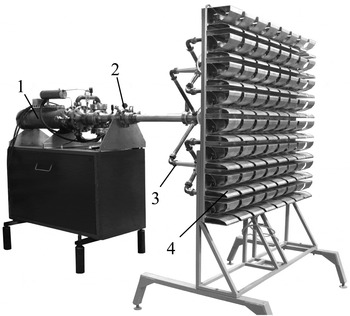
The main components of the source are the following: a monopolar pulse generator, a bipolar pulse former, a power divider, and a transmitting UWB antenna array. Figure 1 presents a physical configuration of the source.
Physical configuration of the source. (1) monopolar pulse generator, (2) bipolar pulse former, (3) power divider, (4) transmitting 64-element array.

A monopolar pulse generator is based on the coaxial line with a built-in Tesla transformer of the SINUS-200 type (Mesyats et al., Reference Mesyats, Korovin, Gunin, Gubanov, Stepchenko, Grishin, Landl and Alekseenko2003). A distinctive feature of this generator is a more high-voltage primary circuit of the Tesla transformer. A monopolar voltage pulse is applied from the generator to the BPF input. The BPF converts a monopolar pulse into a bipolar one of the length τp = 1 ns and amplitude of 200 kV.
The bipolar pulse with the peak power of 3.2 GW enters the input of the power divider by a coaxial line with the wave impedance of 12.5 Ω and is divided into 64 channels. The pulses synchronously enter the inputs of the array (8 × 8) elements by the feeder lines with the wave impedance of 50 Ω. The array elements are CA optimized for bipolar voltage pulses of the length τp = 1 ns. The antennas with a transverse dimension of 15 × 15 cm are placed on a metal plate with a period d = 18 cm in two perpendicular directions. The transverse array size is 141 × 141 cm. Radiation pulses from all elements of the array are added synchronously in the far-field zone, forming a wave beam with a pattern full width at half maximum by the peak power of 10°.
The design details of the UWB source and its operation modes are presented below.
3. BIPOLAR PULSE GENERATOR
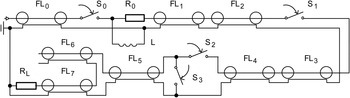
A bipolar voltage pulse generator consists of a monopolar pulse generator, a preliminary sharpening stage, and a BPF. In the circuit diagram of the bipolar voltage pulse generator shown in Figure 2, the monopolar pulse generator is presented by an output forming line FL 0 with the wave impedance of 28.3 Ω and electric length of 3.9 ns and by a gas gap switch S 0. This line could be charged from the Tesla transformer secondary up to the maximum voltage of 485 kV during 4 µs with the pulse repetition rate of 100 Hz. A stage of preliminary sharpening involves a limiting resistor R 0, a leakage inductance L, transmitting FL 1 and intermediate FL 2 lines, and a gas gap switch S 1. The transmitting line FL 1 with variable wave impedances from 65 to 88 Ω connects the gas gap switch S 0 with the line FL 2.
Functional diagram of a bipolar pulse generator.

A BPF is assembled in the circuit with an open line which includes the lines FL 3–FL 7, sharpening S 2 and crowbar S 3 switches, and a load R L = 12.5 Ω. The leakage inductance L serves to remove residual charge at the electrodes of the switches S 0 and S 1 by the moment of generation of the following voltage pulse. Resistor R 0 allows reducing voltage oscillations in the circuit FL 0 – S 0 – R 0 – FL 1 – FL 4 – S 1 – S 2 after the bipolar pulse formation and decreasing the erosion of the switch electrodes.
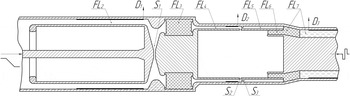
Figure 3 shows the design of a preliminary sharpening stage and a BPF. It consists of two gas volumes and the oil one. In the first volume, in the nitrogen atmosphere under the pressure of 85 atm, the lines FL 1 and FL 2, the switch S 1, and a capacitive voltage divider D 1 are placed. The line FL 1 is not shown in Figure 3. Electrodes of the switch S 1 are made of copper and installed with a 2.8 mm gap. In the second volume, under the nitrogen pressure of 87 atm, the lines FL 4 and FL 5, a capacitive voltage divider D 2, and the switches S 2, S 3 are located. The lines FL 3, FL 6, and the left side of the line FL 7 are insulated with polyamide and serve simultaneously as the bushings. Electrodes of the switches S 2 and S 3 are the copper inserts at the ends of the internal conductors of the lines. The inter-electrode gaps in the switches S 2 and S 3 are equal to 1.7 and 1 mm, respectively. The lines FL 2, FL 4, FL 5 have the wave impedances of 6.25 Ω.
Design of a preliminary sharpening stage and a bipolar pulse former.

The internal diameters of the lines FL 4 and FL 5 are equal to 68 mm. In contrast to the previous work (Koshelev et al., Reference Koshelev, Efremov, Kovalchuk, Plisko and Sukhushin2008), where the forming line was made in the form of series-connected disk lines and switching of the lines was performed with a 15 mm diameter ring switch, in this case a coaxial line with a 68 mm diameter ring switch is used to increase the electric strength. The capacitive dividers D 1 and D 2 are not calibrated and serve to estimate the charging time of the intermediate FL 2 and forming FL 4 lines. The right side of the transmission line FL 7 is an oil-filled coaxial with the wave impedance of 12.5 Ω. Inside the coaxial, a coupled-line divider D 3 is installed to record an output bipolar voltage pulse by means of a 6 GHz frequency-band TDS 6604 oscilloscope. The load R L was a water line with losses (is not shown in Fig. 3).
The charging voltage pulses entered the line FL 2 from the monopolar pulse generator. After series operation of the switches S 1–S 3, the output voltage pulse was removed to the load R L through the transmission line FL 7. The adjustment of the bipolar voltage pulse generator consisted in the series setting of the gaps and pressures in the switches S 1–S 3. The delay time of operation of the sharpening switches S 1 and S 2 was chosen so that their breakdown occurred near the maximum charging voltage of the lines FL 2 and FL 4, without misses at a pulse repetition rate of 100 Hz. Then, a symmetrical waveform of the output bipolar pulse was achieved by adjusting the gap in the crowbar switch S 3. Thus, the delay time of breakdown of the switches S 1 and S 2 was 7.3 and 1.7 ns, respectively.
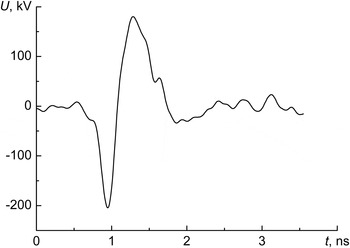
The output bipolar voltage pulse recorded from the divider D 3 and presented in Figure 4 has the voltage amplitudes of −205 kV and +180 kV and the length τp = 1 ns at the level of 0.1 of the amplitudes. A root-mean-square deviation of the voltage amplitude is no higher than 4%. The pulse energy absorbed by the matched load of 12.5 Ω is equal to 1.2 J that is 9% of the energy stored in the forming line FL 0.
Output voltage pulse waveform.

Due to a high rate of the voltage rise at the electrodes of the switches S 2 and S 3, a multichannel commutation of the lines with the wave impedance of 6.25 Ω by means of the 68 mm diameter ring switches was obtained. In comparison with the previous work (Koshelev et al., Reference Koshelev, Efremov, Kovalchuk, Plisko and Sukhushin2008), the rate of the negative voltage rise at the BPF output increased by a factor of 1.4.
4. POWER DIVIDER
To transmit a bipolar voltage pulse from the generator to the antenna array elements, a previously designed (Koshelev et al., Reference Koshelev, Plisko, Sukhushin, Sabath, Giri, Rachidi and Kaelin2010) 64-channel power divider with simultaneous impedance conversion is used. Structurally, the 64-channel power divider consists of three series-connected stages of four-channel dividers. At the input of the first stage, the wave impedance equals to the one of a 12.5 Ω bipolar pulse generator at its output. At the initial part of the arm of the divider first stage, the wave impedance is 12.5 × 4 = 50 Ω. The total impedance of the feeders of 16 array elements, which is loaded by each arm of the first stage, equals to 50/16 = 3.125 Ω, while the total impedance of the feeders of 64 array elements equals to 50/64 ≈ 0.78 Ω. A compensated exponential junction was used for the impedance conversion. The total length of one arm of the divider is 1.2 m.
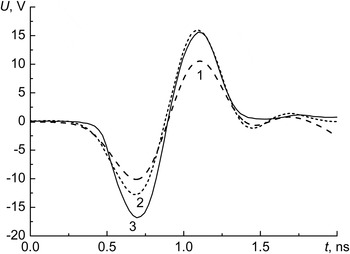
In the previous works (Koshelev et al., Reference Koshelev, Efremov, Kovalchuk, Plisko and Sukhushin2008; Reference Koshelev, Plisko, Sukhushin, Sabath, Giri, Rachidi and Kaelin2010), the transformer oil was used as an insulator for the feeder system. Due to the great losses in the transformer oil, the feeder system lost up to 50% of the power. Romanchenko et al. (Reference Romanchenko, Rostov, Gubanov, Stepchenko, Gunin and Kurkan2012) have shown that using the vacuum oil instead of the transformer one results in a reduction of power losses. Low-voltage tests of the feeder system of a 64-element antenna array have shown that using the BM-1 vacuum oil allows decreasing power losses up to 30%. Figure 5 presents the waveforms of the voltage pulses at the output of the feeder system of a 64-element array when using the transformer (curve 1) and the vacuum (curve 2) oils. For comparison, a voltage pulse waveform in the assumption of absence of the losses is presented (curve 3).
Voltage pulse waveforms from one of the outputs of a 64-channel power divider when using the transformer (1), the vacuum (2) oils and in the absence of power losses (3).

5. RADIATION OF ULTRAWIDEBAND PULSES
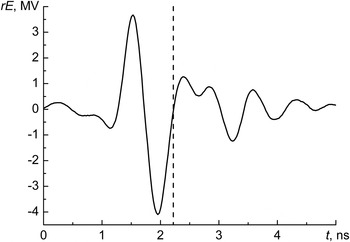
The array was excited with a high-voltage pulse presented in Figure 4. Radiated pulse was recorded by means of a TEM-horn mounted at a 10.5 m distance in the pattern maximum using a LeCroy WaveMaster 830Zi oscilloscope with the frequency band of 30 GHz. Figure 6 shows the waveform of the radiated pulse. Due to the features of the room in which the measurements were carried out, after a dashed line the pulse is superimposed by the reflections from the surrounding metal objects. In these measurements, the product of the peak field strength by the distance reached 4.1 MV.
Waveform of the pulse radiated by a 64-element array.

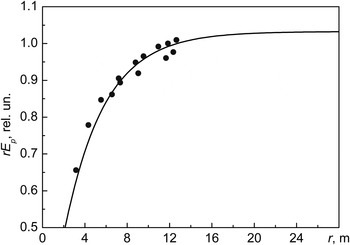
In order to determine the effective potential of radiation, it is necessary to define the far-field zone boundary. For this purpose, we will use the relation for the harmonic signals r = 2D 2/λ0, where λ0 = τpc, τp is the length of a bipolar voltage pulse at the input of the feeder system, c is the velocity of light, D is the maximum transverse dimension of the antenna array. Previous researches (Gubanov et al., Reference Gubanov, Efremov, Koshelev, Kovalchuk, Korovin, Plisko, Stepchenko and Sukhushin2005; Efremov et al., Reference Efremov, Koshelev, Kovalchuk, Plisko and Sukhushin2011) have shown the validity of using this relation for estimation of the far-field zone boundary at excitation of the antenna arrays with bipolar pulses. This estimation of the position of the far-field zone boundary corresponded to the criteria rE p ≈ const used in the measurements. This is caused by the fact that the energy of the radiated UWB pulse is concentrated near the central frequency with the wavelength λ0. The position of the far-field zone boundary for a 64-element antenna array excited with a bipolar voltage pulse of the length τp = 1 ns according to the foregoing relation is r = 26.7 m. Since measurements of rE p for a 64-element antenna array were carried out at a distance of 10.5 m, then basing on the previously performed research of a 4 × 4 array excited with a bipolar pulse of the length 2 ns (Gubanov et al., Reference Gubanov, Efremov, Koshelev, Kovalchuk, Korovin, Plisko, Stepchenko and Sukhushin2005), where the criterion rE p ≈ const was realized, the extrapolation of the rE p(r) dependence was tracked for a 64-element antenna array up to the boundary of the far-field zone (Fig. 7). In this figure, the points show the previously received measurement results for the 64-element array (Koshelev et al., Reference Koshelev, Efremov, Kovalchuk, Plisko and Sukhushin2008; Reference Koshelev, Plisko, Sukhushin, Sabath, Giri, Rachidi and Kaelin2010). From these data it follows that the effective potential of radiation rE p determined in the far-field zone is 5.8% higher than the value rE p(r = 10.5 m) making up 4.3 MV.
Value rE p versus distance.

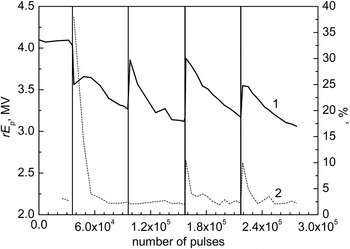
The stability and the operating time of the source of UWB radiation has been tested at a pulse repetition rate of 100 Hz (Fig. 8). Every 10 minutes of continuous operation were followed by an hour interruption to cool the BPF. At the beginning of the series, the nitrogen pressure in the switches was of 84–86 atm and after 10 minutes of operation it rises by 2 atm. With that, the value of rE p decreased by 20%. The bipolar voltage amplitudes reduce as well but the pulse length had no changes. Cooling of the BPF resulted in no full restoration of the initial value rE p = 4.1 MV. A root-mean-square deviation σ of the value rE p was significant at the beginning of ten-minute pulse trains and decreased to the value of ~3%. For a long-term continuous operation with small changes in the value rE p, it is necessary to use forced cooling of the BPF and pressure adjustment in the switches, which is the subject of further research.
Effective potential of radiation (1) and its root-mean-square deviation (2) versus the number of pulses.

6. DISCUSSION
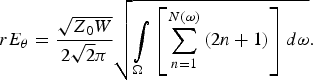
To compare two developing directions of high-power UWB sources, it was interesting to use the relation proposed by Belichenko et al. (Reference Belichenko, Koshelev, Plisko, Buyanov and Litvinov2006) to estimate the limiting effective potential of radiation of an arbitrary antenna
 $$r{E_{\rm \theta} }=\displaystyle{{\sqrt {{Z_0}W} } \over {2\sqrt 2 {\rm \pi} }}\sqrt {\vint\limits_\Omega {\left[{\sum\limits_{n=1}^{N\left({\rm \omega} \right)} {\left({2n+1} \right)} } \right]d{\rm \omega} } }.$$
Here Z0 is the free-space wave impedance, W is the pulse energy at the antenna input radiated with a 100% efficiency, N = [ω0a/c + 2π], ω0 is the central cyclic frequency of radiation spectrum, 2Δω is the radiation spectrum width determined by the level of −10 dB, Ω = {ω0 − Δω < ω< ω0 + Δω} is the integration region, a is the radius of an imaginary sphere inside which a radiator is located.
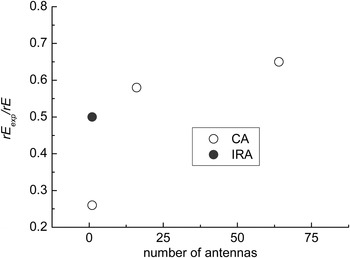
To make a comparative analysis of various radiators, we will use an efficiency factor determined as the ratio of the experimentally measured potential to the limiting one: k = rE exp/rEθ. As it follows from the data presented in Figure 9, a single CA (k = 0.26) (Gubanov et al., Reference Gubanov, Efremov, Koshelev, Kovalchuk, Korovin, Plisko, Stepchenko and Sukhushin2005) is significantly less effective than a 3.66 m diameter impulse radiating antenna (k = 0.5) (Giri et al., Reference Giri, Lackner, Smith, Morton, Baum, Marek, Prather and Scholfield1997). For a 16-element array CA (Gubanov et al., Reference Gubanov, Efremov, Koshelev, Kovalchuk, Korovin, Plisko, Stepchenko and Sukhushin2005), the efficiency factor k = 0.58, while for a 64-element array CA, k = 0.65 at a maximum transverse dimension D = 2 m. Hence, as it follows from the data presented above, the efficiency of the radiator increases with the rise of the number of elements in the array despite the energy losses in the feeder system.
Measured effective potential of radiation versus the limiting one for various radiators.

To estimate UWB radiators, an efficiency factor by the peak field strength is used widely which is determined as the ratio of the effective potential of radiation to the voltage pulse amplitude at the antenna input k E = rE p/{U max. For the UWB source with a 64-element array, k E = 21 while for the JOLT source (Baum et al., Reference Baum, Baker, Prather, Lehr, O'Loughlin, Giri, Smith, Altes, Fockler, McMillan, Abdalla and Skipper2004) k E = 6.
From a foregoing brief analysis it follows that the UWB sources based on multi-element arrays have higher efficiency in several parameters than the sources based on impulse radiating antenna. This is due to the fact that compact combined antennas excited with a bipolar voltage pulse are used in the arrays. It should be noted that the energy radiated is also higher which is caused by the longer duration of the pulse.
7. CONCLUSION
As a result of the work performed, a new design of a bipolar pulse former has been developed providing a stable operation of the voltage pulse generator with the wave impedance of 12.5 Ω and amplitude of 200 kV at a 100 Hz frequency. Energetic efficiency of the feeder system was increased from 50% to 70% due to reduction of the losses in a liquid dielectric. UWB radiation pulses with the effective potential of up to 4.3 MV were obtained in the experiments. Continuous operation of the source was 10 minutes and it was limited due to the heating of the bipolar pulse former.