Introduction
Coffee phenolics, namely chlorogenic and caffeic acids, and alkaloids, including caffeine and other methylxanthines, are regarded as pesticidal compounds (Akazawa & Wada, Reference Akazawa and Wada1961; Nathanson, Reference Nathanson1984; Frischknecht et al., Reference Frischknecht, Ulmer-Dufek and Baumann1986; Appel, Reference Appel1993). The phenolics chlorogenic and caffeic acids are sequestered in vacuoles of coffee leaves and are thought to negatively affect phytophagous insects due to their propensity to produce reactive by-products when oxidized, including semiquinone radicals and other reactive oxygen species, which catalyze lipid peroxidation and destruction of body proteins (Felton et al., Reference Felton, Donato, Del Vecchio and Duffey1989; Ahmad & Pardini, Reference Ahmad and Pardini1990; Appel, Reference Appel1993; Summers & Felton, Reference Summers and Felton1994). Such oxidative stress may be originated during autooxidative processes and/or by the action of plant oxidases during maceration of leaf tissues (Duffey & Stout, Reference Duffey and Stout1996; Johnson & Felton, Reference Johnson and Felton2001).
Caffeine and related methylxanthines are purine alkaloids found in several plant species (Suzuki et al., Reference Suzuki, Ashihara and Waller1992; Ashihara, Reference Ashihara2006). Caffeine is synthesized in young coffee leaves where it remains sequestered in vacuoles, but its biosynthesis does not take place in fully developed leaves (Aerts & Baumann, Reference Aerts and Baumann1994; Fujimori & Ashihara, Reference Fujimori and Ashihara1994; Ashihara, Reference Ashihara2006). The plant location and biological activity of coffee caffeine and related methylxanthines led Frischknecht et al. (Reference Frischknecht, Ulmer-Dufek and Baumann1986) to suggest their potential defensive role. Evidence provided earlier by Nathanson (Reference Nathanson1984) indicated that the pestistatic and pesticidal effects of caffeine and related methylxanthines are mediated through inhibition of nerve cord phosphodiesterase and increase in intracellular cyclic AMP. However, caffeine seems to act through multiple mechanisms involving both action on receptors and channels at the neuron cell membrane, as well as intracellular action on calcium and cAMP pathways (Fredholm et al., Reference Fredholm, Bättig, Homén, Nehlig and Zvartau1999; Fisone et al., Reference Fisone, Borgkvist and Usiello2004). In addition, caffeine and related methylxanthines in low concentrations are also potent synergists of other pesticides, mainly octopamine agonists such as formamidines (Nathanson, Reference Nathanson1984).
Although coffee phenolics and alkaloids have reported pestistatic and pesticidal activity, favourable or neutral effects of such chemicals may take place in some insect species depending on the environmental and physiological context (Metcalf et al., Reference Metcalf, Metcalf and Rhodes1980; Duffey & Stout, Reference Duffey and Stout1996; Bi et al., Reference Bi, Felton, Murphy, Howles, Dixon and Lamb1997; Glendinning, Reference Glendinning2002). The variation in phenolics and alkaloids in coffee species and genotypes was thought to play a relevant role in its resistance to the main insect pests worldwide, the coffee leaf miner (Leucoptera spp.) (Lepidoptera: Lyonetiidae) and the coffee berry borer (Hypothenemus hampei (Ferrari)) (Coleoptera: Curculionidae: Scolytinae), but evidence for this remains elusive (Guerreiro-Filho & Mazzafera, Reference Guerreiro-Filho and Mazzafera2000, Reference Guerreiro-Filho and Mazzafera2003; Ramiro et al., Reference Ramiro, Guerreiro-Filho and Mazzafera2006). The high content of the phenolics chlorogenic and caffeic acids and xanthine alkaloids in young leaves (Ashihara, Reference Ashihara2006; Ramiro et al., Reference Ramiro, Guerreiro-Filho and Mazzafera2006), the most susceptible to attack by the Neotropical coffee leaf miner Leucoptera (=Perileucoptera) coffeella (Guérin-Méneville & Perrottet) (Lepidoptera: Lyonetiidae) (Souza et al., Reference Souza, Reis and Rigitano1998; Gallo et al., Reference Gallo, Nakano, Silveira-Neto, Carvalho, Baptista, Berti-Filho, Parra, Alves, Vendramin, Marchini, Lopes and Omoto2002), compromises the hypothesis of the defensive role of these compounds against this species. However, a stimulant role of these compounds in coffee plants favouring specialist coffee leaf pests such as L. coffeella may take place, as observed for curcubitacins and Diabrotica spp. (Coleoptera: Chrysomelidae) (Metcalf et al., Reference Metcalf, Metcalf and Rhodes1980), and have yet to be considered.
Here, we test the hypothesis that coffee phenolics and alkaloids act as egg-laying stimulants for the coffee leaf miner L. coffeella. Correlational studies relating leaf content of coffee phenolics and alkaloids from different coffee genotypes with egg-laying by the leaf miner were used in a multivariate approach. This provided a basis for a more direct test of oviposition stimulation with increased concentrations of bioactive compounds, as determined in the correlational study.
Material and methods
Coffee genotypes
Leaves of coffee plants from 12 different genotypes showing different levels of resistance to the leaf miner L. coffeella were collected from coffee plants over seven years old, grown in the field of the Coffee Breeding Program of the Department of Plant Pathology, Federal University of Viçosa, Viçosa, Brazil. All of the genotypes were in their production phase, and the leaves were always freshly collected during early morning of the same day for both the chemical determinations and egg-laying experiments. The leaves were collected from the upper third of the coffee canopy and only the three younger leaf pairs were collected from each branch. The 12 coffee genotypes used were (the program breeding codes are in parenthesis): Coffea arabica L. cv. Bourbon Amarelo (UFV 2952 C-146 c 17), C. arabica cv. Catuaí Vermelho IAC 99 (UFV 2147 c 48 EL7), C. arabica cv. Mundo Novo IAC 376-4-32 (UFV 2150 c EL8), C. arabica cv. Oeiras MG 6851 (UFV 2983 c 303), C. arabica cv. Topázio (MG 1190 c 133), C. canephora Pierre ex A. Froehner cv. Robusta (UFV T3580 (1–2) c 171), the natural (tetraploid) hybrid between C. arabica and C. canephora Lour. called Híbrido de Timor, C. racemosa (UFV 545 c 28), and four triploid hybrids resulted from the natural cross between C. racemosa (UFV 544) and C. arabica – Hybrid UFV 557-02, Hybrid UFV 557-03, Hybrid UFV 557-04 and Hybrid UFV 557-06.
Insects
Leaves mined by L. coffeella were collected weekly in the early morning from field plants of C. arabica from an experimental field of the Department of Plant Pathology of the Federal University of Viçosa, where no pesticides are ever used. The leaves collected were placed in ‘Gerbox’ boxes (11×11×3.5 cm (w×l×h) germination boxes) containing aqueous solution of 10−6 M benzyladenine following methods earlier described by Reis et al. (Reference Reis, Lima and Vilela2000). The pupae were collected and transferred to glass vials until adult emergence.
Chemicals
All chemicals used in the present study were obtained from Sigma-Aldrich Química Brasil (São Paulo, SP, Brazil), including the following standards used for the chromatographic determinations: caffeic acid (3,4-dihydroxy-cinnamic acid), chlorogenic acid (5-O-caffeoyl-D-quinic acid), caffeine (1,3,7-trimethylxanthine), theobromine (3,7-dimethylxanthine), theophylline (1,3-dimethylxanthine), xanthine (2,6-dihydroxypurine), 3-methylxanthine (2,6-dihydroxy-3-dimethypurine) and 7-methylxanthine (2,6-dihydroxy-7-methylpurine).
Leaf chemical extraction
Leaves were collected in three batches of 15 g and dried at 40°C for two weeks during which they lost on average 70% of their water content. The dried leaves were ground, and 1 g samples were weighed, mixed with 30 ml methanol and placed in a water bath for four hours at 60°C for the phytochemical extraction. The resulting extract was passed through filter paper, concentrated in rotatory evaporator and rediluted in methanol for a final volume of 3 ml. The samples were subsequently filtered once again under vacuum in a C18 solid phase extractor (Guerreiro-Filho & Mazzafera, Reference Guerreiro-Filho and Mazzafera2000, Reference Guerreiro-Filho and Mazzafera2003; Ramiro et al., Reference Ramiro, Guerreiro-Filho and Mazzafera2006).
Phytochemical identification and quantification
The extracts obtained as previously described were further diluted to 10 ml with methanol. Aliquots of 0.5 ml were obtained from each sample and diluted in methanol:water (1:1) to a 10 ml volume, and 2 ml of this solution were further diluted to 10 ml with the same solvent mixture (i.e. methanol:water at 1:1). This last solution was filtered using a filtering unit with PTFE membrane (0.45 μm mesh and 13 mm diameter). An aliquot of 20 μl of the filtered solution was used for injection in the high-performance liquid chromatographer (HPLC) Shimadzu model LC-10AD (two-pump) with a SPD-10AV dual detector (Kyoto, Japan), adjusted to detect alkaloid compounds (i.e. caffeine and related methylxanthines) at λ=272 nm in channel one and to detect phenolic compounds (i.e. caffeic and chlorogenic acids) at λ=320 nm in channel two. The HPLC was also equipped with a Shimadzu CBM-10A communication system. The compounds of interest were separated with a RP-18 reverse phase column (Lichrosorb: 250 mm×4.6 mm×5 μm) using a methanol:water solution with 1.0 mM HCl in gradient (0.1–7.0 min (17: 83%), 7.1–37.0 min (23: 77%) and 37.1–40.0 min (100: 0%)), at a flow rate of 1.0 ml min−1 following Daglia et al. (Reference Daglia, Cuzzoni and Dacarro1994). The chemical standards were individually injected in the column and also injected together for determining the retention time. Increasing concentrations of each standard (1, 5, 10, 20, 100 and 200 μg ml−1) were injected in the column for establishing the calibration curve of each standard and eventual quantification in the samples obtained from the coffee leaves by the external standard method. The quantifications were carried out in triplicate for each of the three replicated leaf batches used in the extraction and collected at the same opportunity of the egg-laying preference bioassay described below.
Insect egg-laying preference
Leaves including the petiole of each coffee genotype were inserted in glass vials (8.0 cm high×3.0 cm diameter) with an aqueous solution of benzyladenine (10−6M). The petiole projected through the perforated vial lid and was immersed, leaving the leaf itself above the vial. These leaves were placed in wooden cages (40×40×40 cm) covered with organza and containing 40 adults of the coffee leaf miner L. coffeella (20 males and 20 females). The leaves were exposed to the adult insects for 48 h, after which the number of eggs laid in the surface of each leaf was recorded at 15–20× magnification with a stereomicroscope (Leica Mz 7.5; Göttingen, Germany). The bioassay was replicated 16 times.
Concentration-response egg-laying assessment
Once the main phytochemical affecting egg-laying by L. coffeella was recognised by correlating the results of phenolic and alkaloid contents and the egg-laying preference for each coffee genotype, a concentration-response bioassay was carried out. Leaves of a genotype containing a naturally low level of the compound in study were sprayed (2.0 ml) with aqueous solutions containing increasing concentrations of the compound of interest (0.0, 0.01, 0.1, 1.0 and 5.0 mg ml−1), using a Potter tower adjusted to a 0.34 bar. The sprayed leaves were inserted in glass vials of benzyladenine (10−6M) and exposed to egg-laying adult insects as described previously. This bioassay was replicated six times.
Statistical analyses
The results of phytochemical quantification for each coffee genotype were subjected to a multivariate analysis of variance and canonical variate analysis using the procedure CANDISC with the DISTANCE statement from SAS (SAS Institute, 1997). The multivariate approach allows testing the null hypothesis of lack of differences among coffee genotypes for all of the compounds tested, securing an overall P-value of 0.05. This would be compromised if using univariate analysis of variance for each compound and the same set of genotypes. Therefore, this approach was used to recognise if there were significant differences in the overall composition of leaf phenolics and alkaloids among the coffee genotypes and to determine their relative importance and similarity. The contents of phenolics and alkaloids of each coffee genotype were also subjected to a partial canonical correlation against the number of eggs laid in each coffee genotype, using the procedure CANCORR (SAS Institute, 1997). The results of the confirmatory concentration-response bioassay were subject to regression analysis using the curve-fitting procedure of the software TableCurve 2D (SPSS, 2000). Assumptions of normality and homogeneity of variance were checked using the procedure UNIVARIATE from SAS (SAS Institute, 1997). Log (x) data transformation was required for the density of eggs laid and contents of 7-methylxanthine and theobromine.
Results
Phytochemical similarity of coffee genotypes
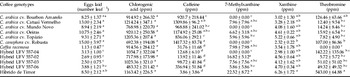
Among the compounds investigated, caffeic acid, theophylline and 3-methylxanthine were detected in just a few genotypes and in low concentrations. Therefore, they were not considered in the subsequent analysis. The genotype content of the phenolic chlorogenic acid and the other methylxanthines are shown in table 1, together with the density of eggs laid in each genotype under the free-choice preference test.
Density of eggs laid by females of Leucoptera coffeella (±SEM) and leaf content (±SEM) of phenolics and alkaloids from 12 coffee genotypes.

* Means followed by the same letter in a column are not significantly different by Fisher's LSD test (P<0.05).
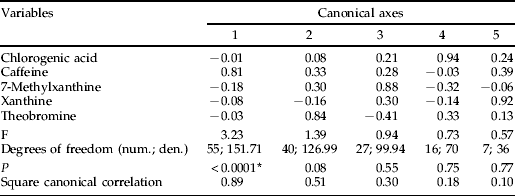
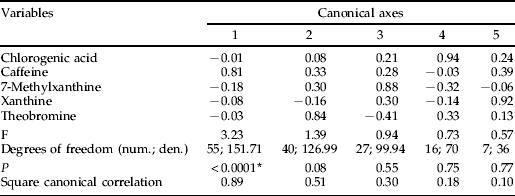
The multivariate analysis of variance for the leaf content of chlorogenic acid and methylxanthines indicated significant differences among coffee genotypes (Wilk's lambda=0.028; Fappr.=3.23; dfnum/den=55/151.71; P<0.0001). Subsequent univariate analyses of variance carried out for each individual compound indicated that the leaf content of chlorogenic acid was similar in all coffee genotypes (F11,36=0.77; P>0.05), unlike the content of the methylxanthines (F11,36>6.0; P<0.05; table 1).
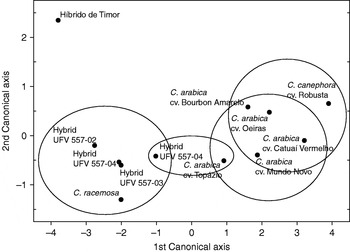
The canonical variate analysis (CVA) carried out, complementing the multivariate analysis of variance, resulted in five canonical axes, of which only the first was significant (P<0.05; table 2), accounting for 81.70% of the total variance explained. The coffee leaf compound with higher canonical loading (pooled within the canonical structure), and which, therefore, contributed the most for the divergence in composition among genotypes, was caffeine (table 2). The ordination diagram derived from the CVA was made using only the first two axes, which explained 92.32% of the total variance observed among genotypes, but only the first axis was significant at P<0.05. Three major genotype clusters were obtained with this procedure (fig. 1). The first cluster encompassed the commercial varieties of C. arabica (i.e. cvs. Bourbon Amarelo, Catuaí Vermelho, Mundo Novo, Oeiras and Topázio), which also closely resembled the commercial variety Robusta of C. canephora, except for C. arabica cv. Topázio. This commercial variety of C. arabica resembled more closely one of the hybrids between C. arabica and C. racemosa – Hybrid UFV 557-06. The second cluster encompassed C. racemosa and its hybrids with C. arabica, while the third cluster was represented by the hybrid between C. arabica and C. canephora – Híbrido de Timor.
Ordination (CVA) diagram showing the divergence among coffee genotypes regarding the leaf content of the determined phenolic and alkaloid compounds (table 1). Only the first canonical axis is significant (P<0.05) and accounts for 81.70% of the total variance explained. The symbols are centroids of treatments representing the class mean canonical variates. The large circles indicate clusters of treatments that were not significantly different by the approximated F-test (P<0.05), based on the Mahalanobis (D2) distance between class means.

Concentration-response relationship between caffeine sprayed on the surface of coffee leaves (Hybrid UFV 557-04) and density of eggs laid by the females of Leucoptera coffeella.

Canonical axes and canonical loadings (pooled within the canonical stracture) for the leaf contents (ppm) of chlorogenic acid and methylxanthines from 12 coffee genotypes.
* Significant at P<0.05.
Insect egg-laying preference among coffee genotypes
There were significant differences in egg-laying by L. coffeella among the coffee genotypes (F11,180=5.51; P<0.0001). The coffee leaf miner showed higher egg-laying preference towards the cultivars of C. arabica and the C. canephora cv. Robusta (table 1). Coffea racemosa and three of its hybrids with C. arabica were less attractive for oviposition by L. coffeella, while one of the triploid hybrids (Hybrid UFV 557-06) and the tetraploid hybrid Híbrido de Timor showed intermediate results (table 1).
Relationship between coffee leaf compounds and insect egg-laying preference
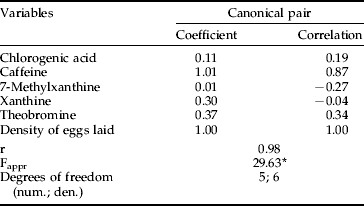
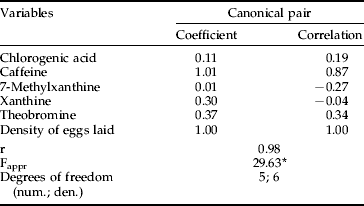
The leaf content of chlorogenic acid and the methylxanthines determined in each coffee genotype were simultaneously correlated with the egg-laying results of the coffee leaf miner using a partial canonical correlation to provide preliminary evidence of the main compound likely to be mediating such insect-plant interaction. The partial correlation was significant (Fappr.=29.63; P<0.0001; r=0.98), suggesting that an increase in the content of the leaf compounds led to increased egg-laying by the insect pest species. The canonical loading associated with each leaf compound indicated much higher loading for caffeine, therefore, the main contributor for the positive and robust (partial) correlation obtained was indeed caffeine, with a small contribution of the other compounds (table 3). The individual correlation between caffeine and egg-laying by the coffee leaf miner also provided significant positive and robust correlation (r=0.85; P=0.0005).
Partial canonical correlation and canonical pair between the leaf contents (ppm) of chlorogenic acid and methylxanthines, and the density of eggs laid (number leaf−1) by females of Leucoptera coffeella in 12 coffee genotypes.
* Significant at P<0.05.
Concentration-response bioassay with caffeine
An assay with caffeine was carried out using leaves of the coffee genotype Hybrid UFV 557-04 sprayed with increased concentrations of caffeine and subjected to a free-choice test of egg-laying preference by the coffee leaf miner. This hybrid was used in this test because it naturally contained low levels of caffeine and was the subject of low egg-laying preference. The increase in concentration of caffeine on the coffee leaves led to a significant increase in egg-laying by the leaf miner following an exponential model (y=axb; P=0.03; R2=0.57), reaching a plateau at around nine eggs per leaf (fig. 2).
Discussion
The coffee leaf miner L. coffeella is a monophagous microlepidopteran species and a key pest of coffee (mainly Coffea arabica and C. canephora) in the Neotropical region (Souza et al., Reference Souza, Reis and Rigitano1998; Gallo et al., Reference Gallo, Nakano, Silveira-Neto, Carvalho, Baptista, Berti-Filho, Parra, Alves, Vendramin, Marchini, Lopes and Omoto2002; Pereira et al., Reference Pereira, Picanço, Bacci, Crespo and Guedes2007). Female adults of this species lay their eggs on the adaxial leaf surface of coffee plants during the night; and the newly hatched larvae arise directly from the eggs to the leaf mesophyll, where they start to feed on the palisade parenchyma cells (Souza et al., Reference Souza, Reis and Rigitano1998; Pereira et al., Reference Pereira, Picanço, Bacci, Crespo and Guedes2007). This insect pest species should, therefore, be well adapted to the main secondary compounds of coffee leaves, phenolics (caffeic and chlorogenic acids, particularly the last) and alkaloids (caffeine and related methylxanthines, particularly the first), which are particularly abundant in young coffee leaves (Ashihara, Reference Ashihara2006; Ramiro et al., Reference Ramiro, Guerreiro-Filho and Mazzafera2006) and which are the leaves most susceptible to attack by the coffee leaf miner (Souza et al., Reference Souza, Reis and Rigitano1998; Gallo et al., Reference Gallo, Nakano, Silveira-Neto, Carvalho, Baptista, Berti-Filho, Parra, Alves, Vendramin, Marchini, Lopes and Omoto2002). Therefore, the recent studies failing to report pestistatic or pesticidal effects of leaf coffee phenolics and alkaloids against the coffee leaf miner L. coffeella, for purposes of coffee breeding for resistance against this insect pest species (Guerreiro-Filho & Mazzafera, Reference Guerreiro-Filho and Mazzafera2000; Ramiro et al., Reference Ramiro, Guerreiro-Filho and Mazzafera2006), come as no surprise. An analogous situation takes place with curcubitacins, a group of bitter-tasting and toxic compounds involved in Curcubitaceae defence against phytophagy, which are also feeding stimulants of diabroticide beetles (Chrysomelidae: Galerucinae: Luperini) associated with this plant family (Metcalf et al., Reference Metcalf, Metcalf and Rhodes1980).
Here, we specifically test the hypothesis of the potential role of coffee phenolics (caffeic and chlorogenic acids) and alkaloids (caffeine and related methylxanthines) as egg-laying stimulants for the coffee leaf miner L. coffeella. The hypothesis was that higher leaf concentrations of one or more coffee phenolics and/or alkaloids would favour egg-laying by the coffee leaf miner. The analysis of leaf content of coffee phenolics and alkaloids revealed significant variation among coffee genotypes, as expected based in previous efforts (Guerreiro Filho & Mazzafera, Reference Guerreiro-Filho and Mazzafera2000; Ashihara, Reference Ashihara2006; Ramiro et al., Reference Ramiro, Guerreiro-Filho and Mazzafera2006). The genotype divergence, established through the coffee leaf content of phenolics and alkaloids, was largely due to caffeine; and further correlation indicated that, indeed, this alkaloid was the only one, among the compounds tested, showing significant correlation with density of eggs laid by L. coffeella. The concentration-response bioassay provided support for the hypothesis of the involvement of caffeine as egg-laying stimulant for L. coffeella.
Plant phenolics, particularly chlorogenic acid, may play important roles as protection against environmental stress, signal molecules in plant-pathogen interactions, structural constituents of cell walls and flower pigments (e.g. Appel, Reference Appel1993; Bi et al., Reference Bi, Felton, Murphy, Howles, Dixon and Lamb1997). Their defensive role against phytophagous insects varies with environmental and physiological conditions, as their potential role as dietary antioxidant in specialist insects (Kono et al., Reference Kono, Kashine, Yoneyama, Sakamoto, Matui and Shibata1998; Bernays et al., Reference Bernays, Oppenheim, Chapman, Kwon and Gould2000; Johnson & Felton, Reference Johnson and Felton2001; Johnson, Reference Johnson2005). We failed to detect any relationship between coffee phenolics and the coffee leaf miner in agreement with the results recently reported by Ramiro et al. (Reference Ramiro, Guerreiro-Filho and Mazzafera2006). However, the potential induction of phenolic production by coffee leaves upon leaf removal was not considered in our investigation, but the final levels of caffeic and chlorogenic acids were not related with egg-laying preferences of L. coffeella. In addition, egg-laying by itself is unlikely to induce phenolic production in coffee leaves. Phenolic production would take place upon leaf injury by the hatched larvae. The approach used here for the extraction of chlorogenic acid from heat-dried leaves may not be as efficient as the alternative approach of freeze-drying the leaves for extraction. However, this is unlikely to account for the lack of correlation between leaf levels of chlorogenic acid and egg-laying by L. coffeella reported in the present study because the same extraction procedure was used for all genotypes, preventing any distortion of this trend (i.e. lack of correlation) even under low overall levels of chlorogenic acid.
The pestistatic and pesticidal activity of caffeine-related methylxanthines have been previously identified (Nathanson, Reference Nathanson1984; Frischknecht et al., Reference Frischknecht, Ulmer-Dufek and Baumann1986; Ames et al., Reference Ames, Profet and Gold1990; Hollingsworth et al., Reference Hollingsworth, Armstrong and Campbell2003). Insects are, however, able to circumvent the deleterious effects of these compounds and even potentially profit from their presence (Glendinning et al., Reference Glendinning, Brown, Capoor, Davis, Gbedemah and Long2001, Glendinning, Reference Glendinning2002), as also observed for curcubitacins and other compounds (Metcalf et al., Reference Metcalf, Metcalf and Rhodes1980; Duffey & Stout, Reference Duffey and Stout1996; Bi et al., Reference Bi, Felton, Murphy, Howles, Dixon and Lamb1997). This has been confirmed in the present study by the increased egg-laying by L. coffeella when subjected to increasing leaf concentrations of caffeine. Guerreiro-Filho & Mazzafera (Reference Guerreiro-Filho and Mazzafera2000) did not detect the favourable effect of caffeine for this same insect species, but they focused on insect injury on coffee leaves and not insect behavioural traits, particularly changes in the number of eggs laid per leaf. This difference in focus, in addition to using different coffee genotypes, probably explains the differences in results.
It is unlikely that caffeine is the sole mediator of egg-laying by L. coffeella and even less so of coffee leaf miner interaction. Since caffeine is naturally present in the cell vacuoles rather than in the leaf surface, it seems more likely that caffeine may be acting indirectly, either suppressing a repellent compound associated with the more resistant genotypes or synergizing a more volatile egg-laying stimulant present in the coffee leaves. Plant volatiles, as pre-ingestion mediators, and even induction of phenolic and alkaloid compounds as post-ingestion mediators of this insect-plant interaction, may also take place and deserve more attention.
Acknowledgements
Thanks to the members of UFV-EPAMIG Coffee Breeding Group, particularly Drs A.A. Pereira, E.T. Caixeta, L. Zambolim and E. Zambolim for their guidance and for access to the coffee genotypes. Financial support provided by the CNP & D – Café through the Consortium EMBRAPA Café, the National Council of Scientific and Technological Development (CNPq) and the Minas Gerais State Foundation for Research Aid was greatly appreciated and is acknowledged here. The comments and suggestions provided by Prof. Geoff Gurr and two anonymous referees were also greatly appreciated.