Introduction
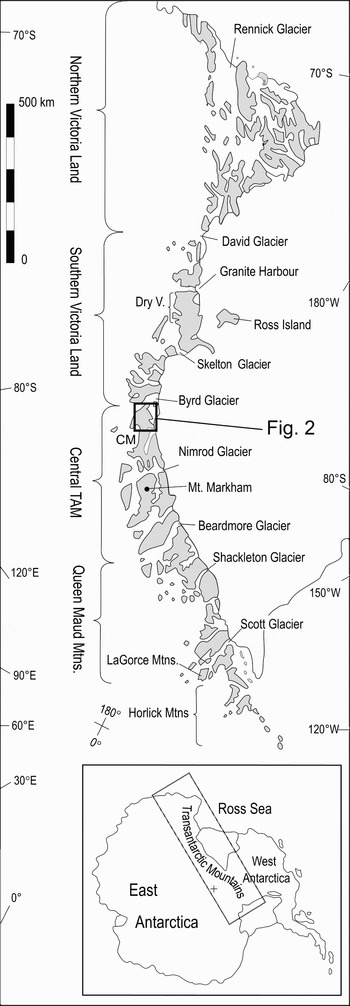
During late Precambrian to early Paleozoic times, the palaeo-Pacific margin of Gondwana was involved in a prolonged period of subduction-related orogenic activity that, in Antarctica, culminated in a period of late Cambrian/Early Ordovician deformation, metamorphism and/or magmatism, known as the Ross orogeny. As summarized by Stump (Reference Stump1995) the main geological framework of the Ross orogen may be subdivided along the ~2000 km length of the Transantarctic Mountains (TAM) facing the Ross Sea/Ross Ice Shelf into three major segments, including northern Victoria Land (from David Glacier to the Pacific end of the chain), southern Victoria Land (SVL, between Byrd and David Glaciers) and the central Transantarctic Mountains (cTAM, from Byrd Glacier to the Queen Maud Mountains) (Fig. 1). Voluminous granitoids (Granite Harbour Intrusive Complex) intruded as batholiths at ~530–480 Ma (Encarnacion & Grunow Reference Encarnacion and Grunow1996), represent a unifying feature throughout most of the length of the TAM (Borg et al. Reference Borg, DePaolo and Smith1990, Stump Reference Stump1995). The general tectonic history of the Ross orogen is fairly well known within each of the major segments of the TAM. Nevertheless, significant variations in lithostratigraphic, structural, and metamorphic patterns, as well as in granitoid geochemical affinity, are evident between the different segments.
Schematic geographical map of the Transantarctic Mountains between Skelton and Beardmore glaciers (redrawn and modified from Grindley & Laird Reference Grindley and Laird1969). CM = Churchill Mountains.

Byrd Glacier - the geographic boundary between cTAM and SVL - was recognized to mark one of the most significant discontinuities in the Ross orogen along the entire length of the TAM (Stump et al. Reference Stump, Gootee, Talarico, Van Schmus, Brand, Foland and Fanning2004, Reference Stump, Gootee, Talarico, Fütterer, Damaske, Kleinschmidt, Miller and Tessensohn2005). The Byrd Glacier discontinuity is orthogonal to the main tectonic fabric of the Ross orogen and separates two main structural domains: i) a northern domain (Britannia Range) with a varied suite of plutonic Granite Harbour Intrusives, intruded into garnet-bearing migmatitic gneisses, and minor quartzitic paragneisses and Ca-silicate rocks (Horney Formation), and ii) a southern domain (south of Byrd Glacier) where most rocks belong to the deformed but low-grade to unmetamorphosed Byrd Group.
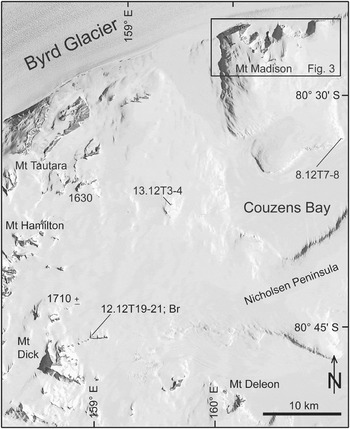
In the southern domain, a unique locality of amphibolite-grade metamorphic rocks (“Selborne Marble”, Skinner Reference Skinner1965) within a 6×15 km area around Mount Madison is anomalous to the pattern (Figs 2 & 3). This paper includes new microstructural and petrological data on the Selborne Group and preliminary data on the adjacent Byrd Group. Together with available geochronological constraints and lithostratigraphic comparisons, which corroborate a strong correlation between Selborne and Byrd Groups (Stump et al. Reference Stump, Gootee, Talarico, Van Schmus, Brand, Foland and Fanning2004, Reference Stump, Gootee, Talarico, Fütterer, Damaske, Kleinschmidt, Miller and Tessensohn2005), the overall dataset allows us to 1) reconstruct the tectono-metamorphic evolution of the Selborne Goup, 2) outline the main similarities and differences between these rocks and the adjacent rock units, 3) contribute new data for regional tectonic modelling for the SVL and cTAM segments of the Ross orogen.
Field area of this study. Base map is a merged Landsat TM/Panchromatic image.

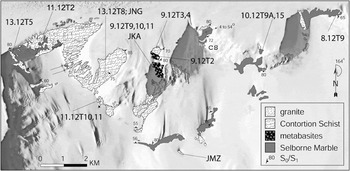
Geological map of Mount Madison area and location of investigated samples. Outcrop areas lacking patterns were not visited. CS = Contortion Spur. Landsat base.

Geological setting and previous work
Three main rock units, with distinctive lithostratigraphic and/or metamorphic features, are exposed in the Byrd Glacier area: the Byrd Group, the Selborne Group (as defined by Stump et al. Reference Stump, Gootee, Talarico, Van Schmus, Brand, Foland and Fanning2004, including the Selborne Marble of Skinner Reference Skinner and Adie1964), both south of Byrd Glacier, and the Horney Formation (Borg et al. Reference Borg, DePaolo, Wendlandt and Drake1989) extensively exposed north of the glacier in the Britannia Range. All three rock units are intruded by different varieties of Granite Harbour Intrusives, including plutons of monzo- and syeno-granites and dyke swarms of microgranite, aplite and pegmatite.
The Byrd Group
The Byrd Group consists of Early Cambrian Shackleton Limestone, and the overlying Starshot Formation and Douglas Conglomerate (Myrow et al. Reference Myrow, Pope, Goodge, Fischer and Palmer2002). Shackleton Limestone crops out extensively from Byrd Glacier to south of Nimrod Glacier (Grindley Reference Grindley1963, Laird Reference Laird1963, Reference Laird and Adie1964, Skinner Reference Skinner and Adie1964, Reference Skinner1965, Young & Ryburn Reference Young and Ryburn1968, Laird et al. Reference Laird, Mansergh and Chappell1971) (Fig. 1). A diverse suite of fossils indicates that it is Lower Cambrian, ranging from Atdabanian to Botomian, and possibly Toyonian (Hill Reference Hill1964, Debrenne & Kruse Reference Debrenne and Kruse1986, Palmer & Rowell Reference Palmer and Rowell1995). In the ranges to the north and south of Nimrod Glacier it occurs in elongate, infolded or infaulted segments bounded by immature clastic rocks previously assigned to Goldie Formation (Beardmore Group) (Grindley & McDougall Reference Grindley and McDougall1969), but now correlated with Starshot Formation, based on a fraction of detrital zircons with U–Pb ages as young as 520 Ma (Goodge et al. Reference Goodge, Myrow, Williams and Bowring2002).
The nomenclature for the clastic portions of the Byrd Group has evolved since the original designation by Skinner (Reference Skinner and Adie1964, Reference Skinner1965) of Dick Formation and Douglas Conglomerate for finer- and coarser-grained units, respectively, in the Churchill Mountains to the north and by Laird (Reference Laird1963) of Starshot Formation for all clastic units, fine- and coarse-grained, in the vicinity of the Holyoake Range to the south. Clasts in the conglomerate are up to boulder size in many occurrences, and include limestone (predominantly), vein quartz, argillite, quartzite, diorite, two-mica granite, gneissic granite, hematitic gneiss, and amygdaloidal volcanics (Skinner Reference Skinner and Adie1964). Rees & Rowell (Reference Rees, Rowell, Thompson, Crame and Thomson1991) applied the term Douglas Conglomerate to all clastic rocks of the Byrd Group. Subsequently, Myrow et al. (Reference Myrow, Pope, Goodge, Fischer and Palmer2002) proposed that finer-grained rocks of the Byrd Group be called Starshot Formation and conglomeratic units be designated Douglas Conglomerate. This is the nomenclature followed in this paper. The contact between Shackleton Limestone and overlying clastic units was unknown until Rees et al. (Reference Rees, Rowell and Pratt1985) discovered an unconformable contact of Douglas Conglomerate overlying folded Shackleton Limestone in the Holyoake Range. However, Myrow et al. (Reference Myrow, Pope, Goodge, Fischer and Palmer2002) later discovered that elsewhere in the Holyoake Range the clastic sequence conformably overlies Shackleton Limestone, demonstrating that clastic deposition had commenced before the onset of deformation, but also that deformation and erosion were followed by ongoing deposition.
At Mount Tuatara, 25 km west of Mount Madison, the Shacketon Limestone has a thickness of ~2200 m and four members are recognized (Gootee Reference Gootee2002, Gootee & Stump Reference Gootee, Stump, Fütterer, Damaske, Kleinschmidt, Miller and Tessensohn2005). The lowermost member is characterized by cross bedding and abundant rip-up clasts. This is overlain by a member characterized by nodular and layered chert. Next is a distinctive member with thin (centimetre scale) intercalations of pink limestone and green shale, which weathers with a characteristic “butterscotch” coloration. The uppermost unit is characterized by archaeocyathid mounds, oolites, pisolites, and abundant burrow-mottling. A 25 m thick section of dark green argillite was found near the top of the section on Mount Tuatara, which signals the first pulse of clastic sedimentation in this area. This is followed by at least 30 more metres of limestone. A layer of tuff occurs several tens of metres below the argillite. Another outcropping of tuff sampled south of Mount Hamilton gave an average age of 512 ± 5 Ma (U/Pb SHRIMP II, Stump et al. Reference Stump, Gootee, Talarico, Van Schmus, Brand, Foland and Fanning2004), interpreted as the eruption age of the tuff and consistent with uppermost Botomian according to the timescale of Landing et al. (Reference Landing, Bowring, Davidek, Westrop, Geyer and Heldmaier1998). A younger grouping of five analyses yielded an average age of 488 ± 5 Ma, which Stump et al. (Reference Stump, Gootee, Talarico, Van Schmus, Brand, Foland and Fanning2004) interpret as a time of radiogenic Pb loss, perhaps due to fluid flow associated with regional heating, related to intrusion in the region ~490 Ma.
Regarding the associated metabasites, Skinner (Reference Skinner and Adie1964) described a 9 m thick spilite interbedded with Starshot Formation on the ridge to the east of Mount Dick. Rees et al. (Reference Rees, Rowell and Cole1988) found snowbound basalts on this ridge, as well as at a grouping of nunataks with spot height 1710 ± to the north of Mount Dick. On the ridge to the east of Mount Dick, Stump et al. (Reference Stump, Gootee, Talarico, Van Schmus, Brand, Foland and Fanning2004) reported well preserved pillow basalts interbedded with units of medium to coarse-grained sandstone several tens of metres thick, and at 1710 ± they reported pillow basalts interbedded with limestone.
Selborne Group and associated Granite Harbour Intrusives
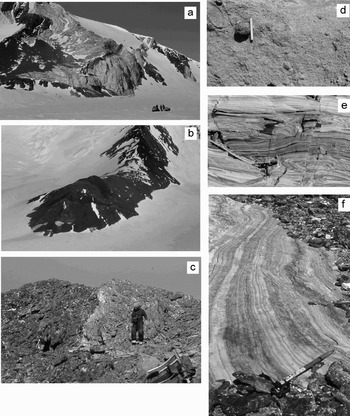
Skinner (Reference Skinner and Adie1964) designated the Selborne Marble for the amphibolite-grade metamorphic rocks he observed in the area around Mount Madison. Stump (Reference Stump1980) and Stump et al. (Reference Stump, Gootee, Talarico, Van Schmus, Brand, Foland and Fanning2004) recognized that approximately equal portions of schist and marble occur in the vicinity of Mount Madison, in areas mutually exclusive of each other, except at two spurs in the middle of the area where interlayering occurs for several tens of metres between the marble and the schist (Figs 3 & 4a). A short stratigraphical distance above the marble is a thick unit of greenstone (metabasalt), which they interpreted as equivalent to the pillow basalts near Mount Dick (Fig. 2). Stump et al. (Reference Stump, Gootee, Talarico, Van Schmus, Brand, Foland and Fanning2004) also reported an appreciable thickness of stretched-pebble conglomerate in the schist at the western end of the massif. Given the abundance of schist in the western half of the Mount Madison area, Stump et al. (Reference Stump, Gootee, Talarico, Van Schmus, Brand, Foland and Fanning2004) proposed to rename Skinner's (Reference Skinner and Adie1964) Selborne Marble as Selborne Group composed of Madison Marble and Contortion Schist, and further that these correlate with Byrd Group Shackleton Limestone and Starshot Formation/Douglas Conglomerate, respectively. In the eastern portion of the Mount Madison area Madison Marble is intruded by post-tectonic plutonic rocks at three localities.
Field relations in Selborne Group. a. Selborne Marble interlayered with Bt schists and folded during the D1 folding phase. Ridge N of Mount Madison. b. Metabasite lenses, interlayered and folded with Bt schist and minor marble (Selborne Marble). Ridge NNW of Mount Madison. c. Contact between metabasite and Bt schist. Ridge NNW of Mount Madison. d. Cam-bearing Cal-Qtz metaconglomerate with pebbles of Bt-Ms quarzite. Mount Madison (west ridge). e. Sheath folds in the Selborne Marble (ridge north of Mount Madison). f. Layered marble (Selborne Marble, ridge north of Mount Madison).

Horney Formation and associated Granite Harbour Intrusives
Cropping out in the Britannia Range to the north of Byrd Glacier, for its full 75 km length, are crystalline rocks including plutonics and amphibolite-grade metamorphics (Horney Formation; Borg et al. Reference Borg, DePaolo, Wendlandt and Drake1989). These authors describe the Horney Formation as “complexly folded amphibolite-grade banded gneisses and schists”. On the basis of reconnaissance sampling this unit consists of dominant garnet-bearing migmatitic gneisses, and minor quartzitic paragneisses, amphibolites and Ca-silicate rocks. Its metamorphic evolution includes an early high-grade stage with generation of garnet-bearing leucosomes at minimum T of 650°C, followed by minor retrogression under medium-grade conditions (Talarico et al. Reference Talarico, Palmeri, Stump, Gootee and Ricci2003). Borg et al. (Reference Borg, DePaolo, Wendlandt and Drake1989) also reported that granites intruding the Horney Formation were “deformed and metamorphosed”, and were intruded by younger granites.
North of the Britannia Range plutonism is pervasive for 150 km up to Skelton Glacier (Fig. 1). The only area which has been mapped and studied in any detail is in the vicinity of the Brown Hills to the north of Darwin Glacier (Haskell et al. Reference Haskell, Kennett and Prebble1965, Felder & Faure Reference Felder and Faure1990, Simpson & Cooper Reference Simpson and Cooper2002). There, a suite of foliated and non-foliated granite and granodiorite is cut by pegmatites and by leucocratic and lamprophyric dykes. The Carlyon Granodiorite, a foliated intrusion thought to represent the oldest rock in the suite, has been U–Pb zircon dated at 515 ± 8 Ma (Encarnacion & Grunow Reference Encarnacion and Grunow1996). U–Pb dates of 545 ± 6.8 Ma and 531.0 ± 7.5 Ma have been reported on a granite pluton and a diorite intrusion, respectively, both from the western end of the Britannia Range by Stump et al. (Reference Stump, Gootee, Talarico, Fütterer, Damaske, Kleinschmidt, Miller and Tessensohn2005).
Structural setting and evolution of the Byrd Group and Selborne Group south of Byrd Glacier
Folding in the Byrd Group from the central Churchill Mountains to the Nimrod Glacier area follows general N–S trends, but whereas the general N–S trend of folding becomes variable in the northern Churchill Mountains with E–W orientations fairly common in the area immediately south of Byrd Glacier fold axes trend ENE sub-parallel to the glacier (Grindley & Laird Reference Grindley and Laird1969). Although only one generation of folding was generally recognized in Shackleton Limestone, the fact that folded Shackleton Limestone is overlain unconformably by deformed Douglas Conglomerate in the Holyoke Range demonstrates that Shackleton Limestone was deformed at least twice in at least some localities (Rowell et al. Reference Rowell, Rees, Cooper and Pratt1988).
Skinner's (Reference Skinner1965) map of the Mount Madison massif shows fold trends ENE–WSW, NNW–SSE, and NW–SE at various places on the massif. Stump's (Reference Stump1980) observations on one spur were that the schists were foliated (S1) with discontinuous bands or streaks containing greater and lesser amounts of biotite. In rare instances small fold closures could be seen in S1 with tight to isoclinal profiles, suggesting that much of S1 was transposed from original bedding. The S1 foliation is overprinted by a discontinuous or crenulation cleavage (S2), which kinked the S1 micas and produced mesoscopic folding of S1.
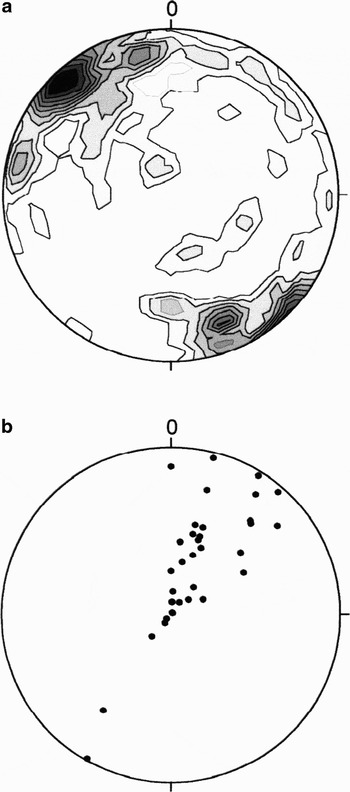
In their mapping of Selborne Group, Stump et al. (Reference Stump, Gootee, Talarico, Van Schmus, Brand, Foland and Fanning2004) distinguished bedding (S0) at a number of localities due to lithological variation, but at others, as observed by Stump (Reference Stump1980), a metamorphic foliation (S1) makes identification of bedding uncertain. Schist and marble are spectacularly interlayered in a complex syncline on Contortion Spur (Fig. 4). The core of the syncline is composed of bluish marble, which has been tightly folded in places on a mesoscale, and plunges shallowly to the north-east. Thin (metre scale) layers of marble in schist and schist in marble can be traced throughout the outcrop, as well as the thicker (tens of metres scale) layers (Fig. 4). The continuity of the individual layers of schist and marble seen at Contortion Spur affirms that they represent original bedding in a sequence of interbedded mudrocks and limestones. Both S0 and S1 are strongly oriented with ENE strikes and steep dips (Fig. 5) similar to the orientations in Shackleton Limestone to the west. Axes of mesofolds in S0 and S1 plunge vertically to horizontally throughout a great circle (with a concentration to the north-east) parallel to the regional layering (Fig. 5). This pattern is characteristic of sheath folds (Cobbold & Quinquis Reference Cobbold and Quinquis1980) and implies shearing in the plane of foliation in the Mount Madison area during the primary deformation. Due to the similarity of the primary deformation of Shackleton Limestone and Selborne Group directly south of Byrd Glacier it can be concluded that both occurred under similar kinematic conditions, albeit Selborne Group was deformed at higher PT conditions.
Structural data in the Mount Madison area (Selborne Group). a. Poles to S0 and S1, 85 points, b. axes of mesofolds (D1), 37 points. Poles to S0/S1 show NNE strikes and steep dips. Folds of S0/S1 lie in the NNE–SSW plane and the variability of the mainly NNE plunges (vertical to gentle to horizontal) indicate the occurrence of sheath folds.

Stump et al. (Reference Stump, Gootee, Talarico, Van Schmus, Brand, Foland and Fanning2004) found that the crenulations (S2) observed by Stump (Reference Stump1980), were of limited occurrence throughout the schist. The crenulation planes generally strike NE–SW and the hinges of crenulations plunge shallowly. Because of the similar orientation of S2 to S0/S1 Stump et al. (Reference Stump, Gootee, Talarico, Van Schmus, Brand, Foland and Fanning2004) suggested that this later episode of deformation occurred under a similarly oriented stress regime, and as discussed below under waning metamorphic conditions.
Selborne Group: lithologies, mineral assemblages and mineral chemistry
Metapelites (Contortion Schist and contact metamorphosed equivalents)
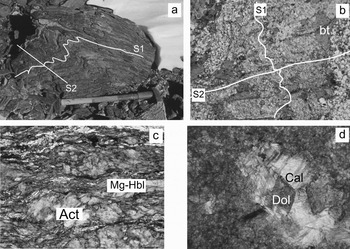
The Contortion Schist is mainly pelitic and calc schist (Fig. 6a), carrying rare beds of micaceous quartzite. In places bedding (S0) is discernable in laminations and in lithologic changes across layering. However, in much of the outcrop the layering is discontinuous, and parallel to the principal foliation (S1). In a few instances, fold closures can be seen in S1, suggesting that it is transposed bedding (Stump Reference Stump1980, Stump et al. Reference Stump, Gootee, Talarico, Van Schmus, Brand, Foland and Fanning2004). S0 and S1 strike consistently to the NE at steep to vertical angles. In places S1 is overprinted by a second cleavage (S2) which crenulates the S1 micas (Fig. 6).
Lithology and petrography of the Selborne Group. a. Cal-bearing Bt-Ms-Qtz schist. The main schistosity (S1) is overprinted by D2 crenulation. b. Cal-bearing Bt-Ms-Qtz schist 13.12T5 (ridge NNW of Mount Madison). The main schistosity (S1) is defined by phengite-rich white micas and overprinted by a discontinuous cleavage (S2), which is in turn overprinted by late Bt flakes. c. Hbl-andesine metabasite 9.12T2 (ridge NNW of Mount Madison). Act porphyroclasts are partly replaced by Mg-Hbl which also defines the main scistosity (S1). (40x, PPL). d. Dol-Cal marble 13T13 (Mount Madison). (40x, PPL).

Contortion Schist includes several varieties differing subtly in the modal content of main minerals and the occurrence of a layered or spotted texture. Ubiquitous mineral phases include: Qtz, Pl, Bt, with variable occurrence of Cal, and rarely Ms (mineral abbreviations according to Kretz Reference Kretz1983, with the addition of Opm = opaque minerals). Accessory minerals are Opm, Ap, Zrn, Mnz with rare Tur, Ttn, Rt and Aln. The dominant type is characterized by Cal ± Opm-bearing Pl-Qtz-Bt mineral assemblages, often with spotted textures, heterogranular fine grain sizes and granolepidoblastic structures. Other, all thinly layered varieties include Cal-Opm-bearing Qtz-Ms schist, Opm-bearing Pl-Cal-Bt-Qtz schist, Cal-bearing Pl-Ms-Bt-Qtz schist and Ms-Pl-Cal-Bt-Qtz schist. Quartzitic varieties include a Pl-Opm-Cal-bearing Ms-Bt type and a Ms-Pl-Cal-bearing Bt type. The S1 cleavage is defined by preferred dimensional orientation of Bt and Ms flakes (or lenticular shaped glomeroblastic aggregates of Bt ± Pl-Qtz-Tur-Opm) and by trails of opaque minerals. The effects of D2 deformation are variable. In the highest strained samples the S1 is highly transposed or in intrafolial rootless microfolds and confined to Qtz-Pl-rich microlithons bounded by a well developed S2 cleavage marked by a second generation of Bt or Ms. However, in most samples D2 only produces a weak crenulation and S2 is poorly developed (defined by Ms, Opm, Bt). In some rare samples Bt spots are deformed by D2 crenulation but more often they are aligned parallel to the incipient S2 or overprint D2 fold hinges. Moreover most samples show a late post-kinematic growth of Bt and Ms, both occurring as scattered, randomly-oriented lepidoblasts overgrowing D2 microfolds, and thin Qtz ± Cal veins. In most samples both Bt and Pl show static pseudomorphic and coronal transformations which definitely post-date D2. The Pl has been replaced by very fine grained saussurite and sericite. Bt is partially replaced by Chl ± FeTi-oxide.
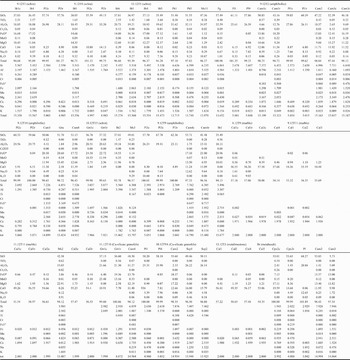
Table I shows our representative analyses of Bt, Pl and white mica from three samples (9.12T3–4 and 13.12T5). The Bt shows XMg (= Mg/(Fe+Mg)) ranging from 0.53 to 0.64, and TiO2 contents in the range 1.42–2.57 wt%. The most Mg-rich Bt (XMg = 0.62–0.64) occurs in the Cal-bearing samples. Pl core compositions have an-contents in the range 29–52, the most calcic ones occurring in the Cal-bearing assemblages (e.g. 9.12T4). In all samples, there is an increase rimward in the an-content (by no more than 3% in the Cal-free samples, but up to 20% in the Cal-bearing variety). The white micas are homogeneous in composition and characterized by low Ti contents (0.38–0.28 wt%) and Si4+ contents of 6.62–6.26 atoms per formula unit (a.f.u.) based on 22 oxygens (Table I); lepidoblasts defining S1 are phengite-rich white micas (Si4+ = 6.6 a.f.u.) and they are associated with rare paragonite, whereas Ms lepidoblasts with the lowest Si4+ contents are aligned parallel to S2 or overgrow the hinges of D2 microfolds.
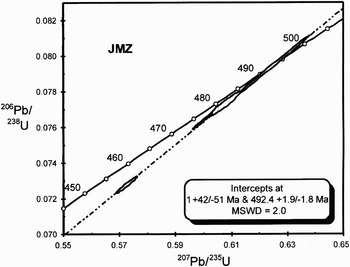
TIMS isotope dilution analyses of zircon grains from sample JMZ. Data are co-linear, defining a discordia with upper intercept of 492.2 +1.9/-1.8 Ma.

Representative microprobe analyses of the main minerals in Selborne Group main lithologies. Mineral analyses were carried out using a JEOL JX 8600 electron microprobefitted with four wavelength-dispersive spectrometers, at the Centro Studi per la Minerogenesi e la Geochimica Applicata (CNR, Firenze), operating with an accelerating voltage of15 kV and 10 nA sample current, using natural minerals as standards.

c = core; r = rim. * = total Fe as FeO. In sample 13.12T5 Ph1 and Ph5 are compositions from phengite-rich white micas defining the S1 schistosity and Ms11 is representative of of syn/post-D2 muscovites. Cations calculated on the basis of 22 oxygens for Bt, Ph, Pg and Ms, 8 oxygens for Pl, 2 cations and 3 oxygens for Cal, 25 oxygens for Scp, 12 oxygens and 8 cations for Grt, 6 oxygens and 4 cations for Cpx. Cations in Cam and Gru were normalized to 23 oxygens and sum (T1 + T2 + M1 + M2 + M3) = 13 (as detailed by Triboulet Reference Triboulet1992), with Fe3+ estimated as maximum according to Papike et al. (Reference Papike, Cameron and Baldwin1974).
A rare Ms-Pl-Bt-Qtz schist (10.12T15) shows the distinctive occurrence of Grt as small subhedral crystals (slightly zoned with alm58 prp12 grs5 sps25 cores and alm55 prp10 grs5 sps30 rims) and a crenulated S1 schistosity defined by Bt (XMg = 0.59; TiO2 = 1.47 wt%) and Ms (Si4+ = 6.38 a.f.u.; TiO2 = 0.23 wt%) (Table I). In this rock Pl is homogeneous in composition (ab62 an37 or1) with inclusions of Qtz and Bt, and Tur, Opm, Zrn and Mnz as accessory minerals.
Ca-silicate rocks and marbles
Throughout its outcrop Madison Marble has a coarse-grained, sugar-like texture. It is primarily white, with shades of grey and pale pink. The colour variations mark bedding, which consistently strikes NE–SW and dips steeply (Fig. 4). Both tight and open mesofolds occur (Fig. 4), but broad areas display uniform bedding or no bedding at all. With the exception of some textures resembling disrupted burrow-mottling in the Upper Member of the Shackleton Limestone (Stump et al. Reference Stump, Gootee, Talarico, Van Schmus, Brand, Foland and Fanning2004), metamorphic recrystallization of the Madison Marble has obscured all other original sedimentary features.
The common mineral assemblage includes: Cal (FeO = 0.00–0.66 wt%; MgO = 0.39–1.73 wt%) with minor Dol, Qtz, Pl, Ms (Si4+ = 5.98 a.f.u.), Zrn, Mnz and Opm. Grey layers are mineralogically distinguished by the higher modal content of Dol (Fig. 6), and sometimes the rare occurrence of Chl or Ttn. Compared to Shackleton Limestone, Madison Marble shows similar mineral assemblages, but coarser grained (fine to medium) granoblastic textures. Interestingly the same correlation between mineralogy and rock colour is shown by the Shackleton Limestone in the Byrd Group. XRD and microprobe investigations of samples from both Shackleton Limestone (e.g. 13.12T3, Cal: FeO = 0–0.11 wt%; MgO = 0.41–1.23 wt%) (Table I), and Madison Marble proved that the grey types are indeed richer in Dol and in disseminated very fine grained Py and Gr grains with respect to the white type. A mm-scale layering is sometimes present, outlined by grain size variation. The main schistosity (S1) is seldom observable and is defined by elongated blasts of Cal and the preferred dimensional orientation of the minor phyllosilicates. A distinctive Opm-Bt-Cpx-Cam marble characterized by a granonematoblastic structure (11.12T2A) consists of Cal-Qtz-Bt-colourless Cam (Tr)-Cpx-Pl (replaced by saussurite and sericite)-Opm-Tur-Ap.
Marbles contain boudinaged thin (a few centimetres thick) layers of Opm-Ms-bearing quartzite and Ca-silicate rocks, which in areas far from exposed plutons or dyke swarms, are represented by layered Qtz-Pl-Grt-Cam granofels (11.12T10) and Cam-Cal-Pl granofels (8.12T11). Thin centimetre-sized boudins and layers of quartzites occur within marbles in the Mount Madison summit area. They show heterogranular, medium to fine grain size and interlobate to subpolygonal granoblastic textures. Their mineral assemblage includes Qtz-Ms-Opm (Ilm, Hem/Lm)-Cal-Ttn-Rt-Kfs, with a mineralogical layering defined by Qtz-Ms-Opm ± Rt-Kfs layers alternating with Qtz-Cal-Ms layers. Opm grains show thin rims of Ttn ± Rt. The Ms lepidoblasts show no preferential orientation, and their growth can be consequently intepreted as post tectonic.
Layered Qtz-Pl-Grt-Cam granofels consists of green Cam (Act with XMg = 0.77, classification after Leake et al. Reference Leake, Woolley, Arps, Birch, Gilbert, Grice, Hawthorne, Kato, Kisch, Krichovichev, Linthout, Lair, Mandarino, Maresch, Nickel, Rock, Schumacher, Smith, Stephenson, Ungaretti, Whittaker and Youzhi1997) -Grt (zoned with alm14 grs32 sps54 cores and alm41 grs21 sps28 prp10 rims) -Pl (ab51 an49, partly replaced by sericite/saussurite)-Cpx-Qtz-Opm-Bt-Cal-Ttn and secondary Chl, sericite and saussurite. They are heterogranular, fine grained, with a marked layering due to variable modal contents of Act and Grt. The structure is granonematoblastic with S1 defined by the preferred orientation of Act nematoblasts. Act carries inclusions of Grt, Cpx and opaque minerals, whereas Bt overgrows Grt.
Cam-Cal-Pl granofels show similar microstructural features. They are composed of Pl (replaced by saussurite)-Cal-pale green Cam (Act)-Ttn-Opm-Ms-Qtz. The S1, defined by Act, is cut by late Cal veins.
Contact metamorphosed marbles and Ca-silicate rocks
Contact metamorphosed marbles and Ca-silicate rocks are well exposed in the contact metamorphic aureole developed in the country rocks of the Bt granite pluton exposed in the cliffs in the north-east sector of the Mount Madison area (Fig. 3). Contact metamorphosed marbles (e.g. 10.12T10) are heterogranular and fine to coarse grained, with granonematoblastic/decussate structures composed of ragged glomeroblastic aggregates of Cam, with inclusions of relict Cpx and Cal. Contact metamorphosed Ca-silicate rocks comprise different mineralogical varieties, all exhibiting mineralogical compositional layering and fine- to medium-grained, interlobate granoblastic/granolepidoblastic fabrics. Mineral assemblages include four main varieties:
1. Qtz-Pl (ab64 an35 or1)-Kfs-colourless to pale green Cam (Act with XMg = 0.77, with Cpx relics) -Bt (partly replaced by Chl)-Scp-Cal-Ttn–Czo/Ep-Opm-Ap-Aln. The layering is defined by Qtz Pl-Kfs-Bt ± Scp-Cam-Ttn layers alternating with Qtz-Cpx ± Pl-Cam-Kfs-Cal layers. A pristine S1/S2 composite fabric (weakly crenulated S1 defined by Cam, Bt, and trails of very fine grained Ttn) is overprinted by late poikiloblastic Act. Kfs (Mc) contains inclusions of Qtz and Pl and is partly replaced by clay minerals. Act is rich in inclusions of Qtz, Pl, Ttn and Ap. Scp forms late granoblasts carrying inclusions of Act and Ttn. Scp is homogeneous in composition, a meionite/Na-carbonate-scapolite solid solution with equivalent anorthite contents (‘eqAn’ = 100 (Al-3)/3, Evans et al. Reference Evans, Shaw and Haughton1969) of 53–54.
2. very pale green Cpx-Cal-Qtz-green Cam-Czo/Ep-Kfs (Mc)-Pl (replaced by saussurite)-Opm-Ttn. Cpx carries inclusions of Cal, Cam, Czo/Ep and Qtz. Cal and Qtz also occur as inclusions in Cam.
3. green Cam (with relics of Cpx)-Qtz-Cal-Pl (transformed to sericite and saussurite)-Czo/Ep-Kfs-Ttn-Ap-Aln-Opm.
4. Qtz-Ves-Opm-Pl (carrying inclusions of Ves and Qtz, and transformed to sericite and saussurite)-Cal-Ms-Ap-Zrn/Mnz. They show a compositional layering defined by layers composed of Ves + Opm ± Qtz and layers consisting of Qtz-Pl-Ms-Opm.
Types 1 to 3 were observed in the country rocks of the Bt granite pluton exposed in the north-east sector of the Mount Madison area. Type 4 occurs at the Mount Madison summit where the Madison Marble is intruded by a swarm of thick granitic and pegmatitic dykes.
Another contact metamorphosed Ca-silicate rock carrying Scp is represented by a fine grained Scp-Qtz-Bt calc-schist found close to a thick pegmatite dyke (13.12T8) in the ridge north-west of the Mount Madison summit (Fig. 3). Its mineral assemblage includes: Cal-Bt (partly replaced by Chl)-Qtz-Scp-Pl (zoned; transformed to sericite and saussurite) -Opm-Tur-Ms-Zrn/Mnz; the structure is poikilo-granolepidoblastic and a weak layering is defined by Bt-Opm rich layers and Scp-rich layers. Relicts of the main schistosity (S1), parallel to the layering, include Bt and trails of Opm. Scp poikiloblasts contain inclusions of Qtz, Bt, Cal, Tur and Opm.
Metaconglomerates
Highly-flattened, polymict metaconglomerates form metre-thick layers within Contortion Schist (mainly layered Ms-Qtz-Bt schists) at two localities on the south-western end of the Mount Madison area. The metaconglomerate matrix is generally heterogranular and fine grained, and consists of an interlobate to subpolygonal granoblastic aggregate of Cal-Pl (zoned)-Qtz-Opm-pale brown Bt-Ttn-Rt-colourless or pale green Cam. Cam sometimes forms glomeroblastic spots. Another type of matrix (11.12T2) includes only clasts of Bt-Opm-Ms-Cal bearing quartzite and Qtz or Pl lithics, and shows a marked S1 defined by Bt ± Ms, which is crenulated, particularly close to clasts. It consists of Qtz-Bt (replaced by Chl)-Cal-Pl (zoned; replaced by sericite and saussurite)-Ms-Opm-Ap-Tur-Rt. Clasts include Bt-Opm-Pl-Qtz marble and Ca-silicate rocks with lesser quartzite and schist (Fig. 6f). Marble clasts are extremely flattened with aspect ratios up to 20:1. The schist clasts are flattened to a lesser degree, whereas the quartzite and Ca-silicate clasts retain their original, well-rounded shapes, with cobbles up to 6 cm in length (Fig. 4d). Quartzite clasts consist of Qtz-Cal ± Tur-Bt (replaced by Chl) ± Pl-Ms-Opm ± Zrn/Mnz-Rt. They are heterogranular and granoblastic with a weak schistosity defined by aligned platy Qtz (sometimes including early coarse grained, strained porphyroclasts surrounded by subpolygonal granoblastic aggregates), flakes of Bt and Ms or Opm-rich layers, and sometimes crenulated and cut by late Cal veins. Ca-silicate rocks are heterogranular fine grained and granoblastic. Their mineral assemblage includes: Pl (replaced by sericite/saussurite)-Cal-Opm-Ttn-Qtz-Ms-Bt-Ap-Zrn/Mnz.
Metabasites
At the next spur to the west of Contortion Spur, approximately 10 m of white marble are exposed at its toe (Fig. 4). This is followed upward by a unit of pelitic and calc-schist, which is overlain abruptly by a unit of metabasalt. Above the metabasalt is a mixed unit (several tens of metres thick) of thinly-bedded calc-schists and impure marble. This gives way to more metabasalt, which continues to the headwall of the spur (Fig. 4).
In places in the lower unit there appear to be amygdales in the rock, and structures suggestive of pillows also occur. The succession of lithologies at this spur suggests a sequence of limestone and mudrock with two pulses of basaltic volcanism. Combining the sequences at the two spurs and placing them in the context of the distribution of lithologies throughout the Mount Madison massif, one sees a transition from extensive limestone deposition, to deposition of several interbedded units of mudrock, to the eruption of pillow basalts slightly overlapping limestone deposition, to widespread deposition of clastic rocks, including conglomerate, containing an appreciable carbonate fraction. It is not possible to determine tops in the succession, but based on regional considerations, one may interpret the limestone deposition to have been earlier, followed by incursions of clastic sedimentation and basaltic volcanism. These rocks are characterized by the most complete record of microstructural transformations related to the low/medium grade ductile deformational stages of the Selborne Group (Fig. 6).
Samples taken from low-strain domains indicate that the variably deformed metabasites most likely derive from an effusive unit consisting of vesicular basalts, at places with pillow-like structures. The basalts are slightly heterogranular, fine to medium grained with granonematoblastic structures. Compositional layering often occurs, defined by Cam-rich or Cam-Czo/Ep ± Pl-Qtz-Opm layers and Pl-rich or Cam ± Pl-Qtz-Czo/Ep layers. The schistosity (S1) is due to the preferred dimensional orientation of Cam and Bt and it warps around coarser grained Cam, probably psedomorphic after former Cpx. S1 is sometimes crenulated and transected by Ca-amphibole + Cal veins.
The general mineral assemblage is: Cam-Czo/Ep-Pl-Qtz ± Bt-Opm-Rt-Ttn-Ap. The coarser grains of Cam are often zoned with pale green cores (Act with XMg = 0.76–0.70) and dark green rims (Fts or Mg-Hbl with XMg = 0.45–0.62) (Table I). Pl, often replaced by saussurite, is zoned, with albite (ab99 an1) cores and oligoclase (ab78 an22) rims in 9.12T9, and with ab61-74 an39-26 cores and ab68-72 an32-28 rims in the other two samples. In sample 9.12T10, from the highest strain volumes, Cam defining the main schistosity (S1) shows complex compositional features with Mg-Hbl (XMg = 0.66) cores, internal rims of Fts, outer rims of Ts (with inclusions of Gru (XMg = 0.46), and, sometimes, discontinuous overgrowth of Act (XMg = 0.65). Bt (XMg = 0.46, TiO2 = 0.59 wt%) occur as scattered flakes overgrowing Hbl and, in places, shows a partial transformation into fish-like aggregates of Prh, aligned parallel to the (001) cleavage, and minor chloritization. Opm is sometimes rimmed by Ttn.
The lower grade equivalents from the Byrd Group (12.12T19-20, Br) consist of Cam-Opm-Cal-bearing spilitic metabasalt. They commonly show vesicular textures with amygdales filled by Cal or by aggregates of ragged Qtz ± Cal-Czo/Ep-Chl. Mineral assemblages consist of: Pl-Cpx-Opm-Czo/Ep-Cal-Qtz-Chl-Ttn-pale green Cam (Act). Both Cpx and Pl, although replaced by Czo/Ep, Ab and minor Cal, occur as subhedral crystals suggesting an igneous-like fabric. Cpx is augite (wo33 en51 fs16), locally overgrown by thin discontinuous coronas of aegirine-augite (acm26-22 jd8-6 wo + en + fs66-72) and partially to completely replaced by fine grained polycrystalline aggregates of Act (XMg = 0.61) (Table I).
Geochronological data
Stump et al. (Reference Stump, Gootee, Talarico, Van Schmus, Brand, Foland and Fanning2004) first reported plutonic rocks in the Mount Madison area where they mapped three post-tectonic plutons of granite intruding marble toward the eastern end of the massif (Fig. 3). One sample (JMZ) was chosen for U–Pb dating of zircons. This rock is a porphyritic granite with twinned, zoned Pl, Mc, Qtz, and Bt, and with phenocrysts of perthite up to 2 cm in length. The Pl is slightly altered to sericite and the Qtz has mildly undulose extinction, but no polygonal recrystallization. Three magnetic and one non-magnetic splits of zircons were analysed by ID-TIMS (Table II). When plotted on a Concordia diagram the analyses define a tight discordia line whose upper intercept is 492.4+1.9/-1.8 Ma (Fig. 7). This date records the crystallization age of the granite and sets a upper limit on cessation of deformation of the Selborne Group.
U–Pb data for zircon fractions from JMZ granite.

Regression for all four analyses: U.I. = 492.4 +1.9/-1.8 Ma, L.I. = 1 +42/-51 Ma.
Notes: ppm = parts per million; obs = observed ratio uncorrected for blank or non-radiogenic Pb, m = magnetic; nm = non-magnetic, (n) = side tilt used on magnetic separator track during preparation of magnetic fractions; Data regressed using Isoplot/Ex (Ludwig Reference Ludwig2001), uncertainties reported at the 2-sigma level (pct = percent), (ρ) = correlation coefficient obtained from PBDAT (Ludwig Reference Ludwig1988), U.I. = upper intercept on concordia; L.I. = lower intercept on concordia. *: Pb data corrected for analytical blank Pb and non-radiogenic Pb using Stacey & Kramers (Reference Stacey and Kramers1975) model Pb. All ages calculated using decay constants recommended by Steiger & Jäger (Reference Steiger and Jäger1977).
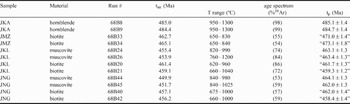
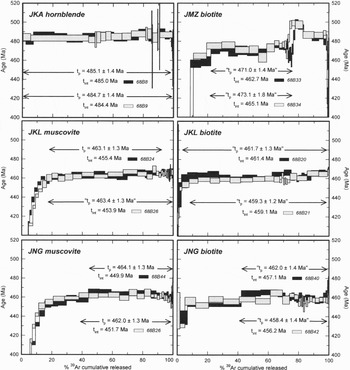
Incremental-heating Reference Massonne and Schreyer40Ar/39Ar age measurements were performed on separated minerals with the main objective of quantifying the cooling history. Results are presented in Table III and shown in Fig. 8, for duplicate analyses of Hbl from sample JKA (Selborne Group metabasalt), Bt from JMZ (granite which provided the zircon for U-Pb geochronology), and Ms and Bt from both JKL and JNG (Contortion schists).
Summary of 40Ar/39Ar analytical results for mineral separates.

tint is the integrated (or total gas) age in Ma and is derived from the summation of all fractions of the incremental heating analysis.
age spectrum analysis where tp is the plateau age in Ma, with 1 sigma uncertainty, derived from the incremental heating spectrum, %39Ar is the percentage of total 39Ar in the plateau fractions, and T range is the temperature interval for the continuous steps comprising the fractions of the plateau. A plateau is defined as contiguous fractions constituting more than 50% of the 39Ar released where the apparent age variations among fractions may be accounted for with analytical uncertainties. A plateau encompasses as many fractions as possible (except where fraction uncertainties are very large) where ages agree with the plateau within their 2sigma uncertainties. Where this strict definition is not observed and variation among “plateau” fractions is minor but still exceeds analytical uncertainties, an approximate plateau is defined. In these cases, the indicated “plateau” age is enclosed in quotation marks (see also Fig. 8).
Analytical measurements performed in the Radiogenic Isotopes Laboratory, Ohio State University. See Supplemental Data for procedural information, a full listing of analytical data, and plots of all data. The monitor used was a intralaboratory biotite standard (“AL-1”) that has a 40Ar/39Ar age of 443.52 Ma. The age for this monitor was determined by simultaneous cross calibration with several monitors including the Fish Canyon Tuff biotite standard (FCT-3) with an age of 27.84 Ma. A systematic uncertainty of 1% is assigned to all ages, in order to allow for uncertainties in the standards against which AL-1 was calibrated; this uncertainty is not included in the uncertainties given.
40Ar/39Ar incremental-heating spectra for mineral separates. Shown are duplicate runs for each separate. Apparent ages are illustrated with ± 2 σ uncertainties. Plateaus, or near plateaus (which are bracketed by quotation marks), are delimited by horizontal arrows; uncertainties for the plateau ages are quoted at ±1σ. (See Table IV).

The age results are illustrated in Fig. 8 in terms of customary age spectra. Replicate runs of these mineral separates show good agreement demonstrating robust incremental-release patterns; the ages for replicates are analytically indistinguishable. Age plateaus are observed for the Hbl and Ms separates using the strict definition (see Table III). For the Bt separates, the age spectra have broad “plateau” regions covering most of the Ar release; over these regions the variations in apparent age somewhat exceed those expected from analytical uncertainties alone, but this discordance is relatively minor. In these cases “approximate plateau ages” are defined.
The Hbl from sample JKA gives an incremental-release pattern that is fully concordant. The plateau ages, where very small fractions at highest temperatures with large uncertainties are omitted, are 485.1 and 484.7 Ma (average 484.9 Ma). The Ms from both JKL and JNG gives very similar results with the apparent ages increasing from the lowest extraction temperatures to a plateau after about 20–40% of the released Ar. For each Ms separate, the lower age fractions are correlated with variations in K/Ca and K/Cl which indicate mineralogic heterogeneities from a phase or alteration that released Ar before the bulk of the Ms. The plateaus indicate the ages of the Ms samples which are: JKL, 463.1 and 463.3 (av. 463.2) Ma; JNG, 464.1 and 462.0 (av. 463.0) Ma. The biotites from these same two rocks also produce age results that are similar to one another with only minor discordance exceeding analytical uncertainties. The most reliable ages are indicated by those fractions including as much Ar as possible while defining near plateaus, which are: JKL, 461.7 and 459.3 (av. 460.5) Ma; and, JNG, 462.0 and 458.4 (av. 460.2) Ma. Finally, the Bt from JMZ is the most difficult to interpret due to the more significant and much greater discordance. The near plateaus, observed for intermediate temperature fractions, are 471.0 and 473.1 (av. 472.0) Ma.
The ages of these minerals are expected to reflect the time of cooling below their Ar closure temperatures. The ages follow a pattern consistent with this interpretation with amphibole (485 Ma) being the oldest mineral, followed by Ms and then Bt. Notably, the ages for both JKL and JNG Ms (463 Ma) and Bt (460 Ma) are essentially identical to one another. The JMZ Bt age (472 Ma) is distinctly older with significant discordance; the apparent age for this Bt is discounted and it is likely that it contains excess Ar.
Petrology and geothermobarometry
Geological and microstructural evidence indicates that the tectono-metamorphic evolution of the Selborne Group includes an early event (M1) of polyphase regional metamorphism - with dynamic crystallization mainly during D1 and only subordinately during D2 - followed by a variably developed post tectonic (post-D2) thermometamorphic event (M2).
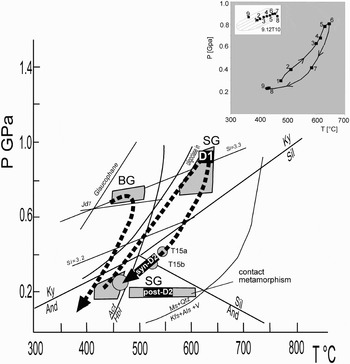
The relatively large number of mineral assemblages in the Selborne Group allows reasonably tight constraints of T and P conditions attending this polyphase metamorphic evolution in P-T space, based on a petrogenetic grid and the application of several geothermobarometric methods. Figure 9 includes several metamorphic equilibria and the approximate P-T fields of both regional metamorphic stages and the contact metamorphic overprint, based on these equilibria as well as on geobarometric and geothermometric estimates.
Inferred P-T-D-t paths for Selborne Group (SG) and metabasalts from the Byrd Group (BG) in the Mount Dick area and P-T conditions of contact metamorphism in the Mount Madison area. D1, D2: major deformation phases in the Mount Madison area. In Selborne Group geochronological data constrain the polyphase syn-D1/D2 evolution between ~ 510 and 492 Ma and post-D2 contact metamorphism at ~492 Ma (see text for discussion). P-T boxes are based on thermobarometric estimates. Al silicate phase relations are after Spear (Reference Spear1993), Act/Hbl transition is according to Barker (Reference Barker1990), oligoclase-in curve is after Maruyama et al. (Reference Maruyama, Liou and Suzuki1983), Si4+ content isopleths are after Massonne (Reference Massonne1991), Jd7, pressure estimate from Cpx composition, is according to Holland (Reference Holland1980). T15a and T15b are the average THERMOCALC pressure-temperature estimates based on Grt core and rim compositions respectively on schist 10.12T15 (see Table V for details).
Inset: P-T data from application of Ca-amphibole thermobarometry after Zenk & Schulz (Reference Zenk and Schulz2004) to sample 9.12T10. Arrow indicates P-T evolution trend according to core to rim zonation and spot location as shown in the microstructural sketch.

Regional metamorphism
Metamorphic conditions and the polyphase nature of M1 are well documented in the metabasites, in which relict Ep-Ab-Act assemblages and lack of glaucophane, diagnostic of low-grade (greenschist facies) conditions (Bucher & Frey Reference Bucher and Frey1994), are almost completely replaced by higher-grade parageneses (Mg-Hbl/Fts – sometimes with Gru inclusions + oligoclase/andesine), and then moderately retrogressed (saussurite, sericite, Chl, Act).
In detail the mineralogical transformations which explain the transition from the low- to higher grade paragenesis, particularly the compositional change of Pl from almost pure Ab to oligoclase/andesine and the change of Cam from Act to Mg-Hbl or Fts (Ts-Cam) could be explained by the combined effect of model reactions which in the CaO-MgO-Al2O3-SiO2-H2O system include:

All reactions are considered to mark the greenschist-amphibolite facies transition (Bucher & Frey Reference Bucher and Frey1994).
Coexistence of plagioclases (due to the peristerite solvus) is commonly observed in prograde metamorphic sequences (Maruyama et al. Reference Maruyama, Liou and Suzuki1983), and coexisting Act and Hbl can reflect a miscibility gap at the greenschist/amphibolite facies boundary (Ghose Reference Ghose1981). The Mount Madison metabasite assemblages could similarly be intepreted as peristerite assemblages. However microstructural relationships in our samples, namely the evidence that both albite and Act occur as relicts whereas oligoclase and Hbl form coronas and the observed Cam zonings, are here considered key evidence to conclude that the observed compositional varieties of Pl and the two amphiboles are most likely not in equilibrium and that they represent arrested stages of reaction during recrystallization along a prograde metamorphic path.
Cam in these rocks displays marked zonations with Act in cores and Mg-Hbl to Fts in rims. These zonations can be interpreted as growth prograde zoning and are well described in terms of AlIV, AlVI and Ti which are known (e.g. Zenk & Schulz Reference Zenk and Schulz2004) to semiquantitatively monitor T and P changes. The overall compositional pattern of zoned Ca-amphiboles from Mount Madison are closely similar - albeit a slight shift towards lower XMg values (Fts instead of Ts) - to those described by Zenk & Schulz (Reference Zenk and Schulz2004) for the Bt, or Grt and Ky zones from the classical Barrovian metamorphic zones in the Dalradian Group in Scotland. As in metabasites in the Dalradian Group, Mount Madison samples similarly show coexistence of Ca-amphiboles with zoned Pl ranging in composition from nearly pure albite cores to an22 rims (typical of the Bt zone) or more frequently, with andesine (Grt or Ky zone).
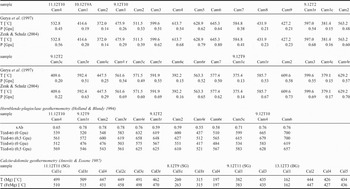
Results of the application of the empirical Ca-amphibole geothermobarometry using the analytical expressions given by Zenk & Schulz (Reference Zenk and Schulz2004) and Gerya et al. (Reference Gerya, Perchuk, Triboulet, Audren and Sez'ko1997) are listed in Table IV. The two methods gave similar T results; P calculated with Zenk & Schulz's (Reference Zenk and Schulz2004) geobarometer are 0.01–0.15 GPa higher than those obtained using the Gerya et al. (Reference Gerya, Perchuk, Triboulet, Audren and Sez'ko1997) barometer. Errors in both methods are± 0.12 GPa and ± 37°C. The Act cores in samples 9.12T2 and 9.12T9 record an early stage at low T and low P of ~ 380–450°C and ~ 0.15–0.3 GPa. Then, amphiboles followed a prograde metamorphic evolution up to peak T of ~ 560–630°C and maximum P of ~ 0.58–0.73 GPa, estimated from Fts rims coexisting with oligoclase (or andesine). Similar T estimates are provided by the Cam-Pl geothermometer of Holland & Blundy (Reference Holland and Blundy1994), which, using the same amphibole (rim) compositions and adjacent Pl compositions and at an assumed P = 0.6 GPa, range between 580–665°C (Ed-Tr equilibria) and 555–635°C (edenite-richterite equilibria) (Table IV).
Results of Ca-amphibole geothermobarometry for Selborne Group metabasites and of calcite-dolomite geothermometry for Selborne Group marbles (SG) and Byrd Group marbles (BG). Ca-amphibole geothermobarometry.

Mineral abbreviations after Kretz (Reference Kretz1983), with the addition of ri = richterite. c: core composition; r: rim composition.
Consistent with the microstructural evidence, these thermobarometric data confirm the prograde metamorphic evolution from an early greenschist grade stage to low-T amphibolite grade. In sample 9.12T10, zoned Ca-amphiboles record an almost continuous increase of P and T from Mg-Hbl cores (giving min P and T of ~0.21 GPa and ~ 427°C) up to max. values of 0.64–0.8 GPa and 645°C for Fts rims (Fig. 9). Significantly some of these zoned Cam crystals also show outer rims of Ts with Gru inclusions, and overgrown by Act, which suggest a subsequent retrograde P-T evolution from ~ 0.54–0.68 GPa and ~ 614°C to ~ 0.21–0.23 GPa and 432°C. The occurrence of MgFe-amphiboles (Gru) as thin inclusions in Ts could be interpreted as exsolutions reflecting a miscibility gap (Ghose Reference Ghose1981) and they are generally considered typical of low-pressure amphibolite facies conditions (Bucher & Frey Reference Bucher and Frey1994). A slight retrogression is also testified by post-D2 mainly coronal/pseudomorphic transformations of oligoclase/andesine to Ep+Ab+Cal+sericite and of Bt to Prh+Chl+FeTi-oxides.
The estimated T values for the metamorphic peak and retrograde evolution recorded in metabasites are also consistent with mineral assemblages and PT results in Contortion Schist, marbles and Ca-silicate rocks. In Contortion Schist the occurrence of Bt and Pl (with minimum an29 compositions), coupled with the stable association Ms+Qtz, are consistent with medium grade (lower amphibolite facies) conditions (Bucher & Frey Reference Bucher and Frey1994).
Minimum P conditions of ~ 0.8–0.96 GPa (at an assumed T range = 560–630°C, i.e. the range of T estimates for the metamorphic peak determined in metabasites) are suggested by the maximum Si content (6.6 atoms a.f.u.) in white mica from sample 13.12T5, following the calibration of Massonne & Schreyer (Reference Massonne and Schreyer1987), modified by Massonne (Reference Massonne1991). It is noteworthy that, in this sample, white mica with the highest Si contents were detected mainly along S1 whereas lepidoblasts along S2 schistosity generally show lower Si contents (down to 6.24 a.f.u.) suggesting minimum P as low as 0.2 GPa during the development of D2 fabrics.
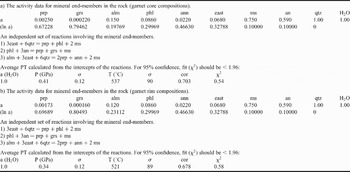
Additional P-T estimates were also obtained from Grt-bearing Ms-Pl-Bt-Qtz schist 10.12T15 in which the higher number of mineralogical phases allows the use of the quantitative, average P-T approach outlined by Powell & Holland (Reference Powell and Holland1988), with the expanded, internally consistent, thermodynamic dataset of Holland & Powell (Reference Holland and Powell1990). A crucial point in using this approach is the recognition of equilibria mineral assemblages. In sample 10.12T15 microstructural evidence (i.e. all phases in mutual contact, no reaction coronas) indicate that Grt, Bt, Ms, Pl and Qtz can be reasonably interpreted as a possible equilibrium assemblage. In agreement with the petrographical interpretation this assemblage gave acceptable χ2 test results with P-T values ranging from 0.41 ± 0.12 GPa (2σ error) and 533 ± 90°C (for Grt core compositions) to 0.34 ± 0.12 GPa and 521 ± 89°C using Grt rim composition (Table V). P estimates using Grt core compositions are lower, but still within the error ranges, with respect to mimimum P of ~0.53 GPa (at T = 533°C) suggested by the Si content (Si4+ 6.38 a.f.u) in white mica. These results, as shown in Fig. 9, fit the retrograde cooling-unloading path reconstructed in metabasites and they could consequently reflect re-equilibration after the metamorphic peak.
Average pressure-temperature calculations on schist 10.12T15.

The calculations have been performed using an updated version of the internally consistent thermodynamic dataset of Holland & Powell (Reference Holland and Powell1990) and an updated version of the program THERMOCALC (Powell & Holland Reference Powell and Holland1988).
Mineral abbreviations after Kretz (Reference Kretz1983), with the addition of east = eastonite.
Application of the Cal-Dol thermometer according to Anovitz & Essene (Reference Anovitz and Essene1987) to Mount Madison marbles gives maximum T values of 315°C (8.12T9), 435°C (9.12T11) and 515°C (11.12T11). T as low as 150–200°C were determined from very fine grained, recrystallized Cal grains in some samples (Table IV). Although this rather large spread may reflect regional variations of metamorphic grade, both this variation and the lower values compared to T determined in metabasites can be more likely attributed to retrograde cation exchange between Cal and Dol during cooling.
The occurrence in some impure marbles (eg. 11.12T2A) of the stable association Cpx +Cal + Qtz and absence of Wo imply temperatures in the range ~ 550–650°C in the presence of H2O-rich fluid (e.g. XH2O = 0.90), and higher T (between 550 and 800°C) in a more CO2-rich enviroment, as suggested by the calculated curves for the univariant equilibria

and

in a T-XCO2 isobaric section for the symplified system CaO-MgO-Al2O3-SiO2-CO2-H2O (CMASCH) at an assumed P of 0.6 GPa, based on the Berman (Reference Berman1988) thermodynamic database.
Despite the possible divergence of Cam and Cpx from the ideal compositions assumed for the model system CMASCH, these estimated temperatures are broadly consistent with the data obtained from the associated schists and metabasites and with the occurrence of sps-rich Grt (sps57 grs30 alm13) in layered granofels (11.12T10). PT estimates based on the application of Zenk & Schulz (Reference Zenk and Schulz2004) geothermobarometry to unzoned Mg-Hbl from sample 11.12T10 yields T of ~533°C and P of ~ 0.45–0.56 GPa, possibly reflecting reequilibration along the retrograde path.
Figure 9 also includes PT data for the lower grade metabasalt from the Byrd Group in the Mount Dick area. In this sample the Act-Ab-Ep-Chl assemblage indicates greenschist facies conditions (Bucher & Frey Reference Bucher and Frey1994). Discontinuous rims of aegirine-augite (with acm27 jd7) (growing over pristine igneous augite) suggest P at ~0.6–0.65 GPa, based on the maximum jadeite content according to Holland (Reference Holland1980). The lack of glaucophane at these P values indicates T > 420–450°C. The occurrence of Act coexisting with the buffering assemblage including Ab, Fe-oxides and Chl permits additional P estimates based on the NaM4 content, which following the geobarometer proposed by Brown (Reference Brown1977), indicates P of ~0.45 GPa (the rare Act close to acmite-rich Cpx) or lower P (< 0.2 GPa) for the late Act coronas.
T estimates ranging between 426 and 447°C, provided by the application of the Cal-Dol geothermometer (Anovitz & Essene Reference Anovitz and Essene1987) to Mg-richest Cal grains in marble 13.12T3 (sampled mid-way from the metabasalt outcrop and Mount Madison) would be consistent with a north-eastward increase of metamorphic grade as suggested by the comparison of the lower grade Mount Dick area with the Mount Madison area.
Contact metamorphism
The contact metamorphic overprint is extensively developed with post-kinematic transformations in Contortion Schist (static growth of Bt and/or Ms) throughout most of the Mount Madison area. Scp (mizzonite)-bearing Di-Kfs-Cal-Qtz assemblages with secondary Cam are present in Ca-silicate rocks restricted to contact aureoles close to the intrusive contact of the post-tectonic granite pluton in the cliff north-east of Mount Madison.
Scp-bearing marbles were also reported by Skinner (Reference Skinner1965) from the summit of Mount Madison and attributed to the “upper Amphibolite Hornfels Facies” of Fyfe et al. (Reference Fyfe, Turner and Verhoogen1958). Our samples collected in the same area include a fine grained Scp-Qtz-Bt calc-schist and Ves-Qtz Ca-silicate rocks hosted within almost pure marbles pervasively intruded by thick granitic dykes. Consistent with Skinner's descriptions and interpretation, the overall mineralogical assemblages observed in samples investigated in this study allow further T constraints.
Composition of late poikiloblastic Ms in Contortion Schist close to the pluton suggests minimum P of 0.2 GPa. Stability of Ms + Qtz indicates that T did not reach T conditions (~600°C at PH2O = 0.2 GPa) for reaction:

Preliminary petrological modelling of Scp-bearing Di-Qtz-Kfs-Cal-Qtz assemblages can be carried out in terms of the symplified system Na2O-CaO-K2O-MgO-Al2O3-SiO2-CO2-H2O (CKMASHC), through a T-XCO2 isobaric section at an average pressure of 0.2 GPa (as shown in Fig. 22 in Labotka Reference Labotka1991). The occurrence of the assemblage Di + Bt + Cal + Kfs imply minimum temperatures of ~ 350-470°C in the presence of H2O-rich fluid (XH2O < 0.95), and T > 470°C in more CO2-rich environments, as implied by the calculated curve for the univariant equilibrium:

As indicated by microprobe data in sample 10.12T9A (Table I), Cam compositions deviate from pure Tr, being an Act with XMg = 0.77. The addition of Fe to the CKMASHC system would change the univariant equilibrium into a divariant field and consequently the above T estimates should be considered only as semi-quantitative. Application of Cam geothermobarometry after Zenk & Schulz (Reference Zenk and Schulz2004) to Act in 10.2T9A provides consistent T estimates (372–415°C) and P = 0.14–0.2 GPa.
Ves-bearing assemblages are known to be restricted to H2O-rich environments (Labotka Reference Labotka1991). The Mount Madison Ves-bearing assemblage with inclusions of Qtz and Pl in Ves could suggest that vesuvianite formed via the reaction

which occurs at low XCO2 and in a very limited T interval (~460°C) at P = 0.2 GPa (Labotka Reference Labotka1991). Similar constraints of fluid composition are indicated by the occurrence of Scp (meionite 53-54).
Textural equilibrium among Scp, Czo, Cal, Qtz, and Pl suggests the reaction

which according to phase relations discussed by Labotka (Reference Labotka1991) for more calcic Scp (meionite77.5) suggests T of ~470°C and XCO2 < 0.03 at 0.2 GPa. Since dilution of the meionite component leading to Scp with more sodic compositions (as in the Mount Madison case) is known to expand the Scp stability field to lower T (Labotka Reference Labotka1991), these estimates could be considered as maximum values during equilibration of the studied Scp-bearing assemblages.
P-T-D-t path and palaeotectonic implications
Field relationships, textures, mineral compositions, geothermobarometric data and the above petrological arguments comprehensively suggest the following sequence of events for the Selborne Group in the Mount Madison area: i) an early limestone deposition (Selborne Marble), followed by incursions of clastic sedimentation (Contortion Schist and metaconglomerates) and basaltic volcanism, in a sequence closely matching the transition from the Shackleton Limestone to the Starshot Formation/Douglas Conglomerate in the Byrd Group (Stump et al. Reference Stump, Gootee, Talarico, Van Schmus, Brand, Foland and Fanning2004), ii) an early stage of upper greenschist facies regional metamorphism (~380–450°C and ~0.15–0.3 GPa), documented only in some least deformed metabasites by relict Act-Ab/Oligoclase-Ep assemblages, iii) prograde metamorphism during D1 up to low amphibolite facies peak metamorphic conditions of P = 0.58–0.8 GPa and T ~ 560–645°C, iv) syn-D2 cooling-unloading retrograde metamorphism, v) a post-D2 contact metamorphic overprint at variable T between 450 and 550°C and ~0.2 GPa connected to the emplacement of granitic plutons and felsic dyke swarms.
Geochronological data and the correlation of Selborne Group with similar, but lower grade and fossiliferous, rock units within the Early-Middle Cambrian Byrd Group allow us to constrain the polyphase syn-D1/D2 metamorphic evolution within a relatively tight time window between ~510 Ma (the youngest protolith age) and 492 ± 2 Ma, the time of emplacement of post-D2 intrusions (Stump et al. Reference Stump, Gootee, Talarico, Fütterer, Damaske, Kleinschmidt, Miller and Tessensohn2005) and concomitant contact metamorphism.
Taking into account these time constraints and mineral ages, a tentative P-T-D-t path summarizing all existing data is shown in Fig. 9. Despite some uncertainties, the determined P-T data from zoned Cam in metabasites are consistent with independent constraints provided by the petrogenetic grid, and clearly reflect relative differences between the early greenschist stage and the metamorphic peak. Moreover, they also indicate a prograde path. The maximum estimated P-T conditions define geothermal gradients of 22–30°C km-1, based on an average crustal density of 2.7 g cm-3, within the intermediate range of P-T gradients typical of continental collision zones (Spear Reference Spear1993). Interestingly, elevated geothermal gradients (~70°C km-1) at the beginning of metamorphism are also suggested by initial P-T conditions at the starting point of the P-T path (~420 to 470°C and 0.2–0.3 GPa). Despite less detailed constraints and the perturbation due to the later contact metamorphic overprint at ~0.2 GPa, the reconstructed retrograde path most likely followed a cooling/unloading trajectory and, consequently, the overall P-T-t path has a clockwise shape.
No radiometric ages are available to provide hints on the thermal history during the post-peak, initial phase of exhumation. Hornblende and mica Ar ages show that no argon was retained in the minerals during the peak and waning stages of dynamic metamorphic growth (S1, S2) prior to the intrusion of the granite (492 Ma). Consequently these dates can be used only to track the cooling history for the Selborne Group after the time of emplacement of the post-tectonic granite. The ages for Hbl (485 Ma), Ms (463 Ma), and Bt (460 Ma) can be used to define the regional cooling rates over this time interval. Assuming Ar closure temperatures of 500°C, 400°C, and 300°C for Hbl, Ms, and Bt respectively, leads to apparent integrated cooling rates of ~5°C m.y.-1 from 485 Ma to 463 Ma, and ~30°C m.y.-1 from 463 Ma to 460 Ma. The data indicate that the cooling rate was initially relatively slow but then increased significantly, possibly due to rapid exhumation in the Mount Madison area. In contrast, the cooling of the Nimrod Group of the Miller and Geologists Ranges, 250 km to the south-west, was earlier than cooling of Selborne Group by about 25 m.y. U–Pb dating of intrusions in the Nimrod Group gave ages in the range of 540–520 Ma (Goodge et al. Reference Goodge, Walker and Hansen1993), with Reference Massonne and Schreyer40Ar/39Ar dates of Hbl and Ms in the range 525–485 Ma (Goodge & Dallmeyer Reference Goodge and Dallmeyer1992, Reference Goodge and Dallmeyer1996). This suggests that exhumation was earlier to the south and west of Mount Madison, consistent with that region being the source of the Douglas Conglomerate detritus.
In agreement with Stump et al. (Reference Stump, Gootee, Talarico, Van Schmus, Brand, Foland and Fanning2004), petrological data from the Mount Dick area and the nunatak mid-way between Mount Dick and Mount Madison consistently support a metamorphic zonation with the Selborne Group representating a higher grade metamorphic equivalent of the Byrd Group. Despite uncertain location of major isograds due to poor exposure, this metamorphic pattern suggests that the whole region south of Byrd Glacier including Byrd and Selborne Groups east of Mount Dick, could belong to a single orogenic domain which experienced a medium P “Barrovian”-type metamorphic regime in Middle to late Cambrian (between 510 and 492 Ma).
Available data indicate that this domain sharply contrasts with the region immediately north of Byrd Glacier, where, according to preliminary investigations (Talarico et al. Reference Talarico, Palmeri, Stump, Gootee and Ricci2003), the Horney Formation (Borg et al. Reference Borg, DePaolo, Wendlandt and Drake1989) shows a metamorphic evolution characterized by an early high-grade event followed by minor retrogression along a near-isobaric cooling path pre-dating the emplacement of post-tectonic granite intrusions dated at 545 ± 6.8 Ma (Stump et al. Reference Stump, Gootee, Talarico, Fütterer, Damaske, Kleinschmidt, Miller and Tessensohn2005). A more detailed study of these rocks is needed to clarify the implications of the Byrd glacier as a major petrological and geological discontinuity in the tectonic evolution of the Ross orogenic belt.
Acknowledgements
Careful and constructive reviews by Alan Cooper and David N.B. Skinner are gratefully acknowledged. The authors thank the NSF (USA) and the Programma Nazionale di Ricerche in Antartide (PNRA, Italy) for logistic support. F.T. acknowledges the PNRA for funding Research Project 2002/4.2. E.S. was funded through NSF OPP-9909463. K.A.F. gratefully acknowledges Ohio State University laboratory support by Fritz Hubacher and Jeff Linder and partial financial support from NSF grants EAR-0137546 and EAR-0452220. The full analytical results and procedural details of Ar–Ar investigation (beyond those given in Table III) are available as Supplemental Data and can be found at www.journals.cambridge.org/jid_ANS.