Introduction
For centuries, fire has been perceived as one of the most detrimental factors influencing life (Kauffmann Reference Kauffmann2004; Pyne Reference Pyne2004; Yoder Reference Yoder2004). However, during recent decades fire has also been identified as a natural disturbance agent and key factor in the persistence of many ecosystems, such as savannahs, prairies, pine forests or Mediterranean scrubland (Whelan Reference Whelan1995; Orgeas & Andersen Reference Orgeas and Andersen2001; Panzer Reference Panzer2002; Kauffmann Reference Kauffmann2004; Keeley et al. Reference Keeley, Fotheringham and Baer-Keeley2005). The positive effects of fire on conservation management of open habitats have been widely recognized, and prescribed burning has become a frequently advocated tool in nature conservation and hazard reduction (Whelan Reference Whelan1995, Reference Whelan2002). As all kinds of disturbance, fire has positive effects on some organisms (see Evans Reference Evans1984; Anderson et al. Reference Anderson, Leahy and Dhillion1989; Panzer Reference Panzer2002) and negative effects on others (see Bock & Bock Reference Bock and Bock1991; Swengel Reference Swengel2001). Hence, there is still dispute about the application of prescribed burning in nature reserves, and particularly about the responses of invertebrate populations (Swengel Reference Swengel2001; Pullin Reference Pullin2002; Fredericksen & Fredericksen Reference Fredericksen and Fredericksen2002). The effects of fire on biodiversity have been intensively studied in prairies, savannahs and coniferous forests, whereas wetlands have received little attention in this context (but see Kirkman & Sharitz Reference Kirkman and Sharitz1994; Pendergrass et al. Reference Pendergrass, Miller, Kauffmann and Kaye1999; Norton & de Lange Reference Norton and de Lange2003; Ratchford et al. Reference Ratchford, Wittman, Jules, Ellison, Gotelli and Sanders2005). In wetlands, burning appears to be a paradox, since fire seems to be an unlikely disturbance regime in such ecosystems (Pullin Reference Pullin2002; Norton & de Lange Reference Norton and de Lange2003). Hence, wetland organisms should lack any fire adaptations and the majority may be expected to react negatively to fire.
Peat bogs represent highly threatened ecosystems (Spitzer & Danks Reference Spitzer and Danks2006). Most raised bogs in western Europe have suffered from drainage, agricultural conversion and commercial peat cutting during the last century (see Pullin Reference Pullin2002). In northern Germany, virtually all peat bogs are heavily degraded. Recently, many of the remaining bogs have become nature reserves (Niemeyer Reference Niemeyer1997). The vulnerable status of these habitats has also been recognized in the Ramsar Convention (Spitzer & Danks Reference Spitzer and Danks2006). It remains a major challenge for conservationists to prevent degraded peat bogs undergoing succession, particular from encroachment by Betula pubescens and Molinia caerulea (Niemeyer Reference Niemeyer1997; Marrs et al. Reference Marrs, Phillips, Todd, Ghorbani and le Duc2004). Presently, prescribed burning combined with sheep grazing is applied to preserve the open character of some peat bogs, which was initially introduced as habitat management for the critically endangered southern golden plover, Pluvialis apricaria apricaria (Parr Reference Parr1980; Niemeyer Reference Niemeyer1997; Whittingham et al. Reference Whittingham, Percival and Brown2000). Concerns have been raised about negative impacts of fire on insects (reviewed in Swengel Reference Swengel2001), but studies in wetlands or on species level are still sparse (Swengel Reference Swengel2001; Panzer Reference Panzer2002). Orthoptera have become the most important invertebrate group for environmental monitoring and assessment in Germany (Henle et al. Reference Henle, Amler, Biedermann, Kaule, Poschlod, Amler, Bahl, Henle, Kaule, Poschlod and Settele1999; Maas et al. Reference Maas, Detzel and Staudt2002). Approximately half of the German species of Orthoptera are red-listed (Ingrisch & Köhler Reference Ingrisch, Köhler, Binot, Bless, Boye, Gruttke and Pretscher1998a) and most species are confined to open habitats (Ingrisch & Köhler Reference Ingrisch and Köhler1998b). Although only few Orthoptera species are specialized on peat bog ecosystems, these insects play an important role as food for many endangered bird species.
In 2003, we studied species-level responses of Orthoptera to prescribed burning and wildfires in four northern German peat bogs. We aimed to test the hypotheses that fire affects Orthoptera abundance and that the effects of wildfires are stronger than those of prescribed burning. Moreover, we wanted to examine whether gradual recolonization from the edge of burned sites occurs and whether species ovipositing in plant stems are more negatively affected than those species which oviposit below ground. In addition, we analysed the response of vegetation descriptors to fire and examined the correlation between Orthoptera species and vegetation.
Methods
The study area
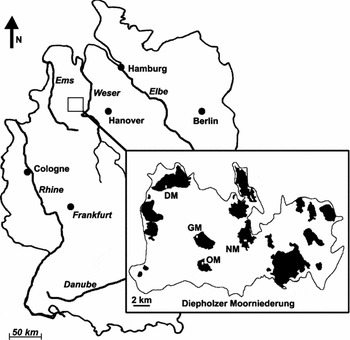
The four studied peat bogs are located in the central part of the natural region ‘Diepholzer Moorniederung’, an area between the towns of Hannover, Bremen and Osnabrück (Lower Saxony, Germany; Fig. 1). The region is characterized by large peat bogs, wetlands and dry sand ridges. All peat bogs are highly degraded, either by cultivation, peat cutting, drainage or succession (Niemeyer Reference Niemeyer1997). In the early 1970s, regional conservationists started a conservation project designed to save the remaining peat bog fauna, which has been continued by the Bund für Umwelt und Naturschutz Deutschland (BUND, i.e. Friends of the Earth, Germany) since 1983. The bogs have been listed as Ramsar site 86 since 1976 (see URL http://www.ramsar.org). Habitat management in these peat bogs focuses on conservation of their open and wet character in order to provide suitable habitat for wetland birds (Niemeyer Reference Niemeyer1997). This is achieved by several management tools, such as hydrological management to restore the water tables, logging of birches and pines, extensive sheep grazing with a regionally typical breed of sheep (white polled heath), and cutting and burning of Molinia stands. To avoid negative effects on animal species, fires are only set in winter (January and February), and only when the following criteria are met: high water levels, frozen turf and a maximum air temperature of 5°C (Niemeyer Reference Niemeyer1997). During these conditions, negative effects on animals should be sparse, since their activity is minimal. Only some of the peat bogs are burned and only in years with the required conditions. Burned areas are generally classified as first priority sites for subsequent sheep grazing in the herding plans of the following spring to prevent increased growth of grasses (Niemeyer Reference Niemeyer1997).
Map of the natural region ‘Diepholzer Moorniederung’ showing the locations of peat bogs (black) including the study sites (Neustädter Moor: NM, Rehdener Geestmoor: GM, Oppenweher Moor: OM, Drebbersches Moor: DM). White spots within the study sites mark the locations of burned areas.

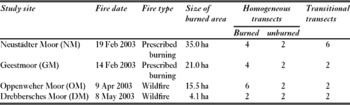
In February 2003, prescribed burning was applied to areas within two larger bogs, the Neustädter Moor (NM) and the Rehdener Geestmoor (GM; Table 1). In spring 2003, parts of two other bogs, the Oppenweher Moor (OM) and the Drebbersches Moor (DM) were affected by wildfires (Fig. 1, Table 1). The four bogs are dominated by grasses and dwarf shrubs, particularly Eriophorum vaginatum, Calluna vulgaris, Erica tetralix and Molinia caerulea. Further plant species are Eriophorum angustifolium, Andromeda polifolia, Oxycoccus palustris, Empetrum nigrum, Festuca ovina, Rumex acetosella, Betula pubescens, Rhynchospora alba, Drosera rotundifolia, Juncus effusus, Vaccinium uliginosus and different species of Sphagnum (mostly S. cuspidatum and S. fallax).
Overview of the study design, including the fire date, fire type, the size of the burned area and the number of homogeneous and transitional transects for each peat bog.

Data sampling
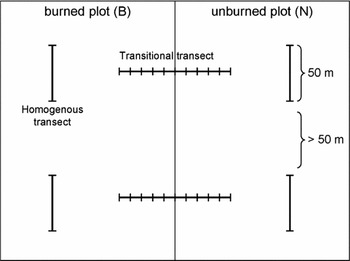
Orthoptera abundance was sampled by visual and acoustic counts on replicated 50 m transects during the period from 14 July 2003 to 21 September 2003 between 11:00 and 18:00 hours. As songs of Orthoptera are species-specific, they represent an ideal tool to map these insects (see also Hochkirch et al. Reference Hochkirch, Witzenberger, Teerling and Niemeyer2006). All individuals, which were heard or seen along the transects were summed. Transect counting represents an efficient way to achieve quantitative data on Orthoptera abundance as it is less influenced by the vegetation type than sweep netting (Hochkirch et al. Reference Hochkirch, Blank, Dieling, Dormann, Hämker, Hoffmann and Rahmel2000). However, the method strongly depends on the insects’ activity, which is affected by the weather conditions. All counts were, therefore, performed during sunny and windless weather. The transects were established on sites with comparatively large, homogeneous burned areas and adjacent unburned zones of similar vegetation type. To study the direct effects of fire, we compared homogeneous transects, which were located parallel to the edge of the burned area at a distance of at least 50 m from the edge or other transects (Fig. 2). Since the majority of Orthoptera are known to move only several metres during their life (Ingrisch & Köhler Reference Ingrisch and Köhler1998b), this distance should be large enough to avoid influences from adjacent transects. To investigate edge effects and recolonization processes, we established transitional transects 100 m in length centred on the edge between the burned and unburned areas. Transitional transects were subdivided into 10 m sections in order to investigate the gradient from the edge to the centre (Fig. 2). The minimum distance between transects was 50 m. Owing to the different sizes of the burned plots, it was not possible to keep the number of transects per bog or treatment constant (Table 1). To investigate secondary effects of vegetation structure on Orthoptera abundance, we measured the vegetation cover for each 10 m section of the transitional transects. The cover of all higher plant species, as well as the categories ‘mosses & lichens’, ‘litter’ and ‘open ground’ were measured across the central line of the transect (10 cm = 1%). Moreover, the mean vegetation height of ten measures for each 10-m section was calculated and the number of grass tussocks counted. To account for the slightly differing phenologies of Central European Orthoptera (Oschmann Reference Oschmann1993) and the special weather conditions during the research period, counts were repeated three times on homogeneous transects and four times on transitional transects (first count 14–25 July; second count 29 July–6 August; third count 6–12 August; fourth count 25 August–21 September).
Study design. Homogeneous transects were located parallel to the edge of the burned area at a distance of ≥50 m to the edge and to other transects. Transitional transects had a length of 100 m centred on the fire edge and were subdivided into 10-m sections in order to investigate the gradient from the edge to the centre.

Statistical analysis
Differences in Orthoptera abundance between burned and unburned plots (‘fire treatment’), between bogs affected by wildfires or prescribed burning (‘fire season’) and between census dates (‘count’) were analysed by a repeated measures analysis of variance (ANOVA, nested design) to avoid temporal pseudoreplication. We also integrated the name of the bog as an explanatory variable, as the four peat bogs differ in size, vegetation, degradation and isolation, and the fires might have differed in intensity or behaviour. Significant differences between the bogs or counts were tested by multiple t-tests with Bonferroni correction in order to identify the significantly different species pairs (Crawley Reference Crawley2005). A repeated measures ANOVA was used for testing differences in Orthoptera abundance for the 10-metre sections of the transitional transects, with ‘section’, ‘fire treatment’, ‘fire season’, ‘bog’ and ‘count’ as the explanatory variables. To test for differences in the vegetation, we performed a three-way ANOVA with ‘bog’, ‘treatment’ and ‘section’ as the explanatory variables. All tests were carried out in R 2.4.0 (R Development Core Team 2006) including the library MASS (Venables & Ripley Reference Venables and Ripley2002) to calculate Box-Cox-lambdas, which represent the optimal power transformation (λ) to fit the data to the model assumptions.
To assess how Orthoptera assemblages corresponded to the vegetation structure, we performed non-metric multidimensional scaling (NMDS) with the community ecology package vegan 1.6–10 for R (Oksanen et al. Reference Oksanen, Kindt and O'Hara2005). This method is commonly regarded as the most robust unconstrained ordination method in community ecology (Minchin Reference Minchin1987). The function ‘metaMDS’ from the vegan library was used, which first transforms the data by Wisconsin double standardization and applies Bray-Curtis dissimilarities as a measure of ecological distance. An advantage of this method is that the procedure is less dependent on data distribution than constrained methods, such as principal component analyses. Wisconsin double standardization is a method, which first standardizes species by maxima and afterwards the sites by totals. The Bray-Curtis distance is a semi-metric non-Euclidean dissimilarity index, which is widely used in community ecology as it appears to function best for this type of data (Faith et al. Reference Faith, Minchin and Belbin1987). Values of the Bray-Curtis distance can range from zero (similar community composition) to one (no similarities). We overlaid environmental factors (i.e. vegetation composition and structure) onto the NMDS plots, using the function ‘envfit’ (Oksanen et al. Reference Oksanen, Kindt and O'Hara2005). This procedure also generates an R 2 measure and ‘significance’ values based on the probability that random permutations of the environmental variables would yield a higher degree of fit than the true environmental variables. The vegetation matrix included the dominant plant species Molinia caerulea, Calluna vulgaris, Erica tetralix and Eriophorum vaginatum as variables. Rare plant species were categorized as ‘forbs and ferns’ (including Rumex acetosella and ferns), ‘trees’ (shoots of Betula pubescens), ‘grasses’ (Juncus effusus, Eriophorum angustifolium, Rhynchospora alba, Festuca ovina), and ‘dwarf shrubs’ (Oxycoccus palustris, Andromeda polifolia and Empetrum nigrum). The variables ‘bare ground’ (including bare ground, mosses and lichens), ‘litter’, ‘mean vegetation height’ and ‘number of tussocks’ were also included.
Results
Homogeneous transects
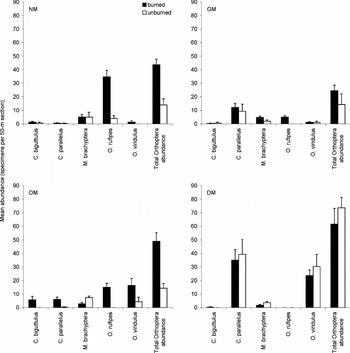
A total of 2697 counts of 13 Orthoptera species was obtained. Twelve species were recorded from the homogeneous transects, five of which accounted for 95.6% of the counts (Omocestus rufipes 30.3%, Chorthippus parallelus 27.1%, Omocestus viridulus 22.8%, Metrioptera brachyptera 10.5%, Chorthippus biguttulus 4.8%). Fire effects were analysed only for these five species, as well as for the total Orthoptera abundance. The total Orthoptera abundance was significantly higher on burned plots than on unburned plots (λ = 0, F 1,4 = 12.28, p = 0.025, Fig. 3), but the only species for which the repeated measures ANOVA detected a significant effect of fire was O. rufipes (λ = 0, F 1,4 = 415.27, p < 0.001, Fig. 3). This species was nearly exclusively found on burned plots. Only at NM did it also occur on unburned transects, which resulted in a significant interaction between the variables ‘bog’ and ‘fire’ (λ = 0, F 2,4 = 54.88, p = 0.001). The type of fire (wildfire versus prescribed burning) had no significant effect on the abundance of any species. However, there were differences among bogs in the abundances of O. rufipes (λ = 0, F 2,4 = 92.25, p < 0.001) and Ch. parallelus (λ = 0.25, F 2,4 = 30.42, p = 0.004) uncovered by the repeated measures ANOVA, although total Orthoptera abundance barely differed among the four bogs (λ = 0, F 2,4 = 6.40, p = 0.057).
Mean Orthoptera abundance on the burned and unburned plots of Neustädter Moor (NM), Geestmoor (GM), Oppenweher Moor (OM) and Drebbersches Moor (DM). Error bars are standard errors.

The total Orthoptera abundance decreased significantly during the research period (λ = 0, F 1,16 = 18.14, p < 0.001). At a species level, O. viridulus abundance differed among census dates (λ = 0.12, F 1,16 = 12.22, p = 0.003) and M. brachyptera abundance tended to differ (λ = 0.48, F 1,16 = 3.87, p = 0.067). There were significant interactions between the fire treatment and phenology in O. rufipes (λ = 0, F 1,16 = 5.95, p = 0.027), Ch. biguttulus (λ = −0.14, F 1,16 = 7.21, p = 0.016) and Ch. parallelus (λ = 0.25, F 1,16 = 5.34, p = 0.035). However, the pattern was not consistent among the species; Ch. parallelus had a delayed phenology on the unburned compared to the burned plots, whereas Ch. biguttulus and O. rufipes showed the opposite pattern. This result was further complicated by a threefold interaction between ‘fire’, ‘bog’ and ‘count’ for O. rufipes (λ = 0, F 2,16 = 5.48, p = 0.015), caused by local differences in phenology. The maximum abundance of this species was measured at the first count in GM, at the second count in NM and on the third count in OM.
Transitional transects
Thirteen species were recorded from the transitional transects, five of which accounted for 94.0% of the counts (Ch. parallelus 25.0%, M. brachyptera 22.2%, O. viridulus 20.5%, O. rufipes 15.3%, and Myrmeleotettix maculatus 11.0%). We only analysed fire effects for these five species. The repeated measures ANOVA revealed significant differences in the abundance of O. rufipes (λ = −0.49) between the four bogs (F 2,104 = 27.44, p < 0.001). This species was most abundant in OM, followed by NM and GM, while it was missing in DM. Similar to the homogeneous transects, the abundance of O. rufipes was higher in the burned than in the unburned sections of the transitional transects (F 1,104 = 6.61, p = 0.012). However, this effect was mainly caused by a step-like transition in OM, resulting in a significant interaction between ‘bog’ and ‘fire treatment’ (F 2,104 = 5.64, p = 0.005). The abundance of O. rufipes varied among census dates (F 1,344 = 6.19, p = 0.013), but decreased significantly faster on the unburned sites than on the burned sites (F 1,344 = 4.92, p = 0.027), particularly at OM (F 2,344 = 5.00, p = 0.007). No significant differences in the abundance of the 10-m sections within the burned plots were revealed.
The abundance of O. viridulus (λ = −0.36) also differed significantly between the bogs (F 2,104 = 24.46, p < 0.001), being most abundant in DM followed by OM, whereas the species was rare in NM and GM. The effects of burning differed between the sites (F 2,104 = 6.77, p = 0.002): at DM the abundance was higher in the unburned sections, whereas the opposite was true for OM. The abundance of O. viridulus differed significantly between the counts (F 1,344 = 119.81, p < 0.001), but no differences between the 10-m sections were revealed.
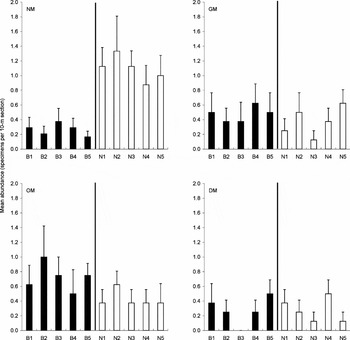
Abundances of M. brachyptera (λ = −0.17) also differed significantly among bogs (F 2,104 = 3.99, p = 0.021). The species was more common at NM and OM, the lowest abundance being at DM. There was a significant effect of the fire treatment on the abundance of this species (F 1,104 = 13.69, p < 0.001), the abundance being higher in the unburned than in the burned sections. However, this pattern was caused by a higher abundance on unburned plots at NM, resulting in a significant interaction between fire treatment and bog (F 2,104 = 5.77, p = 0.004). At NM the transition between the burned and the unburned area was step-like, while in the other bogs the abundance was relatively uniform across the transects (Fig. 4). M. brachyptera decreased significantly in abundance during the season (F 1,344 = 88.62, p < 0.001). The repeated measures ANOVA also revealed a threefold interaction between the variables ‘bog’, ‘fire treatment’ and ‘count’ (F 2,344 = 3.80, p = 0.023), indicating local differences in the phenology in burned and unburned areas of different peat bogs, whereas no differences were found between the sections within one treatment.
Mean abundance of Metrioptera brachyptera on the 10-m sections of transects leading from the burned (black columns, section B) to the unburned (white columns, section N) plots in Neustädter Moor (NM), Geestmoor (GM), Oppenweher Moor (OM) and Drebbersches Moor (DM). The edge of the burned plot is marked by a line between section B5 and N1. Error bars are standard errors.

Ch. parallelus (λ = −0.32) was significantly more common in DM than in GM, while its abundance was extremely low in NM and OM (F 2,104 = 333.92, p < 0.001). The species was generally more abundant in the unburned than in burned sections (F 1,104 = 4.89, p = 0.029). Moreover, there was a significant threefold interaction between ‘fire treatment’, ‘fire season’ and ‘section’, caused by a higher abundance in the unburned than in the burned plots of DM. In the burned and unburned sections of GM Ch. parallelus had a similar abundance. In addition, we found differences in abundance between the counts (F 1,344 = 17.58, p < 0.001). The species had its peak of abundance during the second and third count. However, in GM the peak was found during the first count, resulting in significant interactions between ‘count’ and ‘bog’ (F 2,344 = 29.2, p < 0.001). The abundance of M. maculatus (λ = −0.82) differed significantly between the bogs (F 2,104 = 6.69, p = 0.001), as the species occurred mainly in NM.
Fire effects on vegetation structure and composition
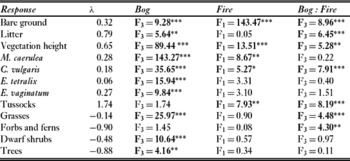
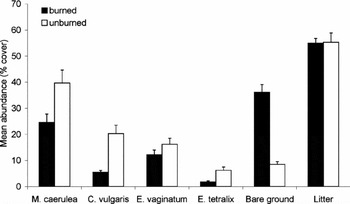
The vegetation was significantly affected by fire, resulting in a higher amount of bare ground on burned sites (Table 2, Fig. 5) and higher amount of vegetation in the unburned sections of the transects. Molinia caerulea and Calluna vulgaris were more abundant on unburned plots than in the burned zones and a trend for such a pattern was also apparent in Erica tetralix (p = 0.071, Fig. 5). The number of grass tussocks was also significantly higher in the burned than in the unburned plots (Table 2, Fig. 5). The bogs differed significantly in nearly all vegetation descriptors and there were statistical interactions between the explanatory variables ‘bog’ and fire’ (Table 2). Although the amount of bare ground was higher in the burned sections of all bogs, the slope (i.e. the fire effect) was steeper in NM and DM than in GM and OM. A smaller amount of litter was only found in DM and GM, but not in OM, and litter was more common in NM owing to the high availability of burned stems of dwarf shrubs. The mean vegetation height was lower in the burned plots of OM and NM than in the burned plots, but in GM and DM there was no difference in the vegetation height between burned and unburned plots. The differences in the cover of C. vulgaris in the burned and the unburned plots was more pronounced in NM (where it was also more common) than in the other bogs. The number of grass tussocks was significantly higher in the burned plots of DM and GM, but not in NM, and there were fewer grass tussocks in the burned plots of OM. Forb and fern cover was lower in the burned plots of OM and NM, while their cover was higher in the burned plots of DM and did not differ between burned and unburned plots of OM. Grasses were more abundant in the burned plots of OM and DM, but not in the other bogs (Table 2).
Results of two-way ANOVAs for the response of vegetation parameters to the explanatory variables ‘bog’ and ‘fire’. All data were boxcox-transformed (λ) to comply with the models assumptions. Values in bold are significant (* = p < 0.05, ** = p < 0.01, *** = p < 0.001, residual DF = 112).

Mean cover of the most important plant species, as well as bare ground and litter cover on the burned and unburned plots across all peat bogs. Error bars are standard errors.

Correlations between vegetation structure and Orthoptera species
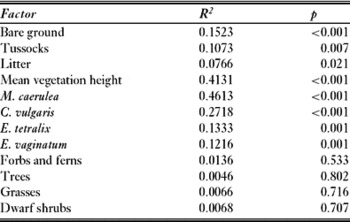
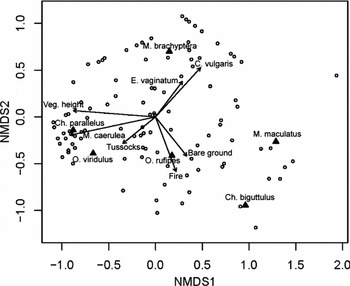
The NMDS ordination had a high resolution (Fig. 6). Eight of the twelve vegetational factors were significantly correlated with the Orthoptera assemblages (Table 3). No significant correlation was revealed for categories with low abundance (forbs and ferns, trees, grasses, dwarf shrubs). The abundances of O. rufipes, M. maculatus and Ch. biguttulus were strongly correlated with the availability of bare ground (and the fire vector) and negatively with mean vegetation height (Fig. 6). The abundances of O. viridulus and Ch. parallelus were correlated with M. caerulea, E. tetralix, tussocks and the mean vegetation height. M. brachyptera was the only species, which was negatively correlated with the fire vector, and positively with E. vaginatum and C. vulgaris.
Squared correlation coefficients (R2) and significance (based on 10 000 random permutations of the data) of vegetation descriptors with the Orthoptera assemblages revealed by a non-metric multidimensional scaling (NMDS).

Non-metric multidimensional scaling (NMDS) ordination of the Orthoptera assemblages. Each circle represents a 10-m section of a transitional transect. Triangles represent the loadings of Orthoptera species. The overlaid vectors were created by the function ‘envfit’ in the vegan library for R (Oksanen et al. Reference Oksanen, Kindt and O'Hara2005). Only significant vectors are shown (p < 0.01).

Discussion
Effects of burning have been analysed for a variety of taxa and ecosystems. Depending on the life history and ecology of the involved taxa, the ecosystem, and the type and season of fire, positive, neutral and negative effects have been reported (Evans Reference Evans1984; Anderson et al. Reference Anderson, Leahy and Dhillion1989; Bock & Bock Reference Bock and Bock1991; Swengel Reference Swengel2001; Panzer Reference Panzer2002; Cochrane Reference Cochrane2003). Since the majority of Orthoptera species occur in open habitat types, positive and neutral effects of fire dominate in this group (Anderson et al. Reference Anderson, Leahy and Dhillion1989; Chambers & Samways Reference Chambers and Samways1998; Swengel Reference Swengel2001; Fredericksen & Fredericksen Reference Fredericksen and Fredericksen2002; Huntzinger Reference Huntzinger2003; Gardiner et al. Reference Gardiner, Gardiner and Hill2005; Joern Reference Joern2005). In the present study, most species’ reactions were neutral, and for one species (O. rufipes) strong positive effects were found. O. rufipes is listed as endangered in Lower Saxony (Grein Reference Grein2005) and Germany (Ingrisch & Köhler Reference Ingrisch, Köhler, Binot, Bless, Boye, Gruttke and Pretscher1998a; Maas et al. Reference Maas, Detzel and Staudt2002). In northern Germany, the species occurs nearly exclusively in peat bogs (Brose & Peschel Reference Brose and Peschel1998) and, therefore, the type of management of these habitats is of fundamental importance for its conservation. Obviously, prescribed burning is a suitable management tool for the conservation of this species, particularly since our results demonstrate that fire does not represent a threat to any of the other Orthoptera species.
Fire effects
Effects of fire generally include direct effects due to combustion (Rice Reference Rice1932; Bock & Bock Reference Bock and Bock1991) and indirect effects, such as changes in vegetation structure and composition (Evans Reference Evans1984; McCullough et al. Reference McCullough, Werner and Neumann1998). Direct effects depend upon many aspects of the burned habitat, environmental conditions and the fire itself, such as fire season, intensity, behaviour, extent and frequency, weather conditions, fuel accumulation, soil type and moisture, and topography (Warren et al. Reference Warren, Scifres and Teel1987; Whelan Reference Whelan1995; McCullough et al. Reference McCullough, Werner and Neumann1998; Keeley et al. Reference Keeley, Fotheringham and Baer-Keeley2005). However, fire effects also depend on the ecology and bionomics of the involved species, such as oviposition (or overwintering) substrate (Evans Reference Evans1984; Hochkirch Reference Hochkirch1997; Chambers & Samways Reference Chambers and Samways1998; Branson & Vermeire Reference Branson and Vermeire2007). Prescribed fires usually move rapidly across the vegetation with little change in soil temperatures (Niemeyer et al. Reference Niemeyer, Fottner, Mohamed, Sieber and Härdtle2004). Since most Orthoptera species in Central Europe hibernate as eggs (Ingrisch & Köhler Reference Ingrisch and Köhler1998b), it is reasonable to assume that egg pods of species ovipositing in the vegetation are exposed to higher temperatures than those of species ovipositing below ground (Anderson et al. Reference Anderson, Leahy and Dhillion1989; Hochkirch Reference Hochkirch1997). In the present study, the only species ovipositing in plant stems was M. brachyptera, but the results concerning this species are inconsistent. While no fire effects were found on the homogeneous transects, a distinct effect of prescribed burning was revealed on the transitional transects of one of the bogs (NM), with a step-like transition between burned and unburned plots (Fig. 4). Possibly these results were caused by differing fire intensities, and in some bogs lethal temperatures were not exceeded in the oviposition substrate. Although it decreased in abundance, M. brachyptera was not eliminated completely in any of the burned plots. It is possible that small unburned patches served as refuges for subsequent recolonization (Bell et al. Reference Bell, Wheater and Cullen2001; Kiss & Magnin Reference Kiss and Magnin2005), but the step-like transition between the burned and the unburned area conflicts with this hypothesis. At the edge of the plots, the mean abundance of M. brachyptera was 6.8 times higher in the unburned area than in the adjacent burned area and no edge effect occurred. M. brachyptera could be negatively affected by fire under special conditions, but here population reduction was never sufficiently devastating to represent a severe threat to its survival.
Although direct effects of burning have been reported for a variety of species (Rice Reference Rice1932), indirect effects are usually stronger (Hulbert Reference Hulbert1969; Evans Reference Evans1984; Warren et al. Reference Warren, Scifres and Teel1987; Moretti et al. Reference Moretti, Conedera, Duelli and Edwards2002; Ratchford et al. Reference Ratchford, Wittman, Jules, Ellison, Gotelli and Sanders2005). This is particularly true when prescribed burning is applied during the cold season (Evans Reference Evans1984; Chambers & Samways Reference Chambers and Samways1998; Swengel Reference Swengel2001). Fire usually alters the vegetation structure and composition, as well as the cover of open ground and litter (Wilson & Shay Reference Wilson and Shay1990). Burned areas are more open, illuminated and desiccated than unburned plots, and favour a more xerophilous fauna (Usher Reference Usher1992; Kiss & Magnin Reference Kiss and Magnin2005). In the four peat bogs, we found significant effects on vegetation structure and composition. The cover of bare ground and mosses increased, while litter was not affected. These changes in vegetation are also known to influence microclimate, food quality and quantity and predation risk (Evans Reference Evans1984). In peat bogs of New Zealand, experimental fires increased radiation and daytime soil temperature for more than four years (Norton & de Lange Reference Norton and de Lange2003). The importance of vegetation structure and microclimate for grasshopper species has long been recognized (Sänger Reference Sänger1977; Uvarov Reference Uvarov1977; Joern Reference Joern1982; Ingrisch Reference Ingrisch1983; Chappell & Whitman Reference Chappell, Whitman, Chapman and Joern1990). Therefore, we would expect negative responses in species preferring dense vegetation and positive effects on species preferring bare ground patches (Bock & Bock Reference Bock and Bock1991; Hochkirch Reference Hochkirch1997; Joern Reference Joern2005). The results of the NMDS confirm this hypothesis. The species which was positively affected by fire (O. rufipes) is known to prefer patches of bare ground (our own data) and was also correlated with the cover of bare ground in the multivariate analysis. Conversely, the only species for which we found slightly negative effects of fire (M. brachyptera) prefers dense and high vegetation.
In some species, we revealed a significant effect of the fire treatment on the phenology. A higher amount of bare ground generally causes more rapid increases in soil (in this case turf) temperatures (Hulbert Reference Hulbert1988), which can cause faster development of eggs or nymphs (Evans Reference Evans1984; Anderson et al. Reference Anderson, Leahy and Dhillion1989). However, the results of our study do not seem to indicate such interactions. The abundance of two species with preferences for bare ground (O. rufipes and Ch. biguttulus) increased during the season on the burned plots, indicating a delayed phenology. Only Ch. parallelus could be interpreted as developing faster on unburned plots. Indirect effects of fire can also include changes in food availability or nutritional content. Although most Orthoptera species are not specialized in food (Chapman Reference Chapman, Chapman and Joern1990), they can be generally classified as forbivorous and/or graminivorous species (Uvarov Reference Uvarov1977). Grass-feeding species often profit from burning, while forb-feeders decline (Evans Reference Evans1984, Reference Evans1988; Bock & Bock Reference Bock and Bock1991). Since strict forbivorous species were not present in the plots, it was not possible to analyse this effect in detail.
Recolonization
Evans (Reference Evans1984) stated that studies on post-fire dispersal are needed to fully understand the impact of fire. The main question is whether species survive in situ or whether they colonize the burned area later (Moretti et al. Reference Moretti, Conedera, Duelli and Edwards2002). The transitional transects in our study were set up to study the edge effect and post-fire recolonization of burned plots. Since the majority of Orthoptera are known to disperse no more than several metres during their life (Ingrisch & Köhler Reference Ingrisch and Köhler1998b), we hypothesized that recolonization should proceed slowly and the abundance should be higher at the edge of the burned area than in its centre. However, such a pattern was not found for any of the species. In most species direct fire-caused mortality was not significant and the pattern was more or less uniform. A lower abundance in the burned sections of the transitional transects was found only in two cases. In DM, Ch. parallelus had a higher abundance in the centre of the burned plot than at the edge to the unburned area. In NM, the transition of abundance of M. brachyptera was step-like, indicating that recolonization did not play any important role and that vegetation structure is of high importance for the habitat choice of Orthoptera (Fig. 6). The increasing abundance of some species in burned plots during the season was not spatially related to the edge of the burned area. If phenology was not delayed on the burned plots (see above), only long-distance dispersal could be an adequate explanation for this pattern (Cook & Holt Reference Cook and Holt2005). It has been argued that mobile species might colonize burned areas faster than flightless species (Hochkirch Reference Hochkirch1997). Interestingly, the two species involved (Ch. biguttulus and O. rufipes) are fully winged and known to be good flyers; both species oviposit below ground and are, therefore, less vulnerable to fire. Thus, survival in situ is also likely, as has been proposed by other authors (Moretti et al. Reference Moretti, Conedera, Duelli and Edwards2002; Cook & Holt Reference Cook and Holt2005).
IMPLICATIONS FOR PEAT BOG MANAGEMENT
Prescribed burning is still discussed controversially as a management tool for open ecosystems and has been criticized particularly by entomologists (Swengel Reference Swengel2001; Pullin Reference Pullin2002), although insect populations are seldom eradicated by single fires (Swengel Reference Swengel1998). There is accumulating evidence that postfire recovery is mostly rapid (Anderson et al. Reference Anderson, Leahy and Dhillion1989; Panzer Reference Panzer2002; Tooker & Hanks Reference Tooker and Hanks2004). Pullin (Reference Pullin2002) argued that, in fens, burning is not a traditional type of management, but charcoal layers in some peat bogs indicate that fire might have been more common than previously thought (Norton & de Lange Reference Norton and de Lange2003), although the fire frequency was probably much lower in the past (Kuhry Reference Kuhry1994). The few studies dealing with fire effects on wetland organisms suggest that species richness increases, threatened species benefit and vegetation recovers (Norton & de Lange Reference Norton and de Lange2003; Ratchford et al. Reference Ratchford, Wittman, Jules, Ellison, Gotelli and Sanders2005). Although we did not find any substantial negative effects of fire on the local Orthoptera fauna, it is reasonable to assume that other taxa are more sensitive to burning. However, even snail communities can be rather resilient to fires, if fire frequency is not too high (Kiss & Magnin Reference Kiss and Magnin2005). Since wetlands typically burn patchily (Panzer Reference Panzer2002), the negative effects of single fires might be low even for other taxa. Conversely, it has been shown that a high fire frequency can cause negative effects even in Orthoptera (Chambers & Samways Reference Chambers and Samways1998), and fires at intervals of two to seven years might be beneficial (Panzer Reference Panzer2002; Moretti et al. Reference Moretti, Conedera, Duelli and Edwards2002; Schurbon & Fauth Reference Schurbon and Fauth2003). In the Diepholzer Moorniederung only comparatively small patches of the large peat bogs are burned and only if certain criteria are met (Niemeyer Reference Niemeyer1997, Reference Niemeyer2004). This type of burning regime should allow post-fire recovery (Bell et al. Reference Bell, Wheater and Cullen2001). Another factor influencing the effect of burning is the fire season. It is generally believed that burning during the cold season is less deleterious than during summer (Warren et al. Reference Warren, Scifres and Teel1987; Chambers & Samways Reference Chambers and Samways1998; Joern Reference Joern2005). We did not find any striking difference between the effect of wildfires and prescribed burning. This could be caused by the fact that even wildfires originated before most Orthoptera nymphs emerged (9 April, 8 May; see Table 1). It has been argued that prescribed burning in winter is a rather unnatural disturbance, since fires should occur naturally during the driest season of the year (Howe Reference Howe1994; Kirkman et al. Reference Kirkman, Drew and Edwards1998; Schurbon & Fauth Reference Schurbon and Fauth2003; Bond & Keeley Reference Bond and Keeley2005). Fears of fire-caused mortality still dominate current management practices, although positive effects have also been reported from military training areas, where fire was induced accidentally during summer months (Clausnitzer & Clausnitzer Reference Clausnitzer and Clausnitzer2005).
Our results support prescribed burning as a management tool for Orthoptera in peat bogs, but there remains a caveat. In the peat bogs of northern Germany, fire is used to control Molinia caerulea, which has been viewed as a major threat to moorland conservation in Europe (Marrs et al. Reference Marrs, Phillips, Todd, Ghorbani and le Duc2004). In the present study, the density of M. caerulea decreased on the burned plots, but recent evidence suggests that the species profits from fire in the long term (Brys et al. Reference Brys, Jacquemyn and de Blust2005). Therefore prescribed burning might counteract peat bog regeneration. In the bogs of the Diepholzer Moorniederung, this problem is considered by classifying burned sites as first priority sites for subsequent sheep grazing during the vegetation period (Niemeyer Reference Niemeyer1997).
ACKNOWLEDGEMENTS
We thank the Division of Ecology at the University of Osnabrück for providing research facilities and financial support. Our thanks also go to the BUND Diepholzer Moorniederung (particularly to F. Niemeyer) for technical support, accommodation, helpful discussion and the realization of management measures. T. Eggers provided essential advice on statistics. J. Gröning, T. Eggers, K. Witzenberger, A. Kratochwil and three anonymous referees provided valuable comments on a previous version of the manuscript. We also wish to thank A. Kratochwil for his constant support and encouragement throughout this project. Access to the study sites was kindly permitted by the former district government of Hannover.