Introduction
In traumatic brain injury (TBI), the typical pattern of acceleration and deceleration forces within the brain leads to a disruption of neural activity, both within and between the ventrolateral, medial and orbital frontal lobes and the ventromedial temporal lobes (Bigler, Reference Bigler2007; Bigler & Maxwell, Reference Bigler and Maxwell2011; Courville, Reference Courville1945; Gentry, Godersky, & Thompson, Reference Gentry, Godersky and Thompson1988; Hadley et al., Reference Hadley, Teasdale, Jenkins, Condon, MacPherson, Patterson and Rowan1988). The results of this disruption are long-term impairments in cognitive functioning (Draper & Ponsford, Reference Draper and Ponsford2008), with one of the most common of these being impairments in learning and memory processes. The learning and memory difficulties experienced are generally non-specific, in that both encoding and retrieval of verbal and visual information can be affected (e.g., Himanen et al., Reference Himanen, Portin, Isoniemi, Helenius, Kurki and Tenovuo2006; Shum, Harris, & O'Gorman, Reference Shum, Harris and O'Gorman2000). Other areas of cognition that are often affected following TBI include information processing speed and executive function (Draper & Ponsford, Reference Draper and Ponsford2008; Levin & Kraus, Reference Levin and Kraus1994; Ponsford & Kinsella, Reference Ponsford and Kinsella1992; Scheid, Walther, Guthke, Preul, & von Cramon, Reference Scheid, Walther, Guthke, Preul and von Cramon2006).
With respect to non-verbal measures of learning and memory, one particular measure that has a long history in neuropsychology (McKay, Lee, Stolwyk, & Ponsford, Reference McKay, Lee, Stolwyk and Ponsford2012) and which may be particularly useful to detect impairments in those with a TBI, is the Austin Maze task (Bowden, Reference Bowden1989; Milner, Reference Milner1965). Used specifically to examine the extent of impairments in complex visuospatial learning, the task requires a person to learn a hidden pathway across a 10 × 10 array of buttons while also adhering to several rules. The task continues until the person has reached a criterion of three correct error-free trials. The Austin Maze task has been used to indicate the extent of impairments in visuospatial learning in both clinical neuro-psychological practice and research, with studies consistently demonstrating that the task is a sensitive measure in TBI populations (McDonald, Reference McDonald1993; Shores et al., Reference Shores, Kraiuhin, Zurynski, Singer, Gordon, Marosszeky and Fearnside1990; Tate & Broe, Reference Tate and Broe1999). Its importance as a measure is also highlighted by the fact that poor performance on the task may be specifically linked to poor psychosocial functioning and reintegration following TBI, particularly in the domains of occupational activities, interpersonal relationships and independent living (Tate & Broe, Reference Tate and Broe1999). Other populations demonstrating sensitivity to this measure have included cigarette smokers (Paul et al., Reference Paul, Brickman, Cohen, Williams, Niaura, Pogun and Gordon2006), and those with schizophrenia (Mattson, Berk, & Lucas, Reference Mattson, Berk and Lucas1997), anorexia nervosa (Szmukler et al., Reference Szmukler, Andrewes, Kingston, Chen, Stargatt and Stanley1992), Parkinson's disease (Reid et al., Reference Reid, Broe, Hely, Morris, Williamson, O'Sullivan and Moss1989), stroke (Bladin & Chambers, Reference Bladin and Chambers1993; Donnan, Bladin, Berkovic, Longley, & Saling, Reference Donnan, Bladin, Berkovic, Longley and Saling1991), Alzheimer's disease (Fowler, Saling, Conway, Semple, & Louis, Reference Fowler, Saling, Conway, Semple and Louis2002), right temporal lobe epilepsy (Hocking et al., Reference Hocking, Thomas, Dzafic, Williams, Reutens and Spooner2013; Thomas, Reference Thomas2011) and alcohol dependency (Bowden & McCarter, Reference Bowden and McCarter1993).
The Austin Maze task was originally developed as a measure of executive function or, more specifically, a measure of planning, error utilisation and regulation ability (Walsh, Reference Walsh1994). It was argued that those with frontal lobe dysfunction would have greater difficulty performing the task due to their inability to eradicate errors across successive trials. However, research in healthy adult samples has indicated that the Austin Maze task is, in fact, predominantly a measure of visuospatial learning rather than a measure of frontal lobe and executive functioning (Crowe et al., Reference Crowe, Barclay, Brennan, Farkas, Gould, Katchmarsky and Vayda1999). In support of this claim, performance on the Austin Maze task has been associated with performance on alternative tasks of visuospatial functioning, including WAIS-R (Wechsler, Reference Wechsler1981) Performance IQ and Block Design, and the Visuospatial Learning Test (Bowden et al., Reference Bowden, Dumendzic, Hopper, Kinsella, Clifford and Tucker1992; Crowe et al., Reference Crowe, Barclay, Brennan, Farkas, Gould, Katchmarsky and Vayda1999; Malec et al., Reference Malec, Ivnik, Smith, Tangalos, Petersen, Kokmen and Kurland1992; Tucker, Kinsella, Gawith, & Harrison, Reference Tucker, Kinsella, Gawith and Harrison1987). The Austin Maze task appears to have negligible associations with measures of executive function including the Wisconsin Card Sort Test (Heaton, Chelune, Talley, Kay, & Curtiss, Reference Heaton, Chelune, Talley, Kay and Curtiss1993) and the Tower of London (Shallice, Reference Shallice1982), and maintains minimal associations with tasks of working memory, including the Brown Peterson Task (Peterson & Peterson, Reference Peterson and Peterson1959) and the WAIS-R Digit Span Backward (Crowe et al., Reference Crowe, Barclay, Brennan, Farkas, Gould, Katchmarsky and Vayda1999).
The conventional form of the Austin Maze task was constructed as a small electronic device with buttons and accompanying circuitry. The device required technical expertise for maintenance and it has never been commercially produced. Both these factors are argued to have contributed to its declining use in research and clinical settings over the past 20 years (McKay et al., Reference McKay, Lee, Stolwyk and Ponsford2012). However, a new computerised adaptation of the Austin Maze task is now available (Bray & McDonald, Reference Bray and McDonald2010), making the task more accessible to both clinicians and researchers alike. Like the traditional version, the new computerised version uses the traditional Milner pathway (Milner, Reference Milner1965).
A recent study by McKay, Lee, Stolwyk and Ponsford (Reference Stolwyk, Lee, McKay and Ponsford2012) found that the new computerised version of the Austin Maze task produced results that were comparable to results on the conventional form of the test in a sample of young, healthy university and community participants aged between 18 and 27 years. The study further validated the applicability of the existing norms for use with the new computerised version in this age group. In a related study using this same sample of participants, Stolwyk, Lee, McKay and Ponsford (Reference Stolwyk, Lee, McKay and Ponsford2013) examined the construct validity of the new computerised Austin Maze task. Their findings were largely consistent with the findings of Crowe et al. (Reference Crowe, Barclay, Brennan, Farkas, Gould, Katchmarsky and Vayda1999) noted above, which demonstrated associations between the Austin Maze task and tasks of visuospatial ability, but not tasks of executive functioning. However, while no unique relationship between working memory (measured using the WAIS-IV Digit Backward task) and the Austin Maze task performance was established in this study, the direct relationship (i.e., zero-order correlation) between the two measures was not examined.
To date, the computerised Austin Maze task has not been examined in a clinical sample. As such, it is not known whether the new version of the task remains sensitive as a measure of visuospatial learning impairments in individuals with TBI. The primary purpose of this current study, therefore, is to validate the computerised Austin Maze task for use in an adult TBI sample. It is specifically hypothesised that individuals with a TBI will perform more poorly on the Austin Maze task compared to a demographically matched control group. It is further hypothesised that the task will demonstrate reasonable levels of convergent and divergent validity with alternative cognitive tasks. Based on the findings of previous research already discussed, it is specifically expected that the Austin Maze task will be highly associated with alternative measures of visuospatial learning and visuospatial functioning, will not be associated with tasks of executive function, and will show minimal association with tasks of working memory. It is further hypothesised that because the Austin Maze task is domain specific, in that it is a measure of visuospatial learning ability, performance on the task will not be related to tasks of verbal learning and memory.
Method
Participants
Ethics approval for this research was obtained from the Human Research Ethics Committee of the University of New South Wales. Participants included 28 adults (20 males) with a mean age of 44.93 years (SD = 14.11; range 22–69) and 12.71 mean years of education (SD = 2.31; range 9–17), who were recruited from the outpatient records of three brain injury units across metropolitan Sydney. All participants met the following inclusion criteria: they had sustained a moderate-to-severe TBI resulting in a period of post-traumatic amnesia (PTA) of at least 1 day, were discharged from hospital and living in the community, and had English as their primary spoken language. Participants were excluded if they had: uncorrected hearing or vision loss, a current diagnosed drug and/or alcohol addiction, active psychosis or psychiatric condition, dementia or other neurodegenerative disease, aphasia, agnosia or profound amnesia.
The mean PTA length was 56.41 days (SD = 49.85; range 3–189). Time post injury at testing ranged from 3 to 33 years (M = 12.11 years, SD = 8.48). Causes of TBI included motor vehicle or motor bike accidents (n = 16), falls (n = 7), sporting accidents (n = 1) and assault (n = 4). Computerised axial tomography (CT) scans indicated that participants’ injuries were right hemisphere-focused (n = 6), left hemisphere-focused (n = 4) or bilateral (n = 12). For the remaining participants, scan readings did not specify which hemisphere contained the injury (n = 3), or were unavailable (n = 3). It should be noted that these scans were conducted for clinical purposes and are unlikely to reflect the true extent of pathology.
A control group of 28 adults without a prior history of head injury were recruited from the general community via advertisements placed online and in local community newspapers. Each control participant was matched to a TBI participant on the basis of being of the same sex, a similar age, and similar educational attainment. The TBI and control groups did not differ significantly with respect to sex distribution, age or years of education (p = 1.00, .906 and .089, respectively).
Measures
Austin Maze – computerised version (Bray & McDonald, Reference Bray and McDonald2010)
This task requires participants to learn through trial and error, a ‘secret’ pathway within a 10 × 10 array of square blocks. The pathway starts in the bottom left-hand corner and concludes in the top right-hand corner of the computer screen. On each successive trial, participants are required to use the mouse to move in a left/right or up/down direction (diagonal moves are not permitted). The block will turn green briefly when the trial is correct and red if the trial is incorrect. The participant returns to the last correct block following an incorrect trial before making a proceeding move. Upon completion of each trial, information containing details of the number of errors at the end of each trial, and the last correct move, remain highlighted on the screen. A discontinue criterion of three errorless trials within 20 trials was applied. The conventional Milner (Reference Milner1965) pathway was also applied.
Other neuropsychological tests
All participants were assessed for:
-
(1) Premorbid IQ – Wechsler Test of Adult Reading (WTAR; Psychological Corporation, 2001), a test requiring participants to read a list of words with irregular pronunciations (estimated IQ based on errors).
-
(2) Processing speed – Digit Symbol from the Wechsler Adult Intelligence Scale – Third Edition (WAIS-III; Wechsler, Reference Wechsler1997a), a test requiring participants to write down corresponding symbols as fast as possible (scaled scores); and Trail Making Test Part A (TMT A) (Reitan, Reference Reitan1992), a test requiring participants to sequentially connect 25 numbers as quickly as possible (time to complete). Processing speed was included in this study as it is not clear from previous studies the extent to which this cognitive domain may be related to Austin Maze task performance.
-
(3) Verbal memory – Logical Memory I and II (LM I and LM II) from the Wechsler Memory Scale – Third Edition (WMS-III; Wechsler, Reference Wechsler1997b), which requires participants to recall verbally presented stories both immediately and following a delay (scaled scores).
-
(4) Working memory – WAIS-III Digit Span, a test requiring participants to immediately recall verbally presented numbers (forwards and backwards; scaled scores).
-
(5) Visual memory – Rey Osterrieth Complex Figure (ROCFT; Rey, Reference Rey1941), a test requiring participants to copy a complex geometrical figure and recall it following a 30-minute delay (Taylor's scoring criteria applied; Strauss, Sherman, & Spreen, Reference Strauss, Sherman and Spreen2006).
-
(6) Perceptual organisation and planning – ROCFT copy trial.
-
(7) Flexibility – TMT Part B (TMT B) (Reitan, Reference Reitan1992), a test requiring participants to sequentially connect alternating numbers and letters as quickly as possible (time to complete). The difference score (TMT Part B minus Part A) was used to control for the effects of processing speed.
Working memory, flexibility, perceptual organisation and planning are elements of executive functioning.
Procedure
After obtaining informed consent from participants, demographic information was collected and the neuropsychological tests were completed. For the Austin Maze task, participants first undertook a practice trial prior to completing the actual task. Scores to evaluate performance on this task included: (1) total cumulative errors for the 20 trials (Total Errors); (2) cumulative errors for the first 10 trials (Errors to 10 Trials); (3) the number of trials undertaken until the discontinue criterion is reached (Trials to Criterion); those individuals who did not meet the criterion within 20 trials were assigned a maximum score of 20 to enable group comparisons; and (4) the total time taken to complete all task trials (Completion Time).
Statistical Analyses
Data were analysed using IBM SPSS (Version 22; IBM Corporation, 2013). To compare the performance of TBI and control-group participants on the Austin Maze task and other background neuropsychological tests, t-tests were calculated. A significance value of p < .001 (criteria of 3.29 z-scores) was used to formally detect outliers and assess normality (Tabachnick & Fidell, Reference Tabachnick and Fidell2013). Only one outlier was detected on the Errors to 10 Trials variables. Moderate positively skewed distributions were detected on the Total Errors, Errors to 10 Trials, Completion Time and TMT B scores. Inspection of histograms also indicated a bi-modal distribution for the Trials to Criterion variable, owing to the relative large number of participants (68% of TBI and 43% of control participants) failing to reach the criterion by trial 20. Homogeneity of variance was violated in the Total Errors, Trials to Criterion and TMT A variables. As a result of these assumption violations, non-parametric Mann–Whitney U-tests were performed in addition to parametric t-tests. Since the results of the non-parametric and parametric analyses did not differ, for simplicity and ease of interpretation only the results of the parametric t-test are reported. Cohen's d effect sizes for the group differences are also reported. A logistic regression was performed to ascertain whether the overall completion rate differed between TBI and control participants. To assess Austin Maze task construct validity, correlations were calculated with alternative standard neuropsychological tests. Variables were again assessed for outliers, normality and linearity. Variables with moderate positively skewed distributions included Total Errors, Errors to Trial 10, Trials to Criterion, Completion Time and TMT B. Inspection of bivariate scatterplots indicated obvious non-linear relationships in all Trials to Criterion analyses. Due to the extent of assumption violations for the correlation analyses, Spearman rank-order correlations were performed. Although group differences in premorbid intelligence (WTAR) were found, this variable was not significantly correlated with the various Austin Maze task variables (r = .13 to −.25, ns), nor did its inclusion as a covariate alter the results of any comparison analysis. Premorbid intelligence was therefore not controlled for in this study. There was also a trend for higher levels of education in the control group. While this variable was significantly correlated with only one Austin Maze measure, the Trials to Criterion variable (r = -.30, p = .026), its inclusion as a covariate did not alter the results of the comparison analysis. As such, education was also not controlled for in this study.
Results
Background Neuropsychological Tests
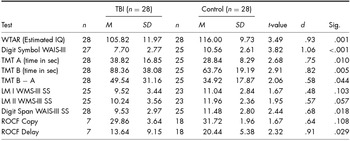
Descriptive data and comparison statistics for performance in standard neuropsychological test scores are summarised in Table 1. The TBI group performed significantly more poorly than the control group on most neuropsychological tests, including the Digit Symbol, TMT A and B, Digit Span, and the ROCF Delay. Consistent with other research demonstrating that such measures are affected by injury severity (Mathias, Bowden, Bigler, & Rosenfeld, Reference Mathias, Bowden, Bigler and Rosenfeld2007; Morris, Wilson, Dunn, & Teasdale, Reference Morris, Wilson, Dunn and Teasdale2005), TBI participants also performed significantly more poorly on the WTAR. Significance was approached in the Logical Memory II (delayed recall) test (p = .057). No differences between groups were detected in Logical Memory I (immediate recall) and the ROCFT copy.
Descriptive Statistics of Standard Neuropsychological Tests by Group with t-test Comparisons

Results of two-tailed t-test comparison analyses are shown. Cohen's d is the reported effect size. LM, Logical Memory; SS, scaled score; TMT, Trail Making Test; WAIS, Wechsler Adult Intelligence Scale; WMS, Wechsler Memory Scale; WTAR, Wechsler Test of Adult Reading. Except where indicated (i.e., SS or time in sec), raw scores are provided in the table.
Austin Maze Task Comparison Analyses
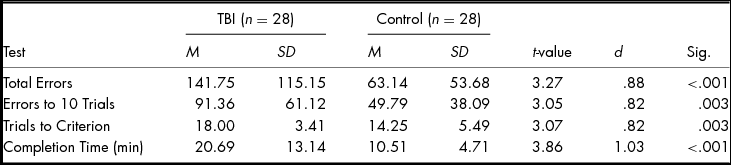
Descriptive data and comparison statistics for performance in the Austin Maze task variables are summarised in Table 2. The TBI group performed significantly more poorly than the control group on all maze task variables, including Total Errors, Errors to Trial 10, Trials to Criterion and Completion Time. Results from a logistic regression analysis indicated a trend toward a lower completion rate in TBI (n = 9/28) than in control participants (n = 16/28) [B = .29, Wald χ2(1) = 3.58, p = .058].
Descriptive Statistics of the Austin Maze Task by Group with t-test Comparisons

Results of two-tailed t-test comparison analyses are shown. Cohen's d is the reported effect size.
Austin Maze Task Correlations with Other Tests
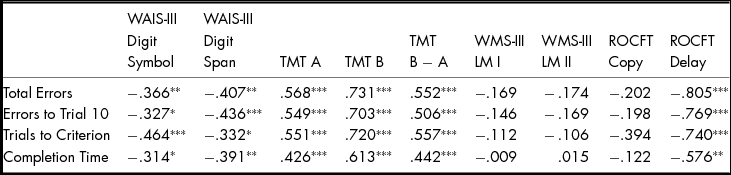
Spearman rank-order correlations examining the relationship between the various Austin Maze task measures and alternative standard neuropsychological tests are shown in Table 3. All Austin Maze task measures were significantly and moderately negatively correlated with the WAIS-III Digit Symbol and Digit Span subtests, significantly and highly positively correlated with TMT A and B, and significantly and highly negatively correlated with the ROCFT Delay task. No Austin Maze task measure was significantly correlated with the WMS-III LM I and LM II or ROCFT Copy tasks.
Spearman Rank-Order Correlations between Austin Maze Task Measures and Alternative Neuropsychological Tests

LM, Logical Memory; ROCFT, Rey Osterrieth Complex Figure Test; TMT, Trail Making Test; WAIS, Wechsler Adult Intelligence Scale; WMS, Wechsler Memory Scale.
*p < .05; **p < .01;***p < .001.
Discussion
The aim of this study was to evaluate visuospatial learning in an adult TBI population using the recently developed computerised version of the Austin Maze task (Bray & McDonald, Reference Bray and McDonald2010). Confirming our primary hypothesis, when compared to a healthy, adult, demographically matched control group, individuals with moderate-to-severe TBI performed more poorly on all Austin Maze task measures. This included the number of total cumulative errors made, the number of cumulative errors made in the first 10 trials, the number of trials required to reach criterion and overall task completion time. Although Austin Maze task completion rates (i.e., criterion reached within 20 trials) were not significant between groups, a trend (p = .058) was apparent, with lower completion rates in individuals with TBI. These results are consistent with prior studies using the conventional Austin Maze task, which indicate that TBI individuals are significantly impaired on the task (McDonald, Reference McDonald1993; Shores et al., Reference Shores, Kraiuhin, Zurynski, Singer, Gordon, Marosszeky and Fearnside1990; Tate & Broe, Reference Tate and Broe1999). Despite the (albeit subtle) differences between the conventional and computerised versions of the task (e.g., the absence of auditory feedback and the provision of visual feedback in the computerised version), these results provide further evidence of the equivalency between the two versions of the task, which was recently demonstrated in a sample of healthy young participants through direct comparison of the two task versions (McKay et al., Reference McKay, Lee, Stolwyk and Ponsford2012).
Supporting our secondary hypothesis, the results of this study demonstrate that the Austin Maze task has strong convergent and divergent validity with alternative standard neuropsychological measures. Most notably, while performance on the various Austin Maze task measures was divergent from performance on verbal-based learning and memory tasks (WMS-III LM I and LM II), they were highly convergent with ROCFT Delay scores, a commonly used index of long-term memory of complex visual information (Hocking et al., Reference Hocking, Thomas, Dzafic, Williams, Reutens and Spooner2013; Shin, Park, Park, Seol, & Kwon, Reference Shin, Park, Park, Seol and Kwon2006). Specifically, poor recall scores on this task were associated with poor Austin Maze performance. Scores on the various Austin Maze task measures were not convergent with ROCFT Copy scores, a finding that appears inconsistent with previous studies in healthy adults, which demonstrate associations between the Austin Maze task and alternative tasks of visuospatial ability, including WAIS-R Performance IQ and WAIS-R Block Design (Bowden et al., Reference Bowden, Dumendzic, Hopper, Kinsella, Clifford and Tucker1992; Stolwyk et al., Reference Stolwyk, Lee, McKay and Ponsford2013; Tucker et al., Reference Tucker, Kinsella, Gawith and Harrison1987). However, since the ROCFT Copy task primarily involves not only abilities in visuospatial constructional praxis, but also executive function planning and organisation abilities (Kuehn & Snow, Reference Kuehn and Snow1992; Shin et al., Reference Shin, Park, Park, Seol and Kwon2006), this finding is not that surprising. It also echoes independent research showing negligible associations between the conventional Austin Maze task and both verbal learning and ROCFT copying tasks in patients with unilateral temporal lobe epilepsy (Hocking et al., Reference Hocking, Thomas, Dzafic, Williams, Reutens and Spooner2013). While the Austin Maze task was originally intended as a measure of planning ability (Walsh, Reference Walsh1994), our results suggest that it is not sensitive to planning (as measured by the ROCFT). This is consistent with previous studies, insofar as they demonstrate that there is little association between the Austin Maze task and measures of executive function, including planning and abstraction (Heaton et al., Reference Heaton, Chelune, Talley, Kay and Curtiss1993; Shallice, Reference Shallice1982).
Our findings also indicate that performance on the Austin Maze task was associated with working memory (WAIS-III Digit Span). In their study of university students, Crowe et al. (Reference Crowe, Barclay, Brennan, Farkas, Gould, Katchmarsky and Vayda1999) found some association between the Austin Maze task and tasks of working memory (Brown-Peterson task and WAIS-R Digit Span Backward). However, this association was minimal and it appeared to be mediated by other visuospatial measures used in the study (WAIS-R Block Design and the Visual Spatial Learning Test). The moderate association found in our study indicates that the Austin Maze task may involve more working memory function than that indicated by Crowe et al. (Reference Crowe, Barclay, Brennan, Farkas, Gould, Katchmarsky and Vayda1999). Indeed, given that the Austin Maze task does require maintenance of spatial information in mind in order to perform the next trial correctly, it seems logical that there would be some involvement of working memory in the task. The extent to which other visuospatial measures may mediate the relationship between Austin Maze task performance and working memory, however, was not specifically examined in this current study.
Performance on the Austin Maze task was also moderately associated with measures of information processing speed (WAIS-III Digit Symbol and TMT A), and divided attention and flexibility (TMT difference score; Johnco, Wuthrich, & Rapee, Reference Johnco, Wuthrich and Rapee2013; Kortte, Horner, & Windham, Reference Kortte, Horner and Windham2002). Although an examination of the relationship between the Austin Maze task and measures of flexibility has not been reported previously in the published research, both performance on the Austin Maze task and TMT B have been found to be conjointly impaired in patients with low-weight anorexia nervosa (Szmukler et al., Reference Szmukler, Andrewes, Kingston, Chen, Stargatt and Stanley1992). The association between the two measures may reflect the self-monitoring requirements of both tasks. Specifically, both tasks require an individual to remember what they did on a previous trial in order to inform the best move for the next trial. That is, there is a requirement to utilise feedback information from both errors and correct trials in order to regulate performance.
Overall, our results suggest that impaired Austin Maze task performance reflects disorder in some, but not all, types of executive abilities in a clinical TBI sample. That is, while Austin Maze performance is related to working memory and flexibility, it is not related to organisation and planning ability. This is not unexpected, given that executive functioning is not a unitary concept but, rather, a collection of ‘higher-order’ processes that co-ordinate several sub-processes in order to achieve a particular goal (Elliott, Reference Elliott2003). However, as only a limited set of neuropsychological tests were used to index executive processes, future research should examine the involvement of various executive processes in Austin Maze performance in detail, and determine whether similar patterns of mediation exist across both clinical and control groups.
An examination of the extent of convergence with other tasks measuring visuospatial ability, such as the WAIS-IV Block Design task, and the extent of divergence with additional measures of executive functioning, such as the Tower of London task or Wisconsin Card Sort Test, would also have been beneficial to further establish the validity of the Austin Maze task. How the computerised version of the Austin Maze task performs with repeated testing in both TBI and healthy populations also remains unknown. In a previous study using the conventional Austin Maze task, Tucker et al. (Reference Tucker, Kinsella, Gawith and Harrison1987) demonstrated significant practice effects and some test–retest reliability over a 1-month period for trials to criterion (r = .56) and total cumulative errors (r = .79) in a sample of healthy young adults. It is important that this retest information be established in future research so that the clinical change parameters of the task can be established. It is also important to note that the current results pertain only to those with a moderate-to-severe TBI. As such, the extent to which individuals who have sustained a mild TBI may be impaired on the Austin Maze task needs to be examined in future research.
In summary, the present research indicates that the Bray and McDonald (Reference Bray and McDonald2010) computerised version of the Austin Maze task is able to discriminate the performance of moderate-to-severely impaired individuals with TBI from that of healthy individuals. The task, therefore, is a useful measure to detect impairments in visuospatial learning following TBI. The Austin Maze measure also demonstrates reasonable convergent and divergent validity with other neuropsychological measures. Most notable is the strong association between performance on the Austin Maze task and the ROCFT following a delay, an alternative measure of visuospatial memory. Given the ease of use and greater accessibility over its conventional counterpart, and its history in the assessment of visuospatial learning in TBI individuals, the computerised version of the Austin Maze task continues to be a useful tool for the assessment of visuospatial learning ability in both clinical neuropsychological practice and research.
Acknowledgement
This research was supported by the Australian Research Council with an ARC Discovery Project Grant (number DP09886689). We are grateful to staff of the Royal Ryde Rehabilitation Centre, who assisted with recruitment. We are particularly grateful to the people with traumatic brain injuries and our control participants who gave willingly of their time to assist this research.
Disclosure Statement
There are no conflicts of interest to declare.