INTRODUCTION
A rapidly growing body of conservation literature addresses various aspects of human–animal interaction, including conservation conflicts (Hill Reference Hill1997; Naughton-Treves Reference Naughton-Treves1998; Woodroffe et al. Reference Woodroffe, Thirgood and Rabinowitz2005; Dickman Reference Dickman2010; Draheim et al. Reference Draheim, Madden, McCarthy and Parsons2015; Redpath et al. Reference Redpath, Gutierrez, Wood and Young2015). However, little attention has been paid to the symbolic meanings of animals (Hill Reference Hill2015), particularly when these are linked to local criticism of conservation policies. Representations of animals can be intricately embedded within people's lived experience of a place. Therefore, to understand the relevance of these narratives around certain species requires an understanding of the tensions and power relations associated with the social context in which such narratives are created and sustained. Despite the lack of representation of this perspective within the conservation literature, several studies in relevant disciplines consider animals’ symbolic meaning in local people's narratives. For example, Jalais (Reference Jalais2008) examines tigers (Panthera tigris) as part of the social world of people in the Sundarbans (Bengal) whose views have often been dismissed as superstition, whether by colonial administrators or today's post-colonial, urban elites. Rural people in the Sundarbans reject the “touristic tiger” and highlight feelings of marginalization and exclusion when evoking their understandings of tigers (Jalais Reference Jalais2008: 34). In Japan, humans and bears (Selenarctos thibetanus japonicus and Ursus arctos yezoensis) are seen as putting each other's livelihoods at risk (Knight Reference Knight and Knight2000). In this context, Knight (Reference Knight and Knight2000) argues that recent negative views about bear conservation stem from the indifference of urban conservationists to the costs to rural dwellers of living alongside bears. Similarly, in Norway, the anti-wolves alliance is sustained by rural people's concern to maintain local ways of life which are “not quite threatened by the actual wolves, but rather by the protected wolves,” with wolf protection being imposed on them by urban elites who neither live with wolves, nor understand, nor value rural ways of life (Marvin Reference Marvin and Brantz2010: 76). In Cameroon, Köhler (Reference Köhler and Knight2000) describes the symbolic representations of elephants as part of a ‘cosmic economy of sharing’ (Bird-David et al. Reference Bird-David, Abramson, Altman, Bicchieri, Burch, Ember, Endicott, Grinker, Gudeman, Ichikawa, Ingold and Wenzel1992) established between humans, animals and other forest beings. Baka people describe what is understood as an insurgency of hybrid elephant–men (mokila) against the Baka community. These mokila kill Baka hunters and kidnap their women and children in revenge for the elephants killed during the period in which Baka hunters participated in the ivory trade (Köhler Reference Köhler and Knight2000).
These case studies go beyond understanding whether local people eat, hunt, like or dislike certain animal species; rather, they shed light on the importance of the symbolic constructions of wildlife across a range of species, geographical locations and different human groups. Particularly when there is a long history of coexistence, efforts are needed to understand representations of animals socially and historically. In this paper, we use insights gained through ethnographic research in Guinea-Bissau to explore local representations of chimpanzees and argue that exploring these symbolic meanings of animals may contribute to a deeper understanding and possible resolution of local conservation conflicts.
Within Euro-American cosmologies, chimpanzees figure among the charismatic African megafauna, and are commonly considered conservation flagship species. Global programmes such as the Great Apes Survival Partnership (GRASP) have recognized great ape tourism as a promising conservation strategy (GRASP 2005). In East Africa, tourism with habituated chimpanzees has been ongoing for over 30 years (e.g. at Gombe and Mahale in Tanzania, and Budongo and Kibale in Uganda); more recently, in West Africa, tourism with unhabituated or semi-habituated chimpanzees has been established at a number of sites including Taï (Côte d'Ivoire), Gola (Sierra Leone) (Macfie & Williamson Reference Macfie and Williamson2010) and Cantanhez National Park (Guinea-Bissau) (Sousa et al. Reference Sousa, Vicente, Gippoliti, Casanova and Sousa2013). However, whether tourism can successfully achieve both conservation and development goals simultaneously remains contested within the literature (Leischer et al. Reference Leischer, Sanjayan, Blockhus, Kontoleon, Larsen, Roe, Elliott, Sandbrook and Walpole2000).
In Guinea-Bissau, the national action plan for the conservation of chimpanzees (Pan troglodytes verus) reports that they have ‘recently disappeared’ from certain areas (Casanova & Sousa Reference Casanova and Sousa2007). Sá et al. (Reference Sá, Ferreira da Silva, Sousa and Minhós2012) describe chimpanzee body parts, particularly skins, being traded in the capital, Bissau. However, in Cantanhez, where people live in close proximity with chimpanzees (e.g. Sousa et al. Reference Sousa, Barata, Sousa, Casanova and Vicente2011, Reference Sousa, Vicente, Gippoliti, Casanova and Sousa2013; Hockings & Sousa Reference Hockings and Sousa2012, Reference Hockings and Sousa2013; Bessa et al. Reference Bessa, Sousa and Hockings2015), local inhabitants perceive them as having increased in number (Sousa Reference Sousa2014). Chimpanzees are regarded as similar to humans and are therefore neither hunted nor eaten (Gippoliti et al. Reference Gippoliti, Sousa, Embalo, Kormos, Boesch, Bakarr and Butynski2004; Karibuhoye Reference Karibuhoye2004; Sousa et al. Reference Sousa, Vicente, Gippoliti, Casanova and Sousa2013). However, because they live in close proximity to human settlements, because they sometimes forage on people's crops and because women and children fear them, Costa et al. (Reference Costa, Casanova and Lee2013) advised against chimpanzees being used as a conservation flagship species in Cantanhez.
Encounters between chimpanzees and people resulting in physical injury or death (to people or apes) are perhaps the most dramatic face of human–chimpanzee interactions. At Bulindi, Hoima District (Uganda), where chimpanzees live amid farms and villages, there are reports of chimpanzees chasing people (McLennan Reference McLennan2008) and attacking young children, which have discouraged agencies from implementing chimpanzee tourism in the area (McLennan & Hill Reference McLennan and Hill2010). There are also reports of chimpanzees injuring children at Bossou in Guinea-Conakry (Hockings et al. Reference Hockings, Yamakoshi, Kabasawa and Matsuzawa2010), killing children and babies in Sierra Leone (Richards Reference Richards and Knight2000) and carrying out predatory attacks on children in villages close to Kibale National Park, Uganda (Wrangham et al. Reference Wrangham, Wilson, Hare and Wolfe2000). In Kibale, three children were eviscerated and had their hands and/or feet severed in the attacks that led Wrangham et al. (Reference Wrangham, Wilson, Hare and Wolfe2000: 187) to argue that chimpanzees “should now be regarded as occasional hunters of humans.” For a recent compilation of records on ape attacks on humans in Africa and Asia, see McLennan and Hockings (Reference McLennan, Hockings and Angelici2016).
However, narratives of chimpanzee aggression are not necessarily straightforward, particularly when the violence is thought to have a human origin. As described by Richards (Reference Richards and Moore1996, Reference Richards and Knight2000) for Sierra Leone, witches are believed to ‘dress’ as chimpanzees, to mutilate and/or murder young people and babies and sell their body parts for the manufacture of ‘bad medicine’. Worldwide, there are wide-ranging interpretations of witchcraft, and it has remained a broad and controversial domain of research (Geschiere Reference Geschiere2013). However, a feature common to several studies is the accusation of witchcraft being directed towards what is perceived of as excessive individualism regarding the distribution of power and goods (Richards Reference Richards and Knight2000; Sarró Reference Sarró2009).
This paper analyses people–chimpanzee encounters in Cantanhez National Park (Guinea-Bissau) where chimpanzee tourism has developed, despite local criticism of, and antagonism towards, the local non-government organization (NGO) that was managing the Park. We discuss the implications that narratives relating to chimpanzee violence may have for nature conservation and for tourism. The analysis framed here contributes to the wider discussion on governance and negotiations of power in nature conservation contexts.
METHODS
Study area
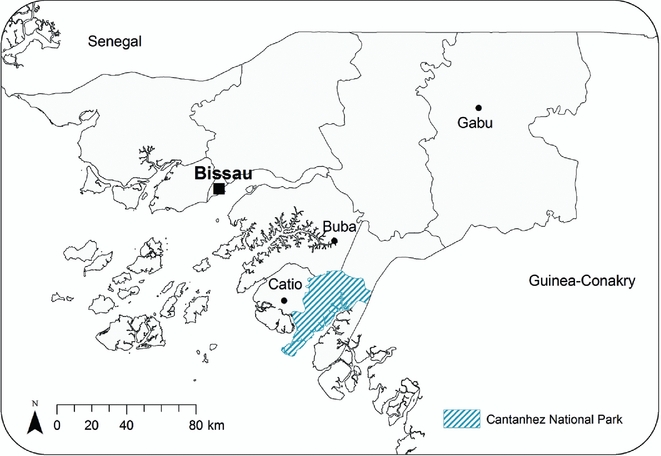
Cantanhez peninsula (Tombali region) is located in southwestern Guinea-Bissau and became part of Cantanhez National Park in 2008 (see Fig. 1). The peninsula comprises a combination of mangrove, forest (at various stages of regeneration), savannah and land under cultivation. There is no obvious frontier between farming areas and forest; instead, farming areas intermingle with forested areas in a temporally and spatially dynamic fashion. In 2002, a partnership of NGOs together with the chieftains and the local administration, in the presence of other members of the community, signed an agreement that approved the internal rules for the future Park (Mendes & Serra Reference Mendes and Serra2002). These regulations prohibited the use of snares and traps for hunting and tried to act against deforestation by banning shifting cultivation in areas set aside for protection (Mendes & Serra Reference Mendes and Serra2002). As part of the settlement, NGOs agreed to: (i) financially support mangrove rice farming; (ii) provide financial incentives, field material and courses to community guards; and (iii) hold regular meetings with local inhabitants (Mendes & Serra Reference Mendes and Serra2002). Local reports suggest that NGOs were considered to have failed to satisfactorily meet these conditions, which caused dismay and outrage among local residents (see Temudo Reference Temudo2009, Reference Temudo2012; Sousa Reference Sousa2014).
Cantanhez National Park in Guinea-Bissau.

Methodological approach
This paper draws on 13 months of ethnographic fieldwork carried out by J.S. over five years (2009–2013) in Cantanhez (see Fig. 1). Data were collected within the scope of a larger research project adopting a mix-methods approach using both ethnographic and quantitative data collection methods.
In this paper, we draw directly on information from 45 in-depth qualitative interviews conducted by J.S. with key informants in Cantanhez to explore local views about NGOs, the Park and sorcery. Rapport had already been established between the interviewer and local people as a consequence of J.S. having completed extended ethnographic fieldwork at this site. As noted by Drury et al. (Reference Drury, Homewood and Randall2011) and Albuquerque et al. (Reference Albuquerque, Cunha, Lucena and Alves2014), qualitative approaches can enable the researcher to access socially sensitive information, as was the case in this study.
Key informants included leaders of associations, elders recognized as knowledgeable about local oral history, people recognized as magically skilled, members of founding lineages, chieftains and village chiefs, healers and preachers, hunters and people involved in protests, as well as those acquainted with cases of witchcraft and of people harmed by chimpanzees.
Further information was gathered during participant observation and informal conversations. Interviews were held in Guinea Kriol, the lingua franca. This approach to data collection provided access to a deeper understanding of existing tensions between local people, NGOs and the Park. The research was approved by the University Research Ethics Committee (UREC), Oxford Brookes University on 2 October 2009.
RESULTS
In Cantanhez, animals were portrayed as creatures that exist independently of people, but also as actors that are enmeshed within the human social world. Local farmers often refer to chimpanzees as intelligent animals that feed on crops but do not waste harvests (see Sousa Reference Sousa2014). Chimpanzees are also said to feed on crops only when they are hungry or when they like a certain crop such as orange, cashew or honey (for studies on the dietary habits of a chimpanzee community in Cantanhez, see Bessa 2014; Bessa et al. Reference Bessa, Sousa and Hockings2015). Indeed, previous studies from Cantanhez have highlighted portrayals of people–chimpanzee interactions as one of peaceful coexistence (Karibuhoye Reference Karibuhoye2004; Hockings & Sousa Reference Hockings and Sousa2012). However, the context-specific nature of these narratives becomes clear when negative views about chimpanzee crop-feeding behaviour are expressed whenever the Park is evoked (see Sousa Reference Sousa2014). To explore this more fully, we examine local narratives about negative interactions between chimpanzees and people in this landscape.
We identify two major types of local narratives used to frame chimpanzees in their encounters with humans. In the first one, the ‘bush chimpanzee’ or ‘clean chimpanzee’ (dari limpu, Guinean Kriol), is perceived as a frightening but essentially predictable animal that will not attack people without provocation. Chimpanzees in Cantanhez are not specifically known for attacking people, but there were two attacks of this nature recorded during fieldwork. One involved a man being hospitalized for more than a month after he shot a female chimpanzee feeding on his orchard. The second event was a consequence of a hunter harassing chimpanzees in the forest. Both episodes were reported as a chimpanzee retaliating to persecution and the injured people had to be hospitalized for medical treatment.
However, the situation becomes more complex when an animal shows certain physical or behavioural characteristics that signal it is ‘not simple’, as people in Cantanhez say, but a human in animal form. This corresponds to the narrative of the ‘unclean chimpanzee’ (dari ka limpu, kl) or ‘shape-shifted chimpanzee’ (dari bidadu, Guinean Kriol, kl). Shape-shifted chimpanzees are distinguished by their all-too-human behaviours, such as the ability to speak human language, or apparent groundless reasons for harassing or attacking people (Sousa et al. Reference Sousa, Hill and Ainslie2017). As an interviewee described, shape-shifted chimpanzees are “people who shape-shift into chimpanzees to commit crimes.” We have gathered 11 reports of chimpanzee witchcraft in southern Guinea-Bissau (Sousa Reference Sousa2014): four in the Boé region and seven in Tombali region (five of these collected in Cantanhez). Each incident was confirmed by several people and all informants explained them as being attacks by a person shape-shifted into a chimpanzee. Three attacks comprised physical threat only (i.e. the recipient was not harmed), four referred to actual attacks that resulted in injury (i.e. the victim received scratches or bites), three involved human deaths and another involved the disappearance of a child.
More recently, there have been reports of chimpanzee attacks on children in the Empada sector, in Quinara region. Four cases of children being injured by chimpanzees were reported in August 2006 (e-Global 2016), and the national newspaper O Democrata reported that there have been seven chimpanzee attacks on children between October and December 2016 and, of these, six were considered serious by the hospital staff who treated the victims (O Democrata 2016). J.S. interviewed one of the children who had his leg, face and hands bitten and lost several toes during the attack. The child identified the attack as witchcraft. Three months had passed since the attack, the child was reticent to talk about the episode and, indeed, reports of traumatized children, who are prone to suggestion from adults, should be taken with caution.
For the interviewees, sorcerers (those doing the shape-shifting) were recognized as attacking members of their own family or those belonging to their social networks. Such actions allow sorcerers to benefit at the expense of others, while at the same time reinforcing their relationships within the society of sorcerers. Sorcery accusations serve as interpretations of undesired events, making someone responsible for a loss or a misfortune. For example, in Cantanhez in 2010, an elderly woman, regarded by many as a sorcerer, was reported to shape-shift into a snake to bite her nephew who was taking care of his absent father's cashew orchard. Rumours suggested the woman wanted control of the revenue from the orchard. Another example refers to a man who was accused of belonging to a sorcerers’ society and of spying for the local NGO at farmers’ meetings where people criticized the Park (full report in Sousa et al. Reference Sousa, Hill and Ainslie2017). Sorcery accusations work at a certain level of social intimacy in which accusations of sorcery are frequently linked to the perceptions of selfishness, excessive greed or the abuse of power.
The description below refers to a chimpanzee attack initially represented as chimpanzee sorcery by neighbours of the victim (i.e. an attack by an ‘unclean’ chimpanzee), but the victim herself (an adult woman, c. 40 years old) suggested a different interpretation of the event when she later recounted the event to J.S.: “I went to get bunches of oil-palm fruits, and my son saw a chimpanzee in a tree. I thought we should avoid it by going a different way. However, surprisingly, there were many chimpanzees there too. A chimpanzee hid behind a tree and grabbed me, it scratched my neck and I thought it would take me to the forest. A man was cutting bunches nearby and he came to help me. When the man came the chimpanzee let me go” (Aua, pseudonym, early 2011).
Upon further enquiry, it transpired that Aua was unsure whether it was a shape-shifted chimpanzee or not. However, she reported that she was going to send a message to the head of the NGO to tell him that his chimpanzees were harming people, an action consistent with her interpreting the event as being caused by a ‘bush’ chimpanzee. This incident of chimpanzee aggression was perceived by neighbours as the outcome of sorcery since in their view there was no reason for the attack. Initially, Aua was uncertain whether the incident involved a bush or shape-shifted chimpanzee, but upon reflection indicated that the attack had been by a bush chimpanzee, and argued that she held the head of the NGO responsible for what had happened to her. The head of the NGO lived and worked in the capital Bissau, only visited Cantanhez occasionally for scheduled events and was thus rarely present locally (for a detailed discussion of the social implications of witchcraft locally, see Sousa et al. Reference Sousa, Hill and Ainslie2017).
Since 2009, J.S. has recorded community guards asking for (though not receiving) salaries, uniforms and boots, and local people requesting meetings with the heads of conservation organizations. Nothing appeared to happen in response to these requests until 2013. In 2007, local people staged a protest, preventing tourists entering local forests, and forest signs indicating the names of the forests were removed by disgruntled local people. The chieftains and other local leaders were accused of being in support of conservation projects and overlooking their responsibilities towards local people (Temudo Reference Temudo, Igoe and Kensall2005, Reference Temudo2009, Reference Temudo2012; Sousa Reference Sousa2014; Sousa et al. Reference Sousa, Hill and Ainslie2017). Additionally, only about a third of the 15 local tourist guides, originally trained by a local NGO, have generated any income through tourism – and thus direct benefit from the Park – since 2010–2011. In 2011, at a public meeting, several farmers demanded a share of the funds generated by the local hotel where tourists are hosted, and a voice in the hotel's management; the hotel is managed by a local NGO. Perhaps not surprisingly, the majority of people express dissatisfaction and exclusion because the benefits they expected to receive as a result of the initial agreement made between local leaders and NGO officials have not been forthcoming. The following quote from a farmer, recorded in 2011, illustrates this broader sense of grievance with the Park: “We gave them the forests. What did they give us? Nothing! Don't you ever tell me about conserving forests!”
DISCUSSION
Local understandings of wildlife, particularly those associated with religious and ritual meanings (e.g. for Brazil, see Neto et al. Reference Neto, Mourão and Alves2011) and medical uses (e.g. for Spain, see Benítez Reference Benítez2011) can be difficult for western-trained conservationists to fully comprehend (Alves et al. Reference Alves, Rosa, Neto and Vocks2012). Meanings attributed to animals in witchcraft, like those described in this paper, are probably not exceptional (for a discussion about culture and conservation from a conservationist's point of view, see Dickman et al. Reference Dickman, Johnson, Kesteren and Macdonald2015). In fact, conservation may also be similarly difficult to understand, and be a cause of concern and consternation for local people. For example, in Zanzibar, a proposal to reintroduce a leopard population classified as extinct caused concerns among local people because the idea of reintroducing leopards was linked to memories of leopard-keeping and witchcraft (Walsh & Goldman Reference Walsh and Goldman2012). Similarly, Richards (Reference Richards and Knight2000: 78) describes that while interviewing young people about conservation in Sierra Leone, he encountered some who “expressed alarm that protection for chimpanzees provided cover” for chimpanzee witchcraft.
Proximity between chimpanzees and people in Cantanhez is expressed through sharing of physical space, portrayals of a common past in oral history (oral tradition in Cantanhez claims that the first chimpanzee was once a blacksmith who was transformed by God into a bush animal) and through shape-shifting and thus sorcery. Despite these multiple meanings in local people's framings, the idea of ‘chimpanzee’ in nature conservation discourse corresponds only to the chimpanzee as a forest (bush) animal. However, because of the intimate, secretive nature of narratives around sorcery, which often imply conflict within the family, attacks from ‘shape-shifted’ chimpanzees very likely go unreported to outsiders.
In Cantanhez, nature conservation has become politically significant and implicated in local governance. Beginning in the 1990s and continuing to the present day, there have been social tensions between the local conservation NGO and local residents (Temudo Reference Temudo, Igoe and Kensall2005, Reference Temudo2009, Reference Temudo2012; Sousa Reference Sousa2014). Nature conservation is seen as a restriction inflicted upon people for the sake of chimpanzee welfare, similar to what Jalais (Reference Jalais2008: 36) described as a perceived “unequal distribution of resources between humans and tigers.” Nature conservation in Cantanhez is thought to defend chimpanzees at the expense of local farmers; at the same time, those who belong to nature conservation circles are perceived to benefit, while local people expressed keen feelings of being disenfranchised and excluded.
There is an extensive literature on witchcraft in African contexts, and more broadly (Geschiere Reference Geschiere2013), and despite the differences in contexts and discourse, accusations of witchcraft are often directed towards individuals who are thought to have benefitted at the expense of others through immoral/inappropriate means, including those challenging culturally accepted norms of reciprocity, and/or those abusing others through alliances with more powerful individuals.
Unwarranted, violent attacks by chimpanzees are subject to local interpretation and are analysed in regard to specific, social contexts. Animals are not perceived as mean or vindictive in their essence. Either the attacker is perceived as a shape-shifted chimpanzee and the sorcery narrative is invoked within intimate circles of sociability or the attack is perceived as undertaken by a ‘clean’ or ‘bush’ chimpanzee that is protected by nature conservation legislation, and then the accusation is directed at those holding senior managerial positions in chimpanzee conservation. In this sense, different natures – the bush chimpanzee (as a protected chimpanzee) and the unclean chimpanzee (as sorcerer) – are both subjects in critical assertions of expropriation and violence. By creating programmes based on unequal divisions of benefits and duties, nature conservation strays into both highly stigmatized political ground and socially fraught terrain that deserves more careful consideration.
ACKNOWLEDGEMENTS
Our deep appreciation to the field assistants of this research as well as to the people who received J.S. in their homes. We acknowledge Fundação para Ciência e Tecnologia (SFRH/BD /45109/2008), Rufford Small Grants Foundation, Primate Society of Great Britain and the Bourses d'Excellence de la Confédération Suisse for the funding and Institute for Biodiversity and Protected Areas for institutional support. We are grateful to James Fairhead, Matthew McLennan and Amanda Webber for their helpful comments on earlier drafts. Thanks are also due to Jeremy MacClancy and Garry Marvin for their insightful comments and suggestions on a previous version of this work.
CONFLICT OF INTEREST
None.