INTRODUCTION
The mimic octopus Thaumoctopus mimicus Norman & Hochberg, Reference Norman and Hochberg2005 is famous for its ability to impersonate a variety of marine organisms. This species typically lives in shallow muddy and sandy habitats near coral reefs where it appears to mimic the shape and behaviour of flatfishes, which are also common in those habitats (Norman et al., Reference Norman, Finn and Trehenza2001). While this fascinating species is well known, it was only discovered in the mid-1990s off the coast of Sulawesi (Norman & Hochberg, Reference Norman and Hochberg2005). To date there have been limited sightings of this species outside of Indonesia, though the purported geographical range of this species includes much of the Indo-West Pacific. This sighting of T. mimicus Norman & Hochberg, Reference Norman and Hochberg2005 on the Great Barrier Reef (GBR) is the first record from Australian waters.
RESULTS
SYSTEMATICS
MOLLUSCA Linnaeus, 1758
CEPHALOPODA Cuvier, 1797
Family OCTOPODIDAE Orbigny, 1840
Genus Thaumoctopus Norman & Hochberg, Reference Norman and Hochberg2005
Thaumoctopus mimicus Norman & Hochberg, Reference Norman and Hochberg2005
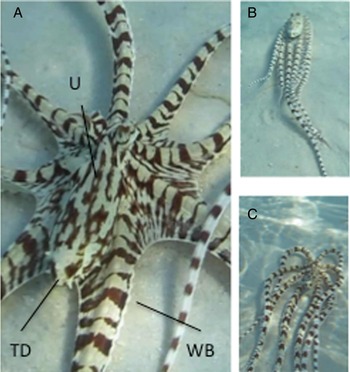
(Figure 2)
MATERIAL EXAMINED
On 4 June 2012 a single individual was found at Lizard Island in the Northern GBR, Australia (14o41′S 145o27′E) (Figure 1). The individual was discovered on a shallow sand flat during the afternoon on one of the lowest diurnal tides of the year (–0.04 m). The individual appeared to be in distress but recovered quickly once moved into slightly deeper water (depth 20 cm). I collected photographic and video evidence of the individual for identification and behaviour for approximately an hour as it moved around in the sandy shallows.
Lizard Island, Northern Great Barrier Reef, Australia and location of the documented individual ‘X’.

DESCRIPTION
Based on the mantle length (approximate mantle length = 100 mm) of the individual it was an adult. The octopus carried the distinct white ‘U’ patch on the posterior-dorsal mantle, a white teardrop ring on the mid-dorsal mantle and long narrow arms with a white band along the edge (Figure 2A). This individual was observed to show flounder-like appearance when moving across the sand (Figure 2B) and to spread its arms out in all directions while stationary (Figure 2C).
Thaumoctopus mimimicus Norman & Hochberg, 2005 adult: (A) closeup showing U patch (U), white teardrop (TD), white band (WB) and (B,C) mimicking behaviour.

ECOLOGY
This species typically lives in shallow (0.5–7 m) muddy estuarine habitats where it has been reported to mimic the shape and behaviour of venomous fish and snakes found in the associated habitats (Norman et al., Reference Norman, Finn and Trehenza2001; Norman & Hochberg, Reference Norman and Hochberg2005; Hanlon et al., Reference Hanlon, Conroy and Forsythe2008). This specimen was documented on sand, close to shallow coral reefs. This species is active during the day, hunting for crustaceans and small fish on the substrate and down holes (Norman & Hochberg, Reference Norman and Hochberg2005; Huffard et al., Reference Huffard, Saarman, Hamilton and Simison2010). Individuals often crawl along the substrate or use jet propulsion with their arms trailing their head (Norman et al., Reference Norman, Finn and Trehenza2001).
GEOGRAPHICAL DISTRIBUTION
The current documented distribution for T. mimicus Norman & Hochberg, Reference Norman and Hochberg2005 extends from the Red Sea to New Caledonia (Nabhitabhata & Sukhsangchan, Reference Nabhitabhata and Sukhsangchan2007). While T. mimicus Norman & Hochberg, Reference Norman and Hochberg2005 has been recorded from as far south as New Caledonia there has only been anecdotal evidence (diver observations, etc.) of this species within Australian waters and the GBR. This species is commonly observed in all-sand environments where mimicking octopus and their behaviour are particularly suited (Norman & Hochberg, Reference Norman and Hochberg2005; Hanlon et al., Reference Hanlon, Watson and Barbosa2010).
DISCUSSION
This is the first documented occurrence of T. mimicus Norman & Hochberg, Reference Norman and Hochberg2005 on the GBR and in Australian waters. This sighting extends the previously documented range down into the GBR, suggesting that its geographical range is much larger than previously documented. This species may simply not have been recorded because of its cryptic nature or unexplored habitat (commonly found in muddy and sandy substrate). This documentation suggests that the GBR may contain many more undocumented species from the Indo-Pacific region but due to the limited familiarity with generalist and non-reef associated species in the GBR and across tropical coastal environments, new species are going undocumented.
ACKNOWLEDGEMENTS
I thank the staff at Lizard Island Research Station for accommodating me and two anonymous referees who greatly added to the quality of this manuscript.