1. Introduction
Family planning interventions can have large effects on fertility outcomes, as previously shown by several micro studies (e.g., Kearney and Levine (Reference Kearney and Levine2009), Miller (Reference Miller2010), Joshi and Schultz (Reference Joshi and Schultz2013)). With easier and cheaper access to contraception, parents have fewer children and educate them more. A more educated and productive populace can lead to higher aggregate levels of development (see Cavalcanti et al. (Reference Cavalcanti, Kocharkov and Santos2021)). Moreover, there is evidence of reproduction externalities and effects of social norms on fertility decisions (e.g., Dasgupta (Reference Dasgupta2000), Fernández and Fogli (Reference Fernández and Fogli2009)). This paper provides a theoretical framework to answer the novel question of whether family planning interventions are more effective in the presence of social norms.
To answer this question, we develop an overlapping generations model of fertility and human capital with costly fertility control and reproductive externalities, describing social norms. We characterize the economic dynamics of a local stable steady-state equilibrium in which fertility decreases with human and physical capital accumulation. We then show that family planning interventions (or innovations in contraceptive methods) decrease fertility and increase human capital and income levels. Further, we show that the effects of family planning interventions are stronger when reproductive externalities are larger. This happens due to a feedback effect in the population. As more and more people respond to the intervention by cutting the number of children, others follow suit.
There is a long tradition in economics to investigate the link between the economic and the demographic processes (cf., Barro and Becker (Reference Barro and Becker1989); Galor and Weil (Reference Galor and Weil2000); de la Croix and Doepke (Reference de la Croix and Doepke2003); Tamura and Simon (Reference Tamura and Simon2017); Baudin et al. (Reference Baudin, de la Croix and Gobbi2018)). According to this literature, parents decrease their family size and invest more in each child when income rises, since the opportunity cost to raise a child increases with wages. This quantity–quality trade-off depends on the income elasticity of the quantity and quality of children, as explained in Doepke (Reference Doepke2015). In general, when income and substitution effects cancel each other (e.g.,
 $\log$
utility), then fertility is independent of income. Our model can generate a negative relationship between fertility and income even in the presence of a
 $\log$
utility. In our formulation, as income rises, modern contraceptive methods become relatively cheaper and therefore fertility decreases.
Although Becker (Reference Becker and Roberts1960) already discussed in detail the importance of contraceptive methods in controlling family size, this is largely neglected in the macro growth literature.Footnote 1 An exception is Cavalcanti et al. (Reference Cavalcanti, Kocharkov and Santos2021). Relative to our previous paper, we add social norms in fertility behavior, which has been pointed out as an important factor in the reduction of fertility during the demographic transition (cf., Munshi and Myaux (Reference Munshi and Myaux2006); Fernández and Fogli (Reference Fernández and Fogli2009); de Silva and Tenreyro (Reference de Silva and Tenreyro2020)). On the other hand, in this paper, we do not analyze distributional aspects of fertility since we work with a representative agent model nor do we model unwanted fertility as shocks. We do this to better focus on the role of social norms. Moreover, we analyze family planning interventions in this scenario and show that such interventions are stronger in the presence of social norms.Footnote 2
Finding a proper empirical measurement of social norms about fertility is not easy. Fernández and Fogli (Reference Fernández and Fogli2009) explore the role of culture for current economic outcomes of women such as labor force participation and fertility. In particular, they show that current completed fertility in a sample of second-generation immigrants to the USA is positively correlated with past total fertility rate in the country of origin of the parents. Moreover, the correlation becomes stronger for females in ethnically clustered neighborhoods, signaling the presence of social norms about fertility.Footnote 3
Myong et al. (2020) take a different approach. First, they document that even though marriage rates in East Asian countries are one of the highest in the world, fertility is one of the lowest. Furthermore, almost all births occur within marriage. They hypothesize that these patterns are historically shaped by social norms imposed by Confucianism: females bear entirely the child care tasks within marriage and out-of-wedlock births are stigmatized. These two social norms are embedded in a structural model of fertility. The results point that, while the gender-biased child care norm indeed influences the low fertility rate of married women, the out-of-wedlock birth norm does not play such a large role for the childlessness of single females.
In a similar fashion, Iftikhar (Reference Iftikhar2018) explores the influence on fertility of social norms about the acceptable number of children in Pakistan. First, the reduced-form relations between past average completed fertility and current fertility by education and ethnicity are estimated. Second, a structural model of fertility and quantity–quality trade-offs is disciplined to generate the same relations by indirect inference. The results point out that around 40% of the fertility dispersion is accounted for by social norms.
Myong et al. (2020) and Iftikhar (Reference Iftikhar2018) augment the quantitative model of Baudin et al. (Reference Baudin, De La Croix and Gobbi2015) by introducing social norms about fertility and/or childlessness. The main advantage of this framework is the explicit modeling of the extensive and intensive margin of fertility. In contrast, here we pose a simple quantity–quality model of fertility and family planning in which social norms are injected and the analytical properties of the model with respect to the fertility social norm and family planning polices are derived. Our model allows us to discuss analytically the role of social norms in the implementation of family planning policies.
Strulik (Reference Strulik2017) studies how cheaper and more effective contraception can lead to higher growth as individuals switch from traditional to modern contraception (see also Fernández-Villaverde et al. (Reference Fernández-Villaverde, Greenwood and Guner2014)). Prettner and Strulik (Reference Prettner and Strulik2017) also study the interplay of contraception and norms (religious beliefs). We add to these papers by analyzing how powerful family planning interventions impact the economy in the presence of social norms.
2. Model
2.1 Demographics and endowments
Individuals live for three periods: childhood, young adulthood, and old adulthood. Children do not make any economic decisions, but they can acquire skills. Young adults have one unit of productive time and are endowed with skills that they acquire during their childhood. They make the relevant economic decisions, including investment decisions. Old adults do not work and simply consume their savings.
2.2 Production
The consumption good is produced with a technology that uses capital, K, and efficiency units of labor, L, as inputs, such that:Footnote 4
 $$\begin{equation}Y=AK^{\alpha}L^{1-\alpha}, \ \alpha\in(0,1), \ A>0.\end{equation}$$
Capital depreciates fully after use. Let w be the wage rate and let R be the rental price of capital. Profit maximization implies that inputs are paid according to their marginal productivity, such that:
 $$\begin{eqnarray}w & = & (1-\alpha)AK^{\alpha}L^{-\alpha},\end{eqnarray}$$
 $$\begin{eqnarray}R & = & \alpha AK^{\alpha-1}L^{1-\alpha}.\quad\end{eqnarray}$$
2.3 Households
Fertility: Couples can have up to
 $N>0$
children, and they can control their family size, n, by investing in contraceptive use, such that:
 $$\begin{equation}n=N-\theta q, \ \theta>0,\end{equation}$$
where
 $q\geq0$
is the investment in contraception and
 $\theta$
is related to the efficiency of contraception on birth control. Contraception is costly and the relative price of contraception is
 $\phi_q\geq0$
.
Human capital: Parents invest in the education of their children,
 $e\geq0$
, such that the human capital of their children is given by:
 $$\begin{equation}h^{\prime}=h(e)=e^{\zeta}, \ \zeta\in(0,1).\end{equation}$$
Investment in education is in terms of the consumption good. Children are also time-consuming. Each child takes a fraction
 $\chi\in(0,1)$
of her parents’ time endowment. We assume that parents are able to provide some hours in the labor market even when they have the maximum amount of children, that is,
 $\chi N<1$
.
Preferences and optimal decisions: Consumption of couples during the young adulthood period is denoted by
 $c_{y}$
, while
 $c^{\prime}_{o}$
denotes consumption of the couple in the next period, when old. Preferences of households are represented by:
 $$\begin{equation}U(c_{y}, c^{\prime}_o, n, h^{\prime})=\log(c_{y})+\beta\log(c^{\prime}_{o})+\gamma\log(n)+\xi\log(h^{\prime})+\psi\left(\frac{n-\bar{n}}{\bar{n}}{}\right),\end{equation}$$
where
 $\beta$
,
 $\gamma$
,
 $\xi$
, and
 $\psi$
are positive numbers.Footnote 5 The variable
 $\bar{n}$
is the average fertility in society and describes social norms in reproduction behavior.Footnote 6
Let s denote savings during the young adulthood period. The problem of the couple is to choose
 $c_{y}$
,
 $c^{\prime}_{o}$
, q, s, and e to maximize (6) subject to (4) and (5), and the following budget constraints:
 $$\begin{eqnarray}c_{y}+s+\phi_qq+en=wh(1-\chi n),\end{eqnarray}$$
 $$\begin{eqnarray}c^{\prime}_{o}=R^{\prime}s.\end{eqnarray}$$
Equation (7) states that consumption plus savings and expenditures on contraceptionFootnote 7 and education equals income. Equation (8) implies that old couples consume their savings from the young adulthood period. Whenever
 $q>0$
, then the equations which describe the solution of this problem after imposing the symmetric equilibrium condition that
 $n=\bar{n}$
areFootnote 8
 $$\begin{eqnarray}c_{y}=\frac{1}{(1+\beta+\gamma+\psi)}\left(wh-\frac{\phi_q}{\theta}N\right),\end{eqnarray}$$
 $$\begin{eqnarray}s=\frac{\beta}{(1+\beta+\gamma+\psi)}\left(wh-\frac{\phi_q}{\theta}N\right), \mbox{ and } c^{\prime}_o=R^{\prime}s, \end{eqnarray}$$
 $$\begin{eqnarray}e=\frac{\xi\zeta}{(\gamma+\psi-\xi\zeta)}\left(wh\chi -\frac{\phi_q}{\theta}\right),\end{eqnarray}$$
 $$\begin{eqnarray}q=\frac{N}{\theta}-\frac{(\gamma+\psi-\xi\zeta)}{\theta(1+\beta+\gamma+\psi)}\left(\frac{wh-\frac{\phi_q}{\theta}N}{wh\chi-\frac{\phi_q}{\theta}}\right),\end{eqnarray}$$
 $$\begin{eqnarray}n=\frac{(\gamma+\psi-\xi\zeta)}{(1+\beta+\gamma+\psi)}\left(\frac{wh-\frac{\phi_q}{\theta}N}{wh\chi-\frac{\phi_q}{\theta}}\right). \end{eqnarray}$$
We make the following assumption:
Assumption 1. Let
 $N\chi<1$
and
 $\frac{(\gamma+\psi-\xi\zeta)}{(1+\beta+\gamma+\psi)\chi}<N$
.
The assumption that
 $N\chi<1$
implies that even when fertility is at its maximum (
 $q=0$
), couples still supply a positive number of hours to the labor market. The second part of the assumption implies that when the price of modern contraceptive methods is zero (
 $\phi_q=0$
), then fertility is lower than the case in which there is no investment in modern contraceptive methods (
 $q=0$
).
Observe that when
 $\phi_q$
goes to zero, then fertility does not depend on labor income (wh). This is because when income rises the opportunity cost (time cost) of having more children rises (substitution effect), but since children are a normal good, then the income effect induces parents to have more children. With log-utility these two effects cancel each other out, and when
 $\phi_q=0$
then fertility does not depend on income—see equation (13).Footnote 9This is explained in Doepke (Reference Doepke2015) and Jones et al. (Reference Jones, Schoonbroodt, Tertilt and Shoven2010). When
 $\phi_q$
is positive, then there is a negative association between fertility and income, as reported in the data. In this case, richer parents can increase the intensity of their use of contraceptive methods in order to control family size.
Notice that whenever the price of modern contraceptives falls, then fertility decreases and this relationship is stronger for a higher
 $\psi$
, which measures how social norms affect reproduction behavior.
Proposition 1. Let Assumption 1 be satisfied, then for a given wage rate w and when
 $q>0$
, we have that
 $\frac{\partial n}{\partial \phi_q}>0$
and
 $\frac{\partial\left(\frac{\partial n}{\partial \phi_q}\right)}{\partial \psi}>0$
.
Proof. See Appendix A.
When the price of contraception falls, it becomes cheaper to lower the number of children. As more people do this, others follow suit due to the social norms. With stronger social norms (higher
 $\psi$
), this feedback becomes more powerful.
One can argue that it is not necessary to explicitly add investment in contraceptives into a standard quantity–quality fertility model because parameter
 $\chi$
, which corresponds to the time cost of children, could capture that investment. Better access to contraceptives could be translated into a rise in parameter
 $\chi$
such that it would raise the quality of children (e) as well as reduce their quantity (n). In fact, the proportional changes in n and e due to a proportional variation in
 $\chi$
have opposite signs but equal magnitude. A fall in the price of contraceptives (
 $\phi_q$
) generates not only different quantitative but also qualitative effects. Indeed, a fall in
 $\phi_q$
also increases e and reduces n but observe that parameter
 $\chi$
does not affect the consumption-saving decision, while the price of contraceptives does. In addition, family planning interventions which reduce the price of contraceptives have strong effects on the quantity and quality of children when income levels are low. Proposition 2 summarizes these findings.
Proposition 2. Let Assumption 1 be satisfied and define
 $\epsilon_{z, \chi}$
and
 $\epsilon_{z, \phi_q}$
as the elasticity of variable
 $z\in\{n,e\}$
with respect to
 $\chi$
and
 $\phi_q$
, respectively. Then whenever
 $q>0$
, we have that:
-
(i)
 $\frac{\partial e}{\partial \chi}>0$
,
$\frac{\partial n}{\partial \chi}<0$
and
$\frac{\partial s}{\partial \chi}=0$
. Moreover,
$r_{\chi}=\frac{|\epsilon_{n, \chi}|}{\epsilon_{e, \chi}}=1$
.
-
(ii)
$\frac{\partial e}{\partial \phi_q}<0$
,
$\frac{\partial n}{\partial \phi_q}>0$
and
$\frac{\partial s}{\partial \phi_q}<0$
. Moreover,
$r_{\phi_q}=\frac{\epsilon_{n, \phi_q}}{|\epsilon_{e, \phi_q}|}=\frac{wh(1-N\chi)}{wh-\frac{\phi_q}{\theta}N}$
and
$\frac{\partial r_{\phi_q}}{\partial (wh)}<0$
.


Proof. See Appendix A.
2.4 Closing the model
Let P denote the number of young adult households such that
 $P^{\prime}=nP$
. In equilibrium, demand equals supply in all markets. In the labor market, this means that
 $L=P(1-\chi n)h$
, and in the capital market,
 $K^{\prime}=Ps$
. Let k denote physical capital per young household. In equilibrium with
 $q>0$
, it can be shown that
 $h^{\prime}=Dk^{\prime\zeta}$
with
 $D=\left(\frac{\xi\zeta}{\beta}\right)^{\zeta}>0$
, and
 $w(k)=(1-\alpha)D^{-\alpha}Ak^{\alpha(1-\zeta)}(1-\chi n(k))^{-\alpha}$
. When
 $q=0$
, we also have that
 $h^{\prime}=Dk^{\prime\zeta}$
, and
 $w(k)=(1-\alpha)D^{-\alpha}(1-\chi N)^{-\alpha}k^{\alpha(1-\zeta)}$
. In addition,
 $$\begin{equation}n(k)=\min\left\{N,\frac{(\gamma+\psi-\xi\zeta)}{(1+\beta+\gamma+\psi)}\left(\frac{(1-\alpha)D^{-\alpha}Ak^{\alpha+\zeta(1-\alpha)}(1-\chi n(k))^{-\alpha}-\frac{\phi_q}{\theta}N}{(1-\alpha)D^{-\alpha}Ak^{\alpha+\zeta(1-\alpha)}(1-\chi n(k))^{-\alpha}\chi-\frac{\phi_q}{\theta}}\right)\right\}.\end{equation}$$
Then the following proposition summarizes the fertility choice and our main results.
Proposition 3. Let Assumption 1 be satisfied. Then it can be shown that
 $n(k)\in\left(\frac{(\gamma+\psi-\xi\zeta)}{(1+\beta+\gamma+\psi)\chi},N\right]$
and
-
(i) there exists a
$\underline{k}>0$
such that if
$k\leq\underline{k}$
, then
$n(k)=N$
; and if
$k>\underline{k}$
, then
$n(k)<N$
; in addition,
$\frac{\partial\underline{k}}{\partial \phi_q}>0$
and
$\frac{\partial\underline{k}}{\partial \psi}>0$
; -
(ii) for
$k>\underline{k}$
fertility is decreasing with capital accumulation, that is,
$n^{\prime}(k)<0$
; -
(iii) for
$k>\underline{k}$
fertility decreases with family planning interventions which reduce the price of modern contraceptives, that is,
$\frac{\partial{n(k)}}{\partial \phi_q}>0$
; and the effects of family planning interventions on fertility is stronger for higher reproductive externality
$\psi$
, that is,
$\frac{\partial\left(\frac{\partial n(k)}{\partial \phi_q}\right)}{\partial \psi}>0$
.


Proof. See Appendix A.
Part (i) of Proposition 3 shows that, for extremely low levels of development, individuals are too poor to use contraception and fertility is at its maximum. After a certain threshold of development is reached (
 $\underline{k}$
), people start using contraception and fertility declines. The richer the economy becomes, the lower is the fertility level (part (ii)). This happens since, as people become richer, contraception becomes relatively cheaper. Finally, part (iii) shows that family planning interventions are more powerful in the presence of social norms due to the feedback from one individual’s decisions onto others.
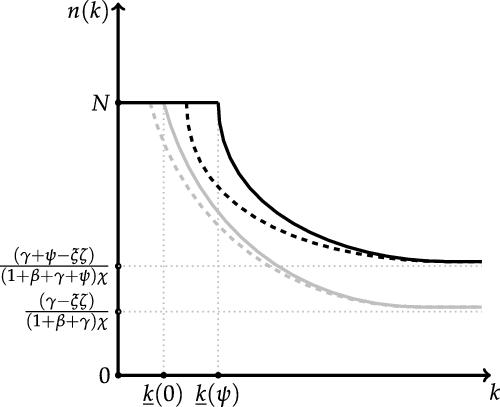
We can also see these results graphically. Figure 1 displays how the fertility rate changes with physical capital stock in an economy without reproductive externality (gray solid line) and with reproductive externality (black solid line). Fertility is higher in an economy with reproductive externalities for any level of capital stock above
 $\underline{k}(\psi=0)$
. When fertility starts to fall with capital levels, then the slope is steeper in an economy with a positive
 $\psi$
. Therefore, for any
 $k\geq\underline{k}(\psi)$
, family planning interventions that decrease the price of contraceptives have stronger effects on fertility in the presence of social norms in fertility, as can be seen by the vertical difference between the solid line and the dashed line in these two economies—one displayed by gray lines (
 $\psi=0$
) and the other displayed by black lines (
 $\psi>0$
).
Fertility and capital levels.
Note: Fertility and physical capital stock for two economies: one without reproductive externality (
 $\psi=0$
)—gray lines; and another with reproductive externality (
 $\psi>0$
)—black lines. The dotted lines correspond to the case of family planning interventions which reduce
 $\phi_q$
for these two economies.

We can now move to finish the solution of the model. The condition that equilibrates the capital market implies that
 $$\begin{equation}k^{\prime}=G(k)=\left \{\begin{array}{cc}\frac{\beta(1-\alpha)D^{-\alpha}A(1-\chi N)^{-\alpha}k^{\alpha+\zeta(1-\alpha)}}{(1+\beta+\xi\zeta)N} &\mbox{for $k\leq \underline{k}$}, \\& \\\frac{\beta\left((1-\alpha)D^{-\alpha}Ak^{\alpha+\zeta(1-\alpha)}(1-\chi n(k))^{-\alpha}\chi-\frac{\phi_q}{\theta}\right)}{\gamma+\psi-\xi\zeta} &\mbox{for $k> \underline{k}$}.\end{array}\right.\end{equation}$$
We also have that
 $$\begin{equation}h^{\prime}=Dk^{\prime\zeta},\end{equation}$$
and human and physical capital are positively related.
Proposition 4. (Existence and uniqueness of equilibrium path) For a given initial capital stock
 $k_0$
, let
 $h_0$
be given by (16); then the dynamic system of difference equations (14)–(16) has a unique trajectory (solution).
Proof. See Appendix A.
Given the path for n, k, and h, we can find consumption and investment decisions (9)–(11), as well as investment in contraceptive methods. Asymptotically, the system may diverge to infinity, converge to a zero, or converge to a nonzero steady-state equilibrium. Observe that when
 $k<\underline{k}$
, we have that
 $\frac{\partial G(k)}{\partial k}>0$
,
 $\frac{\partial^2 G(k)}{\partial k^2}<0$
, and
 $lim_{k\rightarrow0}\frac{\partial G(k)}{\partial k}=\infty$
. Therefore, the system does not converge to a zero steady state. If
 $\underline{k}$
is sufficiently large,Footnote 10 then there will be a locally stable steady state
 $k^*_N=G(k^*_N)$
in which
 $n(k)=N$
. In this case, there is no investment in modern contraceptive methods (
 $q=0$
), and therefore family planning interventions do not have any effect on the long-run level of the capital stock, that is,
 $k^*_N$
is independent of
 $\phi_q$
. However, whenever
 $\underline{k}<k^* _N$
, then it can be shown that there exists a locally stable steady-state equilibrium
 $k^*>\underline{k}$
such that fertility decreases with capital accumulation, and family planning interventions have long-run effects on capital accumulation and output. This is summarized in the following proposition.
Proposition 5. Let Assumption 1 be satisfied and
 $\underline{k}<k^*_N$
. Then there exists at least one locally stable steady-state equilibrium for capital per young household,
 $k^*=G(k^*)$
, such that in the neighborhood of
 $k^*$
, fertility decreases with capital accumulation, and family planning interventions, which reduce the price of modern contraceptives, increase the steady-state level of capital, that is,
 $\frac{\partial k^*}{\partial\phi_q}<0$
. In addition, the higher is the reproductive externality (higher
 $\psi$
), the higher is the steady-state fertility and the lower is the steady-state level of capital, that is,
 $\frac{\partial k^*}{\partial\psi}<0$
.
Proof. See Appendix A.
Since human capital and physical capital are associated by equation (16), then it is trivial to show the following result.
Corollary 1. Let Assumption 1 be satisfied, then human capital increases with physical capital accumulation. If
 $\phi_q$
is sufficiently small (or
 $\psi$
is sufficiently large) such that
 $\underline{k}(\phi_q,\psi)<k^*_N$
, then
 $\frac{\partial h^*}{\partial\phi_q}<0$
and
 $\frac{\partial h^*}{\partial\psi}<0$
.
Proof. See Appendix A.
Notice that the steady-state level of capital per young household,
 $k^*$
, depends on the parameters of the model, and therefore it can lie at any point on the horizontal axis in Figure 1. Hence, the impact of family planning interventions (the gap between the solid and dotted lines) also depends on the exogenous parameters that contribute to determine how rich the economy is.
Taking Proposition 5 and Corollary 1 together, we have that economies with a higher degree of social norms in fertility end up with lower physical and human capital levels. Decreasing the price of contraception leads to lower fertility and more accumulation of both human and physical capital. This latter effect is quantitatively more powerful when social norms are stronger. As contraception becomes cheaper, individuals lower fertility. Due to social norms, others follow suit.
3. Conclusion
In this paper, we present a model that is able to replicate the negative relationship between fertility and income through the intensity in the use of modern contraceptive methods. The main mechanism is that, as income rises, then modern contraceptives become relatively cheaper and fertility decreases. We show the local dynamics of a stable steady-state equilibrium and characterize how family planning interventions affect fertility, human capital, physical capital, and income levels around this equilibrium. We use this framework to study the effects of family planning interventions on fertility in the presence of social norms. Our results show that the effects of such interventions on fertility are stronger when the reproductive externality is larger. Finally, changes in social norms relative to reproductive behavior can trigger a fall in fertility, which can be amplified with better access to modern contraceptives.
To keep the model tractable, we naturally made some simplifying assumptions. One assumption was that the economy is populated by homogeneous agents. Solving such a representative agent model allows us to clarify the role of family planning interventions in the presence of social norms. However, this necessarily prevents us from studying issues that arise with heterogeneous agents. For instance, modeling men and women separately would allow the study of gender gaps in fertility, a feature of developing countries as shown by Field et al. (Reference Field, Molitor, Schoonbroodt and Tertilt2016). To do this, an assumption on intra-household decisions has to be made. The possibility of enriching our model in this dimension is left for future research.
Acknowledgments
Financial support from the Coordenação de Aperfeiçoamento de Pessoal de Nível Superior—Brasil (CAPES)—Finance Code 001 and Faperj is gratefully acknowledged. The opinions expressed in this paper are those of the authors and do not necessarily reflect the views of the Bank of Portugal and the Deutsche Bundesbank.
APPENDIX
A Proofs


A.2 Proof of proposition 2
Proof. For the partial derivative, simply use equations (10), (11), and (13) and take the corresponding partial derivatives with respect to
 $\chi$
and
 $\phi_q$
. For the elasticities, take the logarithm on both sides of equations (11) and (13) and differentiate either with respect to
 $\chi$
and
 $\phi_q$
.
A.3 Proof of proposition 3
Proof. Let
 $N\chi<1$
, then when
 $n(k)<N$
and using the Implicit Function Theorem (IFT) we can show that
 $$\begin{equation*}n'(k)=-\frac{\left[\frac{(\gamma+\psi-\xi\zeta)}{(1+\beta+\gamma+\psi)}(\alpha+\zeta(1-\alpha))(1-\alpha)D^{-\alpha}Ak^{\alpha+\zeta(1-\alpha)-1}(1-\chi n(k))^{-\alpha}\frac{\phi_q}{\theta}(1-\chi N)\right]/X(n(k))^2}{1+\left[\frac{(\gamma-\xi\zeta)}{(1+\beta+\gamma)}\alpha(1-\alpha)D^{-\alpha}Ak^{\alpha+\zeta(1-\alpha)}(1-\chi n(k))^{-\alpha-1}\frac{\phi_q}{\theta}(1-\chi N)\right]/X(n(k))^2}<0,\end{equation*}$$
where
 $X(n(k))=\left((1-\alpha)D^{-\alpha}Ak^{\alpha+\zeta(1-\alpha)}(1-\chi n(k))^{-\alpha}\chi-\frac{\phi_q}{\theta}\right)$
. Moreover,
 $$\begin{equation*}\frac{\partial n(k)}{\partial \phi_q} =\frac{\left[\frac{(\gamma+\psi-\xi\zeta)}{(1+\beta+\gamma+\psi)}(1-\alpha)D^{-\alpha}Ak^{\alpha+\zeta(1-\alpha)}(1-\chi n(k))^{-\alpha}\frac{1}{\theta}(1-\chi N)\right]/X(n(k))^2}{1+\left[\frac{(\gamma-\xi\zeta)}{(1+\beta+\gamma)}\alpha(1-\alpha)D^{-\alpha}Ak^{\alpha+\zeta(1-\alpha)}(1-\chi n(k))^{-\alpha-1}\frac{\phi_q}{\theta}(1-\chi N)\right]/X(n(k))^2}>0.\end{equation*}$$
and
 $\frac{\partial\left(\frac{\partial n(k)}{\partial \phi_q}\right)}{\partial \psi}>0$
. In addition,
 $\lim_{k\rightarrow\infty}n(k)=\frac{(\gamma+\psi-\xi\zeta)}{(1+\beta+\gamma+\psi)\chi}$
. Notice that equation (14) defines a critical value
 $\underline{k}(\phi, \psi)>0$
:
 \begin{equation}\underline{k}=\left(\frac{N\phi_q(1+\beta+\xi\zeta)(1-\chi N)^{\alpha}}{\theta(1-\alpha)D^{-\alpha}A((1+\beta+\gamma+\psi)N\chi-(\gamma+\psi-\xi\zeta))}\right)^{\frac{1}{\alpha+\zeta(1-\alpha)}},\end{equation}
We have that
 $n(k)=N$
for any
 $k\leq\underline{k}$
and
 $n(k)<N$
for any
 $k>\underline{k}$
. In order to see this, observe that without the upper bound in the fertility choice, n(k) would go to infinity as k would be sufficiently small such that
 $n(k)\chi$
would tend to 1. Therefore, given the continuity of n(k), we have that there exists a
 $\underline{k}>0$
such that
 $n(\underline{k})=N$
. Using the IFT we can show that
 $\frac{\partial\underline{k}}{\partial \phi_q}>0$
. Similarly, the IFT and Assumption 1 imply that
 $\frac{\partial\underline{k}}{\partial \psi}>0$
.
A.4 Proof of proposition 4
Proof. Given
 $k_0$
and the fact that
 $h_0$
is given by (16), we can use (14) to find
 $n(k_0)$
, which is unique given that n(k) is non-increasing and continuous in k. Then, we can use equations (15) and (16) to find
 $k_1(k_0)$
and
 $h_1(k_0)$
, respectively; and so on.
A.5 Proof of proposition 5
Proof. If
 $\underline{k}<k^*_N$
, then for any
 $k>\underline{k}$
it can be shown that
 $\frac{\partial G(k)}{\partial k}>0$
, and
 $\lim_{k\rightarrow\infty}\frac{\partial G(k)}{\partial k}=0$
. This implies that
 $k'=G(k)$
has to cross (at least once) the 45 degree line (
 $k'=k$
) from above, and this defines
 $k^*=G(k^*)$
with
 $G'(k^*)\in(0,1)$
, which is locally stable. Fertility thus decreases with capital accumulation. Moreover, we can easily show that
 $\frac{\partial k^*}{\partial\phi_q}<0$
. Using the IFT we can show that
 $\frac{\partial n(k^*)}{\partial\psi}>0$
and
 $\frac{\partial k^*}{\partial\psi}<0$
, completing the proof.