Based on unpublished controlling data, highly expensive drugs account for most of the increases in the hospital expenditures in the majority of the western healthcare systems. Though, growing drug costs are being increasingly challenged by some researchers (Reference Mazzucato1) and “fair pricing for access to drugs” (2) is demanded in public political debates. In the context of this broad debate and in light of the limited healthcare resources, the introduction of new and ever more costly drugs requires decisions on prioritization of existing and new treatment options and eventually a reallocation of resources (Reference Verheijde3). All western countries have therefore implemented more or less transparent processes and methodologies, for example, added benefit analyses and/or pharmacoeconomic evaluations, to support such difficult decisions. Moreover, major decisions on the reimbursement status for individual drugs are often publicly available to support public understanding (Reference Vogler, Paris, Ferrario, Wirtz, de Joncheere and Schneider4).
As in other countries, healthcare expenditures in Austria are especially increasing in hospitals, with expenditures on drugs as the fastest-growing product group. However, standardized processes for national decision making are only in place for the inclusion/exclusion of new drugs in the outpatient pharmaceutical benefit catalogue (called “Erstattungskodex” (5)), while reimbursement decisions on hospital drugs are left to the regional hospital corporations. Since, the processes of the in- and outpatient sectors are totally separated, unequal availability of and access to costly drugs between the nine Austrian federal states can occur. Moreover, this regionalized purchasing of goods has an influence on the bargaining power of the regional entities responsible for hospitals.
On behalf of the Austrian federal states, the Ludwig Boltzmann Institute for Health Technology Assessment (since March 2020, the Austrian Institute for Health Technology Assessment GmbH [AIHTA]), an independent entity for scientific decision-making support in the health sector, was asked to support public decision-making with the information on options for a national process for the reimbursement of costly hospital drugs in order to overcome unequal availability and access. This article aims to provide information on international reimbursement practices and potential Austrian solutions for a transparent and centralized reimbursement process for costly hospital drugs. The following research questions will be answered:
(1) How are international reimbursement processes regulated in the inpatient and outpatient sector? Which options in procedural steps from HTA to reimbursement can be identified?
(2) What are the strengths and weaknesses of the elaborated options for action?
(3) How could different options of an Austria-wide reimbursement process for costly hospital drugs look like?
Methods
A German report (Reference Wolf and Wild6) was the basis for this article; however, a new discussion was added and the report was not directly translated.
To answer the research questions, an iterative, four-step approach was taken. Firstly, one author (SW) collected international evidence on reimbursement processes of originator brand drugs with a special focus on costly and orphan drugs (as these drugs are often treated differently) by undertaking an extended hand search of published and grey literature in English or German on international websites, for example, websites of the European Medicines Agency and the European Commission (EC), of European Network for Health Technology Assessment (EUnetHTA) partner institutions, as well as on the websites of national HTA institutions of ten pre-selected countries (Australia [AUS], Belgium [BE], Canada [CAN], England [Engl.], Finland [FIN], France [FRA], Germany [GER], Netherlands [NL], Norway [NO], and Sweden [SE]). The pre-selection of the countries was based on the availability of transparent methods for added benefit analyses and pharmacoeconomic evaluations. In addition, the WHO Collaborating Centre for Pharmaceutical Pricing and Reimbursement Policies at the Austrian Public Health Institute completed lacking information from the literature. Subsequently, two authors (SW and IZ) systematically reprocessed the information derived and sorted it following the main procedural steps from post-approval HTA and appraisal to the final reimbursement decision.
Secondly, the authors (SW, IZ and CW) analyzed the strengths and weaknesses of the elaborated options for action in the reimbursement processes, based on four criteria following Norman Daniel's concept of “Accountability for Reasonableness (A4R)” and the concept of “Deliberative Decision-Making (DDM)” (7;8):
• Evidence-based: Consideration of the best available scientific evidence from clinical studies, including critical evaluations.
• Transparency: Publication of the evidence syntheses and decisions, and of the methods, involved actors and reasons for decisions.
• Fairness: Enhancing consistent and transparent methods, participation of different stakeholders (e.g., patients) and equal access to drugs between different patient populations.
• Efficiency: Including a pragmatic realization of methods and processes, and the possibility to expeditiously achieve optimal results with limited resources.
Thirdly, the authors (SW, IZ and CW) suggested three scenarios of potential solutions for the Austrian reimbursement process on costly* hospital drugs by taking into account the strengths and weaknesses of the elaborated options for action, as well as already existing reimbursement processes in Austria. In addition, input was provided by the fourth author (NG), especially regarding reimbursement processes of oncological drugs.
*According to the Austrian Medicines Commission, a drug is defined as costly if the factory selling price (FSP) per defined daily dose is ≥40 Euro, the monthly or annual therapy costs per patient based on FSP are ≥1,000–14,000 Euro, and/or the annual cost volume on the basis of the FSP >10 million Euro (Reference Wolf and Wild6).
Results
Options in Procedural Steps From HTA to Reimbursement
The different procedural steps of the reimbursement processes in the ten considered countries are summarized as follows:
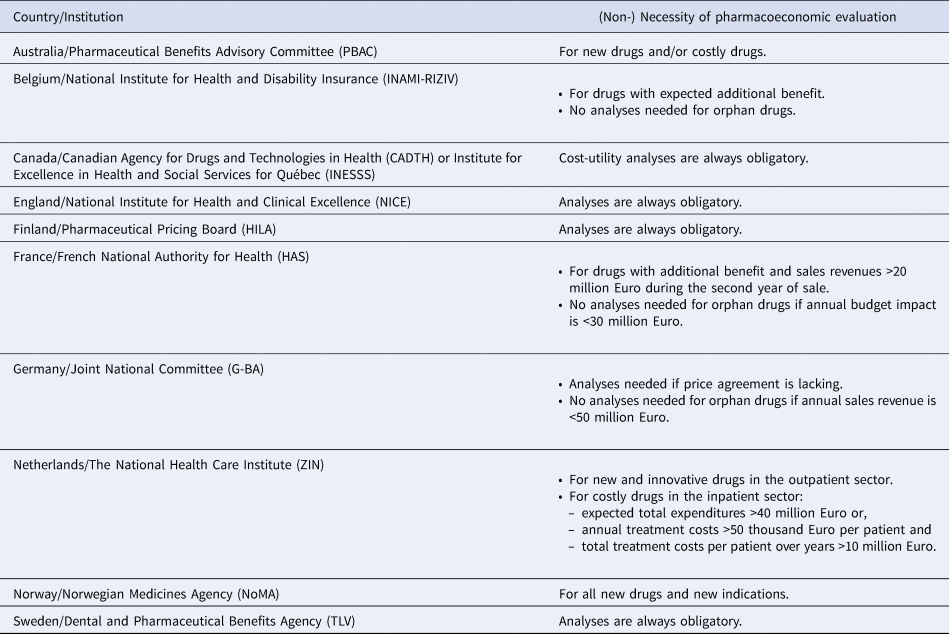
Request for drug reimbursement: There are three options on how a reimbursement process can be initiated: by manufacturers, clinicians or national agencies. Which documents are requested for the initiation of a drug evaluation differ between countries. All countries request clinical trial information, the therapeutic benefit, pharmacoeconomic evaluations and additional gray literature. Some countries also request the mathematical model of pharmacoeconomic evaluations (AUS, Engl., NL, NO, SE), budget impact analyses (Engl., FIN, FRA, NL, NO, SE) and/or systematic reviews and meta-analyses (AUS, Engl., GER, NL, NO, SE). Table 1 summarizes the circumstances under which pharmacoeconomic evaluations for manufacturer-initiated drug reimbursement evaluations are considered in the different countries.
Consideration of pharmacoeconomic evaluations for drug reimbursement evaluations

G-BA, Gemeinsamer Bundesausschuss; HAS, Haute Autorité de Santé; INAMI/RIZIV, Institut national d'assurance maladie-invalidité/Rijksinstituut voor ziekte- en invaliditeitsverzekering; INESSS, Institut national d'excellence en santé et services sociaux; ZIN, Zorginstituut Nederland.
Source: expert information.
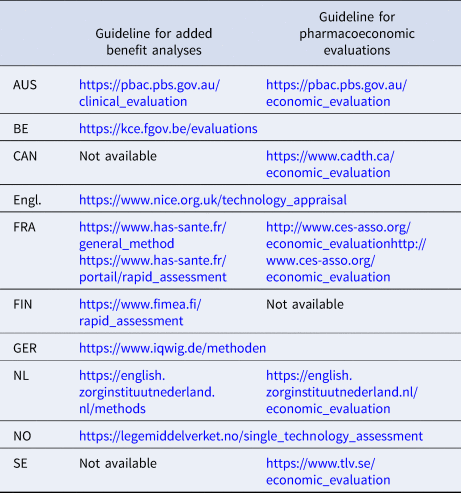
Added benefit analyses: For the evaluation of the added benefit of a drug compared to alternative therapies, randomized controlled trials and non-randomized-controlled trials are the preferred study designs. Systematic reviews and meta-analyses can additionally be considered. However, the considered outcomes for the assessment might differ from country to country: Patient-relevant outcomes are preferred over surrogate endpoints and some outcomes, such as mortality, morbidity, life years gained and safety are considered most often (Reference Zentner, Velasco-Garrido and Busse9–14). The strength of evidence of the available clinical studies is usually assessed with the “Grading of Recommendations Assessment, Development and Evaluation” scheme (15). In addition, the internal validity of the studies is often assessed. Links to the national guidelines for added benefit analyses are presented in Table 2.
Country-specific guidelines for added benefit analyses and/or pharmacoeconomic evaluations

AUS, Australia; BE, Belgium; CAN, Canada; Engl. England; FRA, France; FIN, Finland; GER, Germany; NL, Netherlands; NO, Norway; SE, Sweden.
Pharmacoeconomic evaluations: Nearly all of the ten considered countries have their own guidelines for conducting pharmacoeconomic evaluations (see Table 2). Generally, cost−utility analyses are the preferred study design, followed by cost-effectiveness and cost−benefit analyses. In regard to orphan drugs, the study design of pharmacoeconomic analyses can vary. In England, for example, there are special technology appraisals for orphan drugs (https://www.nice.org.uk/about/what-we-do/our-programmes/nice-guidance/nice-highly-specialised-technologies-guidance). In four countries (FIN, NL, NO, SE) a societal perspective is pursued, while in the remaining countries, either the healthcare perspective (CAN) or the payers' perspective (BE, FRA, GER) is considered for the pharmacoeconomic evaluation (10;11). The parameters analyzed are based on the selected study design and perspective and include direct or indirect costs, efficacy outcomes such as life years gained, quality-adjusted life years (QALYs), and the incremental cost-effectiveness ratio (9;10;12). For the selection of the comparator, no standardized method exists. The preferred options are the most often used alternative therapy, the current standard therapy, no therapy, or drugs of the similar therapeutic group (9–12;14;16). Furthermore, future costs and benefits are discounted in all countries, but with different rates varying between 1.5 and 5.0 percent. In all of the included countries, no official cost-effectiveness threshold exists. However, there are unofficial thresholds ranging from 20,000 pounds per QALY in England to 80,000 Euro per QALY in the Netherlands (11;17).
Additional criteria: In the majority of the analyzed countries, additional criteria beyond the standard added benefit analysis and pharmacoeconomic evaluation are taken into account for the drug reimbursement evaluation, such as the prevalence and incidence of the disease, the severity of the illness, the handling of the new medication, the lack of alternative therapies, the overall societal costs or the equitable distribution of drugs (10;13;17–19). By doing so, different stakeholders, for example, the entire population (CAN, FIN) or patients (CAN, FIN, FRA), can be involved in the evaluation process [expert information].
Appraisal process: The reimbursement decision is often supported by multi-disciplinary appraisal committees, which consider the available added benefit analysis and pharmacoeconomic evaluation, as well as other criteria for reimbursement recommendations. In the case of orphan drugs, some pharmacoeconomic aspects may be disregarded (10;16;19;20). In some countries (AUS, Engl., GER, NO, SE) patients are involved in the appraisal process without voting rights, while for example in France, patients are represented with a voting right in the appraisal committee.
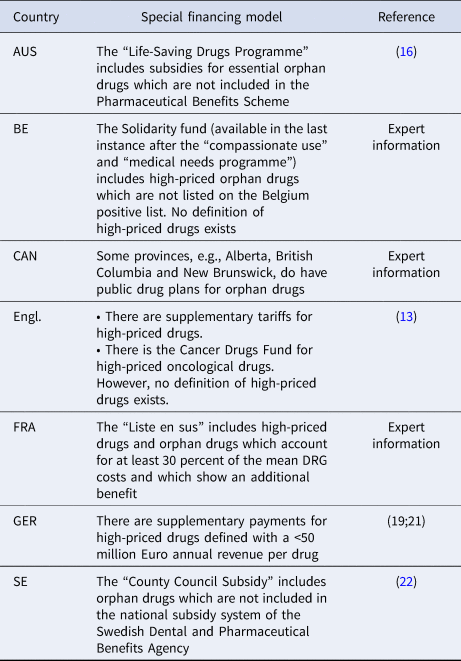
Final reimbursement decision: The final reimbursement decisions can be made by the same institution for the inpatient and outpatient sector (e.g., AUS, BE, Engl., FRA, NL), or the decision is made by separate institutions for the two sectors (e.g., CAN, FIN, GER, NO, SE). In any case, the recommendations of the appraisal committees are considered for the final decisions and most often these decisions are in accordance with the recommendations. In the outpatient sector, (partly) reimbursed drugs are entered onto a “positive list” in the majority of the countries (exceptions: Engl. and GER with “negative lists” containing drugs that are not reimbursed or only reimbursed under special conditions). In the inpatient sector, drugs are financed through a diagnosis-related group (DRG) system in most of the countries. For costly and/or orphan drugs there are often special financing models, illustrated in Table 3 (13;16;19,21;22). However, there are no commonly agreed-upon definitions (e.g., thresholds) of a “costly” drug. Moreover, in some countries (BE, CAN, Engl., GER, NL, NO), drug lists for each hospital (corporation) are decided upon, whereas in other countries (e.g., FRA) national hospital drug lists exist (decentralized vs. centralized reimbursement decisions).
Examples of special financing models for costly and/or orphan drugs

AUS, Australia; BE, Belgium; CAN, Canada; Engl., England; FRA, France; GER, Germany; SE, Sweden.
Transparency: To what extent the processes from the drug assessment to the final reimbursement decision are publicly available can vary between and within countries. In general, a distinction between “completely published”, “partially published with confidential information removed” and “not published” exists. In most of the countries, the evidence analyses are publicly available, while the appraisal processes and the final positive reimbursement decisions are only published in Canada and Germany (15;23). In other countries, confidential information, for example, confidential rebates (Engl., NO, SE) or input data of the pharmacoeconomic model (FIN, SE) may be removed (11;15;24). The results of price negotiations, however, are confidential in all included countries (10;15;20;25).
Deliberation of Options for a Decision-Making Process
The concept of A4R (Reference Daniels7) brings an account of conditions that constitute the right way to make priority setting decisions, and the concept of DDM contributes the critical examination of such decisions by weighing of reasons for and against a course of action (12). Based on the four criteria following these concepts, the strengths and weaknesses of the options for designing reimbursement processes are discussed.
According to the first criterion, “evidence-based methods and processes”, added benefit analyses and pharmacoeconomic evaluations are based on standardized methods and guidelines clearly describing the preferred study design and perspective, accepted outcomes and comparators, as well as a cost-effectiveness threshold for pharmacoeconomic analyses. Moreover, the appraisal process can systematically involve pre-defined criteria beyond added benefit analyses and pharmacoeconomic evaluations.
Considering the second criterion, “transparency”, the methods (methodological guidelines), the processes (procedural steps of evaluation), the results (decisions), or any of those items can be publicly available. The appraisal process can be made transparent by publishing the names of the members of the appraisal committee, their voting records and/or their final recommendations. Furthermore, final reimbursement decisions can be presented transparently via a public positive list. However, decisions can also be presented in a semi-transparent manner, for example, if confidential information, such as rebates, are removed.
The third criterion, “fairness” in terms of equal access to drugs, is characterized by a systematic and comprehensible evaluation of the drug, a consistent methodology for the evidence analyses across disease groups (e.g., generic methods are deemed to be fairer than indication-specific methods), the involvement of patients, their relatives or patient groups in the evaluation and appraisal processes, and the possibility to appeal (with reasons) against the final decision. Furthermore, decentralized decision making and reimbursement processes in the inpatient sector, like in Austria, may increase unequal accesses to drugs. Therefore, a centralized and standardized process may increase accessibility of health care.
Finally, with regard to the fourth criterion, “efficiency”, the methods for the evidence analyses and the decision-making processes need to be feasible and pragmatic in order to achieve optimal results and make more efficient use of certainly limited resources for drug evaluation. For example, the efficiency of national evidence analyses for small countries can be increased through international cooperation (e.g., EUnetHTA) or through the bi- or multilateral reuse of drug evaluations from other countries (e.g., Beneluxa: http://www.beneluxa.org/). Furthermore, the choice of methodology may influence efficiency: for example, in pharmacoeconomic evaluations, the choice of the perspective (payers' vs. societal perspective) influence the use of resources for drug evaluations. Finally, the division of the responsibility of sub-processes (e.g., evidence analyses, appraisal and reimbursement decision) also has an effect on the efficiency of the process.
Overall, a strength of one criterion can be a weakness according to another criterion, for example, a segregation of responsibilities for sub-processes between separate (independent) public bodies can increase the transparency and fairness of the processes but may be less efficient since additional resources are needed.
Option Suggestions for Decision Making on Costly Hospital Drugs in Austria
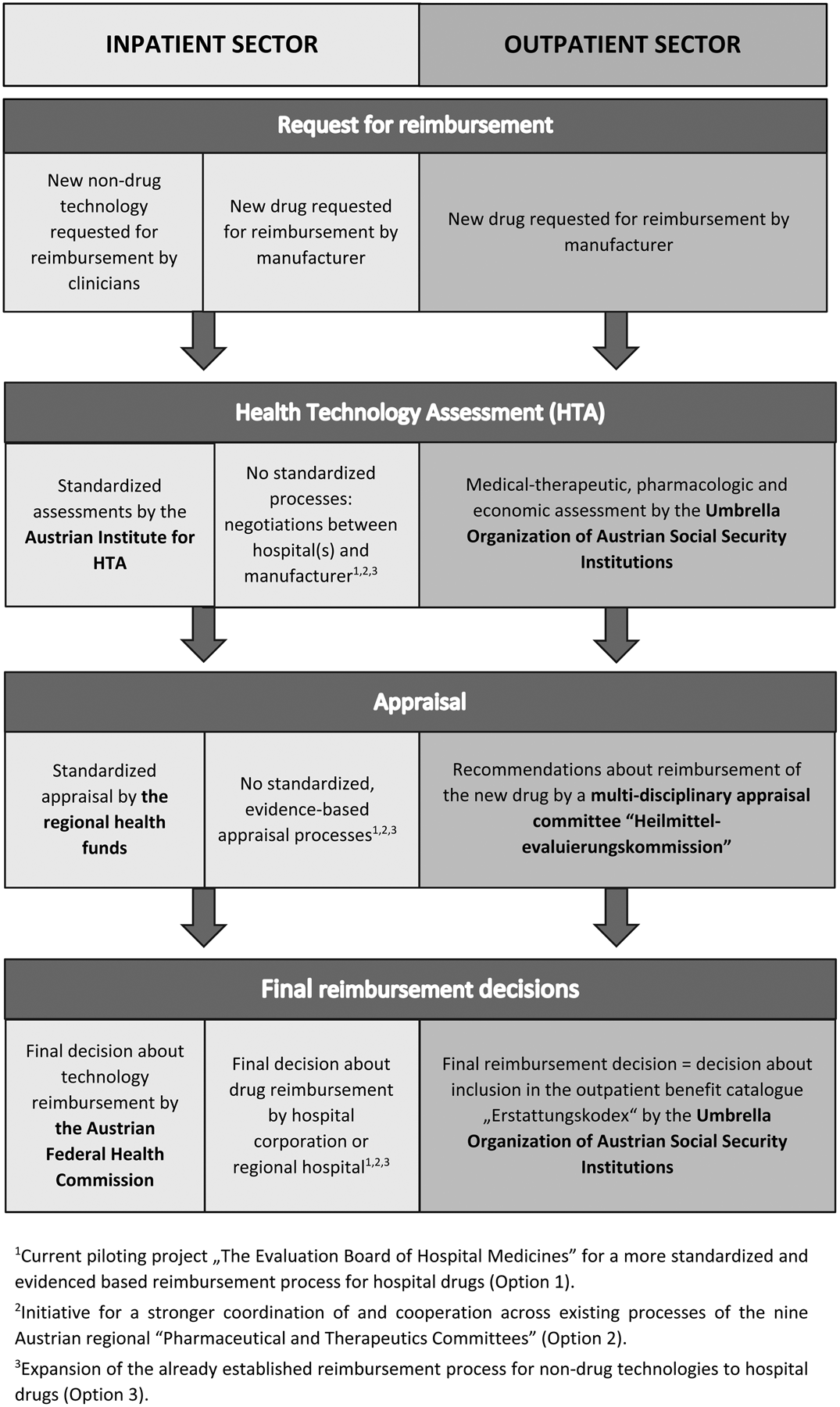
Figure 1 presents the simplified structures of the inpatient and outpatient reimbursement processes in Austria from a national perspective. Regional reimbursement systems are not considered in this figure. Based on the information derived from the international analysis of practices and on the deliberation of the strengths and weaknesses of different procedural steps, three options to reorganize (centralize) the current decentralized reimbursement process in the inpatient sector in Austria, considering already existing systems and actors in the inpatient as well as outpatient sector, were developed.
Simplified overview of reimbursement processes of the Austrian in- and outpatient sector.

Option 1: Centralized recommendations for decentralized implementation
Within a current piloting project, a national drug commission (“The Evaluation Board of Hospital Medicines”) uses the established processes of decision-making for outpatient drugs at the Main Association of Austrian Social Security Institutions (since January 2020, the Umbrella Organization of Austrian Social Security Institutions). The already existing infrastructure (for added benefit analyses) is thereby used and a cross-sector perspective is applied to the evaluations. Requests for evaluation comprise only costly drugs above a pre-defined cost threshold (not defined yet) and are submitted by regional health funds based on a reimbursement request from the regional hospitals. A pharmacologic, medical-therapeutic and – if deemed necessary – economic analysis (simple price comparison, budget impact analysis and/or pharmacoeconomic evaluation) is conducted according to (generic; cross-indication) standardized and transparent methodological guidelines. The evidence analyses are appraised within a separate, multi-disciplinary committee (“Heilmittelevaluierungskommission”) consisting of clinicians, providers, methodological experts, payers (health funds and hospitals) and patient representatives, resulting in recommendations about treatment regimes and algorithms, and/or additional conditions for the assessed drug. These recommendations are non-binding suggestions on a national level, while the final and legislative decisions are exclusively made by regional hospital (organizations). The strength of this option lies in the existing infrastructure for drug evaluations including an established process with separate evaluation and appraisal processes.
Option 2: Coordination of regionalized decision processes
All regional public hospital corporations in Austria have well-established decision processes for their regional drug benefit catalogues (“positive lists”). A stronger coordination of and cooperation across those existing processes of the nine Austrian regional “Pharmaceutical and Therapeutics Committees”, including also “negative lists”, is organized within a second piloting project that started in 2017. Thereby, requests for reimbursement, based on individual clinician's requests (from regional hospitals), are submitted at the time of introduction of a new (costly) drug. The hospital drugs are evaluated based on national (AIHTA) and supranational (EUnetHTA, European Society for Medical Oncology [ESMO], etc.) assessments and their critical appraisal. In addition, the evidence is appraised by an inpatient-only, multi-disciplinary drug evaluation board (“The Medical Innovation Board”), consisting of clinicians and providers/payers (hospitals), coordinated across the nine Austrian regions. The final recommendations about treatment regimens and algorithms, and/or additional conditions for the assessed drug are binding and implemented directly in the regional hospital corporations. Major advantages of this option are the involvement of regional clinicians and patient representatives in the decision-making process and the respective increase of acceptance of decisions.
Option 3: Expansion of the hospital benefit catalogue for the inclusion of costly drugs
Decisions on the inclusion/exclusion of highly specialized, drug and non-drug interventions are based on a standardized process of assessment (by AIHTA) and appraisal (by the regional health funds) for the maintenance of the hospital benefit catalogue by the Federal Health Commission in Austria. So far, only a few oncologic drugs have been included in the benefit catalogue, all of them – in contrast to surgical interventions – without the requirement of critically assessing the added benefit and risks. This third option suggests expanding the already established process for non-drug interventions and widening it to require the critical assessment of costly drugs. Within this process, the request for the inclusion of a hospital drug into the benefit catalogue would be submitted by the individual hospitals. Similar to non-drugs, the requested drug would need to undergo a systematic evaluation following standardized methods by an external institution. The evaluation would involve a systematic analysis of the available clinical evidence, possibly an economic analysis (simple price comparisons, budget impact analysis and/or pharmacoeconomic evaluation) and an appraisal committee consisting of regional providers and payers, but no clinicians or patients. The final decision would be made by the Federal Health Commission, though concrete recommendations about treatment regimes and algorithms, and/or additional conditions for the assessed drug would not be provided due to the nature of the decision to reimburse a drug, because drugs are only listed in the hospital benefit catalogue, but not for specific indications. The implementation would be left to the providers (hospitals). The inclusion of costly drugs in the decision-making process on hospital interventions could be accompanied by the introduction of a specific drug fund for costly drugs. The main strength of this option presents the use of already established standardized methods.
Discussion
The prioritization of public resources to achieve the best possible benefit for the population is crucial. However, such decisions often have to be made under enormous public pressure and demand. Therefore, decisions in democratic societies need, on the one hand, the trust in the legitimacy of the responsible institution (e.g., ministry of health, social insurances, health funds), but also in the legitimacy of the decision process itself, that the decisions are based on the best available evidence, deliberating the needs of patient populations in a fair manner. This and transparency seem to be indispensable within the context of rapidly increasing developments of ever-new technologies and the respectively expanding healthcare costs (7;8).
A deliberation of the presented options for a reorganized (centralized) decision-making process on the reimbursement of costly hospital drugs in Austria aiming at equal access to those therapies across Austria has shown that each option has its strengths. However, limitations to the suggested options are unavoidable and need to be balanced in the context of availability of evidence, transparency, fairness and efficiency/pragmatism:
• Option 1: While the existing infrastructure of the Umbrella Organization of Austrian Social Security Institutions can be used (pragmatic and efficient), the capacity needs to be extended. Publicly available standardized methodologies (across indications) for the medical-therapeutic and economic evaluations are not in place yet (partial lack of transparency in methods), but an established process with a separate appraisal and the possibility to appeal exists (full transparency in process, fairness). Currently, however, fairness is limited in regard to the involvement of patient representatives in the processes. Finally, due to the non-binding character of the recommendations, the commitment of the regional hospitals is crucial for the effectiveness of this process, otherwise, unequal access for patients will be reinforced.
• Option 2: Although, the involvement of regional clinicians and patient representatives in the decision-making process increases fairness and the acceptance and binding nature of the decisions, the regional execution of tough decisions is prone to be influenced by local demands in order to deviate from the final decisions and thus threaten equal access. Furthermore, drug evaluation assessments rely solely on available, published drug evaluations (transparent in methods and efficient) and international scoring criteria for oncological drugs (ESMO Magnitude of Clinical Benefit Scale: transparent in methods). However, the lack of methodological guidelines across indications and sectors (lack of evidence-based methods and processes) and the lack of public availability of insights into the process and the reasoning for the results (lack of transparency) make this option less transparent, but most efficient.
• Option 3: Expanding the existing process of highly specialized, non-drug technologies to costly drugs implies an annual standardized process for evaluations (evidence-based and transparency in methods and processes); however, it entails a time-consuming process (partly inefficient for timely decisions). Moreover, stakeholders (clinicians; no patients) are only involved as peer reviewers, but not in the appraisal process. An appeal is not possible, but a re-evaluation based on additional evidence (partly fair) is. Appraisal criteria are not known and the compliance to the use of hospital drugs cannot be controlled, which is why the commitment of the clinicians is essential, but unlikely (unpragmatic), and probably will not lead to fair access.
Limitations of this article: The included countries were selected based on published materials (hand-searched for and available in German or English) and experts' inputs. Therefore, other countries with well-established systematic approaches to decision making on costly drugs were excluded. Moreover, the majority of the national reports on reimbursement processes were English translations and not all information was very detailed. To what extent the given information in the literature about the reimbursement processes reflects the actual practice remains unsure and important information might have been missed. Furthermore, price negotiations are not addressed in the suggested options, because they are not part of political negotiations since the aim was to focus on the general evaluation processes. However, joint price negotiations should be considered as a next step towards a more standardized and transparent system. Finally, contextual facts such as the legal status of different protagonists of the reimbursement processes of the ten analyzed international countries were not considered. With regard to the legitimacy of the processes in Austria, for instance, there is additional need for an analysis of the legal implications of the three suggested options, as we did not include recommendations for changes in the legal framework.
Conclusion
Overall, due to increasing healthcare expenditures caused by the introduction of new, costly health interventions such as orphan drugs, these expenditures may result in limited resources for other interventions. A prioritization of interventions with large benefits over those with no or marginal benefit is important because the demand for all health interventions cannot be satisfied. Based on the concepts of A4R and DDM, evidence-based, transparent, fair and efficient resource allocations are cornerstones for priority setting decisions. As a result, a higher acceptance, also of negative decisions, and more sustainable preservation of effective healthcare services can be achieved (3;7). However, the limitations of the suggested options for a centralized Austrian reimbursement process in the inpatient sector aiming at equal access to beneficial drugs illustrates that quality, transparency and timeliness need to be pragmatically balanced.
Acknowledgments
We want to thank Sabine Vogler, Peter Schneider and Nina Zimmermann from the Austrian Public Health Institute for the valuable information on international practices. Furthermore, we also want to thank Klaus Klaushofer from the Umbrella Organization of Austrian Social Security Institutions and Markus Narath from the Styrian Hospital Corporation (KAGes) for providing helpful comments, especially on the Austrian process.
Funding
This research received no specific funding from any agency, commercial or not-for-profit sectors.
Conflict of Interest
Authors Sarah Wolf, Ingrid Zechmeister-Koss, Nicole Grössmann and Claudia Wild declare that they have no conflict of interest.