I. INTRODUCTION
Zirconium-based bulk metallic glasses (BMGs) are considered promising materials for biomedical applications because of their high strength, low Young’s modulus, and good wear and corrosion resistance.Reference Johnson1–Reference Qiu, Chen, Liu, Chan, Zhou, Chen and Zhang7 However, elements with high toxicity to cellular metabolism, such as Ni and Cu, are usually found in Zr-based BMGs with high glass-forming ability (GFA),Reference Peker and Johnson8–Reference Yamamoto, Honma and Sumita11 which is disadvantageous to their practical applications as biomaterials. In the last decade, great efforts have been devoted to the exploration of Zr-based BMGs with less hazardous elements, and Ni-free Zr-based BMGs have been developed in Zr–AlCo(Cu),Reference Wada, Zhang and Inoue12, Reference Wada, Zhang and Inoue13 Zr–Al–Co–Nb,Reference Pang, Zhang, Asami and Inoue5 Zr–Al–Cu–Fe,Reference Jin and Löffler14 Zr–Cu–Pd–Al–Nb,Reference Qiu, Chen, Liu, Chan, Zhou, Chen and Zhang7 Zr–Al–Cu–Ag,Reference Jiang, Wang, Nie, Zhang, Ma, Fecht, Bendnarcik, Franz, Liu, Cao and Jiang15 and Zr–Al–Cu–Fe–(Ti/Nb)Reference Liu, Qiu, Huang, Yua, Huang and Zhang16 systems. Among them, Zr–Al–Co BMGs are attractive because they are free from not only Ni but also Cu and exhibit high thermal stability, good mechanical properties, and high corrosion resistance.Reference Pang, Zhang, Asami and Inoue5, Reference Wada, Zhang and Inoue12 However, Zr–Al–Co BMGs possess limited GFA and the maximum diameter was 5 mm obtained at Zr55Al20Co25 (at.%) by injection copper mold casting.Reference Pang, Zhang, Asami and Inoue5 By using a ladle arc melting type casting method, Zr55Al20Co25 alloy and near-eutectic composition Zr56Al16Co28 alloy can be prepared in a bulk glassy rod form with a diameter of 10 and 18 mm, respectively.Reference Wada, Qin, Wang, Yoshimura, Inoue, Sugiyama, Ito and Matsushita17
It has been found that the addition of Ag to Zr-based glassy alloys can improve the GFA and plasticity as well as corrosion resistance.Reference Jiang, Wang, Nie, Zhang, Ma, Fecht, Bendnarcik, Franz, Liu, Cao and Jiang15, Reference Zhang, Jia, Zhang and Inoue18–Reference Zhang, Li, Pan, Guo, Zhang and Liu20 We also noticed, from the viewpoint of biomedical applications, that silver is a potent antibacterial agent with a very broad spectrum of activity, and the Ag-containing materials have proved their effectiveness in reducing infections.Reference Wan, Raman, He and Huang21 Metallic and ionic Ag have been incorporated into several biomaterials such as medical metal implants,Reference Wan, Raman, He and Huang21 dental casting alloys,Reference Wataha22 hydroxyapatite (HA),Reference Chen, Liu, Courtney, Bettenga, Agrawal, Bumgardner and Ong23 bioactive glasses,Reference Balamurugan, Balossier, Laurent-Maquin, Pina, Rebelo, Faure and Ferreira24 and bone cement.Reference Alt, Bechert, Steinrucke, Wagener, Seidel, Dingeldein, Domann and Schnettler25 Therefore, Ag-bearing Zr-based BMGs are considered to be more promising biomaterials.
In this work, with the aim of synthesizing BMGs with high GFA, good mechanical properties, and corrosion resistance, the Zr–Al–Co–Ag BMGs system was investigated. Ni- and Cu-free Zr–Al–Co–Ag BMGs with a critical diameter up to 20 mm were obtained by copper mold casting. Based on the studies on the local atomic structure and crystallization behavior, the effects of Ag alloying on the superior GFA of Zr–Al–Co–Ag alloys are discussed. The mechanical properties and corrosion behavior in phosphate-buffered solution (PBS) of the Zr–Al–Co–Ag BMGs were studied for evaluating their biocompatibility.
II. EXPERIMENTAL
Master alloys with nominal compositions of Zr53Al16(Co1-xAgx)31 (described in atomic percentage, x = 0, 0.2, 0.25, 0.3, and 0.4) alloys were prepared by arc melting the mixtures of pure Zr, Al, Co, and Ag metals in Ti-gettered high-purity argon atmosphere. From the master alloys, cylindrical alloy rods with a diameter of less than 10 mm were prepared by injection copper mold casting, and for preparing the alloy rods of 10 mm in diameter or larger size, the ingots were remelted in a quartz crucible using electromagnetic induction heating and then poured into a copper mold in high-purity argon atmosphere. Ribbon samples with a cross section of 0.02 × 1 mm2 were prepared by melt spinning. Structure of the specimens was examined by x-ray diffraction (XRD) (Cu Kα), synchrotron radiation in transmission and high-resolution transmission electron microscopy (HRTEM). Synchrotron radiation in transmission was carried out using a high-energy monochromatic beam at ID11 beam line of the European Synchrotron Radiation Facility (ESRF) equipped with a nitrogen-cooled double-silicon monochromator. The photon energy was 93.15 keV corresponding to an x-ray wave length of about 0.01331 nm. Further details on the experiments can be found in Ref. 26. TEM specimens were prepared by two-jet electropolishing method using a chemical solution of 4% HClO4 ethanol. Thermal properties including glass transition temperature, supercooled liquid region, and crystallization and melting behaviors of the glassy alloys were investigated by differential scanning calorimetry (DSC) at a heating rate of 0.33 K/s. The error bands of the value of the characteristic temperatures are within 1%. The specimens for the DSC measurement of the bulk samples were taken from their central part. Annealing treatment was carried out in the DSC sample chamber under a continuous flow of pure argon at a heating rate of 0.33 K/s. The annealing temperatures correspond to the offset temperatures of the first and second crystallization events determined from the DSC curves of the BMGs. The annealed samples were examined by XRD, transmission electron microscopy (TEM), and energy-dispersive spectroscopy (EDS).
Microhardness of the BMGs was examined by a Vickers microhardness tester under a load of 200 g. Compressive test was carried out by a mechanical testing machine at room temperature. The dimension of the compressive specimens was 2 mm in diameter and 4 mm in height, and the strain rate was 2.1 × 10⁻⁴ s−1. The elastic properties including Young’s modulus (E), bulk modulus (K), shear modulus (G), Poisson’s ratio (ν) were obtained by a resonant ultrasound spectroscopy (RUS). The error bands of the calculation elastic constants are below 5%. Corrosion behavior of the BMGs was characterized by electrochemical measurements in a PBS at 37 °C with a 4 vol% O2/N2 gas mixture flowing at a rate of 50 mL/min. Prior to the corrosion tests, the specimens were mechanically polished in cyclohexane with silicon carbide paper up to No. 2000, degreased in acetone, washed in distilled water, dried in air, and further exposed to air for about 24 h for good reproducibility. Electrochemical measurements were conducted in a three-electrode cell using a platinum counter electrode and a saturated calomel reference electrode (SCE). Anodic polarization curves were measured at a potential sweep rate of 50 mV/min after open-circuit immersion for about 20 min when the open-circuit potential became almost steady. The anodic polarization curves were measured at least three times to confirm reproducibility.
III. RESULTS
A. Glass-forming ability
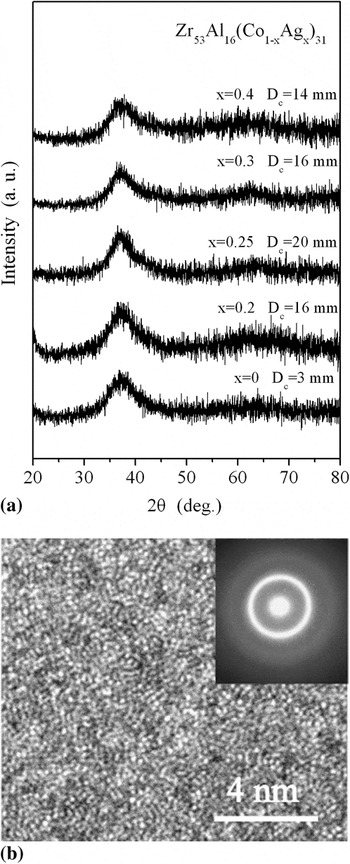
Figure 1(a) shows XRD patterns of the as-cast Zr53Al16(Co1−xAgx)31 (x = 0, 0.2, 0.25, 0.3, and 0.4) glassy rods with their critical diameters (D c). The patterns exhibit a main halo peak without crystalline peaks, indicating the glassy structure of the rod samples. It is seen that the critical diameter of Zr53Al16Co31 glassy alloy is 3 mm. The addition of appropriate amount of Ag can significantly improve the GFA of Zr–Al–Co system and especially the critical diameter of Zr53Al16(Co0.75Ag0.25)31 metallic glass reaches 20 mm. Figure 1(b) presents the HRTEM image and selected-area electron diffraction (SAED) pattern of the cast Zr53Al16(Co0.75Ag0.25)31 rod of 20 mm in diameter. The homogeneous contrast in the image and a broad halo in the SAED pattern confirm the glassy structure of the bulk alloy.
(a) XRD patterns of Zr53Al16(Co1−xAgx)31 (x = 0, 0.2, 0.25, 0.3, and 0.4) cast rods with the critical diameters for glass formation. (b) HRTEM image and selected area electron diffraction pattern (SAED) of Zr53Al16(Co0.75Ag0.25)31 glassy rod with a diameter of 20 mm.

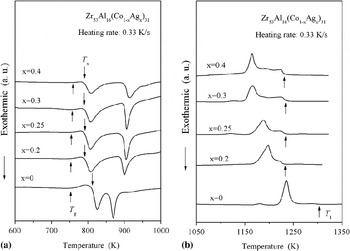
Figure 2 shows the DSC curves of Zr53Al16(Co1-xAgx)31 glassy alloys with their critical diameters, where T g, T x, and T l are glass transition temperature, onset temperature of crystallization and liquidus temperature, respectively. During heating, the samples exhibit a distinct glass transition followed by a supercooled liquid region prior to crystallization. The thermal properties of Zr–Al–Co–Ag system are summarized in Table I. The glassy structure of the bulk samples was further confirmed by comparing their DSC curves with those of the corresponding melt-spun ribbons. There was no distinct difference in T g, T x, and crystallization heat release between the bulk and ribbon samples of the same compositions. It is notable that, with the increase in Ag content, T g increases from 752 to 759 K and T x decreases from 812 to 790 K, leading to the decrease in the temperature interval of supercooled liquid region ΔT x (i.e., T x − T g) from 60 to 31 K. The liquidus temperature T l decreases from 1303 to 1231 K with increasing Ag content as shown in Fig. 2(b). Reduced glass transition temperature T rg (i.e., T g/T l), ΔT x as well as γ [i.e., T x/(T g + T l)] values are usually used as indicators of the GFA of metallic glasses.Reference Inoue27–Reference Lu and Liu29 The present Zr–Al–Co–Ag alloys exhibit higher T rg and γ values than the Zr–Al–Co alloys, corresponding to the enhanced glass-forming ability by the addition of Ag. On the other hand, the supercooled liquid region decreases from 60 to 31 K with increasing Ag content, which is not consistent with the change in GFA of the alloys.
DSC curves of Zr53Al16(Co1−xAgx)31 (x = 0, 0.2, 0.25, 0.3, and 0.4) glassy alloys with their critical diameter.

Thermal properties and critical diameters (D c) of Zr53Al16(Co1−xAgx)31 (x = 0, 0.2, 0.25, 0.3, 0.4) glassy alloys.

B. Atomic structures and crystallization
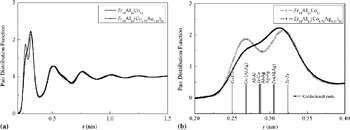
To understand the remarkable effect of Ag addition on improving GFA of the Zr–Al–Co alloy, atomic structure and crystallization process of Zr53Al16Co31 and Zr53Al16(Co0.75Ag0.25)31 BMGs were studied. The local atomic structures were investigated using PDFs derived from high-precision synchrotron radiation x-ray diffraction data. The PDFs of Zr53Al16Co31 and Zr53Al16(Co0.75Ag0.25)31 BMGs are shown in Fig. 3(a), which suggest that Ag alloying generates significant differences in the short range order (SRO) and the medium range order (MRO) up to about 1.5 nm.Reference Yavari30 Figure 3(b) presents a close-up of the first PDF peak that reveals structure changes in the first nearest neighbor (NN) shell. The first PDF peak of the Zr–Al–Co BMG is composed of two maxima, which is similar to the PDFs of the Zr–Al–Cu and Zr–Al–Ni alloys.Reference Antonowicz, Louzguine-Luzgin, Yavari, Georgarakis, Stoica, Vaughan, Matsubara and Inoue31 It can be reasoned that the maxima centered at 0.268 nm in the first PDF peak corresponding mainly to Zr–Co and Co–Al interatomic distances and the maxima centered at 0.318 nm corresponding to Zr–Zr interatomic distance, respectively, and the contribution of Co–Co pairs is minor.Reference Antonowicz, Louzguine-Luzgin, Yavari, Georgarakis, Stoica, Vaughan, Matsubara and Inoue31, Reference Hirata, Morino, Hirotsu, Itoh and Fukunaga32 It is worth noting that the left maximum is centered at r = 0.268 nm, while the Zr–Co interatomic distance predicted by the Goldschmidt atomic radii is 0.288 nm, the interatomic distance corresponding to the first maximum is smaller than that calculated by using the Goldschmidt atomic radii. This may be due to the strong chemical interaction and electron sharing between Zr and Co atoms resulting in the large negative enthalpy of mixing (−41 kJ/mol) between these two elements, the same deviation can be observed in Zr–Cu, Zr–Cu-Al, Zr–Ni, Zr–Ni–Al alloys.Reference Louzguine-Luzgin, Georgarakis, Yavari, Vaughan, Xie and Inoue26, Reference Antonowicz, Louzguine-Luzgin, Yavari, Georgarakis, Stoica, Vaughan, Matsubara and Inoue31, Reference Hirata, Morino, Hirotsu, Itoh and Fukunaga32, Reference Georgarakis, Yavari, Aljerf, Louzguine-Luzgin, Stoica, Vaughan and Inoue33 In the Zr–Al–Co–Ag system, because of the negative heat of mixing between Co–Al (−19 kJ/mol), Zr–Al (−44 kJ/mol) and Zr–Ag (−20 kJ/mol), their average interatomic distances are possibly smaller than those calculated by using the Goldschmidt atomic radii. Adding Ag in the Zr–Al–Co alloy leads to an increase in the right maximum of the first PDF peak at 0.318 nm, which is mainly attributed to the effect of Zr–Ag pairs, and to a decrease in the left maximum at 0.268 nm indicating fewer Zr–Co, Co–Al, and Co–Co bonds in the first NN shell. The remarkable change in localized atomic structure may be attributed to the requirement of efficient dense packing and the chemical affinity between component atoms caused by Ag addition.Reference Fang, Hui, Chen and Liu34 Ample studies on the structure of BMGs support that the structure of multicomponent BMGs can be described in terms of icosahedral cluster packing.Reference Cheng, Ma and Sheng35–Reference Wang, Jiang, Cao, Bednarcik, Franz and Jiang37 In the Zr–Al–Cu metallic glass, Al-centered icosahedral clusters, which are identified as one kind of the basic local structural motifs, distribute in the three-dimensional space and form a “backbone” structure.Reference Fang, Hui, Chen and Liu34 When Ag is alloyed in the Zr–Al–Co alloy, because of the weak chemical affinity between Ag–Al (−4 kJ/mol), Ag–Al bonds would be minor in the structure. Meanwhile, because of the positive mixing heat of Ag with Co (+19 kJ/mol), Co–Ag bonds can rarely form in the structure. Therefore, it can be inferred that Ag atoms would mainly form bonds with Zr atoms because of the strongly attractive Zr–Ag pair interaction,Reference Takeuchi and Inoue38 which also can be indicated from the changing of positions of maxima in the PDFs shown in Fig. 3. The results are in agreement with previous report that paired and stringed Ag atoms are centered in Zr-rich interpenetrating clusters in the structure of Cu45Zr45Ag10 glassy alloy.Reference Fujita, Konno, Zhang, Kumar, Matsuura, Inoue, Sakurai and Chen39 Moreover, as can be seen in Fig. 3(b), the PDFs of both metallic glasses exhibit two maxima in the first NN, while the two maxima of Zr53Al16(Co0.75Ag0.25)31 BMG are split much less compared with those of Zr53Al16Co31 BMG; i.e., the first peak of Zr53Al16(Co0.75Ag0.25)31 has a more harmonic (symmetrical) shape. This indicates that the interatomic distances distribution of Zr53Al16(Co0.75Ag0.25)31 tends to be normal distribution, due to the increase in chemical SROs and moderate atomic size of Ag (0.144 nm) in the Zr–Al–Co–Ag system. The Ag addition causes the formation of a more homogeneous local atomic structure compared with that of the Zr–Al–Co glassy alloy, which could be considered as a reason for the improved glass-forming ability of this alloy. Moreover, the less splitting of the first peak corresponds to the higher GFA, which is in agreement with the PDF results of some Zr-based metallic glasses exhibit two maxima in the first NN.Reference Louzguine-Luzgin, Georgarakis, Yavari, Vaughan, Xie and Inoue26, Reference Sato, Sanada, Saida, Imafuku, Matsubara and Inoue40
(a) PDFs of Zr53Al16Co31 and Zr53Al16(Co0.75Ag0.25)31 bulk metallic glasses. (b) The close-up of the first PDF peak.

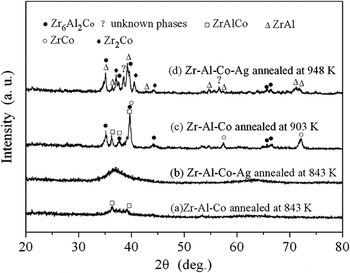
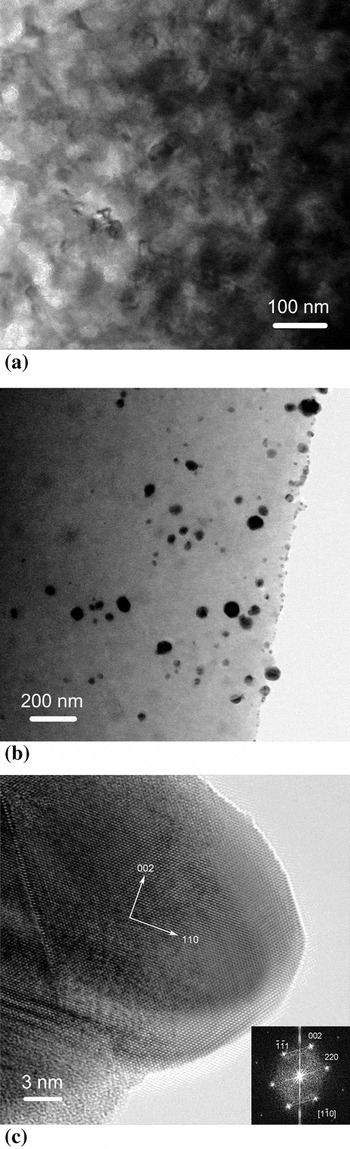
The crystallization behaviors of the Zr–Al–Co and Zr–Al–Co–Ag BMGs were studied by heating the BMGs to the offset temperatures of the first and second crystallization events determined from the DSC curves in Fig. 2, respectively. Figure 4 shows the XRD patterns of Zr53Al16Co31 glassy alloy annealed at 843 and 903 K, respectively, and Zr53Al16(Co0.75Ag0.25)31 glassy alloy annealed at 843 and 948 K, respectively. The XRD pattern of Zr53Al16Co31 alloy annealed at 843 K exhibits a diffusive amorphous halo with some crystallization peaks identified as ZrAlCo phase, while no obvious crystallization peaks can be observed for the Zr53Al16(Co0.75Ag0.25)31 alloy annealed at 843 K. However, as shown in Fig. 5, TEM images reveal that particles of 5 to 50 nm in size precipitated on the glassy matrix for the annealed Zr53Al16(Co0.75Ag0.25)31 alloy, and the volume fraction and size of the crystallites are much smaller than those of Zr53Al16Co31 alloy annealed at the same temperature of 843 K. Furthermore, the nanocrystalline phase in the annealed Zr53Al16(Co0.75Ag0.25)31 alloy can be identified by TEM and EDS analysis as a face-centered cubic (fcc) Ag phase (a = 4.0853 Å), as shown in Fig. 5(c). The results are in agreement with the structure analysis mentioned previously. In Zr–Al–Co–Ag system, Ag atoms mainly form bonds with Zr atoms, and Zr–Ag pair exhibit weaker chemical affinity than those of Zr–Al and Zr–Co pairs. During heating, the less stable Zr–Ag pair may easily be destroyed while the Zr–Al and Zr–Co pairs exhibit higher stability; thus, an Ag phase would preferentially precipitate from the glassy matrix. After annealing to 903 K, the XRD pattern of Zr53Al16Co31 alloy shows sharp diffraction peaks identified as a mixture of ZrCo, ZrAlCo, and Zr6Al2Co phases. The Zr53Al16(Co0.75Ag0.25)31 alloy annealed to 948 K consist of Zr6Al2Co, ZrAl, Zr2Co, and unknown phases. This means that Ag alloying in Zr–Al–Co alloy induced complex crystallization products, indicating that more competitive phases may exist during the crystallization of the Zr–Al–Co–Ag alloy and thus contribute to the enhancement of GFA.
XRD patterns of cast Zr53Al16Co31 and Zr53Al16(Co0.75Ag0.25)31 alloys (ϕ 3 mm) annealed at the offset temperatures of the first and second crystallization events, respectively.

Bright-field TEM images of (a) Zr53Al16Co31 and (b) Zr53Al16(Co0.75Ag0.25)31 alloys annealed at 843 K. (c) HRTEM image and corresponding fast Fourier transformation (FFT) image of Ag nanocrystals in Zr53Al16(Co0.75Ag0.25)31 alloy annealed at 843 K.

C. Mechanical properties
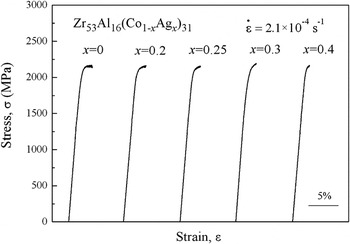
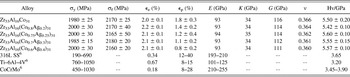
Figure 6 shows compressive stress–strain curves of the Zr53Al16(Co1−xAgx)31 glassy rods with a diameter of 2 mm at a strain rate of 2.1 × 10⁻⁴ s−1. The stress–strain curves are characteristic of a large elastic limit of about 2% for BMGs, followed by yielding and a serrated plastic deformation before fracture failure. Mechanical properties of the Zr–Al–Co–Ag bulk glassy alloys including the compressive yield strength (σy), fracture strength (σf), elastic limit (εe), plastic strain (εp), Young’s modulus (E), bulk modulus (K), shear modulus (G), Poisson’s ratio (ν), and Vickers hardness (HV) are summarized in Table II. The yield strength, elastic limit, and Young’s modulus of 316L stainless steel (SS), Ti–6Al–4V, and CoCrMo alloys are also listed in Table II for comparison.Reference Morrison, Buchanan, Leon, Liu, Green, Liaw and Horton6 The Zr–Al–Co–Ag BMGs exhibit good mechanical properties, e.g., compressive yield strength of 1980 to 2000 MPa, compressive fracture strength of 2160 to 2180 MPa, elastic limit of 2.0 to 2.2%, plastic strain of 0.8 to 1.8%, Young’s modulus of 93 to 94 GPa, Poisson’s ratio (ν) of 0.360 to 0.366, and Vickers hardness of 540 to 560. The Young’s modulus of the Zr–Al–Co–Ag BMGs is nearly half of those for 316L SS and CoCrMo alloy. Moreover, for the Zr–Al–Co–Ag BMGs, the yielding strength is two or three times of those for 316L SS, Ti–6Al–4V and the CoCrMo alloy. These properties are beneficial to reducing the concern of bone resorption, which is generally caused by the mismatch of Young’s modulus between implant and bone.
Compressive stress-strain curves of Zr53Al16(Co1−xAgx)31 (x = 0, 0.2, 0.25, 0.3, and 0.4) glassy rods with a diameter of 2 mm.

Mechanical properties including the compressive yield strength (σy), fracture strength (σf), elastic limit (εe), plastic strain (εp), Young’s modulus (E), bulk modulus (K), shear modulus (G), Poisson’s ratio (ν), and Vickers hardness (HV) of Zr53Al16(Co1−xAgx)31 (x = 0, 0.2, 0.25, 0.3, 0.4) bulk metallic glasses. Some data of 316L SS, Ti–6Al–4V and CoCrMo alloys are also shown for comparison.

D. Corrosion behavior
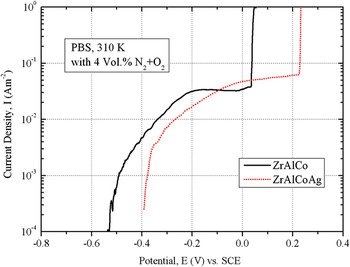
Figure 7 shows the anodic polarization curves of Zr53Al16(Co1−xAgx)31 (x = 0 and 0.25) alloys in PBS at 37 °C with a 4 vol% O2/N2 gas mixture flowing at a rate of 50 mL/min for 1 h prior to testing. It is seen that the alloys are spontaneously passivated, and their passive current densities remain lower than 10−1 A/m2 before the occurrence of pitting corrosion, which corresponds to the abrupt rise in the current density. The high corrosion resistance in PBS of the novel Zr–Al–Co–Ag BMGs free from both Ni and Cu indicates that they are promising biomedical materials with good chemical compatibility. The existence of silver in the BMGs may also provide the materials excellent antibacterial property. It is also notable that the corrosion potential and the pitting potential increase with the addition of Ag, indicating that the present Zr–Al–Co–Ag BMG exhibits better corrosion resistance than the Zr–Al–Co one in PBS. The improved corrosion resistance of the Zr–Al–Co–Ag BMG could result from the composition and structure changes of the passive film caused by the Ag addition. For a better understanding of the effect of Ag addition on corrosion behavior of Zr-based BMGs, further studies on the surface of the Zr–Al–Co and Zr–Al–Co–Ag BMGs are undergoing.
Anodic polarization curves of Zr53Al16(Co1−xAgx)31 (x = 0 and 0.25) bulk metallic glasses in phosphate buffered solution (PBS) at 37 °C with a 4 vol% O2/N2 gas mixture flowing at a rate of 50 mL/min for 1 h prior to testing.

V. CONCLUSIONS
The addition of Ag can significantly improve the GFA of Zr–Al–Co system and a series of centimeter-size Zr–Al–Co–Ag BMGs can be synthesized by copper mold casting. The critical diameter of Zr53Al16(Co0.75Ag0.25)31 metallic glass reaches 20 mm. High-energy synchrotron radiation x-ray diffraction result shows that Ag alloying in Zr–Al–Co system results in a more homogeneous local atomic structure, which could be an origin for the improved GFA of the Zr–Al–Co–Ag alloy. Crystallization products of the Zr–Al–Co–Ag glassy alloy are more complex than those of the Zr–Al–Co glassy alloy. The Ni- and Cu-free Zr–Al–Co–Ag BMGs with superior glass-forming ability exhibit high compressive fracture strength of 2160 to 2180 MPa, high elastic limit of 2.0 to 2.2%, relatively low Young’s modulus of 93 to 94 GPa, and good corrosion resistance in PBS, which make them as promising materials for bioapplications.
ACKNOWLEDGMENTS
This work was financially supported by the National Basic Research Program of China (2007CB613900), the National Nature Science Foundation of China (Grant No. 50631010, 50771005, and 50771006) and Program for New Century Excellent Talents in University (NCET-07-0041).