

INTRODUCTION
Radiocarbon dates on marine samples have not been used as extensively as terrestrial biosphere (charcoal or bone) dates to build absolute chronologies because the interpretation of marine dates is complicated by oceanographic factors. Nevertheless, marine shellfish were widely used by prehistoric populations in various locations, especially in coastal areas, and their shells are abundant and usually well preserved in archaeological deposits. To build chronologies for a particular coastal area using marine samples, background research concerning the oceanographic conditions and the marine reservoir effect for the area in question is needed in order to obtain accurate and reliable results.
The residence time of carbon in the deep ocean is about 1000 yr (Sigman and Boyle Reference Sigman and Boyle2000). Thus, a fraction of the 14C atoms have time to decay (half-life=5730 yr) while the deep water is out of contact with the atmosphere. The deep ocean is therefore depleted in 14C relative to the atmosphere, and the surface seawater (mixed layer) also has a 14C-specific activity lower than that of the atmosphere but greater than that of the deep ocean. Marine waters are therefore deficient in 14C compared with the terrestrial biosphere and, consequently, marine organisms have an apparent age, the so-called reservoir age. This reservoir age, R(t), is defined as the difference between conventional 14C dates from a pair of coeval samples that lived in different carbon reservoirs (Stuiver et al. Reference Stuiver, Pearson and Braziunas1986). R(t) can vary with time since the atmospheric 14C content is not constant and also varies from region to region of the ocean. Oceanographic conditions present in each region are different due to the variability in water mass mixtures, wind regime, bathymetry, and upwelling of deep water.
Considering these issues, Stuiver et al. (Reference Stuiver, Pearson and Braziunas1986) modeled the response of the world ocean to atmospheric 14C variations. From this modeling, a calibration curve for marine samples related to the sea surface water (mixed layer) has been derived. In order to take into account the difference in 14C content between the surface water of a specific region and the average surface water, a parameter, denoted as ΔR (regional marine 14C reservoir effect) and defined as the difference between the reservoir age of the mixed layer of the regional ocean and the reservoir age of the mixed layer of the average world ocean at time t, is required (Stuiver et al. Reference Stuiver, Pearson and Braziunas1986). Usually, ΔR values are determined for a particular geographical region by 14C dating of marine mollusk shells of historic (known) age, collected alive before 1950, i.e. of pre-bomb age, or, perhaps more often, by 14C dating of paired samples of the same age but of different origin (terrestrial and marine). The 14C age of the terrestrial biosphere sample is then converted into a marine model age using the latest calibration curve (Marine13; Reimer et al. Reference Reimer, Bard, Bayliss, Beck, Blackwell, Bronk Ramsey, Buck, Cheng, Edwards, Friedrich, Grootes, Guilderson, Haflidason, Hajdas, Hatté, Heaton, Hoffmann, Hogg, Hughen, Kaiser, Kromer, Manning, Niu, Reimer, Richards, Scott, Southon, Staff, Turney and van der Plicht2013); this marine model age is then deducted from the 14C age of the associated marine sample to yield ΔR (Stuiver and Braziunas Reference Stuiver and Braziunas1993). Although reservoir ages are time dependent, ΔR is not according to the aforementioned model, unless some change of oceanographic conditions has occurred that is restricted to the regional ocean under consideration. This happens in regions affected by an active upwelling of deep water. Rates of regional upwelling can vary in the course of time, and as the intensity of 14C depletion in the mixed layer depends upon the upwelling activity, it is likely that ΔR values can also vary through time (Stuiver and Braziunas Reference Stuiver and Braziunas1993; Kennett et al. Reference Kennett, Ingram, Erlandson and Walker1997; Ingram Reference Ingram1998; Ascough et al. Reference Ascough, Cook and Dugmore2005). For instance, for the western Portuguese coast, a ΔR mean value of 250±25 14C yr was determined for modern times (AD 1880–1940), while for the period 3000–600 BP, ΔR takes a mean value of 95±15 14C yr (Soares and Dias Reference Soares and Dias2006). On the other hand, R(t), taking into consideration its aforementioned definition, always takes a positive value, but ΔR can be either positive or negative (see e.g. Stuiver and Braziunas Reference Stuiver and Braziunas1993: Figure 16; Stuiver et al. Reference Stuiver, Reimer and Reimer2016). Large positive ΔR values are usually associated with a strong upwelling, while negative values can be associated with a nonexistent upwelling and some stratification of the water column.
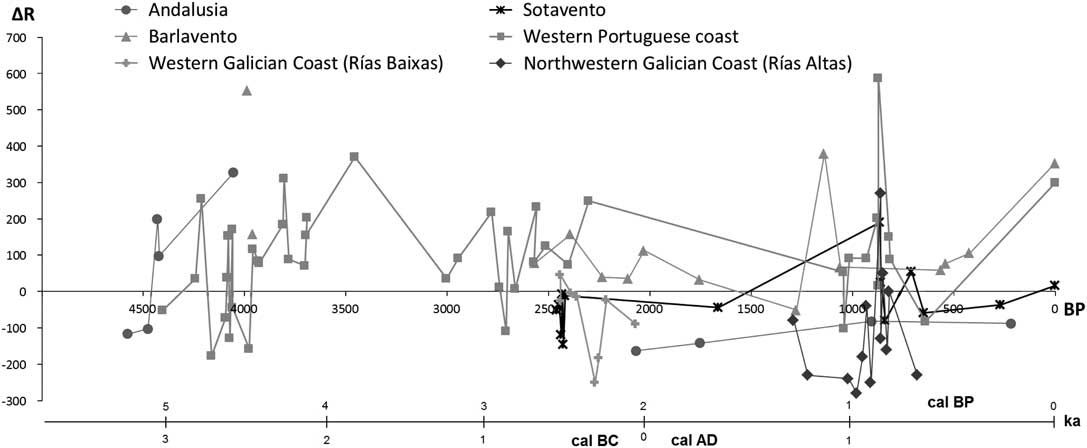
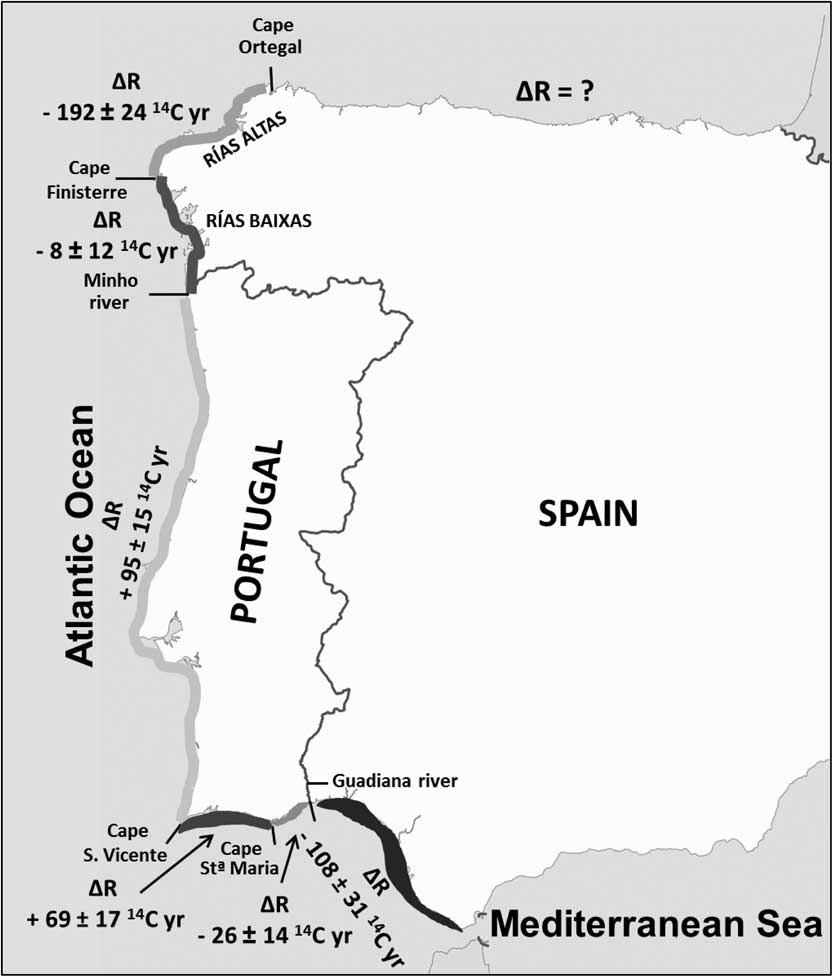
Previous research concerning the variability of ΔR in coastal waters off Atlantic Iberia allowed the quantification of this parameter (Figures 1 and 2), which is of crucial importance for the correct calibration of 14C ages of marine samples. ΔR values were thus determined for the western Portuguese coast, for which weighted mean values are mentioned above, also for western and northwestern Galician coasts (ΔR=–8±12 14C yr and ΔR=–192±24 14C yr, respectively; see Soares and Dias Reference Soares and Dias2007), and southern Atlantic Iberian coast (Barlavento ΔR=69±17 14C yr, Sotavento ΔR=–26±14 14C yr, and Andalusian coast ΔR=–108±31 14C yr; see Martins and Soares Reference Martins and Soares2013). Therefore, concerning the Atlantic coasts of the Iberian Peninsula, only the quantification of ΔR for the northern Atlantic Iberian coast (Cantabrian Sea) was missing (see Figure 1).
ΔR weighted mean values for the Atlantic coasts of the Iberian Peninsula
Variability of marine 14C reservoir effect off Atlantic coast of Iberia
Northern Iberia is a key place for the study of long-term changes in hunter-fisher-gatherer societies. Numerous Upper Paleolithic and Mesolithic sites have been recorded in the region, providing one of the richest archaeological records in the world for the study of the Pleistocene–Holocene transition. Recently, three different (but related) research projects led by two of the authors (IGZ and MGM) have addressed questions regarding environmental conditions and human occupations in Late Pleistocene and Early Holocene coastal locations from northern Iberia (see e.g. Gutiérrez-Zugasti Reference Gutiérrez-Zugasti2011; Gutiérrez-Zugasti et al. Reference Gutiérrez-Zugasti, González-Morales, Cuenca-Solana, Fuertes, García-Moreno, Ortiz, Rissetto and Torres2014, Reference Gutiérrez-Zugasti, García-Escárzaga, Martín-Chivelet and González-Morales2015; García-Escárzaga et al. Reference García-Escárzaga, Moncayo, Gutiérrez-Zugasti, González-Morales, Martín-Chivelet and Cáceres2015b). Building absolute chronologies using archaeological samples is crucial to make reliable interpretations of past human behavior and environmental changes through time. Given the nature of the investigated sites (huge Mesolithic shell middens and more discrete Upper Paleolithic shell lenses) and the sometimes limited amount of terrestrial datable materials (especially in Mesolithic middens), dating of shells is fundamental to establish accurate chronologies in the region. However, as stated above, shell-based dating is biased by the regional marine 14C reservoir effect (ΔR), which must be known in order to calibrate the conventional marine dates. In addition, information on oceanographic conditions derived from the study of the ΔR can be related to data obtained from other environmental proxies (e.g. stable isotopes and elemental analysis). In this paper, we present 14C dates on paired coeval samples of different carbon reservoirs (terrestrial and marine) in order to quantify the ΔR for the Cantabrian Sea during the Late Pleistocene and the Early Holocene. ΔR results will provide an accurate tool for calibration of marine 14C dates and they will also be used for discussion of oceanographic conditions in the region and comparison with other areas of the Atlantic Iberian coast.
OCEANOGRAPHIC CONDITIONS OFF WESTERN AND NORTHERN ATLANTIC IBERIAN COASTS
The western coast of the Iberian Peninsula (37–43°N) has a north-south orientation and is the northern boundary of the NW Africa coastal upwelling system, while the northern Atlantic Iberian coast, with a west-east orientation, develops along ~43°N and is not affected by that upwelling system. At these latitudes, shelf winds follow a seasonal pattern connected with the large-scale climatology of the northeastern Atlantic Ocean. The dominant wind pattern on these coasts is a consequence of the location of the Azores high, which causes changes in wind direction and intensity. These changes, consequently, modify the hydrographic structure of the water column. Hence, the atmospheric circulation associated with the Azores high corresponds to westerly winds off the Atlantic Iberian coast in the winter (when the Azores high occupies its southern position) and to considerably stronger northerly and northwesterly winds in the summer, since the Azores high has moved to its most northern position. These northerly summer winds induce Ekman transport offshore along the western coast, i.e. they are clearly upwelling favorable from June to September. In addition, the western Iberian shelf forms a complex oceanographic system due to its location, size, coastline, and bathymetric features, where a variety of micro-, meso-, and macro-scale physical processes occur, including coastal upwelling and coastal downwelling (Wooster et al. Reference Wooster, Bakun and McClain1976). Northerly winds cause upwelling, while downwelling occurs from October to March, when the coast is under the influence of southerly winds due to the reinforcement of the Iceland low, when the Azores high occupies its most southerly position (Fiúza Reference Fiúza1982, Reference Fiúza1983; Fiúza et al. Reference Fiúza, Macedo and Guerreiro1982; Ferreira Reference Ferreira1984; Nogueira et al. Reference Nogueira, González-Nuevo, Morán, Varela and Bode2003; Lorenzo et al. Reference Lorenzo, Arbones, Tilstone and Figueras2005; Varela et al. Reference Varela, Rosón, Herrera, Torres-López and Fernández-Romero2005).
Galicia is located at the northern limit of the upwelling area of the NE Atlantic. Cape Finisterre is the most northwesterly point in the Galician region and at this distinctive topographic feature, the western coastline abruptly changes its near south-north orientation to a southwest-northeast direction as far as Cape Ortegal and to a west-east direction beyond this Cape (Cantabrian coastline along ~43°N).
The wind field in the Cape Finisterre area has high spatial and temporal variability throughout the year. Nevertheless, an outstanding feature of the Galician coast is the persistent upwelling near Cape Finisterre (Torres et al. Reference Torres, Barton, Miller and Fanjul2003). This recurrent upwelling center off Cape Finisterre divides the Galician coast into two regions, which differ not only in the occurrence and intensity of winds, but also in the origin of the upwelled water. Eastern North Atlantic Central Water of subpolar origin (ENACWsp) has been recorded as upwelled water north of Cape Finisterre when northeastern winds predominate during summer. South of the Cape, ENACW of subtropical origin (ENACWst) prevails during the summer upwelling (Castro et al. Reference Castro, Pérez, Álvarez-Salgado and Fraga2000). Besides the different origin of the upwelled waters, also a lesser intensity of upwelling occurs in the northwestern Galician shelf, and the existence of a thermohaline front near the coastline impedes to a great extent the penetration of upwelled water into the Rías Altas (Prego and Bao Reference Prego and Bao1997; Prego et al. Reference Prego, Barciela and Varela1999).
The Cantabrian Sea is the southernmost part of the Bay of Biscay, in the eastern North Atlantic. The Cantabrian shelf lies in a west-east orientation and comprises narrow and abrupt features, with a mean width of 30–40 km and crossed by a number of canyons and irregularities. In winter, there is a prevalence of westerly winds, while easterlies prevail during summer due to the location of the Azores high. Since the Cantabrian coastline has a west-east orientation, easterly winds trigger the occurrence of coastal upwelling. The upwelling season spans from June to August and the upwelling system is characterized by short-lived events concentrated around the favorable season (Botas et al. Reference Botas, Fernandez, Bode and Anadon1990; Gil et al. Reference Gil, Valdés, Moral, Sánchez and Garcia-Soto2002; Gil Reference Gil2003; Llope et al. Reference Llope, Anadón, Viesca, Quevedo, González-Quirós and Stenseth2006). This upwelling system differs from that on the western coast, where a nearly constant upwelling is usually present throughout the year (Alvarez et al. Reference Alvarez, Gomez-Gesteira, deCastro, Lorenzo, Crespo and Dias2011). An important topographic feature located in the central Cantabrian coast is the Cape Peñas, which reinforces wind-driven upwellings to the west of the Cape. The sea surface temperature follows the expected seasonal warming and cooling pattern, which determines processes of stratification and mixing of the water column. During summer, the stratification of the water column occurs to a depth of 50 m, which can be broken by upwelling events, while during winter the water column remains mixed (Lavin et al. Reference Lavín, Valdés, Gil and Moral1998). Comparing the upwelling phenomenon on the western and northern coasts of Iberia, it can be concluded that upwelling events are more frequent and intense along the western coast than along the northern one. On the other hand, the most favorable upwelling conditions correspond to the spring-summer period on the western coast and only to summer in the Cantabrian Sea, when the stratification of the water column is well established (Alvarez et al. Reference Alvarez, Gomez-Gesteira, deCastro, Lorenzo, Crespo and Dias2011).
MATERIAL AND METHODS
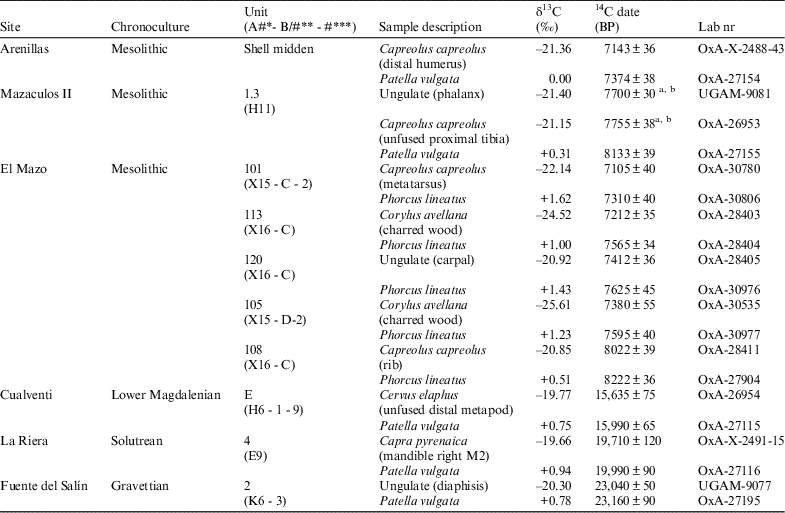
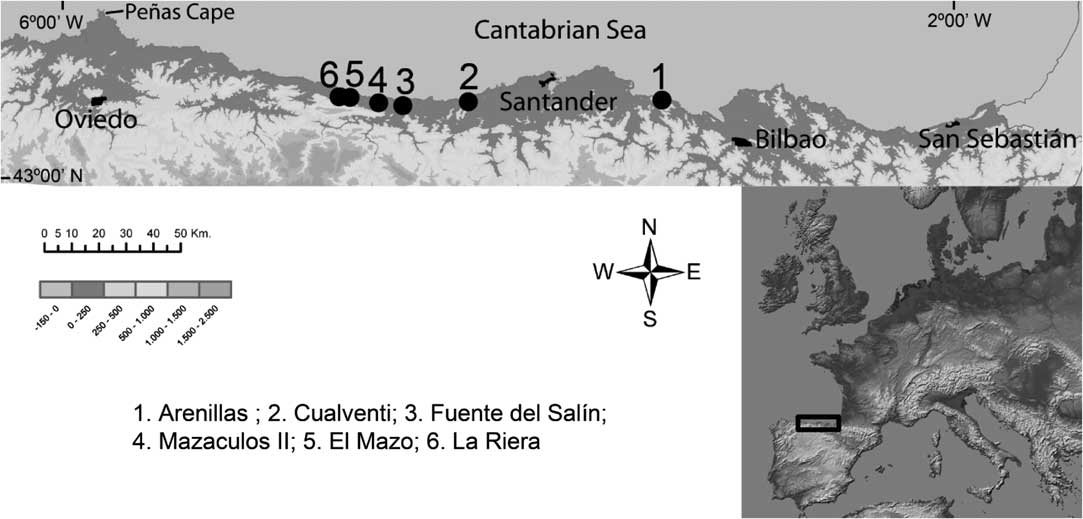
Pairs of closely associated archaeological samples (marine shells and bones/charred wood) from several depositional contexts were collected for 14C dating in order to quantify the marine 14C reservoir effect of coastal waters in the Cantabrian Sea (northern Iberia) (Table 1). In total, 21 samples were selected from the material recovered at six archaeological sites (see Figure 3 for the location of the sites), following two different strategies: (1) paired samples from five sites previously excavated by other scholars were collected from museums and universities; and (2) paired samples were collected from our own excavations at the Mesolithic shell midden site of El Mazo (Figure 4) (Gutiérrez-Zugasti and González-Morales Reference Gutiérrez-Zugasti and González-Morales2014; Gutiérrez-Zugasti et al. Reference Gutiérrez-Zugasti, González-Morales, Cuenca-Solana, Fuertes, García-Moreno, Ortiz, Rissetto and Torres2014).
Locations of sampled archaeological sites on the Cantabrian coast
Stratigraphic profile at the Mesolithic site of El Mazo. Numbers indicate the location of different stratigraphic units. Paired samples for 14C dating were taken from units 101, 113, 120, 105, and 108.

14C age of samples from archaeological contexts of sites located on the Cantabrian coast.

* Square; ** Subsquare; *** Spit; a 1.291; (χ2 :0.05=3.84); b 14C date weighted mean value of 7721±24 BP.
In the first case, samples from the Mesolithic levels of Arenillas (Bohígas and Muñoz Fernández Reference Bohígas and Muñoz Fernández2002), the Lower Magdalenian levels of Cualventi (Lasheras et al. 2005–Reference Lasheras Corruchaga, Montes Barquín, Munoz Fernandez, Rasines Del Río, De Las Heras Martin and Fatas Monforte2006), and the Gravettian site of Fuente del Salín (González-Morales and Moure-Romanillo Reference González Morales and Moure Romanillo2008) were collected from the Museum of Prehistory and Archaeology of Cantabria (Santander, Spain), while samples from the Solutrean levels of La Riera (Straus and Clark Reference Straus and Clark1986) were collected from the Museum of Archaeology of Asturias (Oviedo, Spain). Samples from the Mesolithic site of Mazaculos II (González-Morales and Marquez-Uría Reference González Morales and Márquez Uria1978; González-Morales et al. Reference González Morales, Márquez Uría, Díez González, Ortea and Volman1980) were collected from the storage of the Institute of Prehistory (IIIPC) at the University of Cantabria (Santander, Spain). Each selected pair comes from the same excavation unit, from the same square, and, when possible, from the same subsquare and spit (see Table 1). In the second case, terrestrial and marine samples that were found together or separated apart by just a few centimeters were selected for 14C dating, i.e. samples where very accurate data on the provenance of the samples and on their stratigraphic relationships is known.
Bone, shell, and charred wood samples from the six sites were subjected to species identification prior to dating. In the case of bones, the anatomical part was also identified. Bone samples belong to roe deer (Capreolus capreolus), red deer (Cervus elaphus), and ibex (Capra pyrenaica). Sometimes species identification was not possible and bones were simply identified as ungulates. Shell samples collected from museums/universities belonged to the limpet Patella vulgata, while shell samples recovered at El Mazo were topshells (Phorcus lineatus; Table 1). Both marine species were certainly collected alive by humans to be used as food. The charred wood samples used in the study were identified as Corylus avellana, the common hazel, a shrub that can live for a few decades. The characteristics of the sites, the excavation techniques used, and the analysis of sample taphonomy confirm the integrity of the samples included in our study (Gutiérrez-Zugasti Reference Gutiérrez-Zugasti2009; Gutiérrez-Zugasti et al. Reference Gutiérrez-Zugasti, Cuenca Solana, González Morales and García Moreno2013; García-Escárzaga et al. Reference García-Escárzaga, Gutiérrez-Zugasti and González-Morales2015a).
All samples were 14C dated by accelerator mass spectrometry (AMS). Ten shells, seven bones, and two charred wood samples were run at the Oxford Radiocarbon Accelerator Unit (ORAU) following routine pretreatments and standard dating procedures that included ultrafiltration and measurement of stable isotopic composition (by IRMS) and carbon and nitrogen content (C:N ratio determination) for bones (see Brock et al. Reference Brock, Higham, Ditchfield and Bronk Ramsey2010 and references therein for a description of procedures). Two additional bones were dated at the Center for Applied Isotopes Studies (CAIS) of the University of Georgia (USA) following standard procedures described in Cherkinsky et al. (Reference Cherkinsky, Culp, Dvoracek and Noakes2010) and Vogel et al. (Reference Vogel, Southon, Nelson and Brown1984). 14C ages were calculated in accordance with the definitions recommended by Stuiver and Polach (Reference Stuiver and Polach1977).
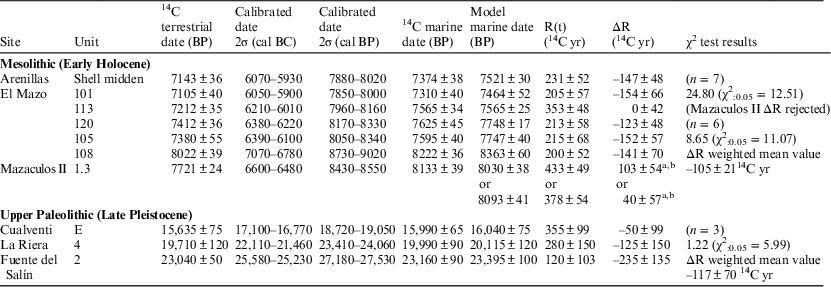
ΔR values were calculated by converting the terrestrial biosphere sample 14C age into a marine model age (see Table 2), which was subtracted from the 14C age of the associated marine shell sample to yield ΔR (Stuiver and Braziunas Reference Stuiver and Braziunas1993; Reimer et al. Reference Reimer, McCormac, Moore, McCormick and Murray2002). We also followed the recommendations of Ascough et al. (Reference Ascough, Cook and Dugmore2005, Reference Ascough, Cook, Dugmore and Scott2007, Reference Ascough, Cook and Dugmore2009) and Russell et al. (Reference Russell, Cook, Ascough, Scott and Dugmore2011) for calculating the ΔR values.
Values for the reservoir effect for coastal waters off Cantabria (northern Iberian Peninsula).

ª 0.624 (χ2 :0.05=3.84); b ΔR weighted mean value of 74±39 14C yr (rejected in the calculation of ΔR weighted mean value for the Mesolithic).
The original focus of the research projects involved in this study was to build absolute chronologies for Upper Paleolithic and Mesolithic contexts, which led to a reduced number of multiple paired samples from each archaeological context (only one case: Mazaculos II, see Table 1). This handicap made the fulfillment of the published methodology difficult to follow. Nevertheless, for the calculation of the ΔR values we employed the following recommendations: (1) unrounded 14C ages; (2) interpolation between calibration curves IntCal13 and Marine13 (Reimer et al. Reference Reimer, Bard, Bayliss, Beck, Blackwell, Bronk Ramsey, Buck, Cheng, Edwards, Friedrich, Grootes, Guilderson, Haflidason, Hajdas, Hatté, Heaton, Hoffmann, Hogg, Hughen, Kaiser, Kromer, Manning, Niu, Reimer, Richards, Scott, Southon, Staff, Turney and van der Plicht2013) for converting the terrestrial biosphere sample 14C age into a marine model age; (3) chi-squared test (χ2 :0.05=Τ) as a statistical criterion in the definition of contemporary samples from each group (terrestrial or marine) collected in the same archaeological context (when more than one sample was available); and (4) establishment of the set of ΔR values that can integrate the weighted mean calculation according to the chi-squared test (χ2 :0.05=Τ) results. The 1σ error for the ΔR determination is obtained by propagation of the errors on the marine age and the modeled marine age from each pair of samples. The reservoir age R(t) was determined following Stuiver et al. (Reference Stuiver, Pearson and Braziunas1986).
RESULTS AND DISCUSSION
R(t) and ΔR values of the terrestrial/marine pairs collected from the described archaeological contexts are listed in Table 2. The context age, also presented in Table 2, was determined by using the samples of terrestrial origin. These ages are presented as conventional 14C dates and also as calendar dates using the IntCal13 calibration curve (Reimer et al. Reference Reimer, Bard, Bayliss, Beck, Blackwell, Bronk Ramsey, Buck, Cheng, Edwards, Friedrich, Grootes, Guilderson, Haflidason, Hajdas, Hatté, Heaton, Hoffmann, Hogg, Hughen, Kaiser, Kromer, Manning, Niu, Reimer, Richards, Scott, Southon, Staff, Turney and van der Plicht2013) and the program CALIB (Stuiver and Reimer Reference Stuiver and Reimer1993).
It must be noted that all the dated samples are short-lived samples with the exception, perhaps, of the two charred wood samples of Corylus avellana. Nevertheless, it is unlikely that 14C dates from this species are affected by the “old wood” effect, since usually this shrub does not live for long. The old-wood effect problem can lead to a reduction of the offset between marine and terrestrial 14C ages of the pair, but this does not happen with the pairs in question from El Mazo. From Mazaculos II, two bone samples from the same context were dated. The results of these two samples are not statistically different [1.291; (χ2 :0.05=3.84), see Table 1], which should make the ΔR obtained for Mazaculos II very reliable.
Since it is known that the climatic conditions and, consequently, the oceanographic conditions and the carbon cycle were different during glacial times compared with the Holocene, two sets of ΔR values were considered in our case: one for the Upper Paleolithic period (Late Pleistocene) and another for the Mesolithic (Early Holocene). These two sets of ΔR values and respective weighted mean values are presented in Table 2.
The ΔR obtained for Mesolithic sites (dated to the Early Holocene) show a homogeneous pattern, except for Mazaculos II, which is significantly different from those recorded at Arenillas and El Mazo [24.80; (χ2 :0.05=12.51)]. Values from Mazaculos II should be considered as reliable since two terrestrial samples were used in the calculations. Two hypotheses can be proposed to explain the difference: (1) the shell sample used for 14C dating at Mazaculos II comes actually from an older level; and (2) oceanographic conditions suffered changes during the Early Holocene in northern Iberia. Excavations at Mazaculos II were carried out using modern techniques (González-Morales and Marquez-Uría Reference González Morales and Márquez Uria1978; González-Morales et al. Reference González Morales, Márquez Uría, Díez González, Ortea and Volman1980), differentiating when possible independent depositional events that have occurred.
In fact, level 1 was divided into three different sublevels due to variations in the characteristics of the shell deposits identified during excavation. Therefore, shell samples should have been recovered successfully according to their separate stratigraphic provenance. Nevertheless, it is possible that the shell sample used for 14C dating in our study was recovered at the contact between level 1.3 and level 2, where shells from both layers could have been mixed together, in which case the dated shell would be older than other shells recorded in layer 1.3. Unfortunately, it is not possible to corroborate this hypothesis since no coordinates were recorded for individual shells. Although the majority of the Holocene was characterized by climatic stability, some important environmental changes have also been recorded (Bond et al. Reference Bond, Showers, Cheseby, Lotti, Almasi, deMenocal, Priore, Cullen, Hadjas and Bonani1997, Reference Bond, Kromer, Beer, Muscheler, Evans, Showers, Hoffmann, Lotti-Bond, Hajdas and Bonani2001; von Grafenstein et al. Reference von Grafenstein, Erlenkeuser, Müller, Jouzel and Johnsen1998; Rasmussen et al. Reference Rasmussen, Vinther, Clausen and Andersen2007). Among them, the 8.2-ka cold event stands out in many North Atlantic Early Holocene climate records as the most prominent climate anomaly, being responsible for changes in oceanographic conditions and, consequently, in the ΔR value [a high value is expected for ΔR due to the huge amount of 14C-depleted freshwater from ice sheets—“many thousands of years of stored precipitation,” according to Teller et al. (Reference Teller, Leverington and Mann2002)—that was injected in the North Atlantic at high latitudes]. However, calibrated 14C dates from Mazaculos II (see Table 2) place the occupations around 8.5–8.4 ka, at least 200 yr earlier than the Bond event 5, as recorded in the Greenland ice cores (NGRIP Members et al. Reference Andersen, Azuma, Barnola, Bigler, Biscaye, Caillon, Chappellaz, Clausen, Dahl-Jensen, Fischer, Flückiger, Fritzsche, Fujii, Goto-Azuma, Grønvold, Gundestrup, Hansson, Huber, Hvidberg, Johnsen, Jonsell, Jouzel, Kipfstuhl, Landais, Leuenberger, Lorrain, Masson-Delmotte, Miller, Motoyama, Narita, Popp, Rasmussen, Raynaud, Rothlisberger, Ruth, Samyn, Schwander, Shoji, Siggard-Andersen, Steffensen, Stocker, Sveinbjörnsdóttir, Svensson, Takata, Tison, Thorsteinsson, Watanabe, Wilhelms and White2004). However, a comparison between oxygen stable isotope ratios on shells from Mazaculos II and Arenillas (including the shells from both sites used for 14C dating in this study) suggests that winters were slightly colder and summers significantly colder in Mazaculos II than in Arenillas (unpublished data), at least in terms of sea surface temperatures, opening up the possibility that a significant change in the climatic conditions and thereafter in the oceanographic conditions in northern Iberia occurred at 8.5–8.4 ka. In fact, a minor cold climatic feature has been identified in the Greenland ice cores around 8.5 ka (Rasmussen et al. Reference Rasmussen, Vinther, Clausen and Andersen2007), which might be related to colder conditions as reflected in the stable isotope ratios of the Mazaculos II shells. In any case, further research is required to provide a precise explanation for the intriguing results from Mazaculos II.
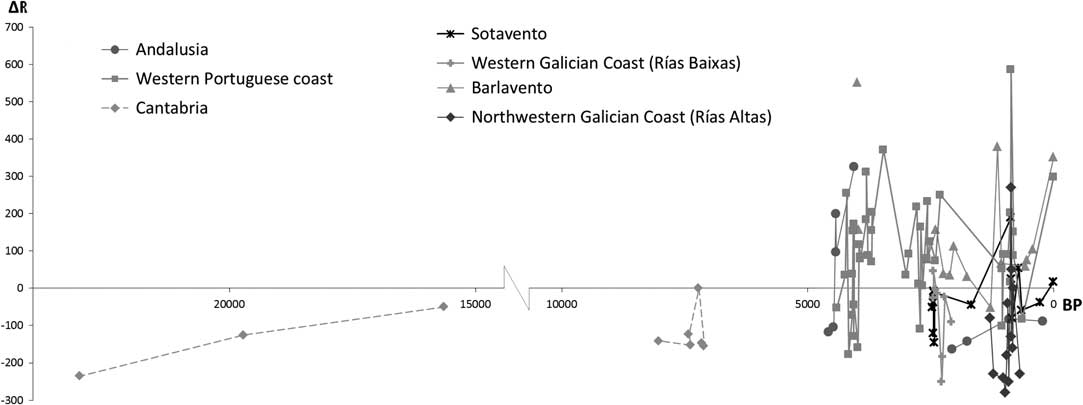
ΔR values from Upper Paleolithic sites (dated to the Late Pleistocene, 19, 23, and 27 ka cal BP) are very similar, statistically not differentiable from those determined for the Mesolithic (Early Holocene, 8–9 cal BP). This finding was unexpected since during glacial times, at these high latitudes (~43°N), an increase of R(t) and, consequently, of ΔR should be expected due to subpolar front movements (southward shift of the polar front) and variations in the mode and rate of North Atlantic Deep Water production, increasing the influence of old polar waters relative to young (tropical) surface waters (Bard et al. Reference Bard, Arnold, Mangerud, Paterne, Labeyrie, Duprat, Mélières, Sonstegaard and Duplessy1994; Bard Reference Bard1988; Stern and Lisiecki Reference Stern and Lisiecki2013). Consequently, further research using more pairs of samples from Upper Paleolithic contexts is needed, in order that the temporal (and spatial) variability of the marine 14C reservoir effect in this region can be more reliably measured and changes in oceanographic conditions precisely recorded.
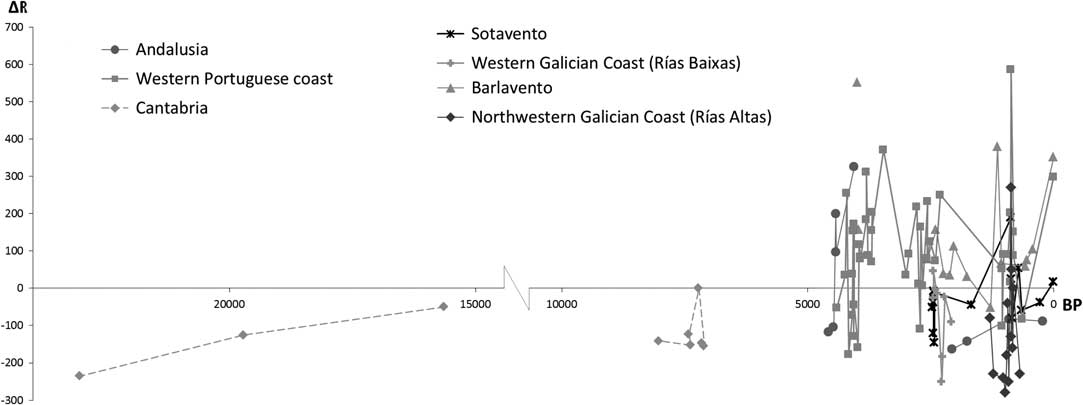
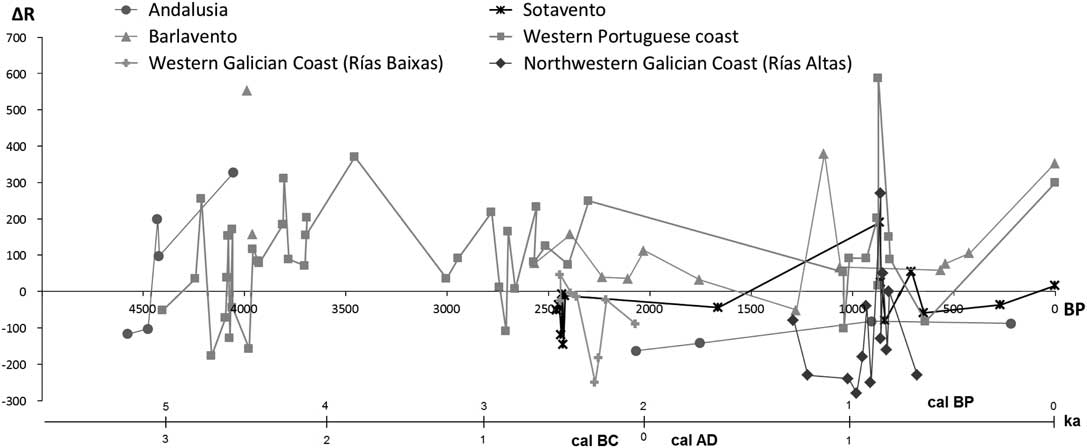
Data from our study can be compared to results from other Atlantic coastal areas of Iberia (Figure 5). Given that no other data on the ΔR exist for the Late Pleistocene in Iberia, only information corresponding to the Holocene will be discussed next. The Holocene ΔR weighted mean value determined for the Cantabrian coast (–105±21 14C yr) can be compared with those determined for the northwestern Galician coast and Andalusian Atlantic coast, respectively, –192±24 14C yr, between 1300 and 900 BP (Soares and Dias Reference Soares and Dias2007), and –108±31 14C yr, between 4600 and 200 BP (Martins and Soares Reference Martins and Soares2013). As already mentioned, a weak upwelling occurs in the northwestern Galician shelf and the existence of a thermohaline front near the coastline does not allow the penetration of upwelled water into the Rías Altas, from where the dated marine shell samples were certainly collected. Moreover, the strong stratification of the water column is a common summer phenomenon in the Rías, which leads to a greater equilibrium with the atmosphere and, consequently, to an enrichment in 14C of the surface waters, which explains the difference in ΔR value compared to the other regions. The ΔR value obtained for the coastal waters off Cantabrian coast is not statistically different from the one obtained for the Andalusian Atlantic coastal waters, where there is no upwelling and also some summer stratification of the water column occurs, similar to the situation that prevails in the coastal waters of the Cantabrian Sea.
Variability of marine 14C reservoir effect off Cantabrian coast compared with the variability for the other Atlantic Iberian coastal regions.
CONCLUSIONS
A record of past reservoir ages is preserved in the 14C content of contemporaneous marine and terrestrial material. Using an archaeological data set of 14C dates, the marine 14C reservoir effect (ΔR) was calculated for coastal waters off northern Iberia (Cantabrian Sea). Results provide a ΔR mean value of –117±70 14C yr for the Late Pleistocene and –105±21 14C yr for the Early Holocene. These values reflect the oceanographic conditions present in the area at that time, pointing to a reduced offset between atmospheric and surface water 14C contents, and therefore suggesting a nonexistent or a very weak upwelling and some stratification of the water column. These conditions are similar to other coastal areas of Atlantic Iberia during the Late Holocene, such as the Andalusian and the Galician northwestern coasts. For the first time, a ΔR mean value was calculated for the Late Pleistocene in Iberia, suggesting oceanographic conditions not very different from those of the Holocene. However, further research is needed to accurately establish the temporal and spatial variability of the ΔR in glacial times. Using the ΔR values established in this study and the most recently published marine calibration curve (Marine13), accurate and reliable calendar dates should be obtainable from shell samples collected in archaeological contexts on the Cantabrian coast. Therefore, data on the marine 14C reservoir effect not only provide environmental information, but also a framework to obtain more accurate and reliable chronologies for the Late Pleistocene and Early Holocene in northern Iberia.
ACKNOWLEDGMENTS
This research was part of the projects HAR2010-22115-C02-01, HAR2013-46802-P (both funded by the Spanish Ministry of Economy and Competitiveness) and NF100413 (Newton International Fellowship granted to IGZ). IGZ and DCS are currently supported by the Juan de la Cierva Research Programme (grant numbers JCI-2012-12094 and IJCI-2014-20590, respectively) of the Spanish Ministry of Economy and Competitiveness. Nine 14C dates from Fuente del Salín, La Riera, Cualventi, Mazaculos II, and Arenillas were funded by the NERC Radiocarbon Facility (NF/2012/1/18). Eight 14C dates from El Mazo, one from Mazaculos II (UGAM-9081), and one from Fuente del Salín (UGAM-9077) were part of the projects HAR2010-22115-C02-01 and HAR2013-46802-P funded by the Spanish Ministry of Economy and Competitiveness. We would like to thank the staff at the Museo de Prehistoria y Arqueologia de Cantabria (MUPAC) and the Museo Arqueológico de Asturias for facilitating access to shell and bone samples. We would also like to thank Mónica Ruiz Alonso and Ana B Marín Arroyo for the identification of charred wood and bones, respectively. This manuscript also benefitted from comments of three anonymous reviewers to whom we are very grateful.