Introduction
In its native range, China and the Korean Peninsula, Anoplophora glabripennis Motschulsky (Coleoptera: Cerambycidae), is recognised as a polyphagous xylophage (Lingafelter and Hoebeke Reference Lingafelter and Hoebeke2002; van der Gaag and Loomans Reference van der Gaag and Loomans2014). The first detection of A. glabripennis in North America occurred in 1996 in New York City, New York, United States of America (Haack et al. Reference Haack, Cavey, Hoebeke and Law1996). Since then, other invasions by this alien species have been discovered in North America and Europe (Hopkin et al. Reference Hopkin, de Groot and Turgeon2004; Haack et al. Reference Haack, Hérard, Sun and Turgeon2010; Straw et al. Reference Straw, Fielding, Tilbury, Williams and Inward2014). Upon discovery of this beetle in an industrial area near the intersection of Weston Road and Steeles Avenue at the boundary of Toronto and Vaughan in Ontario, Canada, (Carter et al. Reference Carter, Smith, Turgeon and Harrison2009, fig. 1), the Canadian Food Inspection Agency (CFIA) delineated a regulated area (152 km2) and implemented an eradication programme. This programme called for the removal of all infested trees and of all trees from the 10 genera considered suitable for the complete development of the beetle, located within 400 m of an infested tree. In 2003, the genera considered suitable for A. glabripennis development under field conditions in Canada were Acer Linnaeus (Sapindaceae), Aesculus Linnaeus (Sapindaceae), Albizia Durazz (Fabaceae), Betula Linnaeus (Betulaceae), Celtis Linnaeus (Cannabaceae), Platanus Linnaeus (Platanaceae), Populus Linnaeus (Salicaceae), Salix Linnaeus (Salicaceae), Sorbus Linnaeus (Rosaceae), and Ulmus Linnaeus (Ulmaceae). The CFIA had developed this list based on observations recorded in the United States of America (host list annotated by Dr. A Sawyer, United States Department of Agriculture, Animal and Plant Health Inspection Service; email message to J.J.T. dated 14 October 2003, unreferenced), and to a lesser extent, in the natural range of the beetle (Nowak et al. Reference Nowak, Pasek, Sequeira, Crane and Mastro2001; Lingafelter and Hoebeke Reference Lingafelter and Hoebeke2002). Nowak et al. (Reference Nowak, Pasek, Sequeira, Crane and Mastro2001) pointed out that the inclusion of some of the tree species as hosts in the literature may be misleading because a number of Anoplophora Hope species in China had a similar appearance. To gain information on tree diversity within the regulated area, the CFIA contracted a tree inventory analysis (Puttock and Gynan Reference Puttock and Gynan2003). That inventory revealed the presence of several tree genera whose suitability for A. glabripennis development was at that time either unknown, because there was no record of attack, or questionable because records suggested that egg development alone or egg development and partial or complete larval development was possible under field conditions but unverified. For the eradication programme to be successful, it was necessary to ensure these genera not officially targeted for survey or treatment were indeed not suitable; otherwise beetle populations that might be in these trees would escape detection and could perpetuate the infestation.
The objective of this study was to acquire knowledge on host plant selection by A. glabripennis outside of its native range and to compare it to that observed in other invasions in the United States of America and in Europe. We surveyed trees from genera with unknown or questionable suitability for three years after the CFIA had completed its initial treatment of the regulated area.
Materials and methods
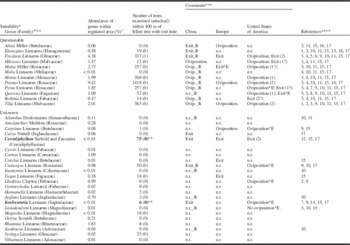
We carried out this survey on properties within the boundaries of the regulated area established in January 2004 by the CFIA to contain the spread of A. glabripennis (Carter et al. Reference Carter, Smith, Turgeon and Harrison2009, fig. 1). The CFIA had removed all trees known to be infested and all trees belonging to a suitable genus that were within 400 m of an infested tree between 20 November 2003 and 31 March 2004. We limited our survey to trees from genera of unknown or questionable suitability that were within 400 m of a tree from a suitable genus that had presented signs of adult emergence (e.g., exit holes). We selected and surveyed the trees for the first time between 1 April and 10 June 2004 and affixed a uniquely numbered aluminum tag to a branch or the bole of each tree (Table 1). In addition, we recorded the following information for each tree surveyed: (1) street address of the property; (2) location on the property (front, back, or side yard); (3) coordinates (Garmin GPSMAP 76; Garmin International, Olathe, Kansas, United States of America: set to North American Datum of 1983 [NAD 83]); (4) genus; (5) tree height (Forestor vertex acoustic hypsometer; Forestor Instrument AB, Taby, Sweden); and (6) diameter at breast height (dbh; Lufkin Executive Thinline metal tape (W606PM); Apex Tool Group, Sparks, Maryland, United States of America). Also, we took digital images of the aluminum tag and of the tree. We clipped a live twig with buds or foliage and placed each sample into a paper bag with the corresponding tree tag number. All bags were stored at room temperature until they could be compared to voucher specimens or to reference descriptions to confirm genus and when possible species identification (Farrar Reference Farrar1995; Muma Reference Muma2012; Flora of Wisconsin 2014).
Tree height class, relative abundance, number of trees surveyed (attacked) for each genus of broadleaf trees present within the regulated area of the Greater Toronto Area (Ontario, Canada) established in 2004 by category of suitability.

Notes: *Questionable, if oviposition and partial larval development have been reported, but without verifiable field evidence that entire development in the United States of America was possible in 2003; Unknown, if no field record of attack in 2003.
≅ Some of the known species surveyed for each genus: Elaeagnus angustifolia Linnaeus; Fraxinus americana Linnaeus, F. excelsior Linnaeus, and F. pennsylvanica Marshall; Hibiscus species; Malus pumila Miller; Morus alba Linnaeus; Prunus armeniaca Linnaeus, P. avium (Linnaeus) Linnaeus, P. persica (Linnaeus) Batsch, P. pumila Linnaeus, and P. virginiana Linnaeus; Pyrus communis Linnaeus; Quercus alba Linnaeus, Q. macrocarpa Michaux, Q. robur Linnaeus, and Q. rubra Linnaeus; Robinia pseudoacacia Linnaeus; Tilia americana Linnaeus and T. cordata Miller; Carpinus betulus Linnaeus; Cercidiphyllum japonicum Siebold and Zuccarini; Crataegus species; Fagus sylvatica Linnaeus; Hamamelis virginiana Linnaeus; Juglans nigra Linnaeus; Koelreuteria paniculata Laxmann; Magnolia acuminata (Linnaeus) Linnaeus; Rhamnus cathartica Linnaeus; Syringa reticulata (Blume) Hara and S. vulgaris Linnaeus.
⊥ Based on Puttock and Gynan (Reference Puttock and Gynan2003) and data from the city of Toronto.
** We did not survey trees of the two genera in bold font between 2004 and 2006 because none was within 400 m of an infested tree with exit holes. Instead, we examined them in 2011 after both genera became recognised as suitable hosts, rather than of unknown suitability. Thus the number of trees reported in the “examined (attacked)” column is that of the total number of trees present within the entire regulated area, not that within 400 m of an infested tree.
*** “n.r.”, no record of oviposition, record indicated as unverified, or no information found;
“?”, record reported as questionable or unverified;
Oviposition (number of), eggs were found and partial larval development confirmed – Plant species on which A. glabripennis has been reported to complete part of its life cycle including species on which A. glabripennis only laid eggs (including those for which no evidence was provided that the oviposition sites actually contained eggs of A. glabripennis; also including species on which full or partial development of larvae has been reported on sections of plants);
Exit (number of), complete larval development has been inferred by the presence of exit holes or emerging beetles have been confirmed as A. glabripennis – Plant species on which A. glabripennis has been reported to complete its life cycle (from oviposition to emergence of new beetles) under field conditions;
Oviposition*E or Exit*E refers to events observed in laboratory or semi-field experiments on a whole plant (i.e., plants and beetles placed in cages or in garden) – Plant species on which A. glabripennis has completed its life cycle in laboratory or semi-field experiments on a whole plant (i.e., plants and beetles placed in cages);
“_R”, genus includes species reported as resistant, resilient or immune to A. glabripennis by Yin and Lu (Reference Yin and Lu2005) or Sjoman et al. (2014).
**** 1, Shao et al. (Reference Shao, Tian, Gao and Shao1997); 2, Zhang et al. (Reference Zhang, Tao, Lu, Zhao and Bai1998); 3, Nowak et al. (Reference Nowak, Pasek, Sequeira, Crane and Mastro2001); 4, Lingafelter and Hoebeke (Reference Lingafelter and Hoebeke2002); 5, Ludwig et al. (Reference Ludwig, Lazarus, McCullough, Hoover, Montero and Sellmer2002); 6, Morewood et al. (Reference Morewood, Neiner, McNeil, Sellmer and Hoover2003); 7, Morewood et al. (Reference Morewood, Hoover, Neiner, McNeil and Sellmer2004); 8, Morewood et al. (Reference Morewood, Hoover, Neiner and Sellmer2005a); 9, Morewood et al. (Reference Morewood, Neiner, McNeil, Sellmer and Hoover2005b); 10, Yin and Lu (Reference Yin and Lu2005); 11, Sawyer (Reference Sawyer2008)/United States Department of Agriculture, Animal and Plant Health Inspection Service, Plant Protection and Quarantine, Center for Plant Health Science and Technology (2015); 12, National Plant Board (2009); 13, Tian et al. (Reference Tian, Lu, Zhang and Sang2009); 14, National Plant Board (2011); 15, van der Gaag and Loomans (Reference van der Gaag and Loomans2014); 16, Sjöman et al. (Reference Sjöman, Östberg and Nilsson2014); 17, Meng et al. (Reference Meng, Hoover and Keena2015).
We re-examined these trees in 2005 and 2006 during the same time of year. We chose that time to survey because it preceded the onset of A. glabripennis emergence period, which occurs shortly after an accumulation of 400° days (threshold 10 °C) (Smith et al. Reference Smith, Tobin, Bancroft, Li and Gao2004). In Toronto, this accumulation typically occurs between mid-June and 1 July (J.J.T., personal observation). In 2004, our reason to extend the survey over a three-year period was circumstantial evidence suggesting that at least in Ontario, A. glabripennis took more than one year and possibly two to complete its life cycle (J.J.T., personal observation): a fact now well established in southern England (United Kingdom) (Straw et al. Reference Straw, Tilbury, Fielding, Williams and Cull2015).
This survey was conducted by forest health officers and arborists with a minimum of 10 years of experience in field identification of forest pests. All officers had taken part in the removal of several hundred trees infested by A. glabripennis in Ontario and, thus, were familiar with the known variability in appearance of the many signs and symptoms of attack (Turgeon et al. Reference Turgeon, Ric, de Groot, Gasman, Orr and Doyle2007). Each year, trees were assessed simultaneously by two observers and only when weather conditions were clear.
The assessment consisted of a visual examination from the ground of the bark surface of exposed roots (if any), bole, and branches larger than 2.5 cm in diameter for evidence of A. glabripennis injury (Turgeon et al. Reference Turgeon, Ric, de Groot, Gasman, Orr and Doyle2007). The officers used binoculars to inspect the upper canopy of smaller trees. For larger trees (dbh⩾30 cm), they completed the inspection of the upper limbs either from a ladder secured within the canopy, a bucket truck, or by requesting an arborist to climb the tree. Suspicious signs or symptoms of attack were photographed, their positions delimited with flagging tape. When uncertain about a sign or symptom, inspectors asked others to examine them and to provide opinions on the identity of the causal agent. When the causal agent could not be confirmed in the field, a 50-cm long portion of the tree with the sign or symptom was removed, labelled, and brought to a laboratory where it was dissected. When necessary, we used a wood chisel (2.54-cm wide blade) to remove the bark around a suspected oviposition pit to reveal the presence of any egg, oviposition stain, or early instar gallery on the outer surface of the sapwood or a pruning saw to cut through the branch.
Upon completion of the assessment, we classified each tree as: (i) unattacked – no sign or symptom of A. glabripennis; (ii) unsuccessfully attacked – oviposition pit or stain, dead egg, or dead larva in feeding gallery or in tunnel into the sap-wood and heart-wood; or (iii) successfully attacked – presence of one or more round exit holes (diameter=6–14 mm; Turgeon et al. Reference Turgeon, Ric, de Groot, Gasman, Orr and Doyle2007), which is a sign of adult emergence.
Results
We found trees from only 18 of the 35 genera targeted by our study within the 400 m area around trees with A. glabripennis exit holes (Table 1). We examined 3144 trees from these 18 genera for the presence of signs or symptoms of injury at yearly intervals for three consecutive years (Table 1). Most examinations, irrespective of the method used, lasted between 1 and 50 minutes per tree (6.14±0.09 minutes: mean±SE). The height of most (71%; n=3075 trees with data) trees examined during this survey was less than 6 m. We examined the crown of 15% (n=2988) of the small trees (dbh<30 cm) using a technique other than just a visual examination from the ground.
All trees, but one, were unattacked. In 2004, we detected an unsuccessful attack by A. glabripennis on a European ash, Fraxinus excelsior Linnaeus (dbh=23.2 cm; height=7.0 m). The tree contained two oviposition pits located on the main stem, at 2.3 m above ground. After removing the bark surrounding these pits, we found in one pit a single dried-up egg with an oviposition stain, and near the other pit we found a dried-up A. glabripennis larva that had died as a young instar in its feeding gallery near an oviposition stain. We found no entrance tunnel into the sapwood or heartwood. This tree was located < 200 m northeast of the most heavily infested tree in that infestation, a Norway maple, Acer platanoides Linnaeus, with > 250 exit holes. We considered that maple tree as the epicentre of the Ontario infestation. We did not find any signs or symptoms of attack on two other species of ash also surveyed during this study: white ash, Fraxinus americana Linnaeus, and red ash (synonym=green ash), F. pennsylvanica Marshall.
We encountered signs and symptoms of injury that resembled those of A. glabripennis on many of the genera examined during our survey. These include: (i) frass and sawdust from ants; (ii) sap flow and wounds attributed to mechanical damage such as grass trimmers, lawnmowers, and pruning tools; (iii) dieback and dead branches due to girdling by guy-wires, excessive pruning, or soil compaction; (iv) holes made by carpenter bees, Xylocopa Latreille (Hymenoptera: Apidae) species, that look like A. glabripennis exit holes; and (v) numerous holes and exposed galleries typical of either the hickory borer Goes pulcher (Haldeman) (Coleoptera: Cerambycidae) or the ash borer, Podosesia syringae (Harris) (Lepidoptera: Sesiidae) (Turgeon et al. Reference Turgeon, Ric, de Groot, Gasman, Orr and Doyle2007). We found no symptoms (i.e., tree responses) of A. glabripennis injury in trees containing these look-a-like signs.
Discussion
The average amount of time our inspectors spent examining each tree was well above that needed to detect simulated signs of A. glabripennis injury. Indeed, Turgeon et al. (Reference Turgeon, Pedlar, de Groot, Smith, Jones, Orr and Gasman2010) reported that 89.7% and 90.1% of all trees (dbh>30 cm) correctly identified by inspectors as having simulated oviposition pits and exit holes located up to 6 m above ground, respectively, were identified as such within 120 seconds of the beginning of the inspection.
Ours is not the first report of attacks on species of Fraxinus Linnaeus by A. glabripennis. A limited number of successful attacks have been confirmed on F. pennsylvanica in the United States of America (Poland et al. Reference Poland, Haack and Petrice1998; Sawyer Reference Sawyer2008; Meng et al. Reference Meng, Hoover and Keena2015, table S1; United States Department of Agriculture, Animal and Plant Health Inspection Service, Plant Protection and Quarantine, Center for Plant Health Science and Technology 2015) and on an unnamed species in Europe (Hoyer-Tomiczek and Cech Reference Hoyer-Tomiczek and Cech2008). There is also a report of unsuccessful attacks by A. glabripennis on F. chinensis Roxbourgh in its native range (Meng et al. Reference Meng, Hoover and Keena2015, table S1). Both F. excelsior and F. americana have been reported as a food source for adults but there is no evidence of full development on them (Meng et al. Reference Meng, Hoover and Keena2015, table S1).
Fraxinus was not the only genus with questionable suitability for A. glabripennis development we found unsuccessfully attacked in Ontario’s regulated area: the other was Tilia Linnaeus. Indeed, we discovered a single little leaf linden (Tilia cordata Miller) (dbh=21.7 cm; height=9.6 m) with many signs of A. glabripennis injury during the intensive phase of the delimitation survey initiated in mid-September 2003. This linden, just like the attacked F. excelsior, was near the epicentre of the infestation. More specifically, this tree was < 150 m southwest of the most heavily infested maple tree (> 250 exit holes). This linden was felled on 17 December 2003. We examined the tree and recorded the presence of 1613 mandible marks, which resembled oviposition pits. We dissected 562 marks: most (77.9%) contained no egg, oviposition stain, or larval frass, suggesting the bark had been chewed by adult beetles but that no oviposition attempt had occurred. We noted the presence of oviposition stains on the sapwood, a known symptom of A. glabripennis (Turgeon et al. Reference Turgeon, Ric, de Groot, Gasman, Orr and Doyle2007), under the remaining pits. We found associated with these stains 74 and 50 unhatched and hatched eggs, respectively. Of the unhatched eggs, 64 were dried-up and 10 were swollen, appearing alive when dissected on 6 January 2004. Near the hatched eggs or oviposition stains, we recovered 32 dead larvae, all in the cambium, and two live early-instars, both on the surface of the cambium. We placed six heavily infested 50-cm logs (range: 102–155 oviposition pits/log) inside a 6-m long, vented shipping container and reared them under natural temperature conditions until early June 2004, before dissecting them. We found no evidence of larval survival or of a tunnel entrance into the sapwood. Again, ours was not the first report of A. glabripennis attacking trees of the genus Tilia: Zhang et al. (Reference Zhang, Tao, Lu, Zhao and Bai1998) had already reported the discovery in Inner Mongolia of a linden (dbh=24 cm; height=12 m) with 1826 A. glabripennis oviposition pits, but without a single exit hole. Also, in an email message to J.J.T. on 14 October 2003 (unreferenced), Dr. A. Sawyer from the United States Department of Agriculture, Animal and Plant Health Inspection Service reported two records of a low number of oviposition pits on T. cordata (< 10 pits/tree): one tree in Chicago (Illinois, United States of America) and one in New York City. Log samples from both cities were reared (conditions unknown) but no A. glabripennis emergence occurred. Unsuccessful attacks on other species of Tilia namely, T. mongolica Maximowicz, T. mandshurica Ruprecht and Maximowicz, and T. amurensis Ruprecht, have been reported in the native range of A. glabripennis (Shao et al. Reference Shao, Tian, Gao and Shao1997; Zhang et al. Reference Zhang, Tao, Lu, Zhao and Bai1998; Lu et al. Reference Lu, Zhang, Tao and Shi2001; Tian et al. Reference Tian, Lu, Zhang and Sang2009; Meng et al. Reference Meng, Hoover and Keena2015, table S1). In Europe, the success of attacks on the genus Tilia was never assessed: attacked trees found in Austria and in France were destroyed before it could be determined if A. glabripennis could complete its development in them (van der Gaag and Loomans Reference van der Gaag and Loomans2014). Thus, the genus Tilia was added as a host plant in the European Union (European and Mediterranean Plant Protection Organization 2013, 2014). Nonetheless, the evidence obtained thus far from China and North America strongly suggests that trees of the genus Tilia are dead-end hosts (Smith et al. Reference Smith, Turgeon, de Groot and Gasman2009). More specifically, these trees can be highly attractive to A. glabripennis adults, but they appear to be completely unsuitable for full larval development; all eggs laid under the bark die as eggs or young instars before tunnelling into the sapwood. Shao et al. (Reference Shao, Tian, Gao and Shao1997) hypothesised that resistance in the genus Tilia against A. glabripennis eggs and larvae, operates through physical characteristics and chemical composition of the tree (antibiosis), respectively. Until well documented, conflicting information on the suitability of Tilia becomes available, it seems reasonable to remove this genus from the host list and to categorise it as unsuitable or resistant. As such, it may be a good genus to consider in reforestation programmes within infested areas (Meng et al. Reference Meng, Hoover and Keena2015, table S2). Antibiosis through the physical mechanism of abundant sap production has been hypothesised as the likely resistance mechanism for Elaeagnus angustifolia Linnaeus (Elaeagnaceae) in China (M.T.S., personal observation) and Pyrus calleryana Decaisne (Rosaceae) (Morewood et al. Reference Morewood, Hoover, Neiner, McNeil and Sellmer2004) to attacks by A. glabripennis.
It is worth noting that both hosts with questionable suitability found in Ontario with signs of oviposition (oviposition pits with eggs) and evidence of early-instar development, F. excelsior and T. cordata, were near heavily infested trees at the epicentre of this infestation. Some of these heavily infested trees were dead as a result of the number of successful A. glabripennis attacks. There are other reports where trees belonging to host genera of questionable suitability have been found in close proximity (no distance provided) to heavily infested trees: Elaeagnus angustifolia in France (van der Gaag and Loomans Reference van der Gaag and Loomans2014) and Quercus palustris Münchhausen in New York (United States Department of Agriculture, Animal and Plant Health Inspection Service, Plant Protection and Quarantine, Center for Plant Health Science and Technology 2015).
Also of interest is that most of the genera considered of questionable suitability either in infestations in the United States of America (Table 1; United States Department of Agriculture, Animal and Plant Health Inspection Service, Plant Protection and Quarantine, Center for Plant Health Science and Technology 2015), or in garden experiments in China (Wang et al. Reference Wang, Mastro and Gao2005), typically have only a limited number of oviposition or emergence events per tree and records (number of trees), as if the attack was accidental. Furthermore, most genera, or species within these genera, are considered immune (no feeding activity and no eggs laid) or highly resistant (limited feeding, small number of eggs laid and presence of entry sites) in the Chinese literature (see Yin and Lu Reference Yin and Lu2005, appendix 1). Thus, additional information on the proximity of heavily infested hosts to trees of questionable or unknown suitability could prove valuable for the development of more effective survey and control strategies in eradication programmes. For example, van der Gaag and Loomans (Reference van der Gaag and Loomans2014) suggested undertaking, as a precautionary measure, a survey targeting all broadleaf trees and shrubs within a specific distance from the epicentre of an infestation. Based on results in Ontario, we propose undertaking this precautionary measure, but only around trees where population pressure is considered high enough that it could lead emerging A. glabripennis to seek and colonise less suitable or more marginal hosts. At the moment, high population pressure is an imprecise concept, but for example, could be defined by a specific threshold level of infestation per tree (e.g., > 100 holes/tree) or any other desirable unit (e.g., > 10 exit holes/cm of dbh). The reason we propose this approach is because one could argue the need and usefulness of finding all infested marginal hosts once all well-known, suitable hosts within 400 or 800 m of an infested tree have been removed, as was the practice in Ontario. In other words, we hypothesise there is a strong possibility the particularly low beetle densities historically found in marginal or less suitable hosts may contribute to an Allee effect, and drive the population to extinction (Liebhold and Tobin Reference Liebhold and Tobin2008).
Suitability of trees from 16 of the 18 genera present within 400 m of an infested tree with exit holes could not be assessed under natural conditions because they were not attacked, as suggested by our inability to detect signs of injury. Whether the absence of signs of attack on these tree genera reflects solely a low preference rather than unsuitability for the food resource they represent in a landscape where almost 50% of the trees are maple (Turgeon et al. Reference Turgeon, Ric, de Groot, Gasman, Orr and Doyle2007), remains to be determined. Nonetheless, it is important to note that none of the more than 2000 fruit trees (the genera Malus Miller (Rosaceae), Morus Linnaeus (Moraceae), Pyrus Linnaeus (Rosaceae), and Prunus Linnaeus (Rosaceae) represented about 15% of trees within infested area) within 400 m of a tree with an A. glabripennis exit hole was infested (Table 1). Also, the suitability of trees from 15 genera, 13 categorised as unknown and two as questionable, could not be assessed because none could be found within 400 m of an infested tree with an exit hole (“Number of trees examined=0” in Table 1).
Host plant selection and resource use by A. glabripennis in its native range differs slightly from that reported in invaded landscapes (Table 1; Sjöman et al. Reference Sjöman, Östberg and Nilsson2014). For this reason, it is important to continue to assess the success and relative abundance of A. glabripennis attacks on tree genera or species found in invaded landscapes during eradication programmes. This knowledge, unlike that obtained from a laboratory evaluation of suitability, has the potential to reduce the number of species targeted for survey or control and could prove more useful at increasing the number of species that could be planted in treated landscapes. These assessments may require extensive laboratory studies mimicking field conditions because the location of several of the species present in infested areas may not be conducive to a rigorous assessment of their suitability as host: more specifically, they are too far from a heavily infested tree. For example, two species categorised under unknown suitability for A. glabripennis development in 2003 were subsequently confirmed as hosts (Table 1): Cercidiphyllum japonicum Siebold and Zuccarini (Cercidiphyllaceae) became a suitable host in 2009 (National Plant Board 2009), whereas Koelreuteria paniculata Laxmann (Sapindaceae) was confirmed as a suitable species in 2011 (National Plant Board 2011). Upon learning of this change in host status, we located all C. japonicum (n=75) and K. paniculata (n=6) trees within the regulated area; none was within 400 m of an infested tree. Nonetheless, we inspected them all and found no sign or symptom of A. glabripennis injury (Table 1).
At the onset of this eradication programme in 2003, there was uncertainty regarding the suitability of fruit trees, linden and ash for A. glabripennis development (Nowak et al. Reference Nowak, Pasek, Sequeira, Crane and Mastro2001). This information need was important because it affected the number of tree genera to include in survey and control operations. The results of our survey suggest that T. cordata and F. excelsior are resistant to A. glabripennis, at least in Ontario. In addition, we found no sign of A. glabripennis injury on fruit trees and on trees from other genera with questionable suitability that were located within 400 m of trees successfully attacked by the beetle. This information is consistent with the implementation of eradication programmes focussed predominantly on treatment of high-risk hosts. Nonetheless, we recommend that future eradication programmes allocate some resources to study, record, critically assess and report information pertinent to attacks on species from genera with unknown or questionable suitability. Information such as the type and abundance of each sign of injury, the number of trees under attack, assessment of unaltered performance of the beetle and the location of these trees in relation to the most heavily infested ones in these infestations could be used to better define what constitute a suitable host plant for this beetle. Had more comprehensive information on host suitability been available in 2003, there would have been no need to debate and investigate whether A. glabripennis might infest certain tree genera not targeted for survey or treatment in sufficient numbers to perpetuate the infestation. The information accumulated thus far in this study and elsewhere (Sjöman et al. Reference Sjöman, Östberg and Nilsson2014; Straw et al. Reference Straw, Fielding, Tilbury, Williams and Inward2014; van der Gaag and Loomans 2014; Meng et al. 2015; United States Department of Agriculture, Animal and Plant Health Inspection Service, Plant Protection and Quarantine, Center for Plant Health Science and Technology 2015) suggests this is an unlikely scenario.
Acknowledgements
The authors thank D. Ambeault, D. Comba, C. Davis, H. Evans, J. Fera, R. Fournier, A. Keizer, K. McNeilly, R. Scharbach, and B. Smith, (Natural Resources Canada – Canadian Forest Service, Sault Ste. Marie); E. Czerwinski, S. McGowan, J. Pollard, L. Rowlinson, D. Rowlinson, and, L. Tucker (Ministry of Natural Resources and Forestry); and M. Ahmad, I. Bykov, K. Filipovich, S. Matsumoto, J. Morris, J. Ric, L. Stalteri, D. Stojanovic-Djordjevic, and others we may have missed (City of Toronto) for assisting with various aspects of this survey. They thank S. Wallace (Canadian Food Inspection Agency) for creating maps illustrating the distribution of the tree species of interest; and T. Kimoto, B. Gill (CFIA), and two anonymous referees for helpful comments on this manuscript.