Implications
Information regarding the interaction between dietary balanced protein, Improvac and ractopamine (RAC) is limited. The results of this study suggest that the level of dietary protein should be increased when ractopamine (RAC) and Improvac are used to improve feed conversion efficiency (FCE).
Introduction
Increasing consumer awareness into animal welfare within meat production systems has raised issues within the pork industry, including the surgical castration of piglets without anaesthesia. With the current shift away from surgical castration and towards intact male production, it is possible that consumer acceptability of pork may decrease as a result of the offensive odour and taste caused by the boar taint compounds androstenone, skatole and indole. Immunocastration has thus been considered an alternative method of controlling the prevalence of boar taint in male pigs.
Currently, Improvac® (ZoetisTM Animal Health, Sandton, South Africa) is the only registered vaccine available for immunocastration in pigs. This vaccine contains an incomplete analogue of gonadotropin-releasing hormone (GnRH) conjugated to a carrier protein. After two vaccinations, circulating antibodies against GnRH increase rapidly within 7 days (Claus et al., Reference Claus, Lacorn, Danowski, Pearce and Bauer2007), blocking the action of GnRH on the pituitary gland. Immunocastrates have a unique hormone and metabolic state compared with intact and surgically castrated pigs, potentially influencing their growth potential and nutritional requirements (Claus et al., Reference Claus, Lacorn, Danowski, Pearce and Bauer2007; Bauer et al., Reference Bauer, Lacorn and Claus2009; Brunius et al., Reference Brunius, Zamaratskaia, Andersson, Chen, Norrby, Madej and Lundstrӧm2011).
Seeing as lean muscle growth is the primary focus in pork production, the dietary protein content and standard illeal digestible (SID) lysine content of swine diets are of particular importance. Although information with regards to the response of immunocastrated pigs to dietary protein content is limited, some studies have investigated the effects of varying dietary SID lysine content. Immunocastrated pigs fed dietary lysine levels increasing from 7 to 10 g/kg, showed decreased backfat thickness and increased percentage lean tissue yield, suggesting that lysine was limiting at the lower concentration (Boler et al., Reference Boler, Kutzler, Meeuwse, King, Campion, McKeith and Killefer2011). Further investigation into the dietary SID lysine/MJ DE ratio suggested that immunocastrates be fed SID lysine concentrations similar to intact males up until 2 weeks after the second vaccination (0.65 g SID lysine/MJ DE), after which the dietary SID lysine content should be decreased (0.43 g SID lysine/MJ DE) (Moore et al., Reference Moore, Mullan, Kim and Dunshea2016).
To further increase the leanness of pig carcasses, β-adrenergic agonists such as RAC hydrochloride are often employed. Currently, the use of RAC is permitted in 25 countries, some of which stipulate maximum residue levels (Food and Agriculture Organization of the United Nations (FAO), 2012). Although the use of RAC is banned in various countries including the current top pork producing countries, China and the European Union (EU), it is permitted in the United States, the third largest producer of pork. In 2015, the EU accounted for 33% of the world’s export shares whilst the United States accounted for 31% and China 3%. The top export destinations from the United States being Canada, China, Mexico, EU and Japan (USDA Foreign Agricultural Service, 2016). Thus despite the ban of the use of RAC in the EU and China, there still exists considerable markets that accept the use of RAC in pork production indicating that it still has potential for improving the efficiency of large-scale commercial production.
Although the dietary energy content appears to have little effect on the efficacy of RAC (Hinson et al., Reference Hinson, Wiegand, Ritter, Allee and Carr2011), RAC-fed pigs benefit from higher dietary protein levels. More specifically, higher lysine levels are needed to generate an increase in growth performance when RAC is included in swine diets (Webster et al., Reference Webster, Goodband, Tokach, Nelssen, Dritz, Unruh, Brown, Real, Derouchey, Woodworth, Goesbeek and Marsteller2007). Although no performance differences have been seen between immunocastrates and entire males at varying dietary energy and amino acids using 5 mg/kg RAC (Lanferdini et al., Reference Lanferdini, Lovatto, Melchior, Orlando, Ceccantini and Poleze2013), when a step-up programme from 5 to 10 mg/kg RAC was used, the growth performance of immunocastrates was better than that of the intact male controls (Rikard-Bell et al., Reference Rikard-Bell, Curtis, Van Barneveld, Mullan, Edwards, Gannon, Henman, Hughes and Dunshea2009).
Thus the adjustment of nutritional strategies of immunocastrates, especially in terms of balanced protein, as well as the use of additives in the diet have the potential to aid in improving their lean growth and slaughter performance. However, information with regards to the interaction of these factors remains limited. This study thus aims to assess the response of immunocastrated pigs to varying dietary balanced protein with and without RAC supplementation at 10 mg/kg with regards to weight gain, feed efficiency and backfat thickness.
Material and methods
The study was approved by the Research Ethics Committee: Animal Care and Use of Stellenbosch University (SU-ACUM13-00022) and the animals were handled according to the South African Pig Welfare Code (NSPCA, 2014).
Animals, housing and feeding
A total of 120 entire male pigs (PIC© Large White×Landrace×White Duroc maternal line cross PIC© 410 terminal sire) were selected from a commercial piggery and placed into individual pens at the Agricultural Research Council’s Boar Testing Facilities at Elsenburg (Stellenbosch, Western Cape, South Africa). They received a commercial grower pig feed which consisted of maize as the primary energy source and soya bean meal as the primary protein source from 16 weeks (57.5±5.36 kg) to 20 weeks of age (89.2±7.78 kg live weight); designated as Period 1 (P1). Each pen was divided into a solid concrete sleeping area covered in fresh pine wood shavings (~3/4 of pen) and a sloped dunging area free from shavings. An adjustable stainless steel feeder was placed in the clean area and a nipple drinker was situated in the dunging area. Treatments were randomly assigned to pens and location in the house was blocked.
The pigs allocated to be immunocastrated received their vaccinations at 16 and 20 weeks of age. Each vaccination consisted of 2 ml of Improvac® injected subcutaneously into the neck, behind the base of the ear. The vaccination timing was selected based on the fact that peak levels of plasma steroids are reached at ~19 weeks of age (França et al., Reference França, Silva, Chiarini-Garcia, Garcia and Debeljuk2000) and thus the second vaccination was to be given at 20 weeks so that the benefit of the male steroid hormones could be realised in terms of anabolic growth. The vaccination interval of 4 weeks between injections, the last vaccination being 4 weeks before slaughter, has also been proven to be effective in terms of androstenone suppression (Jaros et al., Reference Jaros, Bürgi, Stärk, Claus, Hennessy and Thun2005). The change to the experimental diets coincided with the timing of the second vaccination at 20 weeks.
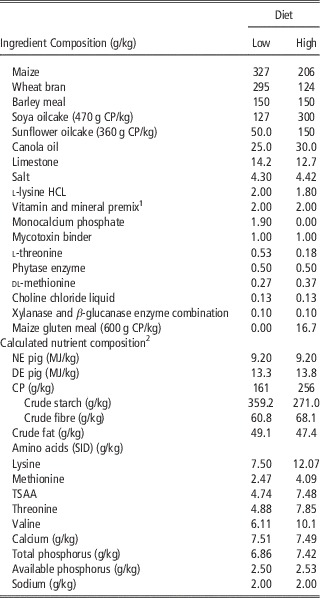
Two basal diets were formulated to contain either 7.50 or 12.07 g lysine/kg, with all other amino acids balanced according to an ideal amino acid balance suggested by Ferguson et al. (Reference Ferguson, Gous and Emmans1994), with the same net energy content (9.2 MJ/kg) in each diet (Table 1). Dietary protein content was increased at the expense of starch. The two basal feeds were mixed by a commercial manufacturer in accordance with standard industry practices and the mid-protein diet was blended from the two basal feeds using a 1 : 1 mixture. Ractopamine was added to the appropriate feeds at a rate of 10 mg/kg before being pelleted. The low, medium and high protein diets, with or without RAC, were thus fed ad libitum to the respective treatments from 20 to 24 weeks of age; designated as Period 2 (P2).
Composition of the low and high balanced dietary protein experimental finisher diets fed to the pigs from 20 to 24 weeks of age (P2); all amino acid values shown are standard ileal digestible values

NE=net energy; DE=digestible energy; SID=standard ileal digestible; TSSA=total sulphur-containing amino acids.
1 Vitamin and Mineral premix: Vitamin A: 5490 IU/kg, Vitamin D: 1005 IU/kg, Vitamin E: 27.6 IU/kg, Vitamin K: 2.8 mg/kg, Niacin: 22.0 mg/kg, Riboflavin 4.9 mg/kg, d-Pantothenate: 16.5 mg/kg, Vitamin B12: 22.0 mcg/kg, Zinc: 100 mg/kg, Iron: 66 mg/kg, Manganese: 25 mg/kg, Copper: 10 mg/kg, Iodine: 0.33 mg/kg and Selenium: 0.25 mg/kg. This is an approximate premix composition obtained for grow-finish PIC© pigs from 68 kg live weight to slaughter from PIC© Nutrients Specification Manual (2011).
2 Nutrient composition determined using the feed formulation programme WinFeed (EFG Software).
The moisture, crude fat, crude fibre, ash, amino acid and mineral contents of the diets were analysed according to AOAC International (2002) approved methods (AOAC methods 934.01; 954.02; 962.09; 994.12; 942.05) and the CP contents using the DUMAS method (AOAC methods 984.13 and 976.06) by the Central Analytical Laboratories (5 Cartwright Street, Stormill, FL, USA) and the LCMS Laboratory, Central Analytical Facility (University of Stellenbosch, Stellenbosch, South Africa).
Live measurements
The period of measurement started at 16 weeks, coinciding with the first Improvac® vaccination and ended when the pigs were 24 weeks of age, at which time the pigs were slaughtered. Feed intake, BW and backfat depth were recorded weekly from 16 to 24 weeks of age. The pigs were weighed using a metal crate on top of GallagherTM load bars connected to a GallagherTM livestock indicator (W310; Gallagher Animal Management Systems, Hamilton, Waikato, New Zealand). Weekly feed intake was measured by weighing the feeders individually using a load cell (Nagata HTR, Tainan, Taiwan). Backfat thickness was also measured weekly, 65 mm from the dorsal midline at the last rib using a Renco Lean-meater digital backfat indicator (Renco Corporation, USA). The position of measurement was marked using a liquid livestock marker so that each measurement would be taken at the same position weekly.
Statistical analysis
The factorial design used in the trial included three levels of dietary protein and two each of RAC and Improvac. All pigs on arrival were weighed and stratified according to weight then allocated randomly within each weight category to one of the 12 treatments. Blocking was by weight category and position in the room. The experimental unit was the individually housed pig, with 10 pigs being used per treatment. Average daily gain (ADG, kg/day), average daily feed intake (ADFI, kg/day), FCE (g gain/kg feed) and average daily backfat gain (ADFG, mm/day) were calculated for the time period between vaccinations (P1, 16 to 20 weeks) as well as between the second vaccination and slaughter (P2, 20 to 24 weeks). Treatment means (main effects and interactions) were obtained from an ANOVA using Genstat (2015). Fisher’s LSD was the chosen post hoc test for comparison of the treatment means. Differences between treatments are reported at a significance level of P<0.05 as indicated by the F ratio in the ANOVA.
Results
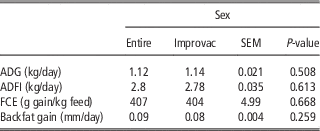
Mean ADG, ADFI, FCE and ADFG during the initial (P1) and final (P2) periods are given in Tables 2 and 3, respectively. It was apparent from the results in P1 that the initial vaccination had no effect on any of the variables measured (Table 2).
Main effect of Improvac during the period 16 to 20 weeks of age on mean daily weight gain (ADG), daily feed intake (ADFI), feed conversion efficiency (FCE) and gain in backfat thickness in male PIC© pigs

Main effects of, and significant interactions between, dietary balanced protein, ractopamine (RAC) and Improvac during the period 21 to 24 weeks of age on mean daily weight gain (ADG), average daily feed intake (ADFI), feed conversion efficiency (FCE) and daily backfat thickness gain in male PIC© pigs

abValues with different superscripts differ significantly at P<0.05 within row of main effects or interactions.
However, during the second period (P2) ADG was significantly influenced by all three factors (Table 3). Those pigs given RAC grew at a mean rate of 1.50 kg/day compared with 1.36 kg/day in pigs fed without RAC (P<0.001), and those injected with Improvac grew at a rate of 1.58 kg/day compared with entire males growing at 1.28 kg/day (P<0.001). Both the high (1.45 kg/day) and medium (1.47 kg/day) protein diets resulted in greater (P=0.008) ADG compared with the low-protein diet (1.37 kg/day). There were no interactions between treatments for ADG.
The only significant treatment effect on daily food intake was in P2 with the use of Improvac (Table 3; P<0.001): those pigs vaccinated with Improvac consumed 4.04 kg/day compared with 3.00 kg/day in the entire males. Thus, the entire males were more efficient (P<0.001) than those given Improvac (429 v. 392 g/kg feed). There was a significant interaction (P=0.007) between RAC and dietary protein content for FCE. Whereas the improvement in FCE at the highest dietary protein levels was the same whether or not RAC was used, the response to the medium level of protein was higher (455 v. 388 g/kg) when RAC was administered (Table 3).
The gain in backfat thickness during P2 was greater (P<0.001) in Improvac-treated pigs (0.15 mm/day) compared with entire males (0.09 mm/day) (Table 3). There was no effect of dietary protein on backfat thickness.
Discussion
Webster et al. (Reference Webster, Goodband, Tokach, Nelssen, Dritz, Unruh, Brown, Real, Derouchey, Woodworth, Goesbeek and Marsteller2007) reported that an increase in dietary lysine content improved growth rates whether or not RAC was included in pig finisher diets; however, a higher lysine level was needed to generate an increase in growth performance when RAC was fed. They concluded that finisher pigs of 79 to 109 kg required ~8 g lysine/kg, but that this should be increased to 12 g lysine/kg to elicit a response in growth performance when 10 mg/kg RAC is included, both these levels being higher than were commercially used at that time. Also, an increase in dietary lysine from 7 to 10 g/kg has been shown to increase lean cutting yields and carcass cutting yields in immunocastrates (Boler et al., Reference Boler, Kutzler, Meeuwse, King, Campion, McKeith and Killefer2011). Thus, in the present trial, a range of balanced protein levels from 161 to 256 g/kg, with digestible lysine contents ranging from 7.5 to 12.0 g/kg was chosen, assuming that the higher dietary protein together with the provision of RAC would enable immunocastrates to increase lean growth while improving feed efficiency.
Beneficial effects were evident with the use of both RAC and Improvac, but with no interaction existed between these treatments; thus there appeared to be an additive effect when using both treatments simultaneously as suggested by Lowe et al. (Reference Lowe, Gerlemann, Carr, Rincker, Schroeder, Petry, McKeith, Allee and Dilger2014). Growth rate was improved also with the use of medium and high dietary protein in all treatments in which pigs received both RAC and Improvac, with no interaction between these treatments.
The results from the current study are in accordance with the results of Dunshea et al. (Reference Dunshea, Colantoni, Howard, McCauley, Jackson, Long, Lopaticki, Nugent, Simons, Walker and Hennessey2001) who found that immunocastrates had a higher weight gain after the booster vaccination than entire male pigs which seemed to be due to an increased food intake rather than a change in FCE. This result is likely due to the lack of testosterone, which inhibits intake. In group housed pigs, a decrease in distraction from aggressive activities will also influence the differences in feed intake between immunocastrated and entire male pigs. Cronin et al. (Reference Cronin, Dunshea, Butler, McCauley, Barnett and Hemsworth2003) showed that before the second vaccination, both entire males and immunocastrates were more active than surgical castrates. However, after the second vaccination, entire males displayed more social behaviour and spent less time at the feeders than did immunocastrates and surgical castrates. Although the pigs in the current trial were individually housed, social interaction was still possible through the pen dividers and even standing activity may contribute to increased energy expenditure and distraction from feed intake, as the energy expenditure for standing is relatively high in pigs (Noblet et al., Reference Noblet, Shi and Dubois1993).
In the research done with immunocastrates backfat is often measured at the time of slaughter using the Hennessey Grading Probe or Fat-O-Meater and not on the live pig using an ultrasound scanner. Claus et al. (Reference Claus, Lacorn, Danowski, Pearce and Bauer2007) evaluated the endocrine and metabolic changes in immunocastrates receiving their second vaccination at 22 weeks, and found that the total body lipid content measured using D2O dilution did not differ significantly to the total body fat content pre-booster. In the current study, immunocastration increased the gain in backfat thickness. This occurred ~3 weeks after the second vaccination and is thus likely due to the effect of the lack of testosterone, as testosterone levels are negatively correlated with feed intake (Weiler et al., Reference Weiler, Claus, Dehnhard and Hofäcker1996). Testosterone levels drop within 2 weeks after the second vaccination in response to the lack of LH (Dunshea et al., Reference Dunshea, Colantoni, Howard, McCauley, Jackson, Long, Lopaticki, Nugent, Simons, Walker and Hennessey2001; Claus et al., Reference Claus, Lacorn, Danowski, Pearce and Bauer2007; Brunius et al., Reference Brunius, Zamaratskaia, Andersson, Chen, Norrby, Madej and Lundstrӧm2011) which lifts its inhibitory effect on appetite as well as its stimulatory effect on protein synthesis. Lealiifano et al. (Reference Lealiifano, Pluske, Nicholls, Dunshea, Campbell, Hennessy, Miller, Hansen and Mullan2011) demonstrated that the increase in feed intake is apparent 2 weeks after immunisation regardless of the timing (in terms of pig age) of the second vaccination and thus the longer the period between the booster and slaughter the greater the opportunity for lipid deposition. Depending on the inclusion level and duration used, RAC is said to benefit growth performance traits, with 5 mg/kg improving weight gain and feed efficiency while at 10 mg/kg additional benefits include improved carcass leanness and carcass dressing percentage (Paylean TM Technical Guide, Version 1.0, Elanco Animal Health, Division of Eli Lilly and Company, 2000). However, a meta-analysis of 23 published reports on live growth performed between the early 1990s to 2005 found that pigs fed RAC had a higher ADG and better feed efficiency while producing larger and leaner carcasses, regardless of the inclusion level (Apple et al., Reference Apple, Rincker, McKeith, Carr, Armstrong and Matzat2007). At 10 mg/kg, ADG was improved by 11.8% and feed efficiency by between 5.6 and 25.9% with little effect on food intake; however, the latter tended to be reduced (Apple et al., Reference Apple, Rincker, McKeith, Carr, Armstrong and Matzat2007). In the current study, the inclusion of 10 mg RAC/kg feed increased ADG by 10.3% whilst food intake remained the same over both RAC-treated and entire males resulting in a significant improvement in FCE. The lack of change in food intake in these treatments agrees with Braña et al. (Reference Braña, Rojo-Gómez, Ellis and Cuaron2013) who noted no significant differences in food intake for immunocastrates fed 0 and 5 mg/kg RAC for 28 days.
Our results indicated that FCE was improved with increased dietary protein as well as with the inclusion of RAC thus agreeing with Webster et al. (Reference Webster, Goodband, Tokach, Nelssen, Dritz, Unruh, Brown, Real, Derouchey, Woodworth, Goesbeek and Marsteller2007) who found that a higher dietary lysine level was needed to generate an increase in growth performance when RAC was included in the diet. This motivates the need to perform an economic comparison in order to determine the optimum economic level of dietary protein taking into account the cost of protein and the resultant improvement in performance. Similarly, an economic comparison involving RAC should be performed where the effect on economically important carcass traits should also be taken into account.
The mode of action of RAC suggests that it inhibits the repartitioning of nutrients towards lipogenesis by decreasing the sensitivity of the adipose cells to insulin, while increasing protein synthesis capacity (Hausman et al., Reference Hausman, Martin, Veenhuizen and Anderson1989; Paylean TM Technical Guide, Version 1.0, Elanco Animal Health, Division of Eli Lilly and Company, 2000). However, previous results in terms of this theory vary. No differences in live backfat thickness were seen in the trial pigs fed RAC, but the data at 24 weeks indicated a slight decrease in backfat depth. Therefore, if RAC were fed for a longer period, an appropriate step-up programme might overcome the desensitisation of β-receptors (Spurlock et al., Reference Spurlock, Cusumano, Ji, Anderson, Smith, Hancock and Mills1994). Rikard-Bell et al. (Reference Rikard-Bell, Curtis, Van Barneveld, Mullan, Edwards, Gannon, Henman, Hughes and Dunshea2009) demonstrated that when immunocastrates (vaccinated at 11 and 17 weeks old) were fed 5 mg/kg RAC for 14 days after the second vaccination, followed by 10 mg/kg for 17 days, lipid mass tended to decrease (P=0.076). However, should the period between the second vaccination and slaughter be optimised, differences in backfat depths should not be seen between entire males and immunocastrates. This is supported by Lealiifano et al. (Reference Lealiifano, Pluske, Nicholls, Dunshea, Campbell, Hennessy, Miller, Hansen and Mullan2011) who investigated various vaccination schedules where the booster was given at 2, 3, 4 and 6 weeks before slaughter. The results indicated that vaccinating 4 weeks before slaughter had no influence on the backfat thickness, but those vaccinated 6 weeks before slaughter showed an increase in backfat thickness compared with the non-vaccinated control.
The differences in backfat gain between the sexes were biologically small and it is thus questionable whether significant differences would be seen at slaughter using the Hennessey Grading Probe. The influence of gut fill on BW and thus ADG could also be evaluated by comparing the hot carcass masses (and dressout percentages) at slaughter. There was no response in backfat thickness seen with RAC supplementation, but this may not be the case with the lipid content of other carcass cuts. Thus the influence of RAC on lean meat yields of the various carcass cuts needs to be investigated in order to obtain a better representation of the effect of RAC on lipid deposition.
Conclusion
The results indicate that immunocastrates perform at the same level as entire males up until the second vaccination and thus can be managed as entire males to that point. However, after the second vaccination food intake and weight gain both increased in immunocastrated pigs whereas FCE decreased significantly. Supplementation with 10 mg/kg RAC also increased weight gain but in this case food intake was unaffected, hence FCE was significantly improved. Feed conversion efficiency in those pigs fed RAC benefited significantly from an increase in dietary protein after the second vaccination. Thus an economic analysis is essential in establishing the relative value of the use of Improvac, RAC and additional dietary protein.
Acknowledgements
This research was funded by the South African Pork Producers’ Organisation, the National Research Foundation (NRF) and the South African Research Chair’s Initiative. The authors would like to thank ElancoTM and ZoetisTM for their support and the Agricultural Research Council for the use of their facilities. Any opinion, finding, conclusion or recommendation expressed in this material is that of the author(s) and the NRF does not accept any liability in this regard.