“Do it the Ford way because it is the best way,” read a slogan posted for workers to see at a mid-1920s factory site in the Soviet Union.Footnote 1 In the country's early years, “Fordizm” and “Fordizatsia” (Fordization) became fashionable watchwords and near-synonyms for industrialization, mass production, and efficiency. While American officials and politicians worked to draw sharp contrasts between “one hundred percent Americanism” and Russian Bolshevism during the post-World War I Red Scare, in that same historical moment workers in Russia often saw no contradiction in the appropriation of “Amerikanizm” and “Fordizatsia” as positive elements in the creation of a new socialist world. Soviet commentators and workers used “Fordizm” interchangeably with phrases like “American tempo” and “American efficiency.”Footnote 2 Children and entire villages were named “Fordson” after the Ford tractor sold in Russia. During the 1920s, dozens of books and brochures on Ford methods appeared in Russia, hundreds of conferences were held on Henry Ford and his system, and his books sold in large numbers.Footnote 3 According to Soviet officials, “the combination of Russian revolutionary sweep and American efficiency” would be a foundation of Soviet society. Americanism and Bolshevism were not oppositional; American techniques and skills like the assembly line and mass production that made up “the Ford way” could produce an “Americanized Bolshevism” that would enable the Soviet Union to surpass the industrial achievements of the United States.Footnote 4
Historians have long assumed that the United States and the Soviet Union diverged along “alternative paths” in the years following the Russian Revolution.Footnote 5 In this essay, I will argue that their relationship during this period is more accurately characterized as one of connection, overlap, and mutual constitution. I use as my case in point the history of the movement of people and ideas between the Ford Motor Company (FMC) and Soviet Russia.Footnote 6 Workers traversed pathways between the United States and Russia in multiple directions, and American managers and Soviet officials strove to cultivate productive connections. Cultural ideas like Americanism and Fordism were understood as potentially valuable components for building the emerging Soviet Union. Furthermore, “Fordizm” and the factories, assembly lines, and workers it conjured in the minds of Russians were not merely imagined from halfway around the world;Footnote 7 notions of Americanism, Fordism, and Bolshevism were produced through face-to-face, embodied encounters between Russian Soviets and the people and programs of the FMC.
A focus on the people and cultural ideas that migrated between the two countries offers a new way to understand events previously framed as a one-way transfer of American industrial technology and goods to “backward” Russia. Ford's efforts to sell cars, tractors, and industrial methods to Russia have often been interpreted in the context of the growth of American multinational corporations, and the “Americanization” of Europe and other parts of the world through the spread of American technology and products.Footnote 8 American historians of the FMC have been explicit about the one-way nature of the connection: “The relationship,” wrote Allan Nevins and Frank Hill in their massive three-volume history of the company, “was purely commercial: Russia bought and Ford sold.”Footnote 9
Recently, historians of the United States and the world have begun to question the narrative of American products and cultural forms flowing unidirectionally outward to Europe and the world over the course of the twentieth century.Footnote 10 As summarized in a recent history of “the Americanization of the World,” scholars have interpreted these trends as part of the imperial expansion of American political and economic power overseas. In some cases, they have added an emphasis on the abilities of people at various global sites to reformulate the meanings and uses of U.S. cultural and commercial imports through a process of “creolization” that created an array of “cultural hybrids.”Footnote 11 However, recent work has interrogated these “Americanization of the world” paradigms by asking how these processes also transformed the United States. In what follows, I extend this work to contend that “American” products were not suddenly transformed into “cultural hybrids” after they arrived in Russia;Footnote 12 in the case of Ford's products and employees, and the ideas that circulated around them, they were already in important respects hybrids, fought over and coproduced at their creation in the United States. Russian immigrants, for example, were a crucial part of a new industrial process in Detroit that not only made “American” products but also relied on an arduous and contested program of working out boundaries between “Americans” and “Russians.”Footnote 13 What went abroad to places like Russia, including products, industrial methods, and people, were not simply “American” in some deep rooted or timeless sense; they were new and the results of intense struggle, and were created within an ordeal of contact and boundary making that also took place inside the United States.Footnote 14
While scholars have examined how American products and cultural forms often acquired new, Soviet meanings and uses in Russia, they have left unexamined the phases of the process within the United States. For example, Lewis Siegelbaum, in his study of the Soviet automobile industry, outlines how “the architecture of the ‘soviet detroits,’ the machinery, the layout of the shops, in many cases the parts themselves came directly from Detroit. So too did many of the engineers, the workers, and some of the directors.” However, Siegelbaum explores how these parts and the vehicles that they made up were not merely American—they ultimately became Soviet in important respects. The result was a Soviet automobile that was “cosmopolitan,” “of mixed parentage,” a kind of “hybrid” entity.Footnote 15
If we expand our attentions beyond the flow of goods and technology outward from the United States, we find a history of both Russian and American workers, managers, immigrants, and return migrants moving back and forth, helping to build automobile factories in both Detroit and the Soviet Union. Like the hybrid vehicles that rolled off of Soviet production lines, the people who came together in the American and Russian factories were produced at the blurry juncture of two worlds, and it was often unclear to which they belonged. The words scrawled under “nationality” on their Ford paperwork said little more about their origins or affinities than the name “Red Putilov” revealed about a tractor assembled in Leningrad from a mix of American and Russian parts, ideas, and contexts.
I highlight here the overlapping co-production of automobiles, ideas about Americanism, Fordism, and Bolshevism, and new notions and practices of industrial life. I do so through an examination of sites of encounter, boundary making, and exchange in both the United States and Russia. Because scholars to date have emphasized unilateral transfers to Russia, I will emphasize how these processes also took place in, and significantly affected, the United States.
The FMC facilities in and around Detroit, Michigan were where these processes played out among Russian migrants who encountered Ford's Americanization programs in the early twentieth century. They also took place between Ford Sociological Department investigators, Ford English School instructors, and the Russians and Americans they sorted out, coerced, and tried to reformulate and put to work. During the 1920s, the Detroit facilities were also a destination for Soviet tourists who visited the United States to see the famous Highland Park factory, for Soviet students, workers, translators, and professors who came to learn about Ford products and methods at the Henry Ford Trade School, and for Soviet officials who maintained offices in nearby Dearborn through their U.S. purchasing agent, the Amtorg Trading Corporation.
I will also scrutinize events surrounding an official delegation of FMC managers who visited the Soviet Union in 1926. They offer an account of detailed engagement of Ford managers and executives with a variety of geographic, manufacturing, and cultural sites there, and their assessment of potential connections between the company and the USSR. Reports produced by these Americans, and by executives and engineers that visited the USSR in 1929, recorded their encounters with Americans and Russian-American migrants who after the Bolshevik Revolution had left the United States to help build the Soviet Union.
By considering these moments and locations within a single analytical frame, we can examine the creation of new modes of constructing workers and a sweeping vision for an industrial world in Detroit alongside the subsequent, connected project to build a new socialist world in Russia. In the first part of the twentieth century, both FMC employees and workers at manufacturing projects in the Soviet Union began to build utopian worlds grounded in a belief in the transformational power of industrial technology and methods. By assessing these events together, we can see that the narrative of one-way dispersion of American goods and technology has presented Ford's project, and the American system it was a frequent metonym for, as fully formed and successful, and the Soviet project as comparatively lacking and incomplete.Footnote 16 By illuminating the blurry boundaries between these ventures, which also converged in Detroit, I reveal how both projects to create industrial societies emerged, overlapped, and shaped each other.Footnote 17
I begin with Ford's fervent anti-unionism and rigid system of labor control, which made his “Ford way” seem to some like an antidote to the spread of Bolshevism in the United States. I will discuss how the FMC's business relationship with the Bolshevik government began at the same time that the company was developing its anti-Bolshevik activities in Detroit. I then turn to ideas about work conditions and social life. Ford personnel visiting the Soviet Union to promote business connections often stressed that work conditions and social life fell short of their standards, but we will see that the arrangements of work and life that seemed natural to them had only recently become normal in Detroit itself. In fact, one facet of FMC's efforts to produce an efficient and enviably successful industrial system was to produce new modes of everyday work and life. These were not readily accepted by either Ford workers or foreign observers, who were often shocked by the goings on in Ford's Detroit facilities, which some called “something startlingly new.”Footnote 18
Next I will look at Ford's ambitions to put these new modes of industrial work and life into action both in Detroit and abroad, in conjunction with Soviet interpretations of how Fordizm might be used to help build the Soviet Union. I will follow this with a discussion of the blurry process of boundary making around categories like “American,” “Russian,” and “Bolshevik.” FMC personnel deployed these categories as a basis for factory production in Detroit and business operations in the Soviet Union. The company's halting attempts at marking distinction often failed when they collided with individuals who, due to their origins, affinities, or geographic locations, fell between these categories.
FORD MOTOR COMPANY AND BOLSHEVIKS
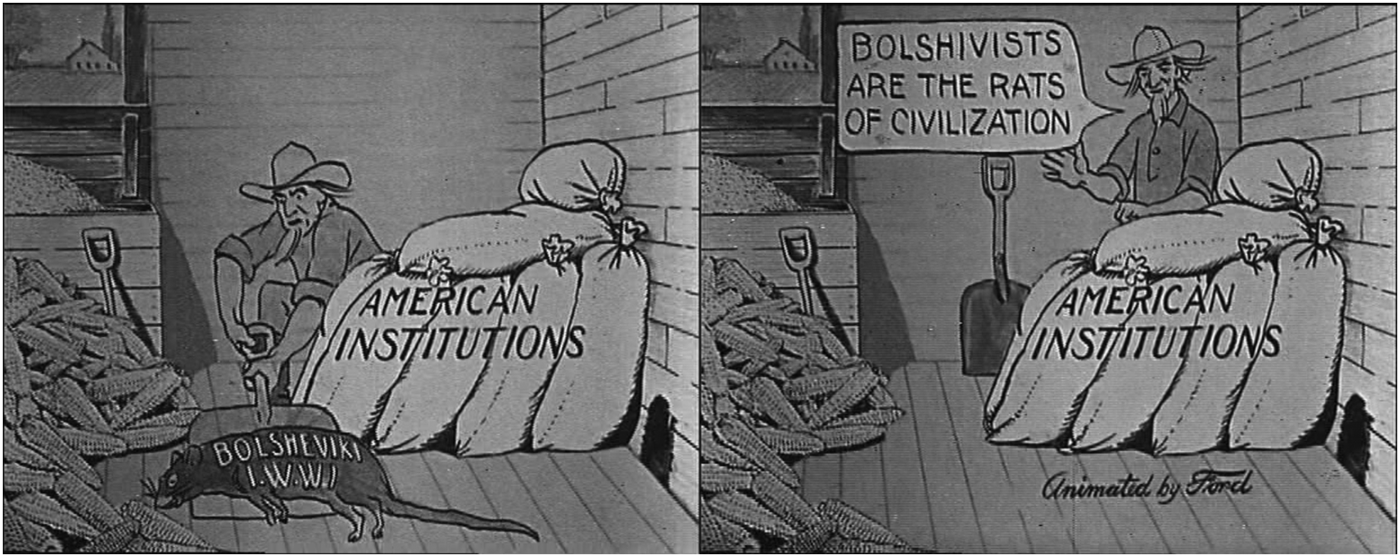
In 1919, during the period of anti-Bolshevik anxieties in the United States that historians have called the “Red Scare,” the FMC joined federal officials and politicians in drawing and enforcing sharp distinctions between “one hundred percent Americanism” and Russian Bolshevism. For example, one prominent politician's treatise Americanism versus Bolshevism explained, “Americanism means increased production and increased prosperity for all; Bolshevism stands for destruction.”Footnote 19 Ford produced films that presented this formulation, such as a short cartoon that contrasted American producers with “Bolsheviki-I.W.W. rats” (see Figure 1). In it, a farmer resembling Uncle Sam stands behind bags of corn representing the products of “American Institutions.” A bounty of produce is, he says, “the results of our fine labor.” When a “varmint” rat labeled “Bolsheviki I.W.W.” enters through a hole in the wall, the farmer hits it with a shovel and tosses it out the window, declaring, “Bolshevists are the rats of civilization.” As he waves good-bye to the audience, the message “Animated by Ford” appears. The film's broader message was clear: American institutions like Ford's system of mass production could produce an abundance of goods and a better life based on mass consumption; “increased production” meant “increased prosperity for all,” but only if Bolshevists' meddling was eliminated.Footnote 20
Two frames from “Uncle Sam and the I.W.W.—Bolsheviki Rat” (Ford Motor Co., ca. 1919). Courtesy of the National Film Preservation Foundation and the National Archives.

During the Red Scare, Ford Motor deployed undercover operatives in its Highland Park factory who targeted Russian and Eastern European migrants and anyone who admitted to being or was rumored to be connected to radical organizations. Their task was to identify and remove “Bolsheviki” workers from tool rooms and assembly lines. Those so identified were paired at work with firmly “American” workers “opposed of Socialist, Bolshivicism, and Radicalism.” Off the job, they were surveiled, and many were transferred or removed from their positions, or simply deported in collaboration with the federal government.Footnote 21
For instance, special agents of the Department of Justice arrested one worker, Russian immigrant Nicolai Mansevich, inside Ford's Highland Park plant for possessing “revolutionary and anarchist literature.” After a search of his home found the attic “arranged for a meeting of the Union of Russian Workers,” Mansevich was deported for “teaching the overthrow by force or violence of the Government of the United States.”Footnote 22 To many American observers, Ford's incredible factory was at the forefront of defending the United States from the radical threat. For them, one recent history noted, “Highland Park stood as a bulwark against Bolshevism.”Footnote 23
However, these actions reveal only one component of Ford Motor's relationship to “Bolsheviks” during 1919 and the decade that followed. In practice, determining precisely who was a Russian, a Bolshevik, or for that matter an American was a fraught and often impossible process. Furthermore, during the same summer that Ford was producing anti-Bolshevik cartoons and deploying undercover operatives on its factory floors, the company contracted to sell its first volume shipment of automobiles to Russia.Footnote 24 Even as Ford executives worked to identify and deport Russian Bolsheviks in Detroit, in the spring of 1919 they met there and in New York with Bolshevik government representatives.Footnote 25 That same year, when New York's Lusk Committee stormed the New York City office of the Russian Soviet Bureau as part of their anti-radical roundup, they uncovered, not a Bolshevik conspiracy to foment radical revolution, but rather agents of the new Soviet government working to arrange a meeting with Henry Ford in Dearborn, at which they hoped to discuss buying automobiles and “the social aspects of the regeneration of Russia.” A letter from the Russian Soviet Bureau in New York, now preserved in Henry Ford's correspondence, carried a similar message; it spoke of “something else than the purely commercial interest your firm may have in Russian trade.” “We believe,” it read, “we could make you understand that Soviet Russia is inaugurating methods of industrial efficiency compatible with the interests of humanity.”Footnote 26 Just two years later, the Ford Company would be selling thousands of Fordson tractors to the Soviet Union each year, but first Ford automobiles had to be produced in Detroit—an effort more arduous than simply identifying “Bolsheviks” in the plants. During the same period when Soviet officials began deploying a new vision for humanity based on “industrial efficiency,” the FMC created and attempted to implement a new vision and practice for industrial work and life.
A NEW NORMAL AND A NEW DISEASE
Henry Ford's idea was straightforward, especially when expressed in his short spurts of folksy wisdom: Ford Motor would make a lot of cars, and cheaply enough so that even autoworkers could buy them. Simple on its surface, the plan in action required Ford and the FMC to sweepingly transform key aspects of industrial and social life. Workers on the factory floor would have to become accustomed to a new way of doing things that Ford thought necessary to attain the extreme efficiency of assembly line mass production. A system of rigid control of the shop floor and coercion of workers was designed to create a homogenized and highly disciplined workforce capable of repetitive, de-skilled tasks. Their lives outside of work would also be reshaped—a particular kind of home life was required if Ford workers were to maintain maximum efficiency on the job. The company had to instill in immigrant workers a specific set of relationships to their earnings, savings, and spending if they were to become industrious Americans capable of consuming automobiles. As historian Stephen Meyer has argued about the implementation of FMC's “five dollar day” labor policy, these two projects—creating a new brand of efficient industrial workers, and reshaping workers' home lives—were intimately linked. “The company,” he writes “attempted to change an immigrant worker's life and culture to its preconceived ideal of an ‘American standard of living,’ which it felt was the basis of industrial efficiency.” According to Meyer, “In the eyes of Ford, his officials, and his factory managers, a workman's efficiency in the factory and his home and family environment were thoroughly intertwined.”Footnote 27
The five dollar day profit sharing program was introduced in 1914. To participate, workers had to follow onerous requirements intended to reshape broad aspects of their lives so as to construct a homogenous, American, efficient workforce capable of performing routinized tasks. Ford created a Sociological Department staffed with inspectors charged with monitoring workers both inside and outside the factory. The company observed and managed how workers saved and spent their new salaries, where and with whom they lived, their marital status, and whether they sent money to relatives abroad. A careful balance of thrift and rest was required, based on a particular vision of the middle-class home. Certain leisure activities, or cohabitation outside of marriage, squandered a worker's wages. A working wife, or the subletting of space to borders, deprived a worker's home life of comfort and relaxation. The Americanization components of these programs targeted immigrant workers, and included attendance at Ford English School classes in which workers learned about both American citizenship and English language. A particular focus was vocabulary that workers would need to fulfill the “role as the head of an ‘American’ family unit.” For example, subjects included “The Man Washing.” At the heart of these FMC programs to create a certain kind of worker was the construction of a particular notion of an American home and family, and a specific kind of man.Footnote 28 Writing of Henry Ford, Samuel Marquis, head of the Sociological Department, suggested that automobiles were “the by-products of his real business, which is the making of men.”Footnote 29 “Mr. Ford's ambition,” advertised a promotional pamphlet called Facts from Ford in 1920, “is ‘to make men,’ as against the simple making of machines and money.”Footnote 30
The company's interventions were often drastic; within days of a worker starting at Ford, the Sociology Department might violently expunge his family's home and all of their possessions. Take the case of one Russian peasant, Joe Kostruba, who found a job at Ford three years after arriving in the United States. Two days after he began work a Sociological Department investigator determined that the attic apartment where he had been living with his wife and six children was “a filthy, foul-smelling hole.” The investigator moved immediately “to help them to make a start toward right living,” providing Kostruba a large loan against his future wages and “a liberal amount of soap … with instructions to use freely.” The Ford investigator then “had their dirty, old, junk furniture loaded on a dray and under the cover of night moved them to their new home. This load of rubbish was heaped in a pile in the back yard, a torch was applied and it went up in smoke.” A promotional report produced by the department about the transformation wrought by the FMC upon this Russian immigrant family concluded triumphantly, “There, upon the ashes of what had been their earthly possessions, this Russian peasant and his wife, with tears streaming down their faces, expressed their gratitude and thanks to Henry Ford, [and] the FORD MOTOR COMPANY….”Footnote 31
But in fact workers in Ford factories questioned the new way of working and its costs, and some described Ford's methods in terms of insanity or disease rather than normality. Henry Ford declared in his book of aphorisms, “Reasonable work is natural,” but some workers at his plant complained that the new mode of work was so abnormal that it created new diseases.Footnote 32 It was, wrote one, “no place for a sane man.” A new kind of nervous condition found among Ford workers was referred to as “Forditis.”Footnote 33 While “Fordizatsia” (Fordization) in Russia signaled the efficiency that would help create a new world for workers, assembly line workers in Detroit used the word to denote a malformation in their bodies wrought by Ford's efficiency methods. “Fordization of the face” referred to the pained and twisted expressions that became stuck on the features of workers who spent day after day trying to clandestinely communicate in circumvention of FMC's rule of total silence on the floor.Footnote 34 According to one historian of labor organizing at Ford, “the Ford Face” was like “a human mask” with no expression and vacant eyes. It was created in conjunction with the “Ford Silence,” a lack of human voices that produced an eerie quietness despite the screech and grind of machinery.Footnote 35
Travelers from abroad who toured the Highland Park plant commented on the shocking newness of Henry Ford's ideas, methods, and operations. “In Detroit Germans found something startlingly new,” historian Mary Nolan writes, summarizing travelers' reactions to the Ford works.Footnote 36 Soviet futurist poet Vladimir Mayakovsky, who toured the plant during his 1925 trip to the United States, was stunned to hear no voices there. “There is just a universal, serious hum,” he wrote. “The faces have a greenish tinge, with black lips, like at a film shoot.” Mayakovsky's critique of the plant connected family life with the practice of efficiency: “In Detroit, you find the highest divorce rate. The Ford system gives its workers impotence.”Footnote 37
The experience of workers in Detroit and comments from visiting observers of Ford's methods, suggest that efforts to create a new normal mode of factory work and life were highly contested, and even shocking to many. Indeed, in their efforts to transform workers Ford programs were in many respects more aspirational than successful. By the mid-1920s, FMC had abandoned plans to reconstitute workers through a “paternalistic” mix of incentive programs and social coercion, in favor of forceful physical intimidation and factory spies. The Sociological Department was eclipsed by the Service Department, tasked with suppressing radicalism and unionism through “anti-labor terror.”Footnote 38 However, FMC tried to promote both the new mode of assembly line factory work and the consumption of the automobiles it produced as a new “universal” standard for Americans and for peoples around the globe.
Ford's Model-T was said to be the “Universal Car” and his Fordson the “Universal Tractor,” marketed as affordable to all people and amenable to all conditions (see Figure 2). But these were not the only Ford products that were to be universally applicable in the United States and abroad: “Our principles, I hold, are universal,” said Ford “and must lead to a better, wider life for all.”Footnote 39 When Ford managers boarded a steamship in New York in 1926, setting out to assess the possibility of bringing the company's vehicles and whole factories for their production to the Soviet Union, they were bearing more than an automotive product. Their ideas about normal industrial production and the normal lives of industrial workers were steeped in the world that the Ford Company and its ethnically and nationally diverse workforce had been creating in Detroit over the previous decade.
A Russian advertisement collected by Ford managers on their 1926 trip to the Soviet Union not only promotes the Fordson as “the universal tractor,” but also envisions the machine reshaping broad aspects of Russian agriculture, transport, and industry. Suggested uses included powering water and oil pumps, sawmills, and even lighting in addition to potato digging, threshing, and plowing snow. Courtesy of Benson Ford Research Center, The Henry Ford, Dearborn, Michigan. Accession 1870, Box 1, Report of the Ford Delegation to Russia. Copy and reuse restrictions apply. http://www.TheHenryFord.org/copyright.aspx
Observation and analysis of Soviet workers' lives outside the factory was a crucial component of the Ford mission to Russia because it was believed that such factors would be telling indicators of their factory performance. For example, while Ford managers who toured the USSR explained that the social system erected by the Bolsheviks was unsuccessful in many respects, they concluded sarcastically that it had “admirably succeeded in destroying all family life” and “purposely taught disobedience to children.” They reported, “The average worker in the USSR today … is much better off than he was before the Revolution,” but lamented, “The worker has too much leisure time under this new system, especially during work hours.” The delegation paid keen attention to how workers spent their leisure time, and reported not only on home life but also on worker's clubs, the role of women, marriage laws, prostitution, and the rearing of children.
Their investigations were structured around similar topics and concerns as those that occupied Ford probed into the lives of immigrants in Detroit. It was impossible, they reported with concern, for Soviet workers to accumulate personal savings under a system in which “the whole scheme has been planned to prevent the accumulation of personal wealth.” This worry mirrored the focus of Ford investigators in Detroit on establishing and tracking worker's efforts to build personal savings. Furthermore, while among the first corrective tasks taken by investigators in Dearborn had been to provide a new Russian immigrant hire and his family with “a liberal amount of soap … with instructions to use freely,” delegates to Russia were quick to note “the extremely strong odor of unwashed bodies which fills the air, as the average workman rarely changes his clothes after work and baths are seldom indulged in.”Footnote 40
Ford delegation executives and managers evaluated the potential for future business with Russia using the same ideas about control of the labor force and efficiency that were being created and resisted in Detroit. “They have no control over the workmen,” wrote the Ford managers, “and therefore are unable to operate their plants on anything near an efficient basis.”Footnote 41 These understandings of normal industrial work and living conditions for workers ultimately structured the contracts for both Ford assistance to Soviet automobile production projects and Ford workers sent to Russia to work on factory construction and operations. When skilled Ford workers were sent to work in an auto plant built with Ford technical assistance at Nizhniy Novgorod between 1929 and 1932, their contracts called for guarantees of “normal living conditions of comfort and rest.”Footnote 42 Correspondence between FMC and Albert Kahn Inc. Architects, advising ways to negotiate the language of agreements for Ford workers going to the USSR, suggests that the term “normal” as utilized in such agreements was in dispute, and that contract writers had to be careful about what exactly the term meant. “In Paragraph No. 3,” wrote Louis Kahn to a Ford representative, “after your wording ‘expected of a normal traveler,’ I would suggest adding the words ‘in the United States.’ Otherwise they will expect your men to travel as a normal Russian traveler.”Footnote 43
Boris Shpotov, a Russian historian of the FMC, has argued, “Every American manufacturing system, including that of Ford, could work effectively in other countries only at strict observance of all rules and norms: uninterrupted inflow of raw materials, skillful engineering, good factory management, disciplined and well-trained workforce, etc. In the USSR such conditions were mostly absent.”Footnote 44 However, Ford managers evaluating conditions in the USSR did not employ, as they imagined they did, a timeless set of “universal” norms for good management, workforce discipline and training, and uninterrupted flow; rather, they were standards of industrial work and its connection to living conditions that had only recently been conceived and striven for in Detroit. Far from a set of “universal” principles that would self-evidently lead to “a better, wider life for all,” these new norms were contested in Detroit and between the FMC and the workers and planners they interacted with in Soviet Russia.Footnote 45 In fact, while Henry Ford endeavored to create a new routine of work and new Americanized lives for workers in his Michigan factories, some of his employees abandoned his vision so they could instead participate in creating another kind of new society on the other side of the world.
BETWEEN TWO UTOPIAN PROJECTS
“Soviet automobiles,” historian Lewis Siegelbaum writes, “were born amid dreams of a technological utopia.”Footnote 46 But as we have seen, so were American automobiles; Henry Ford had a dream for a new world based on mass production and mass consumption. He proclaimed that “Machinery is the new Messiah,” and according to commentators he envisioned a “new thinking and new doing … bringing us a new world, a new heaven, and a new earth.”Footnote 47 Again, Ford and many of his enthusiasts thought that not only his products but his “Ford way” of organizing work, family life, and the social world would better the lives of people everywhere. According to one biographer of Ford, “For him the metaphor of the melting pot included not only the homogenization of foreigners in America, but the mechanization and standardization of all people all over the globe. Men would be mass produced.”Footnote 48 The outlook that historian Greg Grandin has called Ford's “international utopianism,” which he developed leading up to the First World War, became reconfigured in the 1920s as the basis for a series of projects to organize communities of work and life outside of Detroit. Ford built lumber towns in Michigan's Upper Peninsula, planned a vast new municipality at Muscle Shoals in northwest Alabama, and initiated a sweeping project to create a rubber production settlement called “Fordlandia” in the Brazilian jungle. Ford projected the outlines of a future in which animals would be unnecessary for either plowing or food; machines would take over both functions, as tractors replaced draft animals and soybeans were processed into milk and other foods that had once come from livestock.Footnote 49
That many of these projects never materialized, and others ended in dismal failure, reminds us that the Ford Company's many programs to produce a new world of mass production and consumption were always only aspirational. Ford's sales of tractors, car parts, and technical assistance to the Soviet automobile industry all took place within this larger, often quixotic frame. This calls into question past depictions, by Ford executives and scholars alike, of Ford's dissemination of products and production knowledge to Russia in terms of mastery and inevitability. For example, though both groups have highlighted the small number of tractors and low volume of their production in the Soviet Union as these exchanges began in the early 1920s, FMC's own tractor production had started only a few years earlier, when it built and sold just 254 tractors in 1917.Footnote 50 If Ford's view for “a new world” and the Soviet endeavor to create a new society each presented utopian visions, they were both very much projects in the making.
Although Ford managers maligned the status of management, worker conduct, and other conditions of Soviet factories, in some cases work practices there were portrayed as positive examples that Ford facilities ought to emulate. In the same year that Ford officials toured Soviet factories and agricultural sites, Ford's employee newspaper criticized foremen and workers in Detroit who lagged behind when compared to the Soviet model for prevention of workplace accidents and injuries. “Soviet Russia is taking Safety seriously,” the Ford News declared. “Are we in American taking it as seriously as it deserves?”Footnote 51 This company periodical was not alone in looking to Russia as a model. Many Americans thought that elements of the system being developed in the Soviet Union could be detached from socialist politics and deployed in the United States. American agriculturalists who traveled there as technical experts may have been largely indifferent to “the Soviet way of life,” as one account claimed, but they were deeply inspired by Soviet plans for industrial-scale agriculture, and felt that lessons learned from Soviet experiments could transform American large-scale wheat farming.Footnote 52
Despite such instances, many observers envisioned the Soviet project, and that of Americanism and Fordism, as the “two available models for economic and social modernity,” as Mary Nolan has noted in her study of ideas about Fordism in Germany. One German traveler wrote after visits to both the United States and Russia in the 1920s that they were “the two poles of the contemporary era.” Others interpreted the two models in less oppositional frameworks, even suggesting that Americanism and the sort of technological efficiency represented by Fordism offered a more useful model for a socialist Germany than did the example of the Soviet Union. In Germany, Nolan argues, “Bolshevism and Americanism were seldom posited as simple alternatives.” Many Russian and European workers and writers thought Americanism and Fordism were compatible with socialism and that a socialist society could perfect Ford's practices and ideas.Footnote 53
In the Soviet Union, Fordism was deployed excitedly and widely in a variety of contexts. “‘Fordism’ is the most popular term among our labor organizers,” wrote Mayakovsky after returning to the Soviet Union from a trip to the United States in 1926.Footnote 54 According to Siegelbaum, Fordism “deeply impressed Marxist theoreticians, the technical intelligentsia, the cultural avant-garde, and ordinary readers of mass-circulation popular science journals.”Footnote 55Fordizm's popularity in Russia was related to a broader enthusiasm for ideas about the scientific management of industry and the potential for new technology and methods to transform work and life, which also took hold in Europe and the United States in the early twentieth century.Footnote 56 Like advocates of Fordism elsewhere, many Soviet commentators highlighted the potential for scientific methods and industrial technology to bring about material abundance.
Ford wanted to bring people in places like Russia “a better, wider life” through the mass consumption that would be offered by mass production, but Soviet planners and citizens were already developing a new Soviet mode of consumption, which they saw as the basis of a new socialist world.Footnote 57 Many Bolsheviks thought such ideas would be key components of the transformations that the revolution would bring about, and America and Ford often figured as an exemplary model for the Soviet application of scientific management.Footnote 58 In the travelogue A Ford Crosses Soviet Russia, the American university professor George Counts observed, “The present vogue of America in Russia is no doubt due in part to the fact that to a peculiar degree she exemplifies the spirit of science in industry.” After driving around the Volga river valley in a Ford purchased through Amtorg, Counts concluded that, American and Soviet ideological differences aside, when it came to a shared belief in the application of science to industry “these two great republics are walking in harmonious step.”Footnote 59
Nonetheless, even ardent enthusiasts continued throughout the 1920s to debate what Fordizm meant for Soviet Russia and how it might be interpreted, spread, and adopted by Soviet workers. Excitement about Ford varied across urban and rural divides—intellectuals and technical specialists saw Fordizm as a method for organizing industrial efficiency, while peasants admired Ford as an inventor. By the mid-1920s, the study and application of scientific management principles was widespread enough to support several academic and technical journals and a series of labor schools and institutes. There was even a schism between different branches of proponents of the field of study dedicated to nauchnaya organizatsiya truda—the scientific organization of labor.Footnote 60
Soviet efforts to apply American industrial techniques like Fordism to industry encountered varied reactions among workers, factory directors, commentators, and planners. At times they met ambivalence—praised for technical advantages but critiqued for their social meanings.Footnote 61 While Soviet citizens sometimes “talk[ed] about the Ford enterprise almost as though it were an entity that could be transposed, without any changes, to the socialist system,” as Mayakovsky observed, they, like observers elsewhere, more often advocated reshaping elements of “Fordism” that they felt could be separated from unwanted aspects of the Ford system and applied toward different ends.Footnote 62 In his article on Fordizm in the Big Soviet Encyclopedia, Alexei Gastev, a prominent advocate of the scientific organization of labor, acerbically criticized the “cruel exploitation” that characterized Ford's “social concept.” But he also highlighted useful elements of Fordizm like “continuous flow,” and “rhythm” of work that, he explained, “now have a widely recognized role in the organization of production” in the socialist system.Footnote 63 One skeptical parody of popular enthusiasm for American ideas echoed Ford's plans to replace farm animals with industrial machines. “We are far behind American technique!,” it mocked, “In America, mechanized chickens lay cooked eggs—soft-boiled, medium, and hard boiled—according to one's desire. In America, electrified cows give for the choosing—boiled milk, butter, sour cream, whipped cream. We bend our heads in esteem.”Footnote 64
In some cases, Fordist and American ideas, organizations of industrial work, and engineers on the ground in Soviet Russia faced significant obstacles and even active resistance. One account of three hundred American specialists who had been working in the Stalingrad tractor factory for over three months lamented their lack of progress in imparting “American methods of work” to the Russian workers. A reporter for the daily newspaper Za industrializatsiiu (For industrialization) explained that some workers had “systematically hindered the work of American experts” and “young Russian specialists conducted a campaign against the work of the Americans.” One worker who “openly declared that he would not work with the Americans” explained, “We made the revolution ourselves, and we ourselves will establish industry.”Footnote 65
Soviets who promoted the adoption of elements of Ford's work methods did not feel that they had to be separated from a wider program to reshape workers' lives, and they often described Amerikanizm and “the Ford way” as more than a system for industrial work. In the Soviet press, for instance, according to historian Jeffrey Brooks, it figured “not as an economic model but as a human one, for a new type of person.” Soviets talked of creating “Russian Americans” throughout the 1920s, and “the phrase ‘Russian Fords’ was used to refer to active groups of workers and managers.”Footnote 66
Visions for crafting a new kind of man through Ford's system in the United States and Soviet attempts to utilize Ford methods both required worker training, broad cultural changes, and new conceptions of labor discipline.Footnote 67 At the core of each project was the transformation of migrant peasants into industrial workers habituated to the customs, values, and rhythms of factory life. Adoptions of these transformational goals in the two countries were more than merely parallel developments; they were co-produced. Techniques as well as the managers and engineers who applied them moved between the United States and Soviet Russia, and so did people they tried to refashion into disciplined factory workers. As in the case of the Russian migrant Joe Kostruba, peasants from Russian villages were often the targets of such programs in automobile factories in Moscow and Nizhniy Novgorod, but also in Detroit. Ford employees who visited or worked in automobile factories in Russia and grumbled about undisciplined workers with “unwashed bodies,” or who were “right off the farm,” echoed complaints about the migrant populations, many of whom were Russian peasants, which Ford personnel tried to fashion into a new kind of workers in Detroit.Footnote 68 Although Ford programs purported to be Americanizing immigrant workers, Soviet workers in early twentieth-century Russia were also exhorted to maintain a particular balance of leisure, rest, and hygiene that would form the basis for not only work and citizenship but also a wholly new kind of person, a “New Soviet Man.”Footnote 69
This similarity was a key factor that drew Soviet admirers to the American model as a particularly pertinent example. The American path to industrialization that underlay Ford's system had hinged on the successful transformation of a largely rural population and unskilled migrants into a trained and disciplined factory workforce. Advocates for adopting techniques of Fordism and American scientific management of industry, like Gastev, who developed training programs and headed the Central Institute of Labor, argued that Ford's Highland Park factory could be viewed as a training center that modeled the cultural transformation of agricultural people and migrants into skilled workers.Footnote 70
In both countries, efforts to apply Fordism as a system for recreating industrial production and fashioning new kinds of people targeted migrants for transformation, but prior migrations also played a role in the circulation of information between Soviet and American engineers, workers, and academics. During the 1920s, Amerikanskaia tekhnika was just one of the notable American technical journals read in Soviet Russia, and had more than five thousand subscribers. Published in Russian in New York, it was founded by the Association of Russian Engineers in America, a group that included engineers trained in Russia before they migrated to the United States.Footnote 71
The idea that Ford facilities should be models for the development of Soviet training programs inspired and often required the movement of people. In addition to the Ford personnel and other engineers and technical specialists who traveled from the United States to lecture, manage facilities, and build equipment and products, hundreds of Soviet workers, specialists, and teachers traveled to Highland Park in the second half of the 1920s to observe and participate in Ford training and methods. In 1926, the first group of about fifty of what the Ford Company called “Special Russian Students” arrived in Detroit to study the factories, model farms, and methods, as well as tractor and automobile maintenance and repair. Contracts to sell Ford parts, automobiles, and technical assistance to Soviet Russia, signed in 1929, stipulated that fifty Soviet engineers, foreman, and workers per year would study Ford's methods and plants in Detroit, and several hundred visited during the agreement's duration.Footnote 72
Again, prior migrations of workers from Russia to the United States provided a foundation for Ford efforts to train Soviets, sell technical knowledge to Soviet Russia, and approach new markets in Russia and elsewhere. Among the students at the Henry Ford Trade School in the mid-1920s were many migrants from Russia and the former Russian Empire that Ford personnel identified as good prospects to become sales agents, roadmen, and instructors who could profitably return to areas throughout the Soviet Union to work on the company's behalf. For example, one student, “a Russian citizen” born on a farm outside Kiev, had been living in the United States for three and a half years when he began training at Ford in the summer of 1925. The student was still in the process of obtaining U.S. citizenship papers, was rated highly in his Ford coursework, and was able to speak Russian, Polish, Ukrainian, and Chinese (having resided for a time in Harbin, Manchuria). He was considered for positions supporting a range of Ford's expanding international operations. In addition to work in Soviet Russia, these included jobs in Copenhagen as tractor department head for the Ford Polish division, at a prospective plant in Yokohama, Japan developing business in the Manchurian territory, and as an instructor training Soviet students at Detroit factories.Footnote 73 Records pertaining to such trainees remind us that enthusiasm for Fordism and American models of scientific management in Soviet Russia, and the aspiration to expand Ford operations in Detroit to areas like the Soviet Union, grew in a period marked by multidirectional migrations of workers and technical knowledge that underlay such exchanges.
Mutual beliefs that technology and scientific approaches to production would transform work and life, and the disciplinary regimes designed to achieve drastic changes and utopian goals, not only ran parallel in Soviet Russia and the United States, but also emerged from and inspired formative connections. Yet, despite such overlaps, meaningful differences were starkly apparent to workers in both countries, and to the Ford personnel who traveled between them. Frank Bennet, a former Ford employee hired to supervise production of Ford vehicles in Moscow and Nizhniy Novgorod, succinctly recorded the crux of the difference he found in Soviet autoworkers, iterating an observation often made by Americans working in Russia: “they were slow in comparison to what we do,” but they “always referred to [the factory] as ‘our’ plant. It was, ‘We are doing this,’ or ‘That's what we are going to do in the future.’”Footnote 74
Raising productivity through labor discipline was a critical component of the emerging Soviet industry, as it was in Ford's Detroit facilities, but the meanings of discipline and productivity were different in Russia. When workers discussed what made a good manager, both in the Soviet press and in party meetings, they called for factory directors to strike a balance between increasing production and defending workers' interests. As historian Diane Koenker observed in accounts from the first years of the New Economic Policy, the promise offered by new forms of Soviet industrial life meant that workers valued these features in a factory, and those managers who fostered them “out of conscience, and not from compulsion.”Footnote 75 While the meaning of industrial work differed across locations and ideological lines, so did the kind of worker conjured by proposals for a new kind of Ford Man and those for a new Soviet Man. Unlike the homogeneous, coerced, de-skilled, and interchangeable workers that Ford hoped to create, the worker imagined by Gastev and other Soviet enthusiasts for elements of Fordizm was “an active, sentient, and creative part of the productive process.”Footnote 76
These new, utopian meanings for work had limits in Soviet Russia. Ultimately, many workers there acquiesced to or even actively supported an emerging system that, in exchange for increased living standards, increased labor discipline and productivity and limited potential forms of workers' collective, participatory political roles.Footnote 77 Meanwhile, while Russians grappled with how Fordism might fit into open questions about how to construct the Soviet Union, Ford workers in Detroit were inspired by the Bolshevik Revolution and imagined ways in which socialism could reshape work and life in factories in the United States. For a variety of workers, both migrants and U.S.-born, the Bolshevik Revolution was a harbinger of transformations to come, and many employees at Ford's facilities “tied their hopes and dreams to the creation of a new social and economic order.”Footnote 78
Thus the meanings of Fordism that circulated between the United States and Soviet Russia were multivalent and contingent on more than geographic location. During the 1920s, ideas about industrial work and life, technological promise, and the material abundance promised by mass production and mass consumption overlapped as often as they diverged, and the same was true of the people who enacted these ideas and brought them together in places like Ford's factories in Detroit. While some Russian Soviets strove to combine “American” qualities with socialism to create a new kind of person, in Detroit Ford's efforts to create a new industrial world deployed programs to mark elusive boundaries between Russians and Americans, especially after the rise in labor unrest that followed the Russian Revolution.
WHO COUNTS AS WHOM? IMMIGRANTS AND RETURN MIGRANTS, AMERICANS AND SOVIETS
If Ford imagined, longed for, and attempted to forcibly construct a homogenous workforce, the actual collection of laborers who filled his factories was very heterogeneous. In 1920, for instance, the promotional pamphlet Facts from Ford listed “Sixty Different Nationalities Working in the Ford Factory.”Footnote 79 In the fall of 1914, a survey of the national origins of the Highland Park labor force found 3,771 workers, or about 29 percent, had been born in the United States, while “Russians” numbered 2,016, or 16 percent.Footnote 80 A report produced in 1917, after the plant and its labor force had grown tremendously, found that, of just over forty thousand workers, a little over half were foreign-born immigrants.Footnote 81
And yet, while each of these reports listed precise numbers of “Americans” and “Russians,” the actual numbers of workers and, more basically, the qualities that made one American or Russian, are impossible to tell. As outlined above, FMC did not simply employ Americans and immigrants, but struggled to transform individuals in one category into those of the other. This process was challenged by the very workers it was supposed to alter. Americanization programs not only constantly, coercively redrew boundaries between “American” and “Russian,” but did so selectively. For example, in the 1917 survey, “American” employees meant “whites,” a category that included both U.S.-born citizens and naturalized immigrants, but was separated from sub-categories for “Blacks” and “Indians.”
Still harder to determine is what the category of “Russian” employees indicated. The Russian Empire, which employees counted at Ford in early 1917 would have arrived from, was itself heterogeneous and multinational. Those who migrated from the empire often fit uneasily into FMC's categories. Sometimes they were identified as Russian, and sometimes by ethnicities and nationalities that made up the Russian Empire, like Latvian or Ukrainian, or peoples that the empire only partly controlled, ranging from Polish and Finnish people to Manchurians. Furthermore, it is clear that those classified as “Russians” did not include “Jews,” who were categorized separately regardless of what part of the empire they had migrated from. Therefore, there were probably considerably more people working at Ford who had migrated to the United States from these areas than were labeled “Russian” in company records.Footnote 82
Ford Motor did not merely try to sort out Russians and Americans for record keeping and statistical purposes; personnel also had to apply a murky identification process on the factory floor. In practice, attempts to categorize workers who were “Russians” were combined with efforts to identify, neutralized, and remove “Bolshevik” workers during the Red Scare, and more broadly to identify and intimidate workers who were socialists, trade unionists, or merely inefficient to prevent their disrupting production. The company often lumped together as potential threats radical workers who might disrupt production through bombings, unionists who might try to organize the workforce, workers categorized as Russian, and slacking or shirking workers. Written reports produced by a Ford Service Department employee who identified himself as “Operative 15” provide a rich record of the halting and capricious process used to identify these overlapping threats and to define and identify Russians and Bolsheviks. Operative 15 was placed undercover as a worker in various capacities at Ford's Highland Park plant, where he observed, questioned, gained confidence of, and reported on employees. He also followed workers clandestinely after hours, and spent time with them outside of the plant, attending social gatherings and taking notes on meetings, such as one at which workers met to protest American military intervention in the Russian Civil War.Footnote 83
The conflation of Russians, trade unionists, Bolsheviks, and inefficient workers often encompassed so many employees that it seemed that nearly everyone fit into the expanding category. “Ninety per cent of the Russians are Bolshivic,” worried the operative, and “ninety per cent of the tool makers were … pretty good Bolshivic.” One report illustrates the combined efforts of operatives' activities, which were aimed simultaneously at disciplining workers, increasing efficiency, and identifying Bolsheviks. It lists all of the “No. 3 Shift” workers in the Box Factory, with various numbers of stars drawn next to many names. The operative wrote that three stars, “Indicates men that kill time in the toilet and wash before bell rings”; two stars, “Indicates Men that throw stock or scrap at others”; while one star, “Indicates I.W.W. and Bolshivic agitators.”Footnote 84
Operative 15 had difficulty determining which workers that he knew to be “Russians” were “Bolshivic,” and so he had to rely on the other workers to make the connection for him. Some eagerly identified “radical Bolshivics,” like one informant who argued heatedly, “that every body that believes in Bolshivicsm that they ought to burn them to a stake, or throw them in jail for life.” However, this strategy was sometimes unsuccessful, as recorded in a conversation Operative 15 had with two Italian workers who operated nailing machines: “When ever a Russian passes them,” he reported, “they yell out, ‘Hello Bolshivic.’ I asked them, What does Bolshivic means? Both replied we just fooling with them, we call all Russians that, I spoke to several Russians yesterday and today but met no success in meating a Bolshivic.”Footnote 85
These documents record not only ways in which Ford Service Department personnel tried to understand the boundaries between Americans, Russians, and Bolsheviks, but also efforts by Russian-American migrant workers to define and reformulate their own statuses and affinities, particularly following the Bolshevik Revolution. In April of 1920, Operative 15 reported on one worker who planned to leave for Russia. Born in Poland in 1892, the worker identified himself as a Russian-Pole. He had first come to the United States in 1911 and since 1913 had worked for FMC for seven years. Having aroused suspicion by telling Operative 15 that he did not invest his bonus pay in Ford Certificates, the worker then explained that he intended to go back to Russia soon. “I asked him, ‘Was he coming back to the U.S.?’ … He replied indeed not, to HELL with this country, he was going to live under the Soviet Government.”Footnote 86
Several Russian migrants told of similar plans to leave for Russia. Another worker, identified in reports during the summer of 1919 as Alex Fedorinekio, had been living in the United States “ten and a half years” and working at Ford for seven and a half years since 1912, but he did not intend to apply for citizenship because he “expect[ed] to go back to Russia some time.” Many of these workers explained that they were only waiting to save enough money for their return passage, and that they hoped to leave as soon as possible. Several even declared that they would prefer to be deported to Russia so they could get back sooner. One Russian migrant explained, “They had threatened to deport him two or three times each week while he was in the Army, he told them to deport him, he said he is going to Russia as soon as he gets the fare.” Another recounted his plan to arrange for deportation in collaboration with a friendly “U.S. Government immigration officer who deports the Comrades.”Footnote 87
While Operative 15 assumed each of these workers was clearly “Bolshivic,” he got a range of replies when he asked each “was he a Bolshivic?” One worker produced “his credential proving that he is a Bolshivic,” while another answered that “all workers are Bolshivic.” Others gave more nuanced responses, like one who replied that “he was a Communist Socialist but not a Democratic Socialist,” and “a member of the Union of Russian Workers.” Still others replied they “did not believe in Bolshivic[s].” The questions of whether Russians were Bolsheviks and whether Russian migrants would become Americans and efficient and stable Ford workers were of primary importance to the Ford Service Department. But these reports also suggest that these categories lacked clear boundaries. Some Russian migrants crossed categories to become the naturalized citizens that the FMC counted as Americans, or to become the Americans who operative 15 described as “against Organize[d] labor and Bolshivic[s],” but many migrants never planned to become Americans, and some who had lived in the United States for over a decade had decided in 1919 or 1920 to return to Russia.Footnote 88
Those Russian migrants who stayed to work in Ford's Detroit factories may also have shifted their ideas about and affinities toward Russia following the 1917 Revolution. As Mayakovsky observed of Russian immigrants working at the Ford plant he toured in 1925, “In the main, these are former paupers—Russians who speak only dreadful ill of Russia, having arrived here about twenty years ago, and are therefore well, or at least tolerably, disposed towards the Soviet Union.”Footnote 89
Even those Russian-American migrants who chose to leave the United States and their jobs in Detroit often had further, later interactions with the FMC. Many would keep working in automobile production in the Soviet Union and some interacted with Ford managers and executives who toured the USSR in 1926 and 1929. In 1921, 123 Russian-Americans who had worked at the Highland Park factory but then returned to Russia formed an artel (cooperative association) that took over the operation of the AMO (Avtomobilnoe Moskovskoe Obshchestvo) automobile factory in Moscow based on their claims to knowledge of Ford's “mass production” and “assembly-line methods.”Footnote 90 When Ford Motor's delegation of managers and executives arrived in 1926 they were surprised to find Russian-Americans who had returned to the Soviet Union working in the AMO Truck Factory, “A subforeman,” they reported, “approaching us with the question ‘How are things at Dearborn’ said he was formerly employed at the Tractor plant there and that approximately 75 of the mechanics had formerly worked in the United States.”Footnote 91 Touring an auto-plant during his trip to the Soviet Union in 1929, Ford executive Charles Sorensen had a similar series of encounters, “As we went around everybody stopped work to have a look at us,” he later recalled, “much to my surprise I heard a few of them shout out, ‘Charlie, how are you?’ I discovered that some of these men had been working in our Highland Park plant in Detroit.”Footnote 92 Here, the idea that American automobile production was sent to Russian auto-plants becomes especially inadequate, obscuring as it does the fact that many of the same individuals worked on both sides of this exchange.
These interactions and the histories of migrants who returned to Russia reveal that boundaries were also drawn around Americanness and Bolshevism there.Footnote 93 Bolsheviks made similar determinations about the meanings of national and ideological belongings among workers who came from the United States to participate in building up the Soviet automobile industry, even when they had been born in Russia or had come because of an affinity for the ideals of the Bolshevik project. For example, a leader of the Russian-American AMO artel was excluded from the Bolshevik party and labeled a “hanger-on” because of his background, despite his having abandoned the United States to live permanently in Russia and work for Soviet industry.Footnote 94
FMC's 1926 delegation to the USSR, and visits by executives and engineers in 1929, left documents that show how the sorting out of Russians and Americans was also problematic there. In 1926 a man named Harold WareFootnote 95 visited the delegation while it attended the “Tiflis Agricultural and Industrial Exhibition” in Georgia. Ware was a well-known agriculture activist who organized agricultural projects in both the United States and the USSR in the 1920s and 1930s. According to the delegation's report, Ware was “Manager and Founder of the Russian American Reconstruction Farms,” a cooperative that had recently received two Fordson tractors. Ware had left the United States in the early 1920s to join the Soviet project, “he having been a quite prominent I.W.W. here in the States.”Footnote 96 He approached them to discuss their mutual interest in what they called “the Service Problem,” which required making more tractor service stations, spare parts, and trained service technicians available in the Soviet Union. “He had some excellent ideas as to how service should be organized,” they reported, “and made known his willingness to have his farm designated by the Government as an official Service Station for Fordson Tractors.”
However, the Ford representatives were wary of Ware's propositions because they did not know how to sort out just who he was. Who, for example, were the other members of Ware's cooperative farm? The delegation learned that about thirty of its other members had also come over from the United States, and that these “Americans” had changed in important ways since their arrival. “The American ladies and gentlemen associated with Mr. Ware,” read the report “have fully adopted Soviet social customs insofar as marriage is concerned. Two young ladies whom the delegation met had acquired husbands on the signature basis,” they explained, referring to the relative ease of obtaining a Soviet civil marriage. Ware himself had been a “prominent I.W.W.” who had rejected the United States for the Soviet Union, but now “he stated that long ago he had abandoned the sentimental reasons which brought him to Russia.” Perhaps his shifting loyalties merely reflected his indecisiveness: “Mr Ware appears to be an intelligent man, although a dreamer,” they explained, “His head is too full of new ideas to the detriment of the old ones upon which he has embarked. He has a reputation of not being able to stick to anything he commences.” Ware was “supposed to be pro-Bolshevik,” and his partners in cooperative farming had clearly become Soviet in important respects, but the delegation ultimately decided Ware was still an American, not a Russian, and not a Soviet. They could not recommend his farm as an official Service Station for Fordson Tractors because, the Ford representatives said, Russian agricultural groups would become jealous “if we as Americans recommended … another American.” They decided not to even visit Ware's farm because they did “not wish our work to be thrown out of gear by appearing to favor outsiders and at the same time incur the enmity of the Russians themselves.”Footnote 97
Ford personnel thus cast Ware as an “outsider” in the Soviet Union, as apart from “the Russians themselves,” despite his role as the head of a cooperative Soviet agricultural community and he and his partners having “fully adopted” the “Soviet social customs.” In doing so, they stressed their ambition to mark boundaries between Russians, Soviets, and Americans as a basis of business operations. The example of Harold Ware reveals that categories like “American,” “Russian,” and “Soviet,” were as inadequate for explaining people's affinities or presence in the Soviet Union as they were in the United States.
Ultimately, these encounters reveal that comprehending and recognizing Americanness and Russianness was a murky and capricious endeavor throughout Ford's operations from Detroit to Soviet farms. Never self-evident, these categories were hazily redefined and deployed, especially when they collided with individuals at the blurry junctures between the United States and the Soviet Union—the roles of Americans and Russians in producing automobiles, manufacturing methods, and ideas about Fordism were rarely discrete. The contested processes of boundary making around these categories also reveals that the “American” products and technical knowledge created in Detroit were assembled by a heterogeneous mix of people belonging to, or falling in between, a range of uncertain and shifting categories that included “Russian-American.” Meanwhile, when Ford managers brought industrial technology and products to Soviet Russia, they brought them to factories which were built and staffed by an assemblage of American and Soviet parts, people, and ideas, including migrants from the United States and Russian Soviets who styled themselves “Russian Americans” or “Soviet Fords.” Many had already blended their own sense of Fordizm and Amerikanizm with the socialist project long before Ford managers assessed the prospect of bringing them these ideas in the mid-1920s.
This history, in which boundaries between “Russian” and “American” and other categories like “Bolshevik” were fraught and always under construction, disrupts the narrative that “American” products, cultural forms, and industrial methods were transferred to Russia. Workers, engineers, teachers, and technical knowledge circulated in multiple directions, often without discreet origins or self-evident end points. Emphasis on one-way technological transfer and the spread of “Americanization” has obscured the ways that these movements relied on and often collided with the migrations—both into and out of the United States—of people with complex and shifting national and ideological affinities.
Proponents of Fordism in both the United States and Soviet Russia had a mutual belief that technology, scientifically organized mass production, and mass consumption could transform society, and they each pursued programs to construct new cultures of work and life. They often relied on comparisons and sometimes suggested vital commonalities between the two projects. But many also insisted on identifying and accounting for crucial distinctions between American and Soviet people and practices. These efforts at distinction sometimes proffered divergent meanings of work and transformation, and they inspired wrenching yet unreliable redefinitions of categories of people and ideas. Frequently, though, Russian and American efforts to draw the outlines of a new social world overlapped, and were advanced via migrating and visiting Americans and Soviets. This historical moment was marked less by clear boundaries than previous and potential connections. Scholars have emphasized alternative, parallel, or connected paths to describe the histories of the United States and Soviet Russia during this period. Each approach must recognize that multidirectional migrations were frequently the basis for contemporary explanations of similarities between Fordism, Americanism, and the Soviet system, for attempts to define, recognize, and account for crucial distinctions, and for proposals for future circulations of people, products, and ideas.