Introduction
Specific phobias, particularly animal phobias, are very prevalent and include insects, animals, and reptiles (APA, 2014; Eaton et al., Reference Eaton, Bienvenu and Miloyan2018) which are present in 5–12% of the population (Becker et al., Reference Becker, Rinck, Türke, Kause, Goodwin, Neumer and Margraf2007; Suso-Ribera et al., Reference Suso-Ribera, Fernández-Álvarez, García-Palacios, Hoffman, Bretón-López, Baños and Botella2018). This prevalence is higher in childhood and adolescence but continues into adult life because most people live with their problems, or it only interferes with them at certain times (Hamm, Reference Hamm and Wright2015). For example, Chapman University (2016) undertook a study with a large population of North American adults and the results showed that 25% of the participants were afraid of all types of insects and reptiles.
In the intervention of specific phobias, the treatment of choice is live exposure, which has shown efficacy for a wide variety of phobias (Böhnlein et al., Reference Böhnlein, Altegoer, Kriskin, Roesmann, Redlich, Dannlowski and Leehr2020; Thng et al., Reference Thng, Lim-Ashworth, Poh and Lim2020). However, client apprehension towards, and rejection of, this type of intervention and the high dropout rates, mean that other types of interventions based on exposure have been considered, but with a non-live exposure approach prior to the actual encounter with the feared stimulus. This procedure contemplates multiple exposure varieties, from exposure in imagination to virtual reality and augmented reality that have also shown their effectiveness (Botella et al., Reference Botella, Fernández-Álvarez, Guillén, García-Palacios and Baños2017; Choy et al., Reference Choy, Fyer and Lipsitz2007; da Costa et al., Reference da Costa, de Carvalho, Ribeiro and Nardi2018; Kaussner et al., Reference Kaussner, Kuraszkiewicz, Schoch, Markel, Hoffmann, Baur-Streubel and Pauli2020; Malbos et al., Reference Malbos, Burguess and Lançon2020; Raghav et al., Reference Raghav, Wan Wijk, Abdullah, Nurul-Islam, Bernatchez and DeJongh2016; Raghav et al., Reference Raghav, van Wijk, Kumar and de Jongh2019; Serrano et al., Reference Serrano, Botella, Wiederhold, Baños, Rizzo and Bouchard2019; Valmaggia et al., Reference Valmaggia, Latif, Kemption and Rus-Calafell2016; Wolitzky-Taylor et al., Reference Wolitzky-Taylor, Horowitz, Powers and Telch2008).
Compared to the exposure in imagination, where there may be difficulties in vividly recreating what was stated by the therapist (through excess or defect), the exposure through virtual reality adds more control and ease of manipulation of the elements that will be exposed to the individual. Although virtual reality techniques have reduced in cost, they still have a technical difficulty and a cost that can make them less useful and/or profitable for therapists in their private practice, including some side-effects (Guerrero & Valero, Reference Guerrero and Valero2013; Bados & García-Grau, Reference Bados and García-Grau2011).
In terms of manageability and economy, an intermediate method for therapists would be the multimedia exposure (Ruiz-García & Valero-Aguayo, Reference Ruiz-García and Valero-Aguayo2020a, Reference Ruiz-García and Valero-Aguayo2020b, Reference Ruiz-García and Valero-Aguayo2021a, Reference Ruiz-García and Valero-Aguayo2021b, Reference Ruiz-García and Valero-Aguayo2021c), through the use of photographs and videos, which are easily obtainable from the Internet, and even the therapist can make the material using a mobile phone or other devices. Hence, it is a technology that any therapist already has in their workplace and in their daily life. This intermediate multimedia process would facilitate the control and security of the client in the exposure.
Psychological intervention in adults with specific animal phobias (i.e. animals, insects, etc.) will be motivated by the negative effects that their symptoms have on their daily lives, in terms of interference and intensity, preventing them, for example, from carrying out daily activities that are pleasant for them such as spending time with certain people in certain contexts (countryside, for example) and/or visiting certain places due to the fear of encountering or the expectation of encountering the avoided stimulus. These fears that we encounter in adulthood have a long history, either because they may have started in childhood or in early adulthood. Furthermore, and as reported in the literature, specific phobia disorders can generalise to other stimuli that become avoided (Serrano et al., Reference Serrano, Botella, Wiederhold, Baños, Rizzo and Bouchard2019); also, having a specific phobia of the animal subtype has been related to other psychological problems with an increased risk of panic disorder, generalised anxiety disorder, post-traumatic stress disorder, and dysthymia (Lieb et al., (Reference Lieb, Miché, Gloster, Beesdo-Baum, Meyer and Wittchen2016), and even with other health problems, such as heart disease, gastrointestinal diseases, migraines, and so on (Witthauer et al., Reference Witthauer, Ajdacic-Gross, Meyer, Vollenweider, Waeber, Preisig and Lieb2016).
In this study, 11 clinical cases of animal phobia are presented that have been treated by using this progressive multimedia exposure technique. The aim is to verify the effectiveness of the technique in various clinical cases that would receive a diagnosis as a specific phobia, under the subtype ‘animal phobias’.
Thus, the general hypotheses are that: (1) the proposed treatment will reduce the degree of anxiety and avoidance to the feared stimuli (by reducing scores on the measured questionnaires, on the direct assessment of each M-BAT stimulus, and on the physiological measure); (2) treatment improvements will be sustained in the long term; and (3) participants will be able to cope with situations in their daily lives that they previously feared.
Methodology
Participants
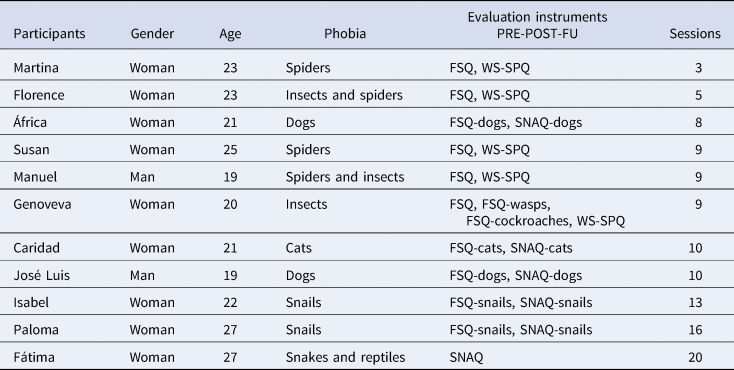
The study participants were all adults who attended the Psychological Attention Service of the University of Malaga. The participants were two men and nine women (between 19 and 27 years old; M = 22.45; SD = 2.88), with anxiety and avoidance problems in relation to various animals. In Table 1 appears the characteristics and type of anxiety stimuli for each participant.
Characteristics, Type of Phobia, Assessment, and Total Number of Sessions for Each Participant

NB: All cases were assessed with the general questionnaires, M-BAT (subjective anxiety) and heart rate measurement.
The participants were informed orally and in writing about the form of intervention, the possible effects, questions regarding ethics in scientific research, and the anonymity of their data. All participants voluntarily requested psychological intervention for their specific phobic problems and signed the informed consent form. The study participants are under assumed names with some assumed personal characteristics. Next, the fundamental problem of the 11 cases was a specific phobia, all whom fulfilled the phobia diagnostic criteria under the subtype ‘animal phobias’ in accordance with DSM-5 (APA, 2014). The following is a short description of the details for each participant.
Case 1. Martina, a 23-year-old woman with spider phobia. She lived with her partner. Her problem with spiders was lifelong and there was no specific initial episode. Interference on a scale of 0–10 was 8, according to the therapist's assessment after the interview. She presented escape/avoidance of situations and supervision at home and elsewhere if there were spiders.
Case 2. Florence, a 23-year-old woman with insect phobia and spider phobia. Her problem with these stimuli was lifelong and there was no specific initial episode. Interference on a scale of 0–10 was 8, according to the therapist's assessment after the interview. She presented avoidance behaviours such as not travelling to certain places and symptomatology such as palpitations, dyspnoea, tremors, the urge to cry, etc., and ruminative thoughts about finding insects.
Case 3. África, a 21-year-old woman with dog phobia. She had endured her problem with dogs during her whole life, and there was no specific initial episode. Interference on a scale of 0–10 was 8, according to the therapist's assessment after the interview. She presented avoidance/escape behaviours such as crossing the pavement if dogs were present, not visiting relatives or friends with dogs, etc., and other symptoms such as tachycardia, excessive sweating, intrusive thoughts about dogs, etc.
Case 4. Susan, a 25-year-old woman with spider phobia. She lived with her partner. Susan's first episode was at the age 6 years when she encountered a large spider in the ground floor of the house. Interference on a scale of 0–10 was 7, according to the therapist's assessment after the interview. She presented escape/avoidance of situations and supervision at home and elsewhere if there were spiders. If a spider appeared, then she would scream and run while calling for her partner or someone else to eliminate the spider.
Case 5. Manuel, a 19-year-old man with spider phobia and insect phobia. When he was 4 years old, Manuel saw a dense cobweb in his storage room that impressed him greatly. Interference on a scale of 0–10 was 6, according to the therapist's assessment after the interview. He presented escape/avoidance of situations and supervision at home and elsewhere if there were spiders, palpitations and breathing problems, and nagging thoughts about spiders.
Case 6. Genoveva, a 20-year-old woman with insect phobia. At the age of 5, she was stung by a wasp. From that point on, an intense fear appeared in Genoveva that was generalised to different types of insects (spiders, wasps, cockroaches, and flying insects). Interference on a scale of 0–10 was 10, according to the therapist's assessment after the interview. Confronted by insects, she presented palpitations, perspiration, thoughts that they would attack her, and she also felt blocked without knowing what to do. She also avoids and escapes from situations involving insects.
Case 7. Caridad, a 21-year-old woman with a cat phobia. She lived with her partner. Her problem began at the age of 14 when a cat unexpectedly climbed onto her table while she was eating in a bar, causing her to have an intense anxiety reaction. Interference on a scale of 0–10 was 9, according to the therapist's assessment after the interview. Caridad avoided and escaped from situations with cats in the street and not going to visit friends with cats, did not eat in terraces of bars, etc. When she had cats around, she suffered palpitations, cried, etc.
Case 8. José Luis, a 19-year-old man with dog phobia. The onset of his phobia was when he was 4 years old when he saw his mother's reaction to some dogs. Interference on a scale of 0–10 was 7, according to the therapist's assessment after the interview. He avoided and escaped from situations involving dogs, for example, he would not go out for walks at certain times and if he found them, he thought they could harm him.
Case 9. Isabel, a 22-year-old woman with snail phobia. Her problem started when she was 8 years old, when her classmates started to bring snails to his face at school. Interference on a scale of 0–10 was 10, according to the therapist's assessment after the interview. He avoided areas with gardens such as parks, swimming pools, going to the countryside, going out on rainy days, etc. In the presence of snails, she felt breathing difficulties, palpitations, perspiration, and a lot of tension and tightness in her chest.
Case 10. Paloma, a 27-year-old woman with snail phobia. She lived with her partner. Her initial episode was when she was 2 years old, peeing in bushes full of snails. Interference on a scale of 0–10 was 10, according to the therapist's assessment after the interview. She always avoided places where there could be snails. She was always feeling tense and hypervigilant. She felt palpitations, chest tightness, perspiration, tremors, and she began to cry inconsolably when she saw snails, because of the anguish they caused her.
Case 11. Fátima, a 27-year-old woman with snake phobia and a general reptile phobia. The first episode was at the age of 7 years when a large albino snake with red eyes was taken out of its cage at the town's animal fair, causing her mother to have an anxiety attack and become paralysed with fear. Interference on a scale of 0–10 was 10, according to the therapist's assessment after the interview. She avoided and escaped from situations where she could potentially encounter snakes or some types of reptiles: gardens, countryside, beaches … When she was in places related to reptiles or when she saw them, she felt palpitations, tremors, dizziness, and even fainting or paralysis.
Design
A single-case A-B-Follow-up design was carried out, with concurrent control of several baselines. This study also involves a systematic replication between subjects, using the same procedure and treatment in 11 different individuals with the same phobia problem. In general, the first follow-up (FU-1) was carried out at 3 months after completing the intervention and the second follow-up (FU-2) was carried out at 6 months after completion (except in the case of Susan, which was carried out at 2 years after completion). In addition, a group analysis of the pre-post measures was performed to assess the overall efficacy.
Instruments
In a standardised way, there was an evaluation similar to all cases, by means of an interview, a multimedia behavioural avoidance test (M-BAT), and general questionnaires; and on the other hand, we used specific questionnaires of each type of animal according to each individual case. Thus, the instruments were as follows:
First an interview with the Behavioural Interview for Specific Phobias (BISP) (Ruiz-García et al., Reference Ruiz-García and Valero-Aguayo2021a). The BISP is a semi-structured interview for the behavioural evaluation of any specific phobia. In it, in addition to the phobic aspects, general aspects such as history of the problem, previous treatments, interference in daily life, and coping styles are explored.
Then, the participants completed the following general questionnaires:
State-Trait Anxiety Inventory (STAI) (Spielberger et al., Reference Spielberger, Gorsuch and Lushene1986). Assesses anxiety as a state and as a trait. It is made up of 40 items in total, and is a highly reliable test, with an internal consistency ranging from α = .93 to .87.
Fear Survey Schedule III (FSS-III-122) (Wolpe & Lang, Reference Wolpe and Lang1964; Spanish version by Carrobles et al., Reference Carrobles, Costa, del Ser and Bartolomé1986). Is a self-report inventory consisting of 122 items, which refer to a wide range of fears: animals, agoraphobia, social, sexual, etc., and the degree of fear is indicated on a scale of 1 to 5. This inventory has an internal consistency of α = .97.
Fear Questionnaire (FQ) (Marks & Mathews, Reference Marks and Mathews1979; Spanish adaptation of Mathews et al., Reference Mathews, Gelder and Johnston1986). It evaluates avoidance, anxiety and depressive responses, and disability. This questionnaire comprises 24 items and evaluates the degree of avoidance of situations corresponding to agoraphobia, blood-injection-injury phobia, SAD, and the main phobia that the person wants to be treated (here animals). This instrument has shown good internal consistency in the range of α = .83 and .86 for total score; and in the range of α = .71 to .83 in the three subscales for clinical population.
Inadaptation Scale (IS) (Echeburúa et al., Reference Echeburúa, Corral and Fernández-Montalvo2000). This instrument evaluates the degree to which the disorder affects various areas of the individual's life, such as studies, social life, free time, relationship, family life, and degree of global maladjustment. The scale consists of six items and the responses score the degree of interference (from 0 to 6), with an α = .94.
Later, the participants completed some specific instruments according to their particular phobia. In this way, the items of FSQ and SNAQ were changed to snails, cockroaches, dogs, cats, and wasps (Ruiz-García & Valero-Aguayo, Reference Ruiz-García and Valero-Aguayo2021a)
Fear of Spiders Questionnaire (FSQ). The FSQ (Szymansky & O'Donohue, Reference Szymansky and O'Donohue1995; Spanish version by McCabe et al., Reference McCabe, Antony, Ollendick and Caballo2005) is a self-report questionnaire with 18 items on a Likert scale from 0 to 7 (totally disagree to totally agree). It has shown good internal consistency using α = .88 and in post-treatment using α = .94.
Snake Anxiety Questionnaire (SNAQ, Klorman, Hastings, Weerts, Melmed, & Lang, Reference Klorman, Hastings, Weerts, Melmed and Lang1974; Spanish version in McCabe et al., Reference McCabe, Antony, Ollendick and Caballo2005). This questionnaire assesses the severity of snake phobia. The SNAQ is made up of 30 true/false items and has a high reliability, α = .78 to .90.
Also, as an observational assessment, the participants completed an M-BAT (Ruiz-García et al., Reference Ruiz-García, Valero-Aguayo and Hurtado-Melero2019; Ruiz-García & Valero-Aguayo, Reference Ruiz-García and Valero-Aguayo2021a). It is an observational test in which the participant was shown 10 photographic elements and 10 video elements, all of which were adapted to the specific anxiety stimuli for each person. The images and videos were downloaded from the Internet in some cases, and in other cases, they were produced with photo or video cameras by the members of the research team. The duration of the videos during the evaluation was 30 s, with the images being shown for a few seconds in order that the participant could observe them. Before each stimulus, the participant reported the degree of subjective anxiety on a 0–10 Likert-type scale, from no anxiety at all (0) to a lot of anxiety (10). In addition, the reactions and emotions that the participants showed regarding each of these visual stimuli were noted in the record of exposures.
To apply this M-BAT, a computer, sound speakers, light-cannon/projector, and projector screen were used. The equipment also included a laptop with Windows 7 as the operating system, a VLC video/media player and a photo display software, 5W powered loudspeakers for the videos with sound, and a projector that was located at one end of the laboratory space. At the other end, there was a white 2 m × 3 m screen, on which images and videos were projected.
In the other hand, during assessment and treatment, to verify the anxiety grade of participants while they were viewing images, a Digital Medical Pulse Oximeter (MD300) was used. This oximeter is an electronic device that is used for clinical and medical measurement, which is placed on a participant's finger and facilitates measurements of heart rate and blood oxygen saturation. In each trial, the maximum heart rate that was displayed by the device when each image or video was shown was recorded.
Finally, during treatment, a Self-registration of Relaxation and Exposure (Ruiz-García & Valero-Aguayo, Reference Ruiz-García and Valero-Aguayo2021a) was used. This self-recording format was made using paper and pencil, so that each participant could apply the relaxation tests and the self-exposure tests that he/she carried out in his/her daily life, as a homework exercise. Each participant recorded the degree of relaxation or subjective anxiety on a daily basis (Likert-type scale of 0–10).
Procedure
During the intervention, after returning the evaluation results, abdominal breathing training was carried out and subsequently, the progressive multimedia exposure began. Approximately 20 items (10 photographs and 10 videos) were presented in each intervention session.
Exposure phase with photographs
High-quality photographs that were related to the stimuli feared by each participant were used; the stimuli were well focused and without distractors in the images. The therapist guided the breathing exercise, when necessary, encouraged the participant to observe the elements that were presented, and also gave feedback and social reinforcement for the progress that was achieved. When the anxiety was rated at less than 5 points, the images were mixed with videos.
Exposure phase with videos
These were of high quality, and they were specific to each participant; further, in some cases, they were produced by the researchers. During the exposure, each video appeared for a maximum duration of between 1 and 3 min. With other videos of longer duration, they were divided into parts, and every 3 min the participant's subjective anxiety report was requested. As in the previous phase, the breathing exercise was used, plus social reinforcement of the achievements that were obtained.
Exposure phase with simulated stimuli
Once the subjective assessment of anxiety had dropped between 30 and 50% when the participants were presented the photos and videos, the simulations were introduced. The participant was not warned that they were engaging in simulated stimuli. Plastic insects, dead insects preserved in alcohol, plastic snakes and lizards, recorded noises, or buzzing, etc., were used. Each new stimulus was exposed for about 3 min duration while recording the final degree of anxiety that was reported by the participant.
Exposure phase with real stimuli
Finally, once the anxiety scores in these situations had been reduced, the therapist facilitated or created live exposure situations (with real insects, lizards, snails, dogs, cats, etc.). These tests were carried out both inside and outside of the laboratory, for example, with dogs in the gardens of the faculty. In real situations, the therapist requested and recorded the anxiety assessment that was reported by the participant at intervals of 3 min.
Data Analysis
Since a single-case design has been used, a visual analysis of the baselines in systematic replication and their progression has been carried out. The pre–post results were analysed individually using the Wilcoxon signed-rank test (which is a non-parametric test), in the case where the scores were obtained in the M-BAT. The scores obtained at pre-, post-, and follow-up were analysed for each case, using the means of subjective anxiety in images and video, mean heart rate for images and videos, and the scores of the general and specific questionnaires and subscales used in each case. Furthermore, in order to obtain an overall efficacy of the procedure, the pre–post data were compared as if they were a single group, also using non-parametric tests, and the effect size was calculated using Cohen's d. All analyses were performed with SPSS version 23 for Mac.
Results
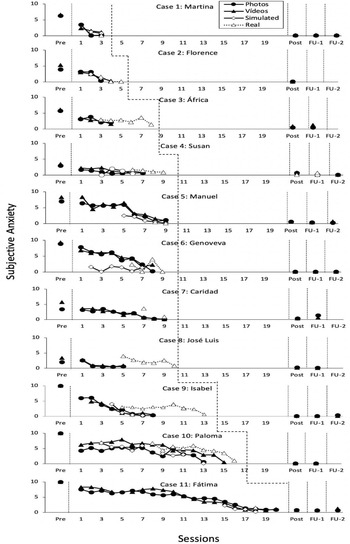
The results that were obtained from the evaluation and intervention in the different cases are presented here, in brief and summarised, and then the general analysis as a group. Table 1 shows the number of sessions and instruments used for the pre-post evaluation for each participant. Also, in Figure 1 the individual data and concurrent baselines can be observed, with systematic replication between subjects, with the evolution of each of the cases and each of the treatment phases.
Baselines of assessment and treatment for each participant.

Case 1. Martina, a woman with spider phobia. The intervention was carried out in three sessions. After the treatment, she could kill or eject spiders from the house. She had reduced her worry and her hypervigilance. Scores were statistically significantly reduced in pre-post (N = 27, Z = −3.173, p < .05), showing no changes between post and FU-1, and in FU-2, thus indicating that long-term treatment improvements were maintained.
Case 2. Florence, a woman with spider phobia. The intervention was carried out in five sessions. When she finished, she could be at home alone even if there were spiders and also, and she could eliminate them without assistance. Statistically significant effects were found in pre-post (N = 27, Z = −1.978, p < .05). In this case, it was not possible to carry out follow-ups due to her change of residence to a location outside of the city.
Case 3. África, a woman with dog phobia. The intervention was carried out in eight sessions. At the end, África could feed dogs from her hand to their mouth and also play with them, and shortly before FU-1, she rescued a stray dog from the street, but her mother did not want to keep the animal at home. Significant changes were found in pre-post (N = 24, Z = −2.142, p < .05) and between post and FU-1 (N = 24, Z = −2.820, p < .005). It was observed that, in addition to maintaining the changes, there were additional improvements in the follow-up.
Case 4. Susan, a woman with spider phobia. The intervention was carried out in nine sessions. Upon completion, Susan was able to touch a live tarantula spider with her bare hands in a controlled environment (pet shop), and visit places with gardens, fields and mountains without a problem. In FU-1 and FU-2, the treatment improvements were maintained, and Susan was able to make a trip to the jungle in South America that she had always wanted but feared because of the size of the spiders there. From this trip, she brought back pictures of spiders that she had taken. Also, significant changes were obtained in pre-post (N = 13, Z = −2.758, p = .006) indicating the improvement, and between post and FU-1 and FU-2 there were no changes, which shows that the improvements were maintained over the long term.
Case 5. Manuel, a man with spider phobia and general insect phobia. The intervention was carried out in nine sessions. After completion, the spiders and cobwebs were not a cause for concern for Manuel, and he even informed the therapist that he would take a trip to South America, despite there being large spiders there. Statistically significant changes were obtained in pre-post (N = 27, Z = −4,111, p < .0001) as expected. In FU-1, and FU-2, a statistically significant reduction was also found (N = 27, Z = −2.832, p < .05).
Case 6. Genoveva, a woman with insect phobia. The intervention was carried out in nine sessions. When she finished, she could go to the countryside with her parents without being overly alert, enjoy the walks, and she even decided to do fitness training by going out for athletic running in the countryside. She also managed to make the trip to South America, and although the first moments were difficult, she was able to face the different situations with insects, for which she affirmed intense satisfaction. Statistical significance data reveal pre–post changes (N = 29, Z = −3.509, p < .0001), but not between post and FU-1, nor between FU-1 and FU-2, which indicates that they were changes which were maintained in a later period.
Case 7. Caridad, a woman with cat phobia. The intervention was carried out in 10 sessions. At the end of her intervention, she could be in a room with cats, touch cats, and let cats pass near her without problems. In FU-1, Caridad reported that she had no problems if she saw cats on the street or if she was at someone's house with cats. There was statistical significance between pre–post (N = 25, Z = −1.972, p < .05) and between post and FU-1 (N = 25, Z = −2.716, p = .007), which indicates that the changes were maintained and even further improved in the parameters that were evaluated.
Case 8. José Luis, a man with dog phobia. The intervention was carried out in 10 sessions. In the end, he could play with dogs and go to his friend's house where there were dogs, hence he was no longer avoiding dogs. Significant changes were found between pre–post (N = 23, Z = −3.140, p = .002), but not between post and FU-1. No further follow-ups could be carried out using questionnaires, although in an accidental encounter with the therapist one year later, José Luis reported that he continued to feel well around dogs and played with his friend's dogs without problems.
Case 9. Isabel, a woman with snail phobia. The intervention was carried out in 13 sessions. Isabel obtained obvious clinical improvements in her daily life after the intervention. She could engage in activities that she did not do before (go for a run-on rainy days, be barefoot on grass, etc.) even if she encountered snails. After several live exposure sessions with snails, the therapist suggested that Isabel take care of the study snails in order to carry out self-exposures at home (keep them at home in her snail carrier, clean it, feed them, etc.). After her intervention, Isabel decided to keep the snails as pets, and after the follow-ups, she continued taking care of them. Regarding the statistical data, significant changes were obtained in pre-post (N = 23, Z = −3.495, p < .0001) and in post versus FU-1 (N = 23, Z = −3.340, p < .001), but not between FU-1 and FU-2. Therefore, the effects of the intervention were maintained for a long time afterwards.
Case 10. Paloma, a woman with snail phobia. The intervention was carried out in 16 sessions. At the end, she could be in the presence of snails, manipulate them, and step barefoot on the sand or grass where there were snail shells nearby. Paloma also took the snails that were used in the intervention as pets, which she kept until the last follow-up, where in the evaluation of the photographs she expressed that the snails were ‘beautiful, with an artistic touch’. The pre–post results were significant (N = 24, Z = −3.949, p < .0001), but these effects were not showing in results between post and FU-1.
Case 11. Fátima, a woman with snake phobia and general reptile phobia. The intervention was carried out in 20 sessions. At the end, she could pass near flower beds where there were lizards and, in the countryside, or on wild beaches that she liked to visit, and she had found snakes and serpents to be no problem. She showed significant changes in pre–post (N = 22, Z = −3.664, p < .0001), also between post and FU-1 (N = 23, Z = −3.520, p < .0001), but not between FU-1 and FU-2, which shows that the changes were maintained for a long time afterwards.
To assess the general effectiveness of the multimedia exposure procedure, the data in the M-BAT, the general questionnaires, and the specific questionnaires were compared as a group. Statistically significant pre-post changes were found in: subjective anxiety in M-BAT images (N = 11, Z = −2.936, p < .01) and M-BAT videos (N = 11, Z = −2.938, p < .01); STAI-E (N = 11, Z = −1.780, p < .05); FSS-122 (N = 11, Z = −2.624, p < .01); FQ (N = 10, Z = −1.897, p < .05); FSQ (N = 12, Z = −3.059, p < .01); SNAQ (N = 6, Z = −2.201, p < .05); and IS (N = 11, Z = −2.803, p < .01). But they were not found in the maximum heart rate in M-BAT images, nor in M-BAT videos. Between post and FU-1, there were no statistically significant changes, which indicates that the achievements were maintained, except in this comparison in SNAQ where there are significant improvements (N = 6, Z = −1.153, p < .05). In FU-1 and FU-2 comparisons, significant improvements were found in FSQ (N = 7, Z = −1.753, p < .05), but in the rest of the variables there were no changes, therefore, we can affirm that the improvements obtained by the treatment continued to be maintained in the follow-ups.
In addition, to assess the degree of change that was achieved with this procedure, the Cohen's d effect size in the pre-post was found, which is significant in M-BAT images and M-BAT videos (d = −2.84 and d = −30.03, respectively), and in the IS, FSQ, SNAQ questionnaires (d = −1.63, d = −2.29, and d = −2.41 respectively), that is, the largest effect size occurs in the specific instruments of the phobias that were evaluated. The table with the original data, means, and SDs is presented in a supplementary file (https://osf.io/2up9y/?view_only = 3c8560fb64dd4ee5a45de26302eaa7b1). Cohen's d was calculated for each variable with the pre versus post value. In this case, the value of M-BAT videos was so large (−30.03) because the participant's scores went from 10 points at pre (SD = .10), to 0.39 at post (SD = .32).
Discussion
The progressive multimedia exposure protocol, that was applied in this group of 11 cases of specific animal phobias, has shown to be effective according to the results obtained, that are presented as unique cases, in the replication of concurrent and between-subjects baselines, in addition to the analysis as a group. In the first, this design with multiple baselines assures that the results are due to the treatment and not to some incidental variable or specific characteristics of the participants. In this type of design, the A baseline is the control of the participant him/herself and also the control of the other subjects. The change in target behaviour occurred precisely and only when the intervention was introduced. Secondly, to add a follow-up phase in this design assures that the results are enduring, and they are not changed by incidental or temporal variables.
In fact, statistically significant improvements have been observed in all cases in the pre–post comparisons and the results were maintained in the long term, and even in some cases, the results continued to improve due to the self-exposures of the participants.
In the present study, we have provided data on the maintenance of very long-term achievements, between 6 months and 2 years. At the clinical level, it is clear that all of the participants improved, since the phobic stimuli that previously prevented their normal functioning (problems entering the house, not visiting certain places, anticipation of encountering phobic stimuli, appearance of physiological responses of anxiety, behavioural avoidance, etc.) were reduced and eliminated in all cases. The treatment protocol, through progressive multimedia exposure, has shown its usefulness and efficacy in all of these clinical cases. Similar results have been obtained in other similar work carried out by the team, where comparisons were made with waiting list conditions and control groups (Ruiz-García & Valero-Aguayo, Reference Ruiz-García and Valero-Aguayo2017, Reference Ruiz-García and Valero-Aguayo2020a).
These statements are supported by the results in the group analyses that were carried out for each dependent variable that was studied, where statistically significant changes have been found in the pre–post comparisons in all of the instruments, except in heart rate. In relation to this type of measurement, mixed results have been found, whereby in some studies, there are relationships between these physiological measures and avoidance or cognitive measures, but in other studies, these relationships do not appear (Ruiz-García et al., Reference Ruiz-García, Valero-Aguayo and Hurtado-Melero2019; Gonçalves et al., Reference Gonçalves, Rodrigues, Novaes, Arbol, Volchan, Silva and Ventura2015). However, in individual sessions, it can be a useful parameter with which to monitor relevant changes in physiological activation, although it does not show these effects as indicated in post-intervention evaluations.
In this study, an average of 10 sessions was needed for the successful resolution of the interventions that are presented. In order to determine whether this procedure is easier or more acceptable for the individual than other forms of exposure, whether it allows greater control for the therapist than other procedures, or whether it is achieved in fewer sessions, it would be necessary to carry out another type of investigation in comparing this technological type of procedure to other procedures that have already been established (Page & Coxon, Reference Page and Coxon2016; Powers & Emmelkamp, Reference Powers and Emmelkamp2008; Quero et al., Reference Quero, Botella, Guillén, Moles, Nebot, García-Palacios and Baños2012). Only a few cases of phobias have been treated in this way (Ruiz-García & Valero-Aguayo, Reference Ruiz-García and Valero-Aguayo2020a, Reference Ruiz-García and Valero-Aguayo2020b; Hassan, Reference Hassan and Olisah2012). However, and assuming equal efficacy, we consider that this type of psychological intervention would be useful and economical for any clinician. It could be adapted to any type of phobic stimulus, with a low cost as a procedure, and it would probably be more accepted by clients as a way of dealing with a later live exposure.
As a proposal for application to other problems or disorders, this same multimedia procedure could be used with other stimuli or situations that are sensitive to work in live exposure, within anxiety disorders, other specific phobias, social phobia, fear of public speaking, or test anxiety. In fact, our team is already working on an assessment and intervention system based on this protocol for exam anxiety.
Despite the good results that were obtained, only the effectiveness of the multimedia procedure has been shown. Therefore, it would also be necessary to verify the effectiveness, that is, compare this type of studies against other active treatment conditions (live exposure, virtual reality, in imagination, etc.), or also test the protocol in other types of cases (blood-injection-injury, situational, etc.) in order to be able to generalise these results to other types of stimuli, and to use even larger samples that would allow providing more strength to the results presented here. On the other hand, since they are types of single-case designs, although they have systematic replications between subjects, they have the limitations in establishing generalisation. However, we believe that replication in baselines and between subjects through different phobias, with clinical and statistical changes in all cases, would allow robustness in the results that are presented.