1. INTRODUCTION
Our study presents a sociolinguistic analysis of lexical variation in the spoken French of 41 French immersion students in Ontario, Canada. Specifically, it focuses on words that in Canadian French refer to the notion ‘car’ (e.g.: auto, char, etc.). While a large body of research now exists on grammatical variation in the spontaneous speech of French immersion students (see Mougeon, Rehner and Nadasdi, Reference Mougeon, Rehner and Nadasdi2004) relatively little is known about the distribution of lexical variants in such speech. To date, only one such study (Nadasdi and McKinnie, Reference Nadasdi and McKinnie2003) has considered this issue. Studies of lexical variation in spoken Canadian French are also rare. This reflects in part the fact that some sociolinguists have expressed reservations about extending the concept of the sociolinguistic variable beyond phonology (e.g., Lavandera, Reference Lavandera1978). However, other sociolinguists have argued that non phonological variables, notably lexical ones, can be the object of sociolinguistic investigation with due consideration given to the methodological principle of the semantic equivalence of variants, see Armstrong, (Reference Armstrong2001); Lodge (Reference Lodge2004); Sankoff (Reference Sankoff and Newmeyer1988) and especially Chambers (Reference Chambers1999, Reference Chambers2000, Reference Chambers2002, Reference Chambers and Hickey2004). Chambers has notably examined lexical variation in Canadian English from the dual perspective of sociolinguistics and geolinguistics. Another reason for the scarcity of variationist studies of lexical variation in spoken Canadian French is the fact that the corpora of semi-directed taped interviews used by variationist sociolinguists yield only a limited number of lexical variables that are frequent enough to lend themselves to statistical analyses of variance.
As a backdrop to the present study, we first present an overview of previous studies of sociolinguistic variation in immersion French and make several hypotheses concerning the use of the variants that make up the current variable. In addition to this review, we will review previous studies having examined the use of variants meaning ‘car’ in the speech of Canadian francophones in order to arrive at an L1 benchmark for the present study.
The main questions addressed in this paper are: a) do the French immersion students use all of the variants that mean ‘car’ in Canadian French; b) does their frequency of use of such variants differ from that of native speakers of Canadian French (e.g., do they under-use the marked informal variant char, do they overuse the hyper-formal variant voiture); c) does their use of the variants under study reflect the treatment of these variants in the educational input of the students' (i.e., French immersion teachers' speech and French language arts teaching materials) – specifically, we examine the frequency of the variants, the information regarding their socio-stylistic status, and any special activities targeting their use; and d) what are the linguistic and extra-linguistic factors that correlate with the students' variant choice (e.g., lexical priming by the interviewer, the students' extra-curricular exposure to Canadian French, the students' home language).
2. METHODOLOGY
The 41 speakers in the present study were Grade 9 and 12 students (ages 14–17) taken from Mougeon and Nadasdi's 1996 corpus of immersion French. The data they have provided come from semi-directed interviews similar to those used in previous sociolinguistic research on variation in L1 Canadian French. All speakers were enrolled in programmes where 50% of courses were taken in French from Grades 5–8, followed by 20% in high school. Though these students speak a variety of languages in the home, none of them learned French as a first language and all come from homes where neither parent is a native speaker of French and where French was not spoken in the household. As such, these students' use of and exposure to French has been largely limited to the school setting. Although these students were not from French-speaking homes, they were by no means all from unilingual Anglophone homes. In fact, 51% of our subjects came from homes where a language other than English was used to varying degrees. Of these students, 39% came from homes where Italian or Spanish were spoken and the rest were from non-Romance language homes. There was approximately the same number of Grade 9 and 12 students, more females than males, and over half were from middle-class families with all but one of the remaining being from lower-middle-class families. The majority of the students have received between 26–37% of their schooling through the medium of French. Most students never use the spoken French media; however, there were more Grade 12 students than Grade 9s who did so occasionally. The Grade 12 students had also spent more time in Francophone environments and with Francophone families than was the case for the Grade 9 students. These stays in a Francophone environment or with a Francophone family took place, for the most part, in Quebec. The average duration of these stays is 17 days.
In addition to the student corpus, we use two corpora in our research that provide data on the type of educational input to which students have been exposed. This data takes two forms. First, we have examined Allen, Cummins, Harley and Swain's Reference Allen, Cummins, Harley and Swain1987 corpus of French immersion teachers' speech to gain insight into the range of variants used by teachers when speaking in the classroom.Footnote 2 Second, we have examined in their entirety two series of materials, one called Portes ouvertes sur notre pays which included series 1A and B (Roy Nicolet and Jean-Côté, Reference Roy Nicolet and Jean-Côté1994) and 3A and B (Le Dorze and Morin, Reference Le Dorze and Morin1994), which was used in the school district where we gathered our student corpus, and the other called Capsules (Deslauriers and Gagnon, Reference Deslauriers and Gagnon1995, Reference Deslauriers and Gagnon1997), which was used in the Toronto District School Board. In our results section, we consider patterns of convergence and divergence between students' use of the ‘car’ variable and the availability of the variants in the input to which they are exposed.
3. PREVIOUS RESEARCH
3.1 Sociolinguistic variation in the speech of French immersion students
Over ten years of research on our French immersion corpus has brought to light a variety of trends concerning sociolinguistic variation in the speech of French immersion students. This research has focused on sociolinguistic variables that include variants that can be placed at various points on a socio-stylistic continuum ranging from marked informal variants to hyperformal ones, discussed notably in Mougeon et al. (Reference Mougeon, Rehner and Nadasdi2004). Our socio-stylistic categorisation of variants is based on the findings of research on the effect of speaker social class and sex on variant choice and on variant frequency in corpora of spoken Quebec French or Ontario spoken French gathered via semi-directed taped interviews (see Mougeon, Nadasdi and Rehner, 2003).Footnote 3 It includes the following categories; i) marked informal variants (used by working class and/or male speakers markedly more often than by speakers from the other social classes and the other sex); ii) mildly-marked informal variants (gradient or weak correlations with social class and sex and high discursive frequency); iii) neutral variants (no correlation with speaker social class and sex); iv) formal variants (used by upper middle class and/or female speakers markedly more often than by speakers from the other social classes and the other sex) and v) hyperformal variants (used only by speakers at the top of the social ladder and low discursive frequency).
The above-mentioned research has revealed that French immersion students:
a) never, or rarely make use of marked informal variants (e.g., (ça) fait (que) with the meaning ‘therefore’, cf. Rehner and Mougeon, Reference Rehner and Mougeon2003).
b) use mildly-marked informal variants at levels of frequency well below FL1 norms (e.g. ne deletion, cf. Rehner and Mougeon, Reference Rehner and Mougeon1999)
c) tend to overuse formal and hyper-formal variants (e.g. subject pronouns nous, cf. Rehner et al., Reference Rehner, Mougeon and Nadasdi2003)
d) use neutral variants in a manner that reflects the systemic properties of these forms (e.g. the under-use of morphologically complex forms such as falloir + que + subjunctive, cf. Lealess, Reference Lealess2005)
e) tend to use variants at levels similar to those found in their educational input (e.g. conjunctions alors and donc to express the notion of consequence, cf. Rehner and Mougeon, Reference Rehner and Mougeon2003)
f) follow some, but not all linguistic constraints on variation found in L1 French (e.g. they respect only one of the linguistic constraints on choice of future tense variants attested in L1 French, cf. Nadasdi, Mougeon and Rehner, Reference Nadasdi, Mougeon and Rehner2003)
g) follow some, but not all social constraints on variation in L1 French (e.g. female and middle-class students use hyperformal subject pronouns nous more often than male and lower-middle-class students, cf. Rehner, Mougeon and Nadasdi, Reference Rehner, Mougeon and Nadasdi2003)
h) tend to use variants that have a home-language counterpart (e.g. students who speak Italian at home use the variant alors exclusively (modeled on allora) to express the notion of consequence, cf. Rehner and Mougeon (Reference Rehner and Mougeon2003).
After having considered the distribution of the variants for the current variable in L1 Canadian French, we will make hypotheses concerning the use of these variants by French immersion students, drawing on the previous findings outlined above.
Concerning the precise topic of lexical variation in the speech of French immersion students, we note that two lexical variables have been previously studied: a) the alternation between verbs with that mean ‘dwell’, i.e., habiter, vivre, rester, demeurer and b) nouns used to refer to remunerated work, i.e., travail, job, ouvrage, emploi, poste, situation (cf. Nadasdi and McKinnie, Reference Nadasdi and McKinnie2003).
Results reveal that French immersion students express the notion of ‘dwell’ with either vivre, a socio-stylistically neutral variant in spoken Quebec French and habiter (a formal variant in spoken Quebec French). Interestingly they do not use demeurer, which is also a marked formal variant in spoken CF and they do not use the verb rester with the meaning of ‘dwell’ (a marked informal variant in spoken Quebec French). As for lexical items referring to remunerated work, it was determined that, here too, French immersion students make use of only a subset of the variants found in spoken Quebec French (namely travail, emploi and job). In keeping with findings regarding the ‘dwell’ variable, the immersion students make no use whatsoever of the marked informal variant ouvrage and also never use the formal variant poste. For both variables, there is evidence that immersion students' use of lexical variants strongly reflects the input to which they are exposed. For example, like the students, French immersion teachers and the authors of the French language arts textbooks do not make use of variants rester and ouvrage. Another relevant finding is that lexical priming exercises a strong influence on the use of variants used by French immersion students, i.e. the use of a given variant in the interviewer's question strongly promotes the use of the same form in the learner's response. One final noteworthy finding from previous research on lexical variation in French immersion students' discourse is that some of the students in our corpus prefer variants that have an equivalent in their home language. This was evidenced, for example, by the fact that the use of the form travail is greatest among individuals who speak Spanish and Italian in the home since both of these languages have a cognate form (cf. Nadasdi and McKinnie, Reference Nadasdi and McKinnie2003).
3.2 Lexical variants meaning ‘car’ in L1 Canadian French
Let us turn now to variationist studies that have examined nouns that mean ‘car’ in the speech of native speakers of Canadian French. Only two such studies exist, namely Martel's (Reference Martel1984) study of lexical variables (including ‘car’) in the variety of French spoken in Sherbrooke (in the Eastern Townships of Quebec) and Nadasdi, Mougeon and Rehner (Reference Nadasdi, Mougeon and Rehner2004) in the varieties of French spoken in Hawkesbury, Cornwall, North Bay and Pembroke, Ontario.
Given that the immersion students focused upon in our research have had interactions with L1 speakers of Canadian French mostly in Quebec, Martel's study is especially relevant for comparative purposes, unfortunately it is based on a corpus gathered in the early 1970s. As for Nadasdi et al.'s (Reference Nadasdi, Mougeon and Rehner2004) study, it is based on the Mougeon and Beniak corpus gathered in 1978. To obtain a more recent picture of the frequency of the variants under study we present below the findings of a special analysis of variant frequency in the corpus of Ontario French gathered in 2005 by Mougeon, Nadasdi and Rehner in the same localities where Mougeon and Beniak collected their corpus. The relevance of the Ontario French corpora lies in the fact that the francophone communities where they were gathered are located near the Quebec/Ontario border and are the result of Quebecois immigration. It is also noteworthy that the speakers of Ontario French who provided these corpora are also of the same age as the immersion students under study.
The two studies mentioned above identified five variants. Examples of these variants, taken from the Mougeon and Beniak and Mougeon, Nadasdi and Rehner corpora, are presented below:
1) j'étais en-dessous du char
2) c'est à peu près une demi−heure de voitured'ici
3) un' autoFootnote 6pouvait te durer au moins 10 ans
4) peut-être j'm'achèterais un' automobile
5) ça va pour des ‘spark plug’ de ma machinedes bougies pour ma machine
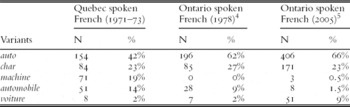
The overall frequencies of variant usage are presented in Table 1.
Variants meaning ‘car’ in Canadian French

Table 1 reveals that the most frequent word used to mean ‘car’ in Quebec and Ontario spoken French is auto. In the spoken French of Sherbrooke char, machine and automobile can be characterised as secondary variants, while voiture is clearly a marginal variant. The Franco-Ontarian corpora yield similar results: auto is the base variant, char is a secondary variant, used approximately one quarter of the time, voiture, which was quite rare in the 1978 corpus has undergone a modest rise in the 2005 corpus and both automobile and machine are marginal. The rarity of machine in the corpora of Ontario French (corpora gathered among adolescent speakers) is in keeping with Martel's findings. Machine is primarily used by the speakers who are 50 years old or older and is hardly used by the younger speakers (20–29 years old) in the Sherbrooke corpus.
3.3 Effect of linguistic constraints on variant choice
In Martel's (Reference Martel1984) study, no linguistic constraints were examined for this variable. However, Nadasdi et al. (Reference Nadasdi, Mougeon and Rehner2004) identified two linguistic factors influencing variant choice, namely interviewer priming and preceding element. Lexical priming by the interviewer is illustrated in 5), taken from the Mougeon and Beniak corpus:
Lexical Priming
5) Interviewer:
ah l'école garde l'auto?
Response:
oui elle garde l'auto
Nadasdi et al. (Reference Nadasdi, Mougeon and Rehner2004) found that when the interviewer asked a question containing one of the variants, this variant was used categorically in the response.
Concerning preceding element, three contexts were examined: a) preceded by a preposition; b) preceded by an adjective; and c) preceded by a determiner. These three contexts are presented below (taken from the Mougeon and Beniak corpus):
Preposition
6) comment je me rends là? en auto
7) non en en char
Adjective
8) bien j'aimerais avoir une belle auto
9) il était le plus beau char au monde
Determiner
10) il y a un' auto stationné là-bas
11) il avait un char
Note, that the effect of context was examined only in relation to auto and char. The other two variants, namely automobile and voiture were not frequent enough to lend themselves to this type of analysis. Consideration of preceding contexts led Nadasdi et al. (Reference Nadasdi, Mougeon and Rehner2004) to the conclusion that, unlike char, auto is favoured in contexts where the preceding element is a preposition. The explanation provided for this pattern is that expressions like en auto are partially lexicalised (especially more so than en char).
3.4 Effect of social constraints on variant choice
Martel (Reference Martel1984) made several observations concerning the effect of social factors on variant choice. He found that char, which he describes as a vernacular variant, is favoured by working class speakers and is used only marginally by those in the professional class. On the other hand, auto is used by speakers from all social groups, and is particularly frequent with speakers under 30 years of age. The form automobile is found, in particular, in the speech of middle-aged speakers. As for the variant machine it is also labelled as vernacular by Martel. Further, it is associated with older speakers and is marginal in the speech of younger speakers. Finally, Martel describes voiture as a prestige variant found almost exclusively in the speech of the upper-middle class.
Nadasdi et al. (Reference Nadasdi, Mougeon and Rehner2004) arrived at the following results concerning social constraints on the variable in Ontario spoken French. First, female students make greater use of the variant auto than do males, while males show a stronger preference for char than do female speakers. Concerning social class, no discernible pattern obtains for char. However, auto is found more often in the speech of middle-class speakers than working class ones. These results suggest that auto may be more marked socially as a formal variant than char as an informal variant. Concerning variant voiture, it was too infrequent in their data to draw conclusions about its distribution according to sex or social class.
One particularly interesting result reported by Nadasdi et al. (Reference Nadasdi, Mougeon and Rehner2004) concerns the distribution of the variant char according to the extent to which speakers used French and English in daily interactions. In particular, they found that speakers who used French and English about as frequently (semi-restricted speakers in the Mougeon and Beniak corpus, see Mougeon and Beniak, Reference Mougeon and Beniak1991) showed a preference for char. The interpretation they offer for this correlation is that it can be attributed to the fact that the balanced bilinguals have relatively high contact with vernacular French, the source of char, and English which possesses the near cognate car. The hypothesis that French/English bilinguals may show a preference for variant char due to its semantic and morphological similarity receives indirect support from the findings of Quebecois lexicologists. They found that the French word char acquired the meaning of English word car in Quebec French around the beginning of the twentieth century, i.e. at the time when cars started to be mass-produced in North-America, see Poirier (Reference Poirier1998). In other words, according to this author use of char to mean an ‘automobile’ is a case of semantic extension induced by contact with English.
In sum, while speakers of Quebec French use auto as the base variant whose socio-stylistic status is relatively neutral, in the speech of Franco-Ontarian adolescents this word is more aptly categorised as a formal variant. Both Quebec and Ontario speakers make very rare use of automobile and even rarer use of voiture although the latter variant may have undergone a relative rise recently (as indicated by the 2005 corpus of Ontario spoken French). The rarity of voiture in the Mougeon and Beniak 1978 corpus made it impossible to determine its socio-stylistic status. In the Sherbrooke corpus however, it was clearly a hyperformal variant. As for char this variant can be viewed as marked informal (although evidence for this in the Ontario corpus is less clear-cut). Finally, balanced bilinguals show a predilection for this latter variant, a result that may be attributed in part to the existence of car in their other language.
4. HYPOTHESES
We have seen that L1 speakers of Canadian French make use of five variants to refer to the notion of ‘car’ in their spoken discourse. Furthermore, our review of previous studies of the variable has revealed that the social status of the variants spans the full stylistic continuum. At the vernacular end of this range, one finds variants char and machine, at the other end one finds the variants automobile and voiture, while the variant auto holds an intermediary position between the two ends. We have also noted that the variable correlates with two linguistic factors and a variety of social factors. These findings, coupled with our review of previous research on the French immersion corpus led us to a number of hypotheses regarding the use of variants by immersion students:
a) it is unlikely that immersion speakers will make use of the vernacular variant machine since previous research shows that marked informal variants are all but absent from immersion speakers speech and since, during their brief stays in Quebec, they are unlikely to have had many interactions with older speakers of Quebec French, the vanishing users of this variant.
b) it is possible that immersion students will make use of the vernacular variant char, given its formal similarities with the English equivalent car and the fact that it ranks second in frequency behind auto in Quebec spoken French.
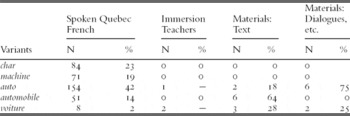
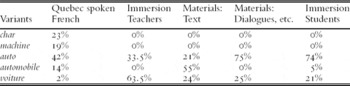
Before finishing with our hypotheses, let us briefly examine the representation of these variants in the input to which French immersion students are exposed. Information regarding the availability of variants in this input is provided in Table 2.
Percentage of variants in Quebec spoken French and in the educational input of immersion students

The first observation to be made is that none of the different kinds of input make use of the marked informal variants char and machine. Furthermore, the frequency of variant voiture in the educational input of the students is higher than in spoken Quebec or Ontario French (including the most frequent 2005 corpus). It should be noted, however, that the teacher classroom speech corpus contained too few instances of the variable to arrive at firm conclusions. While the frequency of voiture in the teaching materials is higher than in spoken Canadian French the disparity is not as extreme as what we observed with other hyperformal variants (e.g., consequential conjunction donc see Nadasdi et al. Reference Nadasdi, Mougeon and Rehner2005). In fact in the dialogic parts of the materials the frequency of auto is not too far removed from that found in corpora of spoken Canadian French. In the textual parts of the materials, however, automobile is clearly the preferred variant, a finding which suggests that this particular word is associated with formal written Canadian French.
Consideration of the input to which students are exposed led us to further hypotheses, regarding the neutral variant auto and the formal ones, namely voiture and automobile:
c) the immersion students will make frequent use of the variant auto since it is abundant in the input to which they are exposed (it is found in all input sources) and is not structurally complex;
d) the immersion students will make use of the hyperformal variant voiture and of the formal variant automobile since both variants are found in their input and automobile has an English cognate; however, in line with their educational input, the frequency of the formal variants should be lower than that of auto.
Regarding correlations between variants and the linguistic and social factors that have been found in L1 Canadian French, it is likely that some, but not all of these factors will condition variant usage.
5. RESULTS
5.1 Overall distribution of variants
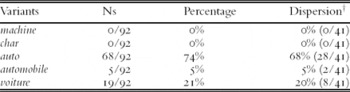
The general distribution of the five variants in the immersion students' spoken French speech is presented in Table 3.
General distribution of variants among immersion students

†Dispersion rate: number of speakers who used a given variant at least once divided by the total number of speakers.
As we can see, neither marked informal variant (char and machine) was used by speakers in the French immersion corpus. This finding clearly confirms hypotheses a) and b) mentioned in the preceding section. It is also in keeping with the general trends discussed above in section 3.1 and is reminiscent of the finding that the vernacular lexical variants rester ‘live’ and ouvrage ‘job’ are absent from the speech of French immersion speakers. While the absence of char is not surprising, it should be pointed out that it constitutes a clear divergence between L1 and L2 speakers since the former speakers use it in approximately one quarter of occurrences in the same situation of communication, namely a semi-directed taped interview. Note also that we had considered the possibility that char might have some currency in the speech of immersion speakers since it is formally similar to the English equivalent car and that a correlation between the use of English and this variant was found in Nadasdi et al.'s (Reference Nadasdi, Mougeon and Rehner2004) study of the same variable in Ontario French. However, it would appear that significant exposure to the variant is a pre-condition to its usage. As we saw in our examination of variants in the educations input, no model for the use of char is found in the input to which immersion speakers are exposed. It may also be surmised that although half of the students have stayed with Francophone families in Quebec, that such stays were too short (17 days on average) to provide the frequency of exposure to char necessary for them to learn this variant.
The primary variant used by students is auto, found in 68% of occurrences. Furthermore, this variant is widely dispersed and is used at least once by almost 70% of speakers in the corpus. These rates of frequency, which are in line with those found in the dialogues included in the teaching materials, confirm hypothesis c) above. The next common form found is the hyperformal variant voiture which is used approximately 20% of the time by students, a rate which is similar to that found in the teaching materials and which confirms our hypothesis that the frequency of voiture would be lower than that of auto. The third variant found in the immersion corpus is automobile. Our results, however, suggest that this is a marginal variant since it is only found in 5% of occurrences and is only used by two speakers. Thus it would seem that the frequent use of automobile in the textual parts of the teaching materials has not, so to speak, rubbed off on the students' speech.
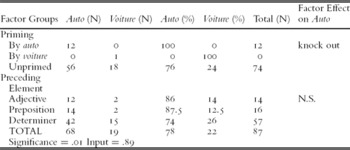
In order to examine the effect of linguistic and social factors on the variable, we have performed regression analysis of the two primary variants, namely auto and voiture and have considered the two linguistic constraints that were found to influence variant selection in L1 French, namely lexical priming and the type of preceding element. Results concerning the effect of these two linguistic constraints are presented in Table 4.
Effects of linguistic constraints on auto versus voiture

5.2 Linguistic factors conditioning the variable in French immersion
Table 4 reveals that, as was the case for Canadian Francophones, priming is highly relevant for the use of lexical variants in the spoken French of immersion students. Thirteen occurrences of the variable were primed, and each case gave rise to the primed variant (12 times for auto and once for voiture). While the frequency of lexical variants in spontaneous speech is relatively modest, the general trend that emerges is identical to that of native speakers: a variant used in the interviewer's speech to elicit speech on a given topic is always used in the speaker's response. This result is perhaps not surprising since lexical priming was selected as a highly significant factor in Nadasdi and McKinnie's (Reference Nadasdi and McKinnie2003) study of verbs of residency. This result constitutes further evidence that immersion students' variant use in a semi-directed interview is strongly influenced by variants used by the interviewer.
Let us now consider the role of the preceding element. The reader will recall that when the effect of preceding element was considered for L1 speakers, it produced a robust association. In particular, it was noted that the presence of a preceding preposition strongly favored the use of auto and disfavored the variant char. The explanation given for this distribution was that there is a strong lexical association between en and auto such that this combination has the status of a fixed lexical expression. However, no such association is found for the immersion students, suggesting that no such lexicalization has taken place for them. One should bear in mind, however, that the association found between en and auto in L1 Canadian French resulted from a comparison with en char. The reader will recall that in the 2005 corpus of Ontario spoken French, we found 51 tokens of voiture representing 8% of all tokens of the variable. Preliminary analysis of these tokens and of the tokens of char and auto suggests that while voiture may be somewhat on the rise in Ontario spoken French, en still exerts the favourable effect on auto found in the Mougeon and Beniak corpus but does not favour voiture or char. Specifically, in the 2005 corpus, after en, we found 48 tokens of auto, and only 5 tokens of char and 5 tokens of voiture. Thus we have an indication that even though the immersion students do not use char they have not mastered the association between en and auto observable in Canadian spoken French.
5.3 Social factors
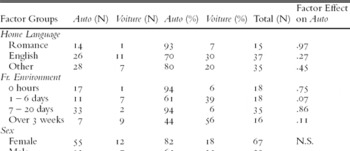
Results concerning the effect of social factors on variant usage are presented in Table 5.
Effects of extra-linguistic constraints on auto versus voiture

The first observation we can make is that there is a clear correlation between speakers' home language and variant use. In particular, speakers from a Romance language background (five students who speak Italian and one who speaks Spanish), display a greater preference for the variant auto than do speakers from other language background groups. While the general rate of auto usage is 68%, it climbs to 93% when the student also speaks a Romance language at home. We attribute this correlation to the fact that the form auto is highly reminiscent of the Italian words auto and automobile and the Spanish words auto and automóvil. This result is in line with previous research on verbs meaning ‘work’ since here too, home language was selected as a significant factor with Romance speakers showing a preference for travail versus emploi (both Italian and Spanish have a cognate for the former). That said, the words auto, automobile and automóvil are not the primary variants used by Italian and Spanish speakers, who in fact make more frequent use respectively of variants macchina and carro and variant coche. Still, based on the correlation we have documented, we surmise that the Romance speakers' preference for auto reflects the fact that auto and its morphologically non reduced variants have wider currency in Italian and Spanish than in English.
Let us now consider exposure to French outside the classroom. When previous research has found stays in a French environment to correlate linearly with variants, the pattern has generally been that the greater the length of stay, the more use of informal variants one finds. The explanation offered for this pattern is that greater exposure in a Francophone environment would provide students with more opportunities to hear non-standard variants not found the classroom input (e.g. ne deletion, cf. Rehner and Mougeon, Reference Rehner and Mougeon1999, on for nous Rehner, Mougeon and Nadasdi, Reference Rehner, Mougeon and Nadasdi2003).
We saw above that the limited stays that the students made in Quebec were not enough of a factor to induce learning of the informal variant char. The lack of an effect of amount of exposure to L1 French in the present study also suggests that such limited stays have not been enough of a factor to sensitise them to the rarity of hyperformal voiture in Quebec spoken discourse.
Results for sex and social class suggest that students are unaware of the hyperformal status of voiture in Canadian French since no correlations exist between the variable and these categories. That said, previous research on the immersion corpus has shown that this is not always the case. For example, middle-class students insert the hyperformal negative particle ne more often than their working-class counterparts and female students use hyperformal nous more often than informal on. Still, it may be that the relatively low frequency of lexical variables prevents students from gleaning information about their sociolinguistic status. Evidence for this claim is also found in Nadasdi and McKinnie's Reference Nadasdi and McKinnie2003 study of lexical variation in immersion French since neither sex nor social class was found to correlate with the lexical variables they examined.
Finally, as with past studies, French-media consumption does not influence variant choice (cf. Mougeon, Nadasdi and Rehner, Reference Mougeon, Nadasdi, Rehner, Dewaele and Mougeon2002).
6. DISCUSSION
An overall comparison of the distribution of variants in Quebec spoken French, pedagogical input and the speech of French immersion students is presented in Table 6.
Comparison of variants in all corpora

Several observations can be made regarding this comparative data. First, the French immersion students make no use of the marked informal variants char and machine. This result is probably unavoidable since they are never exposed to these forms through the classroom input and are unlikely to have been intensively exposed to them in their limited contacts with Francophones outside of the classroom. It is true that like Francophones (and unlike the teachers!), auto is the dominant variant used by immersion students. However, their use of this form surpasses what is found in native speaker discourse. Still, this is a socio-stylistically neutral variant in Quebec French and is not necessarily an undesirable outcome. In other words, it does not cause their speech to appear non-native like. On the other hand, the students' use of the hyperformal variant voiture in close to a quarter of the contexts for the variable is a notable divergence from L1 Canadian Francophone norms (even from those of contemporary adolescent speakers in Ontario). Like the French immersion students, the teaching materials use voiture more often than native speakers do! It is perhaps understandable that texts meant to represent written French make significant use of the voiture variant. However, its overuse in materials designed to replicate spoken dialogues is in need of revision. We therefore suggest that, along the lines of Nadasdi, Mougeon and Rehner (Reference Nadasdi, Mougeon and Rehner2005) the educational materials be modified to familiarise students with informal variants like char and that they make less frequent use of forms like voiture that are rare in spoken Canadian French. This would not be difficult to accomplish since it does not involve the learning of a complex grammatical rule. It is simply a matter of raising their awareness of informal lexical variants and downplaying the prominence of voiture in the classroom input. This is particularly necessary for the teachers' discourse to ensure that students are presented with a sociolinguistically accurate model for variant usage. It should also be noted that such a proposal is in keeping with the Ontario Ministry of Education (2000) guidelines for the teaching of French in high school immersion programmes which underscore the need for students to develop familiarity with varieties of Canadian French.
In the case of automobile the infrequency of this variant in the students' speech is likely the result of several factors: 1) infrequency of this variant in the teachers' speech; 2) absence of this variant in the dialogues included in the teaching materials; and 3) the possibility that the students equate this form with the English word automobile, which is marked in spoken English, and therefore avoid the use of its French equivalent.
Finally, the noteworthy finding that the immersion students strongly prefer auto, in spite of its limited use in classroom teacher speech deserves an explanation. Here again, it is possible to invoke the influence of inter-systemic factors. Specifically, the morpheme auto- is widely used in English in the same semantic field, even though it does not function as a noun (e.g., the auto-industry, auto-workers, automotive) and this may have triggered a process of convergence towards the French variant auto on the part of the immersion students. That said, it is also plausible to hypothesise that such convergence may have been reinforced by the fact that, as we have seen, in the dialogues included in the teaching materials auto is clearly preferred over voiture.
As regards factors that correlate with the variable, we have noted that like native speakers, lexical priming is a key factor in predicting variant use of the French immersion students. That said, the immersion student do not follow the constraint involving the preceding element found in L1 research, namely a strong association between auto and the preposition en. The only social factor that was found to correlate with variation was home language and that the effect of this factor was higher rates of auto use on the part of speakers of a Romance language. We note that in our corpus all of our Romance language speakers speak either Italian or Spanish which have the related words automobile and automóvil.